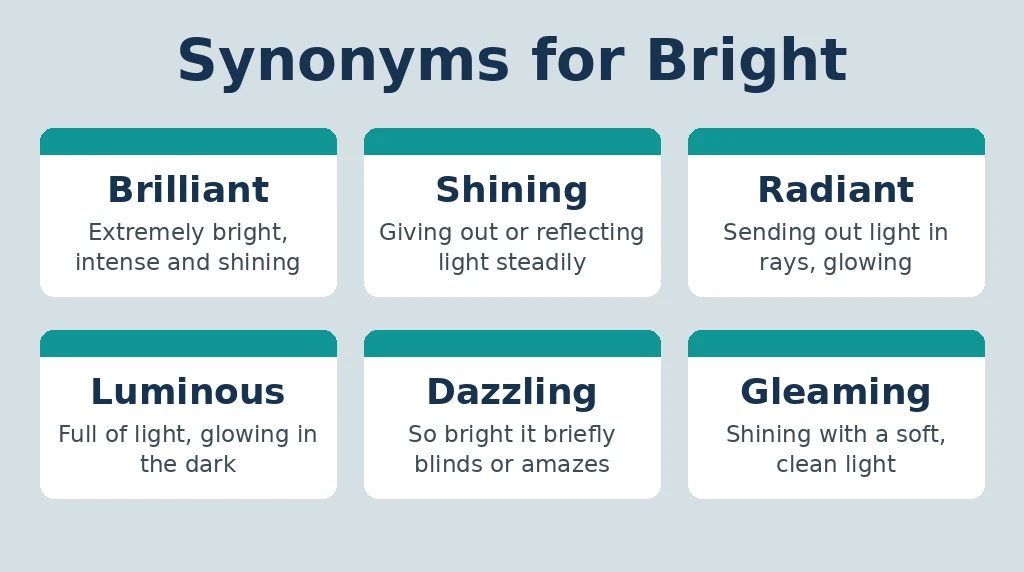
The room was bright, the paint was bright, the child was bright, and her future looked bright. English uses one word for a lamp, a colour, a mind and a hope, and leaves the reader to guess which light is switched on. The closest synonyms for bright split by sense: shining, radiant and dazzling for light, vivid and intense for colour, smart, sharp and brainy for intelligence, and cheerful, sunny and promising for moods and futures. Once you know which brightness you mean, the sharper word is easy to find.
This guide covers 77 distinct synonyms for bright, grouped the way the senses divide: light itself, sunshine and colour, clever minds, cheerful moods, and futures that look good. Every word below was checked against real thesaurus entries, and each one comes with a plain meaning and a short example, so you can pick the word that shines in exactly the way your sentence needs.
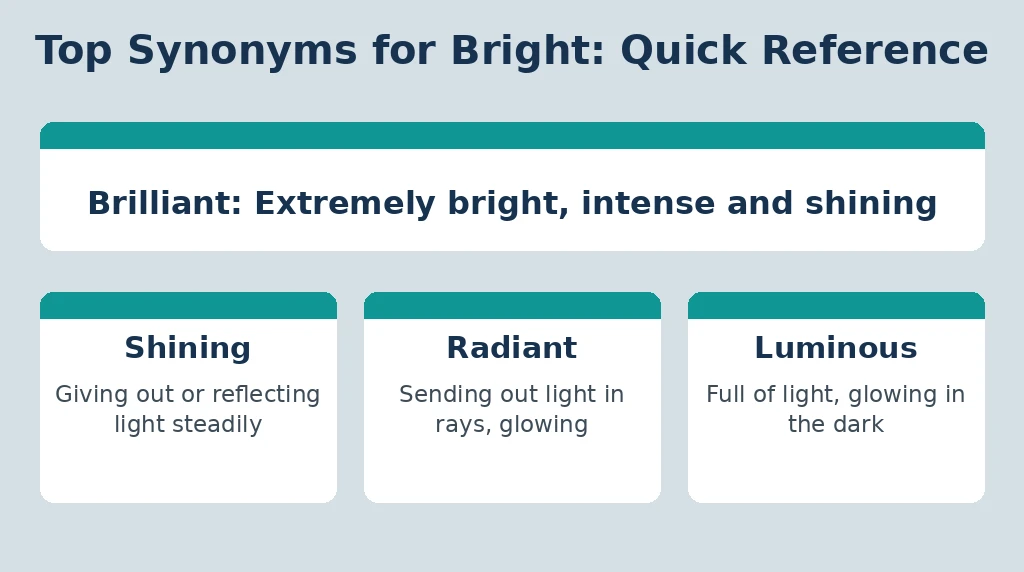
Top Synonyms for Bright: Quick Reference
If you are in a hurry, start here. These are the bright synonyms writers reach for most often, from the floodlit stadium to the promising interview. The full lists further down sort every word into its sense, but this table is the everyday toolkit.
| Word | Meaning in one line | Best for |
|---|---|---|
| Brilliant | Extremely bright, intense and shining | Light, gems, minds |
| Shining | Giving out or reflecting light steadily | Lamps, eyes, examples |
| Radiant | Sending out light in rays, glowing | Sun, faces, heat |
| Luminous | Full of light, glowing in the dark | Paint, dials, skies |
| Dazzling | So bright it briefly blinds or amazes | Sunlight, displays, smiles |
| Gleaming | Shining with a soft, clean light | Metal, teeth, floors |
| Glittering | Sparkling with many small flashes | Jewels, frost, seas |
| Sparkling | Shining with small flashes of light | Water, eyes, conversation |
| Glowing | Giving out a warm, steady light | Embers, skin, reports |
| Beaming | Shining brightly, or smiling widely | Sun, faces, lighthouses |
| Lustrous | Having a soft, reflective shine | Hair, pearls, fabrics |
| Vivid | Strong and intense in colour or effect | Colours, memories, descriptions |
| Colorful | Full of bright colours | Clothes, markets, plumage |
| Intense | Very strong in degree | Colour, light, feeling |
| Sunny | Full of sunshine, or cheerful | Days, rooms, dispositions |
| Golden | Glowing yellow, like gold or low sun | Light, hair, opportunities |
| Intelligent | Able to learn and understand quickly | People, students, minds |
| Smart | Quick and clever in mind | Children, ideas, answers |
| Clever | Skilled at thinking and inventing | People, devices, remarks |
| Sharp | Quick and keen in mind | Wits, lawyers, students |
| Brainy | Very intelligent, in informal use | Students, siblings, characters |
| Quick-witted | Fast to think and reply | Speakers, comedians, debaters |
| Cheerful | Happy and optimistic in manner | People, rooms, greetings |
| Joyful | Full of joy | Occasions, faces, reunions |
| Jolly | Happy and good-humoured, slightly old-fashioned | People, parties, songs |
| Promising | Showing signs of future success | Careers, beginnings, players |
| Hopeful | Full of hope, or giving hope | Signs, futures, people |
| Rosy | Promising and cheerful, like a pink glow | Futures, pictures, prospects |
What Does Bright Mean?
Bright, at home, means giving out light or reflecting it strongly. A bright lamp, a bright morning and a bright white shirt all report the same thing: plenty of light reaching the eye. From that centre the word radiates outward, the way light itself does, into colour, into minds and into moods.
A bright colour is one with the light turned up inside it, vivid rather than pale. A bright child is quick to learn, as if a lamp were lit in the mind, and a bright face is lit from within by good humour. Bright future borrows the whole picture: it looks lit, open and easy to walk into. The opposite of every one of these senses is dark, which is why the two guides mirror each other so closely.
The common failure with bright is using it as a vague compliment. A bright student, a bright idea and a bright room are three different claims, and the sections below give each its own vocabulary, so praise and description both land where they were aimed.
There is a kindness test for this word as well. Bright is the adjective people give to children, mornings and ideas when they want to wish them well, and its warmth is real: nobody was ever insulted by a bright future. That goodwill is worth protecting, which is why the trap words near the end of this guide, garish and lurid among them, matter: they are brightness with the kindness drained out.
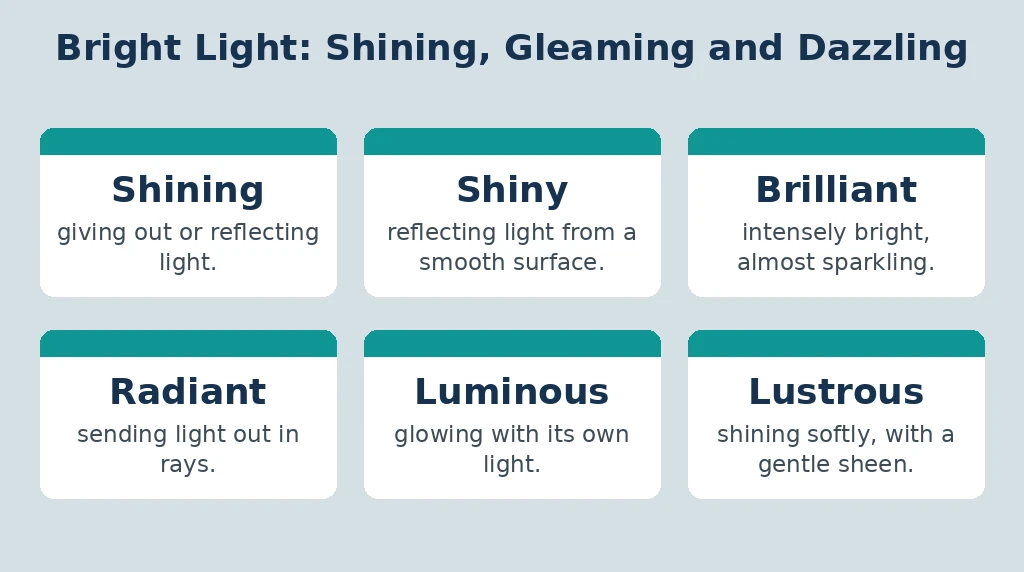
Bright Light: Shining, Gleaming and Dazzling
This is the biggest shelf in the guide, because English is rich in words for light. They differ in steadiness, softness and force, and choosing among them is mostly a matter of how the light behaves.
- Shining: giving out or reflecting light. The shining brass caught the sun.
- Shiny: reflecting light from a smooth surface. She polished the table to a shiny finish.
- Brilliant: intensely bright, almost sparkling. The hall blazed with brilliant light.
- Radiant: sending light out in rays. The radiant sun warmed the valley.
- Luminous: glowing with its own light. Luminous paint marked the path.
- Lustrous: shining softly, with a gentle sheen. Her lustrous hair fell to her shoulders.
- Gleaming: shining with a clean, soft light. The gleaming car stood at the kerb.
- Glistening: shining as if wet. Glistening dew covered the grass.
- Glittering: flashing with many small sparks of light. The glittering frost turned the field white.
- Sparkling: shining with small, quick flashes. The sparkling sea stretched to the horizon.
- Dazzling: so bright it stops the eye for a moment. A dazzling display lit the sky.
- Glowing: giving a warm, steady light without flame. Glowing embers lit the tent.
- Beaming: shining out in a broad beam. The beaming lighthouse warned the ships.
- Blazing: burning and shining fiercely. We hurried out of the blazing sun.
- Flashing: shining in sudden bursts. Flashing lights crossed the harbour.
- Shimmering: shining with a soft, trembling light. Heat rose from the shimmering road.
- Twinkling: shining with tiny on-and-off flashes. Twinkling stars filled the clear sky.
- Illuminated: lit up by lights. The illuminated bridge drew crowds.
- Incandescent: glowing from great heat, or intensely bright. The metal turned incandescent in the furnace.
- Lambent: flickering softly over a surface, literary in tone. Lambent light played on the ceiling.
- Effulgent: shining out radiantly, rare and formal. The effulgent dawn broke over the hills.
- Resplendent: shining splendidly, rich and impressive. The hall was resplendent with candles.
- Scintillating: sparkling with flashes, also of wit. The scintillating surface of the lake hurt our eyes.
- Burnished: polished until it shines. The burnished copper caught the firelight.
Sort them by behaviour: gleaming, lustrous and burnished belong to surfaces, glittering and twinkling to many small lights, and dazzling and blazing to light with force behind it. Glowing is the warm, friendly one, the light of coals and cheeks. A single one of these words can set the lighting of a whole scene, so spend it where the scene matters most.
Photographers divide this shelf better than anyone. They talk about hard light and soft light, and the vocabulary follows them: dazzling, blazing and glaring belong to the hard kind that makes subjects squint, while glowing, lambent and lustrous belong to the soft kind used for faces. Borrow the photographer’s question, is this light striking the scene or resting on it, and it will pick your word faster than any definition.
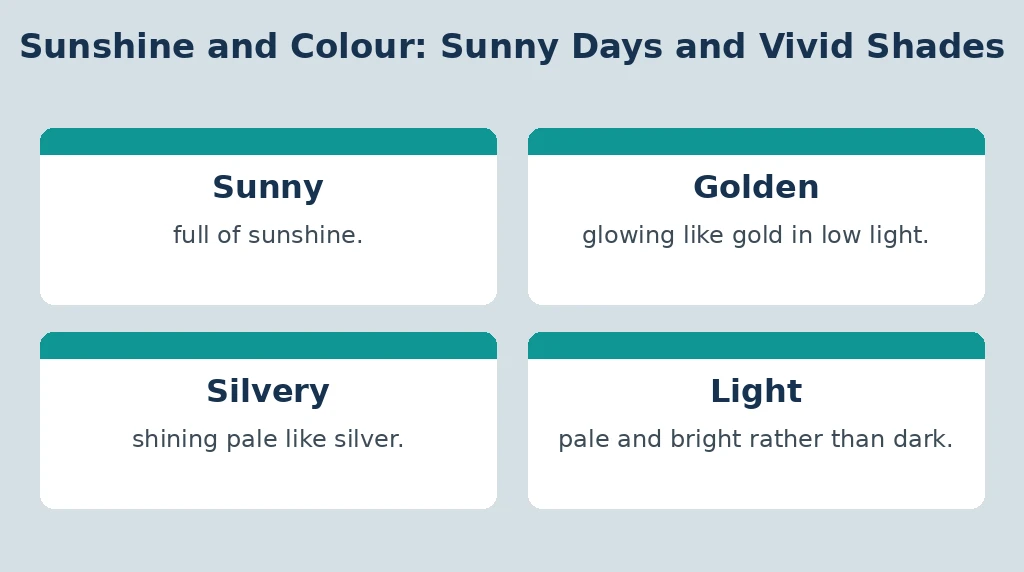
Sunshine and Colour: Sunny Days and Vivid Shades
Weather and colour share this section, because both are brightness you look at rather than brightness that lights your way. The sun words describe the sky; the colour words describe what the light lands on, and they pair naturally with the clear family when the air itself is part of the picture.
- Sunny: full of sunshine. It was a sunny morning in April.
- Golden: glowing like gold in low light. The golden light of evening filled the lane.
- Silvery: shining pale like silver. A silvery moon rose over the fields.
- Light: pale and bright rather than dark. She painted the room a light green.
- Sunlit: lit by the sun. They ate in a sunlit courtyard.
- Vivid: strong, intense and full of life in colour. The parrot had vivid green feathers.
- Colorful: full of bright and varied colours. A colorful market lined the street.
- Intense: very strong in colour or light. The intense blue of the sky hurt to look at.
- Rich: deep and strong in colour. The curtains were a rich red.
- Deep: dark and strong in shade, at the vivid end. Deep purple flowers filled the border.
- Flashy: bright in a showy, attention-seeking way. He wore a flashy jacket to the fair.
- Fluorescent: glowing with intense artificial colour. The signs were fluorescent pink and green.
- Neon: glowing like neon lights, intensely coloured. She chose a neon yellow notebook.
- Psychedelic: wild and swirling in colour, informal in tone. The poster had a psychedelic pattern.
Vivid and intense are the serious colour words, the ones essays and catalogues trust. Flashy, fluorescent, neon and psychedelic bring opinions along with them: they announce that the colour is loud, and hint that the writer may not approve. Golden and silvery are the poets of the sun list, turning light into metal, and both soften a scene even as they brighten it.
Colour words carry a warning from the design trades: brightness is a relationship, not a property. A vivid red is vivid beside grey and quiet beside orange, and the same paint is bright in a cottage and dull in a carnival. Writers borrow the lesson whenever a colour seems to change its nature between scenes: it is the company that changed, and naming the company beats upgrading the adjective.
Interior design is the colour family’s paying customer, and its rule is the one worth stealing: judge brightness at the hour the room is used. A north-facing studio that is merely bright at noon can be radiant at breakfast and dim by four, and paint charts, those small democracies of vivid and pastel, exist because the same shade changes its vote with the light. Describing any coloured thing, in any kind of writing, improves the moment the hour is allowed into the sentence.
Bright Minds: Intelligent, Sharp and Quick-Witted
A bright student lights up a classroom in the metaphor, and this family grades kinds of cleverness: speed, depth, inventiveness and judgement. They are compliments, but each flatters a different gift.
- Intelligent: able to learn, understand and reason well. She is an intelligent reader of contracts.
- Smart: quick and clever, the everyday compliment. The smart answer ended the debate.
- Clever: inventive and skilful in thinking. He found a clever way around the problem.
- Sharp: quick to notice and understand. The auditor had a sharp eye for errors.
- Keen: sharp and eager in mind. She brought a keen mind to the inquiry.
- Acute: sharply perceptive, formal in tone. He had an acute sense of timing.
- Alert: wide awake and quick to notice. The alert guard spotted the fault early.
- Astute: shrewd and good at judging situations. An astute investor sold before the fall.
- Brainy: very intelligent, in informal use. The brainy sister won the scholarship.
- Quick: fast to understand, in everyday praise. He was quick at figures and quicker at jokes.
- Quick-witted: fast to think and reply. The quick-witted host kept the show moving.
- Knowing: showing deep, sometimes secret, understanding. She gave a knowing smile.
- Ingenious: clever at inventing and designing. The ingenious device folded flat.
- Shrewd: sharp in judgement, practical and cautious. A shrewd negotiator never shows hurry.
- Clear-headed: able to think clearly under pressure. The clear-headed captain landed the plane safely.
- Precocious: advanced in mind for one’s age, of children. The precocious reader finished the novel in a day.
Quick and quick-witted praise speed; acute and astute praise aim. Precocious is praise with a raised eyebrow, since it marks a child as ahead of their years and can sound like surprise that they are. In references and reports, intelligent and capable of learning do the safest work, while brainy belongs to family and fiction.
Examinations have quietly sorted this family for us. School and university English rewards the precise praise, an acute analysis, an astute reading, an ingenious solution, and treats bright as the word you use before you have decided what exactly was good. Imitate the examiners in your own reports: let bright open the compliment if you like, then let a sharper word from this list sign it.
Bright Moods: Cheerful, Joyful and Full of Life
A bright face is a lit face, and this family describes people, rooms and occasions that feel lit from inside. Where plain happy reports a feeling, the bright words show it in the face and the manner, which is why storytellers love them.
- Cheerful: happy and optimistic in manner. The cheerful nurse lifted the whole ward.
- Cheery: bright and happy, in friendly informal use. She gave a cheery wave.
- Happy: feeling or showing pleasure. The happy crowd sang along.
- Glad: pleased and grateful. We were glad to be home.
- Joyful: full of joy. It was a joyful reunion after ten years.
- Joyous: full of joy, slightly more formal than joyful. The bells rang out in joyous noise.
- Jolly: happy and good-humoured, slightly old-fashioned. A jolly farmer welcomed us in.
- Merry: cheerful and lively, often of occasions. We wished them a merry holiday.
- Lively: full of energy and spirit. The lively class asked questions for an hour.
- Vivacious: attractively lively, especially of manner. The vivacious hostess charmed the table.
- Buoyant: cheerful and confident, hard to sink. Sales were up and the team felt buoyant.
- Upbeat: positive and optimistic, in modern everyday use. The manager stayed upbeat about the launch.
- Genial: warm, friendly and pleasant. Our genial landlord told stories all evening.
- Chirpy: cheerfully lively, in British informal use. He was chirpy despite the early start.
- Light-hearted: free from worry, cheerful in spirit. It was a light-hearted evening of games.
Cheerful is the steady worker, suited to people and places alike. Joyful and joyous mark peaks, weddings and homecomings, and would be wasted on a Tuesday. Genial describes warmth with manners, the cheerfulness of hosts, while chirpy and upbeat keep the modern, casual register that bright itself loves.
Hospitality runs on the mood family: the cheerful greeting, the genial host, the bright room. Hotels and cafes are reviewed in these words because mood is literally their product, and a single well-chosen one, buoyant staff, a chirpy welcome, does more persuading than a paragraph of facilities. Writers in every trade can borrow the trick: describe the feeling in the room before the furniture.
Music quietly uses this whole section, since a bright performance, a brilliant soloist and a glowing review are the standard coin of concert writing, and the words grade the playing rather than the lighting. The borrowing works because both fields are judging energy made visible or audible, and a critic who reaches for radiant about a voice is saying the sound behaved like light. Writers in other fields can spend the same metaphor once, carefully, and trust readers to hear it.
Bright Futures: Promising, Rosy and Hopeful
The last sense looks forward. A bright future, a bright prospect and a bright start all picture time as a landscape under good light. These words grade how good the outlook seems and how much of it is hope.
- Promising: showing signs of future success. The young cellist gave a promising debut.
- Hopeful: giving reason for hope. There were hopeful signs in the talks.
- Rosy: promising and cheerful, with a pink glow of optimism. The report painted a rosy picture of trade.
- Auspicious: suggesting future success, formal in tone. It was an auspicious start to the reign.
- Favorable: giving an advantage or a good chance. The wind was favorable for the crossing.
- Encouraging: giving hope and confidence. The early results were encouraging.
- Optimistic: expecting the best outcome. She remained optimistic about the appeal.
- Propitious: favourable for success, rare and formal. The propitious weather blessed the harvest.
Promising is the honest journalist of the group: it reports early signs and guarantees nothing. Rosy quietly admits the colour may be in the beholder’s eye, which is exactly why reports get accused of painting rosy pictures. Auspicious and propitious belong to ceremonies, histories and speeches, where the future is being blessed as much as predicted.
Economics has stress-tested the future family harder than any other field. Forecasts are promising in the spring, rosy in the brochure and auspicious in the speech, and readers have learned to grade them by the speaker’s interest in being believed. When your own sentence makes a prediction, that grading is a gift: choose the word whose level of confidence you could defend with the figures in front of a sceptical friend.
Brightness in Nature: Lamps That Grow and Shine
Nature outshines every lamp in this guide without burning a thing. Fireflies carry a cool, living light made by chemistry rather than heat, efficient in a way no bulb has matched, and the deep sea is full of the same invention: fish dangling glowing lures, squid that flash, tiny plankton that turn a night wave into a spill of sparks. On land, snow works the other trick, borrowing daylight and moonlight and handing them back multiplied, until a winter field at noon can be genuinely dazzling.
The vocabulary in this guide quietly records all of it. Luminous began with things that give light and now describes paint that merely stores it; radiant belonged to the sun before it belonged to brides; scintillating was a word for sparks long before it was a word for conversation. Writers describing living light can trust these words to carry the difference between a light that burns and a light that simply, patiently, shines.
There is a writing lesson hiding in the firefly: it produces the maximum of light with the minimum of heat, and the best descriptive prose does the same. One exact word, gleaming, lambent, twinkling, does the work of a paragraph of explanation, and leaves the reader’s attention unspent for the scene that follows.
Fashion keeps the accounts of the colour family. Every season is announced in this vocabulary, bright returns, vivid is declared dead, neon has its annual fortnight, and the words date faster than the clothes. Writers outside fashion can borrow the energy without the risk by choosing the members of the family that do not trend: vivid, intense and rich have dressed well for a century and show no sign of asking to retire.
How to Choose the Right Synonym for Bright
Ask what is giving off the light. If it is a thing, choose by its behaviour: steady (shining, glowing), soft (gleaming, lustrous), sparkling (glittering, twinkling) or forceful (dazzling, blazing). If it is a colour, choose by honesty: vivid and intense describe, while flashy and neon also judge. It is a person, decide whether you are praising their mind, their mood or their prospects, since each has its own shelf.
Register matters with this word more than most. Effulgent and lambent belong to poetry and ceremony; luminous and radiant are the formal all-rounders. Brainy and chirpy are spoken praise, warm and casual, and would look out of place in a report. Auspicious opens conferences and reigns; promising opens match reports and first chapters.
| Situation | Best word | Why |
|---|---|---|
| Describing a watch dial at night | Luminous | It glows by itself, which is the point |
| A school report on a quick learner | Intelligent | Safe, precise and free of slang |
| A travel piece on a market street | Colorful | Says variety as well as brightness |
| A wedding speech about the couple | Radiant | The classic word for faces lit by joy |
| A business forecast with good signs | Promising | Reports evidence without over-promising |
| A poem about evening light on water | Lambent | Soft, flickering and made for verse |
One more piece of discipline: brightness fades with repetition. A page where the light is brilliant, the heroine is brilliant and the plan is brilliant has spent the word three times and bought less each time. The families in this guide exist so that each kind of brightness can have its own word, and the discipline of choosing is what keeps any of them bright at all.
Bright Synonyms for Writing and Dialogue
In essays, bright is often praise doing the work of evidence. A bright idea should become a clever, ingenious or shrewd one, each of which says what kind of good it is, and a bright student deserves the same respect: quick at languages, acute in argument, clear-headed under examination pressure. Precision is the compliment readers trust.
Fiction spends the light words first. Set the lighting with one strong choice, a gleaming platform, a dazzling noon, a glowing hearth, and the reader’s eye will keep the scene lit for pages without another adjective. Dialogue belongs to the spoken end of the lists: smart, brainy, cheery, chirpy and upbeat are words people actually say to each other, and a character’s brightness is best heard in them.
Professional writing keeps bright mostly literal: bright screens, bright lighting levels, bright paint finishes. For people, human resources prose prefers capable, strong and high-performing to clever or brainy, since mind words can sound like they are grading the person rather than the work. For forecasts, promising and encouraging are the professional pair, hopeful about evidence rather than about luck.
Science writing keeps a useful leash on this word. There, bright is measured: luminous intensity, reflectance, magnitudes of stars. The prose words in this guide are the same words wearing ordinary clothes, and a writer crossing between the two worlds should know that radiant and luminous have numbers attached in the laboratory. Borrowed carefully, the precision is flattering; borrowed loosely, it is costume.
Weather presenters are the daily custodians of the sun family, and their grading is worth stealing. Bright is their honest middle word, sunny is a promise, and the phrases bright intervals and bright spells exist precisely to keep hope inside the truth. Any writer describing a mixed day, literal or otherwise, could do worse than borrow the forecaster’s honesty about how much of it was bright, and when.
Antonyms for Bright
Every sense of bright has its own darkness waiting, and the antonyms line up sense by sense:
- Dark: with little or no light, the general opposite. The hall was dark after the show.
- Dim: lit only weakly. A dim bulb hung over the stairs.
- Dull: not bright in light, colour or mind. The paint dried a dull grey.
- Pale: light in colour but weak and washed out. She wore a pale yellow dress.
- Faint: barely visible or audible. A faint star showed through the cloud.
- Overcast: covered with cloud, darkened. The overcast sky promised rain.
- Murky: dark and thick, hard to see through. The river ran murky after the storm.
- Gloomy: dark and depressing in mood. It was a gloomy afternoon in November.
- Sad: unhappy, the plain opposite of cheerful. The news left everyone sad.
- Hopeless: without hope, of futures. The situation seemed hopeless by winter.
Notice how dull does triple duty, answering light, colour and cleverness in a single syllable, which is why writers overuse it as an antonym. Pale and faint answer colour and light politely. Hopeless closes the future sense completely, and it is the darkest word in this section.
Bright in Phrases: Bright Sparks, the Bright Side and Bright and Early
Bright finishes its tour inside a set of friendly fixed phrases, worth learning whole rather than word by word. They do not count towards the seventy-seven synonyms in this guide, because each is a small story, but they are where the light, wit and optimism senses meet in everyday speech.
- A bright spark: a clever person, sometimes said with irony about a blunderer. Some bright spark locked the keys inside.
- Bright-eyed and bushy-tailed: awake, eager and full of energy. The new recruits arrived bright-eyed and bushy-tailed.
- Look on the bright side: to consider the hopeful part of a bad situation. Look on the bright side, the rain saved the garden.
- Bright and early: very early in the morning, and cheerfully. We set off bright and early for the coast.
- Bright as a button: very intelligent and alert, in affectionate use. The child is bright as a button.
- Brighten someone’s day: to make someone’s day happier. Her message brightened his whole day.
- A bright idea: a good idea, or, with irony, a foolish one. Who had the bright idea of parking on the grass?
The irony running through that list is part of the lesson: bright phrases are so warm that speakers love bending them into teasing, and a bright spark or a bright idea may be the opposite of both. Listen for the tone, and the phrase tells you which way the light is pointing.
Common Mistakes: Words That Are Not True Synonyms for Bright
Garish is the classic trap: it means bright in a harsh, unpleasant way, so calling a bride’s dress or a colleague’s design garish is a criticism wearing a compliment’s clothes. Lurid goes further, describing vivid colour or detail presented in a shocking, sensational way, and it lives in headlines about crimes, not in descriptions of sunshine.
Blinding names an effect on the eye, not a quality of the thing: a blinding light overwhelms sight for a moment, and the word tells us about the viewer, not the lamp. It works as an intensifier in speech, a blinding headache, a blindingly obvious point, but as a straight swap for bright it promises more drama than the scene may have. Use dazzling when the thing itself shines.
Finally, be careful with vivid outside sight. A vivid imagination and a vivid memory are fine, since both picture things, but a vivid sound or a vivid smell stretches the word past its home sense, and clear or intense will serve better there.
One last neighbour, brilliant, earns a caution of its own. In British speech it is also the all-purpose word of approval, a brilliant film, a brilliant evening, where it grades quality rather than light, wit or colour. Abroad, that use can puzzle readers who expect the literal families of this guide, so in international writing let brilliant keep its older jobs and let excellent do the cheering.
A last caution about sunny, which moonlights in the mood family as a disposition and in the weather family as a forecast, and is counted once in this guide for all that work. The double life is a pleasure in fiction, where a sunny landlady under a sunny sky is a rhyme the reader feels, and a small risk in reports, where a sunny outlook on sales should not be confused with the weather at the warehouse.
Frequently Asked Questions
What is the best synonym for bright?
For light, shining and brilliant cover most scenes between them. For colour, vivid is the strongest everyday choice, for a clever person, intelligent or smart, and for a hopeful outlook, promising. Match the word to the sense and the strength takes care of itself.
What is a formal word for bright?
Luminous is the formal word for glowing light, and radiant suits formal descriptions of faces, heat and suns. For minds, intelligent is the formal choice, and for beginnings, auspicious carries the ceremonial weight.
What does bright mean when it describes a person?
It can mean two things: quick to learn and understand, as in a bright student, or cheerful and lively in manner, as in a bright smile. Context decides, and where it does not, smart or cheerful will say the one you mean.
What is the difference between bright and brilliant?
Brilliant is bright turned up: more intense, more sparkling, closer to dazzling. A bright day is pleasant; a brilliant one blazes. The same gap holds for minds, where a brilliant student stands a level above a bright one.
What is the opposite of bright?
Dark and dim answer the light sense, dull and pale answer colour, gloomy and sad answer mood, and hopeless answers the future. Each sense of bright keeps its own opposite, just as it keeps its own synonyms.
Final Thoughts
Bright turns out to be a whole lighting rig, a paintbox, a report card and a weather forecast of the future in a single syllable. There is the gleaming platform and the lambent ceiling, the vivid market and the rosy prospect, the quick-witted friend and the radiant bride. Sort the senses, and the exact word is always there, at exactly the right wattage.
Keep this guide near the desk for the next time bright feels too easy, and for an even deeper bench of bright words, including rare and historical ones, the Merriam-Webster Thesaurus entry for bright is the natural next stop. May your rooms be luminous, your students quick-witted, and your futures thoroughly promising.

2 thoughts on “Synonyms for Bright | 77+ Words for Light, Colour, Minds and Futures”