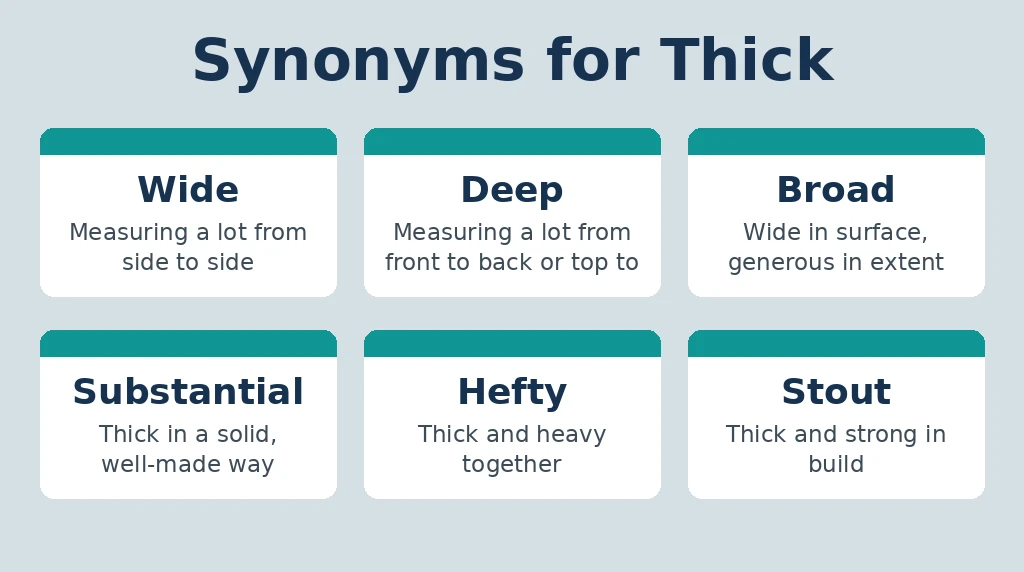
Ask a carpenter, a cook and a barber what thick means and you will get three different answers before lunch: a plank two inches through, a sauce that holds its shape on the spoon, and hair that defeats a comb. Add a fog you cannot see through, a crowd you cannot cross, and a voice rough with a cold, and you have one of the hardest-working adjectives in the language. The closest synonyms are wide and deep for measurement, dense for things packed close, viscous for liquids, stout and chunky for solid build, and husky for voices. This guide sorts the synonyms for thick by those jobs, so your word lands where you aimed it.
Every word below was checked against real thesaurus entries, and each one comes with a plain meaning and a short example. Thick rewards precision because its neighbours are so different: a thick book and a thick accent have nothing in common except the word, and your reader deserves to know which one you meant.
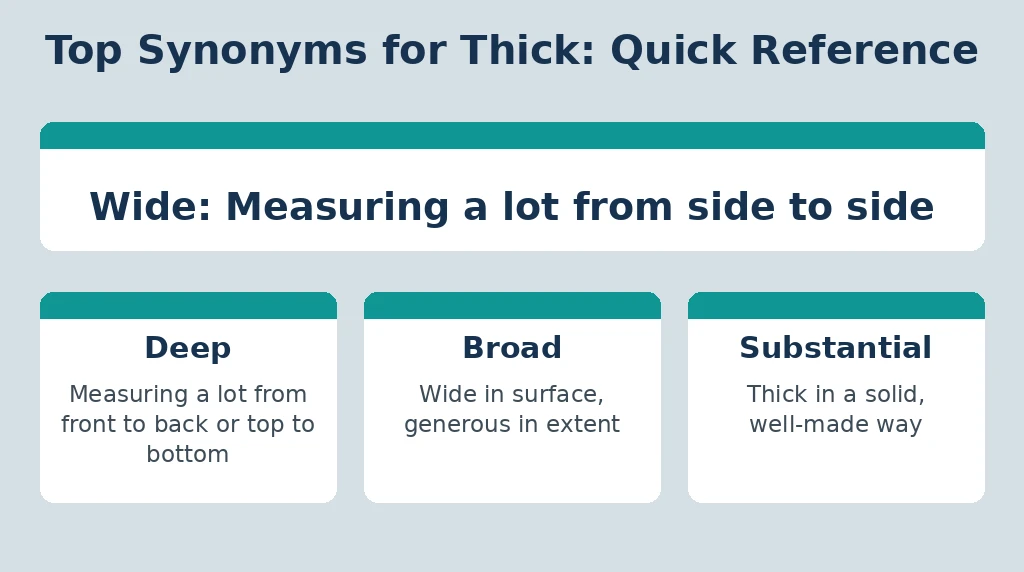
Top Synonyms for Thick: Quick Reference
Start here when you are in a hurry. These are the thick synonyms writers reach for most often, with what each one really means and where it works best. The families below take each job in turn, from tape measures to fog banks to the human voice. Each family also carries a small warning label where the word can insult, because thick describes people as readily as planks, and only one of those audiences can object.
| Word | Meaning in one line | Best for |
|---|---|---|
| Wide | Measuring a lot from side to side | Openings, planks, gaps, rivers |
| Deep | Measuring a lot from front to back or top to bottom | Shelves, snow, cushions, layers |
| Broad | Wide in surface, generous in extent | Shoulders, beams, leaves, accents |
| Substantial | Thick in a solid, well-made way | Walls, books, slices, wallets |
| Hefty | Thick and heavy together | Books, steaks, files, tools |
| Stout | Thick and strong in build | Sticks, boots, bodies, defences |
| Chunky | Thick in a pleasing, solid way | Sweaters, soups, jewellery, furniture |
| Stocky | Short and thickly built | People, ponies, plants |
| Beefy | Big and thick with muscle, informal | Arms, guards, sandwiches |
| Meaty | Thick with flesh or substance | Arms, roles, discussions |
| Dense | Packed closely together, hard to pass through | Fog, forests, crowds, prose |
| Luxuriant | Growing thickly and richly | Hair, gardens, foliage |
| Lush | Thick, green and healthy in growth | Meadows, lawns, vegetation |
| Compact | Packed closely into a small space | Soil, crowds, cases, text |
| Impenetrable | Too thick or dense to enter or see through | Jungle, darkness, jargon |
| Viscous | Thick and sticky, flowing slowly | Oils, syrups, lava, glues |
| Gelatinous | Thick like jelly, trembling and soft | Gravies, ponds, desserts |
| Crowded | Full of people packed closely | Streets, trains, schedules |
| Packed | Crammed full, nothing more fits | Buses, halls, suitcases |
| Teeming | Swarming with life or people | Markets, rivers, streets |
| Congested | Blocked by too much packed in | Roads, noses, ports |
| Husky | Deep and rough in a pleasing way, of voices | Voices, singers, laughter |
| Hoarse | Rough and strained, of a voice | Voices after shouting or illness |
| Throaty | Low and thick, from the throat | Voices, laughter, engines |
| Gravelly | Rough like gravel, of voices | Voices, narrators, old singers |
| Guttural | Made deep in the throat, harsh sounding | Voices, languages, cries |
| Strong | Very noticeable, of accents | Accents, flavours, opinions |
| Pronounced | Strong and clearly marked | Accents, limps, differences |
What Does Thick Mean?
Thick is a measuring word before it is anything else. It names the distance between two surfaces: the top and bottom of a plank, the front and back of a book, the inside and outside of a wall. That single idea, more room between surfaces than expected, explains why the word feels so physical even when it leaves the workshop.
From measurement it spreads to packing. Hair is thick when the strands stand close, fog is thick when the droplets crowd, and a thick crowd is people standing the way the fog droplets do, too close to pass between. Density is measurement turned inward: not how far apart the surfaces are, but how much is squeezed between them.
Liquids borrow the word for resistance. A thick sauce resists the spoon, thick oil resists the cold, and porridge can be thick with virtue or with lumps. Voices borrow it for texture, a thick voice being one that sounds as if something is packed in the throat: emotion, illness or sleep. Accents borrow it for strength, so that a thick accent is one you could almost cut.
The two human senses need care. Thick meaning close, as in as thick as thieves, is warm and old-fashioned, while thick meaning slow to understand is an insult everywhere it lands. Both are alive, and confusing them in writing about real people would be unfortunate. The families below keep all of these apart: measurements first, manners last.
It helps to keep one contrast in mind throughout: thick is not heavy, and it is not wide, though it keeps company with both. A thick rope may be light, a wide road may be a thin ribbon of tarmac, and a heavy book may be slim. Each word measures a different dimension, literally, and the mistakes section returns to this at the end.
English also lets thick work as a noun, in the thick of things, where it names the busiest middle of an event. That little survival tells you how central the packing idea is: the thick of the battle is where the most is happening in the least room. Keep the image in mind and the adjective families below arrange themselves around it.
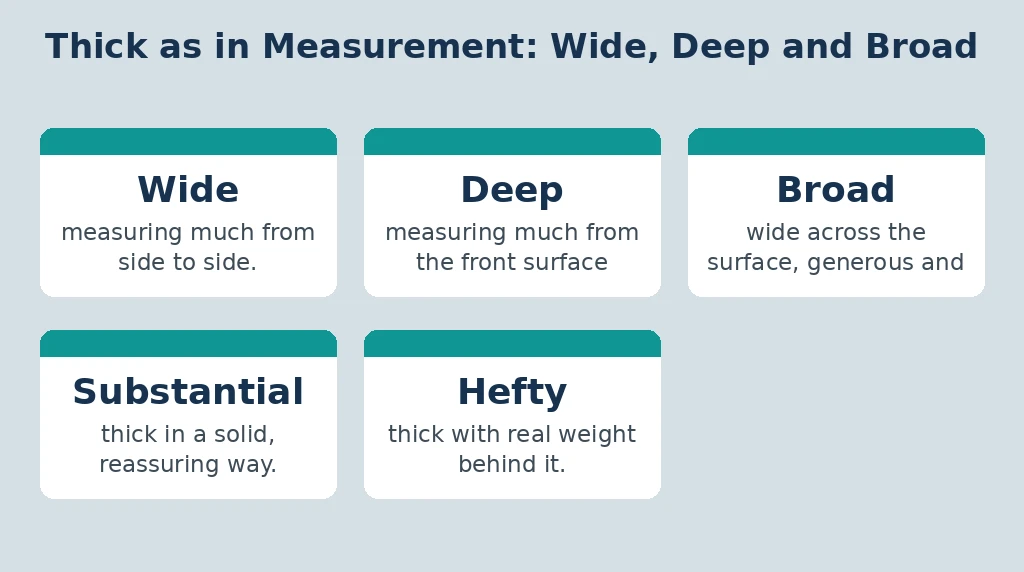
Thick as in Measurement: Wide, Deep and Broad
When thick appears in a specification, two inches thick, a foot thick, it is doing pure measurement, and its synonyms are the other dimension words. Which one you need depends on the direction you are measuring: across, down or through. The fuller story of across lives in the guide to synonyms for wide, while this section keeps the words that can stand in for thick itself.
- Wide: measuring much from side to side. The gate was wide enough for the tractor and its ego
- Deep: measuring much from the front surface backward. Deep snow swallowed the fence to its top rail
- Broad: wide across the surface, generous and open. A broad beam carried the whole barn roof
- Substantial: thick in a solid, reassuring way. Substantial walls kept the cottage cool in August
- Hefty: thick with real weight behind it. A hefty dictionary guarded the desk for thirty years
Carpenters and cooks divide this family by habit: slices, planks and steaks are thick, while gaps and doorways are wide, and snow, soil and cupboards are deep. If you find yourself writing a deep slice or a wide layer of snow, the dimension has slipped. Read the sentence with a ruler in your mind and the right word announces itself.
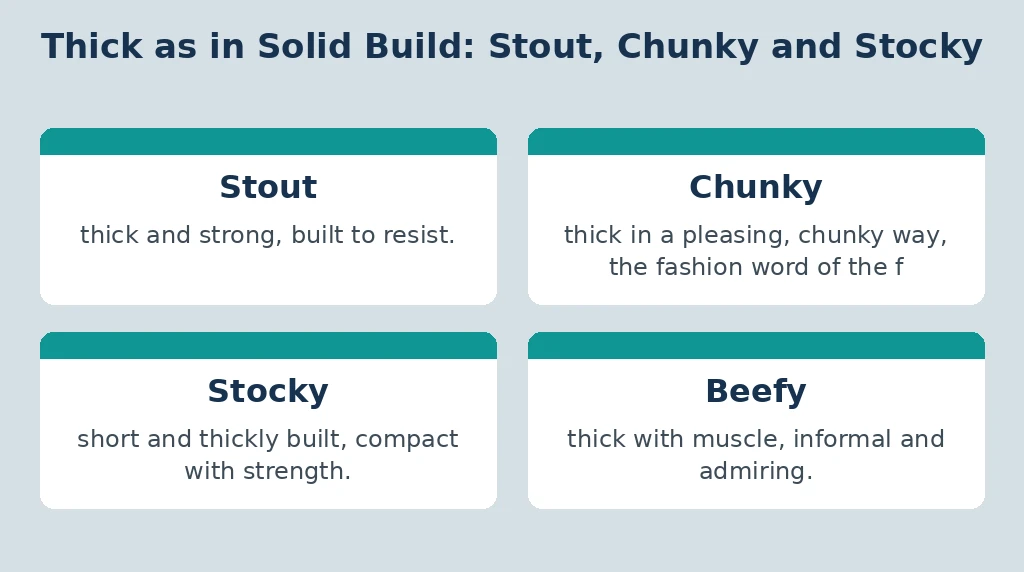
Thick as in Solid Build: Stout, Chunky and Stocky
People, animals, sticks and boots can all be thick in build: solid through, with substance between the surfaces. This family walks a line between compliment and insult more delicate than any other in the guide, and the difference is usually whether the word praises strength or mocks size.
- Stout: thick and strong, built to resist. A stout stick makes a walking companion for years
- Chunky: thick in a pleasing, chunky way, the fashion word of the family. Chunky knitwear outsold everything else that winter
- Stocky: short and thickly built, compact with strength. The stocky pony carried adults without complaint
- Beefy: thick with muscle, informal and admiring. Beefy forearms folded the map in one movement
- Meaty: full of flesh or substance, meaty arms, meaty roles. He landed a meaty part in the spring production
- Plump: softly thick and rounded, gentle in tone. Plump cushions swallowed every sitter gratefully
- Bulky: thick and taking up room, more about volume than strength. A bulky parcel defeated the bicycle basket
- Big: large all over, the plain word a thick build often earns. A big lad in boots two sizes too small opened the gate
Describe objects freely and people carefully. A chunky sweater is delighted to hear it; a chunky stranger is not. Stout has aged into kindness for bodies and stays a compliment for sticks, boots and defences. Stocky is the safest of the family for people, because it packs strength into the description along with the thickness.
Clothing has its own dialect here, and retailers speak it fluently. Chunky knits promise warmth, bulky coats warn about luggage space, and a thick sole on a boot is a selling point measured in millimetres and mud. When you write about clothes, let the build words keep their retail meanings and your descriptions will match what shoppers actually find on the rail.
Thick as in Dense: Hair, Fog, Forest and Air
Density is thick turned inward: strands, drops, leaves or words packed so closely that passing through is work. This is the family for jungles, fogs, beards and difficult books. Weight sometimes joins the picture, since packed things are often heavy too, and the guide to synonyms for heavy covers that side of the load.
- Dense: packed closely, the central word of the family. Dense fog erased the harbour light by seven
- Luxuriant: growing thickly and splendidly. Luxuriant hair defied every comb in the house
- Lush: thick, green and flourishing. Lush grass hid the path by midsummer
- Abundant: present in great quantity, crowding by numbers. Abundant blackberries lined the whole lane
- Heavy: thick in amount or coverage, heavy traffic, heavy foliage. Heavy undergrowth guarded the old orchard
- Compact: pressed closely together into firmness. Compact soil starved the young roots
- Close: packed tightly, in the phrase close ranks or close texture. The close weave kept the rain out all night
- Impenetrable: too dense to enter or see through. Impenetrable briars fenced the ruin better than wire
Prose itself can be thick in this sense, and reviewers use dense as both warning and praise. Dense writing packs ideas the way fog packs water: rewarding to cross slowly, miserable to hurry through. If your own draft feels thick to read, the cure is rarely shorter words. It is more air between the ideas, the textual version of thinning a hedge.
Weather forecasters have quietly professionalised this family. They grade fog by distance rather than poetry, yet the public still says a thick fog the way their grandparents did, because the word describes the labour of seeing, not the metres involved. Both registers are correct; they simply answer different questions, and a good writer knows which question the reader arrived with.
Thick as in Sticky: Sauces, Soups and Slow Liquids
In the kitchen and the workshop, thick describes how a liquid behaves: whether it pours, coats, clings or stands up in soft peaks. The family is small, technical and surprisingly expressive, and cooks guard its distinctions because a sauce can be saved or spoiled inside them.
- Viscous: thick and sticky, flowing slowly, the scientific word. Viscous oil protected the engine through winter
- Gelatinous: thick like jelly, soft and trembling. A gelatinous stock wobbled in the cold pantry
- Semi-solid: halfway to solid, holding a soft shape. The semi-solid custard kept the spoon standing
- Glutinous: gluey and sticky, often a complaint. Glutinous rice glued the festival together, literally
- Gummy: sticky and thick like gum, informal. A gummy residue ringed every jar in the cupboard
If viscous is the laboratory word, the kitchen’s own everyday vocabulary runs on texture words like silky, coating and spoon-standing, plus the great opposite family of smooth and soft textures, covered in the guide to the synonym of soft. Between the two guides, most of what a spoon can meet has a name.
Thick as in Crowded: Streets, Trains and Timetables
A place can be thick with people the way a forest is thick with trees. This family measures the crowd rather than the individuals in it, and journalists reach for it whenever a city fills up: festivals, evacuations, sales and the last train home.
- Crowded: full of people pressed together. The crowded platform exhaled when the train arrived
- Packed: filled to capacity, nothing more fits. The hall was packed an hour before the doors closed
- Teeming: swarming with moving life. The market was teeming by six in the morning
- Congested: blocked by crowding, the traffic word. Congested streets moved at walking pace, uphill
- Jammed: packed so tightly nothing can move. The exit was jammed with cheerful, immovable fans
- Choked: blocked and clogged, of roads and channels. Weeds choked the mill stream by August
- Overflowing: so full that the excess spills out. The overflowing square absorbed three more busloads
- Bursting: full to the point of strain, vivid and informal. The bursting marquee smelled of rain and cake
- Chock-full: completely full, cheerfully informal. The timetable was chock-full of small print
Choose by motion. A packed hall is still, a teeming market moves, a jammed exit has stopped moving against its will, and a congested road moves at the speed of regret. Travel writing lives on those distinctions, and a single well-chosen crowd word can replace a paragraph of counting heads.
There is an honesty test for crowd words: could the scene move? If the people in it are flowing, teeming is your word and the scene is alive. If they are sealed in place, packed and jammed take over. Reporters who learn the difference stop writing crowded for everything, and their festival coverage improves in a single season.
Thick Voices and Thick Accents: Sound and Speech
A voice goes thick when something fills the throat: sleep, grief, a cold, or strong feeling held back. An accent goes thick when its home sounds are strong enough to flavour every word of a second language or a new town. Both senses are about sound with body in it.
- Husky: low and rough in an attractive way. Her husky voice made announcements sound like promises
- Hoarse: rough and sore from use or illness. He was hoarse after coaching the final from the fence
- Throaty: produced deep in the throat, warm and low. A throaty chuckle came from the back row
- Gravelly: rough-textured, like a voice full of small stones. The gravelly narrator made deserts sound local
- Guttural: formed at the back of the throat, harsh to some ears. Guttural consonants defeated the visiting choir
- Strong: very marked, the everyday word for accents. She spoke English with a strong Highland lilt
- Marked: clearly noticeable, formal and neutral. A marked accent placed him two valleys away
- Pronounced: strong and distinct, impossible to miss. His pronounced drawl slowed every meeting pleasantly
Voice words are compliments or diagnoses depending on one syllable of context. Husky flatters, hoarse explains, gravelly characterises, and thick with emotion, said of a voice at a funeral, is understood by everyone present. Accent words need similar tact: strong and pronounced report, while thick itself can sound like a judgement, so save it for fictional voices or your own.
Actors and singers have professional ears for this family, because casting notices use it as shorthand: a gravelly voice suggests a life lived outdoors, a throaty one suggests warmth, a husky one suggests the hour after midnight. If you write dialogue, borrow the shorthand knowingly. One voice word in a character note can steer every line that character speaks.
Thick as in Slow-Witted, and Thick as in Close Friends
Two human senses share this last section because both survive mostly in set phrases. The first, thick meaning slow to understand, is British informal and unmistakably rude. The second, thick meaning devotedly close, as thick as thieves, is affectionate and slightly old-fashioned. Knowing both keeps you from misreading either.
The slow-witted family, for the record and for careful avoidance:
- Stupid: slow to learn or understand, blunt and unkind. Only the villain calls the hero stupid twice
- Dense: slow to catch a point, the same word as the fog, borrowed. He can be a bit dense about hints and birthdays
- Obtuse: slow to understand, formal and cutting. The committee was being deliberately obtuse
- Dopey: sleepy-slow and foolish, informal. Dopey from the early start, he signed the wrong form
- Dim-witted: not quick in understanding, a storybook insult. The dim-witted giant had the kindest heart in the tale
- Brainless: without sense at all, pure insult. A brainless prank flooded the school kitchen
- Slow-witted: slow in understanding, the plain description. Slow-witted but thorough, she caught what the quick ones missed
And the friendly family, small, warm and worth rescuing:
- Close: bound by affection and shared history. The two sisters stayed close through three emigrations
- Intimate: sharing private knowledge and trust. Intimate friends can finish each other’s complaints
- Pally: friendly in an easy, matey way, informal. The rivals grew pally over a shared umbrella
- Chummy: cosily friendly, informal and slightly amused. The inspectors looked chummy with the contractors
The friendly sense explains a phrase everyone uses and few can explain: as thick as thieves. It has nothing to do with width. It means bound together like conspirators, and it is one of the oldest compliments English pays to friendship. Use it, and the slow-witted sense, with full awareness of which one your reader will hear first.
A closing caution for the friendly family: it survives best in warmth and understatement. Call two old friends thick and everyone smiles; announce that your whole office is thick and personnel may wish a word. Old senses keep old manners, and this one prefers to be discovered rather than declared.
How to Choose the Right Synonym for Thick
Start with the dimension. If a ruler could settle the argument, you are in measurement country: wide across, deep through, substantial for reassuring solidity. If no ruler applies, ask what is packed: strands, droplets, people, ideas or sound. The packed thing chooses the family, and the family hands you the word.
For build, mind the manners ladder. Chunky is fashion, stocky is neutral, stout is kind, beefy is admiring among friends, and bulky should be kept for parcels. Writers describing real people should run every candidate past a simple test: would I say this across a garden fence to the person described? The words that survive the test are usually the right ones.
For liquids, decide whether you are praising or diagnosing. Viscous is the laboratory compliment, gelatinous is vivid and slightly comic, glutinous and gummy are complaints. A cookery writer selling a sauce will reach for texture words outside this family entirely, while a mechanic describing old oil can let viscous do honest work.
For voices and accents, context is the whole choice. Husky compliments a singer, hoarse explains a teacher on Friday, gravelly suits a narrator, and pronounced is the safe formal word for an accent you are reporting rather than judging. Thick itself, applied to a real person’s speech, should be a deliberate decision, never a default.
One final habit: keep the number when there is one. A wall thirty centimetres thick is a fact no synonym can improve, and in specifications, recipes and instructions the number outranks the adjective every time. Synonyms are for the sentences around the number, where the reader needs to feel the thickness as well as know it.
| Situation | Best word | Why |
|---|---|---|
| A plank that measures two inches | Thick (or wide across the grain) | Measurement is the home sense; keep the number with it |
| Hair that defeats a brush | Luxuriant | It praises the density instead of merely counting it |
| Fog that hides the harbour | Dense | It is the precise word for packed droplets and low sight |
| A sauce that coats the spoon | Viscous | Scientific, exact, and free of complaint |
| A train at festival time | Packed | It says capacity reached, nothing more fits |
| A voice rough with a cold | Hoarse | It gives the cause with the sound |
| An accent nobody could miss | Pronounced | Formal, neutral and free of judgement |
Thick Synonyms for Writing and Dialogue
In descriptive writing, thick is a gift because it is felt rather than seen. Readers may not picture a dense forest from measurements, but they know the labour of pushing through one. The density family earns its keep in scenes: luxuriant gardens in June, impenetrable hedges around secrets, congested stations at festival time. One accurate density word sets a scene’s resistance, and resistance is what makes description move.
In essays and academic prose, the family needs watching. Dense writing is a common accusation, and compact writing its respectable cousin; the difference is whether the packing serves the reader. If you praise a compact argument you claim every idea earns its place. If you call one dense, say whether you mean rich or merely hard to cross, because your reader will assume the worse one.
In dialogue, the human senses do the character work. A grandmother calls the twins as thick as thieves with pride. A sergeant calls a recruit thick and means trouble. A narrator describes a voice thick with sleep and the whole room softens. Give each speaker their own member of the family and the cast starts sorting itself.
Technical writing should keep thick on a short lead. Specifications want numbers: two millimetres, forty pages, a viscosity grade, and the synonyms become style rather than fact. The one place technical prose keeps the word gladly is the crowded family: congested ports, packed schedules and jammed mechanisms are understood on every continent without a glossary.
One more register to notice: children’s books adore this family. Thick forests hide wolves at exactly the right distance, thick porridge tests bears and heroines, and a thick fog can delay a whole adventure by a chapter. The words are simple, physical and visual, which is why they survive every fashion in adult prose and turn up, generation after generation, at bedtime.
Antonyms for Thick
The opposites of thick divide by the same families: thin for measurement and liquids, sparse for density, clear for voices, bright for wits, and, for texture in general, the whole soft family gathered in the guide to the synonym of soft.
- Thin: measuring little between surfaces, the master opposite. A thin partition carried every whisper in the hotel
- Slender: thin in an attractive, graceful way. Slender birches leaned over the path
- Slim: thin and pleasing, of books, chances and waists. A slim volume out-argued the shelf of reports
- Narrow: small from side to side, the width opposite. A narrow bridge rationed the carts to one an hour
- Sparse: thinly spread, the density opposite. Sparse bookings closed the Tuesday performance
- Watery: thin and weak, of soups and sauces. Watery gravy was the least of the kitchen’s problems
- Runny: too liquid, flowing where it should hold. Runny honey escaped the toast entirely
- Fine: thin and delicate, of hair, thread and rain. Fine hair escaped every grip by noon
- Clear: easy to hear and understand, the voice opposite. Her clear voice reached the back bench
- Bright: quick in understanding, the wit opposite. A bright apprentice asked the dangerous questions
- Sheer: very thin and transparent, of fabrics. Sheer curtains turned the glare into milk
- Shallow: not deep, the depth opposite. A shallow drawer held only string and stamps
A pairing exercise repays the minute it takes: viscous looks to watery, luxuriant to sparse, husky to clear, pronounced to faint, and thick in every sense to thin in the matching sense. When an antonym refuses to pair, your synonym has probably wandered into the wrong family, and the lists above will show you the way back. Do the pairing in the margin of a draft and the whole vocabulary stays honest without a single lecture from the dictionary.
Common Mistakes: Words That Are Not True Synonyms for Thick
Heavy is the nearest trap, and the two words share whole shelves of objects: heavy coats, heavy books, heavy cakes are usually thick ones too. But the scales and the ruler are different instruments. A thick feather quilt is light, a thin lead sheet is very heavy, and confusing the two in a product description or an exam answer is a factual error, not a style choice.
Fat overlaps only at the build border, and even there it behaves badly. A fat volume is an affectionate phrase for a long book; a fat chance is sarcasm; a fat person is an insult in most mouths. None of these measure thickness. Keep fat for the kitchen and the idiom shelf, and let stout, chunky and stocky do the honest build work.
Wide measures one direction only, and thick requires depth between surfaces. A wide ribbon can be paper thin, and a thick post can be narrow. Writers reach for wide when they mean impressive extent, then discover their sentence has described a pancake. If the object could be measured with a tape around its middle, wide is probably innocent; if through its middle, thick is the word.
Solid describes what something is made of, not how far its surfaces stand apart. A thick liquid is gloriously not solid, and a solid argument may be pleasingly brief. The words meet in furniture, where a solid, thick table is doubly praised, but elsewhere they should be made to introduce themselves separately.
Stupid itself is the final caution. It is a genuine member of the slow-witted family, which is exactly why it must be handled like a loaded tool. In narration it brands the narrator as much as the subject. Unless contempt is truly your subject, the writing is better served by the behaviour words: slow to follow, quick to forget, cheerfully uninterested.
Dense needs a guard rail of its own, because it works two jobs in this guide: packing and, borrowed into the human family, slowness. Dense fog is praise for accuracy; a dense colleague is a complaint. The word itself is innocent, but placing it beside people changes its temperature, so check the neighbours of every dense before you let it stand.
Frequently Asked Questions
What is the best synonym for thick?
It depends on what is thick. For measurement, wide and deep are the precise partners; for density, dense; for liquids, viscous; for build, stout or chunky; for crowds, packed; and for voices, husky. The quick reference table at the top of this guide matches each job to its safest word.
What is the difference between thick and wide?
Wide measures from side to side, across a front surface. Thick measures from that front surface to the back, the depth of the thing itself. A doorway is wide, the wall around it is thick; a river is wide, its ice is thick. The two words describe different directions on the same object.
What is the opposite of thick?
Thin is the direct opposite for measurement, liquids and hair. The opposite changes with the family: sparse for density and crowds, watery or runny for sauces, clear for voices, faint for accents and bright for the slow-witted sense. Match the opposite to the sense you used.
What does it mean to be as thick as thieves?
It means to be extremely close and loyal, sharing secrets like partners in crime. The phrase uses the old friendly sense of thick, meaning intimate, and has nothing to do with width or intelligence. It is affectionate, slightly old-fashioned, and usually said with approval.
Is thick a compliment or an insult?
It can be either, which is why it needs care. Thick hair and a thick sweater are compliments; a thick accent is neutral description in careful hands; thick meaning slow-witted is an insult. Context, tone and the noun it describes decide, and writers should decide first. When the word stands alone with no noun to defend it, readers usually hear the insult first, which is worth remembering in reviews and references.
Final Thoughts
Thick turns out to be a workshop, a kitchen, a forest, a station and a throat, all sharing one short word. Its families now stand in order: wide, deep and substantial for the ruler; stout and chunky for build; dense and luxuriant for packing; viscous for the spoon; packed and teeming for the crowd; husky and pronounced for the voice. Choose by family, and the word will measure exactly what you point it at. Carry the families lightly, the way a good joiner carries a tape, and they will be there the moment a sentence needs measuring.
The Merriam-Webster Thesaurus entry for thick collects the wider family in one place for slow browsing, and it rewards the visit. Keep this guide beside it, and the next plank, sauce, fog or accent you meet in a draft will find its proper name waiting.

2 thoughts on “Synonyms for Thick | 52+ Words for Width, Density, Crowds, Voices and Accents”