An estate agent once showed us a “wide hallway” that two people could not pass in without turning sideways, and the word has made me smile ever since. Wide is a promise about space, and like all promises it needs checking. The closest synonyms are broad for simple width, spacious and roomy for interiors, vast and sweeping for land, and comprehensive and wide-ranging when the thing being measured is not a place at all but a selection, a survey or a mind. This guide sorts the synonyms for wide by those jobs, from tape measures to reading lists.
Every word below was checked against real thesaurus entries, and each one comes with a plain meaning and a short example. Wide looks like a simple word, but it quietly measures four different things, and this guide exists so that your sentence measures the one you intended.
Top Synonyms for Wide: Quick Reference
Start here when you are in a hurry. These are the wide synonyms writers reach for most often, with what each one really means and where it works best. The families below separate physical width from roominess, from landscape, and from the wide that means range rather than metres. If you arrived with a single sentence to fix, the table is honestly all you need. The families below are for everyone who wants to know why the fix works.
| Word | Meaning in one line | Best for |
|---|---|---|
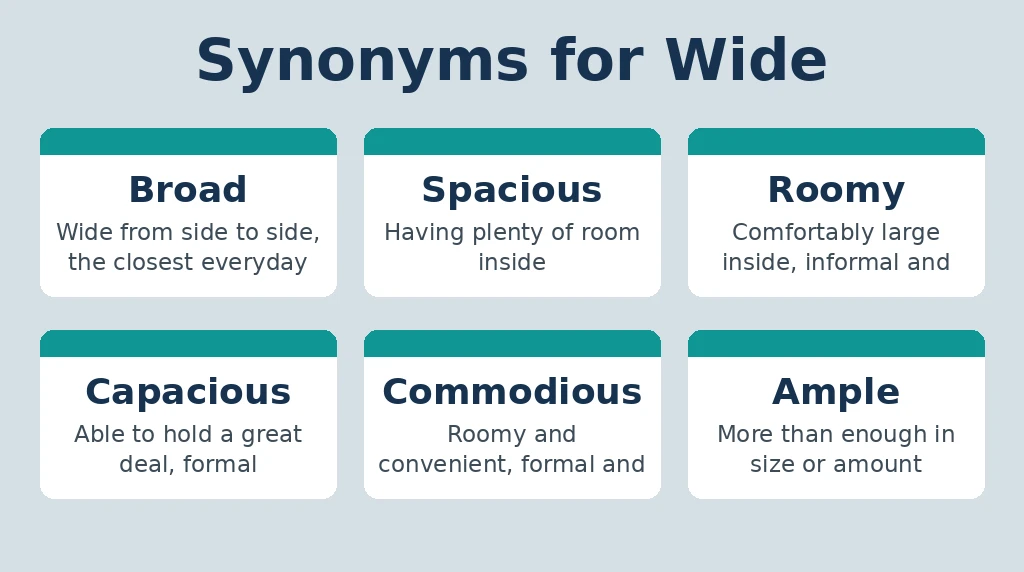
| Broad | Wide from side to side, the closest everyday synonym | Rivers, shoulders, streets, smiles |
| Spacious | Having plenty of room inside | Rooms, flats, gardens, vehicles |
| Roomy | Comfortably large inside, informal and warm | Cars, kitchens, coats, bags |
| Capacious | Able to hold a great deal, formal | Bags, cupboards, venues, formal writing |
| Commodious | Roomy and convenient, formal and old-fashioned | Houses, harbours, literary writing |
| Ample | More than enough in size or amount | Space, proportions, evidence, time |
| Expansive | Wide and spreading out, or grand in scope | Views, gestures, plans, lawns |
| Vast | Immense in extent, far beyond ordinary width | Plains, oceans, deserts, amounts |
| Extensive | Covering a large area or range | Land, damage, reading, networks |
| Sweeping | Extending in a long, wide curve or range | Views, staircases, changes, statements |
| Outspread | Spread out fully and widely | Wings, maps, arms, branches |
| Spread out | Arranged across a wide area | Villages, picnics, documents |
| Extended | Stretched out or made longer in range | Families, visits, warranties, arms |
| Open | Not closed in, wide and free | Country, doors, questions, spaces |
| Wide-ranging | Covering many different subjects or places | Reports, interests, talks, reforms |
| Far-reaching | Having wide effects or range | Changes, decisions, influence |
| Comprehensive | Covering everything or nearly everything | Guides, insurance, reviews, surveys |
| All-embracing | Including everything, formal | Theories, welcomes, definitions |
| Encyclopedic | Covering a vast range of knowledge | Knowledge, guides, memories |
| Catholic | Wide-ranging in taste or interest, formal | Tastes, reading, sympathies |
| Blanket | Applying to everyone or everything | Rules, bans, statements, coverage |
| Overall | Taking everything into account | Views, effects, impressions |
| General | Applying widely, not limited to one case | Rules, approval, practice |
| Widespread | Found or happening over a wide area | Belief, damage, use, support |
| Loose | Not fitting closely, wide on the body | Clothing, knots, covers |
| Baggy | Loose and hanging in folds | Trousers, jumpers, eyes in slang |
| Flared | Widening toward the bottom or edge | Skirts, trousers, nostrils |
| Gaping | Wide open, often alarmingly | Holes, mouths, wounds, deficits |
What Does Wide Mean?
Wide measures the distance from side to side, and it does so with a sense of generosity built in. A wide door invites. A wide smile reassures. Underneath the measurement sits an idea of openness: things that are wide let more through, more light, more people, more air, which is why the word so often sounds like praise.
Rooms claim the word next. A wide room is really a roomy one, and the family of spacious, capacious and commodious exists because interiors are judged by what they hold rather than by a single measurement. Land claims it after that, at scales where width stops being measurable in steps: vast plains, extensive forests, sweeping views, where wide becomes a word for how far the eye can travel.
Then the word leaves the physical world entirely. A wide range, a wide readership, wide experience, widespread alarm: here width has become coverage, the number of different things a net can hold. This is the sense businesses and examiners use most, and it has a precision of its own, since a wide-ranging report and a comprehensive one promise different things.
Finally there is the wide of clothing and openings, where the word describes fit rather than extent: a wide sleeve, a wide opening, a mouth wide with astonishment. Gaping and yawning live at this end of the family, where width has become a state something falls into.
Throughout, wide keeps two quiet contrasts in view. It is not deep, which measures from front to back, and the guide to synonyms for deep handles that direction. And it is not simply big, since a big object may be tall or long instead; the guide to synonyms for big covers size in every direction at once.
One small piece of grammar is worth noticing before the families begin. Wide works both as an adjective and as an adverb: a wide gate, and a gate standing wide open; the ball went wide. The adverb sense, away from the target or fully apart, explains several phrases that puzzle learners, and the mistakes section gathers them, because no synonym in this guide can be swapped into those phrases safely.
Wide as in Broad and Spacious: Rooms, Doors and Interiors
The home sense of wide is room to move. These words describe spaces judged by comfort and capacity as much as by measurement, which is why estate agents, car reviewers and bag makers all live here. One member of the family gets grabbed for thickness by careless hands; thickness between surfaces belongs to the guide to synonyms for thick, not to this section.
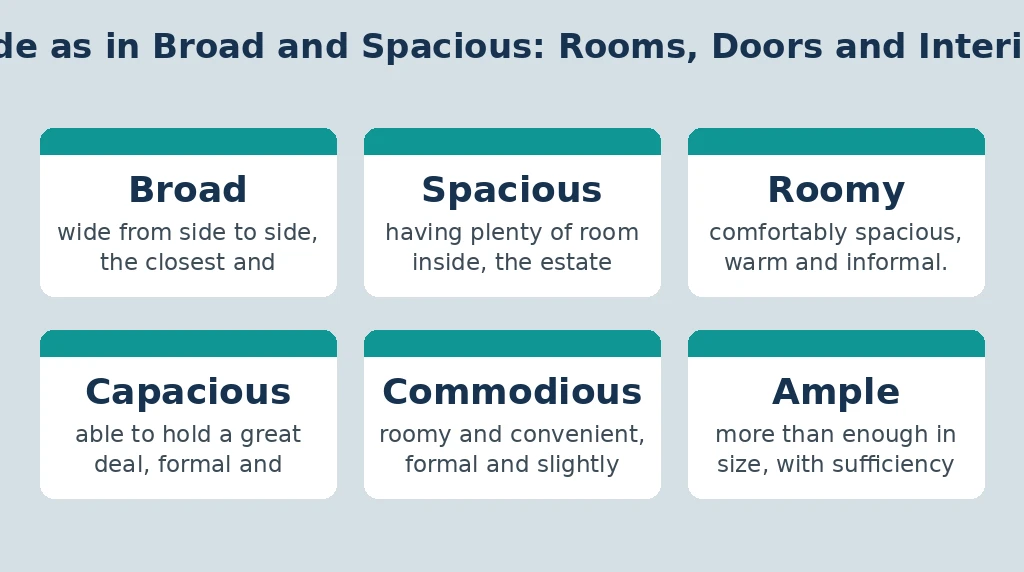
- Broad: wide from side to side, the closest and plainest synonym. A broad staircase carried two centuries of boots
- Spacious: having plenty of room inside, the estate agent standard. The spacious kitchen held a table for ten and a dog
- Roomy: comfortably spacious, warm and informal. A roomy tote swallowed the laptop, lunch and novel
- Capacious: able to hold a great deal, formal and approving. Her capacious handbag produced tissues, plasters and a novel
- Commodious: roomy and convenient, formal and slightly old-fashioned. The commodious inn had stabling for twenty horses
- Ample: more than enough in size, with sufficiency built in. Ample legroom ended the argument about the front seat
- Expansive: wide and spreading, of views, lawns and gestures. An expansive gesture took in the whole valley as his
- Vast: immense, far past ordinary roominess. The vast hall made whispers sound official
Interiors reward the difference between spacious and roomy. Spacious is a measurement wearing a suit; roomy is the same fact told by a friend. Capacious belongs to containers and venues in formal prose, and commodious now survives mostly in hotels and historical novels, where it signals comfort of an older, wood-panelled kind.
There is a social signal hidden in this family.Rooms described as roomy are being recommended by someone who has sat in them. Rooms described as commodious are being remembered. The measurements may be identical. When you choose among them you are choosing a relationship with the reader as much as a dimension, and the wisest property writers know it.
Containers deserve their own sentence of advice. Capacious is the word for things whose job is holding: bags, the boots of cars, store rooms, memories in the metaphorical traffic of essays. A capacious mind is a compliment with a library inside it. Use the word where holding is the virtue and it will never sound inflated.
A small test separates the professionals in this family: ask what the space is for. A wide doorway is for passing, a spacious room is for living, a capacious bag is for carrying, and an ample margin is for surviving mistakes. Purpose picks the word faster than any measurement, and a writer who names the purpose in the sentence rarely needs the grandest synonym at all.
Wide as in Stretching Far: Plains, Coastlines and Views
At landscape scale, width stops being a measurement and becomes a journey for the eye. These words describe land, water and sky that extend beyond easy grasp, and they divide by shape: some sweep, some spread, and some simply refuse to end.
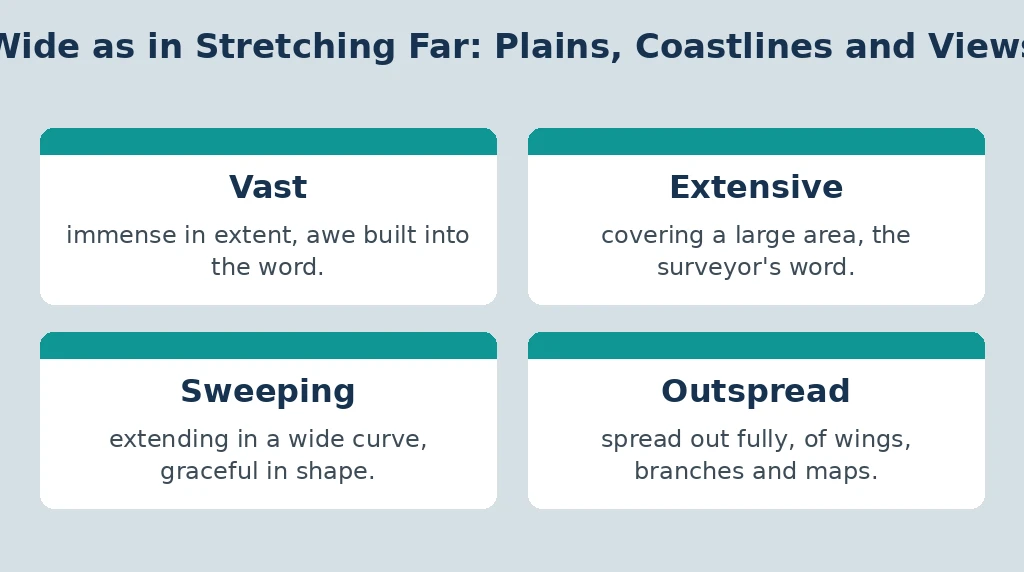
- Vast: immense in extent, awe built into the word. The vast steppe made the railway look improvised
- Extensive: covering a large area, the surveyor’s word. Extensive reed beds sheltered the wintering birds
- Sweeping: extending in a wide curve, graceful in shape. The sweeping lawn ran down to the river wall
- Outspread: spread out fully, of wings, branches and maps. The outspread chart covered the table and two atlases
- Spread out: arranged over a wide area, plain and practical. The orchards spread out below the village in rows
- Extended: stretched out over distance or time. An extended coastline of bays doubled the sailing
- Open: unenclosed and free to the horizon. Open country began where the hedges gave up
Travel writing lives on this family’s distinctions. Sweeping promises shape and movement, extensive promises coverage, and vast promises scale that dwarfs the traveller. A view can be all three, but a sentence should usually pick one, the one the writer actually stood in front of, and let the photograph in the reader’s mind do the rest.
Scale has an honesty problem that this family exposes. Vast gets spent freely in travel prose on views that are merely pleasant, and every spent vast makes the real ones, the steppe, the ocean, the desert at dawn, harder to describe. Keep an unused degree in reserve: extensive for the good views, vast for the overwhelming ones, and your superlatives will still be legal tender when the journey peaks.
Notice, too, how the land words behave in pairs with human things. Outspread belongs to wings and maps equally, spread out to villages and picnic rugs, extended to coastlines and families. The borrowings all run one way, from geography into life, and they work because readers feel the map inside the metaphor without being told it is there.
Cartographers quietly prefer extensive to vast, because a map can prove coverage and cannot prove awe. That preference is a good model for any factual writer. Reach for the provable word in documents that will be checked, and keep vast and sweeping for the passages where your own witness is the evidence: the travel page, the memoir, the speech from the harbour wall.
Wide as in Range: Reading, Reports and Reforms
The most modern sense of wide has no metres in it at all. A wide range of goods, wide powers, a wide consultation: width here means coverage, how many different cases fall inside the boundary. This family is the vocabulary of reports, policies and examinations, and its words make distinct promises that careful writers keep separate.
- Wide-ranging: covering many subjects or places. The wide-ranging inquiry heard farmers, ferry crews and teachers
- Far-reaching: extending far in effect or influence. The far-reaching reforms changed every school in the county
- Comprehensive: covering everything or nearly everything, complete. The comprehensive guide answers questions nobody has asked yet
- All-embracing: including everything without exception, formal. His all-embracing theory explained the exceptions too
- Encyclopedic: covering knowledge the way an encyclopedia does. Her encyclopedic knowledge of train timetables saved the trip
- Catholic: wide in taste and sympathy, formal and easily misunderstood. His catholic reading ran from sagas to cookery books
- Blanket: applying to all cases without exception. A blanket ban grounded every drone in the valley
- Overall: taking everything into account. The overall effect was calmer than the rehearsals promised
- General: applying widely rather than to one case. The general rule held, with two honourable exceptions
- Widespread: found over a wide area or among many people. Widespread frost damaged the early blossom
- Broad-based: drawn from a wide range of people or sources. A broad-based coalition carried the harbour vote
- All-encompassing: including everything within its scope. The all-encompassing survey took four years and nine boats
The promises differ in ways examiners and editors notice. Comprehensive claims completeness, wide-ranging claims variety, far-reaching claims consequences, and blanket claims no exceptions, which is why blanket is the dangerous one in policy writing: a blanket rule will be tested by the first odd case, usually in public.
Examination boards and inspectors lean on this family so heavily that its words have acquired report-card flavours: a broad curriculum, a comprehensive school, a wide-ranging review. Students meet the vocabulary as labels years before they meet it as description. Writers outside education should borrow the words knowing that flavour travels with them, faintly institutional and reassuring.
A word about overall, the quietest member of the family. It rarely gets praised, yet it does a job none of the grander words can: it announces that the speaker has weighed the parts and is now reporting the balance. The overall impression, the overall effect. In argument, that small announcement of fairness is often worth more than another adjective of size.
One member of this family is quietly changing jobs. Widespread began as geography and now mostly reports opinion and behaviour: widespread concern, widespread adoption, widespread confusion. The drift is harmless, but it means widespread no longer guarantees anything about maps. If your sentence needs the geography back, say so with a place or a figure beside it.
Wide as in Loose and Open: Clothing, Mouths and Doorways
The last physical family describes fit and opening rather than extent. Clothes are wide when they leave air around the body, and openings are wide when they gape. These words carry movement in them: sleeves flare, mouths open, and holes yawn.
- Loose: not fitting closely, free to move. A loose jacket forgave the long lunch
- Baggy: loose and hanging in soft folds. Baggy trousers were the uniform of that summer
- Flared: widening toward the edge or hem. Her flared skirt caught the wind like a sail
- Full: wide with gathered material, of skirts and sleeves. The full sleeves required their own chair
- Voluminous: having great volume, billowing and grand. Voluminous curtains drank the morning light
- Gaping: standing wide open, often from damage or shock. A gaping hole in the fence explained the goats
- Yawning: wide open like a mouth in a yawn, literary. A yawning chasm crossed the glacier path
- Cavernous: wide and hollow like a cavern, of spaces and mouths. The cavernous station swallowed the announcement
Fashion writing divides this family by intention. Loose and baggy describe design choices, flared and voluminous describe shapes, and gaping and yawning describe accidents: buttons, seams and cliffs that opened when nobody asked them to. Keep the intention straight and the description stays kind as well as accurate.
Stage and costume designers think in this family professionally. A voluminous cloak reads from the back row; a flared sleeve tells the audience the century before a word is spoken. Their precision is available to any writer: name the shape the cloth makes, not just its looseness, and the reader sees the garment instead of a label.
The opening words, gaping, yawning and cavernous, share a hint of alarm that the clothing words lack, and the alarm is useful. A gaping wound, a yawning deficit, a cavernous empty warehouse: each borrows the body’s shock at a mouth opened too far. Save them for openings that should unsettle, and ordinary doors can keep their dignity with open and ajar.
Sport quietly owns a corner of this family that the guide has kept in the mistakes section for honesty: the wide ball, the wide shot, the delivery that misses. Commentators use it so naturally that learners assume a wide shot in football is a broad one. It is not; it is an escaped one, and its presence in the language is a reminder that every family keeps a door open to the idioms.
How to Choose the Right Synonym for Wide
First, decide what kind of width you are claiming. A measurement, a feeling of room, a stretch of land, or a range of coverage: the four families in this guide answer four different questions, and nearly every misuse of wide comes from letting a word from one family answer another family’s question.
For rooms and containers, match the word to the voice of the piece. Spacious is the professional default, roomy is its friendly form, capacious belongs to formal description of things that hold, and commodious should be saved for period settings and hotels that trade on them. Ample quietly adds approval: it says the space is not merely wide but sufficient, which is often the real message.
For land, choose by shape and scale. Sweeping for curves and views that move, extensive for coverage that can be mapped, vast for scale meant to humble, and outspread for things visibly opened: wings, branches, charts. A writer who has stood in the place rarely confuses them; a writer copying a brochure often does, and readers can tell.
For range, keep the promises apart. Comprehensive must be able to defend its completeness, blanket must survive its exceptions, and catholic, in its taste sense, needs context around it so nobody mistakes it for the Church. When in doubt, wide-ranging is the honest all-rounder: it claims variety and nothing it cannot prove.
There is also a question of evidence. Width claims are checkable, and readers check them with their imaginations even when they cannot check them with a tape. A wide hall in a story will be paced out mentally; a widespread belief will be tested against the reader’s own street. The synonyms that survive such checking are the modest ones used exactly, which is why this guide keeps returning to the unglamorous virtues of broad, open and general.
Finally, let rhythm have a vote. Wide itself is a short, open-vowelled word that sits comfortably at the end of a sentence, where measurements like to live. Its grander synonyms, capacious, comprehensive, encyclopedic, are paragraph words, best placed where the sentence has room to carry them. A page that mixes the two registers, plain wide for the facts and the long words for the judgements, reads like a mind at ease with its subject.
If you keep only one rule from this section, let it be this: never let a range word do a measurement’s job in a factual sentence. A comprehensive doorway and a wide-ranging river both sound like jokes because the reader’s body rejects them before the mind objects. Bodies are excellent editors. Write the sentence, imagine standing in it, and the wrong family usually announces itself as a small physical impossibility.
| Situation | Best word | Why |
|---|---|---|
| A kitchen with room for a table of ten | Spacious | It is the natural word for comfortable interiors |
| A handbag that holds everything | Capacious | It praises holding power in formal terms |
| A view that curves along a coast | Sweeping | It captures the shape as well as the scale |
| A report covering every aspect | Comprehensive | It promises completeness and must deliver it |
| A rule with no exceptions allowed | Blanket | It states total coverage plainly |
| Trousers loose at the ankle | Flared | It describes widening toward the hem |
| A hole nobody expected | Gaping | It gives the shock of the opening as well |
Wide Synonyms for Writing and Dialogue
In essays and reports, the range family does the heavy lifting, and it rewards honesty. Students write that a novel has wide themes when they mean the themes are varied, important or interconnected, and each of those claims needs different evidence. Wide-ranging themes can be listed; comprehensive treatment must be checked against what was left out. The vocabulary is a small examination in itself.
Journalism uses widespread and far-reaching daily, and both are often asked to carry more than they should. Widespread damage needs a map or a count behind it, and far-reaching changes need at least one consequence named. Used with evidence, the words are exact and useful; used as decoration, they are the first phrases a sub-editor should strike.
In fiction and dialogue, the physical families do the work. Characters notice roomy kitchens, sweeping drives and gaping holes, and a narrator can build a whole sense of freedom out of open country and outspread maps. Nobody in a novel has ever admired a comprehensive hallway, and keeping the families apart is what makes description sound observed rather than assembled.
Poetry keeps the oldest members of the family in employment: vast, outspread, yawning. Their slight archaism is a feature there, since a yawning chasm belongs to the world of feeling as much as to rock. In a business report the same words would raise eyebrows, which is the whole lesson of this family in miniature: width is physical, but choosing its words is social.
Teachers meet this word in a special difficulty: the wide essay topic. Students hear wide as an invitation to say everything, and the range family is the cure, because each member limits as it widens. A comprehensive answer is impossible in three pages; a wide-ranging one is merely ambitious; a focused one is a relief. Teaching students to hear the limits inside the wide words saves more marks than any grammar drill.
Translators meet a trap here that monolingual writers escape. Many languages use one word for wide and broad, and another for spacious that carries class connotations English has forgotten. Learners of English often arrive with spacious doing every job, producing spacious roads and spacious arguments. The families in this guide are, among other things, a map of where English insists on changing the word.
Antonyms for Wide
The opposites of wide are mostly the vocabulary of narrowness and limits: narrow for measurement, cramped for rooms, tight for clothing, and limited for range.
- Narrow: measuring little from side to side, the master opposite. A narrow lane rationed the vans to dawn deliveries
- Cramped: small and crowded, the room opposite. The cramped cab seated two and a half
- Confined: kept within small limits, formal. Confined quarters made scholars of them all
- Tight: fitting closely, the clothing opposite. Tight sleeves ended the harp lessons early
- Close-fitting: shaped closely to the body. A close-fitting jacket showed every rehearsal
- Limited: kept within bounds, the range opposite. Limited powers frustrated the new council
- Restricted: officially limited in scope or access. Restricted airspace emptied the afternoon sky
- Narrow-minded: unwilling to consider wide views, the mind opposite. Narrow-minded committees fear every new instrument
- Small: little in size generally. The small hall filled with twelve chairs and optimism
- Thin: measuring little between surfaces. A thin door pretended to keep secrets
- Contracted: drawn smaller, formal and physical. The contracted harbour froze to half its width
- Pinched: drawn in and narrow, of faces and passages. A pinched doorway served the old granary
The pairings keep the families honest: spacious looks to cramped, comprehensive to limited, loose to tight, and vast, interestingly, to small rather than narrow, because vast measures scale and not a single direction. If an opposite refuses to pair with your wide synonym, the synonym has probably drifted into the wrong family, and the lists above are the way back. Keep the pairs on a card if you write often about space or scope; they settle arguments faster than any definition in this guide.
Common Mistakes: Words That Are Not True Synonyms for Wide
Wide awake is the most famous trap in this territory. It means fully awake, and its wide has nothing to do with width at all; it is an old intensifier, fossilised in the phrase. A wide-awake child is not a broad one, and no synonym from this guide can replace it.
Wide-eyed belongs to expression, not measurement. It describes innocence or astonishment shown in the eyes, and while the eyes may literally open wider, the phrase names the feeling, not the distance. The same caution covers wide of the mark, where wide means off target entirely, an archer’s word that wandered into general speech.
Worldwide names distribution, not width. A worldwide shortage is found everywhere, not measured across, and its proper neighbours are global and universal rather than anything in this guide. Writers who use wide itself for world coverage, wide concern, are on safer ground with widespread, which at least lives in the range family.
Widen and broaden are verbs, and they cannot do the adjective’s job, while broad in phrases like broad humour or a broad hint has left measurement behind to mean coarse or obvious. Each of these is respectable in its own sentence; the mistake is only in expecting them to measure a doorway.
Big deserves a mention because it is the word wide most often hides behind. Big includes height, length, weight and importance, and says nothing about shape. A big wardrobe might be tall and narrow. When the shape is the point, when you mean the side-to-side of the thing, wide and its family are the honest tools.
Far and wide deserves its own note, because it is an honourable phrase rather than an error. It means over a great distance in every direction: searched far and wide, known far and wide, and wide inside it is doing adverb work no synonym can inherit. You cannot search broad and spacious. Some phrases are furniture, not machinery, and this is one of them.
Spacious makes the opposite journey and gets used for arguments, voices and vowels, where it means nothing measurable at all. A spacious argument is either a roomy one in metaphor, which a brave writer may defend, or a mistake for a wide-ranging one. The word belongs to places you could stand in; lend it elsewhere only on purpose.
Frequently Asked Questions
What is the best synonym for wide?
Broad is the closest all-purpose synonym for wide, fitting rivers, shoulders, streets and smiles. For rooms, spacious is the natural choice; for land, vast or sweeping; for range, comprehensive or wide-ranging. Pick the family first and the best word usually picks itself.
What is the difference between wide and broad?
The two overlap almost completely, and most sentences accept either. Broad leans slightly toward surfaces and open extent, a broad back, a broad plain, while wide is the word for openings and measurements, a wide door, three metres wide. Broad also has extra senses wide lacks, like broad humour, meaning coarse.
What is the opposite of wide?
Narrow is the direct opposite for measurement. For rooms the opposite is cramped, for clothing tight or close-fitting, for range limited or restricted, and for land, small or confined. As with the synonyms, the right opposite belongs to the same family as your sentence.
What does wide-ranging mean?
It means covering a wide variety of subjects, places or cases. A wide-ranging discussion touches many topics; a wide-ranging reform touches many institutions. It claims breadth of coverage, not depth in any single part, which is why it pairs naturally with comprehensive when both are meant.
Can wide describe things that are not physical?
Yes, constantly. Wide experience, wide support, a wide readership and widespread belief all use width as coverage or extent. The physical image sits underneath, of a net cast wide, and the range family in this guide, comprehensive, blanket, overall and the rest, exists to serve exactly those sentences.
Final Thoughts
Wide turns out to be four promises in one word: a measurement, a feeling of room, a stretch of country and a breadth of coverage. Its families now stand in order: broad and spacious for the room, vast and sweeping for the land, comprehensive and wide-ranging for the report, and loose and gaping for everything that opens. Choose by family, and the promise your sentence makes is one it can keep. That may sound like a lot of ceremony for a word of four letters, but width is how readers enter every scene you build: through its doors, across its fields, and inside the range of what it dares to include.
The Merriam-Webster Thesaurus entry for wide gathers the wider clan in one place, and browsing it beside this guide is a pleasant way to spend ten minutes. Between the two, no doorway, valley, syllabus or sleeve in your writing need ever be measured with the wrong word again. Take the families with you, measure generously but honestly, and the word will keep its side of the bargain every single time.

1 thought on “Synonyms for Wide | 34+ Words for Breadth, Space, Extent and Range”