Lower a bucket into a village well and you learn the oldest meaning of deep before the rope runs out: a long way down. But the same word describes a voice that seems to rise out of the chest of the earth, a red too rich to be called just red, an idea you could think about for a year, and a sleep that swallows a whole night without a ripple. The closest synonyms sort themselves by territory: bottomless and unfathomable for depth itself, dark and intense for colour, low and resonant for sound, profound for thought, heartfelt for feeling, and sound for sleep. This guide keeps those territories apart, because deep is a word that travels.
Every word below was checked against real thesaurus entries, and each one comes with a plain meaning and a short example. The families here sit unusually far apart. A well and a symphony have nothing in common. So precision matters more with deep than with almost any other adjective in this series.
Top Synonyms for Deep: Quick Reference
Start here when you are in a hurry. These are the deep synonyms writers reach for most often, with what each one really means and where it works best. The families below take the territories one at a time: downwards first, then colour, sound, thought, feeling and sleep. Keep one question beside you as you read: what is the surface here, how far below it are we going, and who measured the rope before we trusted it with the story?
| Word | Meaning in one line | Best for |
|---|---|---|
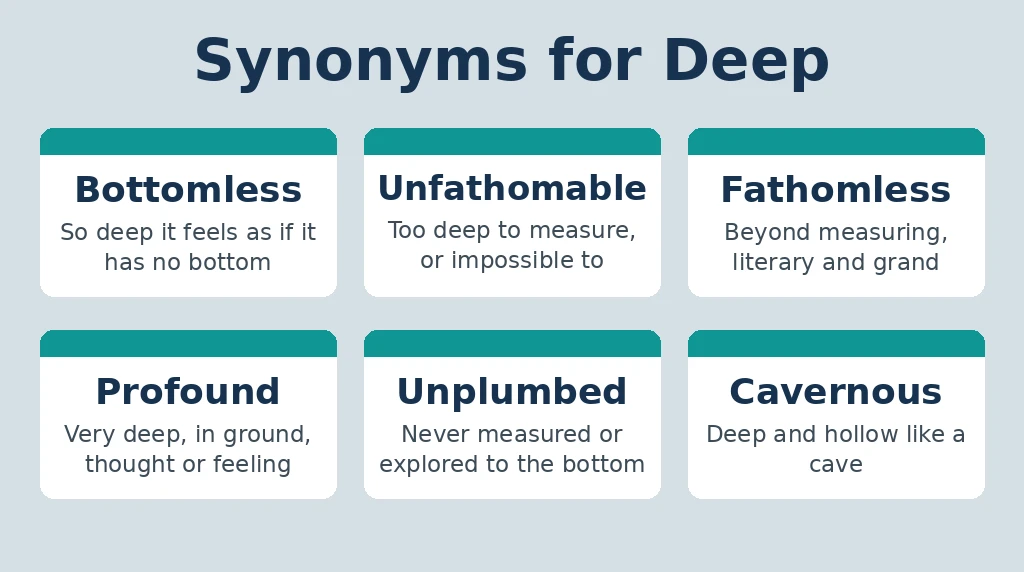
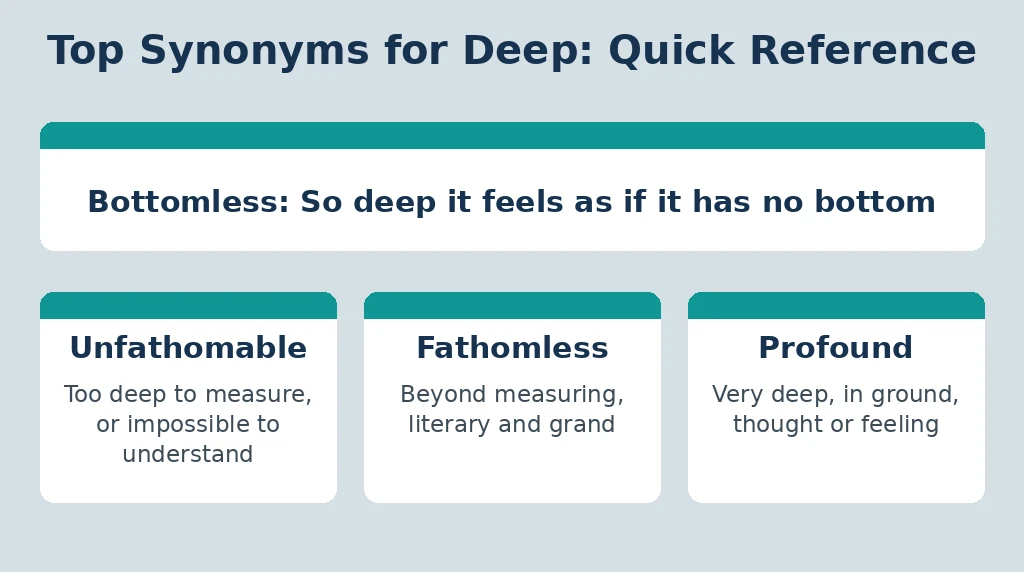
| Bottomless | So deep it feels as if it has no bottom | Pits, wells, grief, informal exaggeration |
| Unfathomable | Too deep to measure, or impossible to understand | Oceans, mysteries, motives |
| Fathomless | Beyond measuring, literary and grand | Seas, skies, literary description |
| Profound | Very deep, in ground, thought or feeling | Thought, silence, effects, formal writing |
| Unplumbed | Never measured or explored to the bottom | Depths, subjects, reserves |
| Cavernous | Deep and hollow like a cave | Spaces, mouths, stations, voices |
| Yawning | Gaping deep and wide open | Chasms, holes, deficits |
| Dark | Deep and strong in colour, near to black | Colours, shades, rooms |
| Intense | Concentrated and strong in degree | Colours, feelings, looks, heat |
| Rich | Full and strong, of colour, sound or flavour | Colours, voices, food, soil |
| Strong | Powerful in degree, plain and general | Colours, feelings, effects |
| Bold | Strong and vivid, standing out clearly | Colours, patterns, statements |
| Low | Deep in pitch, near the bottom of the scale | Voices, notes, sounds |
| Bass | Low and deep in tone, musical | Voices, instruments, speakers |
| Resonant | Deep, clear and echoing with body | Voices, halls, bells |
| Sonorous | Deep, rich and imposing in sound | Voices, prose, ceremonies |
| Booming | Loud, deep and echoing | Voices, cannons, economies |
| Rumbling | Low, deep and continuous in sound | Thunder, stomachs, engines |
| Philosophical | Deep in thought, concerned with big questions | Books, talks, temperaments |
| Weighty | Deep in importance, deserving thought | Matters, books, decisions |
| Penetrating | Going deep into a subject or mind | Questions, analysis, gazes |
| Heartfelt | Deeply and sincerely felt | Thanks, apologies, condolences |
| Fervent | Deeply passionate and earnest | Beliefs, hopes, supporters |
| Earnest | Deeply serious and sincere | People, efforts, conversations |
| Sincere | Truly and deeply meant, not pretended | Apologies, wishes, people |
| Passionate | Full of deep, strong feeling | Beliefs, speeches, attachments |
| Sound | Deep and unbroken, of sleep | Sleep, arguments, investments |
| Absorbed | Deeply engaged, with attention fully taken | Readers, workers, listeners |
What Does Deep Mean?
Deep measures from the surface downward: the top of the well to its water, the deck of a ship to the keel, the skin of a subject to its centre. It makes the opposite journey from wide, which crosses a surface from side to side, and the two words divide the world between them so completely that you can judge almost anything by asking which of them it needs.
Sound borrows the measurement for pitch. A deep voice seems to come from lower in the body, and the metaphor feels so natural that languages all over the world share it. Colour borrows it for saturation: a deep red is red that has gone down into itself, further from white and nearer to black. The guide to synonyms for dark continues that journey, for colours that go further still.
Thought claims the word next. A deep thinker goes below the surface of a question, a deep book rewards a second descent, and profound, the grandest member of this whole guide, began as the Latin for deep before it became the word for wisdom. Feelings follow the same path down: deep sorrow sits lower than sadness, and a deep-rooted belief is imagined under the soil of a person, where the weather cannot reach it.
Sleep completes the set, because sleep has depth the way water does. We fall into it, sink into it, and are hard to raise from its bottom. The guide to synonyms for heavy meets this sense from the other side, since heavy sleep and deep sleep are near neighbours: the first names its weight, the second its depth.
Two smaller senses deserve their place. Deep can mean absorbed: deep in a book, deep in debt, where the person is imagined inside the thing up to the waist. And it can mean cunning: the deep one who keeps his thoughts below his own surface. Both appear in the families below, in their proper, labelled places.
One more quiet test before the families begin: deep asks to be believed. A writer who calls a pond deep invites the reader to imagine a rope going down and not arriving, and the whole vocabulary of this guide trades on that small act of trust. Spend it carefully, on wells and arguments that can honour it, and the word keeps its credit for the moments that matter.
Deep as in Down: Wells, Oceans and Bottomless Places
The home sense: distance below a surface. These words all promise great depth, but they divide by whether the depth can be measured, imagined or survived. For the horizontal twin of this family, the guide to synonyms for wide covers the journey across instead of down.
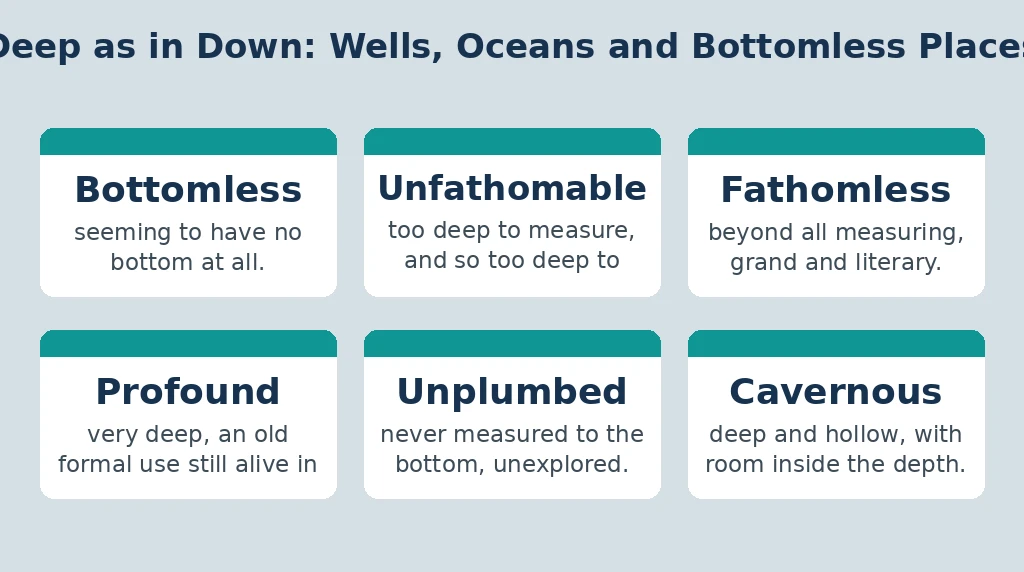
- Bottomless: seeming to have no bottom at all. The bottomless gorge took the dropped torch without a sound
- Unfathomable: too deep to measure, and so too deep to understand. The unfathomable trench holds fish that make their own light
- Fathomless: beyond all measuring, grand and literary. Fathomless night seas rolled under a moonless sky
- Profound: very deep, an old formal use still alive in poetry. A profound chasm split the glacier shelf
- Unplumbed: never measured to the bottom, unexplored. The unplumbed cave system outlasted three expeditions
- Cavernous: deep and hollow, with room inside the depth. The cavernous hall swallowed the choir’s last note slowly
- Yawning: opening deep and wide at once. A yawning fissure crossed the ice road overnight
Handle bottomless with a smile in factual writing: wells and lakes all have bottoms, and the word confesses exaggeration even as it makes it. That confession is exactly its charm in speech and story. In reports, unplumbed and unfathomable do soberer work, marking depths that instruments have genuinely failed to finish.
Divers and cavers divide this family professionally. For them depth is a number with consequences, and unfathomable is not a compliment but a reporting failure. Their discipline makes a useful model for any factual writer: where a depth can be measured, measure it, and let the grand words keep their grandeur for the trenches and aquifers that genuinely refuse the rope.
Deep Colour: Dark, Intense and Rich
A deep colour is one that has travelled far from white: saturated, strong, and holding light rather than reflecting it back. Painters, dyers and designers use the family daily, and its members divide by whether the colour is dark, strong, or full.
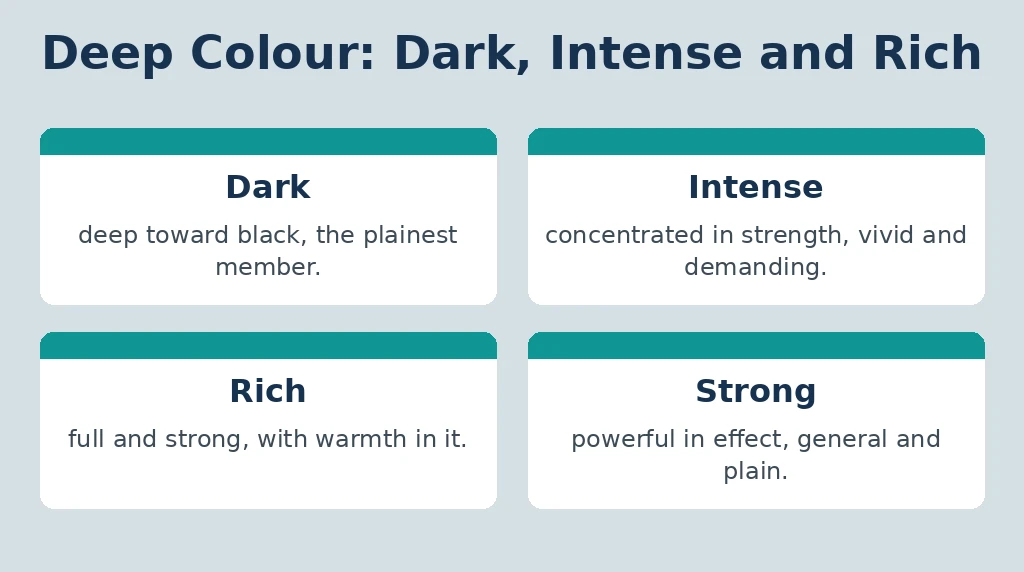
- Dark: deep toward black, the plainest member. A dark green door disappeared into the hedge by dusk
- Intense: concentrated in strength, vivid and demanding. Intense blue tiles lined the courtyard fountain
- Rich: full and strong, with warmth in it. The rich purple of the plums stained every thumb
- Strong: powerful in effect, general and plain. Strong colours held the poster together across the street
- Bold: standing out vividly, unafraid. Bold reds carried the festival banners
The family has a practical order on the paint chart. Rich warms, intense strengthens, dark lowers the light, and bold raises the voice. Interior writers who learn the order stop calling every saturated room dark, which is the colour equivalent of calling every loud sound deep, a confusion the next section untangles.
Fashion borrows the family with a precision of its own: a deep hem, a deep cuff, a deep V, where depth is measured in centimetres and means exactly what it says. The borrowings remind us that the physical sense is not a metaphor waiting to happen but a working measurement that tailors, divers and dyers all still use before breakfast.
Deep Sound: Low, Bass and Resonant
A deep sound sits low in the body of the listener as much as in the throat of the speaker. This family divides by pitch, by body, and by behaviour: some deep sounds ring, some roll, and some simply occupy the bottom of the room like furniture.
- Low: near the bottom of the musical scale, the plain word. A low note from the organ travelled through the floor
- Bass: deep in tone, the musician’s term. The bass voice in the choir had once sung in cathedrals
- Resonant: deep and full, echoing pleasantly in a space. His resonant reading filled the chapel without a microphone
- Sonorous: deep, rich and imposing, slightly formal. The sonorous bell marked hours the village no longer kept
- Booming: loud, deep and echoing, with force in it. A booming laugh announced him before the door opened
- Rumbling: low and continuous, rolling in the background. Rumbling thunder circled the hills all afternoon
- Deep-toned: having a deep tone, descriptive and exact. The deep-toned piano had survived three removals and one flood
Pitch and volume are separate dials, and this family teaches the difference. A booming voice turns both up. A resonant one may be quiet and still fill a room. A low murmur can be nearly inaudible and unmistakably deep. Writers who confuse the dials produce whispers that boom and shouts described as deep, and readers feel the error in their ribs.
Choirs understand this family in their bones. A bass section does not merely sing lower; it gives the harmony a floor, and conductors speak of depth the way builders speak of foundations. When you describe music, borrow their confidence: name the floor of the sound, and the reader hears the whole building.
Deep Thought: Profound, Philosophical and Penetrating
When deep describes minds and books, it promises that the surface is not the whole story. This family holds the most complimentary words in the guide, and also the easiest to overuse, since every author believes their own subject is profound and every reader is the judge.
- Profound: going far below the surface of a subject. Her profound essay on boredom rewarded a whole evening
- Philosophical: concerned with the deepest questions, calmly. A philosophical cab driver improved the whole journey
- Weighty: full of importance, deserving slow thought. Weighty matters were saved for the morning meeting
- Penetrating: reaching the centre of a matter quickly. His penetrating questions emptied the press conference early
- Abstruse: deep to the point of difficulty, scholarly. The abstruse commentary required its own commentary
- Recondite: little known and deeply obscure, the connoisseur’s word. A recondite manuscript tradition occupied her doctorate
- Esoteric: meant for a deep-knowing few. The esoteric ritual puzzled every visitor politely
Use profound the way you would use a medal: rarely, and for work that has survived inspection. Abstruse and recondite, meanwhile, are honest warnings disguised as compliments, telling the reader that the depth ahead has a price in effort. A guide, a review or a syllabus that deploys them fairly has done its reader a genuine kindness.
There is a courtesy hidden in this family for interviewers and examiners. A penetrating question honours its subject by assuming there is more below; a merely hard question does not. Writers setting questions, for examinations or for print, can borrow the distinction and produce papers that feel deep rather than merely long.
Deep Feelings: Heartfelt, Fervent and Deep-Rooted
Feelings are imagined as weather on a surface and roots below it: the deeper the feeling, the less it can be blown away. This family ranges from gratitude to grief, and its members divide by temperature, passion at one end and sincerity at the other.
- Heartfelt: deeply felt and honestly meant. Heartfelt thanks went to the night nurses by name
- Fervent: burning with deep feeling and belief. A fervent supporter, she queued in the rain for tickets
- Earnest: deeply serious and sincere in intent. In earnest conversation, the plan finally sounded possible
- Sincere: truly felt, without pretence. Please accept my sincere apologies for the confusion
- Passionate: full of strong, deep feeling. He made a passionate defence of the village library
- Deep-seated: fixed deep inside, hard to shift. A deep-seated fear of water kept him from the ferry
- Deep-rooted: growing from deep roots, long established. Deep-rooted customs outlived the railway and the war
Formal letters live on the sincere end of this family: heartfelt thanks, sincere apologies, earnest hopes. The passionate end belongs to speeches, manifestos and love letters, where restraint would sound like doubt. Matching the end of the family to the paper it travels on is half of sounding genuine, in condolences most of all.
Grief has its own dialect inside this family. The bereaved are rarely described as passionate or fervent; the words that gather around them are deep sorrow, deep sympathy, heartfelt condolences, a vocabulary of weight rather than fire. Match the dialect to the room and your sentence will sound like it belongs to someone who has actually stood in one.
Deep Sleep: Sound, Heavy and Unbroken
Sleep is the sense where deep becomes almost measurable, since sleep scientists themselves grade its stages by depth. The everyday family is small and exact: these words describe sleep that noise, light and worry cannot easily reach.
- Sound: deep and completely undisturbed, the classic word. He was in a sound sleep before the train left the suburbs
- Heavy: deep with weight in it, hard to wake from. A heavy sleep took her past three alarms
- Unbroken: never interrupted from start to finish. Six unbroken hours repaired what the week had spent
- Dreamless: so deep that no dreams surface. A dreamless night left him oddly unrefreshed
- Fast: fixed and unshakeable, in the phrase fast asleep. Fast asleep in the hayloft, the cat missed the thunderstorm
Sound asleep is the phrase English reaches for first, and it carries a compliment inside it: sound means whole and healthy as well as deep. Heavy sleep, by contrast, can suggest the sleep of exhaustion or fever, the kind people wake from slowly. Choose between them by asking how the sleeper will feel at breakfast.
Parents and night workers could annotate this family from experience. They know the difference between a child sound asleep, who can be carried up two flights like luggage, and a child in the shallow end of the night, who surfaces at a stair creak. The vocabulary survives because the observation is nightly, and its precision is the precision of love and tiredness combined.
Deep as in Absorbed, and Deep as in Cunning
Two smaller senses share this last section because both imagine a person inside something: inside a task, a book or a debt, in the first; inside their own silence, in the second. The first family is complimentary or rueful, the second is a warning, and keeping them apart is mostly a matter of the company they keep.
Absorbed and immersed, the person inside the activity:
- Absorbed: with attention fully taken by something. Absorbed in her proofs, she missed lunch and two calls
- Engrossed: completely absorbed, often by reading. Engrossed in the trial transcript, he forgot the rain
- Immersed: deep in an activity or subject, as if under water. Immersed in rehearsals, the cast lost track of the month
- Rapt: held deep in delighted attention. The rapt audience forgot to cough between movements
- Lost in: absorbed beyond noticing the surroundings. Lost in the atlas, he travelled three continents by tea
- Preoccupied: deep in thought about something else. Preoccupied with the verdict, she salted the tea
And the cunning family, the deep ones who say little:
- Crafty: skilled at hiding intentions, sly in a practical way. The crafty negotiator kept his best card face down
- Cunning: clever at deceiving, with real skill in it. A cunning trail led the hounds in a generous circle
- Devious: not straightforward, going by hidden routes. The devious route avoided every camera in the building
- Sly: quietly cunning, with a hint of humour. A sly reference in the speech rewarded the attentive
Context separates the two families almost every time: deep in plus an activity is absorption, while deep as a description of a person, a deep one, a deep customer, is the warning. The second use is ageing gracefully into literature, but it still lands in speech, usually with a pause before it that does half the work.
Debt is the dark twin of absorption, and the language knows it: deep in debt uses the same picture as deep in a book, a person inside something past the waist. Writers about money borrow the picture constantly, and it works because the reader feels the level rising. Use it knowingly and it stays vivid; use it carelessly and it becomes the wallpaper of financial journalism.
How to Choose the Right Synonym for Deep
Begin by asking what the depth is measured in. Metres, pitch, saturation, thought, feeling or hours of sleep: each unit has its own family in this guide, and borrowing across them produces the familiar wobbles: a profound puddle, a bottomless argument, a heartfelt fog.
For physical depth, keep the measurable words for measurable claims. Soundings, surveys and safety documents want deep itself, or a number, and save unfathomable for the places instruments genuinely fail. In storytelling the licence widens: bottomless and fathomless are atmosphere words, and a single one can lower the light of a whole scene.
For minds, profound is the summit and should be rationed like one. Penetrating suits questions and analysis, weighty suits subjects and decisions, and philosophical describes a temperament or a discipline rather than a single clever remark. Abstruse and esoteric are warnings about audience as much as praise about depth; deploy them where the warning is welcome.
For feelings and sleep, tone decides. Heartfelt and sincere keep their dignity in formal paper; fervent and passionate raise the temperature and belong where heat is wanted. Sound sleep praises the sleeper’s health, heavy sleep hints at exhaustion, and the difference can matter to the person described, especially in a reference or a report.
One last habit separates careful users of this word: they check the surface in the sentence. Every deep implies one, a surface of water, skin, page or composure, and naming it, even silently, tells you which family you are in. If you cannot find the surface, the word is probably doing atmosphere work, which is allowed in stories and suspect in reports.
| Situation | Best word | Why |
|---|---|---|
| A well with no measured bottom | Unfathomable | It states the failure of measurement honestly |
| A red that is nearly black | Dark | It places the colour on the scale toward black |
| A voice that fills a hall quietly | Resonant | It gives body and echo without volume |
| A book that rewards a year of thought | Profound | The summit word, used where it can be defended |
| Thanks that truly mean it | Heartfelt | Warm and sincere without raising the temperature |
| Sleep that survives three alarms | Sound | The classic word for deep, healthy sleep |
| A reader who misses lunch | Absorbed | It names the attention, not the book |
Deep Synonyms for Writing and Dialogue
In descriptive writing, deep is the cheapest special effect in the language and one of the best. A deep valley, a deep voice in the doorway, a deep red door at the end of it: three sentences and the scene has a vertical axis, a sound and a colour temperature. The discipline is to vary the family: cavernous for the station, resonant for the voice, intense for the sky, so the reader keeps descending instead of skimming.
In essays and criticism, the thought family needs evidence the way a well needs a rope. Calling an argument profound invites the examiner to test its depth, and penetrating, weighty and philosophical all make claims that the following paragraph must honour. Used honestly, they are the highest praise academic writing owns; used as decoration, they are the first words a good editor circles.
In dialogue, deep mostly appears in its set phrases: deep trouble, deep breath, deep end, deep down. Characters say these without thinking, which is exactly why they work, and a writer can build a voice out of small preferences among them: the swimmer who says deep end, the singer who says deep breath, the gambler who only ever says deep trouble.
Journalism borrows the absorbed family daily: deep in talks, deep in debt, deep in the second half. The borrowings are efficient because the picture is instant. The same picture can mislead when it does quiet judging, a minister deep in scandal, so careful reporters check whether the depth is a fact or an atmosphere before they let the phrase through.
Science writing uses deep with a ruler in its hand: deep time, deep space, deep sea, deep learning in its newer career. The compounds work because the measurement instinct survives inside them, geology and astronomy borrowing the well and the ocean to measure the unmeasurable. A general writer can borrow the trick sparingly: one good compound lends a whole paragraph its sense of scale.
Antonyms for Deep
The opposites of deep divide by the same territories: shallow for water and thought, high for sound, pale for colour, light for sleep, and surface-level for everything that never goes down.
- Shallow: not deep, the master opposite for water and people. A shallow tray of water warmed in the sun by noon
- Superficial: concerned only with the surface, the thought opposite. A superficial reading missed the letter’s whole point
- Surface-level: never going below appearances. Surface-level reforms changed the signs, not the service
- High: at the top of the pitch scale, the sound opposite. A high whistle floated over the harbour
- High-pitched: shrill and high in sound. The high-pitched alarm cleared the corridor politely
- Pale: light and weak in colour, the colour opposite. Pale ink faded from the exposed page
- Faint: barely there in sound or colour. A faint line of hills closed the view
- Light: not deep, of sleep and touch. A light sleeper woke at the gate latch
- Fitful: broken and restless, the sleep opposite. A fitful night left the decisions worse than the problem
- Slight: small in depth or degree. A slight dent marked the door where the trolley passed
- Open: frank and surface-clear, the cunning opposite. His open manner disarmed the whole committee
- Frank: honest and direct, hiding nothing. A frank answer saved the meeting an hour
Notice how the opposites accuse as well as measure. Shallow is a fact about a stream and a verdict on a person; superficial is a verdict wearing a fact’s clothing. Writers who learn the double life of these words stop sprinkling them as neutral description, and start saving them for the moments when the judgement is intended and defensible.
Common Mistakes: Words That Are Not True Synonyms for Deep
Profound is the most overworked word in this entire guide. It belongs to thought, feeling and effect, and its old physical use survives mainly in poetry. A profound hole, in modern prose, sounds like the hole has opinions. For physical depth, bottomless, unfathomable and plain deep itself all do the job without the comedy.
Low works only where pitch or level is genuinely meant. A low voice is deep; a low opinion is something else entirely, and a low price has nothing to do with depth at all. The word is a good servant in the sound family and a smuggler everywhere else, so check its papers when it appears beside feelings and ideas.
Dark borrows deep’s colour sense so often that the two are mistaken for twins. They are not: dark measures the absence of light, deep measures saturation, and a colour can be deep without being particularly dark, a deep sky blue at noon, or dark without depth, a flat charcoal. Painters keep them apart instinctively; writers should learn to.
Intense describes degree, not depth, and the difference shows in wells and voices. An intense voice may be high and piercing; an intense colour may be a shallow, glaring yellow. Where deep promises somewhere further to go, intense promises only more of the surface, louder. Both are useful; they are not interchangeable.
Deeply is the adverb that escapes supervision. Deeply sorry, deeply moved and deeply held are honest phrases, but deeply lit, deeply wide and deeply asleep in the wrong register all wobble. The rule of thumb: deeply belongs with feelings, beliefs and effects, and the families above will supply a better tool for everything else.
Sound closes the list because it works two jobs in this guide and can confuse a quick reader. Sound sleep is deep sleep, but a sound argument is a solid one and a sound person is a healthy one. None of these uses is an error; the family resemblance is real. The caution is only against assuming the sleep sense travels, since a sound swimmer and a sound sleeper are very differently equipped.
Frequently Asked Questions
What is the best synonym for deep?
For physical depth, bottomless and unfathomable are the strongest choices, with deep itself best where a measurement follows. For thought, profound is the summit word; for colour, dark or intense; for sound, low or resonant; for feelings, heartfelt; and for sleep, sound. Match the family to the subject first.
What is a stronger word than deep?
Unfathomable and bottomless are stronger for physical depth because they claim the bottom cannot be reached or measured. Profound is stronger for thought and feeling, suggesting depth that changes the person who enters it. In every family the stronger word is the one that makes the larger, more specific claim.
What is the opposite of deep?
Shallow is the direct opposite for water, holes and physical depth. For thought the opposite is superficial, for sound high or high-pitched, for colour pale or faint, and for sleep light or fitful. As with deep itself, each territory keeps its own opposite.
What does it mean to be deep in thought, or a deep person?
To be deep in thought is to be fully absorbed, with attention below the surface of everything else. A deep person, in older and literary use, can also mean someone cunning who keeps their real thoughts hidden, so context decides whether the phrase is praising concentration or warning about character.
Is a deep voice the same as a loud voice?
No. Depth in a voice is about pitch and body, not volume. A deep voice is low and often resonant, and it can be very quiet while still filling a room. A loud voice may be high and thin. Booming is the member of the sound family that combines depth with real volume.
Final Thoughts
Deep is the word English sends downward into everything: into wells and oceans, into voices and violins, into colours, arguments, griefs and sleeps. Its families now stand in order: bottomless and unfathomable for the descent, dark and intense for the colour, low and resonant for the sound, profound for the thought, heartfelt for the feeling, and sound for the sleep that repairs us. Choose by family, and your reader will always know how far down they are going, and what they will find at the bottom. It is, in the end, a word about trust: the writer points downward, and the reader agrees to follow.
The Merriam-Webster Thesaurus entry for deep gathers the whole clan in one place for a slow browse, and it repays the time. Keep this guide beside it, and the next well, voice, idea or midnight in your writing will be measured with the right rope.

1 thought on “Synonyms for Deep | 47+ Words for Depth, Sound, Colour, Thought, Feeling and Sleep”