The removal man took one look at our piano, one look at the staircase, and said “heavy” the way people usually say “I’m sorry for your loss.” He meant kilos. But that word puts in a full week elsewhere: heavy rain over the M62, a heavy meeting, a heavy Sunday lunch, a heavy heart on the train home. For pure weight, the closest matches are weighty and hefty. For force, severe and intensive; for amount, copious; at the table, filling; for duties that sit on your chest, onerous. This guide sorts them into families, so the word you pick carries the load you actually mean. In short, this guide gathers synonyms for heavy for every load, from the piano to the heart.
Quick honesty note before we start: every word on this page was checked against real thesaurus entries, and each comes with a plain-English meaning and an example you might actually say out loud. Heavy is a funny word, because your shoulders understand it before your brain does. Get the synonym right and the reader doesn’t just read about the weight. They feel their arms dip. For example, the note is the honesty, and the entry is the proof. In fact, synonyms for heavy for checked words should trust the thesaurus, not the guess.
Top Synonyms for Heavy: Quick Reference
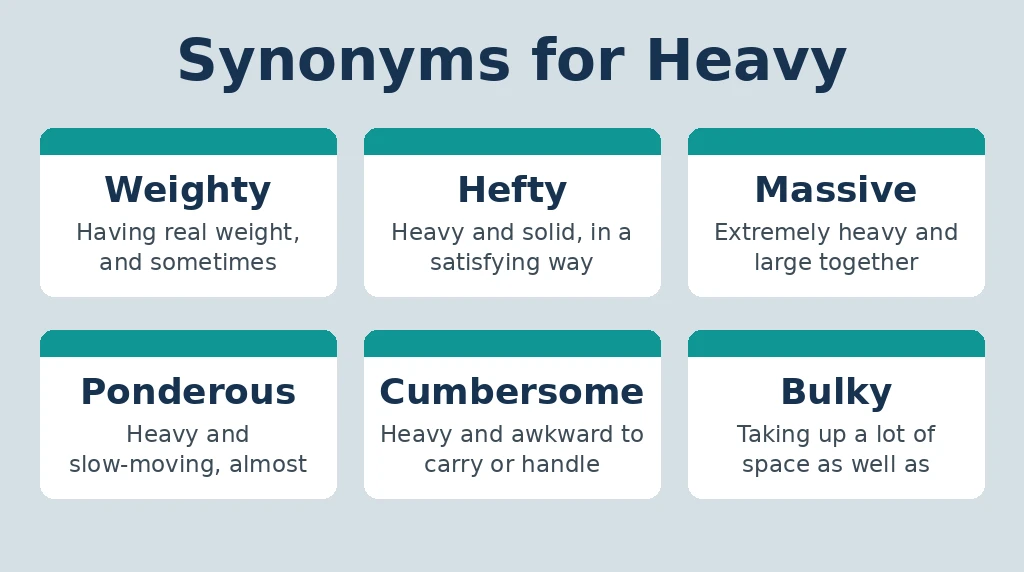
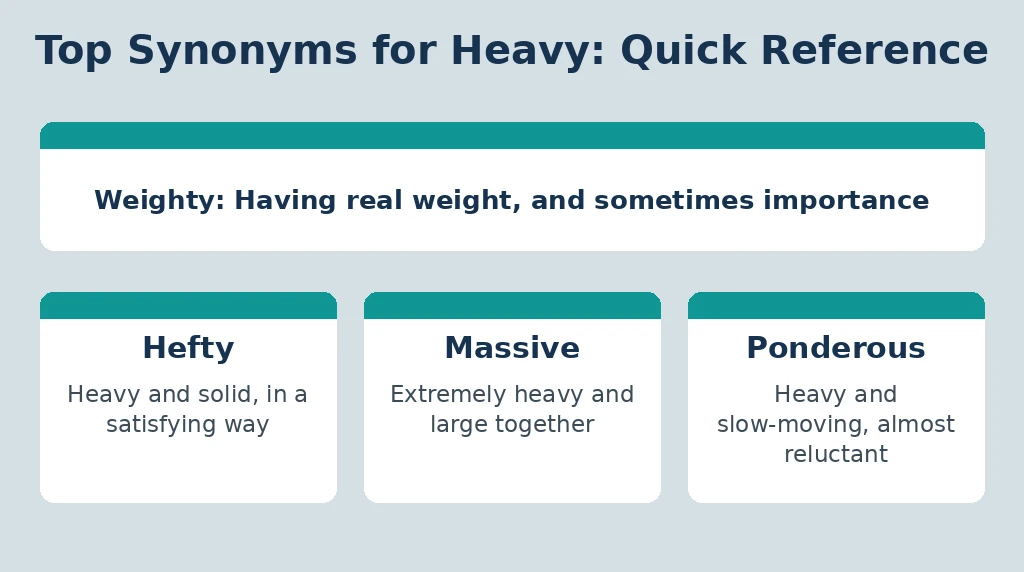
In a rush? Start here. These are the heavy synonyms writers grab most often, each with its real meaning and the jobs it suits. The sections further down dig into trickier territory, where heavy stops being about the bathroom scales and turns into force, food or feeling. Small test of how slippery this word is: try swapping any two words in this table into each other’s sentences. Half the time the sentence falls apart. That’s exactly why the families below exist. In fact, the table is the shortcut, and the families are the map. For example, synonyms for heavy for a rush should start with the table, not the dictionary.
| Word | Meaning in one line | Best for |
|---|---|---|
| Weighty | Having real weight, and sometimes importance | Objects, arguments, formal writing |
| Hefty | Heavy and solid, in a satisfying way | Objects, blows, bills, informal praise |
| Massive | Extremely heavy and large together | Buildings, stones, efforts, news writing |
| Ponderous | Heavy and slow-moving, almost reluctant | Literary writing, machinery, elephants |
| Cumbersome | Heavy and awkward to carry or handle | Equipment, luggage, procedures |
| Bulky | Taking up a lot of space as well as weight | Parcels, furniture, winter coats |
| Substantial | Solidly built, or large in amount | Meals, objects, sums, evidence |
| Intensive | Concentrated and demanding full force | Work, training, negotiations, care |
| Severe | Extreme and harsh in degree | Weather, losses, pain, criticism |
| Fierce | Intense and aggressive in force | Fighting, competition, loyalty, storms |
| Relentless | Never easing off in intensity | Rain, pressure, pursuit, schedules |
| Serious | Grave and important, needing attention | Discussions, injuries, situations |
| Grave | Very serious and worrying | News, dangers, formal writing |
| Considerable | Large in amount or degree, formal | Sums, delays, damage, reports |
| Abundant | Present in large amounts | Supplies, rain, harvests |
| Copious | In large amounts, more than enough | Amounts, notes, formal writing |
| Profuse | Flowing freely and plentifully | Apologies, bleeding, growth, thanks |
| Dense | Packed tightly, of crowds, fog or traffic | Fog, crowds, forests, prose |
| Filling | Making you feel full, of food | Meals, puddings, pub lunches |
| Fatty | Containing much fat, a factual label | Meat, diets, health writing |
| Greasy | Heavy with oil, usually a complaint | Food, hair, workshops |
| Onerous | Burdensome and hard to bear | Duties, taxes, contracts, law |
| Burdensome | Weighing on someone like a load | Responsibilities, rules, debts |
| Oppressive | Weighing down unfairly, or stifling | Heat, regimes, silence, weather |
| Leaden | Heavy and grey like lead, of skies and limbs | Skies, moods, literary writing |
| Sorrowful | Full of sorrow, of hearts and faces | Literary writing, formal sympathy |
| Sluggish | Slow and heavy-moving, lacking energy | People, engines, markets, afternoons |
| Drowsy | Heavy with sleep, ready to drop off | People, afternoons, voices |
What Does Heavy Mean?
Heavy is ancient. It started life on the scales, back when an English speaker’s most pressing question about an object was whether one person could lift it. A heavy stone. A sack of grain, heavy on the shoulder. A heavy toddler who has just learned the word “no.” Underneath that first sense sits a quieter idea, density. Lead is heavier than pine of the same size, and that notion of things being packed tight follows heavy around for the rest of its career. In fact, the scales are the start, and the density is the quieter idea. As a result, synonyms for heavy for ancient words should begin with lifting, not the rain.
From weight, the word wanders into force, and it never really comes back. Heavy rain isn’t heavier drop by drop. It just arrives in quantity and refuses to stop. Heavy fighting. Traffic on the ring road turns heavy too. Heavy losses in a bad quarter. In each case heavy means a lot of something, landing hard. News bulletins live on this sense, and its synonyms are about degree, not kilograms. For instance, the quantity is the force, and the degree is the measure. Consequently, synonyms for heavy for force should count the pressure, not the kilos.
Then food got hold of it. A heavy lunch is the one that sits in your stomach like a house brick at 3 p.m. and turns the afternoon into a negotiation. Weather borrowed it too, for those low grey skies that seem to press down on the rooftops. And feelings took it for the heavy heart, the one bit of emotional anatomy nobody has ever needed explained to them. Also, the lunch is the weight, and the heart is the feeling. In short, synonyms for heavy for feelings should borrow the body, not the scale.
Two stragglers complete the set. Heavy work is work that burdens you, where the weight is responsibility and other people’s expectations. And a heavy discussion, or a heavy book, is weighty in the mind: serious stuff you can’t skim while the kettle boils. One word covering a piano, a downpour, a steak pie and a funeral. Of course it needs families. There’s no other honest way to organise it. In particular, the stragglers complete the set, and the work is the proof. Above all, synonyms for heavy for work should name the burden, not the effort.
Tone splits the families wide open, too. Hefty is cheerful. Ponderous belongs in novels. Onerous lives in contracts and council tax letters. Leaden belongs to poets and the shipping forecast. The sections below keep those voices in separate rooms, so the word you need for a legal letter isn’t the one wandering into a love letter in the wrong shoes. For example, the tone is the test, and the cheerful is the exception. In fact, synonyms for heavy for tone should split by room, not the word.
One more everyday habit worth spotting: heavy glues itself to nouns and makes little idioms. Heavy going. Heavy weather. A heavy sleeper. A heavy loser, if you’ve had a bad night at the bookies. In each pair, the adjective has stopped describing the noun literally. It’s describing what the whole situation feels like from inside. Spot that pattern and you’ll stop reaching for synonyms that don’t fit. A ponderous sleeper and a ponderous storm are two very different problems, and only one of them snores. As a result, the idiom is the habit, and the noun is the partner. In practice, synonyms for heavy for idioms should glue to nouns, not float free.
Heavy as in Weight: Trunks, Stones and Pianos
This is the home sense: things that make your arms ache and your knees reconsider. Every word here involves real mass, but they split by shape and behaviour. Is the thing simply weighty? Awkward to get a grip on? Or so massive it changes the shape of the room it sits in? Thickness is a neighbour, not a family member, and if the distance between two surfaces is what you’re measuring, there’s a separate guide to synonyms for thick. For example, the ache is the home, and the shape is the split. Above all, synonyms for heavy for mass should name the grip, not the label.
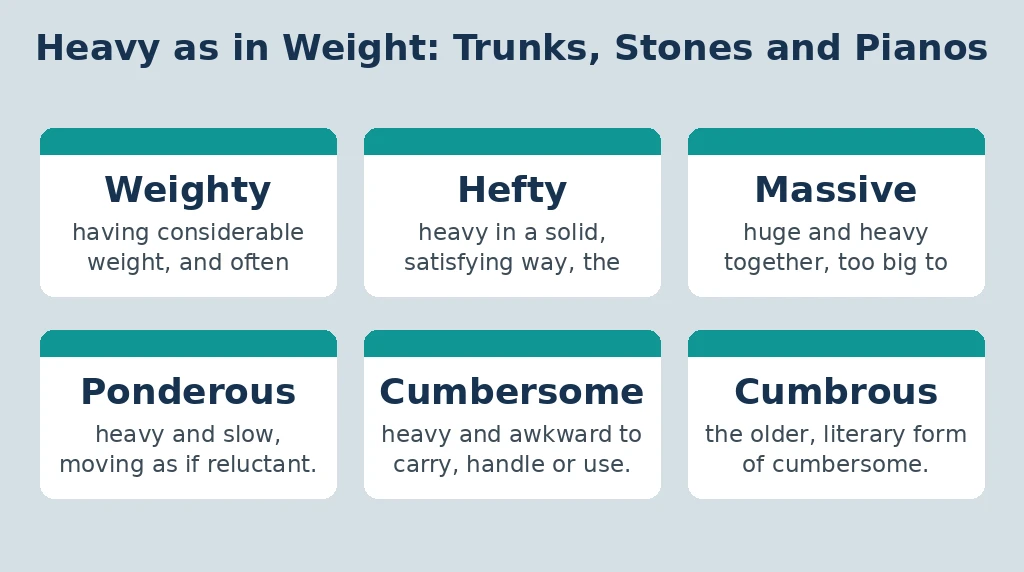
- Weighty: having considerable weight, and often dignity as well. A weighty tome slid off the shelf like a verdict.
- Hefty: heavy in a solid, satisfying way, the cheerful word of the family. He gave the gate a hefty shove and it swung.
- Massive: huge and heavy together, too big to ignore. A massive beam held the barn roof through three storms.
- Ponderous: heavy and slow, moving as if reluctant. The ponderous doors of the vault took two men to close.
- Cumbersome: heavy and awkward to carry, handle or use. Early cameras were cumbersome boxes of brass and hope.
- Cumbrous: the older, literary form of cumbersome. The knight wrestled his cumbrous armour up the stair.
- Bulky: heavy partly because it takes up so much room. A bulky mattress defeated the narrow landing.
- Substantial: solidly made and weighty, with quality implied. A substantial oak table seats twelve and outlives families.
A word of warning if you’re describing people: English turns rude fast in this corner of the dictionary. Hefty is kind. Bulky is for coats and parcels, not waistlines. And words like heavier and portly belong to the vocabulary of build, not weight in general. Writing about a person? Describe what they’re carrying, not what they are. You’ll sound better and you won’t be a villain at the family lunch. In short, the warning is the kindness, and the lunch is the test. Consequently, synonyms for heavy for people should describe the load, not the body.
Furniture teaches this family quicker than any dictionary. A weighty chair is a well-made chair. A cumbersome chair is a badly designed one that traps your fingers on every landing. A ponderous chair sounds like it escaped from a cathedral. If you write listings, rental ads or reviews, that trio does most of the honest work. Save massive for the rare object that genuinely rearranges the room, the piano nobody warned the removal man about. In fact, the chair is the proof, and the dictionary is the teacher. For instance, synonyms for heavy for furniture should sit well, not merely weigh.
Heavy as in Force: Fighting, Rain and Pressure
When heavy describes an event instead of an object, it stops weighing and starts counting pressure: how much, how hard, for how long, with no let-up. A heavy discussion sits in this family too, because talk like that leans on everyone in the room. It’s also why this section rubs shoulders with the guide to synonyms for deep, where serious thought keeps its own set of words. For example, the discussion is the pressure, and the room is the test. As a result, synonyms for heavy for events should count the duration, not the kilos.
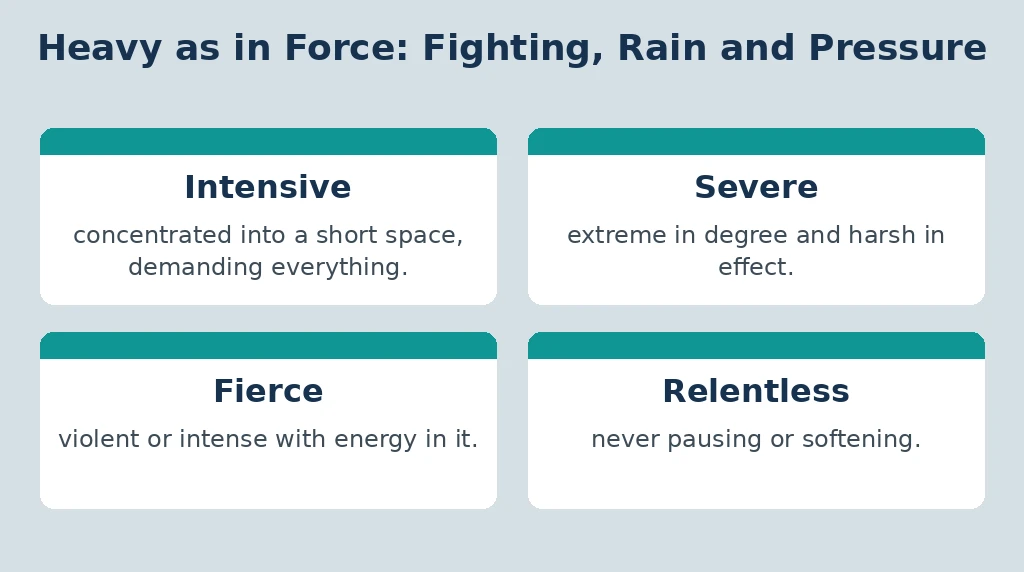
- Intensive: concentrated into a short space, demanding everything. Intensive talks ran for nine days and produced one page.
- Severe: extreme in degree and harsh in effect. Severe frost split the pipes along the whole terrace.
- Fierce: violent or intense with energy in it. Fierce competition closed two shops and sharpened the third.
- Relentless: never pausing or softening. Relentless rain turned the track to soup by noon.
- Concentrated: gathered into one place or effort at full strength. A concentrated search covered the harbour street by street.
- Serious: important and demanding attention, of situations and talks. A serious leak can sink a budget faster than a boat.
- Grave: serious and alarming, the word of official warnings. The grave shortage of nurses closed two wards.
- Profound: deep and far-reaching in effect. The ruling had a profound effect on small farmers.
News writers live in this family, and their discipline is proportion. Spend severe on a traffic jam and you’ve got nothing left for the flood. Grave should be kept for stories where someone could actually get hurt. Always keep one degree in reserve. Then, on the day the worst really does happen, your strongest sentence still lands, because readers know you don’t cry wolf on Tuesdays. Therefore, the proportion is the discipline, and the flood is the measure. In other words, synonyms for heavy for news should save the strong words, not spend them.
Heavy as in Amount: Losses, Traffic and Harvests
This family is the force family’s quieter cousin. It counts instead of striking. Heavy losses. Tickets in heavy demand. Heavy voting in the by-election. The subject is always quantity, and the only real question is how much of it there was. Several of these words moonlight in the vocabulary of plenty, which is why they feel calmer than the bruisers in the section above. Beyond that, the cousin is the quieter, and the quantity is the subject. As a result, synonyms for heavy for amounts should count the loss, not the bruise.
- Considerable: large enough to matter, the measured formal word. The storm caused considerable damage along the pier.
- Large: great in amount, the plain workhorse. A large share of the potato crop never left the county.
- Abundant: more than enough, present in plenty. Abundant volunteers finished the harvest by Friday.
- Copious: in large amounts, flowing freely. She took copious notes through the whole inquest, to the lawyers’ delight.
- Profuse: given or flowing in great quantity. He offered profuse apologies and one small cake.
- Dense: packed close together, of crowds, fog and traffic. Dense traffic inched past the stadium for hours.
Here’s the trick with amount words: give one honest figure and then stop talking. “Heavy losses of forty percent” says everything. Stack up copious, profuse and abundant in the same sentence and all you’ve told the reader is that you got excited. Excitement without numbers is the first thing a good editor cuts, usually with a sigh. In particular, the figure is the proof, and the silence is the trick. Above all, synonyms for heavy for amounts should state one number, not the list.
Business writing runs on this family, and mostly runs well. Heavy investment, heavy demand, heavy trading: every finance desk understands them, because commerce counts things the way weather counts rain. The danger is borrowed drama. Force words creep in next to the figures and a dull quarter starts sounding like a war zone. Losses can be considerable without being grievous, and the calmer word usually scares shareholders less. Sometimes that’s precisely the point. Consequently, the family is the business, and the writing is the proof. For instance, synonyms for heavy for business should run on demand, not the drama.
Heavy Food: The Filling, Fatty and Greasy Table
At the table, heavy describes the aftermath as much as the meal. Heavy food is rich, fatty, filling stuff, the kind of lunch after which a nap stops feeling like laziness and starts feeling like a prescription. Handle this family the way a cook handles chillies: two of its words praise, two of them warn, and grabbing the wrong one changes the whole dish. For example, the lunch is the aftermath, and the nap is the prescription. In short, synonyms for heavy for food should praise the rich, not the greasy.
- Filling: satisfying and substantial, the friendliest word here. A filling stew carried the walkers through the wind.
- Substantial: a real meal, not a snack in disguise. They served a substantial lunch and no apologies.
- Fatty: containing a lot of fat, a fact rather than a compliment. Fatty pork crisps beautifully in a hot oven.
- Greasy: heavy with oil in an unappetising way. The greasy spoon by the depot has fed lorry drivers at dawn since 1974.
- Solid: dense and serious, of a meal that means business. A solid breakfast of eggs and beans set them up.
Menu writers dodge this family almost completely, and the dodge tells you everything. Menus say rich, hearty, generous, because heavy on a menu reads like a warning label for your afternoon. But in reviews and comedy, the family is gold. “One greasy, glorious, heavy plate” is the shortest review written of a lunch that beat its eater, and everyone who reads it can taste the chips. In fact, the dodge is the lesson, and the menu is the proof. On top of that, synonyms for heavy for menus should say rich, not heavy.
Cooks use these words with pride when the setting’s right. A heavy cake fails a baking exam and triumphs at a farmhouse tea, where heavy means fruit, butter and staying power. Context is the entire recipe. The sentence that warns off a dieter sounds like an invitation to a walker still three miles from the next village. Good food writing always knows which of those two readers it’s feeding. Therefore, the cake is the exam, and the pride is the proof. Above all, synonyms for heavy for cooks should fail the cake, not the cook.
Heavy Burdens: Duties, Debts and Hard Work
Some weights never touch a scale. A heavy burden. Heavy responsibility. Heavy taxes that arrive in a brown envelope. The load is real, it just lives in your head and your calendar. This is also where heavy shakes hands with difficulty itself, and the guide to synonyms for hard picks up the story for tasks that push back. Here, though, the focus stays on weight pressing down. In other words, the scale is the test, and the tax is the weight. For example, synonyms for heavy for burdens should press down, not push back.
- Onerous: burdensome in a formal, almost legal way. The onerous clause required weekly reports in triplicate.
- Burdensome: weighing on a person like a load they cannot set down. The burdensome paperwork outlived the project it described.
- Oppressive: weighing down unfairly, of rules, heat or silence. An oppressive quiet settled over the waiting room.
- Harsh: severe in effect, hard to endure. Harsh penalties fell on the smallest traders.
- Grievous: causing grief, seriously harmful, formal. He survived in spite of grievous injuries.
- Difficult: needing much effort, the plain word for heavy going. It was difficult work, digging in frozen ground.
- Strenuous: demanding energy and stamina. Strenuous exercise is forbidden for a month, the doctor said.
- Laborious: taking long, patient effort. Copying the archive by hand was laborious and strangely peaceful.
Law and tax writing settled on onerous generations ago, and it’s a choice worth stealing. Onerous accuses the burden, not the person carrying it, and it does so in a measured voice, which is devastating in a dispute. In personal writing, burdensome is warmer. Save oppressive for weight that feels unjust, because the word quietly points a finger at whoever is pressing. As a result, the law is the choice, and the onerous is the standard. In particular, synonyms for heavy for tax should settle on onerous, not the guess.
Heavy Skies and Heavy Air: Weather That Presses Down
You know the feeling. An hour before the rain starts, the whole street goes quiet and close, the sky drops a shade, and even the birds sound muffled. This small weather family names that pressure, running from grey skies down to the thick, still air of an August bedroom at midnight. What is more, the street is the proof, and the sky is the warning. Consequently, synonyms for heavy for weather should name the pressure, not the cloud.
- Overcast: covered with cloud, the forecaster’s plain word. An overcast morning kept the washing indoors.
- Leaden: grey and heavy as lead, literary and exact. Leaden skies over Blackpool promised the rain they finally delivered.
- Gloomy: dark and cheerless, of weather and rooms. The gloomy platform held one lamp and six umbrellas.
- Cloudy: full of cloud, without the threat leaden carries. A cloudy afternoon softened the photographs.
- Humid: heavy with moisture in the air. The humid greenhouse smelled of earth and oranges.
- Muggy: warm and humid in an unpleasant way, informal. Muggy nights made the whole street sleep badly.
- Close: stuffy and airless, of rooms and weather in Britain. The close little office held nine people and one window.
- Clammy: damp and sticky against the skin. A clammy mist clung to the platform railings.
Weather words are mood words wearing a coat. Leaden and gloomy tell you how the day felt from inside it. Overcast and cloudy just file the report. Muggy and clammy move the weather onto your skin, into the collar of your shirt. Novelists pick from this family by asking one question: where does the heaviness sit? In the sky, in the air, or in the character at the window watching both? For instance, the coat is the mood, and the day is the test. In fact, synonyms for heavy for weather words should feel the sky, not merely see it.
Gardeners and sailors read this family like professionals, because for them it is professional. A close afternoon in the greenhouse means gloves off and everything slowed down. Heavy seas in a ship’s log is a technical judgement, not a mood. Writing for people who work outdoors? Borrow their precision. Keep leaden, gloomy and clammy for the passages where the feeling is the cargo, and let the plain words do the plain jobs. In short, the garden is the trade, and the sea is the proof. Above all, synonyms for heavy for professionals should read the air, not the forecast.
Heavy Hearts and Heavy Days: Sadness, Sleep and Slowness
The last family turns inward. A heavy heart is carrying sorrow. Heavy eyes are carrying sleep, usually against their owner’s wishes. And a heavy afternoon carries nothing at all, which is somehow the worst complaint of the three. These are the most literary words in the guide, and the ones that stick in a reader’s head after the page is closed. For example, the heart is the sorrow, and the afternoon is the complaint. In fact, synonyms for heavy for hearts should carry the feeling, not the scale.
- Sorrowful: full of sorrow, of hearts, faces and news. She gave a sorrowful account of the empty house.
- Melancholy: gently and thoughtfully sad. A melancholy tune followed them down the lane.
- Dejected: low in spirits, cast down. The dejected team folded its banner in silence.
- Despondent: without hope, beyond ordinary sadness. He grew despondent after the third refusal.
- Crestfallen: disappointed in a visible way. The crestfallen baker surveyed the sunken cake.
- Sluggish: slow and heavy in movement or response. The sluggish engine objected to the hill.
- Drowsy: heavy with sleep, pleasantly or not. Drowsy bees drifted among the lime trees behind the church.
- Listless: without energy or interest. The listless audience waited for the interval.
- Torpid: inactive and sluggish, almost dormant. Torpid winter bees cluster and wait for spring.
Notice the slope inside this family, because it’s a slope and not a switch. Sorrowful deepens into despondent. Drowsy deepens into torpid. A heavy heart at a graveside is sorrowful; a heavy heart after the third rejection letter in a month is despondent. Pick your exact point on the slope and the reader supplies the rest of the weather inside that character without being asked. In fact, the slope is the test, and the switch is the trap. As a result, synonyms for heavy for slopes should deepen slowly, not switch suddenly.
There’s a lovely classroom truth buried here. Children learn heavy as a weighing word, then meet the heavy heart in a storybook years before anyone explains the word “metaphor” to them, and they get it instantly. No footnote needed. That instinct is the writer’s best friend: this family never needs explaining, only aiming. A heavy silence in a kitchen. A heavy tread on the stair at 2 a.m. The reader has finished the scene before your next sentence starts. Consequently, the classroom is the proof, and the weighing word is the start. Above all, synonyms for heavy for learners should begin with lifting, not the dictionary.
How to Choose the Right Synonym for Heavy
Start with the oldest question in this guide: could a pair of scales settle it? If yes, you’re in the weight family, and the choice runs like this. Hefty for cheer. Massive when size comes with the weight. Ponderous for slow, dignified bulk. Cumbersome when the real problem is handling, not mass. Never forget they describe different objects: a cumbersome wardrobe and a ponderous wardrobe are not the same piece of furniture, and only one of them will trap your fingers. Therefore, the scales are the question, and the family is the answer. For instance, synonyms for heavy for choosing should ask what the scales say, not the feeling.
If your subject is an event, split force from amount before you write a word. Heavy fighting is force. Heavy losses are amount. Intensive and fierce belong to force; considerable and copious belong to amount; and severe squats on the border between them, which is exactly why journalists flog it to death. Give severe the day off now and then. Let fierce or considerable earn the sentence. In particular, the event is the split, and the force is the measure. In short, synonyms for heavy for events should separate force from amount, not mix them.
At the table, let your verdict pick the word. Filling praises. Substantial approves. Fatty informs. Greasy complains. A review that calls the chips greasy has made up its mind in four letters’ worth of word. A school dinner report that calls them fatty is still being diplomatic. For burdens, it’s simpler: onerous when paperwork or law is doing the talking, burdensome when a human voice describes a human load. For example, the verdict is the word, and the praise is the test. Also, synonyms for heavy at the table should let the verdict choose, not the habit.
For feelings, match the slope I mentioned earlier. Sorrowful is grief with its dignity intact. Despondent is hope running out. Crestfallen is that small, public drop in the face when the raffle ticket isn’t yours. For slowness: sluggish is the everyday workhorse, listless adds a shrug of disinterest, and torpid is for things half asleep by nature. August markets. Committees after lunch. In fact, the slope is the map, and the grief is the measure. As a result, synonyms for heavy for feelings should match the slope, not the label.
One last thing, and it might be the most useful point on this page. Heavy often describes the person experiencing the thing, not the thing itself. A heavy day was not measurably heavier at noon. It just felt endless to the woman living through it. A heavy book might weigh a kilo, or weigh on your mind for a week. When the weight is felt rather than measured, shop in the feeling families (sorrowful, sluggish, oppressive) and leave the scales in the cupboard. Above all, the person is the subject, and the load is the test. Consequently, synonyms for heavy for people should describe the carrying, not the body.
| Situation | Best word | Why |
|---|---|---|
| A trunk one person cannot lift | Hefty | It says heavy and solid without drama |
| A downpour that floods the road | Relentless | It captures rain that never eases off |
| A lunch that ends all productivity | Filling | It praises the meal while admitting the cost |
| A contract clause that crushes small firms | Onerous | It is the precise formal word for burdensome duties |
| A grey sky before a storm | Leaden | It gives colour, weight and threat in one word |
| A discussion about mortality | Serious | It marks the topic as weighty without melodrama |
Heavy Synonyms for Writing and Dialogue
In essays and formal writing, heavy is often a placeholder, the word your brain parks in a sentence while the real thought catches up. A heavy influence is probably a profound one. A majority described as heavy is probably a considerable one. A heavy style might be dense, or might be ponderous, and those are very different criticisms. Examiners reward the writer who converts the placeholder, because each conversion admits what was actually meant. In practice, the placeholder is the trap, and the conversion is the proof. For example, synonyms for heavy for essays should convert the placeholder, not park it.
No register leans on heavy harder than the news. Heavy rain, heavy casualties, heavy traffic, heavy defeat, all before the weather forecast. It’s efficient shorthand, sure, but readers go numb when everything is heavy and nothing is anything else. Vary the family and the facts don’t change at all: relentless rain, severe losses, dense traffic. Only the reader changes. They stay awake. In short, the news is the heaviest register, and the proportion is the discipline. For instance, synonyms for heavy for news should lean on degree, not the drama.
In dialogue, heavy does social work, so listen to how people actually say it. A character calls a bill hefty when they’re half proud of paying it. Heavy going is what they call the book club novel they’re quietly abandoning. And for real grief, characters mostly say nothing, because sorrowful is a narrator’s word, not a speaker’s. A character who announces a heavy heart is performing one; a narrator who reports one is describing it. For example, the dialogue is the social work, and the listening is the proof. Above all, synonyms for heavy in dialogue should sound spoken, not written.
Poets and novelists get the best of this family: the weather and the heart. Leaden skies over a clammy platform. A sorrowful house with the curtains half drawn. Setting carries the feeling and you never touch an abstract noun. The discipline is rationing. One leaden sky in a chapter lowers the light on every scene that follows. Five, and you’ve just got weather. Therefore, the sky is the weather, and the heart is the feeling. For example, synonyms for heavy for poets should take the best of both families, not one.
Technical writers, handle this word with tongs. In a manual, heavy means kilograms or it means nothing. A heavy component gets a number. A heavy procedure gets rewritten until it isn’t one. Heavy traffic in a systems document becomes a measured load with a unit attached. The families in this guide are a general writer’s toolkit, and a good one. But in a specification, the scale and the stopwatch outrank every synonym on the shelf. For example, the manual is the test, and the kilograms are the answer. In fact, synonyms for heavy for manuals should mean kilos, not the feeling.
Antonyms for Heavy
Heavy’s opposites split by family just as neatly as its synonyms do: light for weight, gentle for force, scant for amount, bright for skies, cheerful for hearts. Beyond that, the family is the split, and the opposite is the proof. As a result, synonyms for heavy for opposites should match the family, not the word.
- Light: weighing little, the master opposite. A light case bounced up the stairs ahead of her.
- Lightweight: light in weight, sometimes dismissive of importance. The lightweight champion danced for twelve rounds.
- Featherweight: extremely light, borrowed from boxing. A featherweight laptop survived every commute.
- Portable: easy to carry, the practical opposite of cumbersome. Portable stages folded into a single van.
- Gentle: mild in force, of rain, pressure and words. Gentle rain refreshed the garden without drama.
- Mild: not severe, of weather, illness and criticism. A mild winter spared the pipes and the budget.
- Light (of food): easy to digest, the table opposite. A light supper of soup and toast suited the hour.
- Scant: barely enough, the amount opposite. Scant applause followed the council’s announcement.
- Bright: full of light, the sky opposite. A bright morning undid the whole forecast.
- Cheerful: happy in mood, the heart opposite. Her cheerful letter raised the whole ward.
- Easy: not burdensome, the work opposite. Easy stages alternated with the climbs.
- Airy: light and fresh, of rooms and textures. The airy kitchen faced the garden.
Those pairings teach the families faster than any definition. Cumbersome looks across at portable. Onerous looks at easy. Leaden at bright, greasy at light. So when you’re stuck for the right heavy synonym, try this: name the opposite first. The family usually announces itself, the right section of this guide swings open, and ten seconds of thinking saves a whole paragraph of vagueness. Fair trade, any day. In particular, the pairings teach faster, and the definition is the slow road. Above all, synonyms for heavy for pairings should look across the room, not the page.
Common Mistakes: Words That Are Not True Synonyms for Heavy
Big is the classic false friend. Big measures size; heavy measures weight; and the two part company in every gym and harbour in the country. A big balloon weighs nothing at all. A small cannonball can break your toe. Massive exists precisely for the things that happen to be both. So if your sentence involves lifting, weighing or carrying, put big back in its box. For instance, the size is the measure, and the weight is the test. Consequently, synonyms for heavy for false friends should part company with size, not weight.
Fat should stay out of this vocabulary almost entirely. Applied to people it’s rude in the exact place where hefty is kind. Applied to objects it’s simply wrong: a fat book is a cheerful way of saying a thick one, not a heavy one, and thickness is a different guide’s territory. Fatty survives only as a food label, because there it describes what’s in the dish, not anyone’s character. In short, the vocabulary is the fence, and the rudeness is the warning. For example, synonyms for heavy for fat should stay out, not the word.
Strong is about force, not weight, and the difference matters at a workbench. A strong shelf can still be light enough to carry under one arm. A heavy shelf can be weak and sagging in the middle. The two words do meet, in blows and currents, where a heavy blow and a strong blow are near cousins. But in the furniture of a sentence, let them keep their own jobs. On top of that, the bench is the proof, and the force is the measure. In fact, synonyms for heavy for strong words should mean force, not the kilos.
Difficult is a true synonym at one border only: the burden border, where heavy going means hard work. Everywhere else it wanders off and causes trouble. A difficult smell. Rain described as difficult. A difficult trunk. All nonsense. Let difficult describe tasks and questions, and let the families in this guide describe everything that presses, pours or weighs. As a result, the border is the only home, and the smell is the nonsense. For example, synonyms for heavy for difficult words should stay with burdens, not the rain.
Thick tempts writers because heavy things so often are thick: the winter coat, the reference book with the cracked spine. But thick measures the distance between two surfaces and heavy answers to the scales. A thick feather pillow is light as air. A thin steel plate will wreck your back. The overlap is real, it’s just partial, and careful writers keep the two measuring tools in separate drawers. Therefore, the coat is the proof, and the thickness is the temptation. Above all, synonyms for heavy for thick things should tempt carefully, not confuse.
Hard deserves respect rather than rejection. It’s a near neighbour, not an impostor. Heavy work and hard work can describe the same wet afternoon in a garden: heavy names the load, hard names the resistance. Swap them carelessly inside the right family and the sentence survives. Swap them in the wrong one (a hard rain, a hard trunk) and the reader trips over the furniture. Neighbours may borrow sugar. They shouldn’t borrow each other’s names. In other words, the neighbour is the near, and the impostor is the false. In particular, synonyms for heavy for hard work should earn respect, not rejection.
Frequently Asked Questions
What is the best synonym for heavy?
If real weight is the subject, hefty and weighty are the two to beat: hefty for the warm, everyday voice, weighty when the writing puts on a tie. For force, severe does the most work. For amount, considerable. At the table, filling. For duties, onerous. It always depends on which heavy you mean. And if you take just two words away from this guide, take hefty for things you lift and onerous for duties you carry. Between them they cover most working days in most offices, workshops and kitchens. What is more, the lift is the test, and the carry is the proof. For instance, synonyms for heavy for best words should take hefty and onerous, not the list.
What is a stronger word than heavy?
For weight plus size, massive is the step up, and ponderous adds slow, unstoppable bulk. When intensity is the sense, relentless and severe both outrank plain heavy. For sorrow, despondent is heavier than sad the way a flood is wetter than a puddle. The pattern to steal: strength comes from picking the extreme member of the right family, not from shouting in the wrong one. Above all, the pattern is the steal, and the extreme is the proof. As a result, synonyms for heavy for stronger words should pick the extreme, not the shout.
What is the opposite of heavy?
Light. That’s the direct opposite for weight, with lightweight and portable handling the practical cases. But watch how the answer shape-shifts with the sense: gentle or mild for force, scant for amount, light again at the table, bright for skies, cheerful for hearts, and easy for burdens. One word, seven families, seven different ways to be its opposite. In fact, the light is the direct opposite, and the shape is the family. Consequently, synonyms for heavy for opposites should answer by sense, not by one word.
Can heavy describe food, weather and feelings?
Constantly. A heavy meal is rich, filling stuff that slows the afternoon down. Heavy skies sit low and threaten rain over the rooftops. A heavy heart is full of sorrow on the bus home. In every case the word borrows the feeling of physical weight and spends it somewhere no scale could ever reach, which is exactly why its synonym families look so different from each other. For example, the meal is the richness, and the sky is the threat. In fact, synonyms for heavy for constant words should borrow the body, not the scale.
What is the difference between heavy and hefty?
Hefty is heavy with a nod of approval built in: solid, substantial, satisfyingly weighty, and sometimes just large, as in a hefty phone bill. Heavy itself stays neutral, which means it’s free to be a complaint. A hefty suitcase is a well-packed suitcase. A heavy one is simply a pain to get up the stairs. In fact, the nod is the approval, and the solidity is the proof. As a result, synonyms for heavy for hefty words should stay satisfying, not merely large.
Final Thoughts
Heavy started on the scales and ended up everywhere: in the rain gauge, on the lunch menu, inside the contract, and in the chest of anyone who has had a sorrowful week. Its families are sorted now. Hefty and ponderous for the lift. Relentless and severe for the storm. Copious for the count, filling for the table, onerous for the duty, leaden for the sky, sorrowful for the heart. Choose by family and the word carries its load gracefully. The apprenticeship is short, I promise. For instance, the gauge is the start, and the chest is the end. Above all, synonyms for heavy for final thoughts should carry the load gracefully, not drop it.
The Merriam-Webster Thesaurus entry for heavy makes a natural next browse, hundreds of near matches gathered in one place, and it sits happily open beside this guide. Keep both within reach and no sentence of yours will ever have to carry more than its fair share again. In short, the entry is the next stop, and the matches are the proof. Finally, synonyms for heavy for the shelf should sit happily open, not in the drawer.
Discover More Post:
- Synonyms for Define | Meaning, Examples, and Better Word …
- Synonyms for Shape |25+ Meaning, Context, Examples …
- Synonyms for Sacrifice |25+ Meaning, Examples, and …

1 thought on “Synonyms for Heavy | 78+ Powerful Alternatives, Precise Meanings & Smarter Word Choices in 2026”