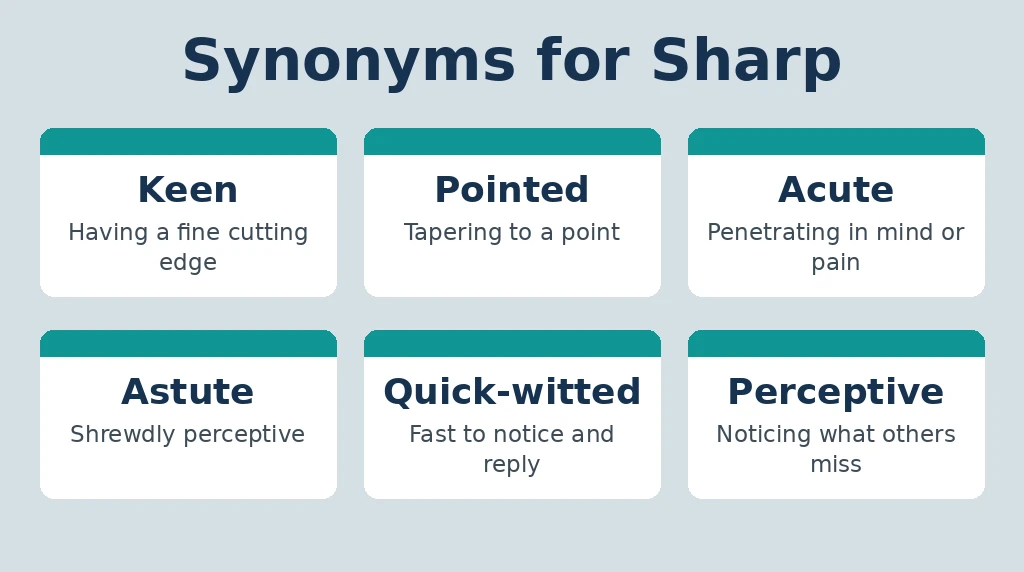
A good knife, a quick mind and a February wind walk into the same adjective, and English doesn’t blink. Sharp is the word for anything that cuts: steel doing the cutting, a remark doing it, or a pain doing it to you at 3 a.m. Its closest synonyms fan out according to what’s on the receiving end. keen and pointed for edges. astute and acute for minds. cutting and caustic for tongues. And tart for the things that cut across your tongue instead. In short, this guide gathers synonyms for sharp for every sense, from the blade to the tongue. In fact, the blade is the test, and the tongue is the proof.
This guide gathers 83 synonyms for sharp and sorts them by sense, because with this word the sense is everything. A sharp suit and a sharp cheese have nothing in common except a certain energy in the compliment. Every word below was checked against real thesaurus entries, and each one arrives with a plain meaning and a short example, so the sharp you pick is the sharp your sentence actually means. In fact, the sense is the whole subject, and the family is the map. For example, synonyms for sharp for the guide should sort by sense, not the alphabet.
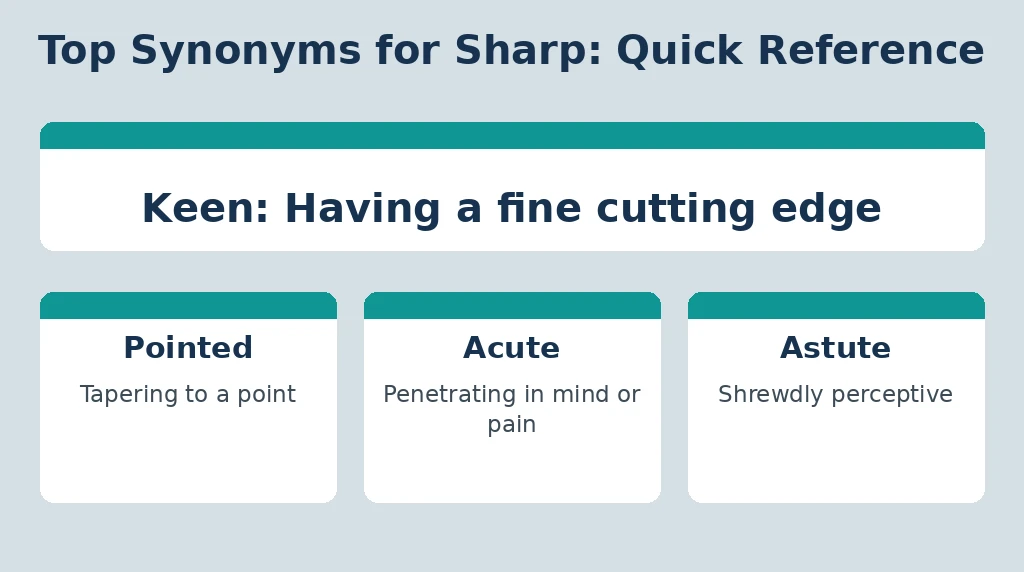
Top Synonyms for Sharp: Quick Reference
Twenty-eight words, covering the main ground: the knife drawer, the boardroom, the cheese board, the weather. The sections after the table sort the full list family by family, so you can see at a glance which sharps can share a sentence and which would collide head-on. Also, the drawer is the start, and the table is the shortcut. In short, synonyms for sharp for quick reference should stay with their sense, not the word.
| Word | Meaning in one line | Best for |
|---|---|---|
| Keen | Having a fine cutting edge | Knives, blades, edges |
| Pointed | Tapering to a point | Tools, toes, features |
| Acute | Penetrating in mind or pain | Minds, angles, pain |
| Astute | Shrewdly perceptive | Deals, judgements, people |
| Quick-witted | Fast to notice and reply | Talkers, negotiators |
| Perceptive | Noticing what others miss | Critics, doctors, readers |
| Discerning | Showing fine judgement | Travellers, buyers, audiences |
| Observant | Careful and quick to register detail | Detectives, doctors, naturalists |
| Alert | Watchful and quick to notice | Guards, grandparents, animals |
| Cutting | Wounding in few words | Remarks, reviews, replies |
| Biting | Cruelly sharp in effect | Criticism, satire, wind |
| Scathing | Fiercely critical | Attacks, reviews, reports |
| Caustic | Burning like acid, witty | Comments, humour, columns |
| Trenchant | Vigorous and sharply critical | Analysis, essays, speeches |
| Sudden | Happening without warning | Turns, rises, drops, stops |
| Steep | Rising or falling sharply | Prices, hills, graphs |
| Abrupt | Sudden and unexpected | Turns, endings, hillsides |
| Tart | Pleasantly sharp in taste | Fruit, candy, dressings |
| Tangy | Strong, sharp and pleasant | Cheeses, sauces, marinades |
| Pungent | Strong in taste or smell | Herbs, spices, cheeses |
| Piquant | Pleasantly sharp, stimulating | Dressings, sauces, remarks |
| Piercing | Seeming to go right through | Pain, cries, looks |
| Stabbing | Like a knife entering | Pain in side, back, head |
| Raw | Cold, damp and penetrating | Mornings, winds, weather |
| Icy | As cold as ice | Winds, roads, stares |
| Smart | Neat and stylish | Suits, dressers, hotels |
| Chic | Elegantly fashionable | Gowns, districts, boutiques |
| On the dot | Exactly on time | Arrivals, meetings, trains |
What Does Sharp Mean?
Sharp starts in the hand. Its oldest, plainest sense is an edge or a point made for cutting or piercing: a sharp knife, a sharp needle, the teeth of a fox. From there the word spreads by metaphor, and every stop on the journey keeps the idea of penetration. A sharp mind gets through problems. Defences fall to the sharp remark just as quickly. A sharp taste gets through to the back of the mouth, a sharp pain gets through the body, and a sharp wind off the North Sea gets through two jumpers and a coat. That’s how one small adjective ends up anchoring such a big, varied family. For example, the knife is the start, and the family is the journey. As a result, synonyms for sharp for the hand should name the edge, not the metaphor.
Two senses break the pattern, usefully. Sharp can mean sudden change (a sharp turn on a country lane, a sharp rise in the price of heating oil), where the picture is a graph line bending like a blade’s edge. And it can mean clarity: a sharp photograph, a sharp distinction, where edges are clean instead of dangerous. In music it’s a technical term, a note raised by a semitone. As an adverb it means exactly on time, eight o’clock sharp, the sense learners usually meet last and then use for the rest of their lives. For example, the graph is the picture, and the blade is the measure. In particular, synonyms for sharp for sudden change should name the bend, not the blade.
Register splits the family cleanly down the middle. The everyday core (keen, quick, sudden, tart, smart) is safe anywhere, from a text message to a tribunal. The literary shelf (trenchant, mordant, acerb, caustic) belongs in reviews and essays, where people are paid to wound elegantly. And one corner carries a warning label: sharp practice, a sharp operator, where sharpness means dishonesty performed with excellent technique. The groups below keep those corners fenced and labelled. In practice, the everyday is the ground, and the literary is the shelf. Consequently, synonyms for sharp for register should match the room, not the word.
Sharp Edges: Keen, Pointed and Ready to Cut
The home sense, and still the one to reach for first when something physical is involved. English is oddly economical here. A handful of words covers every blade, point and thorn you’re ever likely to describe. For instance, the blade is the home, and the handful is the proof. In fact, synonyms for sharp for edges should cut the wood, not the finger.
- Keen: having a fine cutting edge, the classic blade word. A keen blade took the hide off in one pass. For example, the keen edge does the work in one pass, and the blade is the proof.
- Sharpened: given an edge on purpose, ready to cut. He worked with a freshly sharpened pencil and total focus. In fact, the sharpened pencil held its focus, and the edge is the proof.
- Pointed: tapering to a point rather than an edge. The pointed end of the chisel did the delicate work. For example, the pointed chisel did the delicate work, and the taper is the proof.
Keen is the connoisseur’s word. It suggests an edge that somebody maintains: the knife goes back on the steel, the blade gets wiped, the job gets done properly. You’ll also meet keen for senses and minds (a keen eye, a keen sense of smell), where the blade has turned into a metaphor for precision. Pointed is purely about shape, the taper rather than the cut, and it doubles for remarks aimed deliberately at a person: a pointed silence across the dinner table, a pointed question from the back row. Sharpened just reports the process. The edge was made, not born. Consequently, the edge is maintained, and the word is the proof. Above all, synonyms for sharp for keen edges should stay honed, not hurried.
Craftspeople grade these three words without thinking about it. A cook’s knife is keen when it slides through a tomato under its own weight, pointed at the tip for the fiddly work around bones, and freshly sharpened after a session with the steel. Carpenters split the words the same way. So do surgeons. That tells you the distinctions are practical, not pedantic. And the lesson travels: in every family in this guide, the near-synonyms divide real work between themselves. This smallest family is simply the easiest place to watch it happen. In addition, the cook is the judge, and the knife is the proof. For example, synonyms for sharp for craftspeople should grade by use, not the label.
Sharp Minds: Quick, Astute and Perceptive
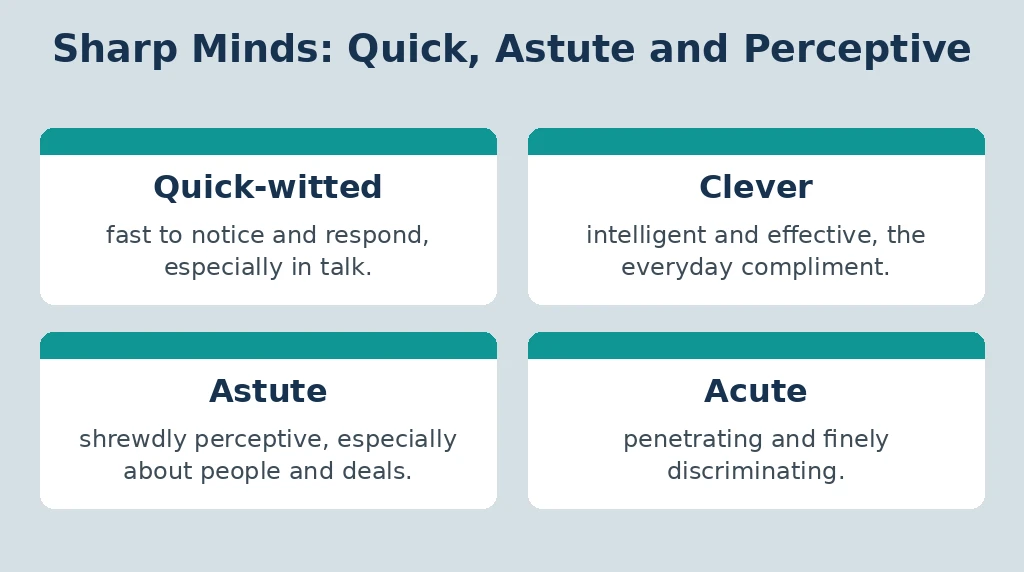
When sharp describes a mind, it praises speed joined to penetration: noticing fast, understanding deep. This family overlaps with the vocabulary of intelligence, the same shelf that holds the synonyms for smart, and with the pure speed words in the synonyms for quick. But its own centre of gravity is judgement. The sharp mind doesn’t just move fast. It arrives at the right place. Beyond that, the judgement is the centre, and the speed is the servant. As a result, synonyms for sharp for minds should arrive right, not merely fast.
- Quick-witted: fast to notice and respond, especially in talk. Quick-witted and calm, she rescued the panel interview in nine seconds flat. For example, quick wit rescues the panel, and calm is the partner.
- Clever: intelligent and effective, the everyday compliment. My sister has always been the clever one in the family. In fact, clever is the everyday compliment, and the family is the proof.
- Astute: shrewdly perceptive, especially about people and deals. He made a series of astute business decisions. On top of that, astute judgement makes the deal, and the series is the record.
- Acute: penetrating and finely discriminating. His relaxed manner hides an extremely acute mind. As a result, the acute mind hides behind a relaxed manner, and the penetration is the truth.
- Quick: fast in thought and understanding. The older students are not always the quickest in debate, but they are exact. In particular, the quickest student is not always the oldest, and debate is the test.
- Bright: intelligent and lively-minded, often of the young. She was brighter than her report cards suggested. Above all, bright minds outshine their report cards, and the suggestion is the proof.
- Alert: watchful and quick to notice change. His grandfather is still alert at ninety-three. In short, alert at ninety-three is the compliment, and the grandfather is the proof.
- Apt: quick to learn, naturally suited to study. She was an apt student of languages from the start. Therefore, apt students learn fast, and the language is the measure.
- Discerning: showing fine judgement and taste. The guide was written for the more discerning traveller. Consequently, discerning travellers choose well, and the guide is the proof.
- Perceptive: noticing what others miss, and understanding it. Her perceptive review caught the novel’s quiet joke. For instance, the perceptive review catches the quiet joke, and the novel is the test.
- Observant: careful in watching and quick to register detail. An observant doctor reads expression and posture, not just charts. In other words, the observant doctor reads posture as well as words, and the expression is the clue.
- Ready: instantly available, in a ready wit or a ready answer. He always had a ready answer for the dilemma. At the same time, the ready answer settles the dilemma, and the wit is the proof.
- On the ball: alert and competent, informal praise. The new assistant is on the ball and misses nothing. Finally, the assistant on the ball misses nothing, and the detail is the test.
Grade the praise before you hand it out. Quick, bright and alert are everyday compliments, safe in school reports and job references. Astute, discerning and perceptive are the professional grades, the vocabulary of editors, senior doctors and appointment panels. Acute is the connoisseur’s term, a mind that cuts to the finest distinctions, which is why critics prize an acute ear and an acute sense of style. And on the ball? Keep that one for speech and lively prose. It’s a certificate, but a casual one. In particular, the praise is the test, and the grade is the proof. Above all, synonyms for sharp for compliments should suit the room, not the flattery.
Too Sharp: Cunning, Sly and Sharp Practice
Every compliment in this family casts a shadow. Sharpness that works only for itself turns into cunning, and English marks the turn with a whole vocabulary of admiring suspicion. These are the words for the operator who wins every negotiation he enters and gets invited to fewer dinners every year. For instance, the operator wins the deal, and the dinner loses the guest. Above all, synonyms for sharp for cunning should name the trick, not the praise.
- Shrewd: clever in practical judgement, sometimes self-interested. She is a shrewd negotiator who gives nothing away.
- Cunning: clever at deceiving, skilful in a sly way. The cunning fox of the fables always eats.
- Sly: secretive and deceitful, enjoying the trick. He is sly, manipulative and impossible to pin down.
- Wily: full of tricks and experience, literary. The wily old statesman survived four prime ministers.
- Crafty: skilled at getting what one wants by indirection. That crafty old devil had taken us all for a ride.
- Artful: clever in a deceptive or skilful way, formal. Her artful questions led him to confess everything.
- Fly: knowing and not easily fooled, British slang. He is devious, experienced and very fly.
- Dishonest: not truthful, the blunt end of this family. He had grown rich by dishonest means and sharp practice.
Shrewd sits closest to the border and often stays respectable: a shrewd investment, a shrewd judge of character at the magistrates’ court. Past it, the ground darkens, through sly and crafty down to dishonest, and the fixed phrase sharp practice names the whole territory: cleverness in business that stops just short of the law, or just past it, depending on the light. Handle this family precisely. Call a character shrewd and you’ve praised them. Call them cunning and you’ve warned the reader. That difference is the whole characterisation. For example, the border is the test, and the shrewd is the exception. In short, synonyms for sharp for shrewd words should stay respectable, not sly.
Sharp Tongues: Cutting, Caustic and Scathing
In this family, words do the cutting, and the metaphors don’t bother hiding it. Remarks bite. Criticism burns like acid. Reviews flay. It’s the vocabulary of feuds, broadsides and bad mornings in the press office. In fact, the bite is the measure, and the verb is the proof. Similarly, synonyms for sharp for tongues should cut the sentence, not the person.
- Cutting: wounding in a few precise words. People make cutting remarks to feel superior, and it shows. For example, the cutting remark lands because it is precise, and the room is the proof.
- Biting: sharp and cruel in effect, like a bite. It was the most biting criticism the minister had faced. In fact, the biting criticism is the most severe, and the minister is the measure.
- Scathing: fiercely critical and contemptuous. He launched a scathing attack on the previous leaders. What is more, the scathing attack spares nobody, and the leaders are the proof.
- Caustic: burning like acid, witty and corrosive. He was famous for abrasive wit and caustic comments. As a result, caustic wit and abrasive comments are the same weapon, and the reputation is the record.
- Sarcastic: using irony to mock or wound. She answered with a sarcastic remark about his timing. In particular, the sarcastic remark wounds by timing, and the answer is the proof.
- Acrimonious: bitter and angry, said of disputes. The acrimonious debate ended without a decision. Above all, the acrimonious debate ends without a decision, and the bitterness is the measure.
- Vitriolic: full of violent hatred and criticism. A vicious, vitriolic campaign followed him for years. In short, the vitriolic campaign follows its target for years, and the hatred is the fuel.
- Trenchant: vigorous, effective and sharply critical, formal. The trenchant review shattered the author’s confidence. Therefore, the trenchant review shatters confidence, and the author is the proof.
- Mordant: bitingly ironic and critical, literary. He describes the scandal with mordant wit. Consequently, mordant wit clears the scandal, and the room is the test.
- Acerb: sharp and critical in temper and tone, rare. Her acerb comments cleared the room in minutes. For instance, acerb comments clear the room in minutes, and the temper is the measure.
- Harsh: severe and unkind in words or judgement. He said many harsh and unkind things that night. In other words, harsh words wound by severity, and the night is the record.
- Severe: strict and extremely critical. The team suffered severe criticism from influential voices. At the same time, severe criticism comes from influential voices, and the team is the proof.
- Bitter: full of resentment and hard feeling. He grew bitter about the way he was dismissed. Finally, the bitter man keeps the resentment, and the dismissal is the cause.
The family grades by temperature and by target. Sarcastic and cutting are the everyday weapons, the ones people actually use across kitchen tables. Scathing, caustic and vitriolic are artillery, kept for print and public life. Acrimonious describes the whole war rather than a single shot: an acrimonious divorce, an acrimonious planning dispute. Trenchant and mordant are the critics’ instruments, sharpness even its victims grudgingly admire. And bitter turns inward. It names the resentment that sharp words leave behind in the person who said them. In fact, the temperature is the scale, and the target is the measure. Consequently, synonyms for sharp for tongues should grade the wound, not the wit.
Sharp Turns and Sharp Rises: Sudden, Steep and Abrupt
Here the picture is a line on a graph, or a road, changing angle. A sharp turn, a sharp rise, a sharp drop: something was travelling one way and, with no gentle transition at all, travels another. Journalists and drivers live in this family. Sometimes on the same stretch of road. Therefore, the road is the oldest, and the graph is the newest. In short, synonyms for sharp for turns should name the bend, not the speed.
- Sudden: happening quickly and unexpectedly. There was a sudden drop in temperature after midnight. For example, the sudden drop came after midnight, and the temperature is the proof.
- Steep: rising or falling sharply in amount or slope. Steep price rises priced the flats out of reach. In fact, the steep rises priced the flats out of reach, and the amount is the measure.
- Sheer: almost vertical, or complete and unbroken. A sheer drop waited just outside the window. In fact, the sheer drop waited outside the window, and the vertical is the proof.
- Vertical: straight up and down, the geometric extreme. The climber inched up a vertical wall of rock. As a result, the vertical wall tested the climber, and the rock is the proof.
- Abrupt: sudden and unexpected, often unpleasantly so. The road ended in an abrupt hillside. In particular, the abrupt hillside ended the road, and the warning is the proof.
Sudden is the all-rounder, true of any change you can name. Steep belongs to slopes and quantities: prices, hillsides, learning curves. Sheer and vertical are for physical drops where a wrong step genuinely matters. Abrupt adds a flavour of rudeness or shock (an abrupt end to the meeting, an abrupt resignation on a Friday afternoon), which is why report writers reach for sudden when it’s markets and abrupt when it’s people. The family even explains the adverb: a car that pulls up sharp stops the way these lines bend. All at once. Also, the graph is the test, and the slope is the measure. For instance, synonyms for sharp for changes should name the size, not the speed.
Headline writers lean on this family harder than on any other, because sharp is short, vivid and fits a narrow column: sharp rise, sharp fall, sharp drop, sharp recovery. The compression costs something, though. In news prose, sharp can mean anything from three percent to thirty, and careful readers learn to hunt for the figure hiding behind the adjective. Writing the headline yourself? Let the number carry the news, and save sharp for the changes that really do bend the line. As a result, the headline is the proof, and the short word is the tool. In other words, synonyms for sharp for headlines should stay vivid, not vague.
Sharp Tastes and Sharp Smells: Tart, Tangy and Pungent
On the tongue, sharp means acid-forward and vivid, the opposite of bland or sweetly flat. Cooks grade this family with real precision, because the same prickle that delights in a salad dressing is a small disaster in a bottle of milk. For example, the dressing wants the snap, and the cheese wants the strength. As a result, synonyms for sharp for tastes should praise the acid, not the bland.
- Sour: having an acid taste, like lemon or bad milk. The stewed apple stayed sour even with honey.
- Tart: pleasantly sharp and acid, especially fruit. A slightly tart candy woke up the whole mouth.
- Tangy: having a strong, sharp and pleasant flavour. The deli board arrived with tangy cheeses, pickles and smoked salmon.
- Pungent: strong and sharp in taste or smell. The more herbs you use, the more pungent the sauce.
- Piquant: pleasantly sharp and stimulating, a cook’s compliment. The salad wore a piquant dressing of mustard and lemon.
- Acid: sharp and sour in taste, slightly technical. The juice had turned somewhat acid in the heat.
- Acidic: containing or tasting of acid. If the sprouts taste acidic, do not eat them.
- Acrid: bitterly sharp in smell and taste, unpleasant. The acrid smell of tobacco filled the carriage.
- Hot: sharp through spice, burning the mouth pleasantly or otherwise. He loved hot curries and ordered the hottest.
Tart and tangy are the compliments: the snap of a green apple, good yoghurt, proper farmhouse cheddar. Pungent and piquant describe designed intensity, flavours the cook put there on purpose. Sour stays neutral until context damns it. Then acid, acidic and acrid slide toward the laboratory and the spoiled, with acrid kept for smells and tastes that sting unpleasantly: burnt toast in a bedsit, tobacco smoke in a closed carriage. Hot earns its seat at this table through chillies, where sharpness is quite literally a tiny burn. For example, the apple is the proof, and the cheese is the measure. Above all, synonyms for sharp for tastes should snap clean, not sting.
American readers know this family best from the cheese counter, where cheddar is officially graded mild, sharp and extra sharp as it ages. The sharpness is that pleasant acid bite young cheese hasn’t developed yet. British English rarely uses sharp for cheese (mature and strong do the job), which makes a small transatlantic trap for shoppers and recipe writers. The grading is the family’s lesson in miniature, really: taste sharpness is a scale, every point on it has its admirers, and the vocabulary exists so you can place a flavour on that scale exactly. For instance, the counter is the proof, and the grade is the measure. In fact, synonyms for sharp for cheese should grade by age, not the label.
Sharp Weather and Sharp Pain: Biting, Raw and Piercing
Cold and pain share a vocabulary because the body files them in the same drawer. Both arrive like blades. The weather words describe wind and mornings that get through coats, scarves and good intentions. The pain words describe sensations that get through everything. In other words, the drawer is the body, and the blade is the weather. In practice, synonyms for sharp for weather should name the wind, not the cold.
- Cold: the plain word for biting low temperature. It was bitterly cold outside and nobody lingered.
- Raw: cold, damp and penetrating, said of days and winds. A raw December morning greeted the fishermen.
- Chill: unpleasantly cold, a noun turned adjective. A chill wind was blowing off the water.
- Chilly: moderately cold, the everyday forecast word. It was a chilly afternoon for the time of year.
- Penetrating: going through clothes and defences alike. A raw, penetrating wind blew in off the plain.
- Icy: as cold as ice, extreme and clean. An icy wind crossed the moor all night.
- Brisk: cold but invigorating, approving. The breeze was cool, brisk and bracing.
- Glacial: freezing and slow as a glacier, dramatic. The air off the sea felt glacial.
One word bridges the two lists: biting, which common usage applies just as happily to a biting wind as to a biting pain. We’ve filed it with the tongues, further up, because biting criticism is its commonest modern home. In weather, brisk is the kind word, cold with approval in it, the word of farmers and dog walkers. Glacial and penetrating are for the days that make the local news. For pain, the scale in the next list runs from sore, the dull everyday ache with an edge on it, up through stabbing and piercing to the full drama of gut-wrenching.
- Violent: extreme and forceful in attack. He had violent stomach pains through the night. For example, the violent pains lasted all night, and the stomach is the proof.
- Intense: of extreme force and concentration. The intense pain made concentration impossible. In fact, the intense pain stopped all concentration, and the force is the measure.
- Painful: causing pain, the plain describer. Her glands were swollen and painful to touch. For example, the painful glands complained at every touch, and the plain word is the proof.
- Shooting: moving fast in bursts, like a shot. Shooting pains ran down his left arm. As a result, the shooting pains ran down the arm, and the bursts are the proof.
- Stabbing: feeling like a knife entering, again and again. A stabbing pain under his ribs stopped him mid-sentence on the stairs. In particular, the stabbing pain stopped him mid-sentence, and the knife is the image.
- Fierce: violent and intense in force. The fierce pain behind his eyes refused to lift. Above all, the fierce pain refused to lift, and the eyes are the proof.
- Stinging: feeling like a sting, sharp and local. Stinging pains followed the nettles and the swim. In short, the stinging pains followed the swim, and the nettles are the cause.
- Piercing: seeming to go right through. I felt a piercing pain behind the ribs. Therefore, the piercing pain went right through, and the ribs are the proof.
- Sore: aching and tender, painful to use or touch. The sore muscle complained at every stair. Consequently, the sore muscle complained at every stair, and the ache is the measure.
- Gut-wrenching: severe enough to twist the stomach, emphatic. Gut-wrenching cramps ended the expedition. For instance, the gut-wrenching cramps ended the trip, and the stomach is the proof.
Sharp Looks and Sharp Focus: Smart, Chic and Crystal Clear
Sharp also dresses people and focuses pictures. A sharp suit is crisp, clean-lined, deliberate: nothing about it happened by accident. A sharp image is the same quality in visual form, every edge exactly where it belongs. The appearance words come first here, and the synonyms for clear are waiting at the end for the focus sense. In fact, the suit is the cloth, and the photograph is the light. Finally, synonyms for sharp for looks should stay crisp, not costume.
- Smart: neat, clean and stylish in appearance. He arrived in a smart navy suit and polished shoes.
- Stylish: fashionable and elegant in design. She was a stylish dresser on any budget.
- Fashionable: following the current fashion. It became fashionable to wear the coat long.
- Trendy: very fashionable and current, informal. A trendy nightclub had opened by the station.
- Chic: elegantly fashionable, French in flavour. Her gown was simple, French and very chic.
- Classy: stylish and high-quality, informal approval. They lived in a classy quarter with quiet streets.
- Natty: neat and stylish in a detailed way, informal. He was a natty dresser, famous for his pin-stripes.
- Dressy: smart and formal enough for occasions. I go to work in quite dressy clothes on Fridays.
Smart is the workhorse, British in flavour. Chic imports a little French polish. Natty adds a dandy’s attention to detail, the pocket square folded just so. Notice, too, that the whole family is complimentary. Nobody is sharp-dressed by accident. Then the sense turns optical, and clarity takes over:
- Clear: easy to see, hear or understand, without blur. All the footmarks were sharp and clear in the mud. For instance, the footmarks were sharp and clear in the mud, and the edge is the proof.
- Distinct: clearly separate and recognisable. There was a distinct improvement in her playing. Above all, the distinct improvement showed in her playing, and the separation is the proof.
A sharp distinction. A focus that stays sharp. A sharp memory for faces at a school reunion twenty years on. In each case the edges between things are clean, and nothing bleeds into anything else. It’s the same compliment the blade gets, transferred to information. No wonder sharp is the adjective English trusts whenever precision itself is being praised. Beyond that, the edge is the compliment, and the information is the blade. As a result, synonyms for sharp for focus should stay clean, not blurred.
Eight O’Clock Sharp: Exactly, Promptly and On the Dot
The smallest family in this guide is the adverb, sharp telling the time. Trains, meetings and shop doors all open sharp in careful English, and its synonyms grade from the ledger’s precision to the pub’s cheerfulness. In short, the ledger is the precision, and the pub is the cheer. For example, synonyms for sharp for time should mean exactly, not nearly.
- On the dot: exactly at the stated time, informal. At nine o’clock on the dot, they arrived. In short, they arrived at nine o’clock on the dot, and the time is the proof.
- Promptly: exactly on time and without delay. We left the hotel promptly at seven. Therefore, they left the hotel promptly at seven, and the punctuality is the measure.
- Precisely: exactly, with emphasis on accuracy. The meeting began at precisely four o’clock. Consequently, the meeting began at precisely four o’clock, and the accuracy is the proof.
- Abruptly: suddenly and without warning, of stops and turns. He stopped abruptly and looked my way. In other words, he stopped abruptly and looked her way, and the warning is the proof.
How to Choose the Right Synonym for Sharp
With sharp, name the sense before you choose the word, because the families barely overlap. Edges take keen and pointed. Minds take astute, acute and perceptive. Tongues take cutting and caustic. Graphs and roads take sudden and steep. Food takes tart and pungent, weather takes raw and biting, pain takes stabbing and piercing, wardrobes take smart and chic, and clocks take on the dot. Borrow a word across families and the sentence usually shows it. An acute knife is a writer reaching, not choosing. (A tart remark is the famous exception, and it works precisely because everyone knows it’s borrowed.) Consequently, the sense is the rule, and the family is the map. Above all, synonyms for sharp for choosing should name the sense first, not the word.
Then grade the judgement inside the family. Quick and bright praise openly. Astute praises professionally. Shrewd begins to watch the exits. In the tongue family, sarcastic wounds lightly, scathing wounds publicly, and vitriolic wounds unforgivably. And keep the two honorary senses in mind: a sharp photograph wants clear or distinct, not keen, and a sharp dresser wants smart, a word that splits into cleverness and clothes, as the mistakes section below explains. In particular, the praise is the judgement, and the wound is the measure. In fact, synonyms for sharp for grading should praise openly or wound publicly, not confuse the two.
| Situation | Best word | Why |
|---|---|---|
| A knife that has just been honed | Keen | A fine edge, maintained with care |
| An analyst who spots the flaw first | Astute | Penetration plus judgement |
| A review that ends a career | Scathing | Public, fierce and contemptuous |
| A bend in a mountain road | Sharp turn: sudden, steep | The angle changes without warning |
| A cheese with real character | Tangy | Designed sharpness, a compliment |
| A pain behind the ribs | Stabbing | It arrives like a blade, repeatedly |
Doubt creeping in? Fall back on the sense test. Ask what, exactly, is being penetrated. If the honest answer is “nothing much,” the sentence probably doesn’t want a sharp synonym at all. It wants a different adjective entirely, and there’s no shame in that. Half of good word choice is knowing when the word in front of you is the wrong tool. Therefore, the sense test is the tool, and the penetration is the question. For example, synonyms for sharp for doubt should ask what is penetrated, not what is pretty.
Synonyms for Sharp in Essays, Stories and Professional Writing
In essays, this family does analytical work. Trenchant analysis. Discerning criticism. An acute sense of context. These are the phrases of strong academic prose, and tutors read them as a promise: this argument will cut rather than bludgeon. Careful, though, with the tongue words in this register. Scathing and vitriolic are much safer describing other people’s arguments than serving as your own method. For example, the essay is the work, and the analysis is the proof. On top of that, synonyms for sharp for essays should cut the argument, not the reader.
Fiction writers use sharp to build characters in miniature. One line does it: a sharp dresser with a caustic tongue and a shrewd eye, and the reader can see the man and is slightly wary of him. Weather and pain do scene work just as fast. A raw morning and a stabbing headache put a body in a world more efficiently than a page of description. The discipline is rationing. A style where everything is sharp starts to feel like handling cutlery: all glint, no nourishment. In fact, the line is the character, and the dresser is the proof. Above all, synonyms for sharp for fiction should build the person in miniature, not the costume.
Professional writing leans on the graph family and the mind family. Reports record sharp rises and sharp falls, flag sharp practices, and praise sharp analysis, while keeping the tongue words out of their own voice entirely. In business speech, sharp has even become a compliment about presentation: a sharp deck, a sharp pitch, meaning crisp, clear, no waffle. Knowing which shelf your workplace means (the graph? the mind? the wardrobe?) prevents the odd misunderstandings this adjective specialises in. Consequently, the report is the record, and the rise is the proof. For instance, synonyms for sharp for professional writing should stay precise, not purple.
Antonyms for Sharp
Sharp’s opposites follow its senses exactly. Edges go blunt. Minds go dull. Tastes go mild, and changes go gradual. Here are the main ones:
- Blunt: having no edge or point, the direct opposite for blades. For example, blunt is the direct opposite, and the blade is the proof.
- Dull: lacking edge, brightness or intelligence, the great all-rounder opposite. In fact, dull is the great all-rounder opposite, and the mind is the measure.
- Rounded: curved rather than pointed or angular. What is more, rounded is the curved opposite, and the angle is the contrast.
- Mild: gentle in taste, temper or criticism. As a result, mild is the gentle opposite, and the temper is the proof.
- Gentle: soft and kind, the opposite of sharp tongues and weather. In particular, gentle is the kind opposite, and the tongue is the measure.
- Kind: benevolent in words, where sharp would wound. Above all, kind is the benevolent opposite, and the words are the proof.
- Vague: unclear in outline or meaning, the opposite of sharp focus. In short, vague is the unclear opposite, and the focus is the contrast.
- Hazy: blurred and indistinct, for images and memories. Therefore, hazy is the blurred opposite, and the memory is the proof.
- Gradual: changing slowly, the opposite of sharp rises and turns. Consequently, gradual is the slow opposite, and the rise is the measure.
- Dim: slow to understand, the opposite of a sharp mind. For instance, dim is the slow opposite, and the mind is the test.
- Sweet: sugary rather than acid, the taste opposite. In other words, sweet is the sugary opposite, and the taste is the contrast.
- Soft: yielding rather than edged, for outlines and impacts. At the same time, soft is the yielding opposite, and the outline is the proof.
Dull does the heaviest lifting here, opposing the blade, the mind and the photograph in a single syllable, which is exactly why it can sound lazy in print. Where dull feels flat, pick the sense-specific opposite instead: blunt for tools, vague for arguments, gradual for graphs, and mild for sauces and tempers alike. In particular, the dull is the workhorse, and the blade is the contrast. As a result, synonyms for sharp for opposites should oppose the sense, not the word.
Common Mistakes: Words That Are Not True Synonyms for Sharp
Acute is a true synonym with strict borders. It serves minds, angles, senses and pain: an acute mind, an acute angle, acute pain. It does not serve blades. An acute knife is a classic learner error, because acute describes a quality of penetration or perception, never a manufactured edge. For the knife in the drawer, the word is keen. In fact, the border is the rule, and the mind is the measure. For example, synonyms for sharp for acute words should mind the angle, not the praise.
Keen leads a second, unrelated life: keen on something means enthusiastic about it, and a keen gardener may not own a sharp tool to his name. Learners who meet keen in that sense first often mistrust it for blades, but keen is the oldest and best blade word in the family. Context separates the two lives completely: an edge, an eye or a mind for sharpness, a hobby for enthusiasm. In short, the life is the second, and the enthusiasm is the first. Above all, synonyms for sharp for keen gardeners should stay enthusiastic, not edged.
Pointed stops at shape and suggestion. It describes things that taper (shoes, roofs, chins) and remarks aimed deliberately at a person. It cannot describe tastes, pains, minds or changes. A pointed flavour and a pointed rise are both impossible, whatever a draft might try. Where the sense is flavour or speed, tart and sudden hold the ground pointed can’t enter. For instance, the taper is the shape, and the suggestion is the hint. In fact, synonyms for sharp for pointed words should stop at shape, not the cut.
Smart overlaps with sharp in two rooms only: the wardrobe, and partly the mind. A smart suit and a sharp suit are near-identical compliments. But smart pain is a different creature altogether, a stinging sensation, and smart taste simply doesn’t exist. Treat smart as a cousin who visits two of sharp’s houses, not a tenant of them all. Also, the wardrobe is the home, and the mind is the part-time guest. As a result, synonyms for sharp for smart words should visit two houses, not every room.
Frequently Asked Questions
What is the best synonym for sharp?
Keen is the best all-rounder we’ve got. It serves blades, senses and minds with equal authority: a keen edge, a keen eye, a keen mind. For minds alone, astute and acute grade the compliment higher. For sudden changes, sudden and steep do the work keen can’t. Match the word to the sense and sharp rarely lets you down. For instance, the blade is the proof, and the mind is the measure. Consequently, synonyms for sharp for best words should serve the sense, not the fashion.
What is a formal word for a sharp mind?
Astute is the professional standard, shrewd and penetrative in its judgement. Discerning adds taste and fine discrimination. Perceptive stresses noticing what everyone else walked past. And trenchant is the formal word for the moment a sharp mind expresses itself in criticism or analysis, the review people quote for years. In particular, the judgement is the proof, and the taste is the test. Above all, synonyms for sharp for formal minds should sound professional, not clever.
What does a sharp turn or a sharp rise mean?
It means a sudden, steep change of direction or size, like a line on a graph bending hard at one point. A sharp turn gives you no gentle curve to lean into. When prices rise sharply, it happens fast and goes far. A sharp drop is the mirror image. Sudden, steep and abrupt are the working synonyms for this family. In particular, the turn is the bend, and the rise is the size. Above all, synonyms for sharp for sudden changes should stay sudden, not gradual.
What is the difference between sharp and pointed?
Pointed describes shape only: something tapering to a point, or a remark aimed at a particular person. Sharp is far wider, covering edges, minds, tongues, tastes, pains, weather and sudden changes. Every pointed thing ends in a narrowing. Only some of them can cut, judge or sting, and those are the sharp ones. Consequently, the point is the shape, and the cut is the test. For example, synonyms for sharp for pointed things should taper, not wound.
What is a sharp taste called?
Tart is the everyday word, pleasantly acid like a green apple straight off the tree. Tangy praises a stronger, designed sharpness in cheeses and sauces. Pungent and piquant belong to cooks and critics. Sour turns neutral, then negative. And acrid is kept for the stinging, unpleasant end of the scale: smoke, burnt milk, regret. In short, the apple is the everyday, and the smoke is the warning. Above all, synonyms for sharp for tastes should stay pleasant, not acrid.
Final Thoughts
Sharp is English’s tribute to penetration. The knife through the rind. The mind through the problem. The remark through the pomposity. The wind through the coat. Its families look unrelated until you feel the common point running through all of them, and then the word turns into a small philosophy of precision: everything graded by what it cuts and how cleanly. Learn the families separately. Choose by sense rather than by sparkle. Let keen do the honest daily work, and keep astute, caustic and trenchant in reserve for the moments that genuinely deserve them. For example, the rind is the proof, and the mind is the tribute. In practice, synonyms for sharp for final thoughts should penetrate, not merely decorate.
Keep this guide handy next time a sentence needs an edge. And for the full historical bench of cousins and near-misses, the Merriam-Webster Thesaurus entry for sharp is the natural next stop. May your knives be keen, your turns anticipated, your criticism trenchant only when it’s earned, and your suits, always, impeccably sharp. In fact, the edge is the test, and the guide is the proof. Finally, synonyms for sharp for the shelf should stay keen, not dull.
Discover More Post:
- Synonyms for Define | Meaning, Examples, and Better Word …
- Synonyms for Shape |25+ Meaning, Context, Examples …
- Synonyms for Sacrifice |25+ Meaning, Examples, and …

1 thought on “Synonyms for Sharp | 65+ Powerful Alternatives to Make Your Writing More Precise and Impactful in 2026”