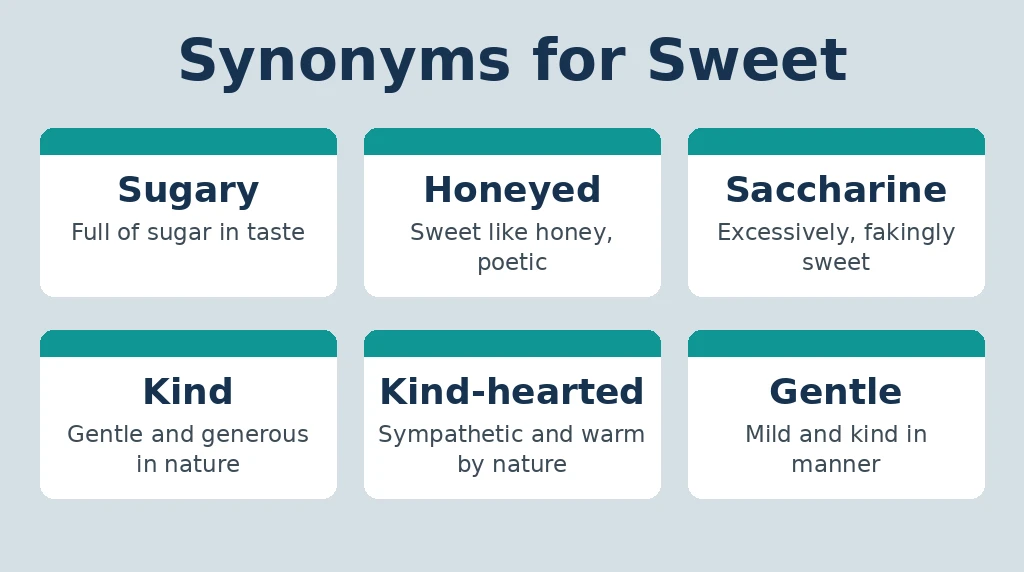
One word sweetens the tea, compliments the baby, describes the violin and forgives the neighbour who borrowed the ladder, and it never sounds strained doing any of it. Sweet might be the hardest-working compliment in English. Its closest synonyms split cleanly by which sense is doing the work: sugary and honeyed for the tongue, kind and kind-hearted for the temper, adorable and winsome for the face, and dulcet for the voice that makes a whole train carriage look up from their phones. In short, this guide gathers synonyms for sweet for every sense, from the tongue to the temper. For example, synonyms for sweet for the tongue should taste of sugar, not of sentiment.
This guide gathers 62 synonyms for sweet and sorts them by sense: taste, personality, appearance, sound, smell, endearment, and the dessert trolley at the end. Every word here was checked against real thesaurus entries, and each comes with a plain meaning and a short example. Keep the senses apart and you get precision as your reward, because a saccharine smile and a sweet smile are opposites that happen to wear the same coat. In other words, the sense is the sort, and the coat is the warning. Consequently, synonyms for sweet for this guide should sort by sense, not the alphabet.
Top Synonyms for Sweet: Quick Reference
Twenty-eight words that carry most of the sweetness in everyday English. The sections after the table sort the full list by sense, so a word that belongs to a voice never has to do a pudding’s work. In fact, the table is the shortcut, and the sense is the rule. Therefore, synonyms for sweet for quick reference should stay with their sense, not the pudding. Above all, the sense is the rule, and the table is the shortcut.
| Word | Meaning in one line | Best for |
|---|---|---|
| Sugary | Full of sugar in taste | Drinks, cereals, sauces |
| Honeyed | Sweet like honey, poetic | Fruit, voices, words |
| Saccharine | Excessively, fakingly sweet | Syrups, smiles, sentiment |
| Kind | Gentle and generous in nature | People, acts, hearts |
| Kind-hearted | Sympathetic and warm by nature | Neighbours, strangers, nurses |
| Gentle | Mild and kind in manner | People, handling, voices |
| Affectionate | Openly showing love | Couples, grandparents, dogs |
| Amiable | Friendly and easy to like | Hosts, colleagues, strangers |
| Gracious | Courteous and pleasing in manner | Hosts, winners, guides |
| Thoughtful | Kind in small, considered acts | Gestures, friends, notes |
| Caring | Attentive to others’ needs | Parents, teachers, friends |
| Selfless | Putting others first | Volunteers, parents, heroes |
| Adorable | Utterly charming | Babies, kittens, little sisters |
| Endearing | Inspiring affection | Habits, flaws, smiles |
| Winning | Attracting affection and approval | Smiles, personalities |
| Winsome | Sweetly charming and innocent | Smiles, children, heroines |
| Delightful | Giving great pleasure | Gardens, evenings, surprises |
| Lovable | Easy to love | Characters, grandparents, rogues |
| Melodious | Pleasant and tuneful | Voices, phrases, birdsong |
| Dulcet | Sweet and soothing in tone | Voices, presenters, tones |
| Mellow | Soft, rich and smooth | Music, light, voices |
| Tuneful | Pleasantly musical | Songs, whistling, choirs |
| Fragrant | Pleasantly sweet-smelling | Gardens, air, herbs |
| Redolent | Strongly scented, literary | Air, kitchens, memories |
| Beloved | Greatly loved | Partners, pets, homelands |
| Dear | Loved and precious | Friends, letters, family |
| Candy | Sweets, American word | Shops, teeth, trick-or-treat |
| Dessert | The sweet course of a meal | Menus, dinners, restaurants |
What Does Sweet Mean?
Sweet starts on the tongue. It’s one of the five basic tastes, the taste of sugar, ripe peaches and honey still in the comb. From that home sense the word radiates outward by a simple logic: whatever gives the senses the pleasure sugar gives the tongue has earned the name. A sweet smell pleases the nose. The sweet voice pleases the ear. A sweet face pleases the eye, and a sweet person pleases everyone in the room at once. Few adjectives travel this gracefully between the senses, which is how this one collected such a large and varied family. In particular, the tongue is the home sense, and the pleasure is the logic. As a result, synonyms for sweet for home senses should radiate from the tongue, not the dictionary.
The word moonlights as a noun, twice over. In British English a sweet is a single piece of confectionery and sweets are the whole paper bag; on both sides of the Atlantic, the sweet can also be the dessert course itself. As a term of address, my sweet keeps company with darling and beloved. And modern slang has stolen the word outright: “Sweet!” as an exclamation just means excellent. None of its synonyms share that sense, as the mistakes section will show. In other words, the noun is the double life, and the slang is the warning. For instance, synonyms for sweet for nouns should name the course, not the compliment.
Sweet also anchors a little estate of set phrases. Home sweet home blesses the familiar. A sweet deal and a sweet victory stretch the taste into fortune: pleasure with no bitterness mixed in. The sweet spot began life on a tennis racket and now means the perfect point of anything, pricing, timing, a negotiation. Short and sweet praises brevity in the family’s own currency. Put together, the phrases show how completely English trusts this taste as its measure of the good. The families below are really a map of the language’s pleasures. In short, the phrases are the estate, and the taste is the measure. In fact, synonyms for sweet for phrases should trust the taste, not the fortune.
Register matters enormously in this family. The taste words are neutral and safe anywhere. The person words climb from everyday kind and nice up to the formal amiable and gracious. Dulcet, redolent and winsome are literary, small change in the pockets of novelists, while icky and cutesy are playground words that criticise by going too far. Sweet itself sits happily at every level, which is exactly why its synonyms need more care than it does. One paragraph can hold a sugary drink, a sweet child and a dulcet chorus without any of them borrowing the others’ clothes, but only if you dress them properly. In fact, the level is the register, and the care is the proof. For example, synonyms for sweet for registers should dress the words, not the clothes.
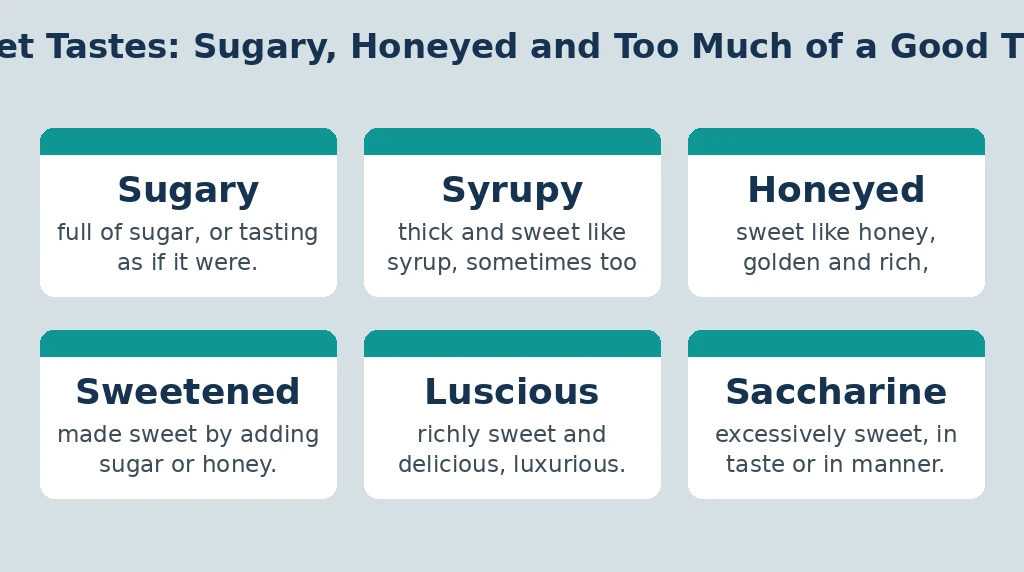
Sweet Tastes: Sugary, Honeyed and Too Much of a Good Thing
The home family. Sweetness of taste runs on a scale, from the plain fact of sugar at one end to the moment pleasure tips over into complaint at the other. This list is arranged along that scale, because cooks and critics pick these words by where the tipping point falls. In other words, the home family is the scale, and the sugar is the fact. Consequently, synonyms for sweet for taste scales should run the scale, not the excess.
- Sugary: full of sugar, or tasting as if it were. The tea arrived sugary enough to stand a spoon in.
- Syrupy: thick and sweet like syrup, sometimes too much so. A syrupy glaze covered the warm buns.
- Honeyed: sweet like honey, golden and rich, poetic. I could smell the honeyed ripeness of peaches.
- Sweetened: made sweet by adding sugar or honey. Lightly sweetened yoghurt suited the tart fruit.
- Luscious: richly sweet and delicious, luxurious. Luscious mangoes dripped over the side of the bowl.
- Saccharine: excessively sweet, in taste or in manner. The syrup was saccharine, and so was the waiter’s smile.
- Cloying: so sweet it becomes sickly and tiring. The pudding was rich without ever turning cloying.
- Icky: unpleasantly sweet and sticky, informal. An icky coating of caramel glued the popcorn together.
Watch the end of the list change sides. Sugary, syrupy and honeyed report, and usually praise. Saccharine and cloying accuse: the sweetness outstayed its welcome. Both words double for manners and art, too (a saccharine film, a cloying memoir). That double life is the single most useful thing to know about this family, and it’s why tasters and reviewers keep the two ends of the list in different pockets. In short, the end is the change, and the praise is the report. Also, synonyms for sweet for changing sides should praise the report, not the excess.
Cooks think about this scale for a living, because sweetness is the flavour most likely to need balancing. A sauce that’s too sweet gets rescued with acid. A pudding that’s too rich gets salt or bitterness. And menu writers know their diners: sugary sells to children, honeyed sells to their grandparents. The vocabulary follows the audience. Icky belongs to the schoolyard verdict, cloying to the restaurant review, and the whole list, read in order, is a biography of a palate growing up. In particular, the scale is the living, and the balance is the proof. As a result, synonyms for sweet for cooks should balance the flavour, not the sugar.
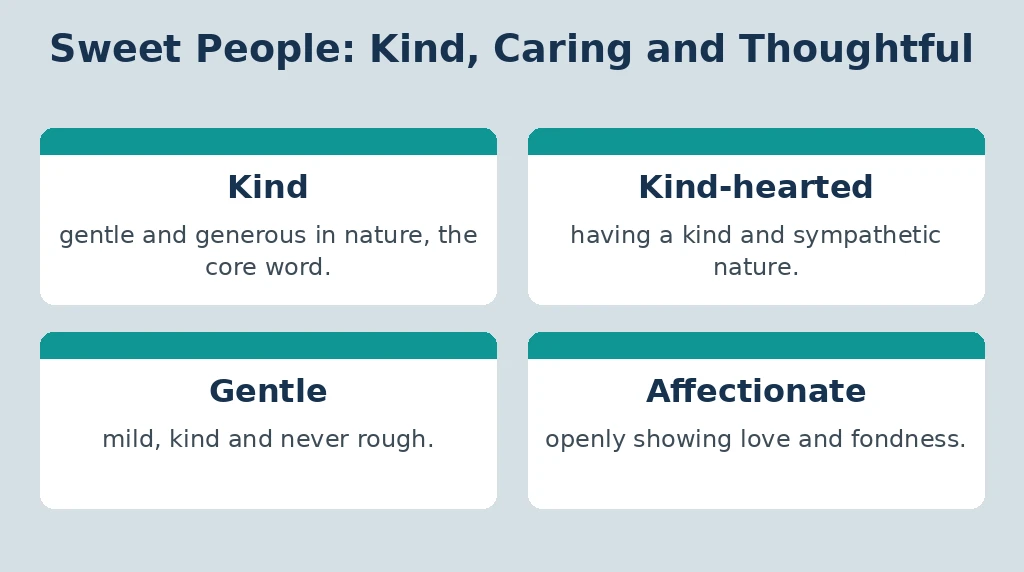
Sweet People: Kind, Caring and Thoughtful
When sweet describes a person, it praises the temper, not the face: someone gentle, generous, easy to be around. This is one of the richest families in the guide, and it overlaps closely with the synonyms for kind. Sweet adds something plain kindness doesn’t promise, though. Warmth. Charm. The feeling that the person is good company, not just good. In fact, the temper is the praise, and the warmth is the proof. Therefore, synonyms for sweet for people should praise the temper, not the face.
- Kind: gentle and generous in nature, the core word. He was a very kind man, full of common sense.
- Kind-hearted: having a kind and sympathetic nature. Our kind-hearted neighbour nursed the stray dog back to health.
- Gentle: mild, kind and never rough. A quiet and gentle man, he liked sports and enjoyed life.
- Affectionate: openly showing love and fondness. They were devoted to each other and openly affectionate.
- Amiable: friendly, pleasant and easy to like. She was surprised at how amiable he seemed.
- Gracious: courteous, kind and pleasing in manner. A very gracious man directed us to the lost and found.
- Nice: pleasant and kind, the everyday word. He is such a nice guy, everyone agrees.
- Caring: looking after others with real attention. I have always thought of her as a deeply caring person.
- Thoughtful: considering others’ feelings in small acts. Thank you for phoning when I was ill; it was thoughtful of you.
- Helpful: ready to assist, practically kind. The staff here are cheerful and very helpful.
- Selfless: putting others before yourself, approving. She is one of the most generous and selfless people I know.
- Unselfish: not selfish, sharing credit and chances. An unselfish player, he set up his teammates all season.
Grade the compliment by its evidence. Nice is the social minimum, true of almost anyone who isn’t actively unpleasant. Kind and kind-hearted describe character. Thoughtful and helpful describe acts. Selfless and unselfish describe sacrifices, the strongest praise the family owns. Gracious belongs to formal occasions and gracious losers. Sweet itself, said of a person, blends character and charm together, which is why it stays the word grandparents earn and managers rarely do. In other words, the evidence is the grade, and the minimum is nice. For instance, synonyms for sweet for grading should follow the evidence, not the minimum.
References and obituaries run on this family, and grading it is a profession in itself. Call a colleague sweet in a reference and it’s warm but light. Kind-hearted adds evidence. Thoughtful implies examples, waiting to be asked for. Selfless makes a claim the writer had better be ready to defend. And readers of references are trained listeners. They hear nice as manners, kind as character, and sweet, placed carefully, as the summary of both, which is exactly the job the word does at funerals and weddings. In fact, the profession is the grading, and the reference is the proof. For example, synonyms for sweet for references should grade the evidence, not the warmth.
One social pattern is worth noticing: sweet is the compliment English hands out most freely at the two ends of life. Babies are sweet before they can be anything else. The very old get called sweet again, a sweet old lady, a sweet old gentleman, with a tenderness that delights or, when the person is still formidable, mildly patronises. In between, working-age adults are more often kind, thoughtful or gracious. The word’s journey through a lifetime tells you where its meaning lives. Sweetness is what strength looks like when it has nothing left to prove. In other words, the pattern is the freedom, and the compliment is the test. Consequently, synonyms for sweet for social patterns should notice the freedom, not the flattery.
Sweet Faces: Adorable, Endearing and Winsome
Appearance keeps its own sweet family, for babies, kittens, smiles and the occasional grandfather. These words praise charm rather than beauty, which is why the family lives next door to the synonyms for pretty while meaning something softer and more affectionate. In short, the appearance is the family, and the softness is the meaning. In practice, synonyms for sweet for faces should keep the softness, not the sweetness.
- Adorable: utterly charming and lovable, often small. She has an adorable little sister with impossible curls.
- Endearing: inspiring affection, often through a flaw. There was something endearing about his complete lack of ego.
- Appealing: attractive and interesting in a gentle way. She has an appealing, crooked sense of humour.
- Engaging: charming and holding attention warmly. He is a very engaging conversationalist at any table.
- Disarming: removing suspicion or hostility by charm. His boyish directness was quite disarming.
- Winning: attracting admiration and affection. Her winning smile closed the interview before it began.
- Attractive: pleasing to look at or be near. We are drawn to attractive, open faces.
- Delightful: giving great pleasure, charming. It was the most delightful garden I had ever seen.
- Lovable: easy and natural to love. His vulnerability makes him even more lovable.
- Winsome: sweetly charming and innocent. She gave them a winsome smile and the argument ended.
- Taking: attractive and captivating, slightly old-fashioned. He looked clean, childish and very taking.
- Likable: pleasant and easy to like, plain and modern. A likable hero carried the whole series.
- Cutesy: deliberately cute, informal and sometimes a complaint. The cutesy card annoyed him more than it charmed him.
The family divides by power. Adorable, endearing and winsome describe charm that asks for affection and usually gets it. Appealing, engaging and disarming describe charm that works on adults, in interviews and negotiations. Disarming is the strategist’s favourite because it names the effect, defences lowered, rather than the face. Cutesy is the family’s built-in warning: charm laid on too thick, curdling into its own opposite, exactly like the taste words at their worst. In particular, the power is the division, and the affection is the proof. As a result, synonyms for sweet for power should ask for affection, not demand it.
Age patrols this family strictly. Adorable is unlimited for babies, animals and the very old, charming for children, and risky for adults at work, where it can shrink the person it means to praise. Grown-ups graduate to engaging, appealing and winning, words that credit the effect without the bonnet. Romance writers keep winsome and endearing in steady work, because those two praise the charm adults actually fall for: warmth with a flaw in it. The crooked smile. The hopeless sense of direction. Included, not despite. In fact, the age is the patrol, and the charm is the proof. Therefore, synonyms for sweet for ages should patrol the family, not the compliment.
Sweet Sounds and Sweet Smells: Dulcet, Mellow and Fragrant
The ear and the nose each keep a shelf of sweet words. Sound first: voices, instruments and music that please the way honey pleases, smoothly, without a single rough edge. In other words, the shelf is the sense, and the sound is the first. For instance, synonyms for sweet for shelves should keep the sound, not the smell.
- Melodious: pleasant and tuneful, formally sweet. She spoke in a quiet, melodious voice. For example, the voice is melodious, and the tone is the proof.
- Musical: like music, pleasant in rhythm and tone. He had a soft, almost musical voice. In fact, the voice is musical, and the rhythm is the measure.
- Mellow: soft, rich and smooth with age or calm. Mellow background music filled the bookshop. For example, the music is mellow, and the room is the proof.
- Tuneful: having a pleasant tune, simple and direct. Melodic and tuneful, his songs made audiences weep. As a result, the songs are tuneful, and the crowd is the proof.
- Dulcet: sweet and soothing, the classic word for voices. Her beautiful, dulcet tones presented the evening news. In particular, the tones are dulcet, and the evening is the proof.
- Silvery: clear and light like silver bells. A silvery laugh came from the next garden. Above all, the laugh is silvery, and the garden is the setting.
- Silver-toned: having a clear, sweet, bell-like tone. The silver-toned soprano filled the chapel. In short, the soprano is silver-toned, and the chapel is the proof.
- Soft: gentle and low, sweet by quietness. Soft music played while the guests arrived. Therefore, the music is soft, and the arrival is the proof.
Then the nose. Sweet air, sweet gardens, sweet kitchens. This family leans literary, because everyday English usually settles for “nice smell” and saves its poetry for gardens and baking. In fact, the nose is the second shelf, and the literary is the proof. For example, synonyms for sweet for smells should lean literary, not the everyday. In short, the literary is the proof, and the everyday is the contrast.
- Fragrant: having a pleasant, sweet smell. We breathed in the fragrant air of the azalea garden.
- Perfumed: filled with a sweet scent. Sweetly perfumed yellow flowers lined the path.
- Redolent: strongly smelling of something pleasant, literary. The air was redolent of cinnamon and apple.
- Fresh: clean and sweet, of air and water. I gulped a breath of fresh, sweet air.
- Pure: clean and unspoiled, of water and air. The spring ran pure and cold.
- Clean: fresh and free of taint. Clean water is available throughout the valley.
Dulcet is the celebrity of the sound family. Dulcet tones is a fixed phrase of broadcasting, half compliment and half cliché, so use it sparingly or with a smile. On the smell side, fragrant is the workhorse and redolent the showpiece, and redolent usually travels with of: a kitchen redolent of cinnamon is remembering as much as smelling. Fresh, pure and clean describe sweet air and water, where sweet means untainted. That’s the oldest of all these secondary senses. In particular, the celebrity is dulcet, and the phrase is the proof. As a result, synonyms for sweet for celebrities should keep the phrase, not the fame.
Nature writing keeps both shelves stocked. Birdsong was the original sweet sound in English poetry, melodious and tuneful centuries before orchestras existed, and a sweet voice in a church choir still borrows the birds’ authority. Gardens return the compliment through the nose: sweet peas, sweet Williams and sweet cicely carry the adjective in their very names, christened by the same instinct that named the taste. When a word is trusted to name flowers, it has become the language’s official seal of sensory approval. In fact, the shelves are the nature, and the birdsong is the proof. Therefore, synonyms for sweet for nature writing should keep both shelves, not one.
Sweetheart Words: Dear, Beloved and Darling
Sweet is also something you call people. This family of endearment runs from the letter writer’s dear to the playground’s angel, and it’s the family most likely to turn up in cards, dedications and last chapters. In other words, the call is the endearment, and the letter is the proof. For instance, synonyms for sweet for endearments should call the person, not the adjective.
- Beloved: greatly loved, formal and deep. She lost her beloved dog last year and still listens for him.
- Dear: loved and precious, the everyday endearment. Mrs Carter is a dear friend of mine.
- Darling: greatly loved, as noun and adjective. My darling, my sweet, the letter began.
- Treasured: valued and kept with love. The treasured photograph travelled with her everywhere.
- Pet: favoured and cherished, in pet projects and names. The proceeds went to her pet charities.
- Angel: a person of perfect kindness, informal praise. Thank you for the lift; you are an angel.
- Treasure: a person valued for kindness and rarity. Charlie? Oh, he is a treasure, so kind to everyone.
Beloved is the formal summit, carved on memorials and spoken in ceremonies. Dear is the daily bread of letters and old friendships. Angel and treasure are praise disguised as nouns, usually said in gratitude on doorsteps and hospital wards. Pet is the quietest member, surviving in pet names and pet projects: the people and things singled out for affectionate favour. In short, the summit is beloved, and the bread is dear. Beyond that, synonyms for sweet for summits should carve the formal word, not the daily one.
Endearments age with their users, and that’s part of their evidence. Children are sweetie and sweetheart. Sweethearts become darling in wartime letters. And dear survives everything, still heading letters between people married fifty years. A writer choosing among these words is really choosing a relationship’s temperature and era, and readers feel a wrong choice instantly. Beloved in a text message is a marble statue on a kitchen table. Sweetie in a eulogy takes a very confident speaker to carry off. In particular, the age is the evidence, and the user is the proof. As a result, synonyms for sweet for endearments should age with the user, not the word.
Sweet as a Noun: Candy, Desserts and Afters
Finally, the edible noun itself. British and American English divide this territory differently, and travellers have lost bets over it, so the list marks the geography as it goes. In fact, the noun is the territory, and the division is the proof. For example, synonyms for sweet for the edible noun should divide by the territory, not the taste.
- Candy: the American word for sweets and confectionery. Remember to brush your teeth after eating candy.
- Sweetie: a small sweet, or a kind person, British informal. The jar of sweeties stood by the till.
- Lolly: a boiled sweet, Australian and New Zealand use. The children compared lollies on the bus.
- Bonbon: a small chocolate or fondant sweet, French in flavour. A box of bonbons arrived with the flowers.
- Sweetmeat: an old word for candied fruit and confections. Sweetmeats and nuts closed the medieval feast.
- Dessert: the sweet course of a meal, the general term. We had homemade ice cream for dessert.
- Pudding: the British everyday word for the sweet course. I tend to stick to fresh fruit for pudding.
- Afters: the sweet course, British informal. What is for afters? became the children’s nightly question.
The rule of thumb is simple. In Britain, sweets are what’s in the jar and pudding is the course. In America, candy is in the jar and dessert is the course, and asking for “the sweet course” in Ohio earns you a puzzled smile. Sweetmeat is the museum piece. Bonbon is the imported luxury. And afters is the word that gives away a British childhood faster than any accent. For instance, the rule is the thumb, and the jar is the proof. As a result, synonyms for sweet for rules should follow the jar, not the course.
The sweet shop itself is vanishing, and its vocabulary is becoming heritage: jars of bonbons and barley sugar, paper bags weighed on brass scales, the penny tray where sweeties were chosen with the gravity of stockbrokers. Writers describing childhoods reach for these nouns because each carries a place and a period in a single syllable. A character who says candy grew up in one country. A character who says afters grew up in another. No amount of description afterwards can move them. In other words, the shop is the heritage, and the vocabulary is the proof. Consequently, synonyms for sweet for heritage should keep the jars, not the slang.
How to Choose the Right Synonym for Sweet
Name the sense first, as with all of sweet’s work. Tongue? Stay in the taste family and place the item on the praise-to-complaint scale. Person? Decide whether you mean character (kind, kind-hearted), acts (thoughtful, helpful) or charm (amiable, gracious). Face: adorable and winsome for affection, engaging and disarming for effect. Voice: dulcet and melodious. Air: fragrant and fresh. Most errors with sweet aren’t wrong words at all. They’re right words in the wrong sense: syrupy people, sugary voices. In short, the sense is the name, and the tongue is the first. On top of that, synonyms for sweet for choosing should name the sense first, not the word.
Then check the warmth of your company, because this family feeds straight into the vocabulary of affection catalogued among the synonyms of happy: sweet compliments land where happiness is being shared. In formal writing, prefer kind, gracious and melodious, and keep adorable and cutesy for speech. In speech, reverse the rule freely. And everywhere, beware the family trap: saccharine and cloying are insults in a synonym’s clothing, and using them as praise is the fastest way to sweeten a sentence into its opposite. In particular, the warmth is the check, and the company is the proof. As a result, synonyms for sweet for warmth should feed the happiness, not the formality.
A worked example makes it concrete. The draft calls a headmistress sweet, a choir sweet and a pudding sweet, and all three are true and none is precise. The headmistress, kind in every remembered act, is kind-hearted. Smooth and tuneful, the choir is dulcet. The pudding, rich to the edge of excess, is cloying if the writer is honest and luscious if the cook is a friend. Three replacements, and the paragraph stops repeating itself and starts reporting. That’s the whole craft this family exists to teach. In fact, the example is the work, and the draft is the proof. Therefore, synonyms for sweet for examples should make it concrete, not the compliment.
| Situation | Best word | Why |
|---|---|---|
| A tea with two sugars too many | Saccharine | The sweetness has become a fault |
| A neighbour who feeds your cat | Kind-hearted | Character shown through acts |
| A baby in a ridiculous bonnet | Adorable | Charm that demands affection |
| A presenter’s evening voice | Dulcet | The fixed phrase of broadcasting |
| A garden after rain | Fragrant | Sweet smell, gardens and air |
| A grandfather in a card | Beloved | Formal, deep and permanent |
When in doubt, plain sweet itself is rarely wrong, and kind covers most human cases with dignity. Save the specialists (winsome, redolent, saccharine) for sentences where their exact shade is the whole point, and they’ll sparkle instead of sticking. In fact, the doubt is the test, and the plain word is the proof. For example, synonyms for sweet for doubt should stay plain, not the flourish.
Sweet Synonyms for Writing and Dialogue
In fiction, sweet words are characterisation at wholesale prices. A narrator who calls a woman winsome admires her. One who calls her saccharine is sharpening a knife, and the reader knows it before the plot explains anything. Dialogue uses the endearment family like a social X-ray: who gets called dear, who rates beloved, and who gets dismissed with a cutesy tells the attentive reader the whole hierarchy of a household. In other words, the fiction is the price, and the character is the proof. Consequently, synonyms for sweet for fiction should name the character, not the price.
Essays and reviews live on the taste family’s double agents. Saccharine, cloying and syrupy are the standard vocabulary for criticising sentimentality in films, novels and memoirs, and a reviewer who grades them finely (syrupy for the merely sweet, cloying for the exhausting, saccharine for the fake) writes criticism readers trust. Food writing proper keeps the literal scale: honeyed and luscious for praise, balanced and restrained for the sophisticated compliment sweet alone can’t pay. In short, the double agents are the taste, and the review is the proof. What is more, synonyms for sweet for essays should live on the double agent, not the praise.
Professional writing uses sweet more carefully than any other compliment family. A sweet deal is excellent in speech and ambiguous in a contract summary. A sweet email is a compliment colleagues pay each other, never a category in a report. Kind, helpful and thoughtful carry the professional load, and gracious is the word of ceremonies and official thanks. The slang exclamation, “Sweet!”, stays out of documents entirely, however warm the news it’s celebrating. In particular, the care is the professional rule, and the deal is the proof. As a result, synonyms for sweet for professional writing should measure the deal, not the compliment.
Children’s literature is the family’s ancestral home, and it grades sweetness with a seriousness adult fiction rarely matches. In the nursery, sweet characters are safe, saccharine ones are villains in disguise, and the endearment ladder, from sweetie through darling to beloved, maps the exact security of a child’s world. Writers for children learn early what this whole guide has been saying: sweetness is never decoration. It’s information about who may be trusted, and young readers audit it more strictly than any critic. In fact, the home is the children’s book, and the grade is the proof. Therefore, synonyms for sweet for children’s literature should grade the sweetness, not the sentiment.
Antonyms for Sweet
Sweet’s opposites divide by sense, just like its synonyms: the tongue goes sour, the temper goes nasty, and the air goes foul. The main antonyms are these:
- Sour: acid in taste, the direct opposite for food and milk. For example, sour is the acid opposite, and the milk is the proof.
- Bitter: the harsh opposite taste, and the opposite temper too. In fact, bitter is the harsh opposite, and the temper is the measure.
- Salty: tasting of salt, the savoury pole of the tongue. In fact, salty is the savoury pole, and the tongue is the proof.
- Savoury: salty or spicy rather than sweet, the menu opposite. As a result, savoury is the menu opposite, and the salt is the proof.
- Unsweetened: having no sugar added, plain and factual. For example, unsweetened is the plain opposite, and the jar is the proof.
- Unkind: not kind, the direct opposite for people. In fact, unkind is the direct opposite, and the person is the measure.
- Nasty: unpleasant in temper and manner, the everyday opposite. Also, nasty is the everyday opposite, and the manner is the proof.
- Mean: unkind and ungenerous, in the American sense. In particular, mean is the ungenerous opposite, and the American sense is the clue.
- Unpleasant: not pleasing to any sense, the general opposite. Above all, unpleasant is the general opposite, and the senses are the test.
- Harsh: rough and unkind, for voices, tempers and sounds. In short, harsh is the rough opposite, and the voice is the proof.
- Foul: offensive in smell or taste, the strong opposite. Therefore, foul is the strong opposite, and the smell is the proof.
- Acid: sharp and sour, where sweet would be mild and sugary. At the same time, acid is the sharp opposite, and the mild is the contrast.
Bitter does the hardest work of any opposite here, fighting sweet on the tongue, in the temper and in experience itself: a bitter defeat, a sweet victory. That pairing is one of the oldest in the language. Keeping their border clean, especially where tart and tangy live near it, is most of what choosing well in this family involves. In fact, the work is the hardest, and the opposite is bitter. For example, synonyms for sweet for hard work should name the bitter, not the sweet.
The two opposites meet in one of English’s best-loved compounds: bittersweet. A bittersweet ending, a bittersweet reunion, pleasure with the pain left in. It describes adult experience so precisely that no synonym has ever replaced it. Its existence proves this guide’s rule: sweet and its opposites aren’t enemies but instruments, and the writers who command both ends of the scale can describe the mixed flavour of real life, which is almost never served neat. In other words, the compound is the meeting, and the ending is the proof. Consequently, synonyms for sweet for meetings should join the bitter and the sweet, not choose one.
Common Mistakes: Words That Are Not True Synonyms for Sweet
Saccharine is the family’s double agent. Dictionaries list it among the synonyms, and chemically it is one, but in living English saccharine almost always criticises. A saccharine smile is fake. A saccharine film is manipulative. Using it as straight praise is the commonest single error in this whole family. If you mean praise, choose honeyed, or sweet itself. In short, the agent is double, and the dictionary is the proof. In practice, synonyms for sweet for double agents should list the chemical fact, not the compliment.
Sweetie is a noun, not an adjective of taste. It names one sweet in a British shop, or a kind person in affectionate speech. It cannot describe tea, music or weather, and a sentence like “a sweetie melody” collapses the moment a native reader touches it. The adjective you want is sweet, or one of the taste family above. In particular, the noun is sweetie, and the adjective is sweet. As a result, synonyms for sweet for nouns should name the shop, not the taste.
Honey names a food and a person, never a general quality. Honeyed is the adjective, for voices, words and fruit, and it carries a poetic warmth that honey itself doesn’t. Learners who write “honey voice” have usually translated too directly from languages where the food word does adjective work. English insists on the -ed. In fact, the food is honey, and the adjective is honeyed. Therefore, synonyms for sweet for honey should name the food, not the quality.
Sweet itself traps translators in the other direction, in its slang life. When a teenager calls a goal or a gadget sweet, the meaning is excellent, not sugary, kind or adorable, and not one synonym in this guide can take its place. Context usually gives the game away, a cheer and an exclamation mark, but dictionaries list the sense last and learners meet it first. That’s why it earns its warning here. In other words, the trap is the slang, and the direction is the proof. For instance, synonyms for sweet for slang should mean excellent, not sugary.
Frequently Asked Questions
What is the best synonym for sweet?
For people, kind and kind-hearted cover the most ground with the most dignity. When taste is the sense, sugary states the fact and honeyed pays the compliment. For faces and small charming things, adorable is the word English actually reaches for, and for voices, dulcet. Sweet has no single best synonym, because it has no single sense. Match the word to the territory first. In fact, the territory is the match, and the sense is the proof. For example, synonyms for sweet for best words should match the territory, not the word. Above all, the territory decides the word, and the sense decides the territory.
What is a fancy or formal word for sweet?
Dulcet is the formal word for a sweet sound, famous in the phrase dulcet tones. Amiable and gracious are the formal compliments for people, melodious suits music, and redolent is the literary word for a sweet smell. Winsome is the bookish choice for a sweet, charming manner. In other words, the formal word is dulcet, and the compliment is amiable. Consequently, synonyms for sweet for formal words should suit the sense, not the fashion. In particular, the phrase is the proof, and the tone is the test.
What do you call a sweet person?
In description, a kind-hearted person. In address and praise, a sweetheart or an angel. Thoughtful fits someone sweet in their actions, and selfless someone sweet at real cost to themselves. In cards and dedications, dear and beloved do the formal work. For example, the description is the test, and the address is the proof. As a result, synonyms for sweet for sweet people should describe the character, not the label. For example, the character is the test, and the label is the risk.
What is the difference between sweet and saccharine?
Sweet is the genuine article. Saccharine is the imitation that overshoots. Saccharine started as the name of an artificial sweetener and kept the suspicion that came with it: excessive, fake, faintly sickly. A sweet smile is kind. A saccharine smile is performed. Only reach for saccharine when the criticism is intended. In fact, the article is genuine, and the imitation is saccharine. For instance, synonyms for sweet for genuine articles should stay sweet, not saccharine. Therefore, the genuine article is sweet, and the imitation is the warning.
What is a sweet in British and American English?
In British English, a sweet is one piece of confectionery, what Americans call a piece of candy, and sweets can also mean the dessert course. Americans use candy for the pieces and dessert for the course. Pudding and afters are the British names for that same final course, and they give the speaker away every time. For example, the piece is the sweet, and the candy is the American word. As a result, synonyms for sweet for British sweets should name the piece, not the course. In short, the piece is the proof, and the course is the contrast.
Final Thoughts
Sweet is the adjective that tastes, glows, charms and forgives by turns, and its family is a small education in how English builds compliments. Sugary for the tongue. Kind for the temper. Winsome for the face. Dulcet for the voice, fragrant for the garden after rain. Each word holds one door of the same warm house. Choose by sense, watch the double agents at the border, saccharine above all, and the family’s warmth survives every translation you ask of it, from the menu to the eulogy and back again. In short, the adjective is sweet, and the family is the proof. Beyond that, synonyms for sweet for final thoughts should taste, glow, charm and forgive. At the same time, the house is warm, and the doors are the words.
Keep this guide near the teapot. And for the deepest bench of related and historical words, the Merriam-Webster Thesaurus entry for sweet is the natural next stop. May your teas be honeyed, your neighbours kind-hearted, your sopranos dulcet, and nothing in your life, or your prose, ever turn saccharine. In fact, the teapot is the test, and the guide is the proof. Finally, synonyms for sweet for the shelf should stay near the teapot, not in the drawer. In the end, the teapot stays near, and the guide stays open.
Discover More Post:
Synonyms for Shape |25+ Meaning, Context, Examples …
Synonyms for Sacrifice |25+ Meaning, Examples, and …

1 thought on “Synonyms for Sweet | 56+ Beautiful Alternatives, Their Meanings, and Perfect Ways to Use Them in 2026”