When writing an essay, resume, sports recap, business report, or social media caption, repeating the word defeat can make your language feel predictable. The best synonyms of defeat help you describe losing, overcoming an opponent, failing at an attempt, or bringing someone or something under control with greater precision.
Not every alternative means exactly the same thing. Words such as loss, failure, conquest, overcome, and setback carry different meanings, tones, and levels of intensity. Choosing the right word lets you communicate whether the situation involved competition, personal struggle, disappointment, or complete victory.
What Are the Best Synonyms of “Defeat”?
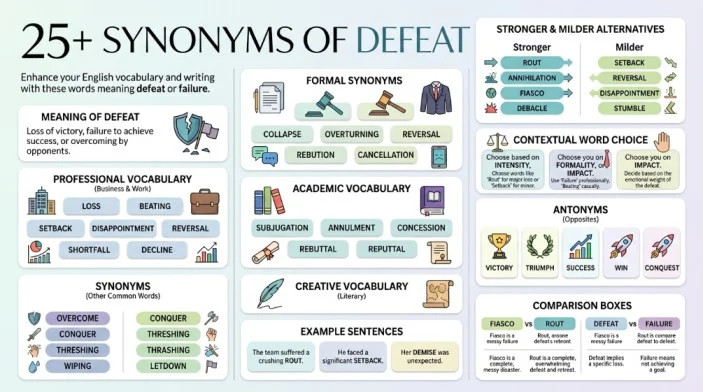
Defeat means losing a contest, failing to achieve an objective, or successfully overcoming an opponent. The best alternatives include loss for a neutral result, failure for an unsuccessful attempt, conquest for complete victory, overcome for defeating a challenge, and downfall for a serious loss of power or position.
Meaning, Tone, and Context
Simple Definition
Defeat can describe both the act of losing and the act of causing someone or something to lose. Its meaning depends on whether it is being used as a noun or a verb.
As a noun, defeat usually refers to a loss or unsuccessful outcome.
“The team suffered a disappointing defeat.”
As a verb, defeat means to beat an opponent or prevent someone from achieving a goal.
“The candidate defeated her opponent in the election.”
Part of Speech
Defeat can function as both a noun and a verb.
Overall Tone
The word is generally neutral, although the situation it describes is often negative because defeat involves losing, failure, or being overcome.
In competitive contexts, it can sound factual:
“The team accepted the defeat.”
In personal or emotional contexts, it can sound more serious:
“He struggled to recover after the defeat.”
Formality Level
Defeat is a neutral to moderately formal word. It works naturally in academic writing, professional communication, journalism, sports reporting, everyday conversation, and creative writing.
Common Uses
Native English speakers commonly use defeat when discussing:
- Sports competitions
- Elections
- Military conflicts
- Political campaigns
- Business competition
- Personal challenges
- Arguments or debates
- Goals and ambitions
- Enemies or opponents
- Problems and obstacles
Word Forms
| Form | Word |
|---|---|
| Noun | defeat |
| Verb | defeat |
| Related noun | defeat |
| Related adjective | defeated |
| Related adjective | defeating, less common |
| Opposite concept | victory |
When and How to Use “Defeat”
Use defeat when you want to clearly communicate that an opponent, competitor, goal, or force was beaten or that an attempt resulted in a loss.
Professional
“The company faced a major defeat after its proposed merger was rejected.”
This works in business writing because defeat can describe a failed proposal or competitive effort without sounding overly emotional.
Academic
“The movement experienced a significant defeat after the proposed reforms were rejected.”
Here, defeat describes an unsuccessful effort or political outcome.
Workplace
“The project team suffered a temporary defeat when the first solution failed.”
The word can describe a setback in a professional setting, although setback may sound softer.
Personal
“She refused to let one defeat define her future.”
This use is common when discussing resilience and personal growth.
“Although our proposal was rejected, the defeat gives us an opportunity to improve our strategy.”
The wording acknowledges failure while maintaining a constructive tone.
Resume
“Helped the team overcome a major competitive defeat and regain market share.”
For resumes, however, a positive achievement is usually more effective than emphasizing defeat itself.
Social Media
“One defeat does not erase all the progress we’ve made.”
This sounds natural in motivational or reflective posts.
Best Synonyms of “Defeat”
No synonym can replace defeat in every context. The best choice depends on whether you mean losing, failing, overcoming something, removing an opponent’s power, or experiencing a disappointing outcome.
Professional Writing: Setback
Setback is useful when you want to describe a failure without making the situation sound final.
“The company experienced a temporary setback during the expansion.”
It is especially effective in professional writing because it can acknowledge a problem while leaving room for recovery.
Academic Writing: Failure
Failure works when an experiment, strategy, theory, or attempt does not produce the desired result.
“The initial approach resulted in failure.”
It is more precise than defeat when there is no opponent involved.
Business Communication: Loss
Loss is appropriate when a company, team, investor, or organization loses something valuable.
“The business reported a substantial loss during the quarter.”
Casual Conversation: Lose
Lose is the natural everyday verb for failing to win.
“We lost the game last night.”
Emotional Writing: Disappointment
Disappointment focuses on the emotional reaction to an unsuccessful outcome.
“The rejection was a painful disappointment.”
Creative Writing: Downfall
Downfall can describe a dramatic decline from power, success, or status.
“His arrogance eventually became the cause of his downfall.”
Resume Writing: Overcome
Overcome is often more useful than defeat on a resume because it focuses on achievement and resilience.
“Overcame significant operational challenges to improve productivity.”
Workplace Communication: Setback
Setback is usually preferable when discussing a problem that can be corrected.
“The delayed shipment was a temporary setback.”
Stronger Meaning: Conquer
Conquer is stronger than defeat when describing complete control or victory over an opponent, territory, fear, or difficult challenge.
“She conquered her fear of public speaking.”
Softer Meaning: Setback
Setback sounds less final and less emotionally negative than defeat.
“The failed launch was a setback, not the end of the project.”
When Not to Use “Defeat”
Although defeat is versatile, it is not always the most accurate choice.
When the Situation Is Only a Temporary Problem
Less effective:
“The delayed shipment was a defeat.”
Better:
“The delayed shipment was a setback.”
Why:
A setback suggests a temporary obstacle, while defeat can imply a more decisive loss.
When There Is No Competitive Element
Less effective:
“The experiment was a defeat.”
Better:
“The experiment was a failure.”
Why:
Failure is more natural when an attempt does not work and there is no opponent.
When You Mean Financial Loss
Less effective:
“The company experienced a defeat of $2 million.”
Better:
“The company experienced a loss of $2 million.”
Why:
Loss directly describes the financial result.
When You Want a Softer Tone
Less effective:
“The project was a complete defeat.”
Better:
“The project experienced a setback.”
Why:
Setback communicates difficulty without suggesting the entire effort was permanently unsuccessful.
When You Mean Emotional Reaction
Less effective:
“Her rejection was a defeat.”
Better:
“Her rejection was a disappointment.”
Why:
Disappointment describes the emotional experience more directly.
When You Mean Complete Victory
Less effective:
“The army defeated the territory.”
Better:
“The army conquered the territory.”
Why:
Conquer can imply gaining control, while defeat simply means winning against an opponent.
Words Commonly Confused With “Defeat”
Loss
Difference: A loss is an unsuccessful outcome or something that has been lost. It does not necessarily imply an active opponent.
When to Use It: Use loss for sports results, money, possessions, opportunities, or general unsuccessful outcomes.
Example:
“The team suffered a narrow loss in the final.”
Failure
Difference: Failure means that an attempt, plan, or effort did not achieve its intended result.
When to Use It: Use it when the focus is on an unsuccessful attempt rather than competition.
Example:
“The first test ended in failure.”
Setback
Difference: A setback is a problem that delays progress but does not necessarily end an effort.
When to Use It: Use it for temporary problems in projects, careers, businesses, or personal goals.
Example:
“The funding delay was a temporary setback.”
Defeat
Difference: Defeat usually involves losing to an opponent or being overcome by a force, challenge, or circumstance.
When to Use It: Use it for competitions, elections, conflicts, arguments, and major challenges.
Example:
“The candidate suffered a narrow defeat.”
Conquest
Difference: Conquest suggests gaining complete control over an opponent, territory, or group.
When to Use It: Use it when victory and control are both important to the meaning.
Example:
“The conquest changed the region’s political structure.”
Downfall
Difference: Downfall describes a serious decline from a position of power, success, or influence.
When to Use It: Use it when the focus is on collapse rather than simply losing.
Example:
“Poor decisions contributed to the leader’s downfall.”
Best Synonyms of “Defeat” by Context
| Context | Best Synonym | Why It Works | Example |
|---|---|---|---|
| Formal writing | Loss | Neutral and precise | “The organization acknowledged the loss.” |
| Academic writing | Failure | Fits unsuccessful experiments or approaches | “The method resulted in failure.” |
| Professional communication | Setback | Suggests a recoverable problem | “The delay was a temporary setback.” |
| Business emails | Setback | Maintains a constructive tone | “The issue created a short-term setback.” |
| Resume writing | Overcome | Emphasizes achievement | “Overcame major operational challenges.” |
| Workplace communication | Setback | Sounds practical and measured | “The error was a manageable setback.” |
| Casual conversation | Lose | Most natural everyday verb | “We lost the match.” |
| Everyday speaking | Loss | Simple and familiar | “It was a tough loss.” |
| Creative writing | Downfall | Adds dramatic depth | “The betrayal began his downfall.” |
| Storytelling | Collapse | Highlights a dramatic decline | “The alliance eventually collapsed.” |
| Emotional writing | Disappointment | Focuses on feelings | “The rejection was a deep disappointment.” |
| Strong emphasis | Conquer | Suggests complete victory or control | “She conquered her fear.” |
| Mild tone | Setback | Reduces the sense of finality | “The failure was only a setback.” |
| Social media captions | Loss | Short and relatable | “A tough loss, but we keep moving.” |
| American English | Defeat | Natural across many contexts | “The team accepted its defeat.” |
| British English | Defeat | Equally standard and natural | “The club suffered a narrow defeat.” |
How to Choose the Best Synonym of “Defeat”
Choosing an alternative becomes easier when you identify what the sentence is actually describing.
If Someone Loses a Competition
Use defeat or loss.
“The team suffered a disappointing defeat.”
For casual speech:
“The team had a tough loss.”
If an Attempt Does Not Work
Use failure.
“The experiment ended in failure.”
This is more accurate than defeat because there may be no opponent.
If the Problem Can Be Fixed
Use setback.
“The technical issue was a temporary setback.”
This communicates difficulty without suggesting permanent failure.
If Someone Gains Complete Control
Use conquer.
“The army conquered the region.”
If Someone Overcomes a Personal Challenge
Use overcome.
“She overcame her fear of public speaking.”
If You Are Writing About Emotional Pain
Use disappointment or loss.
“The rejection was a painful disappointment.”
If You Are Writing Professionally
Choose words that focus on facts and outcomes. Setback, loss, failure, and overcome are often more precise than repeatedly using defeat.
Real Life Examples of “Defeat”
School
Instead of:
“The student suffered defeat when the first solution did not work.”
Better:
“The student experienced a setback when the first solution did not work.”
College
“The research team faced failure after the original hypothesis was not supported.”
Workplace
“The department turned a major setback into an opportunity to improve its process.”
Business
“The company reported a significant financial loss after the failed expansion.”
“Although the proposal was rejected, this setback gives us useful feedback for our next submission.”
Resume
“Overcame operational challenges and helped reduce processing time.”
Conversation
“We lost the game, but everyone had a great time.”
Storytelling
“After years of success, one poor decision marked the beginning of his downfall.”
Blogging
“A failed strategy does not always represent defeat. Sometimes it reveals what needs to change.”
Social Media
“Today’s loss hurts, but tomorrow brings another chance to compete.”
25 Best Synonyms of “Defeat”
| Synonym | Simple Meaning | Best Used For | Example Sentence |
|---|---|---|---|
| Loss | Failure to win or keep something | Sports, money, general outcomes | The team accepted the loss gracefully. |
| Failure | An unsuccessful attempt | Plans, experiments, goals | The first strategy ended in failure. |
| Setback | A problem that slows progress | Business, careers, projects | The delay was a temporary setback. |
| Overcome | Successfully deal with a challenge | Personal growth, obstacles | She overcame her fear of speaking. |
| Conquer | Defeat completely or gain control | Challenges, opponents, territories | He conquered his fear of heights. |
| Beat | Win against someone | Sports, casual conversation | Our team beat its rival. |
| Outplay | Defeat through better skill | Sports, games, competition | The midfielder outplayed his opponent. |
| Vanquish | Defeat completely | Formal and literary writing | The hero vanquished the enemy. |
| Subdue | Bring under control | Conflict, resistance, emotions | The officers managed to subdue the attacker. |
| Overthrow | Remove from power | Governments, leaders | The rebels overthrew the regime. |
| Conquest | Complete victory and control | History, military contexts | The conquest transformed the region. |
| Downfall | Collapse from success or power | Leaders, careers, organizations | Corruption contributed to his downfall. |
| Collapse | Sudden failure or breakdown | Systems, organizations, plans | The negotiations ended in collapse. |
| Reversal | A change from success to failure | Sports, business, politics | The final vote was a dramatic reversal. |
| Disappointment | An unsuccessful result that causes sadness | Personal and emotional contexts | The rejection was a major disappointment. |
| Deficiency | A lack that contributes to poor results | Skills, systems, resources | The report identified a serious deficiency. |
| Frustration | The feeling caused by failure or obstacles | Emotional situations | Repeated delays caused considerable frustration. |
| Rejection | Refusal to accept something | Applications, proposals, ideas | The proposal faced rejection from the committee. |
| Rebuff | A sharp refusal or rejection | Formal or literary contexts | His request met with a firm rebuff. |
| Repulse | Drive back or repel successfully | Military or formal contexts | The defenders repulsed the attack. |
| Discomfiture | Embarrassment or discomfort after failure | Formal writing | The unexpected result caused public discomfiture. |
| Humiliation | Loss accompanied by embarrassment | Emotional or competitive contexts | The public loss was a painful humiliation. |
| Deflection | Turning something away from its intended course | Technical or figurative contexts | The strategy caused a deflection of attention. |
| Neutralization | Making a threat ineffective | Security, strategy, science | The measure led to the neutralization of the threat. |
| Subversion | Undermining or weakening authority | Politics, institutions | The campaign focused on the subversion of the existing system. |
Synonyms of “Defeat” by Usage
Professional vs Personal Synonyms
Professional contexts generally benefit from measured words such as setback, loss, failure, and reversal. These terms allow writers to discuss unsuccessful outcomes without making the language unnecessarily dramatic.
Personal writing can use more emotional alternatives such as disappointment, loss, or downfall, depending on the situation.
For a resume, overcome is usually more effective than defeat because it shifts attention from the problem to the achievement.
Formal vs Conversational Synonyms
Formal writing often favors defeat, failure, conquest, vanquish, subdue, and overthrow, depending on the context.
Everyday conversation usually sounds more natural with lose, beat, loss, or setback.
For example:
Formal:
“The proposal met with significant rejection.”
Conversational:
“They lost the vote.”
Academic Synonyms
Academic writing requires careful distinction between competitive loss and unsuccessful research.
- Use failure when an experiment or method does not achieve its intended result.
“The initial model resulted in failure.”
- Use setback when the problem delays progress but does not end the research.
“The unexpected findings created a temporary setback.”
- Use loss when discussing measurable resources, participants, data, or outcomes.
“The study experienced a significant loss of participants.”
Professional and Business Synonyms
Resumes
Use overcome, reversed, resolved, or recovered from to emphasize accomplishments.
“Overcame major operational challenges and improved workflow efficiency.”
Interviews
Setback is useful when discussing a difficult experience while showing how you responded.
“The project delay was a setback, but it taught me how to manage risks more effectively.”
Meetings
Use loss, setback, or failure according to the actual situation.
Presentations
Key, significant, and critical can explain why a defeat happened or what followed from it.
Performance Reviews
Use constructive language such as setback and challenge rather than dramatic expressions such as humiliation.
Client Communication
Setback is often a useful choice because it acknowledges a problem without unnecessarily alarming the client.
Business Emails
Use direct but measured language:
“The delayed delivery represents a short-term setback, and we are working to resolve it.”
Creative and Literary Synonyms
Creative writing allows more expressive alternatives.
Storytelling
Downfall can create a sense of dramatic decline.
“His ambition ultimately led to his downfall.”
Fiction
Vanquish gives a scene a heroic or dramatic tone.
“The warrior vowed to vanquish the enemy.”
Poetry
Loss, fall, and defeat can communicate emotional pain with relatively simple language.
Descriptive Writing
Collapse can create a stronger image of something breaking apart.
“Their alliance slowly collapsed under the pressure.”
Speeches
Overcome works especially well when discussing resilience.
“We have faced challenges before, and we have overcome them.”
Slang or Modern Synonyms
There is no single slang word that directly replaces defeat in every situation. However, casual American English commonly uses beat and take down in informal contexts.
Beat
Meaning: To win against someone.
Acceptable in: Casual conversation and sports discussion.
Avoid in: Formal academic writing.
“We beat them by three points.”
Take Down
Meaning: To defeat or bring down an opponent.
Acceptable in: Informal speech, sports, entertainment, and social media.
Avoid in: Formal reports when a more precise term is available.
“The underdog took down the defending champion.”
Strongest to Mildest Synonyms
There is no perfectly fixed intensity scale because the strength of a synonym depends on context. Still, these groups provide a useful guide.
| Intensity | Words |
|---|---|
| Mild | Setback, disappointment |
| Moderate | Loss, failure, defeat |
| Strong | Reversal, downfall, overcome |
| Very Strong | Conquer, vanquish, overthrow |
A setback suggests that recovery remains possible. A defeat generally indicates a clearer loss, while vanquish or conquer can suggest complete victory over an opponent.
Emotional vs Neutral Synonyms
Emotional Synonyms
These words add feeling or dramatic weight:
- Disappointment
- Humiliation
- Downfall
- Frustration
- Loss
Use them when the emotional experience matters as much as the result.
Neutral Synonyms
These words communicate the outcome more objectively:
- Defeat
- Failure
- Setback
- Loss
- Reversal
- Rejection
These are generally better for academic papers, business reports, and factual explanations.
Antonyms of “Defeat”
| Antonym | Meaning | Example Sentence |
|---|---|---|
| Victory | Success in a competition | The team celebrated its victory. |
| Win | Successful result in a contest | We managed to win the final. |
| Triumph | A notable or satisfying victory | Her return was a personal triumph. |
| Success | Achievement of a desired result | The campaign was a major success. |
| Conquest | Successful gaining of control | The army’s conquest changed the region. |
| Achievement | Something successfully accomplished | Completing the project was a major achievement. |
| Mastery | Complete skill or control | Years of practice led to mastery. |
| Domination | Control or overwhelming superiority | The team established clear domination. |
| Superiority | Greater ability or position | Their technical superiority was clear. |
| Advantage | A favorable position | The team gained an early advantage. |
| Recovery | Return after a loss or difficulty | The company made a strong recovery. |
| Progress | Movement toward improvement or success | The students showed steady progress. |
| Accomplishment | Successful completion of something | Finishing the marathon was an impressive accomplishment. |
| Breakthrough | Important advance after difficulty | The scientists achieved a major breakthrough. |
| Prosperity | Successful and thriving condition | The business entered a period of prosperity. |
Comparison: “Defeat” vs Similar Words
Defeat vs Loss
Main Difference
Defeat often emphasizes being beaten by an opponent. Loss is broader and can describe losing a competition, money, property, opportunity, or person.
Which Is Stronger?
Neither is always stronger. Defeat is more competition-focused, while loss has a wider meaning.
Which Is More Formal?
Both are suitable for formal writing.
When to Use Each
Use defeat for opponents and contests. Use loss for broader unsuccessful outcomes.
Examples
Defeat:
“The candidate suffered a narrow defeat.”
Loss:
“The company reported a financial loss.”
Defeat vs Failure
Main Difference
Defeat usually involves being beaten or losing. Failure focuses on an attempt that did not achieve its intended goal.
Which Is Stronger?
Defeat can sound more final in competitive situations, while failure focuses more directly on the unsuccessful result.
Which Is More Formal?
Both work well in formal writing.
When to Use Each
Use failure for experiments, plans, and attempts. Use defeat for competitions and opponents.
Examples
Defeat:
“The team suffered a disappointing defeat.”
Failure:
“The experiment ended in failure.”
Defeat vs Setback
Main Difference
A setback is usually temporary. Defeat can suggest a more decisive loss.
Which Is Stronger?
Defeat generally sounds stronger.
Which Is More Formal?
Both are appropriate for professional communication.
When to Use Each
Use setback when recovery is expected or possible.
Examples
Defeat:
“The campaign ended in defeat.”
Setback:
“The campaign experienced a temporary setback.”
Defeat vs Conquest
Main Difference
Defeat means winning against an opponent. Conquest can imply gaining control after victory.
Which Is Stronger?
Conquest can suggest a more complete and lasting result.
Which Is More Formal?
Both can appear in formal or historical writing.
When to Use Each
Use conquest when control is central to the meaning.
Examples
Defeat:
“The army defeated its opponent.”
Conquest:
“The conquest brought the territory under new rule.”
Defeat vs Overcome
Main Difference
Defeat focuses on winning against an opponent or force. Overcome focuses on successfully dealing with a problem, obstacle, fear, or challenge.
Which Is Stronger?
The strength depends on context.
Which Is More Formal?
Both work well in professional and academic writing.
When to Use Each
Use overcome for personal and practical challenges.
Examples
Defeat:
“The team defeated its rival.”
Overcome:
“She overcame her fear of public speaking.”
Defeat vs Downfall
Main Difference
Defeat describes a loss. Downfall describes a decline or collapse that can follow a series of problems.
Which Is Stronger?
Downfall can carry stronger dramatic and emotional implications.
Which Is More Formal?
Both can appear in formal writing, although downfall is especially common in historical and literary contexts.
When to Use Each
Use downfall when discussing the collapse of a person, organization, career, or position.
Examples
Defeat:
“The politician suffered an unexpected defeat.”
Downfall:
“Corruption contributed to the politician’s downfall.”
Common Phrases and Expressions with “Defeat”
Defeat an Opponent
Meaning: Beat someone in a competition or conflict.
Example Sentence:
“The team managed to defeat its strongest opponent.”
Suffer Defeat
Meaning: Experience a loss.
Example Sentence:
“The candidate suffered defeat in the final round.”
Accept Defeat
Meaning: Recognize that you have lost.
Example Sentence:
“After a close contest, the team finally accepted defeat.”
Admit Defeat
Meaning: Acknowledge that you cannot win or succeed.
Example Sentence:
“After several attempts, he finally admitted defeat.”
Defeat the Purpose
Meaning: Prevent something from achieving its intended purpose.
Example Sentence:
“Skipping the training would defeat the purpose of the program.”
Defeat the Object
Meaning: Make an action or plan pointless.
Example Sentence:
“Leaving early would defeat the object of the trip.”
Snatch Defeat from the Jaws of Victory
Meaning: Lose after appearing very close to winning.
Example Sentence:
“The team snatched defeat from the jaws of victory by conceding two late goals.”
A Crushing Defeat
Meaning: A very serious or disappointing loss.
Example Sentence:
“The election ended in a crushing defeat for the incumbent.”
Common Mistakes to Avoid
1. Using “Defeat” When You Mean “Failure”
Incorrect:
“The experiment was a defeat.”
Better:
“The experiment was a failure.”
Why:
An experiment does not normally have an opponent. Failure accurately describes an unsuccessful attempt.
2. Using “Defeat” When You Mean a Temporary Problem
Incorrect:
“The software bug was a defeat.”
Better:
“The software bug was a setback.”
Why:
A setback describes a problem that can be corrected.
3. Using Informal “Beat” in Academic Writing
Incorrect:
“The researchers beat the previous model.”
Better:
“The researchers outperformed the previous model.”
Why:
Outperformed is more precise and appropriate for formal academic discussion.
4. Choosing an Overly Dramatic Word
Incorrect:
“The missed deadline was a devastating defeat.”
Better:
“The missed deadline was a setback.”
Why:
The stronger expression exaggerates a relatively manageable problem.
5. Confusing Defeat With Downfall
Incorrect:
“The election loss was his downfall.”
Better:
“The election loss was his defeat.”
Why:
A single loss is not necessarily a downfall. Downfall suggests a broader decline.
6. Using “Conquer” for Every Kind of Defeat
Incorrect:
“The student conquered the math test.”
Better:
“The student passed the math test.”
Why:
Conquer is much stronger and usually describes overcoming a major challenge, opponent, fear, or obstacle.
7. Repeating “Defeat” Instead of Choosing a More Precise Word
Incorrect:
“The defeat caused financial defeat and emotional defeat.”
Better:
“The loss created financial pressure and emotional disappointment.”
Why:
Different words can communicate different aspects of the same event more clearly.
Frequently Asked Questions
1. What are the best synonyms of “defeat”?
The best synonyms of defeat depend on context. Use loss for a general unsuccessful result, failure for an unsuccessful attempt, setback for a temporary problem, conquer for complete victory, and overcome for challenges.
2. What are the best formal synonyms of “defeat”?
Formal alternatives include loss, failure, reversal, conquest, overthrow, subjugation, and defeat itself. The best choice depends on whether you are describing competition, political change, conflict, or an unsuccessful effort.
3. What are common informal synonyms of “defeat”?
Common informal alternatives include lose, beat, and take down. Lose describes being unsuccessful, while beat means winning against someone. Take down is more casual and should generally be avoided in formal writing.
4. What is another word for “defeat” in professional writing?
Setback is often a strong professional alternative when the loss is temporary. Failure works for unsuccessful attempts, while loss is appropriate for financial or competitive outcomes.
5. What is the difference between “defeat” and “loss”?
Defeat usually describes being beaten by an opponent or force, while loss has a broader meaning. A loss can involve a competition, money, property, opportunity, or another valuable thing.
6. What is the opposite of “defeat”?
The most direct opposite of defeat is victory when used as a noun and win when used as a verb. Other related opposites include triumph, success, achievement, and conquest.
Conclusion
Defeat describes losing to an opponent, failing to achieve an objective, or being overcome by a challenge. The best alternative depends on the exact meaning you want to express. Loss works for general unsuccessful outcomes, failure fits unsuccessful attempts, setback suggests temporary difficulty, and overcome emphasizes successful recovery.
Stronger words such as conquer and vanquish can communicate complete victory, while disappointment and downfall add emotional or dramatic meaning. No synonym works perfectly in every situation, so always consider your audience, tone, purpose, and intended level of intensity before replacing a word.
A useful vocabulary habit is to identify the reason something represents a defeat before choosing an alternative. This simple step will help you use the synonyms of defeat more accurately and make your writing clearer and more natural.
Read More Related Articles:
- 25+ Synonyms of Resume | Meanings, Uses, Examples, and …
- 25+ Synonyms of Bridge | Meanings, Uses, Examples, and …
- 25+ Synonyms of Sincerely | Meanings, Uses, Examples, and …