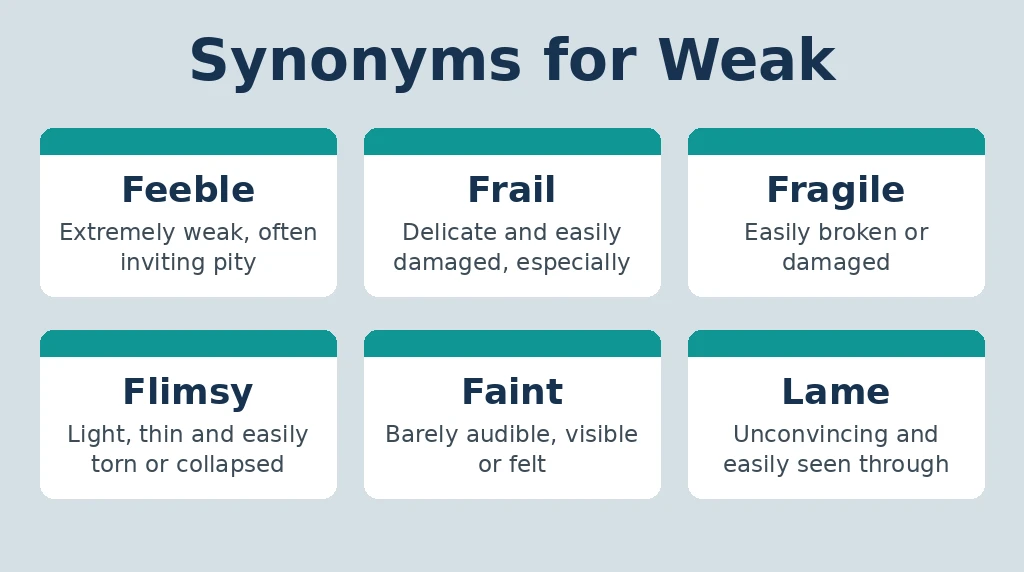
The soup was weak, the excuse was weaker, and by Friday afternoon so was I. Few adjectives hold down as many jobs as weak, and few wear out as fast from overuse. The closest matches split by what’s failing: feeble and frail for bodies that lack strength, flimsy and unconvincing for arguments that won’t stand up, spineless for character, thin for taste and faint for sound. Seventy-nine synonyms are gathered here, grouped by body, structure, argument, character, taste and sound, and by the weak spots where people and plans get caught out.
Every word below was checked against real thesaurus entries, and each one comes with a plain meaning and a short example, because a synonym only proves itself inside a sentence. Whether you’re describing a patient, a proposal, a cup of tea or a phone signal, one of these groups holds the exact word your sentence has been stretching for.
Top Synonyms for Weak: Quick Reference
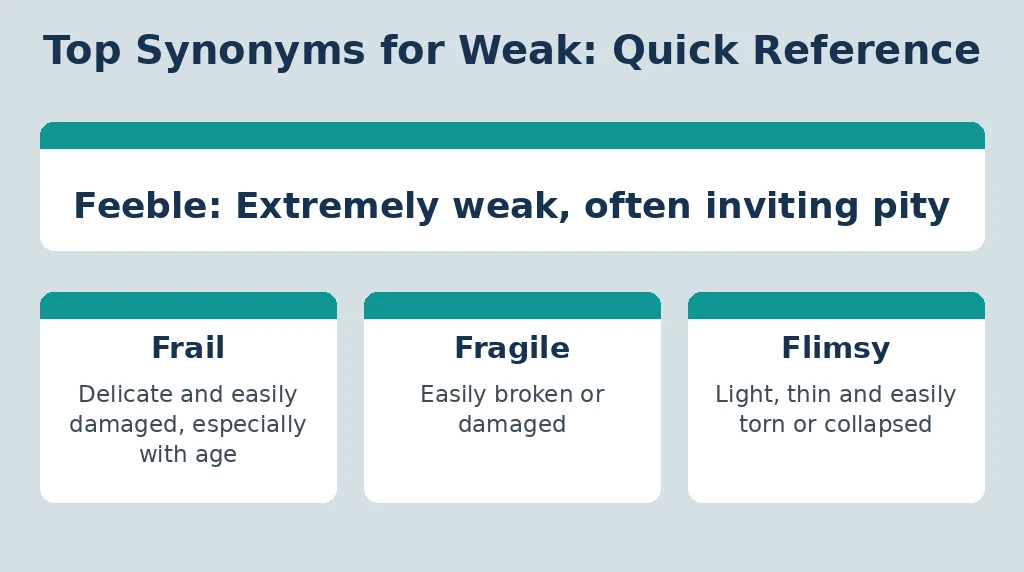
In a hurry? Start here. These are the synonyms writers reach for most, with what each one really means and where it earns its keep. The fuller groups below sort out the finer differences.
| Word | Meaning in one line | Best for |
|---|---|---|
| Feeble | Extremely weak, often inviting pity | Bodies, efforts, arguments |
| Frail | Delicate and easily damaged, especially with age | Older people, health |
| Fragile | Easily broken or damaged | Objects, health, peace talks |
| Flimsy | Light, thin and easily torn or collapsed | Structures, evidence, excuses |
| Faint | Barely audible, visible or felt | Sounds, light, feelings |
| Unconvincing | Easily seen through and hard to believe | Excuses, jokes, arguments (informal) |
| Poor | Below the standard expected | Excuses, quality, performance |
| Infirm | Unsteady through old age or illness | Older or sick people |
| Decrepit | Worn out and broken down by age | Buildings, bodies, machines |
| Puny | Small and weakly built | People, animals (often mocking) |
| Delicate | Easily made ill or damaged | Children, health, fabrics |
| Spineless | Lacking courage or determination | Leaders, decisions, character |
| Cowardly | Unwilling to face danger or difficulty | Behaviour, character |
| Indecisive | Unable to make decisions | Leaders, committees |
| Vulnerable | Open to attack or harm | People, positions, systems |
| Defenseless | Without protection | People, places, arguments |
| Thin | Watery and lacking body | Soups, sauces, coffee |
| Watery | Too diluted, full of water | Food, drinks, eyes |
| Bland | Mild to the point of dullness | Taste, food, remarks |
| Insipid | Without flavour or interest | Food, drink, performances |
| Quiet | Low in volume | Voices, rooms, sounds |
| Low | Soft and near the floor of hearing | Voices, murmurs |
| Rickety | Shaky and likely to collapse | Furniture, stairs, buildings |
| Brittle | Hard but snapping easily | Materials, bones, tempers |
| Hopeless | Completely without skill | Skills (informal) |
| Inept | Clumsy and without skill | Work, communication, attempts |
What Does Weak Mean?
At its core, weak means lacking strength or power. A weak person can’t lift much. A weak structure can’t bear much. Meanwhile, a weak argument can’t convince anyone, and a weak tea can’t wake anybody up. The word comes from the Old English wāc, pliant or yielding, and that old idea of giving way still sits inside every modern use: something weak bends, fades or fails when pressure lands on it.
What changes from sentence to sentence is the kind of pressure. Bodies fail under effort and illness. Materials fail under weight. Arguments fail under questions. Leaders fail under responsibility. Flavours fail under water, and voices fail under distance. Weak is the plain umbrella word for all of these failures, which is exactly why it so often needs replacing: it tells the reader that something failed, but not how, where or how badly.
Tone matters too. Weak itself is fairly neutral, but its synonyms carry strong flavours of feeling. Some are tender, like frail for a much-loved grandmother. Some are pitying, like feeble. Others are openly scornful, like pathetic or puny, and a few, weedy and rubbish among them, belong to the playground and the pub rather than the page. Picking a synonym for weak is partly picking how kindly, or how cruelly, you want to sound.
Weak also builds useful phrases. A weak point or weak spot is the place where a person, a team or a plan is most likely to fail. Students say they’re weak in maths or weak at spelling, using the word to mean unskilled rather than unwell. And a weak voice often sits right next to a soft one, so the two families overlap more than most learners expect.
The word travels with a small crowd of set phrases that writers use without thinking. A weak dollar and a weak market belong to the finance pages, where weak means falling in value rather than in strength. A weak showing belongs to sport and elections: a performance well below expectation. And the weakest link, borrowed from the old truth that a chain snaps at its feeblest point, has become the standard name for the team member most likely to cost everyone the game.
Weak Bodies: When Strength Is Missing
This is the oldest and most familiar sense: a body that can’t do what bodies are supposed to do. Illness, hunger, age and exhaustion all live here, and the words range from the clinical to the cruel. Reach for them when the subject is a person or an animal, and mind the tone, because several of them mock as much as they describe.
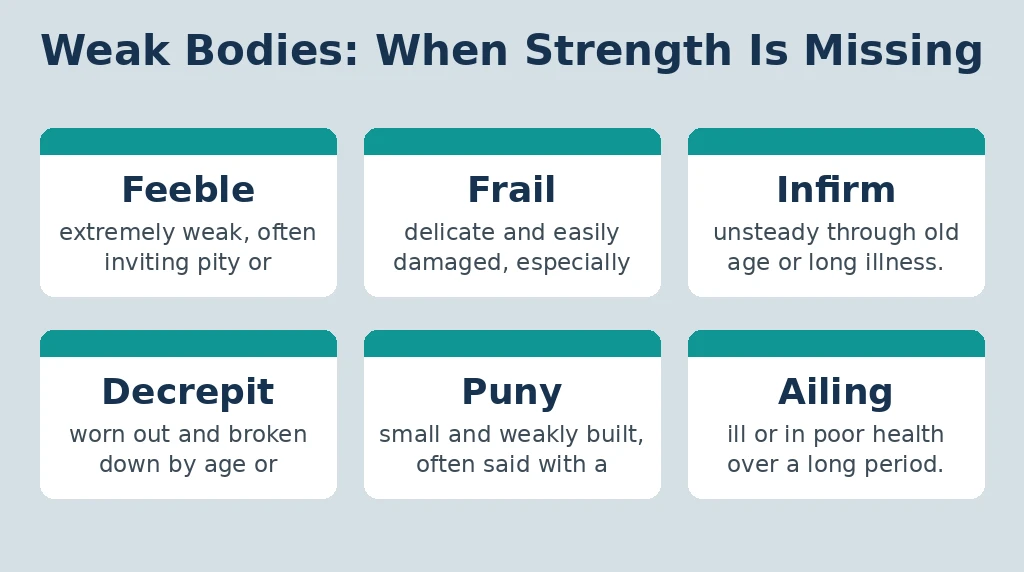
- Feeble: extremely weak, often inviting pity or contempt. After the fever broke, he was too feeble to lift the cup.
- Frail: delicate and easily damaged, above all through age. My frail grandmother still insists on carrying her own shopping.
- Infirm: unsteady through old age or long illness. The infirm residents need a hand on the stairs.
- Decrepit: worn out and broken down by age or neglect. A decrepit old sailor mended nets down by the harbour.
- Puny: small and weakly built, often said with a sneer. He was a puny child who grew into a champion swimmer.
- Ailing: ill or in poor health over a long period. She shares a flat with her ailing father.
- Sickly: often ill, never quite well. He was a sickly boy who missed half of every winter term.
- Delicate: easily made ill, needing gentle handling. Born early, she stayed a delicate child for years.
- Debilitated: drained of strength by illness or hardship. Debilitated by months of treatment, he rested between short walks.
- Exhausted: completely drained of energy. Too exhausted to argue, she fell asleep on the train.
- Enervated: drained of vitality, often by heat or illness (formal). The humid afternoon left the whole office enervated.
- Languid: slow and listless for lack of energy. Languid after lunch, the cat stretched out and refused to move.
- Anemic: lacking vitality, as if short of blood. His anemic handshake inspired no confidence at all.
- Doddery: shaky and unsteady, especially in old age (informal, mainly British). The doddery judge peered over his glasses at the court.
- Weedy: thin, weak-looking and unimpressive (informal, mainly British). The weedy new recruit surprised everyone on the assault course.
Look how the group divides by cause. Infirm, decrepit and doddery blame age. Ailing and sickly blame long illness. Exhausted blames effort, and it’s the only word in the group that expects a good night’s sleep to fix the problem by morning.
Doctors and nurses keep this group in daily service, and their usage explains why plain weak survives alongside its fancier relatives. Patients report feeling weak. Charts record general weakness. Nobody in a hospital corridor reaches for enervated. The lesson for writers: in clinical settings the simple word is the professional one. Save the synonyms for the moments when a specific flavour of frailty, age, pity or contempt is genuinely part of the story.
Weak Structures: Built to Break
Weak also describes things that can’t take weight, knocks or rough handling: fences, floors, ladders, boats and bones. These words warn the reader that something is one good push away from failing, and they’re as useful in a safety report as in a novel.
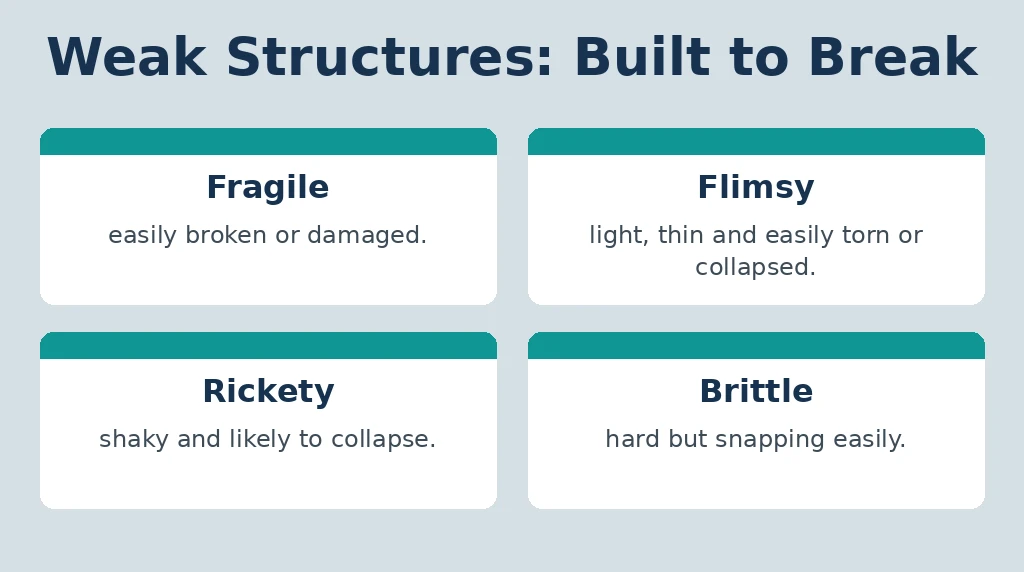
- Fragile: easily broken or damaged. Pack the fragile glasses on top of everything else.
- Flimsy: light, thin and easily torn or collapsed. A flimsy raft is no match for a rough river.
- Rickety: shaky and likely to collapse. We climbed the rickety stairs one at a time.
- Brittle: hard but snapping easily. Dry twigs turn brittle underfoot in autumn.
- Unsound: not solid or reliable in structure. The bridge closed after inspectors found the timbers unsound.
- Breakable: able to be broken easily, a warning word. The shop keeps its breakable vases behind glass.
- Dainty: small, delicate and easily damaged. Dainty china cups chipped whenever we stacked them carelessly.
- Fine: very thin and delicate in texture. Fine threads snapped as she pulled at the seam.
- Shaky: unsteady and liable to give way. A shaky ladder is an accident waiting to happen.
Fragile and delicate are the gentle words here, the ones printed on parcel labels and used in museums. Rickety and flimsy are warnings. Unsound is the word of inspectors and surveyors: it says the weakness is real, measured, and officially somebody’s problem.
Engineers think about this family more literally than the rest of us. Every design review hunts for the weak point, the joint or panel where failure will start, and building codes exist largely to make sure that point is strong enough. When a report calls a structure unsound, it isn’t being poetic. It’s recording that somebody measured the weakness, priced it, and signed their name underneath the measurement for the lawyers to find later.
Weak Arguments, Excuses and Claims
In classrooms, courtrooms and comment sections, weak stops being about muscle and becomes about proof. A weak argument can’t survive questions. A weak excuse can’t survive a raised eyebrow, and most of the words in this group agree that a weak excuse is basically a poor one that everyone can see through.
- Unconvincing: easily seen through and hard to believe (informal). He mumbled some unconvincing excuse about oversleeping again.
- Poor: below the standard expected. That’s a poor excuse for missing the deadline.
- Invalid: not based on sound logic or facts. The hard figures make those arguments invalid.
- Unsatisfactory: not good enough to accept. Inspectors rated a third of the lessons unsatisfactory.
- Faulty: containing mistakes in reasoning or construction. Their reading of the data was faulty.
- Inadequate: not enough in quality or strength. Her answer was inadequate and missed the point entirely.
- Wanting: found lacking when tested. The review examined his work and found it wanting.
- Pathetic: so weak it invites scorn (strong and informal). That’s the most pathetic excuse I have ever heard.
- Shallow: lacking depth or serious thought. A shallow argument collapses at the first hard question.
- Ineffectual: producing no useful effect. The committee issued an ineffectual protest and went home.
- Slight: small in force or effect. His apology made only a slight difference to the outcome.
One caution on the four letter word for a leg that cannot walk properly: its older literal meaning is physical, and some readers dislike the metaphor for exactly that reason. In formal writing, unconvincing, flimsy or inadequate will always be the safer instruments, and they lose none of the sting.
Reviewers and headline writers live on this group. A weak showing at the ballot box, a weak third act, a weak productivity report: the phrase does brisk, neutral work in journalism because it criticises the performance without inventing motives for it. Opinion pages then reach past it for the heavier weapons, unconvincing for the excuse, pathetic for the effort, flimsy for the evidence, and the temperature of the page rises by exactly the amount the writer intended.
Weak Character: Leaders Without a Backbone
Applied to people in charge, weak stops meaning unwell and starts meaning unwilling: unwilling to decide, to refuse, to take a side or to take the blame. These are the words of editorials, resignation speeches and dressing-room arguments, and most of them are accusations rather than descriptions.
- Cowardly: unwilling to face danger or difficulty. I was too cowardly to complain to his face.
- Spineless: lacking courage or determination. Spineless officials refused to make the decision.
- Indecisive: unable to make decisions. Critics called him a weak and indecisive leader.
- Irresolute: hesitant and unable to commit. Fearing to seem irresolute, they attacked at dawn.
- Timorous: nervous and lacking confidence (literary). A timorous creature, he avoided every meeting he could.
- Weak-kneed: lacking in resolution (informal). The weak-kneed response satisfied nobody at all.
- Impotent: powerless to act or influence events. Bullies leave their victims feeling hurt, angry and impotent.
- Powerless: without the power to act. She felt powerless against the committee and its ruling.
- Soft: too lenient, not strict enough. Voters complained that the sentence was soft on criminals.
- Boneless: without firmness or resolve (informal and humorous). His boneless handshake matched his boneless speech.
The kindest word in this group is indecisive, which blames the process rather than the person. The cruellest is spineless, which says the backbone was never there at all. Choose with care. Once a leader has been called spineless in print, the word tends to follow them for years.
Campaign language deserves a footnote, because modern politics runs on this vocabulary. Candidates promise never to be weak on crime, weak on borders or weak on the economy, and the frame “weak on” has become a fixed mould any topic can be poured into. Once you notice the mould, you’ll see it in every debate, which is exactly why the older, stranger words in this group, irresolute, timorous and boneless among them, feel like fresh air when a writer bothers to use them.
Weak Tea and Faint Voices: Taste, Sound and Light
Some weaknesses you can taste. Others you can barely hear. Weak tea, weak coffee and weak soup all fail the same way: too much water, not enough of the thing itself. The flavour words come first here, because they’re the ones cooks and critics actually argue about.
- Thin: watery and lacking body. The soup was thin and clear, with nothing in it.
- Watery: too diluted, full of water. We were served watery cabbage soup and hard bread.
- Diluted: weakened by added water. Children are encouraged to drink diluted fruit juice.
- Runny: thinner and more liquid than it should be. Warm the honey until it turns runny.
- Insipid: without flavour or interest. He sipped the insipid beer and ordered water instead.
- Bland: mild to the point of dullness. The soup is very bland and could use more herbs.
- Tasteless: having almost no flavour at all. The boiled chicken was practically tasteless.
- Flavorless: completely without flavour. Winter tomatoes from the supermarket are often flavorless.
- Watered-down: diluted and less powerful than the original. The bar served bad food and watered-down cocktails.
Sound and light keep a family of weak words of their own. A weak signal, a weak voice and a weak lamp all share one problem: the message is there, but it arrives faded, and the listener or viewer has to strain to receive it.
- Faint: barely audible or visible. Somewhere below us came the faint sound of dripping water.
- Quiet: low in volume. A quiet murmur passed through the classroom.
- Low: soft and near the floor of hearing. Her voice was so low that he strained to catch it.
- Muffled: deadened, as if covered or wrapped. A muffled cough came from behind the door.
- Indistinct: not clear enough to make out. The words stayed indistinct through the thin wall.
- Dim: giving little light. She stood waiting in the dim light of the porch.
- Pale: faint and washed out, of light. A pale light seeped through the curtains.
- Dull: muffled and flat, of a sound. The box landed with a dull thud.
- Wan: pale and feeble, of light (literary). The lamp cast a wan light through the fog.
Technology has given this family a second career. The weak signal is now the most frequently met weak thing in ordinary life, announced by phones, routers and car radios, and it behaves exactly like the faint voices above it: present, fading, demanding that somebody move closer to the source. Photographers speak the same language about weak light at dawn, drummers about a weak beat, so the sense of something arriving below full strength now runs from the concert hall to the coat pocket.
Weak Spots: Where Things Fail Under Pressure
Every system has a weak spot: the fence panel a fox can push through, the password a stranger can guess, the full-back a winger can beat. The first words here describe positions and people left open to attack, the places where a little pressure does a lot of damage.
- Vulnerable: open to attack or harm. The disease most often affects vulnerable people.
- Defenseless: without protection. A leader who leaves the country defenseless will not be forgiven.
- Unguarded: left without protection. The boats slipped in through an unguarded harbour entrance.
- Exposed: left open to attack or criticism. The troops were exposed on the open ridge.
- Helpless: unable to defend or save oneself. The children were left helpless in the storm.
- Unsafe: not protected from danger. In the larger neighbourhood she felt very unsafe.
- Untenable: impossible to defend, of a position or claim. He finally admitted the charges were untenable.
- Wide open: completely exposed (phrase). The virus leaves the body wide open to infection.
A weak spot can also live inside a person’s skills. English is cheerfully blunt about this sense, and most of its words are informal ones you’d use about yourself long before you used them about anyone else.
- Hopeless: completely without skill (informal). I am completely hopeless in the kitchen.
- Useless: bad at a task (informal, mainly British). He is useless at maths and proud of it.
- Rubbish: very bad at something (British informal). She is a pretty rubbish singer, really.
- Incompetent: lacking the skill to do a job properly. The rules make it hard to remove incompetent teachers.
- Inept: clumsy and without skill. He is a woefully inept communicator.
- Inexpert: enthusiastic but unskilled. An inexpert dancer, he stepped on every toe in the room.
- Unskilled: without training or skill. There’s a shortage of unskilled workers on the site.
- Amateurish: done like a beginner, not a professional. Her first efforts at writing were amateurish, to say the least.
Coaches and strategists earn their money inside this section. Attacking the weak side, shielding a vulnerable player, hiding a hopeless defender: whole game plans are built from the words above, and business borrowed the habit wholesale, which is why reports now speak of exposed companies and untenable market positions. Reference works even keep the old expression for the most famous weak spot of all, the Achilles heel, the single tender point in an otherwise armoured hero. Every team, company and government is quietly hoping nobody finds theirs.
How to Choose the Right Synonym for Weak
Start by naming the kind of failure. If a body can’t manage effort, you’re in the feeble and frail family. If a thing can’t manage weight, you want fragile, flimsy or rickety. An idea that can’t manage questions needs unconvincing, invalid or inadequate. And if a person can’t manage responsibility, the choice is between indecisive and spineless, depending on how much blame you intend to deliver.
Next, set the volume. Weak words run on a volume dial, and turning it too far is the commonest mistake learners make. Pathetic, puny and spineless are shouting words: they judge, mock and accuse all at once. Frail, delicate and faint are quiet words that describe without attacking. Most careful writing lives in the middle of the dial, where inadequate, unsound and vulnerable report the weakness plainly and let the reader supply the verdict.
Finally, check the partnership. Weak words keep company with particular nouns, and the wrong pairing sounds off even when the meaning is close. Tea goes watery or watered-down. Arguments go flimsy or invalid. Voices go faint. Positions go untenable. If a pairing sounds strange in your head, it probably is, and one of the neighbours in the same group will usually fit the noun better.
| Situation | Best word | Why |
|---|---|---|
| A grandmother recovering from surgery | Frail | Tender and physical, with no hint of blame |
| An excuse for being late again | Unconvincing | Informal, dismissive and instantly understood |
| A claim that fails in court | Invalid | Precise about logic and evidence |
| Coffee with no strength in it | Watered-down | Blames the extra water, exactly the fault |
| A voice on a failing phone line | Faint | Describes sound fading, not character |
| A leader who will not decide | Indecisive | Criticises the habit without mocking the person |
If you remember nothing else, remember the ladder of kindness. At the gentle end stand frail, delicate and faint, which describe without blaming. On the level middle rungs stand inadequate, faulty and vulnerable, which simply report what they find. At the far end stand pathetic, spineless and puny, which attack. Most mistakes with this family aren’t wrong meanings but wrong rungs: the writer reached for a report and accidentally delivered an attack, and the reader felt the difference at once.
Weak Synonyms for Writing and Dialogue
In fiction, weak is a word to spend carefully, because readers believe specifics and shrug at labels. A feeble hand trembling on a teacup tells us more than a weak man ever could. A rickety staircase creaks in the reader’s ear in a way a weak staircase never will. Give each weak thing its own precise failure and the scene starts to move on its own.
Dialogue runs on its own economy. Real people insulting each other rarely reach for the formal end of this list: they say unconvincing excuse, pathetic effort, useless at maps. Friends describing themselves go softer still, hopeless and rubbish doing cheerful duty in British mouths. Save spineless and cowardly for the moment a relationship is meant to break, because in speech those words aren’t descriptions. They’re declarations of war.
In essays and reports the register flips. Academic and professional writing prefers the measured middle of the family: inadequate evidence, a faulty method, an untenable position, a vulnerable population. These words carry authority precisely because they refuse to sneer. A reviewer who writes that an argument is inadequate sounds like a judge. One who writes that it’s pathetic sounds like a rival, and readers trust judges further.
Journalism lives between the two, reporting weak showings, weak signals and weak leadership in a vocabulary its readers already own. The craft skill is the same at every level, though: pick the word that names the failure exactly, and the plain little adjective weak can be saved for the rare sentence where plainness is itself the point.
Poetry and proverb keep the oldest flag flying for this word. The spirit is willing, but the flesh is weak: the line has been quoted for two thousand years because it divides the human being into the part that intends and the part that fails, which is the whole subject of this guide in nine words. A writer who understands that division will never use weak as a lazy insult again, because the word, properly aimed, is a diagnosis of the exact place where intention and strength part company.
Antonyms for Weak
Every weak word in this guide points at the same missing thing, which is why its opposites cluster so neatly. For most senses, the word writers actually need is strong, and the list below gathers the main members of that opposing family.
- Strong: having power, force or flavour in full measure.
- Sturdy: strongly built and unlikely to break.
- Powerful: having great strength or influence.
- Muscular: having well-developed muscles and force.
- Robust: strong, healthy and full of vigour.
- Healthy: well and in good physical condition.
- Hearty: warm, vigorous and substantial.
- Potent: powerful in effect, of drinks, drugs and arguments.
- Convincing: able to make people believe something.
- Loud: strong in volume, the opposite of a faint sound.
Notice the antonyms sort themselves by the same senses as the synonyms: sturdy answers rickety, potent answers watered-down, convincing answers unconvincing, and loud answers faint. Choosing the right end of the scale matters as much as choosing the right word on it, and a sentence that gets both ends right rarely needs a third draft.
Common Mistakes: Words That Are Not True Synonyms for Weak
The most famous trap isn’t a synonym at all: week. Weak with ea means lacking strength; week with ee is the seven-day period, and the two swap places in student writing more than any other pair in this guide. A memory hook helps: seven has two e’s, and so does week. A weak performance in an exam is a problem. A week performance is just a spelling mistake with good timing.
Next, feeble-minded. It looks like a stronger version of feeble, but it’s an old term for intellectual disability and is now dated and offensive in most contexts. It never simply means physically weak or unimpressive, and it has no place as an upgrade for feeble in modern writing, however old the book you found it in may be.
Weak sauce causes a different kind of trouble. It’s informal slang, a noun phrase meaning something pathetic or disappointing, and it can’t do the adjective’s ordinary work: a presentation can be called weak sauce by a bored teenager, but a weak bridge, a weak tea and a weak signal cannot. Keep it for dialogue, if you keep it at all.
Finally, mind the word family itself. Weaken is a verb, weakness is a noun, and weakly is mostly an adverb: none of them can stand where the adjective weak stands. Sentences like “the soup tasted weakness” fail not on vocabulary but on grammar, and no thesaurus, however honest, can rescue a word asked to do the wrong job.
One modern trap deserves a final word. Voice typing and auto-transcription confuse weak and week constantly, because the two sound identical, and the error survives proofreading precisely because both spellings are real words. Any sentence about a weak showing last week contains both sounds at once, which is why careful writers still read their weakest pages aloud before publishing them.
Frequently Asked Questions
What is the best synonym for weak?
It depends on what’s failing. For bodies, feeble and frail do the most everyday work. For arguments and excuses, flimsy and unconvincing, with invalid as the precise choice when the logic itself breaks. Thin and watered-down are the kitchen standards for taste. For sound, faint is the word writers reach for first.
What is the difference between weak and feeble?
Weak is the general word: any lack of strength or power. Feeble is stronger and narrower. It suggests extreme weakness, the kind that invites pity or even contempt. A boxer can feel weak after a hard round. A feeble attempt at a punch barely deserves the name.
What is a weak argument called?
Casually, a weak argument or excuse is unconvincing, and evidence that can’t support a claim is flimsy. When the reasoning itself breaks the rules of logic, the precise word is invalid. A formal report would more likely settle for inadequate or unsatisfactory.
What is a harsher word than weak?
Pathetic, for people and efforts, with spineless close behind for character and cowardly for behaviour. For bodies and buildings, decrepit travels further than weak by adding age and neglect. All of them judge as well as describe, so they suit opinion writing better than reports.
Final Thoughts
Weak turns out to be a hardworking little word with a surprisingly large family: the frail and the feeble, the flimsy and the unconvincing, the spineless and the watered-down, all failing in their own exact ways. Once you can see which failure you mean, the right synonym usually steps forward by itself, and your sentences stop apologising for their vocabulary.
For an even wider trawl through this family, the Merriam-Webster Thesaurus entry for weak gathers hundreds of relatives, near matches and opposites in one place. Keep this guide nearby as well, and the next weak draft, weak signal or weak excuse you meet will get the precise word it deserves.
Discover More Post:
- Synonyms for Define | Meaning, Examples, and Better Word …
- Synonyms for Shape |25+ Meaning, Context, Examples …
- Synonyms for Sacrifice |25+ Meaning, Examples, and …

1 thought on “Synonyms for Weak | 79+ Powerful Alternatives to Express Every Shade of Weakness in 2026”