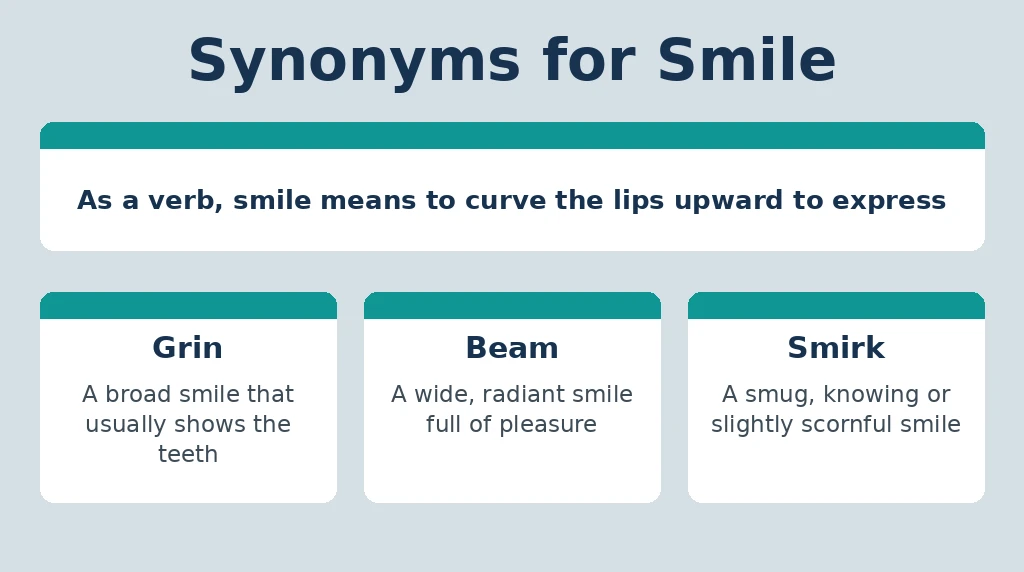
The border officer has seen ten thousand passports today. Then one traveller smiles at him, a real one, and the whole transaction softens. A smile is the smallest unit of friendliness humans trade in, and also one of the easiest to fake, which is why English keeps such a careful vocabulary for it: a grin for delight, a beam for pride, a smirk for secrets, and a whole shelf of phrases for the smiles that are working harder than they look. In fact, this guide to synonyms for smile shows how each one earns its place. In fact, a smile can soften even the most formal meeting.
This guide covers 19 synonyms for smile, sorted by the questions readers actually ask about a face. What is it feeling? Is it genuine? How big is it? And where does it stop being a smile and start turning into a laugh? Every word below has been checked against real thesaurus entries. Begin with the glance table, then read the groups that match the faces you write about, argue with and fall for in an ordinary week. For example, the synonyms for smile in this guide cover delight, pride, kindness, and scorn. In addition, each word comes with a plain meaning and a short example.
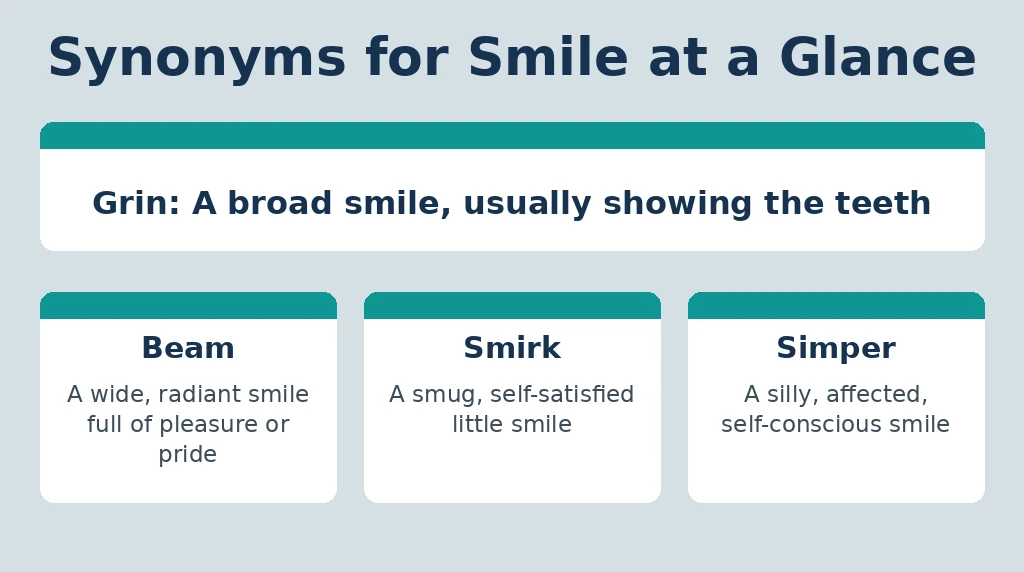
Synonyms for Smile at a Glance
Fourteen words and phrases carry nearly every smile in print. The sections after the table sort them by emotion, honesty and size. For instance, a grin suits delight and a beam suits pride. As a result, writers can pick the exact word for the feeling.
A word about the phrases before the single words complain. English likes to build its smile vocabulary from partnerships (crack a smile, flash a smile, force a smile) more than from fresh single verbs. The partnerships let the language grade effort and duration precisely. A smile cracked, flashed, forced or worn is four different events, and any honest count of synonyms for smile has to include them, as this guide does. Similarly, a cracked smile and a forced smile tell two different stories. In short, the phrases in this guide show how much work a smile can do.
| Word | Meaning in one line | Best for |
|---|---|---|
| Grin | A broad smile, usually showing the teeth | Delight, mischief, victory |
| Beam | A wide, radiant smile full of pleasure or pride | Good news, proud parents |
| Smirk | A smug, self-satisfied little smile | Secrets, scoring points |
| Simper | A silly, affected, self-conscious smile | Flirtation, embarrassment |
| Sneer | A smile twisted into contempt | Scorn, villains, critics |
| Leer | An unpleasant, sidelong smile with bad intent | Threat, sleaze |
| Broad smile | A wide, open, unmistakable smile | Welcome, photographs |
| Gentle smile | A soft, kind, small smile | Comfort, kindness |
| Wry smile | A crooked smile of ironic amusement | Bad luck, dry humour |
| Half smile | A small, partial, uncertain smile | Shyness, sadness, doubt |
| Crack a smile | To smile suddenly, breaking a serious face | Reluctant amusement |
| Flash a smile | To smile briefly and brightly | Greetings, cameras, charm |
| Force a smile | To smile deliberately despite feeling otherwise | Politeness, endurance |
| Grin from ear to ear | To smile as widely as a face allows | Triumph, children, winners |
Notice that even this short table carries a warning label. Three of its entries (smirk, sneer, leer) describe smiles nobody wants to receive. The smile family is not all sunshine, and honest writing needs its shadows named. Meanwhile, the dark smiles in this table warn readers before a single word is spoken. Nevertheless, each one earns its place in the list.
The table hides a small lesson in English spelling habits, too. The happiest entries tend to be short Anglo-Saxon words and phrases (grin, beam), while the doubtful ones arrive dressed in French and older finery (simper, and moue among the antonyms). Language keeps its weather reports in its oldest words, and the face, humanity’s oldest text, is no exception. For example, grin and beam are short words with long histories. In addition, the synonyms for smile in this guide include both the plain and the fancy kinds.
There’s a reason this little expression needs a long guide. A smile is evidence in the courtrooms of the heart. It acquits strangers, convicts liars, and testifies at every first meeting, first date and first day at work. People who “never smile” get described as if a lamp had failed. The vocabulary below is the maintenance manual for that lamp, shade by shade and watt by watt. For instance, a smile can acquit a stranger in a single moment. Also, the wrong smile can convict just as fast.
Keep that officer in mind as the patron of this page. His whole working day is a referendum on the difference between a worn smile and a real one, and he casts his vote in under three seconds, the way readers do. Everything below exists to help you pass his inspection on paper: to know which smile your sentence is wearing, and whether it’s the one you meant to send through the gate. Similarly, a border officer reads smiles the way a teacher reads essays. In short, every smile in this guide faces his inspection.
What Does Smile Mean?
As a verb, to smile is to lift the corners of the mouth, usually to express amusement, pleasure, friendliness or approval. As a noun, a smile is the expression itself, held on a face for a moment. It’s among the first expressions a baby returns and among the first a stranger can read in any country on earth. No wonder it carries so much social weight for something made of two small muscle movements. For example, a smile can lift a room without a single word. As a result, the verb carries more weight than its size suggests.
Smiling even has a professional literature. Flight attendants are trained in its durations. Sales manuals grade its widths. Psychologists time how quickly it fades, because a smile that vanishes instantly reads as performed, while one that blooms slowly reads as felt. Writers rarely need the stopwatch, but the principle transfers intact. In prose as in life, timing is half of sincerity. Meanwhile, sales staff learn the timing of a smile by heart. Nevertheless, the synonyms for smile in this guide still point to real feelings.
The interesting problem is that a smile reports an inner state it can’t guarantee. People smile when they’re happy, nervous, apologising, plotting or posing, and the mouth makes the same basic shape for all of them while the eyes, the timing and the size tell the truth. The synonyms in this guide are lie detectors and mood rings for that shape, each one recording what the rest of the face, and the moment, were doing. For example, a nervous smile can look exactly like a happy one. In addition, the synonyms for smile in this section help readers tell them apart.
The noun runs its own quiet career in phrases. A smile can be exchanged, returned, hidden or suppressed, and in the loveliest idiom of all, it can be worn by a whole landscape, as when a valley smiles in spring. Each partnership opens a different synonym door. An exchanged smile wants smile back. A suppressed one wants half smile, or force a smile read in reverse. A landscape’s smile wants beam, borrowed by the weather. For instance, an exchanged smile feels warmer than a kept one. In practice, a suppressed smile often returns stronger.
Plain smile sounds warm and neutral, the safest expression word in the language. It suits a passport photo and a love poem equally, because it claims so little. Every synonym claims more. Beam claims radiance. Smirk claims superiority. Simper claims silliness, and forced smiles claim effort. Choosing one means choosing what your sentence believes about the person wearing it. Similarly, plain smile works in a courtroom and a nursery alike. In short, it is the safest smile word of all.
One more property of the plain word deserves respect: it’s democratic. Kings and toddlers smile in the same verb. The synonyms are where rank creeps in. Monarchs beam for portraits, toddlers grin at cake, and critics sneer in print. A writer choosing among them is quietly deciding how much ceremony a face deserves, and the decision shows in every line. For example, a king and a toddler wear the same plain smile. As a result, the word suits every rank of person.
Smiles by Emotion
Ask a face what it’s feeling and the smile answers in dialects. Smiles are the face’s native way of being happy, but they also speak pride, kindness, irony and sorrow, sometimes in the same afternoon. Meanwhile, a proud smile lifts the chin as well as the mouth. Nevertheless, the synonyms for smile in this section cover every feeling.
Poets noticed the emotional range long before psychologists timed it. The wry smile belongs to every literature that has known disappointment, which is all of them. The half smile belongs to partings in every language that has a word for railway platforms. Translate these phrases and you carry a whole emotional education with them, which is why this small corner of vocabulary punches so far above its weight. For example, poets have always reached for the wry smile first. In addition, the half smile belongs to partings in every language.
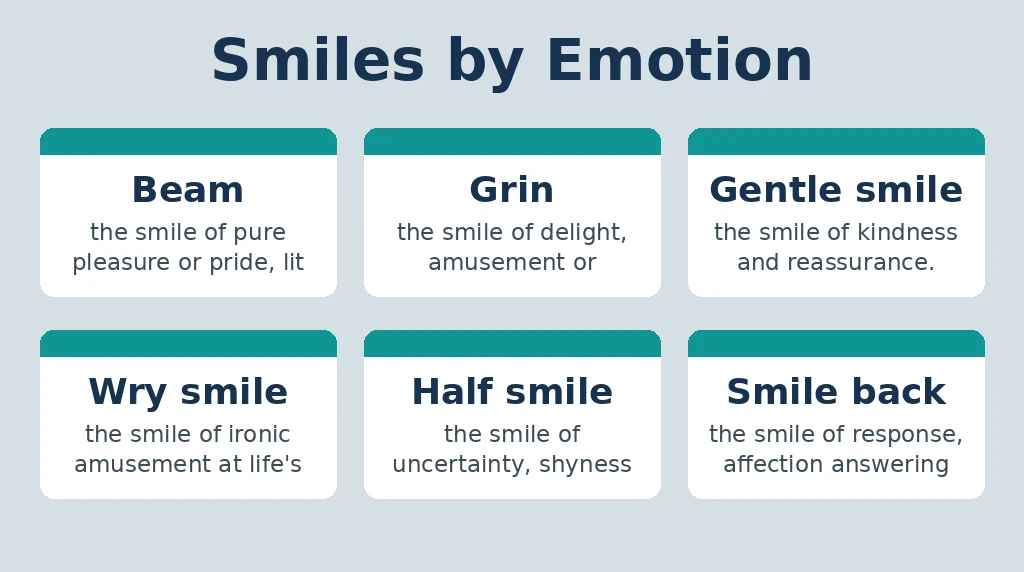
- Beam: the smile of pure pleasure or pride, lit from inside. She beamed when the exam results were posted.
- Grin: the smile of delight, amusement or mischief, teeth showing. He grinned at the punchline before anyone else got it.
- Gentle smile: the smile of kindness and reassurance. The nurse answered with a gentle smile.
- Wry smile: the smile of ironic amusement at life’s small defeats. He allowed a wry smile at the parking fine.
- Half smile: the smile of uncertainty, shyness or quiet sadness. She managed a half smile and looked at the floor.
- Smile back: the smile of response, affection answering affection. The baby smiled back at her grandfather.
- Be wreathed in smiles: the smile of celebration, worn by someone surrounded by good news. The prizewinner was wreathed in smiles for the cameras.
Emotion is where smile earns its reputation as the honest expression, because these words are hard to wear by accident. A wry smile is a whole philosophy in one crooked line. A half smile has ended more arguments in fiction than most speeches, precisely because it admits two feelings at once. For instance, a genuine smile reaches the eyes as well as the mouth. For example, the synonyms for smile in this section help readers tell truth from pose.
Try this exercise. Run one piece of news through the whole family. Tell a character she has won, been forgiven, been mocked and been merely tolerated, and watch the face change: beam, gentle smile, wry smile, half smile. Four sentences, four weathers, no adjectives wasted. Novelists call that economy. Readers call it being unable to put the book down. The difference between the two descriptions is exactly this list. Similarly, one face can wear a dozen smiles in a single day. In short, the exercise proves how much a smile can say.
Genuine Smiles vs Polite and Fake Smiles
Scientists who study faces separate the true smile, which recruits the muscles around the eyes, from the social smile, which is mouth only. Writers have always made the same distinction with vocabulary. This family is where the separation lives. For example, the true smile crinkles the eyes in a way a camera cannot fake. As a result, scientists trust the eye muscles most.
The genuine smile has a scientific name, the Duchenne smile, after the researcher who mapped its muscles. Its signature is the crinkling at the eyes, the thing actors try to fake for cameras. The performed smile’s signature is speed: it arrives too fast and leaves too fast, like a light switched on rather than a dawn. Prose can’t show milliseconds, but it can borrow the distinction wholesale, and this family is the borrowing. Meanwhile, a Duchenne smile warms the whole face at once. Nevertheless, a polite smile can still open doors.
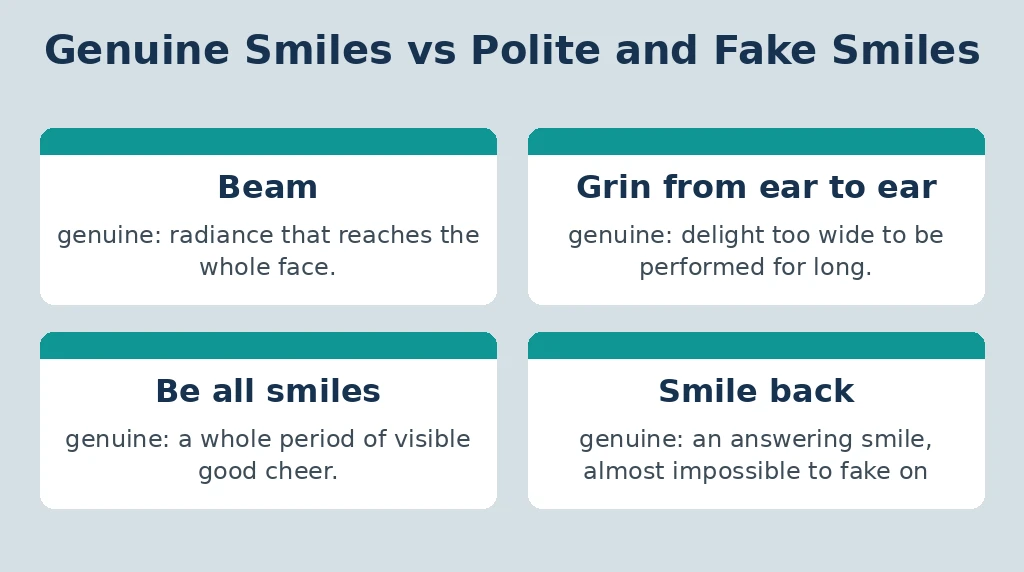
- Beam: genuine: radiance that reaches the whole face. He beamed the moment the letter landed on the mat.
- Grin from ear to ear: genuine: delight too wide to be performed for long. The graduate grinned from ear to ear all through lunch.
- Be all smiles: genuine: a whole stretch of visible good cheer. She was all smiles for days after the wedding.
- Smile back: genuine: an answering smile, almost impossible to fake on cue. He smiled back before he had decided to.
- Force a smile: performed: a smile produced by effort, against the feelings. She forced a smile for the group photograph.
- Wear a smile: performed: a smile put on like clothing for an occasion. He wore a smile through the entire meeting.
- Simper: performed: a self-conscious, affected smile meant to please or flirt. She simpered at the compliment and twisted her napkin.
- Half smile: in between: a smile that starts honestly and gives up. His half smile said everything.
Neither side is morally better in every scene. The forced smile at a difficult counter is a small act of civilisation. The worn smile of a nurse at hour ten is professional kindness. What matters for the writer is that the reader can tell which economy a smile belongs to, effort or overflow. These words keep the accounts separate. For example, the zone words suit smiles that grow slowly. In addition, each one marks a different point on the scale.
Service industries run on the performed side of this family, and their training manuals are secretly synonym guides: greet with a smile (wear one), keep smiling through a complaint (force one), never simper. The genuine side is the currency of celebrations and reunions, where being all smiles is a report, not an effort. Work out which economy your scene trades in and you’ll know whose vocabulary to spend. For instance, an ironic smile hides its meaning behind warmth. Beyond that, readers enjoy spotting the gap.
Smiles That Are Not Happy
The mouth’s curve can carry scorn as easily as joy. Some smiles are weapons, warnings or advertisements of bad character. This small family is essential for villains, critics and awkward dinners, and leaving it out of a smile guide would be like a weather report that omits rain. Similarly, a smile keeps its meaning while it stays quiet. In short, the words in this section stay inside smile country.
Worth asking why the scornful smiles cluster around the mouth while the joyful ones recruit the eyes. Contempt is a judgement, and judgements live in the mouth that would speak them. Joy is a state, and states leak out of every feature at once. The anatomy explains the vocabulary. Leer, smirk and sneer are mouth words because they are verdicts. Beam is a whole-face weather report. For example, a shade of smile can shift the mood of a scene. As a result, writers pick shades the way painters pick colours.
- Smirk: a smug smile of self-satisfaction or secret knowledge. He smirked when his rival misread the question.
- Sneer: a smile curled into open contempt. The critic sneered at the painting and moved on quickly.
- Leer: an unpleasant, knowing smile, usually with desire or threat in it. The stranger leered from the doorway until she left.
- Simper: a foolish, ingratiating smile that invites contempt of its own. He simpered and agreed with absolutely everything.
- Wry smile: an unhappy-adjacent smile of resignation and irony. A wry smile crossed her face at the diagnosis.
Smirk is the mildest of the dark family, often more annoying than wicked: the smile of someone enjoying a point scored. Sneer drops the amusement and keeps the contempt. Leer adds intention and makes bystanders take a step back. Grade these three correctly and you can run a whole antagonist on facial expressions alone. For example, a smirk can ruin a warm welcome in a second. In addition, the dark smiles in this guide warn readers early.
The dark family guards a distinction dialogue writers should note: these smiles are read, not heard, which makes them excellent silent beats. A sneer can answer a paragraph of dialogue without interrupting it. A leer can end a conversation the law would call harassment while the plot calls it chapter three. Spend them carefully. A character who leers twice is a type. One who leers once, at the wrong moment, is a plot. For instance, a mischievous smile warns readers to watch closely. On top of that, irony gives a smile a second meaning.
Smiles by Size and Intensity
Read this family as a ruler laid across the face, from the first crack in a serious expression to a grin that seems wider than the head carrying it. Novelists use the ruler constantly, because a smile growing or shrinking across a scene is a plot in miniature. For example, a crack in a serious face is the smallest smile of all. In addition, a beam is the largest.
Actors train on this ruler the way singers train on scales, moving from crack to broad to beam on a director’s count. The exercise exposes how unnatural the extremes are to hold. An ear-to-ear grin aches within a minute, which is why be wreathed in smiles describes festivals and photographs, short seasons of the face, rather than a temperament anyone could actually live inside. Similarly, actors practise each size of smile like a musical note. In short, the ruler helps writers measure every smile.
- Crack a smile: the smallest unit: a brief smile breaking through seriousness. The stern judge cracked a smile at the witness’s hat.
- Half smile: a partial smile, one side or halfway there. He gave a half smile and shrugged.
- Gentle smile: small but complete, soft rather than wide. Her gentle smile calmed the toddler down.
- Flash a smile: brief and bright, a smile at full power for one second. She flashed a smile at the camera and turned away.
- Broad smile: a wide, open smile that commits the whole mouth. A broad smile spread slowly across his face.
- Grin: broad and toothy, the standard large smile. The grin stayed on his face all morning.
- Beam: wide and radiant, size plus light. She beamed at the audience from the stage door.
- Grin from ear to ear: the maximum grin, a favourite of winners and children. He grinned from ear to ear at the scoreboard.
- Smile from ear to ear: the same maximum in the plain verb’s clothes. They smiled from ear to ear at the news.
- Be wreathed in smiles: beyond size: smiles as a garland, plural and continuous. The bride was wreathed in smiles all day.
Intensity is not the same as sincerity, and the ruler proves it. A flash can be the truest thing in a scene, while an ear-to-ear performance can be pure theatre. Still, in everyday reading, size is the first signal the audience takes. That’s why photographers ask for the big end of this list and passport offices ban it. For example, a flash can be the truest thing in a whole scene. As a result, size alone never proves a smile is real.
Photography has made this ruler famous. The difference between a school-photo grin and a candid beam is the size family and the emotion family colliding, which is why good photographers talk, joke and wait instead of instructing. They’re hunting the moment the performed smile gets replaced by a genuine one. The vocabulary for that hunt is on this page. For example, a school photo catches a performed smile more often than a real one. In addition, the synonyms for smile in this guide mark every size on the ruler.
Words That Blend Into Laughter
At the top of the intensity scale, a smile grows a voice and crosses the border into laugh territory. The words below are not synonyms for smile, and they are not counted in this guide’s list. They are the neighbours across the fence, included because scenes keep wandering over the border and writers need to know when the crossing has happened. For instance, a smile that gains a voice has left smile country. What is more, the neighbours across the border are laughs, not smiles.
Babies patrol this border before anyone teaches them the words. The first social smiles arrive at about six weeks, and the first laughs follow a few months later, as if the face were climbing this guide’s own ladder in order. Parents read the ladder in real time and learn the vocabulary with their hearts first, which may be why these particular words feel less like terminology and more like family news. Similarly, babies learn the smile words before they can spell them. In short, the border between smile and laugh is one babies cross early.
- Chuckle: the first sound past the border: a quiet laugh that often starts as a grin. He chuckled despite himself.
- Giggle: the smile’s younger cousin, sound and silliness together. The class giggled behind the teacher’s back.
- Laugh: the full crossing, breath and voice fully involved. She laughed out loud at last.
- Crack up: the border demolished: helpless laughter, the smile forgotten entirely. The whole table cracked up.
The practical rule is simple. If the scene is silent, you’re still in smile country, whatever the size. The moment breath becomes sound, change families, because readers hear the difference even when the characters pretend not to. Many a seduction, apology and stand-up set turns on exactly that crossing, which is why it earns a signpost here. For example, a silent scene can hold a smile with no sound at all. In addition, a noisy scene may still carry a smile beneath the talk.
There’s a kindness in marking the border clearly, because the two families are judged by opposite standards. A smile gets praised for sincerity; a laugh gets praised for abandon. A character who smiles when laughter is expected seems cold. One who laughs when a smile was wanted seems wild. Whole social tragedies in fiction are built from nothing more than crossing this border at the wrong speed.
How to Choose the Right Synonym for Smile
Three questions choose the word. First, what is the feeling? Joy points to beam and grin, kindness to gentle smile, irony to wry smile, contempt to the dark family. Second, is it honest? Overflow points to the genuine list; effort points to force and wear. Third, how large? The ruler section is your tape measure. Answer the three in order and the vocabulary nearly selects itself.
Situation etiquette adds a fourth question for real life, if not for fiction: what does this room expect? Weddings expect beam and forgive grin. Funerals ration the whole family down to gentle and half. Negotiations reward the wry and punish the smirk. A character who smiles correctly for the room reads as socially fluent before they speak. One who beams at a funeral has started your plot for you.
Watch the eyes in your mind’s picture. The true smile lives as much in the eyes as in the mouth, which is why beam outshines grin when pride or love is involved, and why the dark family (smirk, sneer, leer) all read as mouth-events with cold eyes behind them. If your character’s eyes are laughing too, you’re near beam. If only the mouth moved, you’re near smirk.
Costume matters at the edges of the map. A smile described at a masked ball, in a photograph or across a video call arrives with part of the evidence missing, and writers compensate with the size family, the only one that survives cropping. It’s no accident that emoji, the smallest portraits ever made, are graded almost entirely by this guide’s size and darkness scales.
| Situation | Best word | Why |
|---|---|---|
| A mother at a graduation | Beam | It carries pride and radiance together |
| A boy caught mid-mischief | Grin | It admits delight without apology |
| A diplomat refusing a demand | Wry smile | It softens the refusal with irony |
| A shop assistant at closing time | Force a smile | It honours the effort honestly |
| A rival hearing your bad news | Smirk | It records satisfaction at your expense |
| A shy guest at a loud party | Half smile | It shows participation without confidence |
One more check is duration. Flashes last a second, grins settle in, and being wreathed in smiles describes an era. Match the word’s natural duration to the scene’s clock and the prose stays honest in a way readers feel as trust, even when they can’t name what was done right.
Children read this vocabulary before they can spell it, which is why picture books draw the difference between a grin and a smirk so carefully. Adults pretend the skill is lost, then use it flawlessly at every meeting, reading forced smiles across boardrooms with instruments no scientist has matched. The written words simply give names to an expertise every reader already owns.
Smile Synonyms for Writing and Dialogue
Fiction writers lean on this vocabulary more than any other expression words, because dialogue scenes are full of faces and the verb “said” needs company. A grin before a line makes it bold. A half smile makes it uncertain. A smirk makes it dangerous. Rotate the three through one conversation and a reader can follow the power shifts without a single speech about feelings. Spend the dark family like a strong spice: one sneer can season a whole chapter.
Writing teachers turn this section into a parlour game. Take one line of dialogue and re-tag it with five different smiles, watching the scene curdle, warm or ignite. The game teaches the deepest lesson in this guide: expression words aren’t decoration on dialogue, they’re part of its meaning, as load-bearing as the words inside the quotation marks.
Description has its own fashion to manage. A smile is often called the pretty feature a face can wear, and beauty writing reaches instinctively for beam and broad smile. Resist doing it twice in one piece. The wry and half smiles are the connoisseur’s tools in portraiture, because they suggest a history rather than a mood, and readers lean towards faces with history.
Then there’s the mirror problem. Writers describe the smiles they can picture, so the same three (grin, smile, beam) circle round until the prose goes smooth. The cure sits on the less-visited shelves of this guide. Let a tired hostess wear her smile. Let a proud father be wreathed in them. A rival’s smirk can do the work of a paragraph of backstory, and the faces in your fiction will stop resembling each other at last.
In professional writing, smiles turn up in instructions, reviews and feedback: the welcoming smile of staff training, the forced smile in a complaint letter, the smile a brand promises in its photographs. Naming the exact kind, rather than praising smiles in general, is what separates a useful training manual from a poster. Customer-experience teams have built whole audit forms out of the genuine-versus-performed distinction in this guide.
History offers one more professional corner: portrait painters. Sitters couldn’t hold the big end of the size scale through hours of posing, which is why centuries of portraits wear the half smile, and why one small Florentine half smile became the most famous face in the world. The vocabulary of restraint built Western art’s idea of mystery, a debt every writer describing a quiet face still owes.
Antonyms for Smile
The opposite family turns the mouth down, or turns the whole face against the light. Writers need it as often as the smile itself.
- Frown: to draw the brows together in worry, concentration or displeasure.
- Scowl: to wear a gloomy, angry expression.
- Glower: to stare angrily or sullenly, the frown with eye contact.
- Glare: to look fiercely and fixedly at someone in anger.
- Grimace: to twist the face in pain, disgust or awkwardness.
- Pout: to push the lips out in sulky displeasure.
- Sulk: to refuse cheerfulness in silent resentment.
- Moue: a small pouting expression, a French borrowing for a brief grimace of distaste.
- Cry: to shed tears, the smile’s opposite in the language of joy.
- Weep: to cry quietly and sorrowfully.
Frown is the everyday antonym, but the scales differ. Scowl adds temper. Glower adds a target. Pout subtracts years, belonging to children and to adults being told they resemble them. A scene that moves a face from beam to glower has crossed the whole map of this page, and readers will feel the journey.
The antonyms include two borrowings worth savouring: moue, the little French pout of distaste, and glower, a Scots-flavoured stare that seems to bring its own weather. English collects opposites the way it collects everything, from everywhere. A face in a novel can travel from a Parisian moue to a Highland glower in a single bad afternoon.
Words That Are Not True Synonyms for Smile
Twinkle belongs to the eyes, not the mouth. Eyes twinkle with amusement while the smile does its own work below, and “a twinkle in her smile” is a small category error that editors quietly fix. Keep twinkle upstairs, where it’s a lovely word, and let the mouth keep its own vocabulary.
Dimple names the dents that appear in some cheeks when a person smiles, or the act of producing them. A dimple is evidence of a smile, not the smile itself, the way a footprint is evidence of a walk. It charms in description (“she dimpled”), but it can’t replace smile where the expression itself is the subject.
Gleam and glow are light words on loan. Teeth gleam and faces glow in the neighbourhood of smiles, and poetry may borrow them freely, but in plain prose they describe brightness, not expression. Try the substitution test. “A gleam spread across his face” paints light. “A smile spread across his face” paints a person, and only one of them can be returned.
One final neighbour deserves an honourable mention rather than a warning: laugh lines and smiling eyes are scenery, the traces and instruments of smiles. Meeting them in lists of synonyms is a sign the list has stopped counting words and started counting associations. This guide has kept them out of the count on purpose, and readers comparing guides can use that as a quick honesty test.
Look happy and its cousins (look pleased, look delighted, look amused) are paraphrases, not synonyms, and the difference matters for substitution. They describe the total effect of a face, and posture, dress or news can produce them as easily as a smile can. Swap one into a sentence built for smile and the sentence still works. Swap smile into theirs and the meaning thins. That’s the evidence that near-neighbours are not family.
Frequently Asked Questions
What is the best synonym for smile?
Grin is the strongest all-rounder: warm, clear and slightly larger than life. Beam wins for pride and joy, gentle smile for kindness, and smile itself is still the safest choice when you want to make no extra claim at all. Pick by the feeling behind the face, not by variety alone.
What is the difference between a grin and a smile?
A grin is a smile widened. It usually shows the teeth and often carries delight, mischief or triumph. A smile can be tiny, closed and polite. Every grin is a smile, but most smiles are too small, too shy or too sad to earn the promotion.
What is a word for a fake or forced smile?
Force a smile is the plain phrase. Wear a smile paints it as clothing put on for show. Simper describes the affected, self-conscious version. And for the saddest variant, the half smile that never quite reaches happiness is the writer’s usual choice.
Is a smirk a kind of smile?
Yes, but a smirk is a smile with the warmth taken out: smug, knowing or slightly scornful, and often lopsided. It belongs to the smile family by shape and to the unfriendly family by feeling, which is why it is so handy for rivals, detectives and anyone enjoying a secret.
How do I describe a beautiful smile in writing?
Reach for beam when the beauty is radiance, broad smile when it is openness, and be all smiles or wreathed in smiles when the whole person seems lit by good news. Then add one concrete detail, the timing, a witness, what just changed, and the description will outshine any pile of adjectives.
Final Thoughts
A smile is two muscles and a universe of meanings. It can beam with pride, crack under duty, shrink to a wry little line at bad luck, or widen until it borrows laughter’s voice. Writers who command grin, beam, smirk and the rest aren’t showing off a vocabulary. They’re refusing to lie about faces, and readers trust them the way they trust the rare person whose smile reaches their eyes.
For the complete family album, including the rare historical relatives of the word, the Merriam-Webster Thesaurus entry for smile gathers every shade in one place. It’s the natural next stop for anyone who has started, as this page earnestly hopes you now have, watching the faces around them more carefully than before.
Discover More Post:
- Synonyms for Movement |25+ Powerful Word Choices for …
- 25+ Synonyms for Ignore | Find the Perfect Word for Every …
- Synonyms for Creativity | Meaning, Powerful Alternatives …

1 thought on “Synonyms for Smile | 35+ Beautiful Words to Express Joy Warmth & Happiness in 2026”