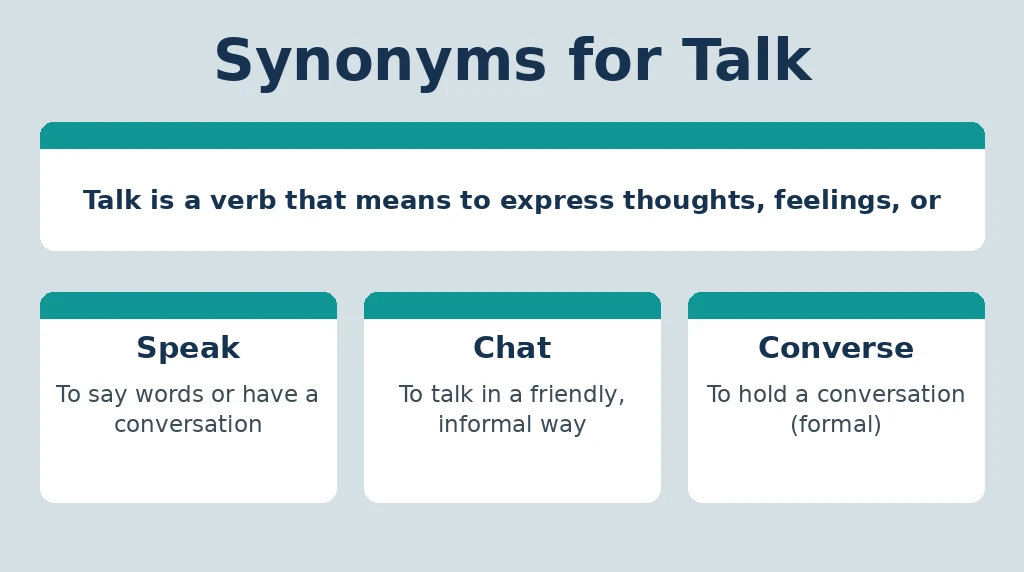
Every office has one: the meeting where a manager talked for forty minutes and said almost nothing. Talk is the easiest verb in English to do badly, in life and on the page. On the page the flatness shows up fast: they talked about the plan, she talked to her brother, he talked and talked. Yet English keeps dozens of sharper instruments for the same act. The core synonyms for talk are speak, chat, converse, discuss, confer and whisper, and each one tunes the volume, the formality and the feeling of the conversation. For example, synonyms for talk give a writer the precise word for each kind of conversation. In addition, the right word can turn a flat exchange into a scene with real tension.
This guide covers 42 distinct synonyms for talk, grouped the way conversations actually differ: casual and friendly talk, formal discussion, quiet talk and secrets, talking far too much, and speaking up to express something that matters. Every word below has been checked against real thesaurus entries and comes with a plain meaning and an example, so you can match the word to the conversation instead of letting one tired verb host every exchange you write. In other words, the guide sorts the words by the job the talking does. As a result, you can find the exact shade you need without wading through a thesaurus.
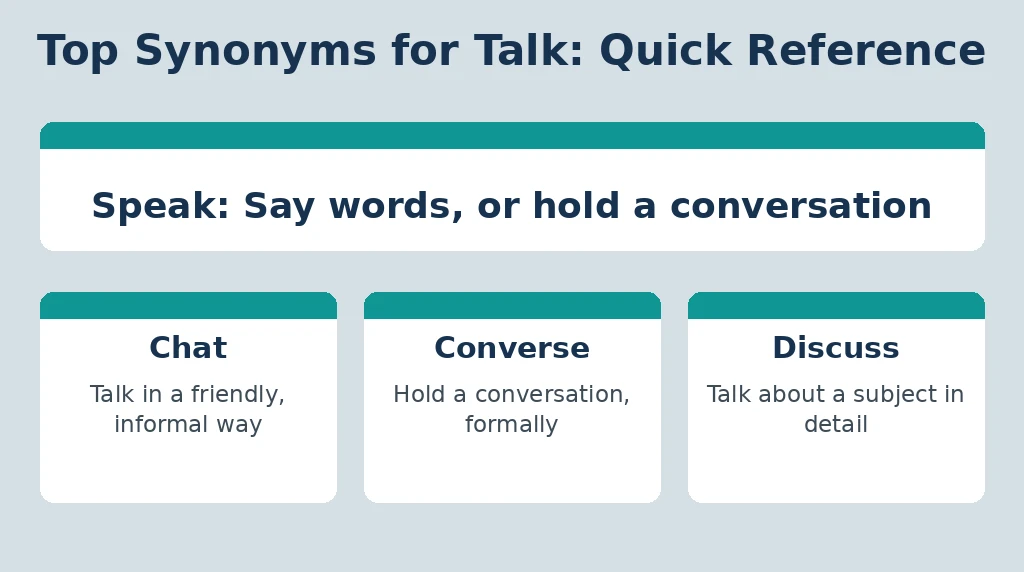
Top Synonyms for Talk: Quick Reference
These are the talk synonyms that cover most of life: the kitchen chat, the boardroom discussion, the whispered secret and the pub rant. The sections below sort them into families and add the specialists, but if you take one table away from this page, this is the one that will serve you daily. For instance, a kitchen chat and a boardroom discussion share a verb but little else. In fact, the setting often picks the word before the speaker does.
| Word | Meaning in one line | Best for |
|---|---|---|
| Speak | Say words, or hold a conversation | The neutral, general word |
| Chat | Talk in a friendly, informal way | Friends, small talk, warmth |
| Converse | Hold a conversation, formally | Polite, formal or old-fashioned tone |
| Discuss | Talk about a subject in detail | Meetings, essays, decisions |
| Confer | Discuss with others in order to decide | Judges, panels, professionals |
| Say | Express something in words | Single statements, short remarks |
| Utter | Say something, or make a sound with the voice | Formal, literary, emphasis |
| Whisper | Speak very quietly | Secrets, libraries, bedtime |
| Murmur | Speak softly and gently, or in a low hum | Tenderness, crowds, complaint |
| Mutter | Speak quietly and unclearly, often angrily | Grumbling, resentment |
| Mumble | Speak quietly and unclearly | Shyness, embarrassment, sleepiness |
| Chatter | Talk quickly about unimportant things | Excitement, children, nerves |
| Gossip | Talk about other people’s private lives | Rumour, scandal, friendly nosiness |
| Lecture | Give a formal talk, or scold at length | Classrooms, telling-offs |
| Communicate | Share information or feelings | Formal, professional, general |
| Express | Show a feeling or opinion in words | Emotions, views, gratitude |
| Verbalize | Put thoughts or feelings into words | Therapy, psychology, formal prose |
| Negotiate | Discuss formally to reach an agreement | Business, diplomacy, pay rises |
| Address | Speak formally to a group | Speeches, ceremonies |
| Debate | Discuss formally, arguing opposite views | Parliament, competitions, essays |
| Consult | Discuss with someone to get advice or a decision | Doctors, lawyers, planning |
| Confide | Tell someone a secret, trusting them | Close friends, diaries, trust |
| Blab | Reveal secrets by careless talking | Comic betrayal, loose tongues |
| Prattle | Talk at length about foolish or trivial things | Silliness, gentle mockery |
| Natter | Talk at length about everyday things, British informal | Neighbours, tea, warmth |
| Gab | Talk a lot, informally | American informal chatter |
| Rap | Talk freely and informally, in slang | Relaxed, streetwise dialogue |
| Rant | Talk angrily and at length | Complaints, outrage, comedy |
One pattern is worth noticing in the table before we go deeper: the friendly words are short and old, chat, gab, rap, while the formal words are long and Latin, converse, negotiate, deliberate. That’s no accident. English keeps its daily life in its shortest syllables, the words children learn first, and dresses up for official business in borrowed finery. Knowing which wardrobe a word comes from tells you most of its register before you even check its meaning, a shortcut that works across this whole family. In fact, short words carry the friendliest meanings in this family. For example, chat and gab feel warm because they sound easy on the tongue.
If you keep only five of these within reach, make them speak, chat, discuss, whisper and rant. They mark the five coordinates nearly every conversation is plotted by: neutral, friendly, serious, quiet and furious. Add confer for professional life and gossip for human life, and you can describe almost any talking scene in English without repeating yourself or reaching for a dictionary in the middle of a sentence you were enjoying. Similarly, a small set of reliable words covers most real conversations. In short, synonyms for talk start with these five and grow from there.
What Does Talk Mean?
Talk means speaking in order to give information, express feelings or hold a conversation. The heart of the word is exchange. Talking is what happens between people, which is why we talk to someone, talk with someone and talk about something. A single sentence shouted at an empty room is speaking, perhaps, but it’s barely talking, because talk expects a listener who might answer. Similarly, speak and converse cover the same act with different manners. In particular, speak stays neutral while converse adds a touch of formality.
That’s also the cleanest way to separate talk from its two famous neighbours. Speak is the general physical act of using the voice in words, and it leans slightly formal: a baby learns to speak, a witness speaks the truth. Say is narrower still, pinned to the words themselves rather than the event of conversation, which is why the synonyms for say are mostly statement words like state, declare and remark. Talk is the social one of the three: the long, looping, two-way business of people exchanging words. For instance, say belongs to the statement family, not the conversation family. Above all, the neighbour test keeps the families apart: talk needs a listener, say needs only a mouth.
The idioms around talk grade character with unusual honesty. Talk is cheap accuses a speaker of words without deeds. To talk the talk is to sound convincing; to walk the walk, in the famous pairing, is to actually be convincing. A talking-to is a scolding, talking back is defiance, and the talk of the town is the person or scandal everyone is discussing. None of these phrases can be rebuilt with speak or converse, which tells you something important: talk is the member of this family that ordinary life chose as its own, and its synonyms should be measured against that warmth as well as against the dictionary. In short, the idioms show how talk judges people. At the same time, none of them works with speak or converse, which proves the point about talk.
Talk also leads a second life as a noun. A talk can be a lecture, as in a talk on climate change, or a negotiation, as in peace talks, or the manner of someone’s speech, as in baby talk and straight talk. Those noun uses explain why address and lecture appear in this guide: both name occasions where talking has been organised, given a room and a starting time, and expected to behave itself. In other words, the noun form covers both the event and the lecture. For this reason, a talk can mean a chat or a sermon, and only context decides which.
Talk has also survived a change of medium that killed lesser verbs. A century ago, talking required a room or a telephone line. Now most talk happens in writing, in group chats, comment threads and voice notes, yet the verb family adapted without blinking: we still chat in text, still gossip in group messages, still rant in posts and still whisper, somehow, in all lowercase at 1 a.m. The words describe the social act rather than the technology, which is why they ported so easily, and why a writer can use the whole family confidently in scenes set in any decade. Consequently, talk now covers phone calls, texts and voice notes as well as face-to-face speech. In fact, the verb adapted faster than the manners around it did.
And watch how talk handles tone. Plain talk is honest talk. Small talk is social grease. Sweet talk is flattery with an agenda, and talking back is a crime known to every child. The verb itself is neutral and friendly, but it sits at the centre of a whole weather system of phrases about honesty, intimacy and power. Its synonyms inherit that range, which is why the families below are sorted by feeling as much as by meaning. In other words, the tone words sort talking by intention. For example, sweet talk and plain talk describe opposite motives in the same conversation.
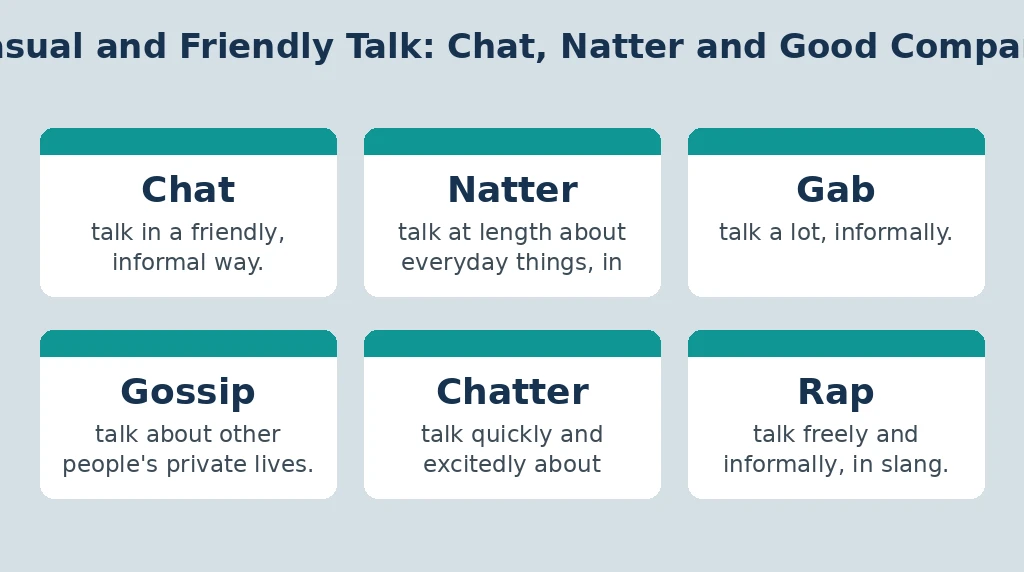
Casual and Friendly Talk: Chat, Natter and Good Company
Most of the talking in a human life is this kind: unplanned, low-stakes and warm. The words below are the vocabulary of kitchens, buses, hairdressers and long phone calls. They differ mainly in how much substance the talk contains, and in how the speaker feels about the talker. For instance, a bus stop chat can carry more warmth than a planned meeting. In addition, the words below come from kitchens and phone calls, not from textbooks.
- Chat: talk in a friendly, informal way. We chatted over coffee for an hour.
- Natter: talk at length about everyday things, in British informal English. The neighbours nattered over the fence.
- Gab: talk a lot, informally. They gabbed on the phone until midnight.
- Gossip: talk about other people’s private lives. The office gossiped about the new manager for a week.
- Chatter: talk quickly and excitedly about unimportant things. The children chattered all the way home.
- Rap: talk freely and informally, in slang. We rapped about music until the shop closed.
- Chew the fat: talk in a relaxed, leisurely way, in an idiom. The old friends sat chewing the fat until dark.
- Shoot the breeze: talk casually about nothing important, in an American idiom. They spent the afternoon shooting the breeze on the porch.
Small talk deserves its own defence, because it’s the most underrated member of the family. Small talk is chat with the stakes deliberately set to zero: weather, traffic, weekend plans. It sounds trivial and does essential work, testing whether a stranger is safe, filling the dangerous silences of lifts and waiting rooms, and warming up relationships that may later carry real weight. Writers who mock it in fiction usually hand it to characters who are about to be lonely; writers who render it kindly are telling you something true about how communities actually hold together. In fact, small talk is the oil that keeps strangers from seizing up. For this reason, synonyms for talk include several words for this gentle art.
Notice the judgements hidden inside these friendly words. Chat is approval-neutral; anyone can chat. Gossip is chat with a raised eyebrow, because the subject is other people’s business. Chatter adds speed and lightness, plus a hint that the content doesn’t matter much. Chew the fat and shoot the breeze are pure leisure: they describe talk as an activity in itself, the way fishing is an activity, where catching anything is a bonus rather than the point. Also, the judgements sit inside the words themselves. To sum up, friendly words still carry opinions about the speaker.
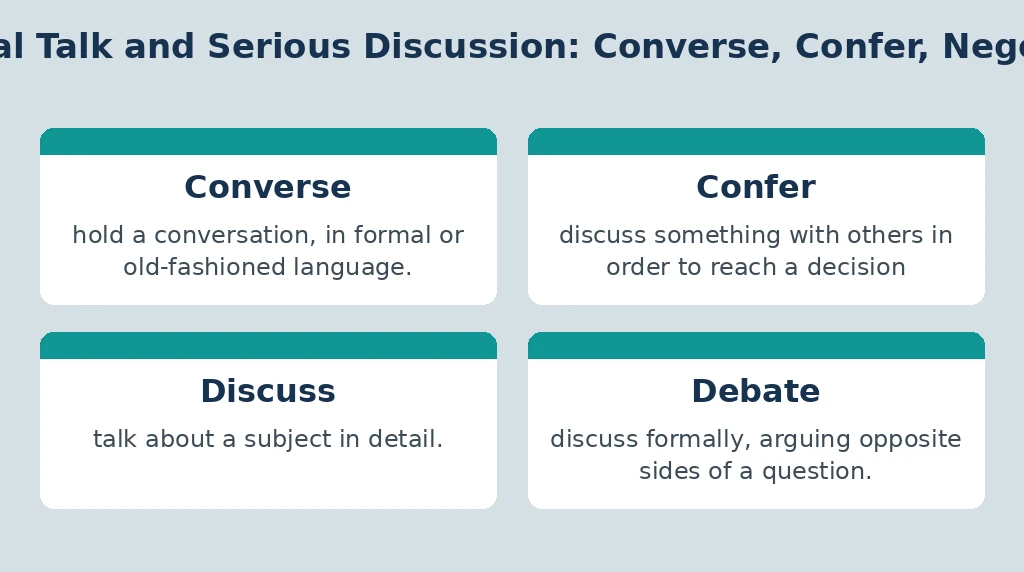
Formal Talk and Serious Discussion: Converse, Confer, Negotiate
When talk puts on a suit, it’s usually because something is at stake: a decision, a treaty, a verdict, a deal. Formal talk words describe conversation with an agenda, and often a record. They’re the verbs of meeting rooms, courtrooms, parliaments and examination halls. Consequently, formal words arrive with rules about who may speak and when. In particular, a treaty or a verdict gives the talking a weight that a chat never carries.
- Converse: hold a conversation, in formal or old-fashioned language. The guests conversed politely over dinner.
- Confer: discuss something with others in order to reach a decision. The judges conferred before announcing the result.
- Discuss: talk about a subject in detail. The committee discussed the budget for three hours.
- Debate: discuss formally, arguing opposite sides of a question. Parliament debated the bill until midnight.
- Negotiate: discuss formally in order to reach an agreement. The union negotiated a new contract.
- Parley: discuss terms between opposing sides, in older or literary language. The captains parleyed under a flag of truce.
- Consult: discuss with someone in order to get advice or reach a decision. She consulted her lawyer before signing.
- Deliberate: discuss and think carefully before deciding. The jury deliberated for two days.
- Address: speak formally to a group of people. The principal addressed the whole school.
- Discourse: talk or write formally and at length on a subject. He discoursed on the history of the valley for an hour.
Students meet two of these words constantly in essay instructions, and confusing them costs marks. To discuss a question is to examine it from several sides, weighing evidence as you go. To debate it is to defend one side against an opposing one, in a structure that has winners in mind. An essay that only argues a single side when asked to discuss reads as lopsided; one that balances politely when asked to debate reads as evasive. The verbs are instructions about shape, not just synonyms for writing a lot, and reading them precisely is a quiet academic superpower. In other words, the essay question tests the verb as much as the answer. For instance, a student who debates a claim and one who discusses it earn different marks.
The ladder here is purpose. Converse is just formal exchange, no outcome required. Discuss adds a subject examined properly. Confer and deliberate add a decision waiting at the end. Negotiate and parley add opponents, or at least interests pulling in different directions, and debate adds an audience to persuade. Choose the rung your scene is actually standing on, because calling a friendly chat a negotiation flatters nobody, and calling a negotiation a chat can look naive in print. In the same way, each rung adds a stronger purpose to the talking. As a result, the ladder itself becomes a guide to choosing the right word.
Quiet Talk and Secrets: Whisper, Confide and Blab
Lower the volume and talk changes character. Quiet talk is where secrets, tenderness, embarrassment and resentment live, and English sorts it finely: by how soft the voice is, by whether the words are clear, and by whether the speaker wants to be understood at all. In fact, quiet words carry the most trust in a conversation. For example, synonyms for talk include whisper and confide for exactly these hushed moments.
- Whisper: speak very quietly, using the breath rather than the full voice. She whispered the answer in his ear.
- Murmur: speak softly and gently, or make a low continuous sound of voices. He murmured an apology and looked away.
- Mutter: speak quietly and unclearly, usually in anger or resentment. She muttered something about unfair rotas and left.
- Mumble: speak quietly and unclearly, from shyness, sleepiness or embarrassment. He mumbled his name and stared at his shoes.
- Confide: tell someone a secret, trusting them to keep it. She confided that she was planning to resign.
- Blab: reveal secrets by careless talking. Someone blabbed about the surprise party.
- Tattle: inform on someone or tell their secrets, especially by a child. He tattled to the teacher about the broken window.
The stage whisper is the family’s favourite paradox: a whisper designed to be heard by five hundred people. Actors mastered it centuries ago and politicians inherited it, the aside delivered straight to the microphone in a voice of pretend secrecy. In everyday life the same trick survives as the loud whisper in a quiet train carriage, which confides nothing and announces everything. When you use whisper in writing, decide which one you mean, the true secret or the performance, because readers will picture one of them whether you choose or not. In other words, the whisper works because everyone is meant to hear it. At the same time, the audience enjoys the pretence of secrecy.
Mutter and mumble look like twins and aren’t. Muttering is unclear on purpose, a complaint the speaker wants half-heard; the emotion underneath is resentment. Mumbling is unclear by accident, the voice failing its owner through shyness, exhaustion or a mouth full of toast. Confide and blab are the twin poles of the secret itself: confiding is trust given, blabbing is trust spilt, and a whole novel can turn on the distance between the two. Similarly, the difference sits in the speaker’s reason, not the sound. In particular, anger makes the mutter while shyness makes the mumble.
Talking Too Much: Words for Long, Loud and Pointless Talk
Every language keeps a rich vocabulary for people who will not stop, and English is no exception. These words are talk with a complaint built in: too long, too loud, too trivial or too angry. They’re wonderful in dialogue and dangerous in real life, because each one is an accusation wearing a verb’s clothes. In other words, long talk attracts the most judgement of all. For instance, a person who talks too much collects a whole shelf of unkind labels.
- Prattle: talk at length about foolish or trivial things. She prattled on about the wedding seating plan.
- Witter: talk at length about trivial things, in British informal English. He wittered on about train timetables.
- Spout: talk at length in a pompous, showing-off way. He spouted opinions about wine all evening.
- Rant: talk angrily and at length about something unfair. She ranted about the council for ten minutes.
- Lecture: talk at someone at length, scolding or teaching unwanted lessons. He lectured the boys about respect.
- Yak: talk a lot, in informal slang, often pointlessly. They yakked through the whole film.
- Hold forth: talk at length in an opinionated way. Grandfather held forth on politics until dessert.
- Sound off: express opinions loudly and forcefully, in an idiom. He sounded off about the referee in the pub.
- Chatter: talk quickly and lightly, sometimes too much for the moment. Nervous chatter filled the waiting room.
- Gab: talk a lot, informally, when there is work waiting. Stop gabbing and help me lift this.
Ranting deserves one kind word before we judge the rest. A good rant is a performance art, and everyone knows somebody whose rants are the highlight of a gathering: structured, furious and funny, the anger of a man complaining about trains in a country where the trains genuinely are terrible. The verb only turns sour when the rant has no audience awareness at all, no rhythm and no end. In writing, that makes rant a precision instrument: give it to a character your reader should enjoy, or to one your reader should fear for, and it does the characterisation for you. In fact, a good rant can feel like a small piece of theatre. For example, synonyms for talk give that performance a name readers recognise at once.
Sort these by the speaker’s real offence. Prattle and witter accuse the content: it was trivial. Spout and hold forth accuse the ego: it was a performance. Rant accuses the temperature. Lecture accuses the power balance, because a lecture is talk that forbids an answer. In fiction, these verbs let a narrator judge a character without a single editorial sentence, which is efficient, slightly unfair, and exactly how people actually describe each other over breakfast the next morning. In practice, the offence matters more than the volume. To sum up, the word you pick should name the fault, not only the noise.
Speaking Up: Talk as Expression
Some talk words aren’t about conversation at all. They’re about the moment an inner thing becomes an outer thing: a thought, a feeling or a fact finding its way into words. These are the verbs of honesty, therapy, protest and confession, and they carry more weight per syllable than the chat family ever tries to. In particular, expression words turn feelings into something others can hear. As a result, a private thought becomes a public act the moment it is spoken.
- Speak: use the voice to say words, the neutral root of the whole family. She spoke quietly and clearly.
- Express: show a thought or feeling in words. He expressed his thanks in a short note of speech.
- Verbalize: put a thought or feeling into words, in formal or therapeutic language. Patients learn to verbalize their fears.
- Vocalize: express something with the voice, or say it openly. Workers vocalized their concerns at the meeting.
- Articulate: express an idea clearly and in well-chosen words. She articulated the problem better than anyone.
- Communicate: share information or feelings so others understand. Good leaders communicate early and often.
- Utter: produce a word or sound with the voice, formally. He did not utter a word all evening.
- Voice: express a feeling or opinion publicly. Residents voiced their anger at the plan.
There’s a reason the expression family matters so much in modern life. Job interviews, therapy sessions, performance reviews and difficult family dinners all turn on getting an inner state into outer words, and English grades the attempt at every stage: the thought occurs, the feeling is verbalized, the case is articulated, the concern is voiced. A character in a novel who moves along that chain across a chapter has visibly grown. A real person who learns to do it has gained one of the few skills that improves every other part of life. In short, the expression family earns its place in daily life. At the same time, interviews and therapy sessions both run on the same few verbs.
The distinctions here are about success. Anyone can talk; to articulate is to talk well, with the joints of the idea showing clean. Verbalize names the hard step before that, the wrestling of a feeling into any words at all, which is why therapists love it and novelists should ration it. Voice, as a verb, always implies an audience that needed to hear it: people voice concerns, objections and support, usually in public, usually because silence had stopped working.
How to Choose the Right Synonym for Talk
Four questions settle most choices. How formal is the occasion? Is the speaker loud, and how clear is the message? How long does the talking go on? And how does the narrator feel about it? A five-minute friendly exchange fails all four tests for confer and passes all four for chat. A whispered plan between spies fails chat on volume alone. The answers point to one family, and inside the family, one word usually stands up and volunteers.
Picture two colleagues by a coffee machine. Friends killing five minutes chat or natter. If they’re dodging a painful subject with cheerful noise, they chatter. If one is quietly telling the other that she has resigned, she confides. Complaining about the boss at a volume the boss can almost hear makes him mutter. Same machine, same two people, four different verbs, and each one writes a different scene around them. That’s the whole craft of this family: the verb is the stage direction, the character note and the mood lighting, all in a single word.
| Situation | Best word | Why |
|---|---|---|
| Two friends catching up after a year | Chat | Friendly, informal and content-light |
| Judges deciding a verdict | Confer | Discussion aimed at an official decision |
| A diplomat trying to end a dispute | Negotiate | Formal discussion between opposing interests |
| A child telling her best friend a secret | Confide | Trust is the whole point of the word |
| An employee complaining under his breath | Mutter | Quiet, unclear and resentful |
| A fan furious about a referee for an hour | Rant | Angry, long and one-directional |
| A shy student giving an answer to the class | Mumble | Unclear from embarrassment, not anger |
Register deserves a word of its own, because talk words date and place a speaker faster than almost any other vocabulary. Natter and witter plant a flag in Britain; gab and shoot the breeze plant one in America; rap belongs to the street and the studio; converse belongs to the nineteenth-century drawing room unless it’s handled with care. None of this makes any of them wrong. It makes them casting decisions. Give the wrong regional word to a character and readers from that region will hear the false note instantly, the way you hear a wrong note in a familiar song.
One caution belongs to every writer: the judging words in this family, prattle, spout, gossip, lecture, are accusations, and readers will hold you to them. Use one about a real person in an essay and you’ve made a claim about character, not just conversation. Use them in fiction and you’ve revealed your narrator. Either way, choose them as carefully as you’d choose an insult, because grammatically they’re verbs, but socially they’re verdicts.
Talk Synonyms for Writing and Dialogue
Dialogue is where talk words earn their living. The famous beginner’s mistake is decorating every line of speech with a new verb: he declared, she ejaculated (in the old sense), they expostulated. Readers find it exhausting, because the talking verb’s job in dialogue is usually to disappear. That’s why fiction runs on said, plain, invisible and endlessly reusable, and why a working writer needs the full range of synonyms of said only for seasoning: a whisper here, a mutter there, where the manner of speaking changes the meaning of the line.
The other half of a dialogue scene is physical. Characters rarely only talk; they glance, look away, stare at the floor. Pairing a talk word with a look word is the oldest trick in fiction because it works: she whispered, looking at the door tells the reader about fear without naming it. When a scene feels flat despite good dialogue, the fix is often to vary the looking as much as the talking, so keep the synonyms for look within reach of this page and treat the two families as partners on the desk.
In essays and speeches, the talk family does persuasive work. A writer who says the committee discussed the proposal sounds neutral; one who says it debated the proposal promises conflict; one who says it merely chatted about it has delivered a small, lethal review of the committee. Public speakers feel the same scale from the other side: an audience that murmurs is restless, one that chatters is bored, and one that falls silent at the right moment is worth more than applause. Choose the verb that tells the truth about the room, and the rest of the paragraph writes itself.
For learners of English, the safest everyday set is small and forgiving: talk, speak, chat, discuss and say, used in that order of confidence. Master the differences among those five and ninety percent of life is covered. Add whisper, mutter and mumble as a quiet trio, then confer, negotiate and address for when life puts a suit on, and you hold the family in a sensible order, friendliest words first, exactly the way fluency actually grows.
Antonyms for Talk
The opposite of talking isn’t one thing but two: the silence of the person who will not speak, and the listening of the person who is doing something better than speaking.
- Listen: give attention to what someone else says. Sometimes the kindest move is to listen.
- Be silent: say nothing at all. During the reading, everyone was silent.
- Keep quiet: stay silent, often deliberately. He kept quiet about the plan for months.
- Hush: become or be made quiet. The crowd hushed as the lights fell.
- Hold your tongue: stop yourself from speaking, in an idiom. She held her tongue and smiled.
- Clam up: refuse to talk, suddenly and completely, informally. The witness clammed up under questioning.
- Shut up: stop talking, rude as a command, blunt as a description. He told the heckler to shut up.
- Say nothing: choose complete silence as your answer. Asked about the money, she said nothing.
- Fall silent: become quiet after talking. The room fell silent at the news.
- Ignore: pay no attention to someone who is speaking. He talked on; she ignored him entirely.
Silence words are dialogue gold. A character who clams up has made a decision the reader can feel, and a room that falls silent gives a scene its full stop. Writers underuse these opposites because talking feels like action and silence like nothing, but on the page the opposite is true: anyone can fill a silence, while the person who withholds speech holds the power in almost every scene ever written.
Common Mistakes: Words That Are Not True Synonyms for Talk
Shout. Shouting is a volume, not a conversation. A shout is one-way, aimed at distance or through noise, and it expects no reply beyond obedience or alarm. A person can talk at any volume, including a whisper, so shout belongs to the vocabulary of loudness, alongside yell and scream, not to the vocabulary of exchange.
Listen. Listening is the other half of the event, and halves are not synonyms. A talk with no listener is a monologue or a rehearsal; a listener with no talker is just a quiet person in an empty room. Careless lists group them because they share a topic, conversation, but sharing a topic is not sharing a meaning.
Write. Writing puts words on a surface for later; talking puts them in the air for now. The two overlap more than they used to, since so much modern talk happens in text messages and chats, but even there the distinction holds: a written chat is still writing, and reading it aloud does not retroactively make it a talk.
Think. Thinking is the silent rehearsal that talk sometimes follows. It has no voice, no listener and no words that leave the skull. The confusion appears in phrases like talk it over with yourself, which is a metaphor, and metaphors are decorations, not definitions. Keep think in the mind’s family, where it belongs.
All four traps share the same flaw: they live near talk without being it. Volume, reception, medium and raw material are all neighbours of conversation, and neighbour words are the ones that slip into careless synonym lists, because they feel close. The families in this guide keep the line where it belongs: if it isn’t voiced words exchanged between people, it isn’t talk.
Frequently Asked Questions
What is the best synonym for talk?
Speak is the most general and safest swap, but the best word depends on the conversation. Chat wins for friendly exchanges, discuss for serious ones, and whisper for quiet ones. If you can only remember three, remember chat, discuss and whisper: friendly, formal and hushed cover nearly everything.
What is the difference between talk and speak?
Speak is the act of using your voice in words, and it leans formal and one-directional: speeches, languages and truths are spoken. Talk is the social, two-way version, the conversation itself. You speak a language, but you talk with a friend, and confusing the two is a classic learner error.
What is a formal word for talk?
Converse is the formal word for holding a conversation, and confer is the formal word for discussing something in order to decide it. In business and law, negotiate and consult do the heavy formal lifting. Address is the formal word for speaking to a group at a set occasion.
What is a word for someone who talks too much?
For the talking itself, prattle and witter describe trivial, endless talk, spout describes pompous talk, and rant describes angry talk. Yak is the slang all-rounder. Each one accuses the speaker of something slightly different, so pick the accusation you actually mean.
What is the difference between mutter and mumble?
Both are quiet and unclear, but the reason differs. Muttering is a complaint kept half-private, usually angry or resentful, and the speaker half-wants to be heard. Mumbling is unclear by accident, through shyness, sleepiness or nerves, and the speaker usually wants the opposite of attention.
Final Thoughts
Talk looks like the plainest verb in the language until you watch it work. It chats over fences, confers in chambers, whispers in libraries and rants in pubs, and each of those scenes needs its own word to come alive on the page. The vocabulary in this guide is not decoration. It’s the difference between reporting that people talked and showing how they talked, which is most of what readers actually remember.
For an even wider circle of conversation words, rare and historical terms included, the Merriam-Webster Thesaurus entry for talk is the natural next stop. Now go and put the right words in the right mouths.
