Try a quick experiment. Open a draft of your own writing and count the walks. She walked to the door. He walked across the room. They walked home. The word does its job so quietly that it vanishes, and the scene goes flat around it. Swap in something sharper and the picture wakes up at once: she strode to the door, he shuffled across the room, they trudged home through the rain. The best synonyms for walk are stride, stroll, amble, saunter, march, wander, hike and trek, and every one of them smuggles in a speed, a mood and a reason for moving that plain walk leaves out. For example, synonyms for walk let a writer show the mood of a journey in a single verb. In addition, the right word can turn a flat sentence into a scene.
This guide covers 50 distinct synonyms for walk, grouped the way people actually choose them: by speed, by manner and style, by purpose, by formality, and by the work walk does as a noun. Every word has been checked against real thesaurus entries and comes with a plain meaning and an example, so you can pick the word that matches your scene instead of grabbing the first one that floats into your head. In other words, the guide sorts the words by speed, manner and purpose. As a result, you can find the exact shade you need without wading through a thesaurus.
Top Synonyms for Walk: Quick Reference
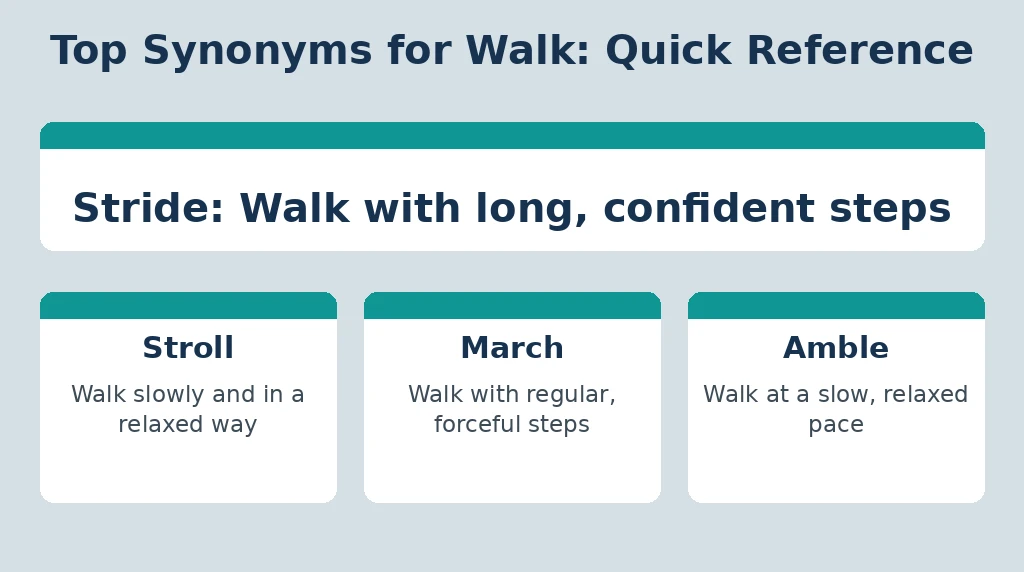
In a hurry? Start here. These are the walk synonyms writers reach for most, the ones that cover nearly every corridor, pavement and hillside you’ll ever describe. The full lists further down add the specialists, but this table is the everyday toolkit. For instance, a tired father and a proud bride need different words for the same act. In fact, the table below is the fastest way to find the right one.
| Word | Meaning in one line | Best for |
|---|---|---|
| Stride | Walk with long, confident steps | Purpose, confidence, entrances |
| Stroll | Walk slowly and in a relaxed way | Leisure, evenings, parks |
| March | Walk with regular, forceful steps | Determination, protest, soldiers |
| Amble | Walk at a slow, relaxed pace | Easygoing scenes, no hurry |
| Saunter | Walk slowly with confidence and ease | Cool, unbothered characters |
| Wander | Walk without a fixed route or aim | Dreamy, lost or curious moods |
| Pace | Walk back and forth over the same ground | Worry, waiting, impatience |
| Tread | Walk on or over a surface, often carefully | Literary tone, care, quiet |
| Hike | Walk a long distance in the countryside | Trails, hills, outdoors |
| Trek | Make a long, hard journey on foot | Endurance, remote places |
| Step | Move a short distance on foot | Brief movements, instructions |
| Ramble | Walk for pleasure in the countryside | Country walks, wandering routes |
| Tramp | Walk with heavy steps over a distance | Tired journeys, mud, effort |
| Trudge | Walk slowly with tired, heavy steps | Exhaustion, bad weather |
| Plod | Walk slowly and with great effort | Determination through difficulty |
| Traipse | Walk about in a tiring, reluctant way | Annoyance, errands, complaints |
| Mosey | Walk slowly and casually, informally | Relaxed speech, westerns, humour |
| Toddle | Walk with short, unsteady steps | Small children, comic effect |
| Tiptoe | Walk quietly on the toes | Silence, sneaking, sleeping babies |
| Creep | Move slowly and quietly, unnoticed | Suspense, stealth |
| Stagger | Walk unsteadily, nearly falling | Injury, drink, shock, heavy loads |
| Swagger | Walk proudly in a showy way | Arrogance, bravado, confidence |
| Promenade | Walk in a public place to be seen | Formal or old-fashioned leisure |
| Meander | Walk slowly along a winding route | Riversides, markets, daydreams |
| Roam | Walk widely with no fixed plan | Freedom, travel, animals |
| Shuffle | Walk dragging the feet along the ground | Age, illness, reluctance |
| Stomp | Walk with heavy, noisy, angry steps | Anger, tantrums, boots |
| Limp | Walk unevenly because of an injured leg | Injury, pain |
Notice how few of these are truly interchangeable. Stroll and trudge both describe slow walking, but one belongs to a Sunday afternoon and the other to a flooded footpath at midnight. That gap between speed and feeling is exactly what the grouped lists below are for. In fact, the table shows meaning living inside the verb itself. For example, synonyms for walk reward the writer who reads the whole row, not just the word.
What Does Walk Mean?
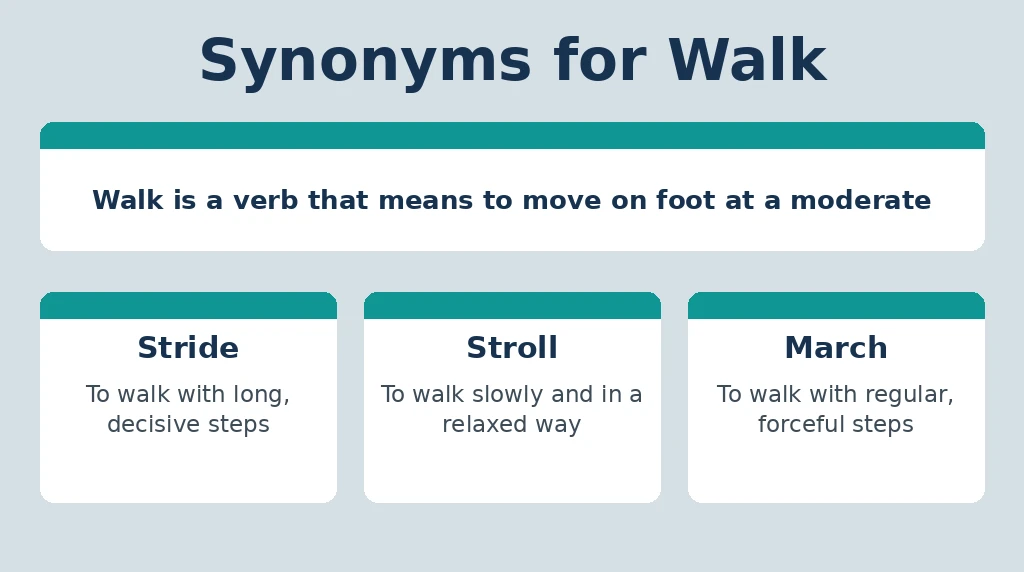
At its plainest, walk means moving on foot at a moderate pace, one foot in front of the other, with one foot always on the ground. That last detail is the technical line between walking and running: in running, there’s a moment when both feet leave the ground at once. It’s a small distinction, but it explains why run and its family can never be honest synonyms for walk, however often the two get tangled up in quick writing. In particular, that moderate pace is what separates walking from running. As a result, the verb can carry a whole paragraph of meaning in a single step.
Walk is also one of the hardest-working verbs in English. You can walk a dog, walk a guest to the door, walk a picket line, or walk someone through a problem step by step. A road can walk you to the village in older, literary English, and a deal can walk, meaning fall through, in business slang. The core sense stays physical, though, and nearly every synonym in this guide grows out of one simple question: how, exactly, are the feet moving? In other words, walk earns its keep in every register of the language. For instance, the same verb serves a dog, a guest and a business deal.
That question has more answers than most people expect. Walking words divide along speed, along the look and feel of the steps, along the walker’s purpose, and along attitude. A nurse pacing a corridor and a poet wandering a lane are both walking, but the verbs that fit them share almost nothing. Good writing names the difference, which is why English keeps so many of these words alive. Also, the four dimensions sort the whole family at a glance. For example, synonyms for walk divide by speed first, then by manner, purpose and attitude.
Walk also moonlights in everyday phrases, and the phrases explain why the word feels like furniture. To walk the dog is to exercise it. Walking someone through a task means guiding them step by step. To walk out is to leave in protest or anger. A soldier can walk point, a bride walks down the aisle, and a tired employee dreams of walking away from the whole thing. None of these is really about feet. They show how deeply the idea of steady forward movement on your own two legs is baked into how English thinks about independence, effort and patience.
One more thing worth knowing: walk is neutral. It fits a legal report, a bedtime story and a text message equally well. Most of its synonyms aren’t neutral at all; they lean formal or slangy, kind or rude, fresh or worn out. So choosing among them isn’t about finding a fancier word. It’s about matching the word to the walker, the ground underfoot and the mood you want the reader to carry away. In fact, neutral words are the ones that travel furthest. At the same time, walk fits a courtroom and a nursery without changing its coat.
Walk Synonyms by Speed
Speed is the first thing readers sense in a walking word, before they’ve even pictured the scene. Slow walking words hint at ease, age, illness or reluctance. Steady ones suggest routine and purpose. And there’s no truly fast synonym for walk, because the moment walking gets fast it turns into something else. Treat any list that offers you sprint as a walk synonym with open suspicion. In particular, speed sets the scene before the picture forms. As a result, a single walking verb can tell the reader how the day is going.
The slow end of the scale is crowded, because slow walking is where mood lives: Similarly, slow words carry the most feeling in this family. For this reason, the list below begins where the mood lives, at the slow end.
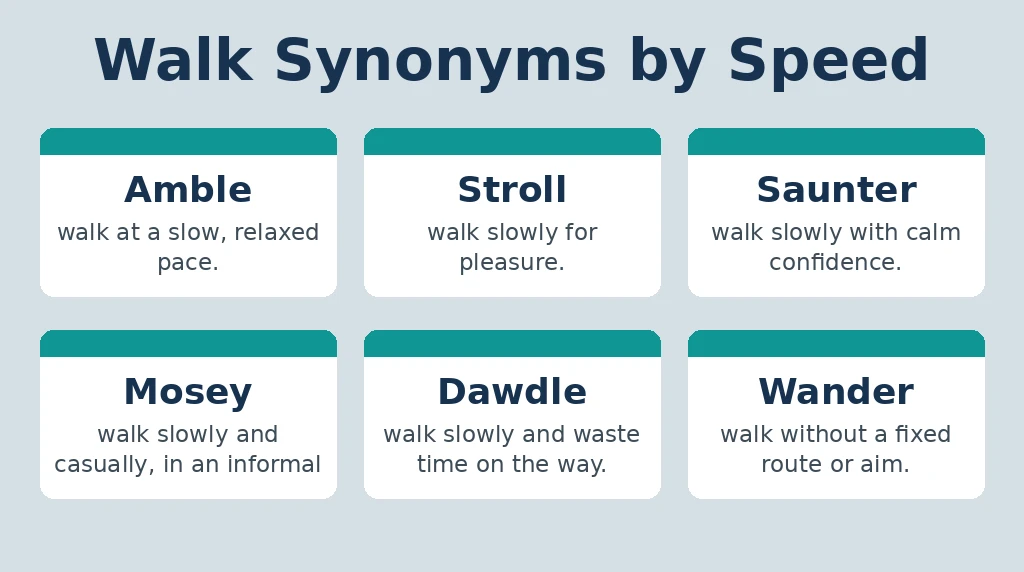
- Amble: walk at a slow, relaxed pace. She ambled down the lane, in no hurry to be anywhere.
- Stroll: walk slowly for pleasure. They strolled along the seafront after dinner.
- Saunter: walk slowly with calm confidence. He sauntered in ten minutes late, smiling.
- Mosey: walk slowly and casually, in an informal way. We moseyed over to the food stalls.
- Dawdle: walk slowly and waste time on the way. The children dawdled home from school.
- Wander: walk without a fixed route or aim. She wandered from shop to shop all afternoon.
- Meander: walk slowly along a winding route. We meandered through the old town until dark.
- Toddle: walk with short, unsteady steps. The baby toddled across the room to her mother.
The steady middle covers normal, purposeful walking, the words for people who know where they’re going: In other words, the middle of the scale is the busiest ground of all. For instance, a commuter and a teacher use these words without thinking twice.
- Stride: walk with long, decisive steps. He strode across the platform and boarded the train.
- March: walk with regular, forceful steps. The students marched through the square chanting.
- Pace: walk back and forth over the same ground. She paced the corridor outside the operating theatre.
- Step: move a short distance on foot. He stepped forward and gave his name.
- Tread: walk on or over something, often carefully. They trod the narrow path in single file.
When even stride is too slow and your walker is covering ground in a genuine hurry, you’ve crossed into a different verb family, and the honest move is to switch to the synonyms for run, from jog up to sprint. And when the slowness itself is the point, when you want the reader to feel time dragging like a wet afternoon, it’s worth browsing the synonyms for slow as well, because a slow word sitting next to the verb often does more work than some rare walking word your reader has to stop and decode. In fact, that crossing point is where the families meet. At the same time, synonyms for walk stop here and the running words take over.
Walk Synonyms by Manner and Style
Manner is where walking words earn their keep. Two people can cross the same kitchen at the same speed, and one glides while the other clumps. The words below describe how the walking looks and sounds, and they’re the fastest way to show character without a single adjective of explanation. In practice, manner reveals character faster than any dialogue. For example, a swagger and a shuffle tell different stories about the same person.
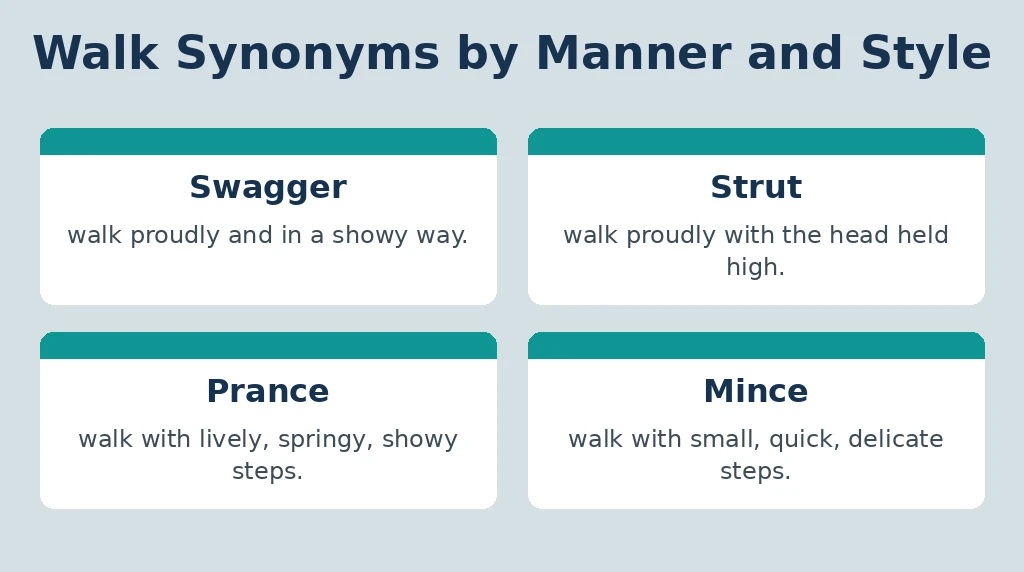
- Swagger: walk proudly and in a showy way. He swaggered into the room like he owned it.
- Strut: walk proudly with the head held high. The peacock strutted across the lawn.
- Prance: walk with lively, springy, showy steps. The horse pranced around the ring.
- Mince: walk with small, quick, delicate steps. She minced across the ice in high heels.
- Tiptoe: walk quietly on the toes. He tiptoed past the nursery door.
- Creep: move slowly and quietly, trying not to be noticed. Someone was creeping around outside the tent.
- Prowl: walk quietly and watchfully, like a hunter. The cat prowled the garden wall at dusk.
- Pad: walk with soft, quiet steps. She padded down the hall in bare feet.
- Stagger: walk unsteadily, nearly falling. He staggered under the weight of the bags.
- Lurch: walk with sudden, uneven, unsteady movements. The boat lurched and he lurched with it, grabbing a rail.
- Shuffle: walk dragging the feet along the ground. The old man shuffled to the window in his slippers.
- Shamble: walk awkwardly, dragging the feet. He shambled into the kitchen, half asleep.
- Waddle: walk with short steps, rocking from side to side. The ducks waddled down to the pond.
- Limp: walk unevenly because one leg is hurt. She limped off the pitch holding her ankle.
- Hobble: walk with difficulty, in an uneven, painful way. He hobbled to the bench and sat down heavily.
- Stomp: walk with heavy, noisy steps, often in anger. She stomped upstairs and slammed the door.
- Tramp: walk with heavy steps, especially over a distance. They tramped the muddy fields all morning.
- Plod: walk slowly and heavily with effort. The donkey plodded up the hill with its load.
- Trudge: walk slowly with tired, heavy steps. We trudged home through the snow.
- Traipse: walk about in a tiring, reluctant way. I have traipsed round every shop in town looking for it.
Read that list again and notice how much storytelling each word does on its own. Swagger tells you about ego. Shuffle tells you about age, or defeat. Trudge tells you about weather, distance and mood in a single syllable. That’s why manner words, used sparingly and precisely, beat a pile of adverbs every time: walked wearily home says less than trudged home, and costs you an extra word for the privilege. In particular, the manner words carry the story without any help. As a result, synonyms for walk can replace a whole sentence of description.
Walk Synonyms by Purpose
Sometimes the important thing isn’t how the walking looks but why it’s happening at all. Purpose words carry the reason inside the verb, so the sentence doesn’t need a because clause trailing behind it like a shopping trolley. In other words, purpose sorts the words by the walker’s aim. For instance, a hike and a march look different because the reasons differ.
- Hike: walk a long distance in the countryside, for pleasure or exercise. They hiked the coastal path in two days.
- Trek: make a long, difficult journey on foot. The team trekked for a week to reach the base camp.
- Ramble: walk for pleasure in the countryside, often on a wandering route. We rambled through the woods all morning.
- Roam: walk widely over an area with no fixed plan. Herds of deer roam the park freely.
- Patrol: walk around an area to guard it or check it. Guards patrolled the fence through the night.
- March: walk in protest, or as soldiers in step. Thousands marched on the capital.
- Promenade: walk in a public place to be seen and to see others. Families promenaded along the pier in their best clothes.
- Escort: walk with someone to guide or protect them. A nurse escorted her back to the ward.
- Accompany: go on foot with someone as a companion. He accompanied her to the gate.
Everyday purpose deserves a mention too, because most walking in most lives is neither leisure nor ceremony. It’s transport: the walk to school, to work, to the corner shop. English is oddly quiet about this ordinary journey and usually leaves plain walk to carry it, because the purpose is too obvious to name. That quietness is itself a style lesson. When walking is merely how a character reaches the scene, a decorated verb grabs attention the journey hasn’t earned. Save the purpose words for journeys that mean something, and let life’s errands pass at a plain, honest walk, the way they should. In other words, ordinary walking is the quietest work in this family. For example, the walk to school and the walk to work both hide their meaning in plain sight.
Purpose words also sort themselves by kindness. Escort and accompany are protective or polite; the walker is there for somebody else. Patrol is watchful, slightly tense. Hike and trek are about the walker’s own goal, and they scale neatly by hardship: a hike is a good day out, while a trek is the kind of journey people write books about afterwards. If your characters are only getting from one room to another, none of these big words belongs in the sentence, and plain walk, used without apology, is the mark of a confident writer. For example, kindness sorts the purpose words as surely as speed does. For instance, an escort protects while a march demands, and the verbs show the difference.
Formal Synonyms for Walk
Reports, ceremonies and older novels sometimes need walking words with their collars buttoned. Formal synonyms for walk are fewer than the informal ones, and they tend to describe either dignified movement or the business of guiding other people from place to place. In particular, formal words slow the scene down. As a result, a ceremony reads with more weight when the walking matches the dress code.
- Proceed: walk in a formal, orderly way, especially in a group. The graduates proceeded into the hall in pairs.
- Perambulate: walk through or around a place, very formal or humorous. The inspector perambulated the entire boundary.
- Promenade: walk in public in a leisurely, display-conscious way. Couples promenaded along the front at sunset.
- Tread: walk, in a literary and slightly solemn tone. Pilgrims have trodden this road for centuries.
- Escort: walk with someone in order to guide or protect them. Officers escorted the witness from the building.
- Conduct: lead or escort someone in a formal way. The guests were conducted to their seats.
- Usher: show someone to a place by walking with them. We were ushered into a small office.
- Shepherd: guide a group of people carefully in one direction. The teacher shepherded the children across the road.
- Guide: walk with someone, showing them the way. A ranger guided us down the gorge.
- Accompany: go with someone as a companion or escort. Two aides accompanied the ambassador.
Use these with care. Perambulate sounds so grand these days that most writers only use it as a joke, and proceed belongs in minutes, orders and ceremonial descriptions, not in a child’s bedtime story. Formal words earn their place when the setting is formal too: a courtroom, a graduation, a state visit. Drop one into ordinary prose and it’s the writer who ends up looking like the show-off, which is the opposite of what good word choice is for. In fact, perambulate can tip a sentence into comedy. For example, an inspector who perambulates a boulevard sounds grander than one who walks it.
Informal and Slang Synonyms for Walk
At the other end of the scale sit the words people actually say to each other. Informal walk words are loose, friendly and often funny, and dialogue is their natural home. An essay full of them looks sloppy. A story with none sounds like it was written by a committee. In short, the informal words belong in speech, not in reports. For this reason, a character who says mosey sounds relaxed at once.
- Mosey: walk slowly and casually. Let us mosey down to the river and see.
- Hoof it: go on foot, in slang. The bus never came, so we hoofed it home.
- Traipse: walk about in a tiring, reluctant way. We traipsed around the mall for hours.
- Toddle: walk with unsteady little steps, used humorously of adults. He toddled off to bed at nine.
- Wander: walk without a fixed aim. I wandered into town to kill an hour.
- Stroll: walk slowly for pleasure, relaxed rather than slangy. They strolled down for a coffee.
Mosey carries a whiff of the American West, all dust, boots and unhurried afternoons, which is why it sounds so good in casual speech and so odd in a business report. Hoof it is pure practicality, the word for missed buses and dead lifts. The rule for all slang is the same: it dates quickly and it belongs to a voice. If the character wouldn’t say it, the narrator probably shouldn’t either, unless the whole piece runs in that register on purpose. In fact, the western flavour is what makes mosey hard to use elsewhere. For instance, the same word in a London office would sound like a joke.
Walk as a Noun: Names for the Journey Itself
Walk is a noun as well as a verb, and plenty of its synonyms do the same double duty. As nouns, these words name the journey or the outing rather than the movement itself, and they sort themselves by length and effort just as neatly as the verbs do. Beyond that, the noun forms carry the same meanings as the verbs. For example, a stroll and a hike name both the act and the outing.
- Stroll: a short, slow walk for pleasure. We took a stroll around the harbour.
- Amble: a slow, relaxed walk. An amble through the market took all morning.
- Saunter: a slow, confident walk. His saunter across the yard annoyed everyone.
- Ramble: a countryside walk with a wandering route. The club organises a ramble every Sunday.
- Hike: a long walk in the countryside. The hike to the summit took six hours.
- Trek: a long, hard journey on foot. The trek to the village took three days.
- Tramp: a long, tiring walk. It is a good tramp from the station to the farm.
- March: an organised walk by soldiers or protesters. The march ended with speeches in the square.
- Promenade: a leisurely public walk, or the paved place for it. We joined the evening promenade along the seafront.
- Constitutional: a regular walk taken for health, old-fashioned and charming. He took his constitutional after breakfast every day.
- Perambulation: a walk through or around a place, formal and often official. The annual perambulation of the parish boundary took all day.
Noun choice matters most in travel writing and memoir. Call the same outing a stroll, a hike or a trek and you’ve quietly told the reader how to pack for it, mentally at least. Stroll means sandals and ice cream. Hike means boots and a map. Trek means blisters and a story you’ll tell for years. Pick the noun that matches the memory, not just the distance. In particular, the noun picks the tone of the whole passage. As a result, synonyms for walk can change a memory from a chore into a pleasure.
How to Choose the Right Synonym for Walk
Choosing well comes down to four questions. First, how fast is the person moving, and is the pace the point? Second, how do the steps look and sound: light or heavy, smooth or broken, proud or exhausted? Third, why is the person walking at all: pleasure, duty, escape, exercise or plain transport? Fourth, whose voice is telling the scene, and would that voice plausibly use this word? Answer those four and the right synonym usually picks itself. In other words, the four questions act as a filter for every choice. For this reason, a writer who answers them first rarely picks the wrong walking word.
A worked example helps. Picture a tired father crossing a dark car park at midnight, sleeping child on one shoulder, a bag in each hand. Stroll is a lie. Stride is too heroic. March is comic in the wrong way. Shuffle and trudge both fit, and choosing between them is about what you want the reader to feel: shuffle keeps him in that car park, small and local, while trudge implies distance and weather, a whole journey behind him. Neither one is more correct. They’re different sentences wearing similar boots. In fact, the worked example shows the questions doing their job. For instance, the tired father needs a word with weight, not speed.
There’s also a kindness test, and it matters more than writers expect. Walking words get used about the old, the ill and the injured all the time, and the wrong one can sound like mockery. Shuffle is honest about an older man’s steps; shamble and waddle can sound like ridicule if the tone around them isn’t warm. Toddle is affectionate for a baby and insulting for a grown man, unless the insult is the point. Writing about real people rather than characters? Choose the word you’d be willing to have used about your own grandfather. In other words, the kindness test protects real people from careless words. For example, the wrong walking verb can turn a description into mockery.
| Situation | Best word | Why |
|---|---|---|
| A confident manager entering a meeting | Stride | Long steps read as purpose and authority |
| A couple in a park on a Sunday | Stroll | Slow, relaxed and pleasure-led |
| A worried parent outside a hospital room | Pace | Back-and-forth movement shows anxiety |
| Hikers crossing mountains for a week | Trek | It carries distance, hardship and time |
| A teenager sent to bed after an argument | Stomp | Heavy, noisy steps carry the anger |
| An older man with a stick, in slippers | Shuffle | Dragging steps show age and frailty |
| Couples in evening dress by the sea, 1890 | Promenade | Formal, public and period-perfect |
And remember, fast is a trap in this family. Writers hunting for a stronger walk word often reach for speed words, but walking has no fast gear. If the pace is the story, the honest verb is usually a run word; if the pace isn’t the story, a manner word will serve you better. Where the quality you really need is speed itself, an adjective for the journey rather than the walker, the synonyms for fast will hand you a sharper tool than any walking verb can. In fact, the fast trap catches writers who want more energy. For instance, synonyms for walk stay slow while the speed words do the hurrying.
Synonyms for Walk in Essays, Stories and Professional Writing
In fiction, walking verbs are stage directions that double as psychology. A character who saunters into bad news is a different person from one who creeps into it, and the reader learns the difference without being told. The craft rule is restraint: one precise verb per scene does the work of a paragraph of description, while three fancy ones in a row make the prose feel dressed up. Let the big word land, then go back to plain walk for the ordinary crossings, because contrast is what makes the big word visible. In particular, a single walking verb can reveal a character’s mood. As a result, synonyms for walk carry the psychology of a scene without any extra words.
Essays and journalism shift the register, but the same precision pays. Travel writing lives on the difference between a stroll through a market and a trek through a mountain pass, and a review that gets those words right sounds travelled rather than researched. Reporters covering protests should reach for march only when the walk is organised and purposeful, and for wander or drift-like words only when the crowd genuinely has no direction, because the verb quietly takes a side about the event. On top of that, the same precision lifts essays and journalism too. For example, a travel article reads better when the walking matches the place.
Students and language learners do best learning walking words in little families instead of one long list. Learn the slow family together (stroll, amble, saunter, wander), the tired family together (trudge, plod, shuffle, traipse) and the proud family together (stride, strut, swagger, march), and give each family a picture in your mind. Words learned in families stick, because each one is defined partly by its neighbours, and a learner who can feel the gap between stroll and saunter has understood something about English that no dictionary definition quite delivers on its own. In other words, little families beat long lists for learning. For this reason, synonyms for walk are best learned in small, friendly groups.
Professional writing is where plain walk wins most often, and there’s no shame in that. Instructions, safety guides and business reports should say walk, clearly and repeatedly, because a reader standing on a ladder or halfway through a fire drill needs the familiar word, not a synonym hunt. The exception is text about moving people in an official capacity: patients are escorted, visitors are accompanied, delegations are conducted. Even there, clarity outranks elegance, and a word your reader must stop to decode is a word that has failed at its job. In other words, plain walk is the professional’s best friend. For instance, an instruction that says walk reads clearer than one that says proceed.
Antonyms for Walk
Walking is movement on foot, so its opposites fall into two groups: staying still, and moving in ways that aren’t walking at all. In particular, the two opposite groups sort the antonyms neatly. For example, staying still and moving by vehicle both cancel the walking.
- Stand: stay upright without moving. He stood at the window and watched the rain.
- Sit: rest on a seat instead of moving. She sat on the bench and fed the pigeons.
- Stay: remain in one place. The dog stayed by the gate.
- Stop: cease moving. We stopped at the bridge to look down.
- Wait: stay in place until something happens. They waited at the corner for the bus.
- Rest: pause and recover instead of walking on. The climbers rested at the shelter.
- Run: move on foot with both feet leaving the ground. When the gate opened, the children ran.
- Ride: travel on or in a vehicle or animal. We rode the last mile on the cart.
- Drive: travel by controlling a vehicle. He drove rather than walked, to save time.
- Crawl: move on hands and knees or close to the ground. The baby crawled across the rug.
Antonyms turn out to be useful sharpeners. A scene where everyone else is seated makes one walking figure feel exposed, and a character who finally stops walking can close a whole chapter of a story. In lessons for children or language learners, walk is best taught inside its little family of contrasts: walk, run, stop, sit. Opposites pin a word in the memory in a way definitions alone rarely manage. What is more, the still figures make the walker stand out. For instance, a crowded room of sitters makes a single walker the centre of attention.
Common Mistakes: Words That Are Not True Synonyms for Walk
Run. The commonest false friend of all. Running has a moment where both feet leave the ground; walking never does. A character who runs to the door has hurried, panicked or fled. A character who walks there has done none of those things, whatever the writer intended. Swap walk for run just to add energy and you haven’t changed the flavour of the scene. You’ve changed its facts. In fact, the airborne moment is the whole difference. As a result, synonyms for walk never borrow the airborne words.
Climb. Climbing is vertical, and it usually involves hands. People climb stairs in loose everyday speech, but in careful writing they walk up them. Save climb for ladders, ropes, rocks and steep hillsides where the hands join in, and keep it out of ordinary corridor scenes. In other words, the vertical direction changes everything. For instance, people climb stairs in everyday speech, but the verb still means up.
Ride and drive. These involve vehicles or animals, so the person is being carried rather than walking. They sneak into sloppy synonym lists because they share the idea of travelling, but travel is a topic, not a meaning. A single journey can mix all three, and the verbs have to change as the traveller does. In other words, the rider is carried, not walking. For instance, a bus that carries you to work still leaves the walking to the last hundred yards.
Crawl. Crawling is movement on hands and knees, or flat against the ground. Traffic can crawl and babies crawl, but a walking adult can’t crawl upright, so the word only works as a synonym for walk when the writer actually means that low, slow, ground-hugging movement. In fact, crawling belongs to babies and traffic jams. For example, a walking adult can never crawl without turning the scene into comedy.
Follow. Following is walking behind someone; it describes a relationship between two movers, not a way of moving in itself. Your follower still needs a walking verb of his own: he followed her, yes, but did he stride, trail, shuffle or creep? The trap words all share territory with walk, which is exactly why they sneak into lists. Neighbouring ideas aren’t synonyms, and keeping that line clean is most of what this guide is for. In particular, follow names the relationship, not the stride. As a result, synonyms for walk never include follow, however close the feet may be.
Frequently Asked Questions
What is the best synonym for walk?
There isn’t one. The right word depends on speed, manner and mood. Stride is the most useful all-rounder for confident, purposeful walking, stroll covers the relaxed kind, and trudge covers tired walking. Between those three, most everyday scenes get described honestly. In other words, the best word always depends on the scene. For example, a tired walker and a proud walker need different verbs. As a result, stride wins only when confidence matters most.
What is a formal word for walk?
Proceed. The graduates proceeded into the hall, that sort of thing: orderly, official, safe. Perambulate is more formal still, so formal that it mostly sounds like a joke now. For guiding people, the formal working words are escort, accompany and conduct. In fact, proceed is the safest formal choice in this family. For instance, an official ceremony calls for proceed rather than walk. In fact, the verb suits documents and speeches alike.
What is the difference between stroll, amble and saunter?
All three are slow, but the attitude differs. A stroll is slow walking done for pleasure. An amble is slow walking with no particular aim or energy behind it. A saunter adds confidence, even a touch of showing off: the saunterer is unhurried because nothing in the world can hurry him. In other words, the attitude is what separates the three. For example, a stroll seeks pleasure while an amble seeks nothing at all. As a result, the pick depends on the walker’s mood.
Is hiking a synonym for walk?
Yes, but a narrow one. Hiking is walking a long way in the countryside or hills, usually for pleasure or exercise, and it implies proper outdoor ground, suitable shoes and real distance. Walking to the corner shop is never hiking, and calling it that sounds like a joke. In fact, hiking is the narrowest sense in this family. For instance, a hill walk counts as hiking while a park walk does not. Also, the distance and the ground both matter.
What is a word for walking slowly and tiredly?
Trudge is the classic choice: slow, heavy steps from someone who’s tired and still has far to go. Plod comes close, with a little more dogged effort and a little less misery. Shuffle fits when the tiredness shows in dragging feet rather than in distance covered. In other words, trudge is the tired walker’s word. For example, a long day and heavy boots both invite it. As a result, the verb carries exhaustion inside it.
Final Thoughts
Walk is not a weak word. It’s a plain one, and plain words are the floor that all the interesting verbs stand on. Nobody needs a synonym for every crossing of a room. But when the scene matters, when the reader should feel the tiredness in a trudge, the pride in a swagger or the peace in an evening stroll, the right word is waiting in this list, and it’ll do more quiet work than a sentence of explanation. In fact, plain words hold the whole family up. For example, every fancy walking verb leans on plain walk for its meaning.
Keep this page nearby when you write. And for an even deeper bench of walking words, rare and historical ones included, the Merriam-Webster Thesaurus entry for walk is the natural next stop. Happy walking, whichever verb you choose for it. In short, this page is a writer’s pocket guide. For instance, a quick check here can save a flat sentence.
