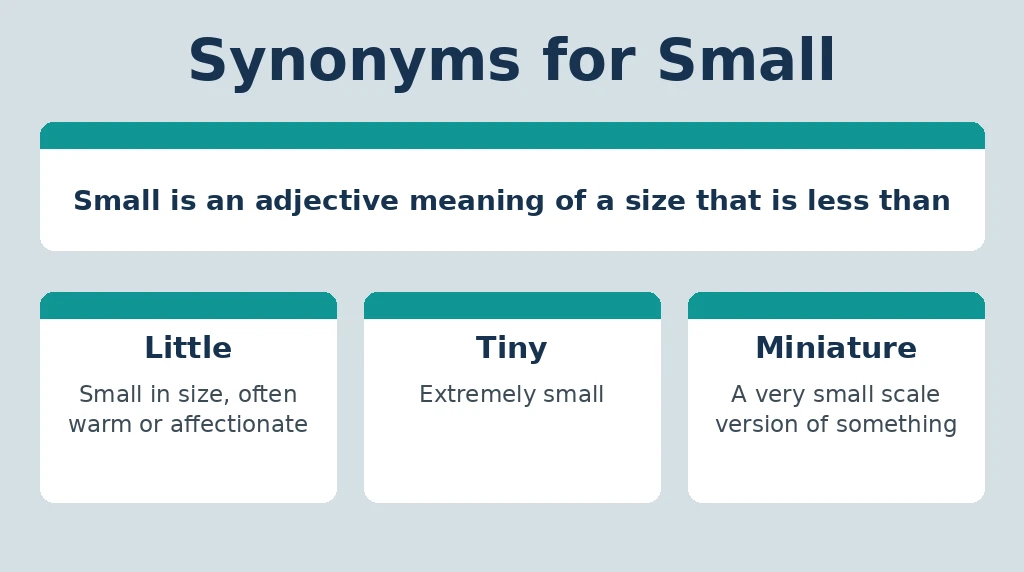
Every estate agent knows the trick: no flat is ever small, it is “cosy,” “compact” or “bijou.” Small is one of those plain words that quietly undersells whatever it touches, a small garden, a small voice, a small fortune, when each of those deserves a sharper word of its own. The closest synonyms are little for warmth, tiny for emphasis, miniature for exact small-scale copies, minute and minuscule for the very bottom of the scale, and minor, slight and negligible when the smallness sits in amount or importance. This guide covers 66 synonyms for small, grouped by everyday size, by extreme smallness, by amount, by build and by the playful words of speech.
Every word below has been checked against real thesaurus entries, and each one arrives with its meaning and an example. Small words cast long shadows. The wrong one can shrink a compliment into an insult, or inflate a speck into a crisis. The traps are marked as you go: the words that look like synonyms for small and are not, the spellings that embarrass careful writers (minuscule, not miniscule), and the pronunciations that give learners away (minute, said my-NOOT). Choose carefully, and small stops being a weakness in your writing. It becomes one of its finest instruments.
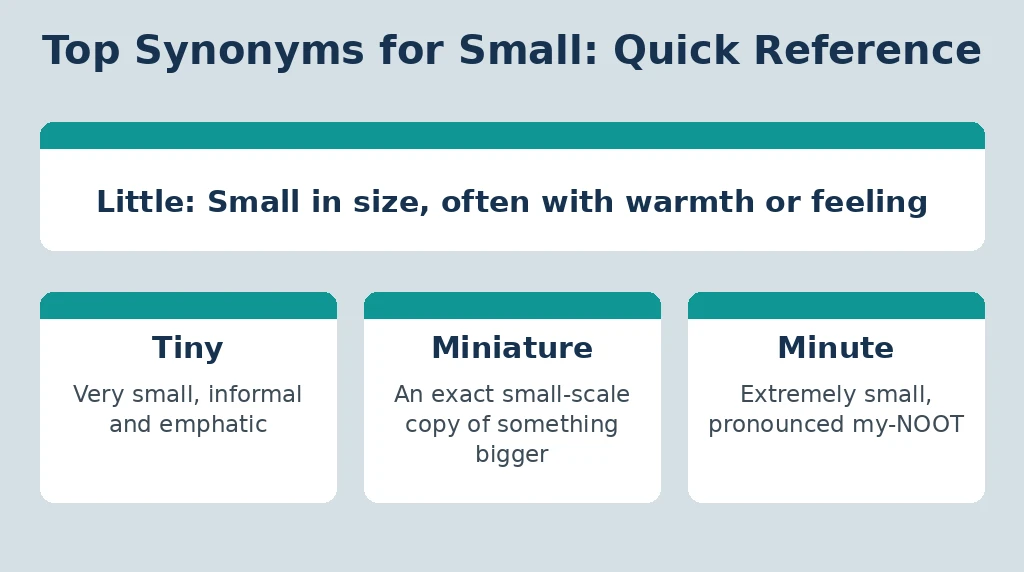
Top Synonyms for Small: Quick Reference
In a hurry? These are the synonyms for small that writers reach for most, with the meaning of each and the place it works best. The groups below sort out the full family and explain the finer differences.
| Word | Meaning in one line | Best for |
|---|---|---|
| Little | Small in size, often with warmth or feeling | Everyday speech, children, affection |
| Tiny | Very small, informal and emphatic | Speech, stories, everyday emphasis |
| Miniature | An exact small-scale copy of something bigger | Models, replicas, dollhouses |
| Minute | Extremely small, pronounced my-NOOT | Formal writing, science, detail |
| Minuscule | Very small, precise and slightly formal | Essays, reports, careful prose |
| Microscopic | Too small to see without a microscope | Science, medicine, exaggeration |
| Diminutive | Unusually or strikingly small | Literary writing, formal description |
| Petite | Small and neat in build, a compliment | People, fashion, design |
| Compact | Small because everything is packed in neatly | Cars, kitchens, gadgets, cases |
| Mini | A small version of the standard thing | Products, fashion, informal writing |
| Wee | Very small, warm and Scottish in flavor | Speech, children, affection |
| Teeny | Extremely small, playful | Informal speech and writing |
| Slight | Small in degree, barely there | Changes, chances, differences |
| Minor | Lesser in size, rank or seriousness | News, medicine, formal writing |
| Limited | Small in scope, number or range | Business, formal, careful claims |
| Modest | Small in amount, unshowy | Sums, homes, ambitions, praise |
| Negligible | So small it can be ignored | Science, reports, risk, statistics |
| Insignificant | Too small in importance to matter | Formal writing, arguments |
| Trifling | Small and unimportant, slightly dismissive | Amounts, matters, formal tone |
| Pocket-sized | Small enough to carry in a pocket | Books, tools, gadgets, guides |
| Pint-sized | Small, originally the size of a pint pot | People and portions, informal |
| Dwarf | Much smaller than the usual kind | Plants, animals, stars, breeds |
| Lilliputian | Tiny, from the island in Gulliver’s Travels | Literary and humorous writing |
| Smallish | Fairly small, hedged and honest | Speech, careful description |
| Teeny-weeny | Extremely small, childlike and comic | Children, jokes, speech |
| Itty-bitty | Very small, playful American informal | Speech, children, humor |
| Scaled-down | A smaller version made to the same proportions | Models, plans, budgets |
| Baby | A young or small version of the thing | Vegetables, animals, products |
What Does Small Mean?
Small is an adjective meaning below average in size for its kind, whether the measure is height, area, number, amount or importance. Almost everything about small is relative: a small elephant outweighs a large dog, and a small fortune would still change most lives. Its comparative and superlative are smaller and smallest, and it works quietly in hundreds of phrases, from small talk and small print to the small hours of the morning.
Dictionaries give small a second family of meanings around importance and worth, and the two families behave differently. A small serving is a size; a small victory is a judgment. A small man may be short, or petty, and the reader decides from the company the word keeps. That is why this guide separates its groups so strictly: synonyms borrowed across the fence, a size word doing an importance job, are the ones that make sentences wobble.
The history of the word helps explain its range. Small began in Old English as a word for thin and slender, grew to cover anything below the usual size, and picked up its importance meanings along the way. That is why a small voice, a small hour and a small mind are all small in different currencies. Modern English keeps every currency in circulation at once, and readers convert between them without thinking. Your job is simply to hand over the right coin, and this guide lays the coins out in rows.
Small also has a tone problem, and its synonyms solve it one by one. Plain small can sound blunt, even disappointed. That is exactly why agents say cosy and parents say little. Petite praises, compact approves, and tiny charms, while puny and paltry condemn. Pick a synonym for small and you are really picking an attitude toward the thing described. The attitude is what the reader remembers.
The word itself is ancient, older than English as we know it, and it has survived because it is useful. But useful is not the same as best. At the other end of the scale stand the synonyms for big, from large and huge to vast and colossal, and a writer who commands both ends can set any scene at exactly the size it deserves.
Everyday Words for Small
These are the words of daily life, safe in almost any sentence and understood at once. Even here, small choices matter: little warms, tiny insists, compact compliments the designer, and petite compliments the person. Master this group and you can describe kitchens, dogs, gardens and grandchildren for the rest of your life without repeating yourself.
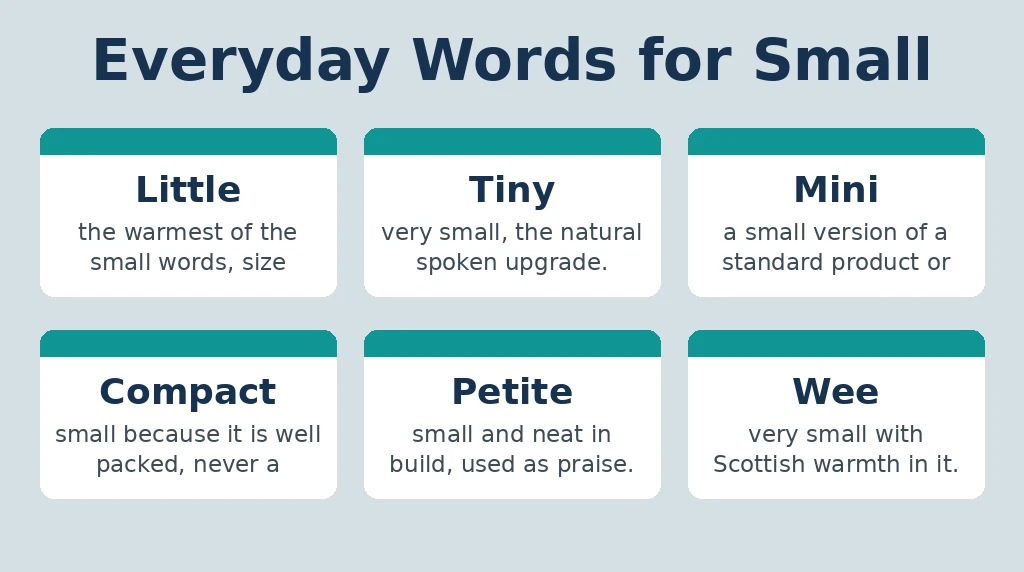
- Little: the warmest of the small words, size blended with feeling. She kept a little garden behind the house and knew every plant in it.
- Tiny: very small, the natural spoken upgrade. Tiny cracks had formed in the painting near the frame.
- Mini: a small version of a standard product or style. The hotel room came with a mini fridge stocked with juice.
- Compact: small because it is well packed, never a criticism. The compact kitchen hides a full oven behind one neat door.
- Petite: small and neat in build, used as praise. The petite dancer seemed to float across the stage.
- Wee: very small with Scottish warmth in it. Come in for a wee cup of tea before the train.
- Pocket-sized: sized for carrying anywhere. He wrote a pocket-sized guide to the birds of the coast.
- Pint-sized: small and full of character, informal. The pint-sized goalkeeper bossed the whole defense.
- Baby: the young or small version of something. Baby carrots and baby corn filled the salad bowl.
- Scaled-down: reduced in proportion, faithful to the original. The architect built a scaled-down model of the bridge.
- Model: a small copy made for study or play. The museum displays a model of the ship as she looked in 1890.
- Toy: bred or made very small, in names of breeds and copies. A toy poodle slept through the entire meeting.
- Smallish: fairly small, honestly hedged. They rented a smallish flat two streets from the station.
One member of this group deserves a special note: little is the only synonym that regularly beats small at its own game in set phrases. It is a little while, not a small while; a little later, a little-known painter, little by little. Learners who swap in small everywhere produce sentences that are correct and yet somehow off, the surest sign that fluency lives in partnerships between words, not in the words alone.
Extremely Small: The Tiny End of the Scale
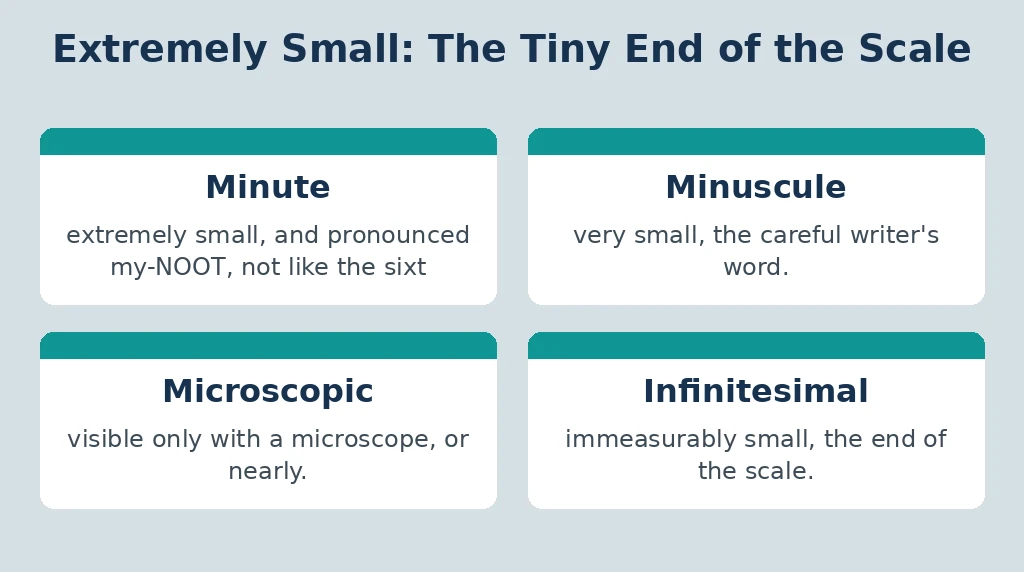
Sometimes small is not small enough. Print shrinks to minuscule, cracks narrow to the microscopic, and quantities dwindle toward the infinitesimal. This group holds the words for the bottom of the scale, from the laboratory to the nursery. Handle the scientific end with respect: microscopic and subatomic make precise claims, and readers who know the difference will trust you less if you spend them on a small kitchen.
- Minute: extremely small, and pronounced my-NOOT, not like the sixty seconds. Only a minute amount of the powder is needed.
- Minuscule: very small, the careful writer’s word. The minuscule print at the foot of the page hid a major condition.
- Microscopic: visible only with a microscope, or nearly. Microscopic grains of pollen filled the spring air.
- Infinitesimal: immeasurably small, the end of the scale. The infinitesimal gap between the panels let the rain in.
- Atomic: at the smallest scale physics knows. The watchmaker worked at almost atomic levels of precision.
- Subatomic: smaller than an atom, purely scientific. Subatomic particles vanish the moment instruments catch them.
- Micro: extremely small, modern and clipped. The bakery sells micro loaves baked for one person.
- Diminutive: strikingly smaller than the kind usually is. The diminutive singer filled the concert hall with sound.
- Lilliputian: tiny in the storybook sense. A Lilliputian railway wound around the garden pond.
- Teeny: extremely small and playful. There is a teeny chip in the rim of the cup.
- Teensy: teeny with an extra curl of cuteness. She added a teensy pinch of salt and tasted again.
- Itty-bitty: very small, American and affectionate. An itty-bitty spider had built its web in the lampshade.
- Itsy-bitsy: the nursery-rhyme twin of itty-bitty. The itsy-bitsy boat bobbed on the pond.
- Bitty: small in bits and pieces, informal. The recipe calls for bitty cubes of cheese.
Writers of fantasy and satire raid this group for names and kingdoms. Lilliputian comes from Swift’s island of six-inch citizens, and it still carries a whiff of the storybook, which is why journalists reach for it when politics shrinks to parish size. At the opposite pole, atomic and subatomic belong to laboratories and headlines about physics; borrowing them for a small apartment is a joke, and it lands only when the reader knows you know.
Small in Amount, Number and Importance
Budgets, risks, chances and differences are not measured with rulers, and big is not the only word that blurs them. Reports, essays and arguments live in this group: slight for changes, negligible for risks, paltry for offers that insult, scant for attention that should have been paid. Choosing among them is choosing how much the smallness matters, which is usually the real point of the sentence.
- Slight: small in degree, just noticeable. There was a slight improvement in her breathing by morning.
- Minor: lesser in seriousness, scale or rank. The car suffered only minor damage in the collision.
- Minimal: the smallest amount possible or allowed. The redesign kept changes minimal so staff could adjust.
- Limited: small in scope or number, deliberately bounded. Tickets are limited to four per household.
- Modest: small and unshowy, often a deliberate understatement. They live on a modest income and give generously anyway.
- Negligible: so small it safely does not count. The risk to swimmers is negligible after the cleaning.
- Insignificant: too small in importance to matter. The cost difference proved insignificant over ten years.
- Trifling: small and hardly worth mention, slightly stiff. He would not argue over a trifling sum.
- Trivial: so small it deserves no worry at all. The meeting wasted an hour on a trivial disagreement.
- Paltry: insultingly small, for sums and offers. The workers rejected a paltry raise of two percent.
- Scant: barely enough, less than needed. The report paid scant attention to the flood risks.
- Scanty: thin and insufficient in supply. Scanty rainfall left the wells low by August.
- Meager: small and unsatisfying in amount. They shared a meager supper of bread and soup.
- Nominal: small in name only, a token figure. The club charges a nominal fee to cover printing.
- Token: small and symbolic rather than real. She made a token payment on the first of the month.
- Marginal: small in effect, at the edge of mattering. The new filter made only a marginal difference.
- Small-scale: done on a small plan or in a small area. Small-scale farmers supply most of the town’s vegetables.
- Lesser: smaller in importance or degree, comparative. The lesser peak is climbed far more often than the famous one.
Notice how many of these words began life in counting houses, courts and laboratories. Negligible comes from the Latin for “not to be picked up,” a word for things beneath notice; paltry descends from a word for rags, which is why it still sneers; scant once described a stingy measure of grain. The history is not decoration. It explains the temperature of each word today, and temperature, in amount words, is usually the difference between a fact and an accusation.
Small in Build and Stature
Describing the build of people and animals asks for tact as well as accuracy. Petite and elfin praise; undersized and puny judge; dwarf and pygmy are technical words for breeds and species that spill carelessly into insult when aimed at people. Midget belongs to history and to vintage product names, and modern writers leave it there. The examples below keep these words where they belong: on plants, animals, objects and the occasional fictional hero.
- Petite: small-framed and neat, the kind word for a person’s build. The petite tailor stood on a stool to pin the hem.
- Dwarf: bred or grown much smaller than the kind. A dwarf apple tree fits a courtyard and still fruits heavily.
- Pygmy: the smallest kind of a species, used of animals. The pygmy hippo at the zoo weighs less than a piano.
- Bantam: a small breed, and by extension a plucky small person. The bantam hens ruled the farmyard.
- Undersized: smaller than it should be, a plain judgment. The undersized fish went back into the river.
- Puny: small and weak, never kind. The puny seedlings failed in the first frost.
- Runty: stunted, the smallest of a litter or batch. The runty pup grew into the strongest dog of the three.
- Short: low in height, one dimension only. The short ladder would not reach the gutter.
- Squat: short and wide, low to the ground. A squat lighthouse stood at the harbor mouth.
- Dinky: small and neat in British use, small and shabby in American. They rented a dinky studio above the bakery.
- Elfin: small and delicate with a fairy lightness. Her elfin features suited the costume perfectly.
- Midget: an older word for very small versions of things, now avoided for people. Vintage midget radios are collectors’ items today.
A word about how usage has shifted, because build words age faster than any others in this guide. Terms that Victorian novelists spent freely on heroes and heroines can read as mockery today, and editors quietly retire them one by one. The safe modern pattern is to describe what is seen rather than what is judged: a small-framed dancer, a five-foot guard, a compact, powerful build. Precise beats colorful whenever the subject is a person who might read it.
Small Spaces: Cramped, Confined and Snug
Rooms have their own vocabulary of smallness, and it splits neatly into complaint and compliment. Cramped, confined and poky grumble; snug and bijou glow. Real estate writing lives on this fault line, but honest writers cross it deliberately, choosing the word that matches the room rather than the rent. Width has its own word here too: narrow, the specialist for passages, alleys and escapes.
- Compact: small because everything fits with no waste. The compact cabin sleeps four in surprising comfort.
- Cramped: uncomfortably small, with no room to move. Six of us squeezed into the cramped lift.
- Confined: small and shut in, formal in tone. Rescue teams trained in confined spaces under the rubble.
- Narrow: small in width, whatever its length. A narrow alley ran between the two warehouses.
- Snug: small in the comfortable way, warm and close. The snug reading corner became her favorite place in the house.
- Bijou: small and elegant, British and approving. They bought a bijou apartment two streets from the theater.
- Poky: small and rather mean, informal. The poky back room served as office, store and kitchen.
Travel writers lean on this group harder than anyone, because a hotel room, a sleeper berth and a village square must each be sized in a single phrase. The honest ones report the poky bathroom along with the snug window seat, and readers trust the praise precisely because the complaint was not edited out. Smallness in spaces is never just measurement; it is a forecast of how a body will feel living there, and these words are the forecast.
Informal and Playful Words for Small
Speech shrinks words for fun. Teeny grows a tail and becomes teeny-weeny; itty-bitty doubles itself for rhythm; half-pint turns a beer measure into an affectionate name for a child. None of these belong in a report, and all of them belong in dialogue, where they do the work of a wink. Children’s writing especially runs on this group, because young readers hear the smile in them.
- Wee: tiny with a smile, beloved in Scotland and Ireland. Just a wee dram of whisky remained in the bottle.
- Teeny: the classic playground small. He held up a teeny shell for the class to see.
- Teensy: teeny stretched thinner still. Move the picture a teensy bit to the left.
- Teeny-weeny: extremely small, proudly childish. The recipe needs a teeny-weeny pinch of chili.
- Itty-bitty: the American favorite for cute smallness. She packed itty-bitty sandwiches for the train.
- Itsy-bitsy: immortalized by the spider in the rhyme. An itsy-bitsy crack ran across the screen.
- Pint-sized: small and bursting with energy. The pint-sized winger outran every defender.
- Half-pint: an old informal name for a small person, usually affectionate. Come here, half-pint, and reach the top shelf for me.
- Knee-high: very short, from the saying knee-high to a grasshopper. He has followed the team since he was knee-high.
- Mini: the modern clip for anything shrunk. The children demanded mini versions of everything on the menu.
The pattern underneath the play is worth noticing: English repeats and rhymes when it wants to shrink something with love. Teeny-weeny, itty-bitty, itsy-bitsy and even tiny-winy in baby talk all double the sound as the size halves, which is why these words feel musical before they feel precise.
How to Choose the Right Synonym for Small
Begin by asking what is being measured. A thing, a space, an amount and a reputation each take different words, and most bad swaps come from answering the wrong question. A negligible portion sounds like a laboratory note, while a tiny portion belongs on a plate. Then ask how small: the scale in this guide runs from smallish at the gentle end to infinitesimal at the invisible end, and landing two rungs too low is the exaggeration readers notice first.
There is also the question of honesty in scale, which matters more at the small end than anywhere else. Calling a risk negligible when it is merely small is not a style choice; it is a claim, and in medicine, engineering and finance it can be a costly one. The ladder in this guide exists so that you can stand on the exact rung the facts support: slight for a change you can barely measure, minimal for the least that is possible, negligible only when the thing can be set aside with a clear conscience.
Then ask how you feel about it, because small words carry attitude more openly than most. The same flat is bijou in the brochure, snug in the diary and poky in the complaint letter. The same offer is modest from the employer and paltry from the union. If you are writing for someone else, a client, a character, a child, borrow their attitude, not yours, and the word will fit the mouth it has to live in.
Finally, mind the fixed partnerships. Small talk, small print, small hours and small change keep the word small and refuse every synonym; nobody says tiny talk or negligible print. Outside those phrases, though, you have free choice, and one more resource: when the subject is a place or a face and the feeling is delight rather than measurement, the synonyms for pretty will often finish the sentence better than any size word can.
| Situation | Best word | Why |
|---|---|---|
| A formal report on risk | Negligible | Precise, calm and defensible |
| An advertisement for a flat | Bijou | Turns smallness into elegance |
| A story about a puppy | Runty | Affectionate, visual and full of character |
| An essay on budgets | Modest | Measured and credible |
| A complaint about a raise | Paltry | Says the insult out loud |
| Instructions for medicine | Minute | Exact about quantity, no warmth needed |
Small Synonyms for Writing and Dialogue
In essays and reports, the amount family does the heavy lifting. Examiners trust slight increases, minimal changes, limited evidence and negligible risks because each phrase sounds considered rather than decorated. The essayist’s error is spending tiny and wee in formal prose, where their playfulness reads as carelessness. Save the music for the subjects that deserve it, and let the measured words carry the argument.
Dialogue is where the playful group earns its living. A grandmother says wee, a toddler says teeny-weeny, a Londoner says dinky, and each word places the speaker before the description lands. Fiction writers also work the contrast between the families: the diminutive professor with the enormous voice, the petite detective nobody takes seriously until she speaks. Small words, chosen by character, become characterization.
Children’s writing is a craft of its own here, because young readers are connoisseurs of smallness. The teeny-weeny and itty-bitty words give them rhythm to chant, while little carries the emotional weight of every small hero from storybooks onward: the little engine, the little prince, the little mermaid. Writers for children choose small words the way composers choose instruments, and the playful group in this guide is their orchestra.
Description sits between the two, in stories, travel writing and reviews, where a scene must be sized in a breath. A snug harbor, a bijou café, a pocket-sized guidebook: these phrases measure and charm at once. And when the quality of the small thing is the real story, when it is not just little but lovely, the synonyms of good are waiting on the next shelf to finish the job.
Antonyms for Small
The rising scale mirrors the falling one, with a word for every degree of largeness:
- Big: above average in size, the direct opposite. A big garden can still feel private.
- Large: greater in size or amount, slightly formal. They chose a large hall for the wedding.
- Huge: extremely large, emphatic. A huge crowd gathered outside the stadium.
- Enormous: very large in size, scale or amount. The project was an enormous success.
- Immense: vast beyond easy measuring. Immense pressure built behind the dam.
- Vast: extremely large in area or scope. Vast forests cover the north of the country.
- Gigantic: like a giant, beyond normal scale. A gigantic statue watches over the harbor.
- Colossal: so large it inspires awe. The cleanup was a colossal task.
- Massive: large, heavy and solid. A massive oak door closed behind them.
- Substantial: large in amount or value. She made a substantial donation to the library.
- Considerable: large enough to deserve attention. The repairs took considerable time.
- Significant: large enough to matter. The results showed a significant improvement.
Notice the symmetry: as small splits into size and importance, so do its opposites. A substantial majority is not a huge majority, and a significant crack in a cup is nonsense, because cracks take size words and votes take importance words. Writers who keep the two ladders side by side rarely fall off either. One more pattern completes the picture: English loves these opposites in pairs, the big and the small of it, great and little, much and little, and skilled writers borrow the music of those pairings when a sentence needs balance. A story that opens with an immense silence can close, satisfyingly, on a tiny sound.
Common Mistakes: Words That Are Not True Synonyms for Small
Short is the most common stand-in, and the most misleading. Short measures one line only, height in a person, length in a rope, time in a meeting. A short, wide, deep box is not a small box, and a short novel can still be a huge achievement. When overall size is the point, small and its family are the honest words; when the single line is the point, short wins and small should step aside.
Narrow and thin fail the same way, sideways. A narrow road may run for a hundred miles; a thin book may be tall, wide and heavy in every other respect. Both words describe one dimension and stay silent about the rest, which is why the narrow escape in stories is about closeness, not about size at all. Light belongs to another sense entirely: a small suitcase can be heavy, a large balloon is light, and swapping the two words swaps the subject from size to weight.
The subtlest trap is young. In phrases like “my small brother,” small quietly means younger, not shorter, and in many languages the same word does both jobs, which is why learners mix them. In careful English, keep the families apart: young, younger and youngest for age; small, little and tiny for size. A writer who respects that border will never describe a little old lady as a small young one, and the reader will never have to guess.
Frequently Asked Questions
What is the best synonym for small?
Little is the best all-purpose synonym for small, and the one native speakers choose most often, because it carries size and feeling together. For pure emphasis, tiny is the natural upgrade, and for formal writing, minute, minuscule and diminutive are the trusted choices. The right pick depends on whether you mean physical size, amount, or importance.
What is a stronger word than small?
Tiny is the everyday stronger word, and the scale keeps falling from there: minute and minuscule for careful prose, microscopic for the nearly invisible, and infinitesimal for the smallest thing words can name. In speech, teeny-weeny and itty-bitty push smallness further with humor than any formal word can.
What is the difference between small and little?
They overlap almost completely, but small is the measurer and little is the feeler. Small judges size against a standard, as in a small engine or a small serving, while little often carries affection, dismissal or youth, as in her little garden or his pathetic little excuse. A small child is measured; a little child is loved.
What is a formal synonym for small?
Diminutive, minuscule and minute are the formal words for physical smallness, and they sit comfortably in essays and reports. For amounts and importance, minimal, negligible and insignificant do the same work. Compact is the formal choice when the smallness is efficient rather than lacking, as in a compact design.
What is the opposite of small?
The direct opposites are big and large, and the scale rises through huge, enormous and immense to vast and colossal. For amounts and importance the opposites are substantial, considerable and significant. Choosing the right end of the scale matters as much as choosing the right word on it.
Final Thoughts
Small is not a failure of size; it is a size with its own honors. Little warms it, tiny sharpens it, compact respects it, petite praises it, and minuscule and infinitesimal carry it down to the edge of the invisible. With this family at your command, you can describe a speck of dust, a shy budget, a beloved grandmother and a harbor flat, and give each one exactly the smallness it owns. That precision is a kindness to every reader. Keep the ladders in this guide side by side in your mind, the size ladder and the importance ladder, and most sentences will choose their own word before you finish writing them. Small, handled well, is never the weak option. It is the exact one.
To keep browsing the scale, the Merriam-Webster Thesaurus entry for small gathers hundreds of relatives and opposites, sorted by sense. Vocabularies grow the way gardens do: a few well-chosen words at a time, each planted where it will thrive.
