A friend of mine once handed her editor a novel draft and called it “a big book.” The editor circled big three times in red pen. Fair enough, really. Big is the word we all grab first, and it tells the reader almost nothing. For plain everyday size you want large. For real scale, huge and enormous. When weight is part of the picture, massive. And when size is not the point at all and you mean importance, major or significant. This guide works through 85 synonyms for big, sorted by sheer size, by area and amount, by bulk, by importance and by the word’s warmer senses, so you can pick the exact word instead of the nearest one.
Every word below has been checked against real thesaurus entries, and each one comes with its meaning and a short example, because a synonym only proves itself when you can see it sitting in an actual sentence. Essay, story, report or birthday card: whatever you are writing, one of these groups holds the word your sentence has been missing.
Top Synonyms for Big: Quick Reference
In a rush? Start here. These are the synonyms for big that writers actually reach for, with a plain note on what each one means and where it earns its keep. The groups further down get into the finer differences.
| Word | Meaning in one line | Best for |
|---|---|---|
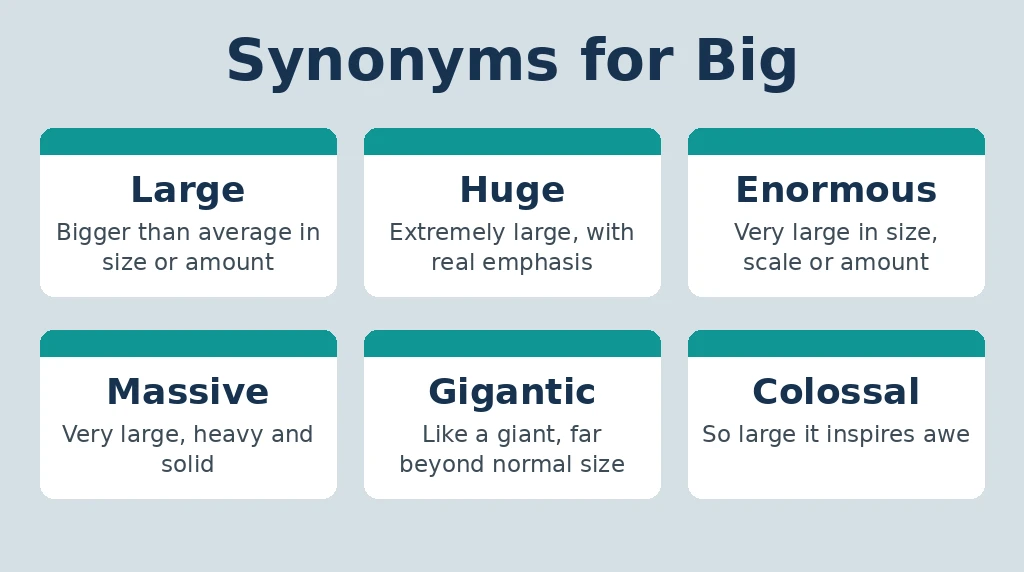
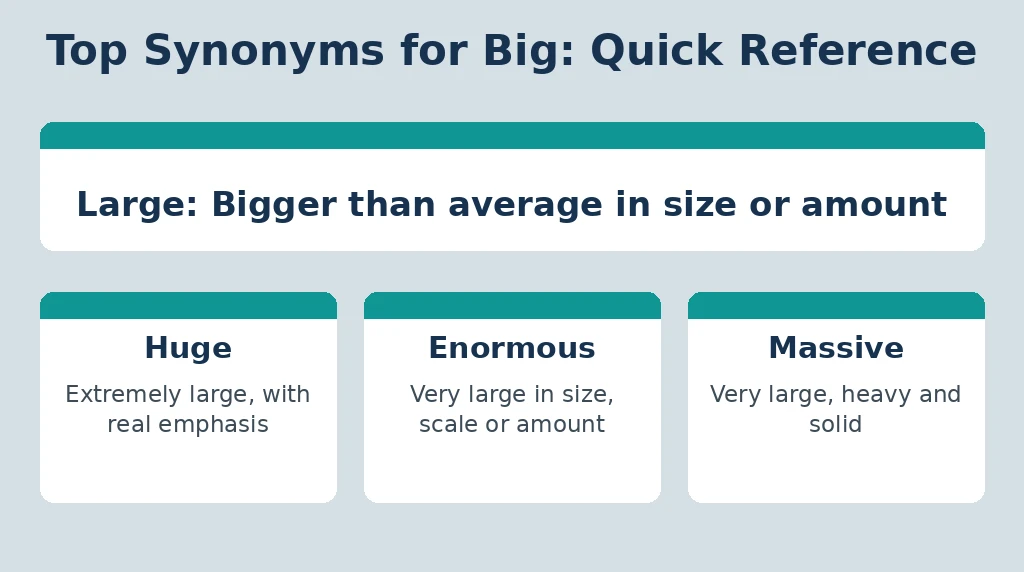
| Large | Bigger than average in size or amount | Everyday writing and neutral descriptions |
| Huge | Extremely large, with real emphasis | Strong statements, news, stories |
| Enormous | Very large in size, scale or amount | Formal writing, reports, essays |
| Massive | Very large, heavy and solid | Buildings, efforts, changes, crowds |
| Gigantic | Like a giant, far beyond normal size | Fiction, description, wonder |
| Colossal | So large it inspires awe | Statues, projects, dramatic scale |
| Immense | Impossible to measure, vast | Formal and literary writing |
| Vast | Extremely large in area or scope | Land, oceans, knowledge, majorities |
| Great | Large in degree, amount or importance | Formal, literary, classic tone |
| Sizable | Fairly large, more than expected | Measured, careful descriptions |
| Substantial | Large in amount, value or importance | Business, academic, news |
| Considerable | Large enough to be worth noticing | Formal reports and analysis |
| Extensive | Covering a large area or range | Research, damage, collections |
| Spacious | Having plenty of room inside | Rooms, homes, vehicles |
| Ample | More than enough, generously large | Supplies, evidence, time |
| Bulky | Large in an awkward, space-taking way | Objects, parcels, furniture |
| Hefty | Large and heavy, solidly built | Objects, books, fines, people |
| Jumbo | Oversized version of a normal thing | Products, food, playful contexts |
| Oversize | Bigger than the standard size | Clothing, luggage, equipment |
| Mammoth | As big as a mammoth, enormous | Tasks, projects, dramatic scale |
| Gargantuan | Gigantic, often about appetite or scale | Literary and humorous writing |
| Tremendous | Extremely large in amount or degree | Success, pressure, effort |
| Monumental | Massive and historically important | Achievements, buildings, tasks |
| Major | Large in importance or rank | News, decisions, problems |
| Significant | Large enough to matter | Formal, academic, statistics |
| Momentous | Of great importance and consequence | Events, decisions, occasions |
| Humongous | Extremely large, playful slang | Speech, jokes, children |
| Whopping | Surprisingly, impressively large | Informal amounts, prices, lies |
What Does Big Mean?
Big is an adjective that means of a size greater than average for its kind. A big house, a big dog and a big pizza only make sense because you are silently comparing them with other houses, dogs and pizzas. Its comparative and superlative forms are bigger and biggest, and it is one of the first adjectives most children learn, which may be why grown adults lean on it so hard.
Size is only the first of its jobs. Big measures importance too: a big decision, a big day, a big name in the industry. It measures degree: a big mistake, a big fan of the team. It can even describe character. A big heart is a generous one, and the person who says sorry first is sometimes called the bigger person. Each sense has its own family of synonyms, and mixing those families up is the most common way writers go wrong with this word.
Register matters too. Big is the most general and the most colloquial of the size words: friendly, plain, at home in speech. Large steps half a pace toward formality. Great is the formal, almost poetic member of the family when it describes things, as in the great plains or a great oak. Knowing which of the three a sentence wants is already half the craft of choosing well.
Big also does quiet social work that no size word can replace. “That was big of you” praises generosity after an apology, and “I am not big on spicy food” confesses a preference, or the lack of one. In the first, big has drifted a long way from tape measures, all the way to magnanimous. In the second it is doing the work of keen or fond, turned negative. Spotting which job big is doing in a sentence, size, importance, degree, character or taste, is the real skill this guide teaches, because each job has its own shelf of replacements.
One last habit to notice: big loves company. English is full of fixed phrases built on it, from big picture and big deal to big break and big cheese. Inside those phrases the word big stays put, and no synonym can take its place. Everywhere else, though, big can be traded up, and the groups below show the full market. If you need the opposite end of the scale instead, the synonyms for small cover everything from tiny to minuscule with the same care.
Synonyms for Big by Sheer Size
These are the heavy lifters, the words for things that are simply very large. They differ mainly in how far they push the scale and how much wonder they carry. Large states the fact. Huge raises its voice. By the time you reach gargantuan you are describing something out of a storybook. Pick your rung on the ladder and stop there; climbing higher than the truth makes readers stop believing you.
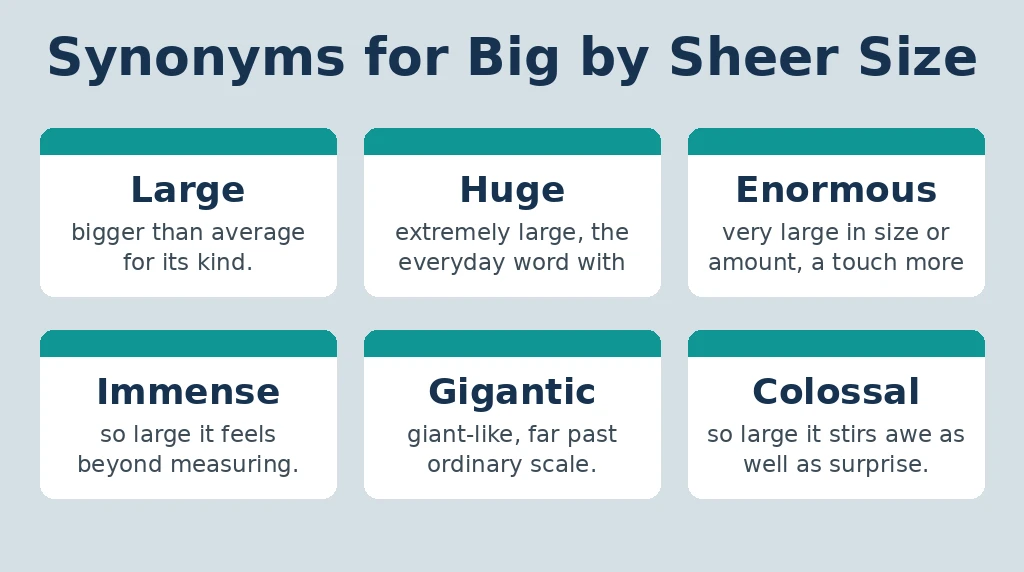
- Large: bigger than average for its kind. The shelter only takes large dogs, so our terrier stayed home.
- Huge: extremely large, the everyday word with the most punch. A huge wave knocked the whole sandcastle flat.
- Enormous: very large in size or amount, a touch more formal than huge. The factory employed an enormous workforce in its best years.
- Immense: so large it feels beyond measuring. From the ridge, the immense glacier stretched white to the horizon.
- Gigantic: giant-like, far past ordinary scale. A gigantic ferris wheel turned slowly above the fairground.
- Colossal: so large it stirs awe as well as surprise. Building the dam was a colossal undertaking for such a small country.
- Mammoth: enormous, borrowed from the extinct beast itself. Clearing the warehouse turned into a mammoth job that took all month.
- Gargantuan: gigantic, often playful or literary. He ordered a gargantuan breakfast and finished every bite.
- Monstrous: shockingly, unnaturally large. A monstrous shadow moved across the wall of the cave.
- Titanic: enormous in size or force. The two companies fought a titanic legal battle for six years.
- Elephantine: huge and heavy like an elephant, sometimes clumsy too. The old safe was elephantine, and it took four men to shift it.
- Mountainous: as large as a mountain, often for piles and waves. Mountainous seas kept every fishing boat in the harbor.
- Jumbo: an oversized version of a standard thing. She ordered the jumbo popcorn and still shared half of it.
- Mega: very large, modern and informal. The band played one mega concert before taking a year off.
- Humongous: extremely large, slangy and cheerful. That is a humongous pumpkin; it must weigh more than the kids.
- Whopping: surprisingly large, usually for numbers. The repair bill came to a whopping nine hundred dollars.
Big in Area, Space and Extent
Some things are big not because they are tall or heavy but because they spread. Fields, oceans, libraries, views and responsibilities all grow sideways, and English has a calm, spacious family of words for them. These synonyms suit land, rooms, collections and ideas, and several of them, like ample and capacious, quietly promise that there is room for more.
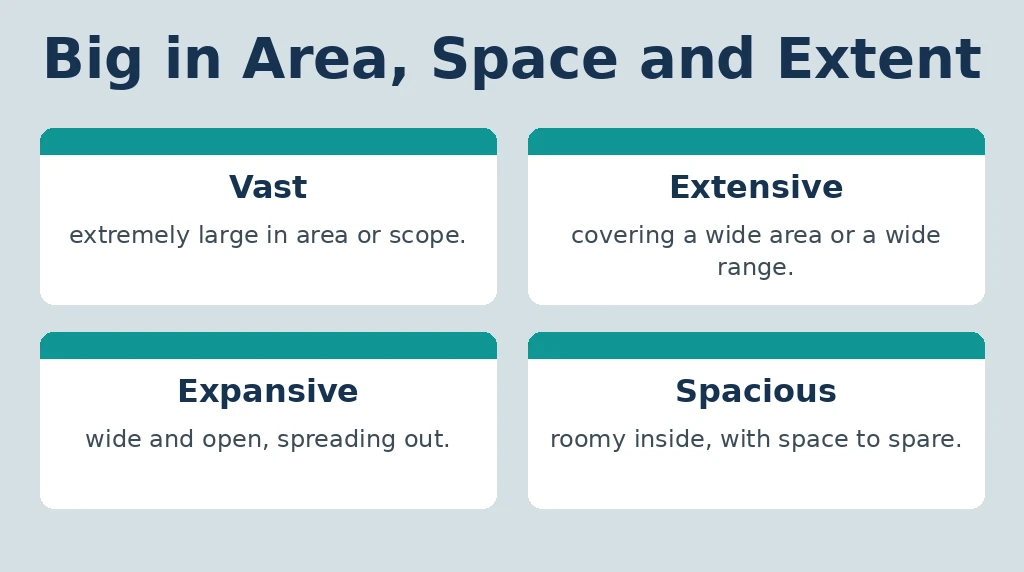
- Vast: extremely large in area or scope. Vast stretches of the desert have no road, well or shade.
- Extensive: covering a wide area or a wide range. The library holds extensive records of every ship built in the town.
- Expansive: wide and open, spreading out. Their new office has an expansive view over the bay.
- Spacious: roomy inside, with space to spare. The flat felt spacious because every room caught the light.
- Roomy: comfortably large inside, warmer than spacious. The car is roomy enough for three car seats across the back.
- Capacious: able to hold a great deal, formal and precise. She carried a capacious bag that swallowed books, bottles and umbrellas.
- Commodious: roomy and convenient, an older formal word. The house was commodious, with a pantry, a study and room for guests.
- Ample: more than enough space or supply. There is ample parking behind the hall on weekday evenings.
- Sweeping: wide in reach or effect. The report recommends sweeping changes to the whole pension system.
- Wide-ranging: covering a large span of topics or places. The inquiry took wide-ranging evidence from farmers, drivers and port workers.
- Boundless: without limits, endless in feel. His boundless energy kept the whole team going through the night shift.
- Immeasurable: too large to measure or express. The nurses made an immeasurable difference to the ward that winter.
Big in Amount and Number
Money, time, evidence, crowds and trouble all come in amounts, and big is a blunt instrument for measuring them. The words in this group let you say how much with more precision: considerable asks to be noticed, substantial feels solid in the hand, and bumper belongs to harvests and happy surprises. Reports and essays live on this group, because amounts are where vague writing hides.
- Considerable: large enough to deserve attention. The project took a considerable amount of patience as well as money.
- Substantial: solidly large in amount or value. She inherited a substantial sum and paid off the house at once.
- Great: large in degree or number, formal in flavor. A great many readers wrote in to praise the series.
- Ample: generously more than enough. The data gives ample proof that the treatment works.
- Abundant: existing in large quantities. The valley has abundant water even in dry summers.
- Plentiful: plentiful supplies are easy to find and freely available. Jobs were plentiful in the boom years, and wages rose fast.
- Hefty: large and weighty, for sums and objects alike. He faced a hefty fine for dumping waste in the river.
- Large-scale: done on a big plan or across a big area. The charity runs a large-scale vaccination program in rural districts.
- Bumper: unusually large, especially for harvests and sales. Farmers celebrated a bumper crop after the long rains.
- Tremendous: extremely large in amount, degree or force. The team felt tremendous pressure before the final.
One caution belongs with this group: amount words tempt writers to exaggerate, because no reader can check a “tremendous turnout” the way they can check a huge building with their own eyes. Journalists therefore pair amount words with figures whenever they can, and careful writers do the same in essays and reports. When no figure exists, choose the cooler word, considerable over tremendous, substantial over massive, and your page keeps the trust that hotter words spend.
Big and Heavy: Words for Bulk and Build
A thing can be big chiefly because it is bulky, dense or strongly built, and describing it with a pure size word misses the point. This group covers parcels that will not fit, tools that need two hands, and people whose build fills a doorway. Use the people words with care: burly and strapping are compliments about strength, while bulky about a person can sound unkind, so save it for furniture and freight.
- Bulky: big in an awkward way that takes up space. The bulky parcel would not fit through the letter box.
- Hefty: heavy and substantial in the hand. He lifted the hefty toolbox onto the bench with both hands.
- Hulking: large, heavy and looming. A hulking figure stood silently in the doorway.
- Burly: strongly and heavily built, for people. The burly guard checked every badge at the gate.
- Brawny: muscular and powerfully built. Years of farm work had left him brawny and sun-browned.
- Strapping: tall, strong and healthy-looking. Her strapping son carried both suitcases up the stairs at once.
- Thickset: solidly built, broad and compact. The thickset pony pulled the cart without effort.
- Stocky: short and solidly built. The stocky dog had the heart of a lion and the legs of a stool.
- Solid: dense and heavy for its size. The door was solid oak and took two men to hang.
- Oversize: larger than the standard size for its kind. He wore an oversize coat against the mountain wind.
- Massive: large, heavy and solid all at once. A massive anchor chain coiled across the deck of the ship.
When Big Means Important
Half the work big does in English has nothing to do with size at all. A big decision changes a life, a big name opens doors, and a big problem keeps people awake, none of which can be measured with a tape. This is the group for news writing, essays and professional life, where the scale is consequence rather than centimetres. Notice how the words shade from neutral (major, main) to solemn (grave, momentous): match the shade to the stakes.
- Major: large in importance, rank or seriousness. The storm caused major damage along the coast.
- Significant: large enough to matter or to be noticed. The new drug showed a significant improvement in recovery times.
- Important: of great value or effect, plain and direct. It is important to sign the form before Friday.
- Momentous: of the highest importance, history-making. Signing the treaty was a momentous day for both nations.
- Weighty: serious and demanding thought. The committee faced the weighty question of closing the hospital.
- Consequential: having important results that follow. Choosing the site was the most consequential decision of the whole project.
- Far-reaching: affecting a great deal, now and later. The ruling will have far-reaching effects on small farmers.
- Historic: famous or important in history. The crew made a historic landing on the far side of the Moon.
- Landmark: marking a major turning point. The court delivered a landmark judgment on privacy rights.
- Crucial: so important that everything depends on it. The next ten minutes are crucial if the patient is to recover.
- Key: central and essential. Cost was the key factor in their decision to move.
- Chief: first in importance, main. Her chief concern was the safety of the children.
- Principal: first in rank or importance, formal. The principal export of the region is coffee.
- Main: the largest or most important part. The main road into town floods every winter.
- Leading: most important or best known in a field. She is a leading expert on coastal erosion.
- Foremost: first and most important, slightly literary. He was the foremost poet of his generation.
- Prominent: important and well known. A prominent surgeon spoke against the cuts.
- Serious: large in a worrying way, demanding attention. The factory faces serious problems if orders keep falling.
- Grave: very serious and solemn, formal. The doctors gave a grave warning about the outbreak.
- Big-time: reaching the highest level, informal. She finally hit the big-time with her third novel.
Big-Hearted and Grown: The Other Senses of Big
Two quieter senses of big deserve their own shelf. The first is generosity: to be big about something is to be large-hearted, and the synonyms here carry warmth that no size word can. The second is the grown-up sense, where big simply means fully developed, as when a five-year-old announces she will pour her own juice because she is big now. Both families are easy to overlook, and both are exactly where a careless synonym swap goes wrong.
- Generous: giving more than expected, freely. He left a generous tip and a kind note for the staff.
- Magnanimous: noble and forgiving, especially after winning. The champion was magnanimous in victory and praised her rival warmly.
- Big-hearted: kind, warm and generous by nature. Our big-hearted neighbor checks on every elderly person on the street.
- Liberal: generous in giving or in amount. Add a liberal handful of herbs to the sauce.
- Bountiful: plentiful and generously given. The bountiful harvest filled every barn in the valley.
- Unselfish: putting others first, quietly generous. Her unselfish care for the team never made the headlines.
- Noble: high-minded and generous in spirit. It was a noble gesture to fund the scholarship anonymously.
- Adult: fully grown, the plain word for big in the grown-up sense. An adult elephant eats for most of the day.
- Grown: fully developed, often in grown man or grown woman. The novel follows three grown siblings returning to the family farm.
- Grown-up: adult in manner or status, slightly informal. Their grown-up daughter lives two streets away.
- Full-grown: having reached full size. A full-grown oak can shade a whole garden.
- Mature: fully developed, with a hint of ripeness or judgment. Mature trees were planted along the avenue fifty years ago.
Informal and Slang Words for Big
Speech needs its own giants. These informal words are too loud for reports and essays, but in dialogue, children’s writing and friendly prose they carry energy that formal words cannot. Ginormous began as a blend of gigantic and enormous, which tells you everything about the spirit of this group: when the regular words feel too small, speakers simply build bigger ones.
- Ginormous: giant and enormous blended into one playful word. The kids built a ginormous snowman in the schoolyard.
- Humongous: the classic playground word for extremely big. He made a humongous sandwich with everything in the fridge.
- Whopping: impressively big, usually for amounts. The striker signed a whopping contract with the new club.
- Walloping: very big, old-fashioned and cheerful. Grandad caught a walloping fish and talked about it for years.
- Thumping: notably big, British informal. The team celebrated a thumping win over their rivals.
- Super-sized: enlarged beyond the standard serving or version. The cinema sells super-sized drinks that last the whole film.
- Mega: huge in modern informal use, often before nouns. Their wedding turned into a mega party that ran past midnight.
How to Choose the Right Synonym for Big
Ask three questions before you choose. First, what kind of bigness is it: size, area, amount, bulk or importance? Each answer sends you to a different group in this guide, and choosing from the wrong group is the classic mistake. A substantial crowd sounds like a printing error, because crowds take size words like huge, while sums of money take substantial beautifully. Second, how big is it really? Keep your scale honest; if every hill in your story is mountainous, the real mountain has nowhere to go.
Third, who is reading? A formal report wants substantial, extensive and significant; a story wants huge, hulking and whopping; a technical manual often wants plain large and nothing fancier. Think also about what the synonym drags with it. Massive suggests weight as well as size, vast suggests distance, and ample suggests comfortable sufficiency. And when the failing is one of quality rather than scale, no size word will save the sentence; that is the territory of the synonyms for bad, from poor and faulty to atrocious.
Collocations are the other quiet guide. English glues certain synonyms to certain nouns: substantial sums, extensive damage, major surgery, ample evidence, vast majorities, hefty fines. When a pairing sounds wrong, it usually is, because native readers have heard the right one ten thousand times. If you are learning English, collecting these partnerships in a notebook will improve your writing faster than memorizing long lists, and the examples throughout this guide were chosen to show the partnerships in action.
A final trick from working writers: read the sentence aloud. Big synonyms have rhythm as well as meaning. An enormous effort rolls smoothly, a huge effort lands with a thump, and a mammoth effort lumbers, which may be exactly the picture you want. Your ear often knows the answer before your vocabulary does.
| Situation | Best word | Why |
|---|---|---|
| A formal report on funding | Substantial | Sounds measured and credible, never excitable |
| A story describing a wave | Mountainous | Gives the reader a picture, not just a measurement |
| A headline about a decision | Major | Short, serious and instantly understood |
| A child speaking in dialogue | Ginormous | Sounds like real excited speech |
| An essay on land use | Extensive | Precise about area and range |
| A product listing for a bag | Capacious | Promises room without exaggeration |
Synonyms for Big in Essays, Stories and Professional Writing
Essays reward the formal end of this word family. Substantial evidence, extensive research, considerable attention and significant results are the phrases examiners and editors trust, because each word measures as it describes. The common essay fault is not using big too often; it is using huge and massive as all-purpose intensifiers until the argument sounds like advertising. Swap in the measured words and the whole page calms down and convinces more.
Stories want the opposite: size the reader can see. A hulking figure in a doorway, a whopping fish, mountainous seas: these words paint. Fiction writers also play the senses of big against each other, letting a physically small character carry a big heart, or giving the big-time lawyer a tiny, frightened voice. Contrast is where this word family earns its keep. And when a scene turns on quality rather than scale, on whether something is wonderful rather than merely large, the synonyms of good are the shelf to reach for.
Dialogue deserves a word of its own, because characters betray themselves by the size words they choose. A child says ginormous, an estate agent says spacious, a sailor says mountainous about the sea, and a finance director says substantial about everything, including lunch. Matching the synonym to the speaker keeps fiction honest, and it is the fastest way to make a crowd of characters stop sounding like one author.
Professional writing sits between the two. Reports, proposals and emails need size words that inform without inflating: a large-scale rollout, a major milestone, a substantial saving. The rule of thumb is simple. If a number is available, give the number and let big retire; if no number exists, choose the synonym that tells the reader which kind of bigness you mean. Precision is the whole of the job.
Antonyms for Big
The opposite family is just as rich. It runs from the everyday to the almost invisible:
- Small: below average in size, the direct opposite. A small garden can still feed a family.
- Little: small with a touch of affection or dismissal. He kept one little photograph in his wallet.
- Tiny: very small, informal and emphatic. Tiny cracks had formed in the painting.
- Minute: extremely small, pronounced my-NOOT. Only a minute amount of the powder is needed.
- Minuscule: very small, formal and precise. The minuscule print hid a major condition.
- Microscopic: too small to see without help. Microscopic grains of pollen filled the air.
- Diminutive: unusually, strikingly small. The diminutive singer filled the hall with sound.
- Insignificant: too small in importance to matter. The cost difference proved insignificant.
- Minor: lesser in size, rank or seriousness. The car suffered only minor damage.
- Trivial: so small it deserves no worry. They wasted an hour on a trivial disagreement.
- Slight: small in degree, barely there. There was a slight improvement in her condition.
Notice that the antonyms split the same way the synonyms do: size on one side, importance on the other. A minor problem is not a tiny problem, and a microscopic majority makes no sense at all. Keeping the two families apart is the quiet skill underneath every good swap in this guide. Writers who learn to think in scales, from slight and minor up through big itself and on to vast and immense, gain a kind of volume control for prose: they can turn a description up or down by a single notch instead of shouting or whispering. That control, more than any single fancy word, is what makes descriptions feel exact.
Common Mistakes: Words That Are Not True Synonyms for Big
Tall is the most frequent impostor. Tall measures height alone, from the ground up, which is why a tall building can still be a small building if it is thin and short on floors. A wardrobe can be big without being tall, and a giraffe is tall without being especially big. Reach for tall only when the vertical line is the point.
Long misleads in the same way, one dimension at a time. A long bridge may be narrow and low; a long meeting may involve three people in a tiny room. Length is not size, and swapping long for big quietly changes the picture in the reader’s mind. The same caution applies to wide, which measures a single span across. A wide river can be shallow, short and unimpressive in every other way, so wide earns its place only when width is what matters.
Fat is not a neutral size word at all. About people it is blunt to the point of rudeness, and about objects it describes thickness in a way that often carries mockery, as in a fat wallet or a fat chance. Writers who use it as a casual synonym for big import a judgment they may not intend. Heavy fails for the opposite reason: it is all judgment about weight and none about size. A small stone is heavy, a huge balloon is not, and the two words part company whenever density enters the picture. Keep heavy for weight, and let the bulk words in this guide do the rest.
Frequently Asked Questions
What is the best synonym for big?
Large is the safest all-purpose synonym for big, because it fits almost any context without sounding dramatic. When you want more force, huge and enormous are the strongest everyday upgrades, and massive adds a sense of weight and solidity. The best choice always depends on whether you mean physical size, amount, or importance.
What is a stronger word than big?
For sheer size, enormous, gigantic, colossal and gargantuan are all stronger than big, and each one lifts the scale a step further. For importance, momentous and monumental carry more weight than big. Use the strongest words sparingly, because a page where everything is colossal soon makes nothing feel big at all.
What is a formal synonym for big?
Enormous, immense, substantial and considerable are the formal workhorses, and they sit comfortably in reports, essays and business writing. Capacious is the precise formal word for a space that holds a lot. Great is the classic formal and literary choice, as in a great oak or a great achievement.
Is large the same as big?
Nearly. Big and large overlap so much that they swap places in most sentences, but large is a little more formal and a little more measured. Big is the word of speech and feeling, the one a child reaches for, while large is the word of labels, sizes and reports. For degree and quality, as in a big mistake, great often beats both.
What is the opposite of big?
The direct opposites are small and little, and the scale runs down through tiny, minute and minuscule to microscopic and infinitesimal. For importance, the opposites are minor, trivial and insignificant. Choosing the right end of the scale matters as much as choosing the right word on it.
Final Thoughts
Big is a fine servant and a lazy master. It will describe a dog, a decision, a debt and a heart without complaining, but it will never tell your reader which kind of bigness you mean. Now you have large for the everyday, enormous for the overwhelming, vast for the endless, substantial for the serious and humongous for the playground, each with its own shade of meaning. Choose the shade, and the plain little word big can finally take a rest.
If you want to keep exploring the family, the Merriam-Webster Thesaurus entry for big lists hundreds of related words, near matches and opposites, and it is a pleasure to browse. Every writer’s vocabulary grows the same way: one honest, well-chosen word at a time.
