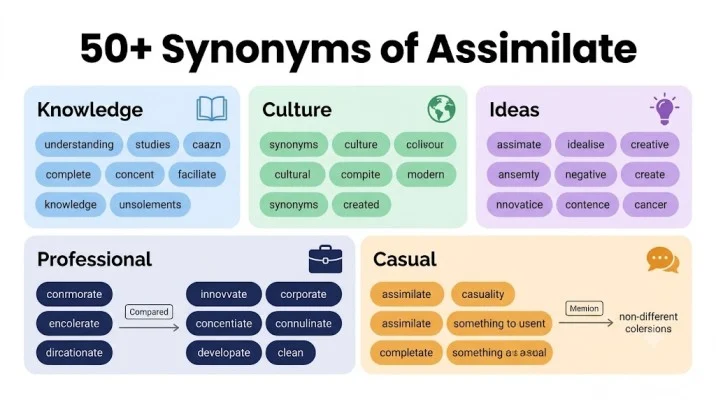
Strong vocabulary can transform writing into precise communication, especially when one word carries several shades of meaning. The word assimilate often appears in academic, professional, and everyday contexts, but choosing an alternative can make your message more natural and specific. Exploring synonyms of assimilate helps writers express ideas with accuracy while avoiding repetition.
From absorbing information to adapting to a culture or becoming part of a group, assimilate can describe different processes depending on context. The best replacement may suggest learning, integration, adaptation, absorption, or acceptance, so context matters when selecting the right term. This guide to synonyms of assimilate brings together useful alternatives, meanings, and natural examples to help strengthen vocabulary and make writing more polished, flexible, and engaging.
What Are the Best Synonyms of “Assimilate”?
Assimilate means to absorb, integrate, or understand something fully. The best synonyms depend on context. For culture, use integrate or incorporate. For ideas, use digest or internalize. A softer meaning, use acclimate or adapt. The right choice depends on your audience and purpose.
Meaning, Tone, and Context
Understanding the word assimilate is the first step to using it effectively.
Simple Definition:
Assimilate has three main meanings. First, it means to absorb and understand information fully. Second, it means to integrate into a new culture or society. Third, it means to incorporate new ideas or methods into an existing system.
Part of Speech:
Verb
Overall Tone:
Neutral. Assimilate is a functional word that does not carry strong emotion. However, in cultural contexts, it can have a complex meaning.
Formality Level:
Formal to Semi-Formal. Assimilate is used in academic writing, professional communication, and formal discussions.
Common Uses:
Native English speakers use assimilate to describe learning new information, adapting to a new environment, incorporating feedback, understanding complex ideas, and merging different systems or cultures.
Word Forms:
- Verb: assimilate
- Noun: assimilation
- Adjective: assimilative
- Noun (person): assimilator
Opposite Forms:
Reject, separate, segregate, exclude, misinterpret.
When and How to Use “Assimilate”
The word assimilate fits specific situations where you want to describe absorbing, integrating, or understanding something fully.
Professional Context:
New employees need time to assimilate our company’s procedures and values.
Academic Context:
Students must assimilate large amounts of information before the final exam.
Workplace Context:
The team successfully assimilated the new software into their daily workflow.
Personal Context:
It took her several months to assimilate into the new community.
Email Context:
Please take some time to assimilate the feedback before responding.
Resume Context:
Demonstrated ability to rapidly assimilate complex information and apply it effectively.
Social Media Context:
Learning new skills requires patience and time to assimilate the knowledge.
Best Synonyms of “Assimilate”
No single synonym works perfectly in every situation because assimilate has multiple meanings. The best choice depends on what you are trying to express.
For Knowledge and Information:
Use absorb, grasp, or digest. These words emphasize understanding and learning.
For Culture and Society:
Use integrate, incorporate, or acclimate. These words emphasize fitting into a new environment.
For Ideas and Methods:
Use internalize or embrace. These words emphasize making something part of yourself.
For a Softer Meaning:
Use adapt or adjust. These words emphasize change without pressure.
For a Stronger Meaning:
Use engulf, absorb, or consume. These words emphasize complete integration.
For Professional Writing:
Use integrate, incorporate, or absorb. These words sound clear and results oriented.
For Academic Writing:
Use assimilate itself or comprehend and internalize for precision.
When Not to Use “Assimilate”
Even though assimilate is a useful word, there are times when it is not the best choice.
When the Word Sounds Too Technical:
Assimilate can sound overly academic in casual conversation.
Original:
He quickly assimilated the new video game rules.
Better Recommendation:
Use learn or pick up.
Rewritten Sentence:
He quickly learned the new video game rules.
When the Word Sounds Too Formal:
Assimilate is too formal for everyday speech.
Original:
She assimilated the delicious flavors of the dish.
Better Recommendation:
Use savor or enjoy.
Rewritten Sentence:
She savored the delicious flavors of the dish.
When the Word Sounds Forced:
Assimilate can sound unnatural when describing simple actions.
Original:
I assimilated the warm sunlight.
Better Recommendation:
Use enjoy or soak up.
Rewritten Sentence:
I soaked up the warm sunlight.
When Cultural Context Is Complex:
Assimilate can have a negative connotation in cultural discussions.
Original:
Immigrants must assimilate into American culture.
Better Recommendation:
Use integrate or adapt.
Rewritten Sentence:
Immigrants can integrate into American culture while maintaining their traditions.
Words Commonly Confused With “Assimilate”
Several words are often confused with assimilate because they share similar meanings.
- Assimilate vs Absorb
- Difference: Absorb emphasizes taking something in. Assimilate emphasizes making it part of yourself.
- When to Use It: Use absorb for information. Use assimilate for becoming part of a new environment.
- Example: She absorbed the new material quickly. / He assimilated into his new community.
- Assimilate vs Integrate
- Difference: Integrate emphasizes combining parts into a whole. Assimilate emphasizes becoming part of something.
- When to Use It: Use integrate for systems or groups. Use assimilate for individuals or ideas.
- Example: The new software was integrated into the system. / He assimilated into the team culture.
- Assimilate vs Internalize
- Difference: Internalize emphasizes making something part of your beliefs or values. Assimilate emphasizes absorption.
- When to Use It: Use internalize for values or principles. Use assimilate for information or environments.
- Example: She internalized the importance of honesty. / He assimilated the new company policies.
- Assimilate vs Adapt
- Difference: Adapt emphasizes changing to fit new circumstances. Assimilate emphasizes becoming part of something.
- When to Use It: Use adapt for general change. Use assimilate for cultural or social integration.
- Example: The animals adapted to their new environment. / The immigrants assimilated into their new country.
- Assimilate vs Comprehend
- Difference: Comprehend emphasizes understanding. Assimilate emphasizes absorption and integration.
- When to Use It: Use comprehend for understanding. Use assimilate for full absorption.
- Example: She comprehended the complex theory. / He assimilated the new ideas into his thinking.
Best Synonyms of “Assimilate” by Context
| Context | Best Synonym | Why It Works | Example |
|---|---|---|---|
| Formal Writing | Integrate | Sounds precise and professional | The new policy was integrated into existing procedures. |
| Academic Writing | Comprehend | Sounds scholarly and precise | Students must comprehend advanced concepts. |
| Professional Communication | Incorporate | Clear and results oriented | We incorporated the client’s feedback into the final design. |
| Business Emails | Absorb | Clear and professional | Please take time to absorb the attached report. |
| Resume Writing | Internalize | Emphasizes deep understanding | Internalized customer service best practices. |
| Workplace Communication | Embrace | Positive and engaging | The team embraced the new workflow. |
| Casual Conversation | Pick up | Simple and natural | He picked up the new skills quickly. |
| Everyday Speaking | Learn | Easy and clear | She learned the new system in a week. |
| Creative Writing | Absorb | Adds imagery and depth | The city absorbed the energy of its residents. |
| Storytelling | Engulf | Emphasizes drama and intensity | The culture completely engulfed him. |
| Emotional Writing | Embrace | Warm and positive | She embraced her new identity. |
| Strong Emphasis | Consume | Powerful and dramatic | The new role consumed his every thought. |
| Mild Tone | Get used to | Gentle and approachable | He got used to the new environment. |
| Social Media Captions | Take in | Short and clear | Taking in all the new experiences. |
How to Choose the Best Synonym of “Assimilate”
Choosing the right synonym depends on several factors. Use this practical guide to make the best decision.
Meaning:
What does assimilate mean in your sentence? Is it about knowledge, culture, or ideas? Choose a synonym that matches the specific meaning.
Tone:
Do you want to sound formal, casual, or emotional? Formal words like integrate fit professional writing. Casual words like pick up fit conversation.
Audience:
Who is reading your writing? Academic readers expect precise vocabulary. Friends expect natural language. Business readers expect clear communication.
Emotional Strength:
Do you want to emphasize absorption, transformation, or understanding? Strong words like consume suggest complete integration.
Writing Purpose:
Are you writing a report, an email, a story, or a social media post? Match your synonym to the purpose.
Level of Formality:
Consider the formality of your situation. Reports, essays, and official documents require formal synonyms. Texting and social media allow casual language.
Natural Sounding Usage:
Always read your sentence aloud. If the synonym sounds forced or awkward, choose a different word.
Real Life Examples of “Assimilate”
School Context:
The students quickly assimilated the new math concepts.
Stronger Version:
The students quickly absorbed the new math concepts.
College Context:
She needed time to assimilate the complex theories.
Stronger Version:
She needed time to digest the complex theories.
Workplace Context:
New hires must assimilate our company culture.
Stronger Version:
New hires must integrate into our company culture.
Business Context:
The team assimilated the feedback and improved the product.
Stronger Version:
The team incorporated the feedback and improved the product.
Email Context:
Please assimilate the documents before our meeting.
Stronger Version:
Please review the documents before our meeting.
Resume Context:
Assimilated complex data to make strategic decisions.
Stronger Version:
Internalized complex data to make strategic decisions.
Conversation Context:
It took me a while to assimilate the new rules.
Stronger Version:
It took me a while to get used to the new rules.
Storytelling Context:
The new city slowly assimilated the young immigrant.
Stronger Version:
The new city slowly embraced the young immigrant.
Blogging Context:
Readers need time to assimilate new information.
Stronger Version:
Readers need time to process new information.
Social Media Context:
Assimilating all the new experiences from my trip!
Stronger Version:
Taking in all the new experiences from my trip!
25 Best Synonyms of “Assimilate”
| Synonym | Simple Meaning | Best Used For | Example Sentence |
|---|---|---|---|
| Absorb | Take in fully | Knowledge, information | She absorbed the new material quickly. |
| Integrate | Combine into a whole | Culture, systems | The new members integrated into the group. |
| Incorporate | Make part of something | Ideas, feedback | We incorporated the client’s suggestions. |
| Internalize | Make part of yourself | Values, beliefs | He internalized the importance of teamwork. |
| Digest | Process and understand | Complex ideas | She needed time to digest the report. |
| Grasp | Understand fully | Concepts, knowledge | He grasped the concept immediately. |
| Comprehend | Understand completely | Information, ideas | She comprehended the lecture fully. |
| Embrace | Accept willingly | Change, culture | The team embraced the new technology. |
| Adopt | Take on as your own | Practices, habits | She adopted the new system quickly. |
| Adapt | Adjust to new conditions | Environment, change | He adapted to the new office culture. |
| Acclimate | Become accustomed to | New environment | She acclimated to the new city quickly. |
| Adjust | Make small changes | Behavior, expectations | He adjusted to the new schedule. |
| Ingrain | Establish firmly | Habits, values | She ingrained the importance of punctuality. |
| Instill | Gradually establish | Ideas, beliefs | The teacher instilled a love of learning. |
| Engulf | Completely surround | Immersion | The new culture engulfed him. |
| Consume | Absorb completely | Resources, attention | The project consumed all his time. |
| Imbibe | Absorb mentally | Knowledge, ideas | She imbibed the wisdom of her mentors. |
| Soak up | Take in fully (informal) | Experiences, knowledge | He soaked up the new information. |
| Take in | Absorb | Information, sights | She took in the breathtaking view. |
| Pick up | Learn casually | Skills, information | He picked up the new software quickly. |
| Learn | Acquire knowledge | General learning | She learned the new process. |
| Master | Become expert | Skills, subjects | He mastered the new system. |
| Understand | Comprehend | Ideas, concepts | She understood the assignment. |
| Perceive | Become aware of | Information, situations | He perceived the changes immediately. |
| Fathom | Understand deeply | Complex ideas | She could not fathom the complexity of the problem. |
Synonyms of “Assimilate” by Usage
Professional vs Personal Synonyms
Professional Synonyms:
Integrate, incorporate, internalize, adopt, adapt.
Why They Work:
These words sound precise and results oriented. They fit reports, emails, and professional communication.
Personal Synonyms:
Get used to, pick up, soak up, learn, take in.
Why They Work:
These words feel natural in conversation, personal writing, and casual settings.
Formal vs Conversational Synonyms
Formal Synonyms:
Integrate, incorporate, internalize, digest, comprehend.
Why They Fit:
These words sound authoritative and precise. They work in academic papers, business reports, and official documents.
Conversational Synonyms:
Pick up, get used to, soak up, learn.
Why They Fit:
These words feel natural in everyday speech, texting, and casual writing.
Academic Synonyms
Recommended Words:
Comprehend, internalize, absorb, digest, integrate.
Why They Work:
These words sound precise and scholarly. They show attention to detail and accurate communication.
Professional and Business Synonyms
Recommended Words:
Integrate, incorporate, internalize, adopt, adapt.
Why They Fit:
These words are specific and professional. They fit business emails, reports, and presentations.
Creative and Literary Synonyms
Recommended Words:
Engulf, imbibe, consume, soak up.
Why They Fit:
These words add imagery, emotion, and variety to storytelling, poetry, and descriptive writing.
Modern English Synonyms
Recommended Words:
Learn, pick up, adapt, get used to.
These words are widely used in modern American English. They are clear, direct, and easy to understand.
Strongest to Mildest Synonyms
Mild (Soft Adaptation):
Get used to, adapt, adjust, learn.
Moderate (Clear Integration):
Pick up, absorb, incorporate, integrate.
Strong (Deep Integration):
Internalize, digest, comprehend.
Very Strong (Complete Integration):
Engulf, consume, absorb completely.
Emotional vs Neutral Synonyms
Emotional Synonyms:
Embrace, accept, engulp, consume.
When to Use Emotional Synonyms:
Use them in personal writing, creative writing, and situations where emotional connection matters.
Neutral Synonyms:
Integrate, incorporate, absorb, learn, adapt.
When to Use Neutral Synonyms:
Use them in professional writing, academic papers, and factual communication.
Antonyms of “Assimilate”
| Antonym | Meaning | Example Sentence |
|---|---|---|
| Reject | Refuse to accept | She rejected the new ideas completely. |
| Separate | Divide or keep apart | The cultures remained separate for centuries. |
| Segregate | Keep apart | The group was segregated from the rest. |
| Exclude | Leave out | The new members were excluded from the group. |
| Isolate | Keep apart | He isolated himself from the team. |
| Alienate | Make feel unwanted | The new policy alienated many employees. |
| Misunderstand | Not understand | She misunderstood the new instructions. |
| Disregard | Ignore | He disregarded the important details. |
| Dismiss | Reject as unimportant | She dismissed his concerns immediately. |
| Overlook | Fail to notice | The team overlooked important factors. |
| Abandon | Give up completely | He abandoned his previous beliefs. |
| Resist | Oppose or fight against | She resisted the proposed changes. |
| Refuse | Say no to | He refused to accept the new policy. |
| Neglect | Pay no attention to | She neglected to learn the new system. |
| Reject | Turn down completely | The proposal was rejected by the committee. |
Comparison: “Assimilate” vs Similar Words
Assimilate vs Absorb
Main Difference:
Absorb emphasizes taking something in. Assimilate emphasizes making it part of yourself.
Which Is Stronger?
Assimilate is stronger because it implies full integration.
Which Is More Formal?
Assimilate is more formal.
When to Use Each:
Use absorb for information. Use assimilate for becoming part of something.
Examples:
Assimilate: He assimilated into the new team culture.
Absorb: She absorbed the new information quickly.
Assimilate vs Integrate
Main Difference:
Integrate emphasizes combining parts. Assimilate emphasizes becoming part of something.
Which Is Stronger?
Assimilate is stronger because it implies becoming indistinguishable.
Which Is More Formal?
Both are formal.
When to Use Each:
Use integrate for systems. Use assimilate for individuals or groups.
Examples:
Assimilate: He assimilated into the new company culture.
Integrate: The new software was integrated into the system.
Assimilate vs Internalize
Main Difference:
Internalize emphasizes making something part of your beliefs. Assimilate emphasizes absorption.
Which Is Stronger?
Internalize is stronger for personal values.
Which Is More Formal?
Both are formal.
When to Use Each:
Use internalize for values. Use assimilate for information or environments.
Examples:
Assimilate: She assimilated the new policies.
Internalize: He internalized the importance of honesty.
Assimilate vs Adapt
Main Difference:
Adapt emphasizes changing to fit. Assimilate emphasizes becoming part of something.
Which Is Stronger?
Assimilate is stronger because it implies complete integration.
Which Is More Formal?
Assimilate is more formal.
When to Use Each:
Use adapt for general change. Use assimilate for cultural integration.
Examples:
Assimilate: The immigrants assimilated into their new country.
Adapt: The animals adapted to the new climate.
Assimilate vs Comprehend
Main Difference:
Comprehend emphasizes understanding. Assimilate emphasizes absorption and integration.
Which Is Stronger?
Assimilate is stronger because it implies full absorption.
Which Is More Formal?
Both are formal.
When to Use Each:
Use comprehend for understanding. Use assimilate for full absorption.
Examples:
Assimilate: He assimilated the new ideas into his thinking.
Comprehend: She comprehended the complex theory.
Assimilate vs Embrace
Main Difference:
Embrace emphasizes accepting willingly. Assimilate can be neutral or forced.
Which Is Stronger?
Embrace is more positive and voluntary.
Which Is More Formal?
Embrace is more emotional and less formal.
When to Use Each:
Use embrace for positive acceptance. Use assimilate for neutral absorption.
Examples:
Assimilate: He assimilated the new procedures.
Embrace: She embraced the new opportunities.
Common Phrases and Expressions with “Assimilate”
| Phrase | Meaning | Example Sentence |
|---|---|---|
| Assimilate into a culture | Become part of a new culture | He worked hard to assimilate into his new country. |
| Assimilate information | Absorb and understand information | She needed time to assimilate all the new information. |
| Assimilate new ideas | Incorporate new ideas | The team successfully assimilated the new ideas. |
| Rapidly assimilate | Absorb quickly | She rapidly assimilated the new skills. |
| Assimilate feedback | Understand and use feedback | He assimilated the feedback and improved his work. |
| Fully assimilate | Understand or integrate completely | It takes time to fully assimilate new knowledge. |
Common Mistakes to Avoid
Choosing a Vague Synonym Instead of a Precise One
Incorrect:
He got the new information.
Better:
He assimilated the new information.
Why:
Assimilated is more specific and professional.
Confusing “Assimilate” With “Absorb”
Incorrect:
She assimilated the new material into her mind.
Better:
She absorbed the new material into her mind.
Why:
Absorb is more natural for information.
Using an Informal Synonym in Formal Writing
Incorrect:
The team got used to the new system quickly.
Better:
The team integrated the new system quickly.
Why:
Integrated is more formal and professional.
Selecting an Overly Dramatic Synonym
Incorrect:
The small change engulfed the entire company.
Better:
The small change was adopted by the entire company.
Why:
Engulfed is too dramatic for a small change.
Repeating the Same Word Too Often
Incorrect:
He assimilated the new rules. Then he assimilated the new culture. Then he assimilated the new language.
Better:
He learned the new rules. Then he adapted to the new culture. Then he mastered the new language.
Why:
Varying synonyms improves flow and readability.
Choosing a Word With the Wrong Emotional Tone
Incorrect:
She was forced to assimilate into the group.
Better:
She gradually adapted to the group.
Why:
Assimilate can sound forced. Adapted sounds more natural.
Frequently Asked Questions
What are the best synonyms of “assimilate”?
The best synonyms of assimilate are absorb, integrate, incorporate, internalize, digest, and adapt. The right choice depends on context. For knowledge, use absorb or digest. For culture, use integrate or adapt.
What are the best formal synonyms of “assimilate”?
The best formal synonyms of assimilate are integrate, incorporate, internalize, comprehend, and digest. These words sound precise and scholarly. They fit academic papers, business reports, and professional presentations.
What are common informal synonyms of “assimilate”?
Common informal synonyms of assimilate include pick up, get used to, soak up, and learn. These words are used in casual conversations, friendly writing, and everyday speech. They are simple and natural.
What is another word for “assimilate” in professional writing?
In professional writing, use integrate, incorporate, or internalize. These words are clear, results oriented, and professional. They fit reports, business emails, and presentations.
What is the difference between “assimilate” and “integrate”?
Assimilate emphasizes becoming part of something and losing distinct identity. Integrate emphasizes combining parts while maintaining some distinctness. Use assimilate for individuals in a culture. Use integrate for systems and ideas.
What is the opposite of “assimilate”?
The opposite of assimilate is reject, separate, segregate, or exclude. Choose the most accurate opposite based on your context. For knowledge, the opposite is misunderstand or ignore. For culture, the opposite is isolate or exclude.
Conclusion
Assimilate is a powerful and precise word that describes absorbing, integrating, and understanding. The best synonyms of assimilate help you express this concept in any context, whether you need formal, academic, professional, or casual language.
The more you practice choosing the right synonym, the more natural and confident your writing will become. A strong vocabulary helps you connect with readers, express your ideas clearly, and make a lasting impression.
Definitions, meanings, and usage recommendations should be verified with trusted language references before publication. Recommended sources include Cambridge Dictionary, Oxford English Dictionary, Merriam Webster, Collins Dictionary, and Britannica.
Read More Related Articles:
Synonyms for Thus | Meaning, Examples, and Better Word …
50+ Synonyms of Significant | Meanings, Uses, Examples, and …
50+ Synonyms of To | Meanings, Uses, Examples, and Best …