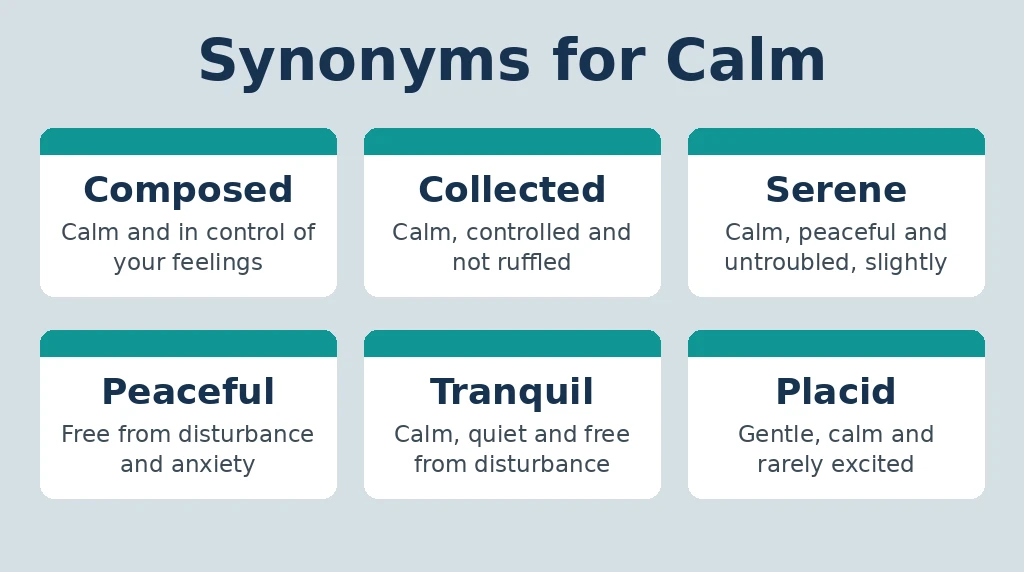
“Stay calm” is the most given and least obeyed instruction in the language, shouted in departure lounges, hospital corridors and driving lessons. Yet everyone recognises the real thing on sight: the nurse whose entrance lowers the room’s heart rate, the pilot whose voice stays level on the intercom, the sea on a windless morning. Calm means free from agitation, excitement or disturbance, and the closest synonyms for calm are composed and collected for a steady person, serene, peaceful and tranquil for calm minds and places, and quiet and still for calm weather, seas and streets. In fact, the instruction is the test, and the room is the proof. For example, synonyms for calm for steady people should lower the heart rate, not raise the voice.
This guide collects 39 synonyms for calm and sorts them by what exactly is being calmed: a person under pressure, a temperament that never rattles, a mind at rest, a place or a sea, and the verb for doing the calming. Every word was checked against real thesaurus entries and comes with a plain meaning and an example, so you can tell genuine composure from its impostors: coldness, numbness and mere quiet. In other words, the sort is the map, and the subject is the key. Consequently, synonyms for calm for a person should name the achievement, not the absence.
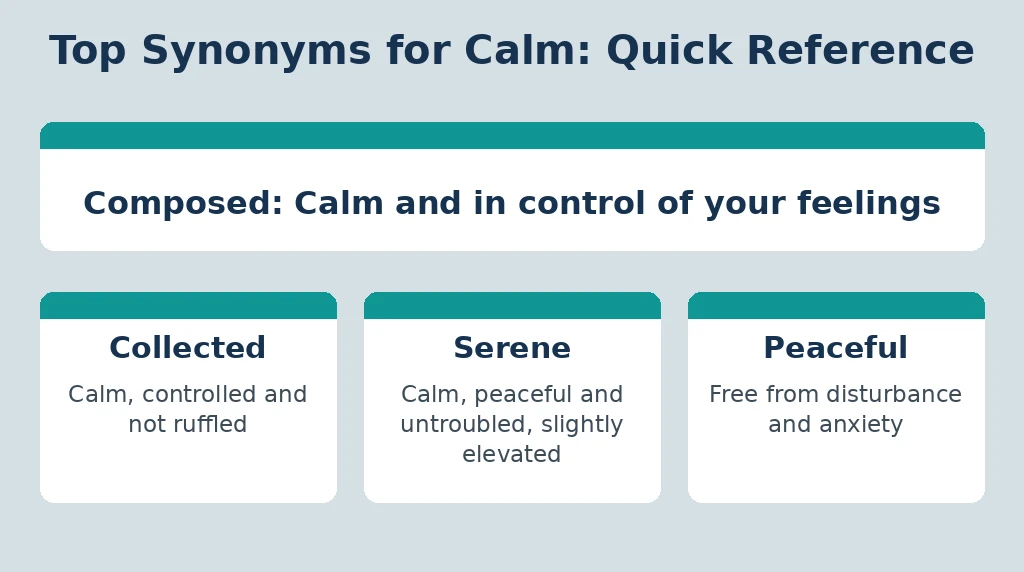
Top Synonyms for Calm: Quick Reference
Start here when you need composure in a hurry. These are the calm synonyms people reach for most, covering people, moods, places and weather. The sections after the table sort the full list into finer groups, including the verb senses and the words that only pretend to mean calm. In short, the hurry is the test, and the table is the shortcut. In fact, synonyms for calm for quick reference should sort by the subject, not the alphabet.
| Word | Meaning in one line | Best for |
|---|---|---|
| Composed | Calm and in control of your feelings | People under pressure and in public |
| Collected | Calm, controlled and not ruffled | Interviews, speeches and crises |
| Serene | Calm, peaceful and untroubled, slightly elevated | Faces, places and spiritual calm |
| Peaceful | Free from disturbance and anxiety | Minds, homes, valleys and protests |
| Tranquil | Calm, quiet and free from disturbance | Gardens, lakes and formal writing |
| Placid | Gentle, calm and rarely excited | People, cows, lakes and tempers |
| Unruffled | Not worried or disturbed by trouble | Managers, hosts and spokespeople |
| Unperturbed | Not worried or anxious, rather formal | Reports, officials and steady minds |
| Self-possessed | Calm, confident and in control of yourself | Formal praise of public figures |
| Poised | Calm, graceful and ready | Performers, athletes and interviews |
| Cool-headed | Calm and sensible in difficulty | Emergencies and workplace praise |
| Level-headed | Calm and able to think clearly | Advice, leadership and references |
| Unflappable | Never shocked or upset, informal admiration | Assistants, diplomats and parents |
| Imperturbable | Impossible to worry or upset, formal | Judges, butlers and grand portraits |
| Unfazed | Not surprised or worried, informal | Modern speech and interviews |
| Nonchalant | Calm in a casual, unconcerned way | Teenagers, stars and shrugs |
| Relaxed | Calm and free from tension | Holidays, bodies and meetings |
| At ease | Comfortable and free from anxiety | Guests, patients and new starters |
| Untroubled | Not worried by anything | Sleepers, consciences and villages |
| Easygoing | Calm and relaxed in manner, not easily annoyed | Bosses, travellers and flatmates |
| Patient | Calm in enduring delay or provocation | Teachers, queues and parents |
| Quiet | With little noise or activity | Streets, seas, rooms and mornings |
| Still | Without movement or sound | Air, water, photographs and nights |
| Soothe | To calm someone gently, the verb sense | Children, pain and frightened animals |
One observation before the groups: English grades calm like temperature. Cool is a little of it. Serene is a lot. And imperturbable is the absolute zero of anxiety, a state no real human sustains through a whole Tuesday. The groups below are arranged so you can pick a temperature your sentence and your subject can honestly support. In particular, the grades are the temperature, and the temperature is the meaning. As a result, a writer should choose synonyms for calm for grades by how much calm they carry, not by how grand they sound.
What Does Calm Mean?
Calm describes a state free from agitation, and it does so for four different subjects. A calm person isn’t excited, anxious or angry on the inside, whatever’s happening outside. A calm place or sea is without disturbance, wind or rough movement. Calm weather is windless or nearly so, which is why sailors and forecasters use the word more technically than the rest of us. And as a noun, a calm is a period of such stillness, most famously in the phrase the calm before the storm, where the stillness itself turns into a warning. In fact, the subjects are the map, and the state is the territory. Therefore, synonyms for calm for people should describe the achievement, not the absence.
Calm is also a verb, and an unusually honest one. Calming someone is work: soothing, settling, quietening. Almost nobody calms by instruction alone, which is why “calm down” shouted at a crying child has the success rate it does. The verb matters for writers because the adjective family describes a state while the verb family describes an achievement, and many scenes, in fiction and in life, are really about the journey between the two. In other words, the verb is the work, and the work is the test. For instance, synonyms for calm as verbs should soothe the person, not the sentence.
Notice what calm is not. It isn’t the absence of feeling. The composed surgeon cares intensely, and the serene grandmother feels everything her family feels. Calm is feeling governed, disturbance refused a vote. That’s why the impostor words in the Mistakes section (numb, detached, cold) cause such trouble: they describe the absence that calm gets mistaken for, and it’s why a calm character written as an empty one bores readers within a page. In fact, the feeling is the test, and the absence is the error. For example, synonyms for calm for characters should describe governed feeling, not empty feeling.
The synonyms divide naturally by subject, and mixing them is the commonest calm error in English: a tranquil boss sounds medicated, a composed sea sounds theatrical. The groups below follow the subjects in order: people first, then temperaments, moods, places and weather, and finally the verbs. Each word waits in the company it actually keeps. In other words, the subject is the rule, and the mix is the error. Consequently, synonyms for calm for groups should follow the subject, not the sound.
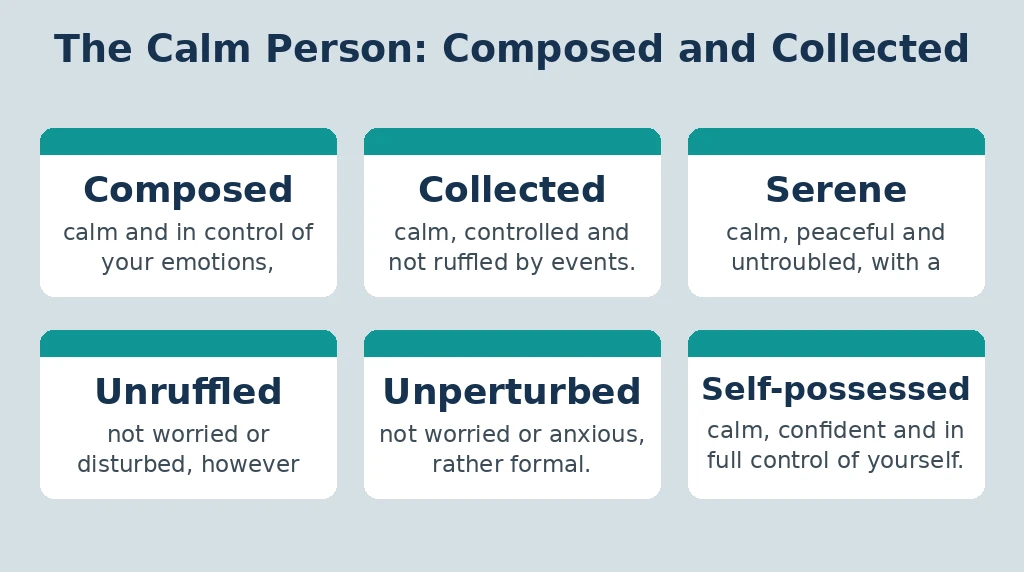
The Calm Person: Composed and Collected
This group describes the achieved state, calm as something a person is doing, usually while something difficult happens around them. These are the words of references, obituaries and eyewitness accounts, and they carry a quiet compliment: whatever this person felt, they governed it. Composed heads the family, the word for the witness who answers steadily and the defendant who listens without flinching. In short, the state is the achievement, and the achievement is the test. Also, synonyms for calm for achieved states should name the doing, not the seeming.
Within the group there are social grades. Collected suggests a recovery, calm gathered up after a startle, while unruffled and unperturbed insist there was never a crease to begin with. Self-possessed adds confidence, poise adds grace and readiness, calm with good posture. Serene stands slightly above the rest, calm with light on it, the word of faces in paintings and grandmothers in memoirs. In particular, the grades are the social test, and the recovery is the proof. As a result, a writer should choose synonyms for calm for social grades by the recovery, not the rank.
- Composed: calm and in control of your emotions, especially under pressure. The composed witness answered every question without raising her voice.
- Collected: calm, controlled and not ruffled by events. He remained collected throughout the emergency landing.
- Serene: calm, peaceful and untroubled, with a quiet dignity. Her serene expression never changed during the verdict.
- Unruffled: not worried or disturbed, however awkward things become. Unruffled by the hecklers, the speaker finished her sentence.
- Unperturbed: not worried or anxious, rather formal. The minister seemed unperturbed by the leaked report.
- Self-possessed: calm, confident and in full control of yourself. Self-possessed at nineteen, she chaired the meeting like a veteran.
- Poised: calm, graceful and ready for what comes. The poised gymnast waited, perfectly still, for the music.
Professions keep their favourites within this group. Aviation and medicine run on composed and collected, said of voices as much as of people, because in those worlds a calm voice is itself an instrument, measurably lowering the fear of everyone listening. Diplomacy prefers unruffled, sport prefers poised, and the law reaches for the sober end of the family in its judgements, where calm shades into dignity and the two qualities certify each other. In fact, the profession is the proof, and the favourite is the standard. For instance, synonyms for calm for professions should earn the trust, not the praise.
A usage warning fits here: this family flatters, and readers know it. Calling a politician composed in a news report lends them your credibility, which is why careful journalists save these words for witnessed behaviour, the steady answer actually given, instead of spending them on a press release’s description of its own man. In other words, the flattery is the trap, and the warning is the guard. Therefore, synonyms for calm for flattering words should flatter the act, not the title.
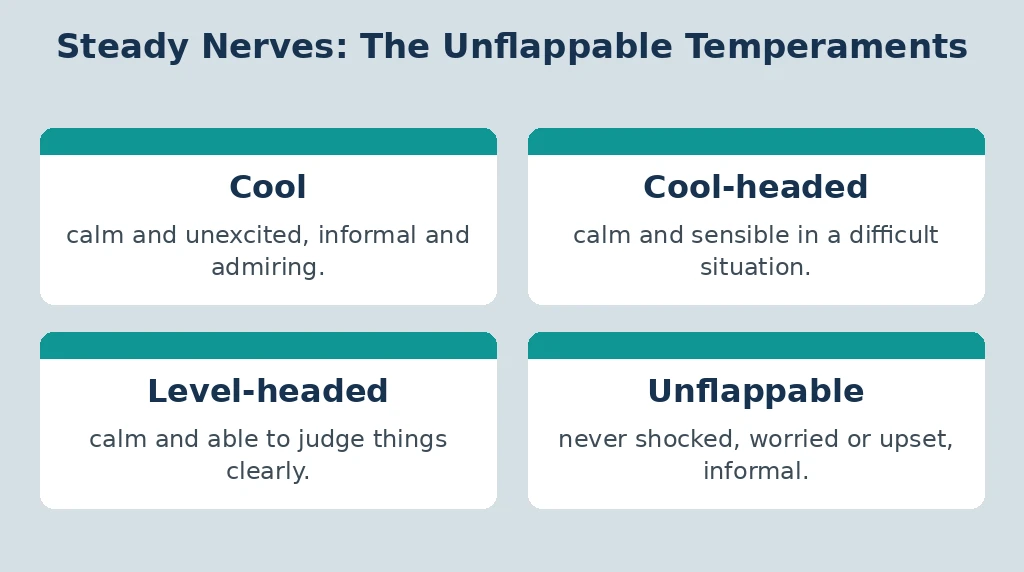
Steady Nerves: The Unflappable Temperaments
Where the first group describes a state, this one describes a nature: people built calm, whose steadiness is a trait rather than an achievement. Several are built from cool, because English has long pictured temper as temperature, and the head words, cool-headed and level-headed, locate the calm exactly where decisions are made. These are the people you want holding the map, the rope or the microphone when things go wrong. In fact, the nature is the test, and the state is the contrast. For example, synonyms for calm for temperaments should describe the build, not the act.
Unflappable and imperturbable are the twin summits, separated mostly by dress: unflappable is the informal admiring word of offices and dressing rooms, imperturbable its formal, almost scientific cousin. Unfazed is the modern everyday version, unbothered by surprise. Nonchalant adds a shrug, calm that borders on not caring, which in a teenager is charm and in a surgeon would be a scandal. Steady closes the group as the quiet virtue word, calm you can set your watch by. In other words, the twin summits are the dress, and the centre is the office. Consequently, synonyms for calm for twin words should follow the dress, not the height.
- Cool: calm and unexcited, informal and admiring. She stayed cool while the alarms went off around her.
- Cool-headed: calm and sensible in a difficult situation. A cool-headed driver steered the bus onto the verge.
- Level-headed: calm and able to judge things clearly. We need a level-headed treasurer for the rebuilding fund.
- Unflappable: never shocked, worried or upset, informal. The unflappable assistant had handled worse before breakfast.
- Imperturbable: impossible to worry or make anxious, formal. His imperturbable calm annoyed opponents more than any insult.
- Unfazed: not surprised or worried by something unexpected, informal. Unfazed by the power cut, the chef cooked by lantern light.
- Nonchalant: calm in a casual way that shows little concern. He gave a nonchalant shrug and asked for the bill.
- Sedate: calm, serious and unhurried in manner. The sedate chairman let every speaker finish before replying.
- Steady: calm, regular and not easily upset. Her steady hand made her the natural choice for the repairs.
There’s a national flavour to admire here too. British praise leans heavily on this family, the cool head and the unflappable manner being close to a civic ideal, while American English reaches more quickly for cool and unfazed, the same virtues in modern dress. Neither dialect owns calm, but each has tailored the compliment to its own wardrobe, and reading across the two is a small lesson in what cultures applaud. In short, the flavour is the praise, and the nation is the evidence. In practice, synonyms for calm for British praise should lean on the head, not the hype.
Calm in Mind and Mood: At Peace with the Day
This group describes calm as a felt condition rather than a performance: the mind unclenched, the body unbraced, the shoulders down where they belong. It’s the vocabulary of holidays, gardens, Sunday mornings and good news, and it leans towards contentment and good cheer, with one foot always kept firmly in peace rather than in joy. A person in this group isn’t managing a crisis. They’re enjoying the absence of one. In particular, the condition is the feeling, and the performance is the contrast. As a result, synonyms for calm for moods should describe the feeling, not the show.
Peaceful is the family’s centre, used of minds, places and even protests, meaning disturbance refused or absent. Relaxed is its bodily cousin, calm you can see in shoulders, while at ease and at peace phrase the state as a location, somewhere a person has arrived. Patient and easygoing belong here as the social forms of the mood, calm measured by how someone treats delay and other people, which is where this family shakes hands with the one in our guide to synonyms for kind. In fact, the centre is peaceful, and the refusal is the meaning. Therefore, synonyms for calm for centres should mean refusal, not absence.
- Peaceful: free from disturbance, anxiety or violence. They spent a peaceful week in a cottage with no signal.
- Relaxed: calm and free from tension or worry. The relaxed meeting ended with laughter and cake.
- At ease: comfortable and free from anxiety or embarrassment. The doctor soon put the children at ease.
- At peace: in a state of calm acceptance, often after struggle. After the long dispute, she was finally at peace with the decision.
- Untroubled: not worried or disturbed by problems. He slept the untroubled sleep of a man with a clear conscience.
- Unworried: not anxious about what might happen. Unworried by the forecast, they packed the picnic anyway.
- Easygoing: calm and relaxed in manner, rarely annoyed. An easygoing landlord, he never once mentioned the rent.
- Patient: able to wait or endure provocation calmly. The patient teacher explained the sum a fourth time.
Health writing leans on this group heavily, and mostly well: an untroubled night, an unworried patient and a relaxed recovery are real clinical goods, described in words a reader can feel. The caution is against promising the mood as a duty. Patients told to stay positive and at peace can hear blame inside the kindness, so the gentle members of this family, restful and untroubled, serve better than any instruction to relax on command. In other words, the health is the fact, and the judgement is the contrast. For instance, synonyms for calm for health writing should measure the heart rate, not the opinion.
Calm Places, Weather and Seas: The Quiet World
Turn from people to the world and the vocabulary changes temperature. This group describes the stillness of air, water and places, and its words are the stock of poets, forecasters and travel writers. Its centre is the family mapped in detail in our guide to synonyms for quiet, since a calm place is usually a quiet one too, though the two ideas part company on a windy, silent cliff. In fact, the world is the test, and the temperature is the proof. For example, synonyms for calm for places should describe the stillness, not the silence.
Tranquil and placid divide the waters between them. Tranquil is the elevated word, of gardens, lakes and spa brochures, while placid belongs to cows, wide rivers and unhurried afternoons, calm with a hint of slowness. Restful and soothing describe what such places do to a visitor, and hushed adds the human version of stillness, a room where everyone has lowered their voice. Mild and smooth serve the forecasters, describing weather and seas that have stopped arguing. In other words, the waters are the test, and the elevation is the difference. Consequently, synonyms for calm for waters should follow the garden, not the gutter.
- Quiet: with little or no noise, activity or disturbance. They anchored in a quiet bay beyond the harbour.
- Still: without movement or sound, completely calm. The air was still and the lake held the mountains like glass.
- Tranquil: calm, quiet and free from disturbance, elevated in tone. The tranquil garden sat behind high walls of yew.
- Placid: gently calm and rarely disturbed, of water or temperament. Placid cows watched the train pass without interest.
- Restful: giving a feeling of calm and rest. The restful green of the valley slowed everyone’s walking.
- Soothing: having a gently calming effect. The soothing rhythm of the train rocked her to sleep.
- Hushed: quiet because people are speaking softly or awed. A hushed crowd waited for the first note.
- Mild: gentle and not severe, of weather or manner. A mild, kind evening followed the long storm.
- Smooth: without waves or roughness, of a sea or crossing. The crossing was smooth and the decks stayed dry.
Writers of weather should borrow one habit from the sailors: observe before you name. “A calm morning” is a label. “The smoke went straight up and the harbour held the boats without a ripple” is calm shown, and the second sentence calms the reader as it goes. The words in this group work hardest as captions under such evidence, a single tranquil or still set like a signature beneath a paragraph of proof. In short, the habit is the lesson, and the naming is the reward. For example, synonyms for calm for weather should observe first, and name second.
Sailors give this group its most precise vocabulary of all, because for them calm is a measurement: the bottom of the Beaufort scale, wind under one knot and a sea like a mirror. Landlocked writers borrow the precision for atmosphere, and one sentence of true weather calm, properly observed, can still an entire chapter around it.
Calm as a Verb: Soothing, Settling and Quietening
Finally, the working words: the verbs for producing calm in someone else. English is rich here because the job is universal, done nightly by parents, nurses, teachers, negotiators and friends. The group divides by method. Soothe works by comfort, settle works by removing the cause of the wobble, and pacify and appease work by concession, which is why diplomats use them with care.
Quieten is the plain British member, mostly in the phrase quieten down, and compose turns the verb on the self: to compose yourself, gathering the composed state of the first group by an act of will. Relax earns its place as the friendly instruction of the family, the verb form of the holiday mood, though as advice it shares the family curse of being easier to say than to do.
- Soothe: to calm someone gently and comfortingly. She soothed the baby with a song her mother had sung.
- Settle: to make someone calm and comfortable again. A cup of tea settled everyone after the fright.
- Quiet: to make someone or something calm and silent. He quieted the class with a single raised eyebrow.
- Quieten: to become or make someone calm and less noisy, British. The crowd quietened as the lights dimmed.
- Pacify: to calm someone who is angry or agitated, often by concession. The offer pacified the strikers for a week.
- Appease: to calm someone by giving them what they demand. He appeased the toddlers with biscuits and cartoons.
- Relax: to make or become less tense and more calm. A walk by the river relaxed the whole party.
Technique deserves a paragraph of its own, because these verbs are also instructions. Soothe works through the senses (voice, warmth, rhythm, rocking), which is why it governs babies and animals. Settle works through arrangements: chairs, tea, explanations and time. Pacify and appease work through the wallet or the treaty, giving ground to buy quiet, and an honest writer keeps the price visible in the sentence, since calm that is bought reads differently from calm that is given.
How to Choose the Right Synonym for Calm
Begin with the subject. People under pressure take the composed family, temperaments take the unflappable family, moods take the peaceful family, and places, weather and seas take the quiet family. Most wrong choices in this vocabulary are simply the right word at the wrong address, a tranquil manager or a composed ocean, and the fix is a forwarding address, not a bigger dictionary.
Next, choose the temperature. A colleague who handles one awkward meeting well is composed or unruffled; the one who has handled a decade of them is unflappable, and imperturbable should be saved for the almost mythic. The calm choice usually makes the whole day feel easy for everyone nearby, which is the social test: real calm lowers other people’s heart rates, while the impostors in the Mistakes section merely lower the volume.
A further check catches the subtlest errors: does the word survive the whole day? Calm words imply duration. One steady answer in a press conference earns composed for that hour, not serene for the biography. Match the word’s implied timescale to the evidence you actually have (minutes, seasons or a lifetime) and the family will never embarrass you in print.
Finally, mind the dress code. Serene, tranquil and imperturbable wear formal clothes; cool, unfazed and easygoing wear weekend clothes; at ease and at peace are phrases rather than adjectives and sit happiest mid-sentence. The table below collects the everyday decisions.
| Situation | Best word | Why |
|---|---|---|
| Situation | Best word | Why |
| A witness steady under cross-examination | Composed | Calm as an achievement, witnessed live |
| An assistant nothing can rattle | Unflappable | A temperament, praised informally |
| A mind free of worry on holiday | At peace | Calm as a resting place, not a performance |
| A lake with no wind at dawn | Still | Weather and water take the weather words |
| A baby being comforted (verb) | Soothe | Calming done gently, by comfort |
| A crowd being quieted by concessions | Pacify | Calm bought, and the word admits it |
Synonyms for Calm in Essays, Stories and Professional Writing
In stories, calm is a pacing instrument before it is a trait. The still scene before the storm, the composed voice in the chaotic chapter, the tranquil garden the plot keeps returning to, all borrow their power from contrast, which is why the calm before the storm is a cliché with a true engine inside it. Give your calmest character one permitted crack, a hand that shakes only when pouring tea, and the composure around it becomes believable. Readers trust calm that costs something.
One more feature of the word deserves a writer’s attention: calm scales. A person can be fairly calm, perfectly calm, eerily calm or suspiciously calm, and the adverbs do real work, because past a certain point readers begin to doubt the performance. Fiction lives in that doubt. The calmest person in the room is either the hero, the culprit or the one who hasn’t yet heard the news, and a good writer lets all three possibilities hang in the stillness.
Dialogue separates this family beautifully. The imperturbable butler, the unflappable friend, the nonchalant teenager and the serene grandmother all speak at different speeds and temperatures, and a writer can cast a whole room from this one shelf. In essays and reports, composed and level-headed do the professional work, certifying steadiness without gushing, while serene and tranquil should be rationed, since in nonfiction they can read as travel-brochure varnish over an ordinary Tuesday.
Children’s writing has its own corner of the shelf. Picture books run on soothed, settled and safe, calm presented as something a trusted adult provides, while books for older readers begin the handover: characters who compose themselves, breathe, count and find their own level heads. It’s a tidy history of the whole vocabulary in miniature. Calm starts as a gift, becomes a skill, and ends, in the words of the first two groups, as a character.
Meditation and wellness writing overdraws this vocabulary worst of all, stacking serene, tranquil, peaceful and calm itself into a scented fog. The cure is the same as everywhere in this guide: one precise word, anchored in something observed. Not a tranquil mind in the abstract, but a mind like the lake at six in the morning, still enough to hold the mountains. Anchored calm persuades. Perfumed calm merely drifts.
Antonyms for Calm
The opposite shelf describes the loss of stillness, and English stocks it at every volume, from the first flutter of nerves to full frantic weather. The words divide usefully into states of anxiety, states of agitation and states of emergency, and a writer choosing among them is really choosing how far the stillness has been lost.
- Anxious: worried and afraid about what might happen. The anxious passengers kept checking the departure board.
- Nervous: easily worried and unable to relax. The nervous speaker arranged his notes for the fifth time.
- Agitated: restless and disturbed in mind or behaviour. The agitated caller paced the office with the phone.
- Stressed: under mental pressure and unable to rest, modern and everyday. Stressed staff took the argument into the corridor.
- Tense: tight with suppressed feeling, unable to relax. A tense silence followed the announcement.
- Excitable: easily excited and hard to calm. The excitable puppy treated every visitor as a parade.
- Jumpy: nervous and easily startled, informal. After the break-in, the whole street was jumpy.
- Panicky: in a state of sudden, uncontrollable fear. Panicky shoppers cleared the shelves by noon.
- Frantic: wildly hurried and anxious, out of control. A frantic search went on through the night.
- Restless: unable to stay still or settled. The restless audience began to cough and whisper.
These words also carry a sympathy gradient worth handling honestly. Anxious and nervous ask for kindness, agitated asks for space, and frantic asks for help, while excitable, in a critic’s mouth, can be a put-down aimed at the young, the keen or the female. The opposite shelf isn’t a set of insults by default. It’s a scale of alarm, and the writer’s job is to read the scale before pointing at it.
Notice that the human opposite of calm is rarely anger. It’s anticipation, the mind rehearsing disasters. That’s why the antonyms lean anxious rather than furious, and why the true cure words in the verb group, soothe and settle, work by answering the rehearsal instead of ordering it to stop.
Common Mistakes: Words That Are Not True Synonyms for Calm
The commonest impostor is quiet itself, which is at least a genuine neighbour and appears honestly in this guide’s place and weather group. But for people, the words part company. A surgeon can be calm and loud, singing through an operation in perfect composure, and a sulking teenager can be quiet and in turmoil. Quiet describes the volume; calm describes the weather inside. Test any sentence by asking which of the two you actually witnessed.
Stoic is the near relation most often miscast. A stoic endures pain and hardship without complaint, which overlaps calm in the steady groups, but stoicism is specifically about bearing suffering, often with a philosophy attached, while calm can be a person on a beach with nothing to bear. The stoic in the deckchair is a coincidence. The word belongs at the hospital and the battlefield of endurance.
Deeper trouble comes with numb. Numbness is the absence of feeling after shock, and it can look exactly like calm from across a room: the same still face, the same level voice. But numb is calm’s opposite in everything that matters, a stage of injury rather than a state of health. Describing a grieving or traumatised person as calm is one of the cruellest compliments English allows, and careful writers, friends and managers learn to spot the difference.
One phrase belongs in this section rather than among the synonyms: calm down. As an instruction it fails so reliably that comedians retire on it, because it orders a state while offering no path to it, and often smuggles in the accusation that the other person’s feelings are the problem. The verb group in this guide is the repair kit: soothe, settle, listen, and only then, perhaps, the state itself arrives uncommanded.
Finally, detached and its cousin cold describe calm without care: the professional distance of the surgeon or the negotiator, or the emotional absence of someone who has checked out. Detachment has its honest uses, and this guide isn’t against it. But it’s a tool or a symptom, never the same thing as composure, which is feeling governed rather than feeling gone. If the person in your sentence cares and is steady, choose from the calm family. If they’ve stopped caring, say so with the colder word and mean it.
Frequently Asked Questions
What is the best synonym for calm?
Composed is the best all-purpose synonym for a calm person. It fits formal and everyday writing and implies self-control under pressure. For a calm mind or mood, peaceful is the warmest choice, and for calm places, weather and water, still and tranquil are the classics. Cool-headed is the favourite when calm, clear thinking in a genuine crisis is the point.
What do you call a person who stays calm under pressure?
Composed and collected are the standard words, and unflappable is the admiring everyday choice. Cool-headed and level-headed praise the clear thinking that comes with the calm, while imperturbable is the formal extreme, a person who cannot be ruffled at all. In references and reports, “composed under pressure” is the phrase employers and selection panels trust most, because it reports observed behaviour rather than a personality claim.
What is a formal synonym for calm?
Composed, serene and imperturbable are the formal synonyms, with unperturbed close behind. Tranquil is the formal choice for places and scenes, and self-possessed is formal praise for a person in full control of themselves. These words suit reports, ceremonies and serious essays better than cool or unfazed.
What is the difference between calm and peaceful?
Calm usually describes the absence of agitation in a person, a sea or the weather, a state that can return to storm. Peaceful adds the absence of conflict and carries a warmer, more settled feeling, and it’s the word for places, protests and states of mind. A calm sea can still surround a battle; a peaceful one, by suggestion, does not.
What is the opposite of calm?
The main opposites are anxious and agitated, with nervous, tense and stressed for everyday states. Panicky and frantic describe calm fully lost, and restless describes the body that cannot settle. For weather and seas the opposites are stormy, rough and wild, and for a room or street, noisy and chaotic.
Final Thoughts
Calm is the quietest compliment in this whole series of guides, and one of the most valuable, because everyone in a crisis looks first for the composed face and the level voice. Keep the family sorted by subject and temperature (composed for the person, unflappable for the temperament, peaceful for the mood, still for the water, and soothe for the work of calming) and keep numb and detached clearly labelled as the impostors they are.
For the complete reference lists, with phrases, related words and example sentences for every sense, the Merriam-Webster Thesaurus entry for calm is the natural next step. Keep this guide beside it. Next time a room needs lowering by one heartbeat, in life or on the page, you’ll have the exact word for the person who does it so well.
Discover More Post:
- Synonyms for Define | Meaning, Examples, and Better Word …
- Synonyms for Shape |25+ Meaning, Context, Examples …
- Synonyms for Sacrifice |25+ Meaning, Examples, and …

4 thoughts on “Synonyms for Calm | 39+ Powerful Words to Express Peace, Composure, and Inner Strength in 2026”