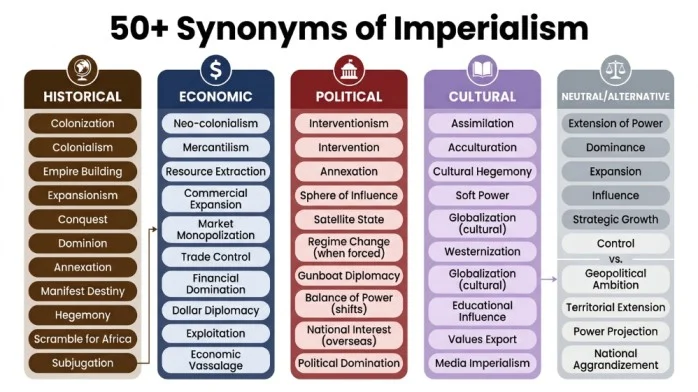
Imperialism has shaped borders, economies, cultures, and political power across centuries, leaving a mark on history. For students, writers, and readers, finding language to describe imperial expansion can make your analysis clearer, and more precise. Exploring synonyms of imperialism reveals words that highlight different aspects of domination, control, conquest, influence, and territorial ambition.
The best alternatives depend on context and the intensity of the idea being expressed. Some terms emphasize colonial rule, while others focus on political dominance, economic exploitation, or aggressive expansion. This guide to synonyms of imperialism brings together accurate alternatives with clear meanings, distinctions, and natural examples, helping you choose wording that fits academic writing, historical discussion, essays, and everyday explanations without losing the meaning or nuance.
What Are the Best Synonyms of “Imperialism”?
Imperialism means the policy of extending a country’s power and influence through colonization, military force, or economic domination. The best synonyms depend on context. For historical expansion, use colonialism or conquest. For economic influence, use hegemony or domination. Aggressive expansion, use expansionism or militarism. Formal writing, use colonial expansion or imperial domination.
Meaning, Tone, and Context
Understanding the word imperialism is the first step to using it effectively.
Simple Definition:
Imperialism means a policy or practice where a powerful country extends its control over weaker regions. This can happen through military force, political influence, economic pressure, or cultural domination.
Part of Speech:
Noun
Overall Tone:
Negative. Imperialism carries strong negative connotations because it involves domination, exploitation, and the suppression of other cultures.
Formality Level:
Formal. This word is used in political science, history, international relations, and academic writing.
Common Uses:
Native English speakers use imperialism to describe historical events like the British Empire, the colonization of Africa, or modern economic and cultural influence.
Word Forms:
- Noun: imperialism
- Adjective: imperialistic
- Verb: imperialize
- Noun (person): imperialist
Opposite Forms:
Decolonization, independence, self-governance, autonomy, liberation.
When and How to Use “Imperialism”
The word imperialism fits specific situations where you need to describe power imbalances between nations or cultures.
Professional Context:
The company’s expansion into foreign markets was viewed by some as corporate imperialism.
Academic Context:
The historian analyzed the effects of European imperialism on African political structures.
Workplace Context:
The policy of cultural imperialism within the organization discouraged diversity.
Personal Context:
Studying the history of imperialism helped me understand current global inequalities.
Email Context:
The article’s discussion of economic imperialism raised important questions for our business strategy.
Resume Context:
Led research on the economic impact of imperialism in post-colonial nations.
Social Media Context:
Learning about imperialism is essential for understanding the modern world.
Best Synonyms of “Imperialism”
No single synonym works perfectly in every situation because imperialism has multiple aspects. The best choice depends on what you are trying to express.
For Historical Expansion:
Use colonialism or conquest. These words emphasize the territorial and political aspects.
For Economic Influence:
Use hegemony or domination. These words emphasize control and power.
For Aggressive Expansion:
Use expansionism or militarism. These words emphasize forceful growth.
For Cultural Influence:
Use cultural imperialism or cultural hegemony. These words emphasize influence over culture.
For Formal Writing:
Use imperial expansion or colonial expansion. These words sound precise and academic.
For Creative Writing:
Use domination or subjugation to add emotional weight.
For Professional Writing:
Use influence or control when you want to avoid the negative connotations of imperialism.
When Not to Use “Imperialism”
Even though imperialism is a powerful word, there are times when it is not the best choice.
When the Word Sounds Too Accusatory:
Imperialism is a loaded word that can sound overly critical in neutral contexts.
Original:
The United States’ economic policy was a form of imperialism.
Better Recommendation:
Use economic influence or global leadership.
Rewritten Sentence:
The United States’ economic policy was a form of global leadership.
When the Word Is Too Strong:
Imperialism is too strong for describing minor influence.
Original:
The new store’s opening was a form of cultural imperialism.
Better Recommendation:
Use cultural influence or market expansion.
Rewritten Sentence:
The new store’s opening was a form of market expansion.
When the Word Is Unfamiliar to Readers:
Imperialism may require explanation for some audiences.
Original:
The company’s expansion was a clear example of imperialism.
Better Recommendation:
Use dominance or control.
Rewritten Sentence:
The company’s expansion was a clear example of dominance.
When the Word Is Too Political:
Imperialism can sound political and judgmental.
Original:
The government’s foreign policy was imperialistic.
Better Recommendation:
Use expansionist or influential.
Rewritten Sentence:
The government’s foreign policy was expansionist.
Words Commonly Confused With “Imperialism”
Several words are often confused with imperialism because they share similar meanings.
- Imperialism vs Colonialism
- Difference: Colonialism specifically refers to settling and controlling territories. Imperialism includes broader influence like economic and cultural domination.
- When to Use It: Use colonialism for settlement and direct rule. Use imperialism for broader power and influence.
- Example: The colonialism of the British Empire involved settlement in North America. / The imperialism of the 19th century involved control over global trade.
- Imperialism vs Hegemony
- Difference: Hegemony means leadership or dominance of one group over others, especially politically. Imperialism emphasizes direct control and exploitation.
- When to Use It: Use hegemony for political or cultural dominance. Use imperialism for direct control and exploitation.
- Example: The United States maintained hegemony in the Western Hemisphere. / The imperialism of European powers shaped the modern world.
- Imperialism vs Expansionism
- Difference: Expansionism simply means a policy of expanding territory. Imperialism emphasizes domination and exploitation.
- When to Use It: Use expansionism for territorial growth. Use imperialism for domination and exploitation.
- Example: The country’s expansionism led to conflicts with neighbors. / The imperialism of the 19th century devastated African societies.
- Imperialism vs Militarism
- Difference: Militarism emphasizes military strength. Imperialism can involve military force but also economic and cultural control.
- When to Use It: Use militarism for military-focused expansion. Use imperialism for broader control.
- Example: The militarism of the regime threatened regional stability. / The imperialism of the empire relied on both military and economic power.
- Imperialism vs Domination
- Difference: Domination means control or rule over others. Imperialism is a specific form of domination by powerful nations.
- When to Use It: Use domination for general control. Use imperialism for nation-level control.
- Example: The dictator’s domination was absolute. / The imperialism of the West affected global development.
- Imperialism vs Subjugation
- Difference: Subjugation means bringing someone under control. Imperialism involves subjugation on a national or global scale.
- When to Use It: Use subjugation for oppression. Use imperialism for systemic control.
- Example: The subjugation of minority groups was condemned. / The imperialism of the period was characterized by subjugation.
Best Synonyms of “Imperialism” by Context
| Context | Best Synonym | Why It Works | Example |
|---|---|---|---|
| Formal Writing | Colonial expansion | Sounds precise and scholarly | The colonial expansion of European powers reshaped the world. |
| Academic Writing | Imperial domination | Sounds authoritative and precise | Imperial domination had lasting effects on colonized nations. |
| Professional Communication | Economic influence | Sounds neutral and professional | The company’s economic influence extended to multiple continents. |
| Business Emails | Global reach | Clear and professional | Our global reach has expanded significantly this year. |
| Resume Writing | International expansion | Sounds results oriented | Led international expansion strategies into emerging markets. |
| Workplace Communication | Growth strategy | Positive and neutral | Our growth strategy involves entering new markets. |
| Casual Conversation | Power and control | Simple and natural | The power and control of the empire were overwhelming. |
| Everyday Speaking | Dominance | Clear and easy | The empire’s dominance was visible everywhere. |
| Creative Writing | Conquest | Adds drama and intensity | The conquest of the region was swift and brutal. |
| Storytelling | Invasion | Emphasizes conflict | The invasion changed the course of history. |
| Emotional Writing | Oppression | Adds emotional weight | The oppression of colonized people lasted for generations. |
| Strong Emphasis | Exploitation | Strong and critical | The exploitation of resources was systematic. |
| Mild Tone | Influence | Gentle and neutral | The influence of the empire was widespread. |
| Social Media Captions | Control | Short and impactful | Control was the key to their success. |
How to Choose the Best Synonym of “Imperialism”
Choosing the right synonym depends on several factors. Use this practical guide to make the best decision.
Meaning:
What aspect of imperialism are you describing? Is it military, economic, cultural, or political? Choose a synonym that matches the specific aspect.
Tone:
Do you want to sound formal, critical, neutral, or emotional? Formal words like colonial expansion fit academic writing. Critical words like exploitation fit strong critiques.
Audience:
Who is reading your writing? Academic readers expect precise vocabulary. General readers need clear language. Business readers prefer neutral terms.
Emotional Strength:
Do you want to emphasize oppression, dominance, or growth? Strong words like subjugation suggest injustice. Neutral words like influence suggest less criticism.
Writing Purpose:
Are you writing a report, an essay, a story, or a social media post? Match your synonym to the purpose.
Level of Formality:
Consider the formality of your situation. Academic papers require formal synonyms. Social media allows casual language.
Natural Sounding Usage:
Always read your sentence aloud. If the synonym sounds forced or awkward, choose a different word.
Real Life Examples of “Imperialism”
School Context:
The students studied the history of imperialism in their world history class.
Stronger Version:
The students studied the history of colonial expansion in their world history class.
College Context:
The professor’s lecture on imperialism focused on economic exploitation.
Stronger Version:
The professor’s lecture on economic domination focused on resource extraction.
Workplace Context:
The company’s strategy was compared to cultural imperialism.
Stronger Version:
The company’s strategy was compared to cultural influence.
Business Context:
The multinational corporation’s expansion was seen as economic imperialism.
Stronger Version:
The multinational corporation’s expansion was seen as economic dominance.
Email Context:
The article discusses the lasting effects of imperialism on modern politics.
Stronger Version:
The article discusses the lasting effects of colonial rule on modern politics.
Resume Context:
Researched the impact of imperialism on post-colonial development.
Stronger Version:
Researched the impact of colonial policies on post-colonial development.
Conversation Context:
Imperialism changed the course of world history.
Stronger Version:
Colonial expansion changed the course of world history.
Storytelling Context:
The empire’s imperialism left scars that lasted for centuries.
Stronger Version:
The empire’s domination left scars that lasted for centuries.
Blogging Context:
Understanding imperialism is key to understanding modern inequality.
Stronger Version:
Understanding colonial history is key to understanding modern inequality.
Social Media Context:
Imperialism shaped the world we live in today.
Stronger Version:
Colonial expansion shaped the world we live in today.
25 Best Synonyms of “Imperialism”
| Synonym | Simple Meaning | Best Used For | Example Sentence |
|---|---|---|---|
| Colonialism | Control over colonies | Historical writing | The colonialism of the 19th century affected millions. |
| Colonial expansion | Growth through colonies | Academic writing | Colonial expansion reshaped global politics. |
| Imperial domination | Rule by an empire | Formal writing | Imperial domination was enforced through military might. |
| Imperial expansion | Growth of an empire | Historical writing | The imperial expansion of the empire was relentless. |
| Hegemony | Leadership or dominance | Political science | The hegemony of the United States shaped global policy. |
| Domination | Control over others | General use | The domination of the empire was complete. |
| Expansionism | Policy of expansion | Neutral writing | The nation’s expansionism led to war. |
| Conquest | Seizure by force | Creative writing | The conquest of the region was brutal. |
| Subjugation | Forced submission | Emotional writing | The subjugation of native peoples was tragic. |
| Oppression | Unjust treatment | Critical writing | The oppression of colonies was widespread. |
| Exploitation | Using for profit | Strong criticism | The exploitation of resources caused resentment. |
| Economic dominance | Control over economies | Business writing | The economic dominance of the West was evident. |
| Cultural influence | Impact on culture | Cultural writing | The cultural influence of the empire was profound. |
| Political control | Control over government | Political writing | Political control was maintained through alliances. |
| Military force | Use of military | Military history | Military force was used to expand the empire. |
| Territorial expansion | Growth of land | Neutral writing | Territorial expansion was a key goal. |
| Global influence | Power across the world | Professional writing | The company’s global influence grew steadily. |
| Supremacy | Being supreme | Strong emphasis | The supremacy of the empire was unchallenged. |
| Ascendancy | Rising power | Historical writing | The ascendancy of the empire was gradual. |
| Preponderance | Greater power | Formal writing | The preponderance of Western power was clear. |
| Supremacy | Being supreme | Strong emphasis | The supremacy of the empire was unchallenged. |
| Mastery | Complete control | Creative writing | The mastery of the region was complete. |
| Sovereignty | Supreme authority | Formal writing | The sovereignty of the empire was absolute. |
| Authority | Power to rule | General use | The authority of the empire was respected. |
| Rule | Government or control | General use | The rule of the empire lasted centuries. |
Synonyms of “Imperialism” by Usage
Professional vs Personal Synonyms
Professional Synonyms:
Hegemony, global influence, economic dominance, territorial expansion.
Why They Work:
These words sound neutral and professional. They fit reports, business writing, and professional communication.
Personal Synonyms:
Power, control, dominance, conquest.
Why They Work:
These words feel natural in conversation, personal writing, and storytelling.
Formal vs Conversational Synonyms
Formal Synonyms:
Colonial expansion, imperial domination, hegemony, preponderance.
Why They Fit:
These words sound authoritative and precise. They work in academic papers, business reports, and official documents.
Conversational Synonyms:
Power, control, dominance, influence.
Why They Fit:
These words feel natural in everyday speech, texting, and casual writing.
Academic Synonyms
Recommended Words:
Hegemony, colonial expansion, imperial domination, ascendancy.
Why They Work:
These words sound precise and scholarly. They show expertise in political science and history.
Professional and Business Synonyms
Recommended Words:
Global influence, economic dominance, territorial expansion, international reach.
Why They Fit:
These words are specific and professional. They fit business emails, reports, and presentations.
Creative and Literary Synonyms
Recommended Words:
Conquest, subjugation, oppression, domination.
Why They Fit:
These words add drama, emotion, and imagery to storytelling, poetry, and descriptive writing.
Strongest to Mildest Synonyms
Mild (Neutral Influence):
Influence, reach, impact, global presence.
Moderate (Control and Power):
Control, dominance, authority, rule.
Strong (Aggressive Expansion):
Expansionism, conquest, colonial expansion, territorial growth.
Very Strong (Critical and Oppressive):
Imperialism, subjugation, oppression, exploitation, hegemony.
Emotional vs Neutral Synonyms
Emotional Synonyms:
Subjugation, oppression, exploitation, conquest.
When to Use Emotional Synonyms:
Use them in critical writing, personal reflection, and situations where injustice or suffering is the focus.
Neutral Synonyms:
Hegemony, dominance, influence, expansion, control.
When to Use Neutral Synonyms:
Use them in professional writing, academic papers, and factual communication.
Antonyms of “Imperialism”
| Antonym | Meaning | Example Sentence |
|---|---|---|
| Decolonization | The process of colonies becoming independent | Decolonization transformed the global political landscape. |
| Independence | Freedom from control | The country celebrated its independence from colonial rule. |
| Self-governance | Governing oneself | Self-governance was the goal of the independence movement. |
| Autonomy | The right to govern oneself | The region demanded autonomy from the central government. |
| Liberation | Setting free | The liberation of the country was achieved through diplomacy. |
| Freedom | The state of being free | Freedom from colonial domination was their goal. |
| Sovereignty | Supreme authority of a state | Sovereignty was restored after years of colonial rule. |
| Self-determination | The right to choose one’s own government | Self-determination was the guiding principle of the movement. |
| Democracy | Government by the people | Democracy replaced the oppressive imperial system. |
| Equality | Equal rights and treatment | Equality among nations replaced imperial dominance. |
| Cooperation | Working together | Cooperation between nations replaced colonial rivalry. |
| Mutual respect | Respecting others’ rights | Mutual respect is essential in international relations. |
| Partnership | Working as equals | The partnership between nations was based on equality. |
| Alliance | A union for mutual benefit | The alliance replaced imperial domination. |
| Confederation | A league of states | The confederation of states ensured shared sovereignty. |
Comparison: “Imperialism” vs Similar Words
Imperialism vs Colonialism
Main Difference:
Colonialism specifically refers to settling and controlling territories. Imperialism includes broader influence like economic and cultural domination.
Which Is Stronger?
Imperialism is broader and can be more critical.
Which Is More Formal?
Both are formal.
When to Use Each:
Use colonialism for settlement. Use imperialism for broader influence.
Examples:
Imperialism: The imperialism of the 19th century affected global trade.
Colonialism: The colonialism of European powers reshaped Africa.
Imperialism vs Hegemony
Main Difference:
Hegemony means leadership or dominance, often through influence rather than direct control. Imperialism emphasizes direct control and exploitation.
Which Is Stronger?
Imperialism is stronger because it implies direct control and oppression.
Which Is More Formal?
Both are formal.
When to Use Each:
Use hegemony for influence. Use imperialism for direct control.
Examples:
Imperialism: The imperialism of the empire was brutal.
Hegemony: The hegemony of the United States is based on economic power.
Imperialism vs Expansionism
Main Difference:
Expansionism simply means a policy of expanding territory. Imperialism emphasizes domination and exploitation.
Which Is Stronger?
Imperialism is stronger because it implies oppression.
Which Is More Formal?
Both are formal.
When to Use Each:
Use expansionism for territorial growth. Use imperialism for domination.
Examples:
Imperialism: The imperialism of the period was characterized by exploitation.
Expansionism: The expansionism of the nation was driven by economic needs.
Imperialism vs Militarism
Main Difference:
Militarism emphasizes military strength. Imperialism can involve military force but also economic and cultural control.
Which Is Stronger?
Imperialism is broader and more comprehensive.
Which Is More Formal?
Both are formal.
When to Use Each:
Use militarism for military focus. Use imperialism for broader control.
Examples:
Imperialism: The imperialism of the empire relied on economic and military power.
Militarism: The militarism of the regime threatened global stability.
Imperialism vs Domination
Main Difference:
Domination means control or rule over others. Imperialism is a specific form of domination by powerful nations.
Which Is Stronger?
Imperialism is more specific and critical.
Which Is More Formal?
Both are formal.
When to Use Each:
Use domination for general control. Use imperialism for nation-level control.
Examples:
Imperialism: The imperialism of European powers affected developing nations.
Domination: The domination of the dictator was absolute.
Imperialism vs Subjugation
Main Difference:
Subjugation means bringing someone under control. Imperialism involves subjugation on a national or global scale.
Which Is Stronger?
Subjugation is emotionally stronger and more critical.
Which Is More Formal?
Both are formal.
When to Use Each:
Use subjugation for oppression. Use imperialism for systemic control.
Examples:
Imperialism: The imperialism of the period was systematic.
Subjugation: The subjugation of minority groups was condemned.
Common Phrases and Expressions with “Imperialism”
| Phrase | Meaning | Example Sentence |
|---|---|---|
| Cultural imperialism | Dominance of one culture over others | The global spread of American media is often described as cultural imperialism. |
| Economic imperialism | Economic control over other nations | The company’s expansion was accused of economic imperialism. |
| Imperialism of the past | Historical colonial expansion | The imperialism of the past still affects modern politics. |
| Anti-imperialism | Opposition to imperialism | The anti-imperialism movement grew in the 20th century. |
| Imperialism and colonialism | Two related concepts of domination | Imperialism and colonialism are closely linked in history. |
| Western imperialism | Imperialism by Western nations | Western imperialism reshaped the global order. |
Common Mistakes to Avoid
Choosing a Vague Synonym Instead of a Precise One
Incorrect:
The empire’s control was huge.
Better:
The empire’s domination was absolute.
Why:
Domination is more specific and powerful than control.
Confusing “Imperialism” With “Colonialism”
Incorrect:
The British imperialism of India involved settlement.
Better:
The British colonialism of India involved settlement.
Why:
Colonialism specifically involves settlement. Imperialism is broader.
Using an Informal Synonym in Formal Writing
Incorrect:
The empire’s take-over was brutal.
Better:
The empire’s conquest was brutal.
Why:
Conquest is more formal and appropriate for academic writing.
Selecting an Overly Dramatic Synonym
Incorrect:
The company’s expansion was pure oppression.
Better:
The company’s expansion was aggressive.
Why:
Oppression is too strong for business expansion.
Repeating the Same Word Too Often
Incorrect:
Imperialism affected Africa. Imperialism affected Asia. Imperialism was brutal.
Better:
Imperialism affected Africa. Colonial expansion affected Asia. The domination was brutal.
Why:
Varying synonyms improves flow and readability.
Choosing a Word With the Wrong Emotional Tone
Incorrect:
The imperialism of the corporation was appreciated.
Better:
The expansion of the corporation was appreciated.
Why:
Imperialism has negative connotations that do not fit appreciation.
Frequently Asked Questions
What are the best synonyms of “imperialism”?
The best synonyms of imperialism are colonialism, hegemony, expansionism, conquest, and domination. The right choice depends on context. For territorial control, use colonialism or conquest. For economic influence, use hegemony or economic dominance.
What are the best formal synonyms of “imperialism”?
The best formal synonyms of imperialism are colonial expansion, imperial domination, hegemony, and ascendancy. These words sound precise and scholarly. They fit academic papers, historical reports, and professional political analysis.
What are common informal synonyms of “imperialism”?
Common informal synonyms of imperialism include power, control, dominance, and influence. These words are used in casual conversations, friendly writing, and everyday speech. They are simple and natural.
What is another word for “imperialism” in professional writing?
In professional writing, use global influence, economic dominance, or territorial expansion. These words are neutral and professional. They fit business reports, corporate communications, and international strategy documents.
What is the difference between “imperialism” and “colonialism”?
Colonialism specifically refers to settling and directly controlling territories. Imperialism includes broader influence like economic and cultural domination. Use colonialism for settlement. Use imperialism for broader power and control.
What is the opposite of “imperialism”?
The opposite of imperialism is decolonization, independence, self-governance, or autonomy. These terms describe the process of breaking free from control and establishing self-rule.
Conclusion
Imperialism is a powerful and precise word that describes the domination of powerful nations over weaker regions. The best synonyms of imperialism help you express this concept in any context, whether you need formal, academic, professional, or creative language.
The more you practice choosing the right synonym, the more natural and confident your writing will become. A strong vocabulary helps you connect with readers, express your ideas clearly, and make a lasting impression.
Definitions, meanings, and usage recommendations should be verified with trusted language references before publication. Recommended sources include Cambridge Dictionary, Oxford English Dictionary, Merriam Webster, Collins Dictionary, and Britannica.
Read More Related Articles:
Synonyms for Thus | Meaning, Examples, and Better Word …
50+ Synonyms of Significant | Meanings, Uses, Examples, and …
50+ Synonyms of To | Meanings, Uses, Examples, and Best …