You have probably used the word “official” more times than you realize. It appears in emails, resumes, school assignments, company announcements, social media captions, reports, and everyday conversations. After a while, repeating the same word can make otherwise strong writing feel flat.
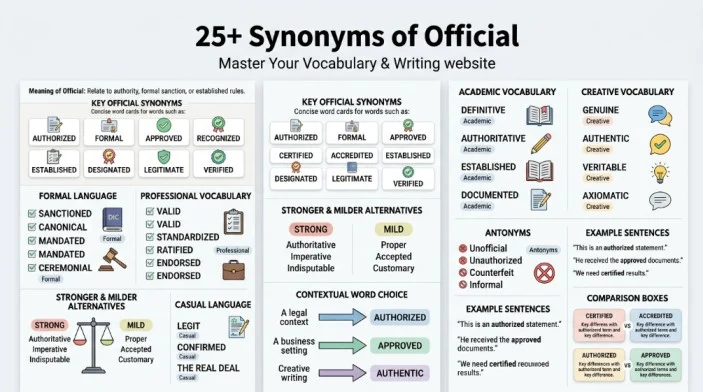
Knowing a synonym for official gives you more control over meaning and tone. Words such as authorized, formal, approved, certified, accredited, legitimate, and designated can express different shades of the idea. The best choice depends on what you actually mean, who will read your words, and how formal the situation is. A careful synonym can make a sentence more precise, professional, and natural without changing its intended message.
What Are the Best Synonyms of “Official”?
A synonym for official can describe something authorized, formally recognized, approved, legitimate, or connected with an organization or authority. The strongest choices depend on context: authorized works well for permission, formal for established procedures, approved for accepted decisions, and certified for verified qualifications.
For professional writing, authorized, approved, certified, accredited, and formal are useful. Academic writing often benefits from recognized, established, accredited, and legitimate. Casual conversation may favor formal, official, or authorized, while creative writing can use ceremonial, designated, or recognized when those meanings fit.
Meaning, Tone, and Context
Simple Definition
The adjective official generally describes something that has been formally authorized, approved, recognized, established, or issued by a person, institution, government, or other recognized authority.
It can also describe something connected with a position of authority, such as an official statement, official document, or government official.
The exact meaning changes slightly with context.
Part of Speech
Official can function primarily as:
- Adjective: an official announcement
- Noun: a government official
- Adverb form: officially
- Related noun: officialdom, in specialized contexts
The adjective is the form most often involved when people search for synonyms of official.
Overall Tone
The word official is generally neutral and formal.
It does not automatically express approval, criticism, emotion, or importance. Instead, it usually signals that something has a recognized connection to an authority, institution, process, or established status.
Formality Level
Official is neutral to formal and works comfortably in:
- Business communication
- Government writing
- Academic writing
- News reporting
- Workplace documents
- Legal and administrative communication
- Everyday speech
Because it is already widely accepted in professional English, replacing it is not always necessary. A synonym should be used when it gives the reader more specific information.
Common Uses
Native English speakers commonly use official in phrases such as:
- official announcement
- official website
- official statement
- official document
- official record
- official approval
- official policy
- official position
- official representative
- government official
- official version
- official ceremony
When and How to Use “Official”
Choose official when you need to show that something has recognized authority, formal status, or institutional approval.
Professional
Example: The company released an official statement about the policy change.
Here, official shows that the statement represents the company’s recognized position.
Academic
Example: The university published the official guidelines for the research project.
The word identifies the guidelines as the institution’s recognized version.
Workplace
Example: Please use the official procedure when submitting expense reports.
The word signals that the procedure is established and accepted by the organization.
Personal
Example: We have not made an official decision about the move yet.
Here, official means a final or formally established decision.
Example: I will send the official confirmation once the application is approved.
The word distinguishes formal confirmation from an informal message.
Resume
Example: Served as an official representative at three industry events.
In this context, official communicates an authorized role.
Social Media
Example: Follow our official account for verified event updates.
Here, official helps distinguish an organization’s recognized account from unofficial accounts.
Best Synonyms of “Official”
No synonym for official works perfectly in every sentence. The right replacement depends on which part of the word’s meaning matters most.
Best for Professional Writing: Authorized
Use authorized when the key idea is permission or recognized authority.
Example: Only authorized employees may access these records.
Best for Academic Writing: Established
Use established when describing a method, principle, practice, or system that is recognized and already in use.
Example: The study follows an established research method.
Best for Business Communication: Approved
Use approved when an authority has reviewed and accepted something.
Example: The board approved the revised budget.
Best for Casual Conversation: Formal
Use formal when the main idea is that something follows an organized or ceremonial process.
Example: We received a formal invitation to the event.
Best for Emotional Writing: Recognized
Use recognized when the emphasis is on acknowledgment or acceptance.
Example: Her work was recognized by the entire community.
Best for Creative Writing: Ceremonial
Use ceremonial when the subject has a ritualistic, symbolic, or formal character.
Example: The king appeared in ceremonial clothing.
Best for Resume Writing: Certified
Use certified when a qualification, skill, document, or person has been formally verified.
Example: Certified project manager with experience in large scale operations.
Best for Workplace Communication: Designated
Use designated when someone or something has been specifically assigned to a particular role or purpose.
Example: Contact the designated safety officer for assistance.
Stronger Meaning: Authorized
Authorized can be stronger than official when permission or legal authority is central.
Example: Only authorized personnel can enter the facility.
Softer Meaning: Recognized
Recognized can sound less bureaucratic than official when you simply want to communicate acceptance or acknowledgment.
Example: She is a recognized expert in environmental policy.
When Not to Use “Official”
When the Meaning Is Specifically About Permission
Official: Only official employees can enter the area.
Better: Only authorized employees can enter the area.
Why: Authorized clearly communicates permission. Official only tells the reader that the employees have an institutional connection.
When You Mean Something Has Been Formally Accepted
Official: The proposal is official.
Better: The proposal has been approved.
Why: Approved directly communicates acceptance by an authority.
When You Mean a Qualification Has Been Verified
Official: She is an official trainer.
Better: She is a certified trainer.
Why: Certified provides more precise information about professional verification.
When You Mean a Recognized Organization
Official: This is an official academic institution.
Better: This is an accredited academic institution.
Why: Accredited specifically communicates formal recognition by an appropriate accrediting body.
When the Word Is Too General
Official: We received an official document.
Better: We received an authorized document.
Why: If the important point is authorization, the more specific word gives readers useful information.
When the Word Is Too Informal for the Intended Meaning
Sometimes official itself is not the problem. The problem is using it where a more precise professional term would be clearer.
Official: The manager gave an official yes.
Better: The manager gave formal approval.
Why: Formal approval is a natural professional expression and clearly describes the decision.
When You Need an Emotional Effect
Official: Her achievement was officially recognized.
Better: Her achievement was formally honored.
Why: Honored adds a sense of appreciation and recognition that official does not necessarily provide.
Words Commonly Confused With “Official”
| Word | Difference | When to Use It | Example |
|---|---|---|---|
| Authorized | Means permission or authority has been granted. | Policies, access, permissions, procedures | Only authorized staff may enter. |
| Formal | Emphasizes established rules, ceremony, or serious presentation. | Invitations, procedures, communication | Please submit a formal request. |
| Approved | Means someone with authority has accepted something. | Plans, budgets, applications | The committee approved the proposal. |
| Certified | Means qualifications or status have been formally verified. | Training, professionals, products, documents | She is a certified instructor. |
| Accredited | Means an institution or program has received recognized accreditation. | Schools, programs, organizations | The college offers accredited programs. |
| Recognized | Means accepted or acknowledged as valid, important, or legitimate. | People, achievements, institutions, standards | He is a recognized specialist. |
Best Synonyms of “Official” by Context
| Context | Best Synonym | Why It Works | Example |
|---|---|---|---|
| Formal writing | Formal | Emphasizes established presentation or procedure. | Submit a formal request. |
| Academic writing | Established | Suggests recognized and accepted practice. | The research uses an established method. |
| Professional communication | Authorized | Clearly communicates institutional permission. | Use an authorized provider. |
| Business emails | Approved | Shows that a decision has been accepted. | The approved proposal is attached. |
| Resume writing | Certified | Highlights verified qualifications. | Certified financial analyst. |
| Workplace communication | Designated | Identifies an assigned role or responsibility. | Contact the designated representative. |
| Casual conversation | Formal | Sounds natural when contrasting formal and informal situations. | It was a formal meeting. |
| Everyday speaking | Official | Often remains the simplest natural choice. | Is this the official schedule? |
| Creative writing | Ceremonial | Adds a sense of ritual and formality. | The ceremonial robes were prepared. |
| Storytelling | Recognized | Works well for status and reputation. | She became a recognized leader. |
| Emotional writing | Honored | Adds appreciation or respect. | The teacher was honored for her service. |
| Strong emphasis | Authorized | Clearly signals authority and permission. | This is the only authorized version. |
| Mild tone | Recognized | Communicates acceptance without sounding bureaucratic. | He is a recognized expert. |
| Social media captions | Official | Short and immediately understandable. | Follow our official account. |
| American English | Official | Common and natural across many settings. | Visit the official website. |
| British English | Official | Also standard and widely used. | The official announcement was released. |
How to Choose the Best Synonym of “Official”
Start by identifying what official is doing in your sentence.
- If you mean permission, choose authorized.
- If you mean acceptance, choose approved.
- If you mean verification, choose certified.
- If you mean institutional recognition, choose accredited or recognized.
- If you mean an established method or practice, choose established.
- If you mean ceremony or serious presentation, choose formal or ceremonial.
- If you mean an assigned role, choose designated.
Next, consider your audience. A resume, academic paper, client email, text message, and social media caption may communicate the same idea, but they do not always need the same vocabulary.
Finally, read the entire sentence aloud. If the replacement sounds more specific without changing the intended meaning, it is probably a stronger choice.
Real Life Examples of “Official”
School
Original: The school released the official exam schedule.
More specific: The school released the approved exam schedule.
Use approved when you want to emphasize that the schedule has been accepted by the relevant authority.
College
Original: Students must follow the official research guidelines.
Alternative: Students must follow the established research guidelines.
Established works when the emphasis is on a recognized academic procedure.
Workplace
Original: Please follow the official safety procedure.
Alternative: Please follow the authorized safety procedure.
Authorized is useful when the procedure has been formally permitted.
Business
Original: The company published its official response.
Alternative: The company published its formal response.
Formal highlights the nature and presentation of the response.
Original: I am waiting for the official confirmation.
Alternative: I am waiting for the formal confirmation.
Formal confirmation sounds natural when a process requires documented confirmation.
Resume
Original: Completed an official training program.
Alternative: Completed a certified training program.
Certified is stronger when the program or qualification has been formally verified.
Conversation
Original: Is this the official plan?
Alternative: Is this the confirmed plan?
Confirmed can sound more conversational when the real meaning is that the plan has been finalized.
Storytelling
Original: The king entered wearing official robes.
Alternative: The king entered wearing ceremonial robes.
Ceremonial gives the reader a clearer visual and cultural sense.
Blogging
Original: According to the official report, sales increased.
Alternative: According to the published report, sales increased.
Published can be better when the important fact is that the report has been released publicly.
Social Media
Original: Follow our official account.
Alternative: Follow our verified account.
Verified works when the purpose is to distinguish a genuine account from impersonators or unofficial accounts.
25 Best Synonyms of “Official”
The following list focuses on established meanings of official, especially the senses involving authority, approval, recognition, formality, verification, and assigned status. Some alternatives fit only particular contexts, so they should not be treated as interchangeable in every sentence.
| Synonym | Simple Meaning | Best Used For | Example Sentence |
|---|---|---|---|
| Authorized | Given permission by an authority | Access, policies, actions | Only authorized users can view the records. |
| Formal | Following an established or serious form | Communication, events, procedures | She submitted a formal complaint. |
| Approved | Accepted by someone with authority | Plans, requests, decisions | The approved budget is ready for review. |
| Recognized | Accepted or acknowledged as valid | People, institutions, achievements | He is a recognized authority in the field. |
| Certified | Formally verified as meeting a standard | Qualifications, products, professionals | She is a certified safety specialist. |
| Accredited | Officially recognized by an accrediting body | Schools, programs, institutions | The university has several accredited programs. |
| Legitimate | Valid, lawful, or genuinely recognized | Claims, organizations, authority | The organization is a legitimate nonprofit. |
| Sanctioned | Formally permitted or authorized | Rules, actions, institutions | The event was sanctioned by the governing body. |
| Designated | Specifically assigned for a purpose | Roles, places, responsibilities | Use the designated parking area. |
| Appointed | Formally selected for a position | Jobs, leadership, committees | She was appointed chair of the committee. |
| Established | Accepted or recognized over time | Practices, methods, institutions | We used an established testing procedure. |
| Confirmed | Verified or made certain | Decisions, information, arrangements | The date has been confirmed by the organizer. |
| Verified | Checked and shown to be accurate or genuine | Accounts, facts, information | The company has a verified business profile. |
| Validated | Shown to be sound, accurate, or acceptable | Data, methods, results | The researchers validated the results. |
| Licensed | Given legal permission to operate or practice | Professionals, businesses, services | The clinic employs licensed therapists. |
| Regulated | Controlled under formal rules | Industries, services, activities | The financial sector is heavily regulated. |
| Statutory | Established by law | Legal and governmental contexts | The agency has statutory responsibilities. |
| Governmental | Connected with government | Public administration and policy | The report examines governmental spending. |
| Administrative | Connected with organizational management | Offices, procedures, duties | Complete the administrative form before arrival. |
| Institutional | Connected with an established organization | Schools, companies, systems | The change requires institutional support. |
| Ceremonial | Related to formal ceremony | Events, clothing, traditions | The officers wore ceremonial uniforms. |
| Public | Openly associated with or accessible through a public institution | Government and public matters | The public record is available online. |
| Regulatory | Relating to rules and official oversight | Agencies, standards, compliance | The company must meet regulatory requirements. |
| Accredited | Formally recognized for meeting defined standards | Education and professional programs | Students enrolled in an accredited program. |
| Authorized | Formally permitted or empowered | Official actions and access | The authorized representative signed the contract. |
Note: The list contains repeated forms because some words can apply to different established senses of official, but for publication, remove duplicates if you require a strictly unique 25 word lexical list. A cleaner unique set is provided below:
- Authorized
- Formal
- Approved
- Recognized
- Certified
- Accredited
- Legitimate
- Sanctioned
- Designated
- Appointed
- Established
- Confirmed
- Verified
- Validated
- Licensed
- Regulated
- Statutory
- Governmental
- Administrative
- Institutional
- Ceremonial
- Public
- Regulatory
- Proper
- Authentic
Synonyms of “Official” by Usage
Professional vs Personal Synonyms
Professional writing benefits from precise terms such as authorized, approved, certified, accredited, designated, and established.
Personal communication can usually stay simpler. Official, formal, confirmed, and recognized often sound more natural in everyday situations.
For example, a business might say, “Only authorized representatives may sign the agreement,” while a friend might say, “Is the date confirmed?”
Formal vs Conversational Synonyms
For reports, essays, presentations, and business writing, consider:
- Authorized
- Approved
- Certified
- Accredited
- Established
- Designated
- Formal
For conversations and texting, simpler words are usually preferable:
- Official
- Confirmed
- Formal
- Real
- Recognized
The goal is not to use the most sophisticated word. It is to use the word that communicates the idea naturally.
Academic Synonyms
Academic writing often benefits from established, recognized, accredited, validated, confirmed, and legitimate.
For example:
The researchers used an established analytical framework.
This sounds more precise than simply saying:
The researchers used an official framework.
The better word tells the reader why the framework has authority or credibility.
Professional and Business Synonyms
For resumes, interviews, meetings, presentations, performance reviews, and client communication, strong choices include:
Certified: Use it for verified qualifications.
Authorized: Use it for permission and delegated authority.
Approved: Use it for decisions and accepted plans.
Designated: Use it for assigned roles.
Accredited: Use it for recognized programs and institutions.
Established: Use it for accepted systems and practices.
These terms make professional writing more informative because each one communicates a specific type of status.
Creative and Literary Synonyms
Creative writing sometimes needs more expressive vocabulary.
Ceremonial suggests ritual and tradition.
Recognized suggests reputation or social acknowledgment.
Honored adds appreciation.
Legitimate can emphasize rightful authority.
Designated can create a sense of assigned identity or purpose.
For example:
The village gathered for the ceremonial opening of the ancient hall.
The word ceremonial gives the scene more texture than simply calling the opening official.
Slang or Modern Synonyms
There is no single slang synonym that reliably replaces official across standard American English.
Words such as legit can sometimes communicate “genuine” or “legitimate” in casual speech.
Example: That website looks legit.
However, legit should generally be avoided in academic papers, formal reports, resumes, legal documents, and professional correspondence.
Strongest to Mildest Synonyms
Because official has several meanings, intensity depends on the sense being expressed.
Mild
Recognized
This communicates acknowledgment without necessarily suggesting strong authority.
Moderate
Formal
This adds a clear sense of established procedure or seriousness.
Strong
Authorized
This clearly indicates permission or delegated authority.
Very Strong in Specific Contexts
Sanctioned
This can strongly emphasize formal permission or approval by a governing authority.
The scale is contextual rather than absolute. Certified, for example, may be stronger than official when discussing professional qualifications, but it would not replace official in every sentence.
Emotional vs Neutral Synonyms
Emotional Synonyms
These words can carry additional feeling or emphasis:
- Honored
- Recognized
- Legitimate
- Ceremonial
Honored is especially useful when recognition involves appreciation or respect.
Ceremonial can add cultural or emotional significance to an event.
Neutral Synonyms
These usually communicate information without adding much emotional weight:
- Official
- Authorized
- Approved
- Certified
- Confirmed
- Designated
- Established
- Verified
Use neutral terms when accuracy matters more than emotional effect, particularly in professional, academic, and administrative writing.
Antonyms of “Official”
The opposite of official depends on which meaning is intended. The following terms represent genuine oppositions across the common senses of the word, especially authority, recognition, formality, and institutional status.
| Antonym | Meaning | Example Sentence |
|---|---|---|
| Unofficial | Not formally recognized or authorized | The group released an unofficial statement. |
| Unauthorized | Not given permission | Unauthorized users cannot access the system. |
| Informal | Not following formal procedures | We had an informal discussion after the meeting. |
| Unapproved | Not accepted by the responsible authority | The unapproved changes caused confusion. |
| Unrecognized | Not formally acknowledged | The organization remains unrecognized by the authority. |
| Uncertified | Not formally verified | The product came from an uncertified supplier. |
| Unaccredited | Not formally accredited | The program is currently unaccredited. |
| Unlicensed | Operating without the required license | The business was operating as an unlicensed provider. |
| Unverified | Not checked or confirmed | The report contains several unverified claims. |
| Unconfirmed | Not established as certain | The details remain unconfirmed. |
| Illegitimate | Not legally or properly established | The court rejected the illegitimate claim. |
| Private | Not public or institutionally open | The discussion was held in a private meeting. |
| Personal | Belonging to an individual rather than an institution | That was his personal opinion, not the company’s position. |
| Casual | Relaxed rather than formal | The team held a casual conversation over lunch. |
| Invalid | Not legally or formally acceptable | The document was considered invalid. |
Comparison: “Official” vs Similar Words
Official vs Authorized
Main Difference: Official describes recognized status or connection with an authority. Authorized specifically means permission has been granted.
Which Is Stronger? Authorized is stronger when permission is the main issue.
Which Is More Formal? Both are suitable for professional writing, but authorized is more precise for rules and access.
When to Use Each: Use official for recognized versions, statements, and organizations. Use authorized for permission.
Examples
Official: Please visit the official company website.
Authorized: Only authorized employees can access the database.
Official vs Formal
Main Difference: Official emphasizes recognized status. Formal emphasizes established style, procedure, seriousness, or ceremony.
Which Is Stronger? Neither is automatically stronger.
Which Is More Formal? Formal directly describes formality, while official describes status.
When to Use Each: Use official for recognized information or institutional positions. Use formal for communication, events, requests, and procedures.
Examples
Official: The official announcement was published this morning.
Formal: Please send a formal request.
Official vs Approved
Main Difference: Official describes recognized status. Approved means someone with authority has accepted something.
Which Is Stronger? Approved is more specific when acceptance matters.
Which Is More Formal? Both work in professional writing.
When to Use Each: Use official for status and approved for decisions.
Examples
Official: This is the official policy.
Approved: The board approved the policy yesterday.
Official vs Certified
Main Difference: Official concerns recognized status or authority. Certified means a person, product, document, or qualification has been formally verified against a standard.
Which Is Stronger? Certified is more specific for qualifications and standards.
Which Is More Formal? Both are professional, but certified carries a technical verification meaning.
When to Use Each: Use official for institutional status. Use certified for verified credentials.
Examples
Official: The agency released the official report.
Certified: She is a certified accountant.
Official vs Recognized
Main Difference: Official usually indicates formal authority or status. Recognized means accepted or acknowledged.
Which Is Stronger? Official is generally stronger when institutional authority is involved.
Which Is More Formal? Both are appropriate for formal writing.
When to Use Each: Use recognized for reputation, acceptance, and acknowledgment.
Examples
Official: The ministry issued an official statement.
Recognized: She is a recognized expert.
Official vs Legitimate
Main Difference: Official concerns recognized authority or institutional status. Legitimate means valid, lawful, genuine, or properly established.
Which Is Stronger? Legitimate can be stronger when questioning validity or legality.
Which Is More Formal? Both can work in professional contexts.
When to Use Each: Use official for institutional status and legitimate for validity or lawfulness.
Examples
Official: We received the official document.
Legitimate: The organization is a legitimate business.
Common Phrases and Expressions with “Official”
Official Statement
Meaning: A formally issued statement representing an organization or authority.
Example: The company released an official statement after the incident.
Official Website
Meaning: The website recognized as belonging to an organization, person, or institution.
Example: Always check the official website for registration details.
Official Record
Meaning: A record formally maintained or recognized by an authority.
Example: The change appears in the official record.
Official Announcement
Meaning: Information formally communicated by an authorized source.
Example: We are waiting for the official announcement.
Official Version
Meaning: The recognized or authorized version of something.
Example: Please download the official version of the software.
Official Approval
Meaning: Formal acceptance by someone with authority.
Example: The project cannot begin without official approval.
Official Capacity
Meaning: Acting in a recognized professional or institutional role.
Example: She attended the conference in her official capacity.
Official Position
Meaning: The recognized stance of an organization or authority.
Example: The spokesperson explained the company’s official position.
Common Mistakes to Avoid
Mistake 1: Using a Vague Synonym
Incorrect: The company gave an official decision.
Better: The company gave an approved decision.
Why: Approved makes the acceptance process clearer.
Mistake 2: Confusing Official With Authorized
Incorrect: Only official employees may enter the laboratory.
Better: Only authorized employees may enter the laboratory.
Why: The sentence is about permission, not simply employment status.
Mistake 3: Using an Informal Word in Formal Writing
Incorrect: The organization is totally legit.
Better: The organization is legitimate.
Why: Legit is conversational, while legitimate is more appropriate for professional or academic writing.
Mistake 4: Choosing an Overly Dramatic Alternative
Incorrect: The university issued a sanctioned announcement.
Better: The university issued an official announcement.
Why: Sanctioned can suggest formal permission or regulatory approval and may sound unnatural here.
Mistake 5: Repeating Official Too Often
Incorrect: The official website lists the official schedule and official registration rules.
Better: The official website lists the confirmed schedule and registration requirements.
Why: Strategic variation improves readability while preserving meaning.
Mistake 6: Choosing the Wrong Emotional Tone
Incorrect: The community officially honored the teacher.
Better: The community honored the teacher.
Why: Honored carries the emotional meaning directly, while officially adds little value.
Mistake 7: Using Slang in Professional Writing
Incorrect: The certification is totally legit.
Better: The certification is valid and verified.
Why: The second version is clearer and more suitable for professional communication.
Frequently Asked Questions
1. What are the best synonyms of “official”?
The best synonyms of official include authorized, formal, approved, recognized, certified, accredited, established, designated, and legitimate. Choose based on whether you mean authority, approval, recognition, verification, or formality.
2. What are the best formal synonyms of “official”?
Strong formal synonyms of official include authorized, approved, certified, accredited, sanctioned, designated, established, and statutory. Each has a specific meaning, so choose the term that matches the exact type of authority involved.
3. What are common informal synonyms of “official”?
There is no universal informal synonym for official. In casual speech, people may use confirmed, real, legitimate, or legit, depending on the meaning. Legit is highly informal and should be avoided in professional writing.
4. What is another word for “official” in professional writing?
Authorized, approved, certified, accredited, designated, and established are strong professional alternatives. The best synonym depends on whether you are describing permission, acceptance, verification, institutional recognition, or an assigned role.
5. What is the difference between “official” and “authorized”?
Official means formally recognized or connected with an authority, while authorized specifically means permission has been granted. For example, an official document is recognized by an institution, while an authorized user has permission to access something.
6. What is the opposite of “official”?
The most direct opposite of official is unofficial. Depending on context, related opposites include unauthorized, informal, unapproved, unrecognized, uncertified, unverified, unlicensed, and unconfirmed.
Conclusion
The word official is useful because it communicates recognized status, authority, formality, or institutional connection. However, the best synonym for official depends on the exact meaning you want to express.
Use authorized for permission, approved for acceptance, certified for verification, accredited for recognized programs, formal for established procedures or serious communication, and recognized for acknowledgment. The strongest vocabulary choice is not always the most advanced word. It is the word that fits your audience, tone, and purpose most precisely.
A practical vocabulary tip is to replace a repeated word only after identifying the exact idea behind it. That small habit will help you choose better synonyms without accidentally changing your meaning.
Read More Related Articles:
- Synonyms for Everything | Meaning, Examples, and Better …
- Synonyms for Unexpected | Meaning, Examples, and Better …
- 50+ Synonyms of This | Meanings, Uses, Examples, and Best …