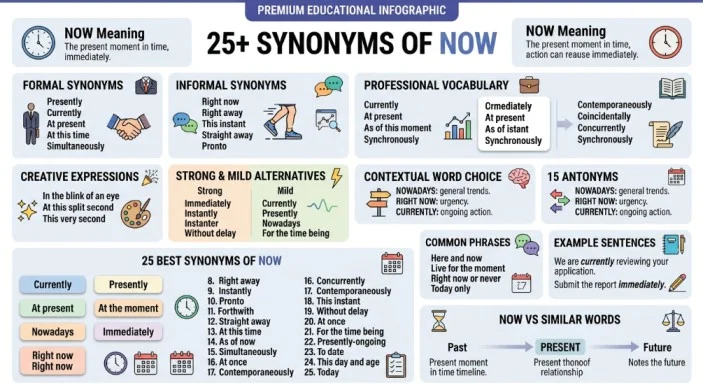
When you write emails, essays, captions, resumes, or everyday messages, the word now can appear again and again. Although it is one of the most common words in English, repeating it too often can make your writing sound plain or less precise.
Learning the best synonyms of now gives you more control over time, tone, and meaning. Words such as currently, presently, at present, right now, and at this moment can communicate the same general idea while fitting different situations. The key is knowing when a replacement is truly interchangeable and when it changes the meaning slightly.
What Are the Best Synonyms of “Now”?
Now refers to the present time or the current situation. The best alternatives include currently, presently, at present, and at this moment for formal or neutral writing, while right now works naturally in conversation. For emphasis, immediately or at once may fit when now means without delay.
Meaning, Tone, and Context
Simple Definition
Now primarily refers to the present time, the period happening at or around the current moment. It can also introduce a change, indicate an immediate action, or describe a situation that has recently become true.
For example:
“I am busy now.”
Here, now means at the present time.
It can also be used differently:
“Now that the project is finished, we can relax.”
In this sentence, now introduces a new situation rather than simply naming a moment in time.
Part of Speech
Now is most commonly an adverb, but it can also function as an adjective, noun, conjunction, or discourse marker depending on the sentence.
Examples:
Adverb:
“I need the report now.”
Adjective:
“The now familiar procedure is easy to follow.”
Noun:
“Try to focus on the now.”
Conjunction or linking expression:
“Now that the meeting is over, we can leave.”
Overall Tone
Now is generally neutral. It is neither strongly formal nor informal, which makes it suitable for almost every type of communication.
Its tone changes according to the expression around it.
For example:
“Please respond now.”
This can sound direct or urgent.
“I’m available right now.”
This sounds natural and conversational.
“The company currently operates in three states.”
This sounds more professional.
Formality Level
Now has a neutral formality level.
It works in:
- Academic writing
- Business communication
- Emails
- Conversations
- Social media
- Journalism
- Creative writing
- Presentations
- Everyday speech
More formal alternatives include currently, at present, and at this time.
More conversational alternatives include right now, at the moment, and these days, depending on the intended meaning.
Common Uses
Native English speakers use now to express several related ideas.
Present Time
“I am working now.”
Immediate Action
“Please call me now.”
Current Situation
“She now works in Chicago.”
A Recent Change
“He is now studying medicine.”
A New Stage
“Now we can begin the next phase.”
Contrast With the Past
“She used to live here, but she now lives in Boston.”
Introducing a New Point
“Now, let’s look at the second example.”
Word Forms
Unlike many vocabulary words, now does not have a large family of direct grammatical forms.
Common related expressions include:
- nowadays, referring to the present period in general
- right now, referring to the immediate present
- by now, referring to a point that has been reached
- from now on, referring to the future beginning at the present
- for now, referring to a temporary present situation
- nowadays, referring broadly to modern times
These expressions should not automatically be treated as exact synonyms because each adds a different meaning.
When and How to Use “Now”
Now is the best choice when you want a short, natural way to refer to the present moment or current situation. It is especially useful when the exact timing is obvious from context.
Professional
“The company is now reviewing applications for the position.”
Here, now indicates a current business activity.
Academic
“Researchers now have access to larger datasets.”
The word shows that the situation has changed from the past to the present.
Workplace
“We can now begin the final stage of the project.”
Here, now marks a transition to a new stage.
Personal
“I feel much more confident now.”
This sentence contrasts the speaker’s current state with an earlier one.
“I am now available to discuss the proposal.”
This sounds professional while remaining straightforward.
Resume
“Now responsible for managing a team of twelve employees.”
In a polished resume, a more specific construction is usually better:
“Currently responsible for managing a team of twelve employees.”
Social Media
“Now is the time to start something new.”
This use creates emphasis and can sound motivational.
Best Synonyms of “Now”
No alternative to now works perfectly in every sentence. The right replacement depends on whether you mean the exact present moment, the current period, immediate action, a recent change, or a future beginning at the present.
Professional Writing: Currently
Currently is one of the strongest choices for professional writing when you mean “at the present time.
“The company currently serves customers in five states.”
It sounds clear, neutral, and professional.
Academic Writing: Currently
Currently also works well in academic writing when describing an existing situation.
“Researchers currently use several methods to measure the effect.”
It is more formal than conversational expressions such as “right now.”
Business Communication: At Present
At present is a polished alternative for reports and business communication.
“At present, the department has no plans to expand.”
It clearly describes the current situation without sounding overly casual.
Casual Conversation: Right Now
Right now is extremely natural in everyday American English.
“I can’t talk right now.”
It emphasizes the immediate moment more strongly than simply saying “now.”
Emotional Writing: At This Moment
At this moment can create a more reflective or emotional tone.
“At this moment, everything felt possible.”
It works particularly well when the writer wants readers to focus on a specific point in time.
Creative Writing: At This Moment
Creative writing often benefits from a phrase that draws attention to a specific scene.
“At this moment, the entire room fell silent.”
The phrase creates a sense of immediacy.
Resume Writing: Currently
Currently is generally better than now in resumes when describing an ongoing role or responsibility.
“Currently managing a team of eight sales representatives.”
It provides a professional description of an active responsibility.
Workplace Communication: At the Moment
At the moment is useful when discussing a temporary current situation.
“We don’t have any additional positions available at the moment.”
It sounds natural in workplace conversations and emails.
Stronger Meaning: Immediately
When now means that an action must happen without delay, immediately is stronger.
“Please submit the document immediately.”
This communicates urgency rather than simply present time.
Softer Meaning: At Present
At present can sound less forceful than an urgent command using now.
“At present, we are considering several options.”
It describes a current situation without demanding immediate action.
When Not to Use “Now”
Although now is highly flexible, there are situations where a more precise expression improves your sentence.
When “Now” Is Too General
Sometimes readers need to know whether you mean this exact moment or the broader current period.
Less Precise:
“People use this technology now.”
Better:
“People commonly use this technology today.”
Why:
“Now” can mean the immediate present, while “today” can describe the current era or the present day depending on context.
When “Now” Is Too Vague
If timing matters, currently, at present, or a specific time reference may communicate the idea more clearly.
Less Precise:
“The company is hiring now.”
Better:
“The company is currently hiring for several technical positions.”
Why:
The second sentence sounds more professional and gives readers clearer context.
When “Now” Is Too Informal
In some academic or formal documents, currently can sound more polished.
Less Formal:
“Scientists now study the problem differently.”
More Formal:
“Scientists currently study the problem using several approaches.”
Why:
Both are grammatically correct, but currently creates a more formal academic tone.
When “Now” Is Too Weak
If you mean immediate action, simply saying “now” may not fully express urgency.
Less Effective:
“Please respond now.”
Stronger:
“Please respond immediately.”
Why:
“Immediately” clearly communicates that there should be no delay.
When “Now” Is Too Strong
The word can sound demanding when used in direct commands.
Strong:
“Send me the file now.”
Softer:
“Please send me the file when you can.”
Why:
The second version reduces pressure and sounds more polite.
When a More Specific Time Expression Is Better
If you know the exact time, use it instead of a vague reference.
Less Precise:
“The meeting starts now.”
Better:
“The meeting starts at 10:00 a.m.”
Why:
A specific time removes ambiguity.
Words Commonly Confused With “Now”
Currently
Difference:
Currently means at the present time. It is one of the closest alternatives to the basic temporal meaning of now.
When to Use It:
Use it in professional, academic, and neutral writing.
Example:
“She currently works for a nonprofit organization.”
Presently
Difference:
Presently can mean currently, although in American English it can also mean soon or shortly.
When to Use It:
Use it carefully when the intended meaning is clear.
Example:
“The museum is presently closed for renovations.”
Nowadays
Difference:
Nowadays refers to the present period in general, not necessarily this exact moment.
When to Use It:
Use it when discussing modern life or current trends.
Example:
“Nowadays, many people work remotely.”
Today
Difference:
Today specifically refers to the current day. It does not always mean the exact current moment.
When to Use It:
Use it when discussing something happening during the present day.
Example:
“The package should arrive today.”
Immediately
Difference:
Immediately means without delay. It can refer to action that must happen now or very soon.
When to Use It:
Use it when urgency matters.
Example:
“Please contact the manager immediately.”
Then
Difference:
Then generally refers to another time, especially a past or future time. It often contrasts with now.
When to Use It:
Use it when comparing the present with a different point in time.
Example:
“I lived in Texas then, but I live in California now.”
Best Synonyms of “Now” by Context
| Context | Best Synonym | Why It Works | Example |
|---|---|---|---|
| Formal writing | Currently | Clear and professional | “The policy is currently under review.” |
| Academic writing | Currently | Objective and precise | “The method is currently widely used.” |
| Professional communication | At present | Polished and neutral | “At present, no changes are planned.” |
| Business emails | Currently | Natural in professional messages | “We are currently reviewing your request.” |
| Resume writing | Currently | Clearly describes an active role | “Currently managing regional operations.” |
| Workplace communication | At the moment | Natural for temporary situations | “The system is unavailable at the moment.” |
| Casual conversation | Right now | Very natural and immediate | “I am busy right now.” |
| Everyday speaking | At the moment | Common and conversational | “I’m working at the moment.” |
| Creative writing | At this moment | Creates immediacy | “At this moment, the door opened.” |
| Storytelling | Right then | Refers to a particular point in a story | “Right then, the lights went out.” |
| Emotional writing | At this moment | Focuses attention on the present | “At this moment, I feel grateful.” |
| Strong emphasis | Immediately | Communicates urgency | “Call me immediately.” |
| Mild tone | At present | Calm and neutral | “At present, we are exploring options.” |
| Social media captions | Right now | Short and conversational | “Right now, I’m choosing peace.” |
| American English | Currently | Common in formal and neutral writing | “She currently lives in Seattle.” |
| British English | At present | Natural formal alternative | “The service is unavailable at present.” |
How to Choose the Best Synonym of “Now”
Choosing the right alternative starts with identifying exactly what now means in your sentence.
If You Mean the Exact Current Moment
Use:
- Right now
- At this moment
- At the moment
Example:
“I need to leave right now.”
If You Mean the Current Situation
Use:
- Currently
- At present
- Presently
Example:
“The company currently operates online.”
If You Mean Modern Times
Use:
- Nowadays
- These days
- In the present day
Example:
“Nowadays, online learning is widely available.”
If You Mean Without Delay
Use:
- Immediately
- At once
- Straightaway
Example:
“Please call the office immediately.”
If You Mean From This Point Forward
Use:
- From now on
- Henceforth
- Going forward
Example:
“From now on, all requests must be submitted online.”
If You Mean the Present Day
Use:
- Today
- This day
- As of today
Example:
“As of today, the new policy is in effect.”
Consider Your Audience
- For a professor, choose currently or at present.
- For a business client, choose currently, at present, or as of today.
- For a friend, choose right now or at the moment.
- For creative writing, choose at this moment, right then, or another expression that fits the scene.
Consider Emotional Strength
“Now” is neutral.
“Right now” adds immediacy.
“Immediately” adds urgency.
“At present” sounds calm and measured.
“At this moment” can sound reflective or dramatic.
Consider Natural Usage
Do not replace every occurrence of now with a more complicated word. Sometimes now is the most natural option.
“Now let’s begin.”
Replacing it with “currently” would change the meaning and sound unnatural.
The best synonym is the one that preserves both the meaning and the natural rhythm of the sentence.
Real Life Examples of “Now”
School
Original:
“Students now use digital tools for many assignments.”
Improved:
“Students currently use digital tools for many assignments.”
Why:
“Currently” fits a formal school report better.
College
Original:
“Students can now access the research database.”
Improved:
“Students can currently access the research database.”
Why:
The alternative works well when describing an existing academic resource.
Workplace
Original:
“We are now accepting applications.”
Improved:
“We are currently accepting applications.”
Why:
“Currently” sounds polished in workplace communication.
Business
Original:
“The company now offers international shipping.”
Improved:
“The company currently offers international shipping.”
Why:
The second version clearly describes a current business service.
Original:
“I am now available to discuss the project.”
Improved:
“I am currently available to discuss the project.”
Why:
“Currently available” sounds professional and natural in an email.
Resume
Original:
“Now managing a team of ten employees.”
Improved:
“Currently managing a team of ten employees.”
Why:
“Currently” is generally more polished for professional documents.
Conversation
Original:
“I can’t talk now.”
Alternative:
“I can’t talk right now.”
Why:
“Right now” sounds especially natural when referring to the immediate moment.
Storytelling
Original:
“Now the room was completely silent.”
Alternative:
“At that moment, the room became completely silent.”
Why:
“At that moment” creates a clearer scene and emphasizes a specific point in the story.
Blogging
Original:
“People now expect websites to load quickly.”
Improved:
“People today expect websites to load quickly.”
Why:
“Today” can emphasize a broader modern expectation rather than one exact moment.
Social Media
Original:
“Now is the perfect time to start.”
Alternative:
“Right now is the perfect time to start.”
Why:
“Right now” adds energy and immediacy, making it suitable for an informal caption.
25 Best Synonyms of “Now”
The following alternatives and contextual equivalents cover the major meanings associated with now. They are not all interchangeable in every sentence. The best choice depends on whether you mean the exact moment, the current period, urgency, or a transition from the present.
| Synonym | Simple Meaning | Best Used For | Example Sentence |
|---|---|---|---|
| Currently | At the present time | Formal and professional writing | “The company is currently hiring.” |
| Presently | At the present time | Formal or neutral writing | “The facility is presently closed.” |
| At present | At this time | Formal writing | “At present, we have no vacancies.” |
| Right now | At this exact time | Casual conversation | “I am busy right now.” |
| At the moment | At the current time | Everyday communication | “She is unavailable at the moment.” |
| At this moment | At this particular time | Emotional or creative writing | “At this moment, everything changed.” |
| Today | On the current day or in modern times | General and modern contexts | “People today communicate differently.” |
| Nowadays | In the present period | Modern trends | “Nowadays, remote work is common.” |
| These days | During the present period | Informal discussion | “These days, many classes are online.” |
| At this time | At the present time | Formal and neutral writing | “We are unable to comment at this time.” |
| At this point | At the current stage | Decisions and processes | “At this point, we need more information.” |
| As of now | Up to the present time | Status updates | “As of now, no changes have been made.” |
| As of today | Beginning or continuing from today | Official updates | “As of today, the policy is active.” |
| For the time being | During the present temporary period | Temporary situations | “For the time being, work will continue remotely.” |
| For now | At present, temporarily | Everyday communication | “For now, let’s keep the plan unchanged.” |
| Immediately | Without delay | Urgent action | “Please respond immediately.” |
| At once | Without delay | Commands and urgent situations | “The manager asked him to leave at once.” |
| Straightaway | Immediately | Informal or conversational English | “I’ll take care of it straightaway.” |
| Henceforth | From this time forward | Very formal writing | “Henceforth, all records must be stored digitally.” |
| From now on | Beginning at the present time | Rules and future changes | “From now on, meetings will start at nine.” |
| Going forward | From this point into the future | Business communication | “Going forward, we will review the process monthly.” |
| Here and now | At the present moment | Emotional or persuasive writing | “We need to make a decision here and now.” |
| At this juncture | At this particular stage | Formal writing | “At this juncture, further research is necessary.” |
| At this stage | At the current stage | Projects and processes | “At this stage, the proposal remains under review.” |
| In the present | In current circumstances or time | Formal and philosophical writing | “The decision matters greatly in the present.” |
Synonyms of “Now” by Usage
Professional vs Personal Synonyms
Professional writing benefits from precise, neutral alternatives.
Use currently, at present, at this time, as of now, and going forward in workplace communication.
Personal communication is usually more natural with right now, at the moment, these days, and for now.
Compare:
“I’m unavailable right now.”
with:
“I am currently unavailable.”
The first sounds conversational. The second is more suitable for a professional email or status message.
Formal vs Conversational Synonyms
For reports, essays, and formal documents, choose currently, at present, at this time, or at this stage.
For casual conversations and texting, right now, at the moment, for now, and these days sound more natural.
Avoid making formal writing unnecessarily complicated. A simple now can still be the best option when the context is clear.
Academic Synonyms
Academic writing often uses:
- Currently
- At present
- At this stage
- At this time
- In the present
Example:
“Researchers currently recognize several limitations in the existing method.”
These choices make the timing clear while maintaining an objective tone.
Professional and Business Synonyms
Resumes
Use currently for an ongoing role.
“Currently managing a team of fifteen employees.”
Interviews
Use currently or at present when describing your current position.
“I currently work as a project coordinator.”
Meetings
Use at this stage when discussing project progress.
“At this stage, we need approval from the finance team.”
Presentations
Use currently when describing existing conditions.
“The company currently serves more than ten markets.”
Performance Reviews
Use currently when describing ongoing responsibilities.
“She currently oversees employee training.”
Client Communication
Use at present or currently for polite updates.
“We are currently reviewing your request.”
Business Emails
Use currently, at present, or as of today depending on the intended meaning.
“As of today, your application remains under review.”
Creative and Literary Synonyms
Creative writing often requires more than a simple time reference. A writer may want to create immediacy, tension, reflection, or a sense of transition.
At This Moment
“At this moment, she understood what had happened.”
This focuses the reader on a specific emotional point.
At That Moment
This is useful when telling a story about a particular event.
“At that moment, the entire crowd became silent.”
Here and Now
This phrase creates emphasis.
“She had to decide here and now.”
At This Point
This can work in reflective storytelling.
“At this point, he knew there was no turning back.”
Slang or Modern Synonyms
There is no single true slang replacement for now that works across all contexts.
However, casual expressions such as right now, this second, and these days are common in informal American English.
Right Now
Meaning: The immediate present.
Acceptable in: Conversation, texting, captions, casual emails.
Avoid in: Highly formal academic writing when a neutral alternative such as “currently” is more appropriate.
This Second
Meaning: Immediately at this exact moment.
Example:
“I need to leave this second.”
It is strongly conversational and can imply urgency.
These Days
Meaning: During the present period.
Example:
“These days, I spend more time working from home.”
It is natural in conversation but less suitable for highly formal writing.
Strongest to Mildest Synonyms
Unlike adjectives such as important, the intensity of now depends primarily on whether the word emphasizes time or urgency.
Mild or Neutral
- Currently
- At present
- At this time
- At this stage
These simply identify the current situation.
Moderate
- Right now
- At the moment
- As of now
- At this point
These create a stronger sense of immediacy or current status.
Strong
- Immediately
- At once
- Straightaway
These communicate that an action should happen without delay.
Very Strong
- Here and now
- This second
These can create a forceful or urgent effect, depending on context.
The important distinction is that immediately is not simply a stronger version of every use of now. It specifically adds the idea of no delay.
Emotional vs Neutral Synonyms
Emotional Synonyms
These expressions can add urgency, drama, or personal emphasis.
- Right now
- At this moment
- Here and now
- This second
- At this very moment
Example:
“At this very moment, someone is making the decision that will change everything.”
Neutral Synonyms
These simply communicate time.
- Currently
- At present
- At this time
- At this stage
- As of now
Example:
“The proposal is currently under review.”
Neutral expressions are usually better for academic and professional communication.
Antonyms of “Now”
The opposite of now depends on which meaning of the word is intended. If now means the present, the clearest contrasts refer to the past or future.
| Antonym | Meaning | Example Sentence |
|---|---|---|
| Then | At another time, usually past or future | “I lived there then, but I live here now.” |
| Previously | At an earlier time | “She previously worked for another company.” |
| Formerly | In the past | “The building was formerly a school.” |
| Before | At an earlier time | “I had never seen it before.” |
| Earlier | At a previous time | “We discussed the issue earlier.” |
| Once | At some time in the past | “This area was once farmland.” |
| In the past | During an earlier period | “People in the past relied on different tools.” |
| Beforehand | Before a particular event or time | “Please register beforehand.” |
| Later | At a subsequent time | “We can discuss the details later.” |
| Afterwards | After a particular event | “They went home afterwards.” |
| Eventually | At some later point | “The project eventually became successful.” |
| In the future | At a time yet to come | “The system may change in the future.” |
| Someday | At an unspecified future time | “Someday, I hope to visit Alaska.” |
| Tomorrow | On the day after today | “We can finish the report tomorrow.” |
| Subsequently | After a particular event or period | “The policy was subsequently revised.” |
Comparison: “Now” vs Similar Words
Now vs Currently
Main Difference
Now is broader and more natural in everyday English. Currently specifically means at the present time and often sounds more professional.
Which Is Stronger?
Neither is inherently stronger.
Which Is More Formal?
Currently is more formal.
When to Use Each
Use now for general communication. Use currently for professional, academic, and formal descriptions of an ongoing situation.
Examples
Now:
“She lives in Denver now.”
Currently:
“She currently lives in Denver.”
Now vs Presently
Main Difference
Presently can mean currently, but it can also mean soon or shortly in some varieties of English.
Which Is Stronger?
Neither is stronger.
Which Is More Formal?
Presently sounds more formal than ordinary conversational now.
When to Use Each
Use now when clarity is the priority. Use presently when its intended meaning is unmistakable.
Examples
Now:
“The office is closed now.”
Presently:
“The office is presently closed.”
Now vs Nowadays
Main Difference
Now can refer to an exact moment. Nowadays refers to the present era or current period.
Which Is Stronger?
Neither is stronger.
Which Is More Formal?
Both are neutral, although nowadays is common in conversational and general writing.
When to Use Each
Use now for a current moment or situation. Use nowadays for broader trends.
Examples
Now:
“I need to leave now.”
Nowadays:
“Nowadays, many people shop online.”
Now vs Today
Main Difference
Today refers specifically to the current day. Now can refer to a moment within that day or the broader present.
Which Is Stronger?
Neither.
Which Is More Formal?
Both are neutral.
When to Use Each
Use today when the day matters. Use now when the current moment or situation matters.
Examples
Now:
“I am working now.”
Today:
“I am working today.”
Now vs Immediately
Main Difference
Now refers to the present. Immediately emphasizes action without delay.
Which Is Stronger?
Immediately is stronger when urgency is intended.
Which Is More Formal?
Immediately often works better in formal instructions.
When to Use Each
Use now for present time. Use immediately when delay is unacceptable.
Examples
Now:
“You can leave now.”
Immediately:
“You must leave immediately.”
Now vs Then
Main Difference
Now refers to the present. Then usually refers to another time, especially the past or a particular future point.
Which Is Stronger?
Neither.
Which Is More Formal?
Neither is more formal.
When to Use Each
Use these words together when comparing different points in time.
Examples
Now:
“I understand the problem now.”
Then:
“I didn’t understand it then.”
Common Phrases and Expressions with “Now”
Phrase: Right Now
Meaning: At this exact moment.
Example:
“I am working right now.”
Phrase: For Now
Meaning: Temporarily, at the present time.
Example:
“For now, we will keep the existing system.”
Phrase: From Now On
Meaning: Starting at the present time and continuing into the future.
Example:
“From now on, employees must submit requests online.”
Phrase: By Now
Meaning: At or before the present point in time.
Example:
“She should have arrived by now.”
Phrase: Now That
Meaning: Because a new situation has occurred.
Example:
“Now that the exam is finished, we can relax.”
Phrase: Just Now
Meaning: A very short time ago or, in some contexts, at the present moment.
Example:
“She called me just now.”
Phrase: Here and Now
Meaning: At the present moment, often with emphasis.
Example:
“We need to make a decision here and now.”
Phrase: Every Now and Then
Meaning: Occasionally.
Example:
“I still visit my hometown every now and then.”
Common Mistakes to Avoid
1. Replacing Every “Now” With “Currently”
Incorrect:
“Now, let’s begin the meeting.”
Better:
“Now, let’s begin the meeting.”
Why:
Here, now introduces an action or transition. “Currently” does not have the same function.
2. Confusing “Now” With “Nowadays”
Incorrect:
“I need help nowadays.”
Better:
“I need help right now.”
Why:
The first sentence refers to a broad period, while the intended meaning is the immediate present.
3. Using “Today” When You Mean This Exact Moment
Incorrect:
“I can’t talk today.”
Better:
“I can’t talk right now.”
Why:
“I can’t talk today” suggests that the person will not be able to talk at any point during the day.
4. Using “Immediately” Without Urgency
Incorrect:
“I am immediately working on a new project.”
Better:
“I am currently working on a new project.”
Why:
“Immediately” describes a lack of delay. “Currently” describes an ongoing present situation.
5. Using Informal Expressions in Formal Writing
Incorrect:
“We are dealing with this right now.”
Better:
“We are currently addressing the issue.”
Why:
The second version is more appropriate for a formal report or business document.
6. Treating “Presently” as Always Meaning “Now”
Incorrect:
“The manager will arrive presently.”
Better:
“The manager is currently in the office.”
Why:
In some contexts, presently can mean soon rather than currently. Choose an unambiguous alternative when precision matters.
7. Using “Now” When a Specific Time Is Necessary
Incorrect:
“The appointment starts now.”
Better:
“The appointment starts at 2:30 p.m.”
Why:
A specific time is clearer when scheduling information matters.
Frequently Asked Questions
1. What are the best synonyms of “now”?
The best synonyms of now include currently, presently, at present, right now, at the moment, and at this time. Use stronger expressions such as immediately only when you mean without delay.
2. What are the best formal synonyms of “now”?
The best formal alternatives include currently, at present, at this time, at this stage, and as of now. These expressions work particularly well in academic papers, reports, professional emails, and business communication.
3. What are common informal synonyms of “now”?
Common informal alternatives include right now, at the moment, for now, and these days, although their meanings differ slightly. Right now is best when you mean the immediate present.
4. What is another word for “now” in professional writing?
Currently is usually the most natural professional alternative to now when describing an ongoing situation. At present and as of now are also useful for formal status updates and reports.
5. What is the difference between “now” and “currently”?
Now can refer to the immediate present, a current situation, or a transition. Currently specifically emphasizes the present time and is more common in formal and professional writing.
6. What is the opposite of “now”?
The opposite of now depends on the time being contrasted. Then, previously, formerly, and before refer to the past, while later, tomorrow, and in the future refer to a time ahead.
Conclusion
Now is a simple but highly flexible English word that can refer to the present moment, a current situation, a recent change, or a transition. Because its meaning changes with context, the best alternative is not always the same.
For professional and academic writing, currently, at present, and at this time are strong choices. In everyday conversation, right now and at the moment sound natural. When urgency matters, immediately or at once may be more precise, while nowadays and these days work better for broad discussions of modern life.
The best synonyms of now are the ones that preserve your intended meaning while matching your audience, tone, and purpose. A useful vocabulary habit is to identify exactly what kind of time you mean before replacing a common word with a more advanced one.
Read More Related Articles:
- 25+ Synonyms of Resume | Meanings, Uses, Examples, and …
- 25+ Synonyms of Bridge | Meanings, Uses, Examples, and …
- 25+ Synonyms of Sincerely | Meanings, Uses, Examples, and …