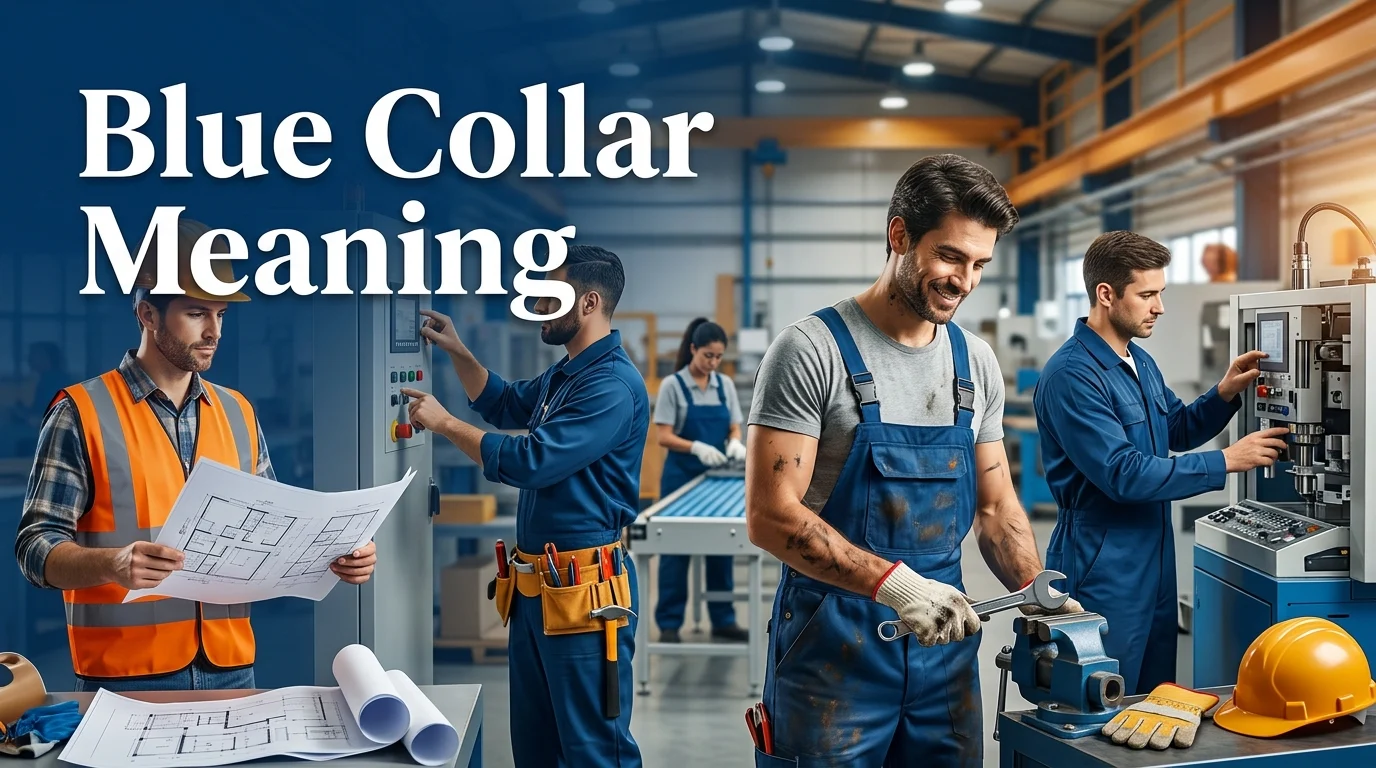
The blue collar meaning refers to work that traditionally involves manual, physical, technical, or hands-on tasks. A blue-collar worker may work in construction, manufacturing, transportation, maintenance, utilities, repair, or skilled trades. Electricians, plumbers, mechanics, welders, machine operators, and construction workers are common examples.
The term describes an occupational category, not a person’s intelligence, education level, income, or social value. Many blue-collar jobs require extensive training, technical knowledge, certifications, apprenticeships, and years of practical experience. In modern workplaces, the line between blue-collar and other types of employment can also be less clear than the traditional labels suggest.
What Does Blue Collar Mean?
Blue collar describes a type of work that is commonly hands-on, physical, technical, or trade-based. A person who performs this kind of work is called a blue-collar worker.
Common blue-collar occupations include:
- Construction worker
- Electrician
- Plumber
- Welder
- Mechanic
- Carpenter
- Machine operator
- Maintenance technician
- Factory worker
- Truck driver
- HVAC technician
- Equipment operator
The term is often contrasted with white collar, which traditionally refers to professional, administrative, managerial, and office-based work.
Blue Collar Definition in Simple English
In simple English, blue collar means a job that often involves working with your hands, tools, machines, equipment, or physical materials.
For example:
A person who installs electrical systems on construction sites may have a blue-collar job.
Another example:
A mechanic who repairs cars is generally considered a blue-collar worker.
Blue-collar work is not limited to jobs that require heavy physical effort. Many modern trade occupations combine practical work with technology, mathematics, diagnostics, engineering concepts, and specialized training.
A skilled electrician, for instance, may need to understand electrical codes, wiring systems, safety procedures, diagrams, measurements, and diagnostic equipment.
Why Is It Called Blue Collar?
The expression blue collar comes from the traditional clothing associated with industrial and manual workers.
Historically, workers in factories, workshops, construction sites, and similar environments often wore durable work clothing. Blue fabrics were practical because they could hide dirt and stains better than lighter-colored clothing.
Over time, blue collar became a broader term for people working in manual and industrial occupations.
The word collar refers to the collar of a shirt, while blue connects the expression with traditional workwear.
Today, the color itself is not important. A worker does not need to wear a blue shirt to be considered blue collar.
What Is a Blue-Collar Worker?
A blue-collar worker is someone whose occupation generally involves practical, manual, mechanical, technical, or physical work.
Some jobs require considerable physical strength. Others depend more heavily on technical knowledge and specialized skills.
For example:
| Occupation | Typical Blue-Collar Classification | Main Type of Work |
|---|---|---|
| Electrician | Yes | Technical and hands-on |
| Plumber | Yes | Skilled trade |
| Welder | Yes | Technical and physical |
| Mechanic | Yes | Repair and diagnostics |
| Carpenter | Yes | Skilled trade |
| Construction worker | Yes | Physical and construction work |
| Factory machine operator | Usually | Industrial and technical |
| HVAC technician | Yes | Technical and field work |
| Truck driver | Often | Transportation |
| Maintenance technician | Yes | Repair and maintenance |
The classification can vary across industries and workplaces. Occupational categories are useful for general understanding, but they do not perfectly describe every modern job.
Examples of Blue-Collar Jobs
Understanding real occupations makes the term much easier to recognize.
Electrician
Electricians install, maintain, inspect, and repair electrical systems. Their work can involve wiring, electrical panels, tools, testing equipment, safety procedures, and technical diagrams.
Plumber
Plumbers work with water supply systems, drainage, pipes, fixtures, and related equipment. Their work often takes place in homes, commercial buildings, factories, or construction sites.
Mechanic
Mechanics diagnose and repair vehicles, machinery, or other mechanical systems. Modern mechanics may use computerized diagnostic equipment alongside traditional tools.
Welder
Welders join metal components using specialized equipment and controlled processes. Welding can be used in construction, manufacturing, automotive work, shipbuilding, and other industries.
Carpenter
Carpenters work with wood and other construction materials. They may build structures, install fixtures, create frameworks, or perform detailed finishing work.
Construction Worker
Construction workers can perform many different tasks, including operating equipment, preparing materials, installing components, assisting tradespeople, and building structures.
HVAC Technician
HVAC technicians install, inspect, maintain, and repair heating, ventilation, and air-conditioning systems. The job combines hands-on work with technical troubleshooting.
Machine Operator
Machine operators work with industrial equipment used to manufacture, process, package, or shape products. Modern machines may involve computerized controls and automated systems.
Blue Collar vs. White Collar
The simplest distinction is based on the traditional nature of the work.
| Blue Collar | White Collar |
|---|---|
| Often hands-on or field-based | Often office or professional-based |
| May involve tools and equipment | Often involves computers and documents |
| Common in trades and industry | Common in business and professional services |
| Can require apprenticeships or technical training | Often requires academic or professional qualifications |
| Examples include electricians and mechanics | Examples include accountants and office managers |
This distinction is useful, but it should not be treated as a strict rule.
A job can contain elements associated with several occupational categories. Technology has also changed many traditional workplaces. A modern manufacturing technician, for example, may operate computerized machinery, analyze data, troubleshoot equipment, and perform physical tasks in the same role.
Blue Collar Does Not Mean Unskilled
One of the biggest misunderstandings about the term is the assumption that blue-collar work is automatically low-skilled.
That is not accurate.
Many blue-collar occupations require specialized knowledge and extensive practical training. An experienced electrician may need to understand electrical systems, safety requirements, building practices, tools, measurements, and technical documentation.
Similarly, an experienced welder may need specialized knowledge of materials, equipment settings, welding processes, workplace safety, and quality standards.
The better distinction is often type of work, rather than simply “skilled versus unskilled.”
In fact, many blue-collar occupations are specifically known as skilled trades.
Skilled Trades and Blue-Collar Work
A skilled trade is an occupation that typically requires specialized practical knowledge and training.
Examples include:
- Electrical work
- Plumbing
- Welding
- Carpentry
- Automotive repair
- HVAC
- Masonry
- Machining
- Equipment operation
- Industrial maintenance
Training can take several forms, depending on the occupation and location. Apprenticeships, vocational programs, technical schools, workplace training, certifications, and supervised experience can all play a role.
This is an important distinction for readers searching for blue collar jobs. A job can be blue collar and highly specialized at the same time.
Blue Collar Meaning in the Workplace
In workplace discussions, blue collar is often used to describe employees who perform operational, technical, field, production, maintenance, transportation, or trade-related duties.
For example:
The company is hiring more blue-collar workers for its manufacturing facilities.
Here, the phrase refers to employees involved in practical or industrial operations rather than office-based administrative roles.
Another example:
Blue-collar employees received additional safety training before the new equipment was introduced.
In this sentence, the term identifies a group of workers whose roles are connected to hands-on operations.
Blue Collar Meaning in a Sentence
Here are natural examples showing how the expression works:
- My uncle has worked as a blue-collar worker for more than twenty years.
- The company needs more blue-collar workers at its new manufacturing plant.
- Electricians and plumbers are often considered blue-collar professionals.
- She chose a blue-collar career in automotive repair.
- The training program helps young people prepare for skilled blue-collar jobs.
- Modern blue-collar work often involves advanced technology.
- His blue-collar job requires both physical ability and technical knowledge.
- The factory depends on skilled blue-collar employees to maintain its equipment.
- Many blue-collar occupations require hands-on training before workers can work independently.
- The construction company is looking for experienced blue-collar workers.
Is a Blue-Collar Job Always Physical?
Not necessarily.
Physical activity is common in many blue-collar occupations, but it is not the only defining feature.
Consider an industrial maintenance technician. The worker may spend part of the day walking around a facility, inspecting machinery, reading technical information, using diagnostic equipment, entering measurements, and repairing components.
The work is hands-on, but it also requires problem-solving and technical knowledge.
Likewise, a machine operator may spend much of the day monitoring computerized equipment rather than performing heavy manual labor.
So, physical work is a common feature of blue-collar employment, but practical and technical work are equally important parts of the broader category.
Are Blue-Collar Jobs Good Careers?
The term blue collar describes an occupational category. It does not determine whether a particular career is good or bad.
Career suitability depends on factors such as:
- Required training
- Working conditions
- Pay and benefits
- Schedule
- Physical demands
- Job security
- Advancement opportunities
- Location
- Personal interests
- Long-term career goals
Someone who enjoys practical problem-solving may prefer a skilled trade. Another person may prefer an office-based career.
The important point is that the label itself does not tell you the full story about a particular occupation.
Blue Collar vs. Working Class
The terms blue collar and working class are related, but they are not exact synonyms.
Blue collar primarily describes an occupational type.
Working class is a broader social and economic term that can involve occupation, income, employment conditions, and other factors.
For example, a person may describe an occupation as blue collar without using the term working class. Likewise, not every person described as working class necessarily has a traditionally blue-collar occupation.
Keeping these meanings separate makes writing about work and social groups more precise.
Blue Collar vs. Manual Labor
Manual labor generally refers to work involving physical activity or the use of one’s hands.
Blue collar is a broader occupational label.
There is significant overlap, but they are not identical.
For example, a technician may perform hands-on work while also spending considerable time diagnosing systems, reading technical documents, or using computerized tools.
This means calling all blue-collar work simply “manual labor” can leave out the technical and specialized side of many occupations.
Common Misunderstandings About Blue-Collar Work
Myth 1: Blue-collar workers are uneducated
Education levels vary widely among workers. Some blue-collar occupations require vocational education, technical training, apprenticeships, licenses, or specialized certifications.
Myth 2: Blue-collar work is always low-skilled
Many occupations classified as blue collar require advanced practical skills and extensive experience.
Myth 3: Blue-collar jobs only exist in factories
Blue-collar occupations exist across construction, transportation, utilities, repair, maintenance, manufacturing, energy, automotive services, and skilled trades.
Myth 4: Technology has eliminated blue-collar work
Technology has changed many blue-collar jobs, but it has also created new technical responsibilities. Modern workers may operate automated systems, computerized machinery, robotics, and digital diagnostic tools.
Myth 5: Blue collar and white collar are completely separate
The categories can overlap. Modern occupations often combine technical, administrative, digital, and physical responsibilities.
How to Use “Blue Collar” Correctly
Blue collar is normally used as an adjective before a noun:
- blue-collar worker
- blue-collar job
- blue-collar occupation
- blue-collar career
- blue-collar workforce
It is commonly written with a hyphen when it appears before a noun:
He works in a blue-collar occupation.
When the phrase is used differently in a sentence, punctuation conventions can vary depending on the grammatical construction and style guide.
The related noun is:
blue-collar worker
For example:
She is a blue-collar worker.
Blue Collar as a Career Search Term
People searching for blue collar careers are often looking beyond traditional office employment.
Some common areas include:
- Construction
- Electrical work
- Plumbing
- Automotive repair
- Manufacturing
- Welding
- HVAC
- Industrial maintenance
- Transportation
- Equipment operation
- Carpentry
- Utilities
A useful career search should go beyond the label. Look at the exact occupation, training requirements, licensing rules, working environment, expected duties, and local employment conditions.
That approach gives a much clearer picture than simply searching for “blue collar jobs.”
Related Terms You Should Know
Several terms appear alongside blue collar in discussions about occupations.
White Collar
Traditionally refers to professional, administrative, managerial, and office-based employment.
Pink Collar
Historically associated with occupations concentrated in service and care-related fields. The term has a complex history and can carry gendered assumptions, so context matters.
Skilled Trade
An occupation requiring specialized practical training and technical skills. Many skilled trades are blue-collar occupations.
Manual Labor
Work involving significant physical or hands-on activity.
Working Class
A broader social and economic term that can overlap with blue-collar employment but has a different meaning.
Frequently Asked Questions
What does blue collar mean?
Blue collar describes work that is commonly hands-on, manual, technical, industrial, or trade-based. Electricians, mechanics, plumbers, welders, and construction workers are common examples.
What is a blue-collar worker?
A blue-collar worker is someone employed in an occupation that typically involves practical, physical, technical, industrial, or trade-related duties.
Why is it called blue collar?
The term is associated with the durable blue work clothing traditionally worn by many industrial and manual workers. The expression later became a broader occupational label.
Is an electrician a blue-collar worker?
Yes. Electricians are commonly classified as blue-collar workers because their occupation involves skilled, hands-on technical work.
Is a mechanic a blue-collar worker?
Yes. Mechanics are generally considered blue-collar workers because they perform practical repair, maintenance, and diagnostic work.
Are blue-collar jobs low-skilled?
No. Many blue-collar occupations are highly skilled and require specialized training, practical experience, technical knowledge, certifications, or licenses.
What is the difference between blue collar and white collar?
Blue collar traditionally refers to hands-on, technical, industrial, or trade-related work. White collar traditionally refers to professional, administrative, managerial, and office-based work.
Can a blue-collar job require a college degree?
Yes. Occupational categories do not always correspond directly to education level. Some jobs can combine hands-on responsibilities with advanced technical, engineering, management, or academic requirements.
Final Takeaway
The blue collar meaning is broader than simply “a person who works with their hands.” It refers to an occupational category commonly associated with practical, technical, industrial, physical, and skilled-trade work.
Electricians, plumbers, mechanics, welders, construction workers, HVAC technicians, machine operators, and maintenance workers are common examples. Many require serious training and specialized knowledge.
The most useful way to understand the term is to focus on the nature of the work, rather than making assumptions about a worker’s education, intelligence, income, or social status. As workplaces become more technology-driven, many blue-collar careers now combine hands-on skills with digital tools, diagnostics, automation, and technical problem-solving.
Read More Related Articles:
- Parasocial Meaning | Definition, Examples, Psychology & the …
- Helonium Meaning | Definition, Origin, Uses & the Story …
- Inshallah Meaning | Definition, Origin, Usage & the Deeper …