When the same word appears repeatedly in an essay, email, caption, resume, blog post, or conversation, the writing can quickly feel flat. This is especially true when you need to describe an indirect reference without repeating the word “allusion.” Learning the right synonyms of allusion gives you more control over meaning, tone, and style.
However, replacing a word with any similar term is not always effective. An allusion can quietly point to a person, event, book, place, idea, or cultural reference without explaining it directly. Depending on your purpose, words such as “reference,” “hint,” “implication,” “intimation,” “nod,” or “echo” may work better. The key is choosing an alternative that preserves the intended level of indirectness.
What Are the Best Synonyms of “Allusion”?
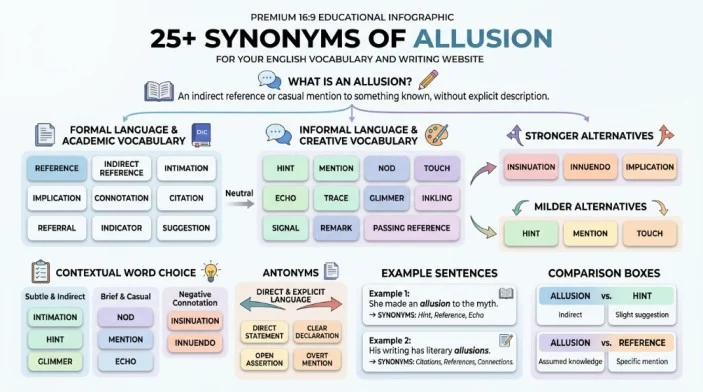
Featured Snippet Answer: An allusion is an indirect reference to a person, event, text, idea, or cultural work. The best synonyms include “reference,” “hint,” “indirect reference,” “intimation,” “implication,” “nod,” and “echo.” Formal and academic writing often favors “reference” or “indirect reference,” while creative writing can use “echo,” “nod,” or “evocation.”
The word allusion is generally neutral and somewhat formal. It is especially common in literary criticism, academic writing, essays, journalism, and discussions about culture or rhetoric.
For casual conversation, “reference” or “hint” usually sounds more natural. For professional communication, “reference” is often the safest choice. Creative writing, “echo,” “nod,” “evocation,” and “gesture” can add a more interpretive quality.
Meaning, Tone, and Context
Simple Definition
An allusion is an indirect reference to something recognizable. The writer or speaker expects the audience to understand, identify, or infer the thing being referenced without receiving a full explanation.
For example:
The speech made an allusion to George Orwell’s 1984.
The speaker does not necessarily name a specific passage or explain the entire novel. Instead, the reference points readers toward an idea associated with the work.
Part of Speech
Allusion is a noun.
Example:
Her poem contains an allusion to Greek mythology.
The related verb is allude.
Example:
The author alludes to Greek mythology throughout the novel.
The adjective allusive describes language that contains or relies on indirect references.
Example:
His allusive writing style rewards careful readers.
Overall Tone
“Allusion” is usually neutral, but it carries a somewhat literary or analytical tone.
It does not inherently express approval or criticism. The surrounding context determines the emotional effect.
Formality Level
“Allusion” is generally formal to neutral.
It fits naturally in:
• Academic essays
• Literary analysis
• Research writing
• Professional discussions
• Journalism
• Formal presentations
• Serious criticism
It can sound more sophisticated than “hint” in ordinary conversation.
Common Uses
Native English speakers commonly use “allusion” when discussing:
• Literature
• Poetry
• Movies
• Music
• History
• Religion
• Politics
• Popular culture
• Speeches
• Advertising
• Symbolism
• Rhetoric
Word Forms
| Form | Word | Example |
|---|---|---|
| Noun | allusion | The novel contains an allusion to Shakespeare. |
| Verb | allude | The writer alludes to a famous historical event. |
| Adjective | allusive | The poem has an allusive quality. |
When and How to Use “Allusion”
Use allusion when a reference is indirect and the audience is expected to recognize or interpret what is being suggested.
Professional
The presentation included an allusion to the company’s earlier product launch.
This works when discussing a subtle reference in a professional presentation.
Academic
The poem contains an allusion to classical mythology.
This is a natural choice for literary or academic analysis.
Workplace
His comment seemed to be an allusion to the team’s previous disagreement.
Here, “allusion” emphasizes that the speaker referred to the disagreement indirectly.
Personal
Her story included an allusion to an embarrassing moment from college.
The word can describe indirect personal references when the listener is expected to understand the connection.
Your message seems to contain an allusion to our earlier discussion.
This is grammatically correct, although “reference” may sound more natural in a routine business email.
Resume
Avoid writing a resume bullet that contains an allusion to an achievement without explaining the result.
In resumes, direct language is usually more effective than indirect references.
Social Media
The caption contains a playful allusion to the movie’s most famous scene.
This works well when the audience is expected to recognize the cultural reference.
Best Synonyms of “Allusion”
No synonym is identical to “allusion” in every situation. The original word specifically emphasizes an indirect reference, while alternatives such as “reference” or “mention” can be broader.
Best for Professional Writing
Reference
“Reference” is clearer and more widely understood in professional settings. It can describe both direct and indirect mentions.
The report references the company’s previous strategy.
Best for Academic Writing
Indirect reference
This phrase makes the relationship especially clear. It works well when precision matters more than stylistic elegance.
The passage contains an indirect reference to classical mythology.
Best for Business Communication
Reference
Business writing usually benefits from direct, familiar vocabulary.
The manager made a reference to the previous quarterly report.
Best for Casual Conversation
Hint
“Hint” is more conversational and usually suggests something indirectly.
Was that a hint about your plans for the weekend?
Best for Emotional Writing
Intimation
“Intimation” can suggest a subtle indication of something without stating it openly. It has a more literary and formal feel.
The letter offered a quiet intimation of regret.
Best for Creative Writing
Echo
“Echo” is useful when one text, image, phrase, or idea recalls another.
The scene creates an echo of the hero’s childhood.
Best for Resume Writing
Reference
Resumes normally benefit from clear statements rather than subtle allusions.
Instead of:
An allusion to my leadership abilities appears in the project description.
Use:
The project description highlights my leadership abilities.
Best for Workplace Communication
Mention or reference
Choose “mention” for a straightforward statement and “reference” when discussing a specific source, event, or earlier subject.
Stronger Meaning
Insinuation
“Insinuation” can suggest an indirect suggestion, often with a negative or suspicious undertone.
His comment sounded like an insinuation that I had made the mistake.
Use it carefully because it can imply accusation or criticism.
Softer Meaning
Hint
“Hint” is usually less formal and can feel less weighty than “allusion.”
She dropped a hint about the surprise.
When Not to Use “Allusion”
When the Reference Is Completely Direct
“Allusion” is not the best choice when someone explicitly names or explains the subject.
Less effective:
The report alludes to the company’s 2025 sales figures by listing the figures in a table.
Better:
The report references the company’s 2025 sales figures.
The second sentence is clearer because the information is directly identified.
When You Mean a Simple Mention
“Allusion” can sound unnecessarily formal when the writer simply means “mention.”
Less effective:
I made an allusion to your email during the meeting.
Better:
I mentioned your email during the meeting.
When You Mean a Strong Suggestion
If the speaker is deliberately implying something, “insinuation” or “implication” may communicate the idea more precisely.
Less effective:
Her statement was an allusion that he had lied.
Better:
Her statement implied that he had lied.
When You Need Extremely Clear Professional Language
Business readers often benefit from direct wording.
Less effective:
The proposal contains an allusion to potential budget concerns.
Better:
The proposal refers to potential budget concerns.
When You Need a Casual Expression
“Allusion” can sound academic in everyday conversation.
Less effective:
That was an interesting allusion to your brother.
Better:
That was an interesting reference to your brother.
When You Need Emotional Precision
If the reference carries accusation, suspicion, or criticism, “insinuation” may be more precise.
Less effective:
His comment was an allusion that she was dishonest.
Better:
His comment was an insinuation that she was dishonest.
Words Commonly Confused With “Allusion”
| Word | Difference | When to Use It | Example |
|---|---|---|---|
| Reference | A reference can be direct or indirect, while an allusion is normally indirect. | Use it when you want a broad, clear term. | The article references several historical events. |
| Mention | A mention simply brings something up without necessarily suggesting a deeper connection. | Use it for ordinary speech and writing. | She mentioned the issue during the meeting. |
| Hint | A hint gives an indirect clue or suggestion. | Use it when someone is suggesting something without saying it plainly. | He gave me a hint about the surprise. |
| Implication | An implication is a meaning that can be inferred from words or actions. | Use it when the focus is on the meaning suggested by a statement. | The implication was that the plan had failed. |
| Insinuation | An insinuation is an indirect suggestion, often negative or critical. | Use it when the indirect meaning carries suspicion or accusation. | Her remark sounded like an insinuation. |
| Citation | A citation identifies a source or passage directly. | Use it in academic and research writing. | The paper includes a citation from the study. |
Best Synonyms of “Allusion” by Context
| Context | Best Synonym | Why It Works | Example |
|---|---|---|---|
| Formal writing | Indirect reference | Precise and clearly describes the relationship. | The essay contains an indirect reference to the event. |
| Academic writing | Reference | Familiar and suitable for analysis. | The author makes a reference to Greek mythology. |
| Professional communication | Reference | Clear and broadly understood. | The manager referenced the previous report. |
| Business emails | Mention | Natural and efficient for routine communication. | I mentioned the issue in my earlier email. |
| Resume writing | Reference | More direct and professional than allusion. | The bullet references measurable project results. |
| Workplace communication | Reference | Works for discussions of earlier subjects. | She referred to the previous meeting. |
| Casual conversation | Hint | Conversational and naturally indirect. | He gave me a hint about the gift. |
| Everyday speaking | Mention | Simple and familiar. | She mentioned your name yesterday. |
| Creative writing | Echo | Suggests a recognizable connection or resemblance. | The scene echoes a classic tragedy. |
| Storytelling | Nod | Can describe a subtle acknowledgment of another work or idea. | The ending is a nod to old detective stories. |
| Emotional writing | Intimation | Suggests a subtle emotional indication. | The letter carried an intimation of loss. |
| Strong emphasis | Insinuation | Adds a potentially accusatory or negative undertone. | His words sounded like an insinuation. |
| Mild tone | Hint | Less formal and generally softer. | She dropped a hint about moving away. |
| Social media captions | Nod | Concise and familiar in discussions of cultural references. | The caption is a nod to a famous sitcom. |
| American English | Reference | The broadest natural choice in general usage. | The article references the earlier debate. |
| British English | Reference | Also widely natural and understood in British usage. | The essay references several historical sources. |
How to Choose the Best Synonym of “Allusion”
Start by identifying exactly what the original sentence means.
- If you mean a general mention or connection, choose “reference.”
- If you mean a small clue, choose “hint.”
- If you mean a suggested meaning, choose “implication.”
- If you mean an indirect negative suggestion, choose “insinuation.”
- If you are discussing a literary or cultural connection, “allusion,” “echo,” or “nod” may be appropriate.
Then consider your audience. Academic readers may accept “allusion” naturally, while a customer reading a business email may respond better to the simpler word “reference.”
Finally, check emotional strength. A neutral word such as “reference” communicates information without adding much emotion. “Insinuation” can make the sentence sound suspicious or critical.
Real Life Examples of “Allusion”
School
The student explained how the poem uses an allusion to a well known historical event.
College
Her essay analyzes the author’s allusion to classical mythology.
Workplace
The manager’s comment seemed to be an allusion to the team’s earlier disagreement.
Business
The presentation included a subtle allusion to the company’s original mission.
Your message contains a reference to the proposal we discussed last week.
This version is usually more natural in ordinary business correspondence.
Resume
Instead of using an indirect reference:
My resume alludes to my leadership experience.
A stronger version is:
My resume highlights my experience leading a cross functional team.
The second sentence gives the reader concrete information instead of asking them to infer it.
Conversation
She gave a hint that she might leave the company soon.
“Hint” is more natural than “allusion” in casual speech.
Storytelling
The final chapter contains an echo of the opening scene.
“Echo” works particularly well when the writer intentionally creates a connection between two parts of a story.
Blogging
The article makes a brief reference to the debate without discussing it in detail.
Social Media
The caption is a playful nod to a classic comedy.
This phrasing sounds natural for modern online writing.
25 Best Synonyms of “Allusion”
The following list includes exact or context specific alternatives. Some are broader than “allusion,” so they should not automatically replace the original word in every sentence.
| Synonym | Simple Meaning | Best Used For | Example Sentence |
|---|---|---|---|
| Reference | A mention or connection to something | General and professional writing | The article includes a reference to the earlier study. |
| Indirect reference | A reference made without stating everything directly | Academic and analytical writing | The passage contains an indirect reference to war. |
| Hint | A small clue or indirect suggestion | Casual conversation | She gave me a hint about the surprise. |
| Suggestion | An idea presented indirectly or tentatively | General and persuasive writing | His comment was a suggestion that we reconsider the plan. |
| Intimation | A subtle indication of something | Formal and literary writing | The letter offered an intimation of regret. |
| Implication | A meaning that can be inferred | Analysis and professional discussion | The implication was that the deadline might change. |
| Insinuation | An indirect suggestion, often negative | Critical or sensitive contexts | His statement sounded like an insinuation of dishonesty. |
| Mention | Bringing something into discussion | Everyday and professional communication | She mentioned the earlier agreement. |
| Indirect mention | A reference that does not fully identify the subject | Clear explanatory writing | The article makes an indirect mention of the dispute. |
| Oblique reference | A deliberately indirect reference | Literary and analytical writing | The poem makes an oblique reference to exile. |
| Veiled reference | A reference whose meaning is partly concealed | Political, literary, or sensitive writing | His speech contained a veiled reference to the controversy. |
| Passing reference | A brief mention without detailed discussion | Reports and essays | The author makes a passing reference to the earlier theory. |
| Nod | A brief acknowledgment of another work, idea, or tradition | Creative and conversational writing | The film is a nod to classic adventure movies. |
| Gesture | An indirect indication or acknowledgment | Literary and rhetorical analysis | The scene serves as a gesture toward the character’s past. |
| Echo | A recognizable resemblance or recurrence of an earlier idea | Creative and literary writing | The ending creates an echo of the opening chapter. |
| Evocation | A calling to mind of a person, place, mood, or idea | Literary and descriptive writing | The music creates an evocation of childhood summers. |
| Allusive reference | A reference that depends on indirect recognition | Literary criticism | The poem uses an allusive reference to mythology. |
| Cultural reference | A reference connected to shared culture | Media, marketing, and social content | The advertisement contains a cultural reference to a popular film. |
| Literary reference | A reference to a literary work or tradition | Literature and academic analysis | The novel includes a literary reference to Shakespeare. |
| Historical reference | A reference to a past event or period | History and academic writing | The speech contains a historical reference to the Civil War. |
| Mythological reference | A reference to mythology | Literature and cultural analysis | The character’s name is a mythological reference. |
| Biblical reference | A reference to a biblical person, story, or idea | Religious and literary writing | The poem contains a biblical reference to the flood. |
| Classical reference | A reference to ancient Greek or Roman culture | Academic and literary writing | The essay identifies a classical reference in the poem. |
| Subtle reference | A reference that is not immediately obvious | General and creative writing | The story includes a subtle reference to the author’s childhood. |
| Indirect suggestion | An idea communicated without stating it plainly | General communication | Her remark was an indirect suggestion that we should leave. |
Synonyms of “Allusion” by Usage
Professional vs Personal Synonyms
Professional writing usually favors reference, mention, and indirect reference because these terms are clear and efficient.
Personal and creative communication can make better use of hint, nod, echo, or suggestion, depending on the intended tone.
For example:
The report references the previous policy.
sounds professional.
She gave me a hint about what happened.
sounds natural in conversation.
Formal vs Conversational Synonyms
For reports, essays, presentations, and academic writing, consider:
• Allusion
• Reference
• Indirect reference
• Oblique reference
• Intimation
• Implication
For emails, conversations, texting, and informal writing, consider:
• Reference
• Mention
• Hint
• Suggestion
• Nod
The simpler option is usually better when the context does not require literary precision.
Academic Synonyms
Academic writing benefits from precise terms such as:
Reference: Best when identifying a connection to another source or idea.
Indirect reference: Useful when emphasizing that the connection is not explicit.
Allusion: Appropriate for literary analysis when the author expects readers to recognize another work, person, event, or idea.
Implication: Better when analyzing an unstated meaning rather than a cultural or textual reference.
Oblique reference: Useful when discussing deliberately indirect wording.
Professional and Business Synonyms
For resumes, interviews, meetings, presentations, performance reviews, client communication, and business emails, the safest choices are usually reference, mention, indication, and suggestion.
For example:
The proposal references the client’s previous concerns.
is clearer than:
The proposal contains an allusion to the client’s previous concerns.
Use “allusion” in business settings when the indirect or cultural nature of the reference is itself relevant.
Creative and Literary Synonyms
Creative writing allows more expressive alternatives.
Echo suggests a recognizable connection to an earlier idea.
Nod suggests a brief acknowledgment.
Evocation focuses on bringing an image, mood, person, or idea to mind.
Intimation can create a subtle sense of something being suggested rather than openly stated.
These alternatives can make literary analysis or storytelling more precise.
Slang or Modern Synonyms
There is no perfect slang replacement for “allusion.”
However, shout out can sometimes describe a public acknowledgment of another person, work, or cultural reference.
The director gave a shout out to classic horror films.
This is not a direct synonym for “allusion.” It is more explicit and celebratory, so it should not replace “allusion” in academic writing.
Avoid “shout out” in formal reports, research papers, resumes, and serious business correspondence unless the context specifically calls for informal language.
Strongest to Mildest Synonyms
Because “allusion” describes indirectness rather than emotional intensity, its synonyms do not form a perfect strength scale. Still, their practical effect can be organized roughly as follows.
Mild
Mention
Usually adds little emotional force.
Reference
Generally neutral and informational.
Hint
Suggests something without stating it directly.
Moderate
Suggestion
Adds a stronger sense that an idea is being proposed or communicated indirectly.
Allusion
Can carry literary, cultural, or interpretive meaning.
Indirect reference
Clearly emphasizes the indirect relationship.
Strong
Implication
Draws attention to an unstated meaning.
Intimation
Can make the suggestion feel subtle and deliberate.
Very Strong
Insinuation
Often adds suspicion, criticism, or an accusation.
Because of this negative potential, “insinuation” should not be used as a neutral substitute for “allusion.”
Emotional vs Neutral Synonyms
Emotional Synonyms
These alternatives can add feeling, tension, suspicion, or artistic atmosphere:
• Insinuation
• Evocation
• Intimation
• Echo
• Nod
• Suggestion
For example:
The letter carried an intimation of sadness.
This is more emotionally suggestive than:
The letter contained a reference to sadness.
Neutral Synonyms
These terms usually communicate information without adding much emotional interpretation:
• Reference
• Mention
• Indirect reference
• Indirect mention
• Cultural reference
• Literary reference
• Historical reference
Use neutral vocabulary when clarity is more important than stylistic effect.
Antonyms of “Allusion”
“Allusion” does not have a single perfect one word antonym. Its practical opposite is usually a direct or explicit statement. The following terms and phrases describe ways of communicating without relying on indirect reference.
| Antonym | Meaning | Example Sentence |
|---|---|---|
| Direct statement | Says the information plainly | She made a direct statement about the problem. |
| Explicit statement | Expresses the meaning clearly and openly | The policy contains an explicit statement about deadlines. |
| Direct reference | Identifies the subject without indirect wording | The report makes a direct reference to the incident. |
| Explicit reference | Clearly identifies the person, event, or idea | The author makes an explicit reference to the source. |
| Direct mention | Names or discusses something openly | He made a direct mention of the agreement. |
| Clarification | Removes uncertainty by explaining something | The manager provided clarification about the new policy. |
| Explanation | Gives information needed to understand something | The teacher offered an explanation of the historical event. |
| Declaration | States something openly and firmly | The company issued a declaration of its position. |
| Announcement | Publicly communicates information | The school made an announcement about the schedule. |
| Specification | States exact details | The contract includes a specification of the required materials. |
| Identification | Clearly identifies a person, thing, or source | The report includes identification of the responsible department. |
| Naming | Gives the actual name of something | The speaker avoided vague language and used direct naming. |
| Literal statement | Communicates meaning without figurative or indirect reference | The sentence is a literal statement of the facts. |
| Plain statement | Expresses an idea in simple, direct language | She gave a plain statement of what happened. |
| Straightforward explanation | Communicates the point without concealment or indirectness | His straightforward explanation cleared up the confusion. |
Comparison: “Allusion” vs Similar Words
Allusion vs Reference
Main Difference
An allusion is normally an indirect reference. “Reference” is broader and can describe either a direct or indirect connection.
Which Is Stronger?
“Allusion” usually carries more interpretive or literary weight.
Which Is More Formal?
Both are suitable for formal writing, but “allusion” sounds more specialized.
When to Use Each
Use “allusion” when indirectness matters. Use “reference” for general communication.
Examples
Allusion:
The poem contains an allusion to an ancient myth.
Reference:
The report contains a reference to the previous study.
Allusion vs Hint
Main Difference
An allusion points toward a recognizable person, work, event, or idea. A hint gives a clue about something.
Which Is Stronger?
A hint may be more immediate, while an allusion often depends on background knowledge.
Which Is More Formal?
“Allusion” is more formal.
When to Use Each
Use “hint” in everyday communication. Use “allusion” for literary, cultural, or analytical references.
Examples
Allusion:
The novel makes an allusion to Shakespeare.
Hint:
She gave me a hint about the answer.
Allusion vs Implication
Main Difference
An allusion points indirectly toward something recognizable. An implication is a meaning that can be inferred from what is said.
Which Is Stronger?
“Implication” can carry stronger interpretive force because it focuses on the unstated meaning.
Which Is More Formal?
Both are formal enough for academic writing.
When to Use Each
Use “allusion” for indirect references. Use “implication” when analyzing what a statement suggests.
Examples
Allusion:
The speech contains an allusion to a famous historical event.
Implication:
The implication was that the plan needed more work.
Allusion vs Insinuation
Main Difference
An allusion can be neutral. An insinuation often suggests something negative, suspicious, or accusatory.
Which Is Stronger?
“Insinuation” is usually stronger and more emotionally charged.
Which Is More Formal?
Both can appear in formal writing.
When to Use Each
Use “insinuation” only when the negative or suspicious undertone is genuinely intended.
Examples
Allusion:
The author makes an allusion to the earlier conflict.
Insinuation:
His comment contained an insinuation that she was responsible.
Allusion vs Mention
Main Difference
A mention simply brings something into the discussion. An allusion usually refers to something indirectly.
Which Is Stronger?
“Allusion” is more interpretive.
Which Is More Formal?
“Allusion” is more formal.
When to Use Each
Use “mention” for ordinary communication. Use “allusion” for subtle literary or cultural references.
Examples
Allusion:
The story includes an allusion to Greek mythology.
Mention:
She mentioned Greek mythology during the lecture.
Allusion vs Citation
Main Difference
A citation identifies a source or passage, usually for documentation. An allusion does not necessarily identify its source directly.
Which Is Stronger?
A citation is more explicit and specific.
Which Is More Formal?
“Citation” is especially common in academic and research contexts.
When to Use Each
Use “citation” when documenting evidence. Use “allusion” when discussing an indirect reference.
Examples
Allusion:
The poem contains an allusion to the Bible.
Citation:
The research paper includes a citation from a biblical passage.
Common Phrases and Expressions with “Allusion”
An allusion to
Meaning: An indirect reference to a particular person, event, idea, or work.
Example Sentence:
The novel contains an allusion to the author’s childhood.
Make an allusion to
Meaning: To refer indirectly to something.
Example Sentence:
The speaker made an allusion to the country’s difficult past.
Contain an allusion to
Meaning: To include an indirect reference.
Example Sentence:
The poem contains an allusion to classical mythology.
Literary allusion
Meaning: An indirect reference to a literary work, character, writer, or tradition.
Example Sentence:
The professor identified a literary allusion in the final paragraph.
Historical allusion
Meaning: An indirect reference to a historical person, event, or period.
Example Sentence:
The speech contains a historical allusion that many listeners recognized.
Biblical allusion
Meaning: An indirect reference to a person, story, phrase, or idea from the Bible.
Example Sentence:
The novel includes a biblical allusion that reinforces its central theme.
Cultural allusion
Meaning: An indirect reference to something associated with a shared culture.
Example Sentence:
The advertisement uses a cultural allusion to a famous television series.
An allusion to the past
Meaning: An indirect reference to an earlier period or experience.
Example Sentence:
The old photograph serves as an allusion to the family’s past.
Common Mistakes to Avoid
Mistake 1: Using “allusion” when you mean “illusion”
Incorrect:
The writer created an illusion to the author’s childhood.
Better:
The writer created an allusion to the author’s childhood.
Why: “Allusion” means an indirect reference. “Illusion” refers to a false perception, misleading appearance, or deceptive image.
Mistake 2: Using “allusion” for every kind of reference
Incorrect:
The manager made an allusion to the deadline by clearly stating the deadline.
Better:
The manager made a direct reference to the deadline.
Why: An allusion is generally indirect. A clearly stated subject is better described as a direct reference or mention.
Mistake 3: Using a literary word in a simple business message
Incorrect:
I made an allusion to your previous email during the meeting.
Better:
I mentioned your previous email during the meeting.
Why: “Mentioned” is simpler and more natural for routine professional communication.
Mistake 4: Choosing “insinuation” when the meaning is neutral
Incorrect:
The article contains an insinuation to Shakespeare.
Better:
The article contains an allusion to Shakespeare.
Why: “Insinuation” often suggests something negative or suspicious. A neutral literary reference is an allusion.
Mistake 5: Using an indirect synonym when direct wording is better
Incorrect:
The resume makes an allusion to my leadership skills.
Better:
The resume highlights my leadership skills.
Why: Resumes should communicate qualifications directly and efficiently.
Mistake 6: Repeating “allusion” when another word is clearer
Incorrect:
The first paragraph contains an allusion, and the second paragraph adds another allusion to the same event.
Better:
The first paragraph contains an allusion, while the second refers to the same event more directly.
Why: Varying vocabulary can improve readability when the alternative preserves the meaning.
Mistake 7: Treating every “similar” word as an exact synonym
Incorrect:
Replace every use of “allusion” with “hint.”
Better:
Choose “hint” only when the sentence describes a clue or indirect suggestion.
Why: Synonyms overlap in meaning but often differ in purpose, tone, and context.
Frequently Asked Questions
What are the best synonyms of “allusion”?
The best synonyms of allusion include “reference,” “indirect reference,” “hint,” “intimation,” “implication,” “mention,” “nod,” and “echo.” The best choice depends on whether the context is academic, professional, conversational, or creative.
What are the best formal synonyms of “allusion”?
The strongest formal synonyms of allusion include “reference,” “indirect reference,” “oblique reference,” “intimation,” and “implication.” For academic writing, “reference” is usually the clearest general alternative.
What are common informal synonyms of “allusion”?
Common informal alternatives include “hint,” “mention,” “reference,” and sometimes “nod.” “Hint” works particularly well when someone indirectly communicates an idea in everyday conversation.
What is another word for “allusion” in professional writing?
“Reference” is usually the best professional alternative to allusion. It is clear, familiar, and flexible enough for emails, reports, presentations, workplace discussions, and business documents.
What is the difference between “allusion” and “reference”?
An allusion is normally an indirect reference that expects the reader or listener to recognize a connection. “Reference” is broader and can describe either a direct or indirect mention of something.
What is the opposite of “allusion”?
The opposite of allusion is generally a direct or explicit statement. Useful oppositional terms include “direct reference,” “explicit statement,” “direct mention,” “clarification,” and “plain statement.”
Conclusion
An allusion is an indirect reference that points readers or listeners toward a person, event, work, idea, or cultural connection without fully explaining it. It is especially useful in literature, academic analysis, storytelling, and discussions of culture.
The best alternative depends on your purpose. Choose “reference” for professional clarity, “hint” for casual communication, “implication” for inferred meaning, “insinuation” for a potentially negative suggestion, and “echo” or “nod” for creative writing.
No synonym works perfectly in every sentence. Consider the audience, tone, intended meaning, and level of formality before making a substitution. A practical vocabulary improvement tip is to learn synonyms in context rather than memorizing isolated word lists, because context reveals which alternative sounds natural.
Read More Related Articles:
- Synonyms for Everything | Meaning, Examples, and Better …
- Synonyms for Unexpected | Meaning, Examples, and Better …
- 50+ Synonyms of This | Meanings, Uses, Examples, and Best …