Finding the right boost synonym can make your writing sharper, more natural, and more precise. The word boost works in many situations, from increasing sales and improving performance to lifting confidence or energy. However, the best alternative depends on the meaning and tone you need. An another word for boost may be increase, raise, improve, strengthen, or enhance, while a boosting synonym can change based on whether you are describing results, emotions, or growth.
This guide explores useful boost synonyms, including an another word for boosting, the synonyms of boost, and each boost other term in practical contexts. You’ll also find the synonyms of boosts and the most accurate synonym for boosting with examples. For casual writing, we explain boost synonym slang options too, helping you choose words that sound natural without changing the intended meaning.
What Are the Best Synonyms of “Boost”?
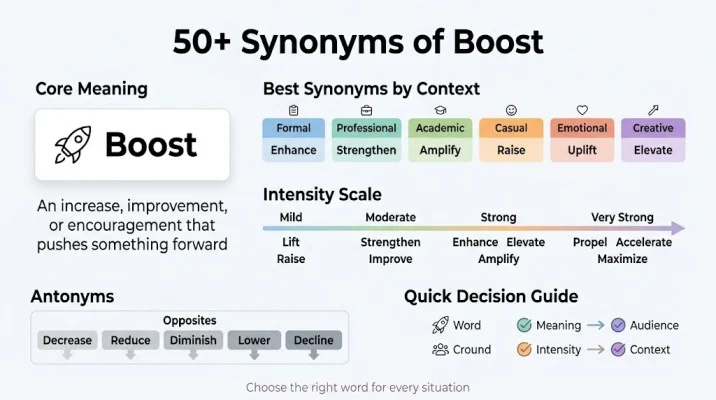
Boost describes an increase, improvement, or encouragement that pushes something forward. The best synonyms include enhance, elevate, amplify, strengthen, improve, increase, raise, and uplift. Choose enhance for professional writing, elevate for personal development, amplify for marketing, strengthen for business contexts, and uplift for emotional or motivational situations.
Meaning, Tone, and Context
Simple Definition
The word boost describes an action or force that increases, improves, or encourages something or someone. It refers to a push forward, an upward movement, or a positive change.
Part of Speech
Boost can be used as a noun or a verb.
Overall Tone
The word usually has a positive tone. It highlights growth, improvement, or encouragement without adding extreme emotion.
Formality Level
Boost is considered neutral, making it suitable for both formal and informal communication. It appears naturally in business writing, academic papers, marketing, workplace discussions, everyday conversations, and motivational writing.
Common Uses
Native English speakers commonly use boost when talking about:
- Confidence boost
- Energy boost
- Productivity boost
- Sales boost
- Performance boost
- Morale boost
- Career boost
- Economic boost
- Mental boost
- Physical boost
Word Forms
| Form | Word |
|---|---|
| Noun | boost |
| Verb | boost |
| Adjective | boosted |
| Related Form | boosting |
| Opposite Form | decrease, decline |
When and How to Use “Boost”
The word boost works well whenever you want to show an increase, improvement, or positive push. However, choosing a more specific synonym can make your message clearer and more impactful.
Professional
“The new marketing strategy will boost our sales by twenty percent.”
Academic
“Regular exercise has been shown to boost cognitive function in older adults.”
Workplace
“Employee recognition programs can boost morale and productivity.”
Personal
“A good night’s sleep always gives me an energy boost.”
“I hope this message finds you well and gives you a boost of motivation.”
Resume
“Implemented strategies that boosted team efficiency by 15 percent.”
Social Media
“Starting my day with a morning run gives me the boost I need.”
Best Synonyms of Boost
The word boost is useful because it fits almost every type of writing, but no single synonym works perfectly in every situation. Some alternatives emphasize improvement, while others highlight increase, strengthening, or encouragement. Choosing the right synonym helps your writing sound more natural and precise.
Professional Writing: Enhance
Enhance is one of the strongest professional alternatives to boost. It suggests improving quality or value rather than just increasing quantity.
Example:
“The new software will enhance our team’s productivity significantly.”
Why it works:
Business writing benefits from precise language, and enhance communicates quality improvement clearly.
Academic Writing: Amplify
In essays, research papers, and reports, amplify is often a better choice than boost because it highlights expansion or intensification.
Example:
“The study’s findings amplify the importance of early childhood education.”
Why it works:
It sounds objective, formal, and academically appropriate.
Business Communication: Strengthen
Strengthen expresses fortification and indicates making something stronger or more resilient.
Example:
“Building strong client relationships will strengthen our market position.”
Why it works:
It immediately communicates long-term benefit and stability.
Casual Conversation: Raise
For everyday speaking, raise sounds natural without becoming overly formal.
Example:
“Getting that promotion really raised my confidence.”
Why it works:
Native English speakers frequently use raise to describe an upward movement or improvement.
Emotional Writing: Uplift
When discussing personal experiences, emotions, or motivation, uplift is usually more expressive than boost.
Example:
“Her kind words uplifted my spirits during a difficult time.”
Why it works:
It emphasizes emotional improvement instead of practical progress.
Creative Writing: Elevate
Creative writing often benefits from descriptive vocabulary. Elevate helps create stronger imagery.
Example:
“The artist’s work elevates ordinary subjects to extraordinary art.”
Why it works:
It captures the reader’s attention and adds depth to storytelling.
Resume Writing: Accelerate
Recruiters frequently see the word accelerate because it quickly highlights fast progress.
Example:
“Accelerated product development cycles, reducing time-to-market by 30 percent.”
Why it works:
It sounds concise, professional, and achievement-focused.
Workplace Communication: Optimize
Optimize emphasizes making something as effective or efficient as possible.
Example:
“We need to optimize our workflow to boost productivity.”
Why it works:
It communicates efficiency while maintaining a professional tone.
Stronger Meaning: Propel
When you need stronger emphasis, propel is one of the best replacements for boost.
Example:
“Her leadership propelled the company to new heights.”
Why it works:
It suggests powerful forward movement and significant impact.
Softer Meaning: Lift
Sometimes you want to acknowledge improvement without making it sound dramatic.
Example:
“The positive feedback lifted her confidence.”
Why it works:
It gives balanced emphasis without exaggeration.
When Not to Use “Boost”
Although boost is versatile, it is not always the most effective word. In many situations, a more specific synonym communicates your message more clearly.
When It Sounds Too General
Sometimes boost is too broad and fails to explain the type of improvement.
Less Effective
“We need to boost our sales.”
Better
“We need to amplify our sales through targeted marketing.”
Why
Amplify clearly explains the method and type of improvement.
When Greater Precision Is Needed
If the situation requires specifying the area of improvement, boost may sound too vague.
Less Effective
“The training will boost employee skills.”
Better
“The training will enhance employee technical skills.”
Why
Enhance specifies exactly which skills are being improved.
In Academic Writing
Academic writing usually favors more precise vocabulary.
Less Effective
“The results boosted the theory’s credibility.”
Better
“The results strengthened the theory’s credibility.”
Why
Strengthen is more objective and commonly used in academic writing.
On a Resume
General wording often reduces the impact of your achievements.
Less Effective
“Boosted company revenue.”
Better
“Accelerated revenue growth by 25 percent through strategic initiatives.”
Why
Accelerate immediately highlights the speed and significance of the achievement.
In Creative Writing
Using boost repeatedly can make storytelling feel flat.
Less Effective
“The experience boosted his confidence.”
Better
“The experience elevated his confidence to new levels.”
Why
Elevate creates stronger imagery and leaves a lasting impression.
When Expressing Emotional Impact
If something had emotional significance, choose a more expressive word.
Less Effective
“Her words boosted my mood.”
Better
“Her words uplifted my spirits.”
Why
Uplift communicates emotional improvement more naturally.
Words Commonly Confused with “Boost”
| Word | Difference | When to Use It | Example |
|---|---|---|---|
| Enhance | Focuses on improving quality. | Professional, quality improvement. | “The training enhanced her skills.” |
| Elevate | Suggests raising to a higher level. | Personal development, creative contexts. | “The promotion elevated his career.” |
| Amplify | Emphasizes making something larger or stronger. | Marketing, sound, impact. | “The campaign amplified brand awareness.” |
| Strengthen | Focuses on making something more powerful. | Business, relationships, arguments. | “The evidence strengthened the case.” |
| Improve | General word for making something better. | All contexts. | “The changes improved efficiency.” |
| Uplift | Emphasizes emotional or moral improvement. | Personal, motivational contexts. | “Her kindness uplifted everyone.” |
Best Synonyms of Boost by Context
| Context | Best Synonym | Why It Works | Example |
|---|---|---|---|
| Formal Writing | Enhance | Sounds precise and professional. | “The policy will enhance public safety.” |
| Academic Writing | Amplify | Fits research and essays naturally. | “The findings amplify existing theories.” |
| Professional Communication | Strengthen | Highlights long-term benefit. | “This will strengthen our market position.” |
| Business Emails | Optimize | Concise and professional. | “Let’s optimize our workflow.” |
| Resume Writing | Accelerate | Emphasizes fast progress. | “Accelerated product development cycles.” |
| Workplace Communication | Optimize | Stresses efficiency. | “We must optimize our processes.” |
| Casual Conversation | Raise | Sounds natural in daily speech. | “That really raised my confidence.” |
| Everyday Speaking | Lift | Common informal alternative. | “The news lifted my spirits.” |
| Creative Writing | Elevate | Adds vivid description. | “The experience elevated his perspective.” |
| Storytelling | Propel | Shows forward movement. | “The event propelled him toward success.” |
| Emotional Writing | Uplift | Expresses personal significance. | “Her words uplifted my mood.” |
| Strong Emphasis | Propel | Indicates powerful forward motion. | “The initiative propelled the company forward.” |
| Mild Tone | Lift | Gives moderate emphasis. | “The feedback lifted her confidence.” |
| Social Media Captions | Elevate | Sounds engaging and natural. | “Today elevated my perspective!” |
| American English | Enhance | Frequently used in business. | “That will enhance our reputation.” |
| British English | Bolster | Common in formal and everyday usage. | “We need to bolster our defenses.” |
Synonyms of Boost by Usage
The word boost works in almost every situation, but choosing a more specific synonym makes your writing stronger and more natural. The sections below explain which alternatives fit different types of communication.
Professional vs Personal Synonyms
- Professional communication requires precise vocabulary, while personal conversations sound better with simpler, more relatable words.
Professional Synonyms
| Synonym | Best Used For | Why It Works |
|---|---|---|
| Enhance | Reports, policies | Shows quality improvement. |
| Strengthen | Business priorities | Emphasizes fortification. |
| Optimize | Meetings, presentations | Highlights efficiency. |
| Accelerate | Workplace communication | Indicates speed and progress. |
| Amplify | Marketing, strategy | Shows expansion. |
Recommendation
Use enhance, strengthen, or optimize in resumes, business emails, presentations, and reports because they sound more precise than boost.
Personal Synonyms
| Synonym | Best Used For | Example |
|---|---|---|
| Lift | Mood, spirits | “The news lifted my spirits.” |
| Raise | Confidence, energy | “That raised my confidence.” |
| Uplift | Emotions, motivation | “Her words uplifted me.” |
| Elevate | Personal growth | “The experience elevated my perspective.” |
Recommendation
In conversations with friends and family, natural words like lift, raise, and uplift often sound better than formal alternatives.
Formal vs Conversational Synonyms
Choosing the right level of formality helps your writing match the audience.
| Situation | Best Synonyms |
|---|---|
| Reports | Enhance, Strengthen |
| Essays | Amplify, Strengthen |
| Business Writing | Optimize, Enhance |
| Presentations | Accelerate, Strengthen |
| Professional Emails | Enhance, Optimize |
| Casual Conversations | Lift, Raise |
| Text Messages | Lift, Raise |
Example
Formal:
“The new strategy will enhance our competitive advantage.”
Conversational:
“That really raised my energy levels.”
Academic Synonyms
Academic writing benefits from vocabulary that sounds precise and objective.
Amplify
Commonly used when discussing expanding or intensifying something.
Example
“The study’s results amplify the need for further research.”
Strengthen
Best for explaining how evidence supports arguments.
Example
“These findings strengthen the case for early intervention.”
Enhance
Ideal when describing quality improvement.
Example
“The program enhanced participants’ critical thinking skills.”
Bolster
Useful when discussing support or reinforcement.
Example
“New data bolstered the researchers’ hypothesis.”
Elevate
Appropriate when emphasizing raising to a higher level.
Example
“The course elevated students’ understanding of the subject.”
Recommendation
For essays and research papers, strengthen, enhance, and amplify usually sound stronger and more authoritative than boost.
Professional and Business Synonyms
Business communication often requires concise and specific language.
Enhance
Perfect for quality improvement.
Example
“Enhancing customer experience is our top priority.”
Strengthen
Highlights fortification and resilience.
Example
“Strengthening our supply chain is essential.”
Optimize
Describes making something as effective as possible.
Example
“The new system optimized production efficiency.”
Accelerate
Frequently appears in resumes and presentations.
Example
“She accelerated the company’s growth trajectory.”
Amplify
Shows expansion and intensification.
Example
“The marketing campaign amplified brand awareness significantly.”
Recommendation
Use these words in resumes, interviews, meetings, presentations, business emails, and client communication to sound more professional.
Creative and Literary Synonyms
Creative writing benefits from expressive vocabulary that creates emotion and imagery.
Elevate
Adds a sense of raising something to a higher level.
Example
“The sunset elevated his mood and inspired his poetry.”
Uplift
Emphasizes emotional or moral improvement.
Example
“Her presence uplifted everyone in the room.”
Propeller
Suggests powerful forward movement.
Example
“His ambition propelled him to achieve greatness.”
Bolster
Creates a sense of support and strengthening.
Example
“The community’s support bolstered his confidence.”
Lift
Adds a gentle, positive improvement.
Example
“The kind gesture lifted his weary soul.”
These words make stories, speeches, and descriptive writing more engaging.
Slang or Modern Synonyms
There are very few true slang synonyms for boost, but native speakers often use casual expressions.
| Expression | Meaning | Appropriate For | Avoid In |
|---|---|---|---|
| Amp up | To increase energy or intensity | Everyday conversations | Academic papers |
| Kick up | To raise or increase | Friends, social media | Business reports |
| Beef up | To strengthen or improve | Casual speech | Formal writing |
Example
Casual:
“We need to amp up our social media presence.”
Formal:
“We need to enhance our social media presence.”
Strongest to Mildest Synonyms
The following scale shows how different synonyms express different levels of improvement or increase.
| Intensity | Synonyms |
|---|---|
| Mild | Lift, Raise |
| Moderate | Improve, Strengthen |
| Strong | Enhance, Elevate, Amplify |
| Very Strong | Propel, Accelerate, Maximize |
Understanding the Scale
- Lift means a gentle increase.
- Raise means an upward movement.
- Improve means making better.
- Strengthen means making more powerful.
- Enhance means improving quality or value.
- Elevate means raising to a higher level.
- Amplify means making larger or stronger.
- Propel means driving forward with force.
- Accelerate means increasing speed.
- Maximize means making as large as possible.
Emotional vs Neutral Synonyms
Some synonyms express feelings, while others simply communicate improvement.
Emotional Synonyms
| Synonym | Best Used For |
|---|---|
| Uplift | Personal encouragement |
| Lift | Mood improvement |
| Elevate | Personal growth and inspiration |
| Bolster | Support and confidence |
These words add emotion and help readers connect with the message.
Neutral Synonyms
| Synonym | Best Used For |
|---|---|
| Enhance | Professional writing |
| Strengthen | Business communication |
| Optimize | Efficiency |
| Accelerate | Speed and progress |
| Amplify | Expansion |
Neutral words communicate improvement without adding unnecessary emotion.
Antonyms of Boost
| Antonym | Meaning | Example Sentence |
|---|---|---|
| Decrease | To make smaller or less | The economic slowdown decreased revenue. |
| Reduce | To make smaller in size or amount | We need to reduce unnecessary expenses. |
| Diminish | To make less important or less effective | His influence began to diminish over time. |
| Lower | To reduce in amount or level | The company lowered its prices. |
| Decline | To become smaller or weaker | The team’s performance began to decline. |
| Deteriorate | To become worse | The building’s condition continued to deteriorate. |
| Weaken | To make less strong | The lack of support weakened the project. |
| Undermine | To weaken gradually | The criticism undermined her confidence. |
| Suppress | To prevent or limit | The medication suppressed his appetite. |
| Depress | To lower in value or spirits | Bad news can depress the stock market. |
| Dampen | To reduce enthusiasm | The poor weather dampened their spirits. |
| Hinder | To create difficulties | The obstacles hindered our progress. |
| Impair | To damage or weaken | The injury impaired his performance. |
| Curtail | To reduce or restrict | The budget cuts curtailed our plans. |
| Abate | To become less intense | The storm began to abate overnight. |
Comparison: “Boost” vs Similar Words
Although boost is a versatile word, several similar words carry different shades of meaning. Understanding these differences helps you choose the most accurate word for each situation.
Boost vs Enhance
Main Difference
Boost is a general word that describes an increase or improvement. Enhance emphasizes improving quality or value.
Which Is Stronger?
Enhance is stronger in terms of quality improvement.
Which Is More Formal?
Enhance is more common in professional and academic writing.
When to Use Each
Use boost for general increases.
Use enhance for quality improvements.
Examples
Boost:
“The new policy boosted employee morale.”
Enhance:
“The training program enhanced employee skills.”
Boost vs Elevate
Main Difference
Boost suggests a general increase. Elevate suggests raising something to a higher level or status.
Which Is Stronger?
Elevate is stronger because it implies a significant upward movement.
Which Is More Formal?
Elevate is more common in formal and creative writing.
When to Use Each
Use boost for general improvements.
Use elevate for raising to a higher level.
Examples
Boost:
“The promotion boosted his career.”
Elevate:
“The promotion elevated his status in the company.”
Boost vs Amplify
Main Difference
Boost suggests an increase. Amplify suggests making something louder, stronger, or more intense.
Which Is Stronger?
Amplify is stronger because it implies intensity and expansion.
Which Is More Formal?
Amplify is common in academic and professional contexts.
When to Use Each
Use boost for general increases.
Use amplify for making something stronger or more intense.
Examples
Boost:
“The campaign boosted brand awareness.”
Amplify:
“The campaign amplified brand awareness significantly.”
Boost vs Strengthen
Main Difference
Boost suggests an increase. Strengthen suggests making something more powerful or resilient.
Which Is Stronger?
Strengthen is stronger in terms of durability and power.
Which Is More Formal?
Strengthen is common in professional and academic writing.
When to Use Each
Use boost for general increases.
Use strengthen for making something more powerful.
Examples
Boost:
“The exercise boosted his energy.”
Strengthen:
“The exercise strengthened his muscles.”
Boost vs Propel
Main Difference
Boost suggests an increase. Propel suggests forceful forward movement.
Which Is Stronger?
Propel is much stronger and more dynamic.
Which Is More Formal?
Propel is common in professional and creative writing.
When to Use Each
Use boost for general improvements.
Use propel for powerful forward movement.
Examples
Boost:
“The new product boosted sales.”
Propel:
“The new product propelled the company to success.”
Boost vs Uplift
Main Difference
Boost suggests an increase. Uplift suggests emotional or moral improvement.
Which Is Stronger?
Uplift is stronger in emotional contexts.
Which Is More Formal?
Uplift is more common in personal and motivational writing.
When to Use Each
Use boost for practical improvements.
Use uplift for emotional encouragement.
Examples
Boost:
“The good news boosted his mood.”
Uplift:
“Her kindness uplifted his spirits.”
Common Phrases and Expressions with “Boost”
| Phrase | Meaning | Example Sentence |
|---|---|---|
| Confidence boost | An increase in self-assurance | The compliment gave her a confidence boost. |
| Energy boost | An increase in physical or mental energy | A cup of coffee gives me an energy boost. |
| Boost morale | To improve spirits | The team celebration boosted morale. |
| Boost sales | To increase revenue | The marketing campaign boosted sales. |
| Boost productivity | To increase efficiency | The new software boosted productivity. |
| Boost economy | To stimulate economic growth | Government spending boosted the economy. |
| Boost performance | To improve results | Regular practice boosted his performance. |
| Boost confidence | To increase self-belief | The training program boosted her confidence. |
Common Mistakes to Avoid
1. Using a General Word Instead of a Specific One
Incorrect
“We need to boost our sales.”
Better
“We need to amplify our sales through targeted marketing.”
Why
Amplify clearly explains the method and type of improvement.
2. Using Informal Words in Formal Writing
Incorrect
“We need to amp up our marketing efforts.”
Better
“We need to enhance our marketing efforts.”
Why
Formal documents require precise and professional vocabulary.
3. Choosing an Overly Strong Synonym
Incorrect
“We need to maximize our small budget.”
Better
“We need to optimize our small budget.”
Why
Reserve maximize for situations involving the largest possible increase.
4. Repeating “Boost” Too Often
Incorrect
“We need to boost sales. Boosting sales is important because boosted sales help our company.”
Better
“We need to amplify sales. Increasing revenue is important because higher sales help our company grow.”
Why
Using varied vocabulary improves readability and style.
5. Confusing “Boost” with “Amplify”
Incorrect
“The feedback boosted his voice.” (when meaning volume)
Better
“The microphone amplified his voice.”
Why
Amplify is used for sound and intensity.
6. Using Emotional Words in Academic Writing
Incorrect
“The results uplifted the research findings.”
Better
“The results strengthened the research findings.”
Why
Academic writing generally prefers objective language.
7. Overusing Strong Synonyms
Incorrect
“Every task must be maximized.”
Better
“Important tasks should be prioritized, while routine tasks can be optimized.”
Why
Saving stronger words for genuinely significant situations makes them more effective.
Frequently Asked Questions
What is another word for boost?
A strong alternative is increase, raise, improve, strengthen, or enhance, depending on the context.
What is a synonym for boosting?
Common options include increasing, improving, enhancing, strengthening, and promoting.
What are the common boost synonyms?
Common boost synonyms include increase, improve, raise, enhance, strengthen, promote, and support.
What is another word for boosting sales?
Useful alternatives include increasing sales, growing sales, driving sales, promoting sales, and expanding revenue.
What is a boost other term in informal English?
In casual English, lift, push, jump, bump, or kick can sometimes describe a boost, depending on the situation.
What are synonyms of boosts?
Depending on the meaning, boosts can mean increases, raises, improves, enhances, strengthens, or supports.
What is a synonym for boosting confidence?
You can use building, strengthening, improving, increasing, or reinforcing confidence.
What is a boost synonym in slang?
In slang, boost can mean a lift, push, kick, or hype, depending on the context.
What are the best synonyms of “boost”?
The best synonyms of boost include enhance, elevate, amplify, strengthen, improve, increase, raise, and uplift. The right choice depends on your audience, tone, and writing purpose.
What are the best formal synonyms of “boost”?
Strong formal alternatives include enhance, strengthen, amplify, optimize, accelerate, and bolster. These words work well in academic papers, reports, and business communication.
What are common informal synonyms of “boost”?
Common informal alternatives include lift, raise, amp up, and kick up. These expressions sound natural in everyday conversations and social media posts.
What is another word for “boost” in professional writing?
In professional communication, excellent alternatives include enhance, strengthen, optimize, accelerate, and amplify. These words make reports, emails, resumes, and presentations sound more precise and polished.
What is the difference between “boost” and “enhance”?
Boost is a broad term that describes an increase or improvement. Enhance emphasizes improving quality or value, making it more common in professional and academic writing.
What is the opposite of “boost”?
The most common opposites include decrease, reduce, diminish, lower, decline, and weaken. Each describes a reduction in amount, strength, or effectiveness.
Conclusion
The word boost is one of the most useful verbs in English, but using it repeatedly can make your writing feel repetitive. Learning the best synonyms of boost helps you express your ideas with greater accuracy, stronger style, and better clarity.
You’re writing an essay, preparing a business presentation, updating your resume, or having a casual conversation. No single synonym fits every situation. Words like enhance, elevate, amplify, strengthen, optimize, and uplift each carry unique meanings and should be chosen based on your audience, tone, and purpose.
A simple way to improve your vocabulary is to pause before writing boost and ask yourself what kind of improvement you mean. Choosing the most appropriate synonym will make your writing more engaging, professional, and natural.
Read More Related Articles:
- Synonyms for Liked| Meaning, Examples, and Better Word …
- 50+ Synonyms of Information | Meanings, Uses, Examples …