A student may write about an author’s “alliteration” several times in the same essay, while a blogger, teacher, or writer may need a different way to describe the same sound technique. That is where synonyms of alliteration become useful. The right alternative can make literary analysis more precise without changing the meaning.
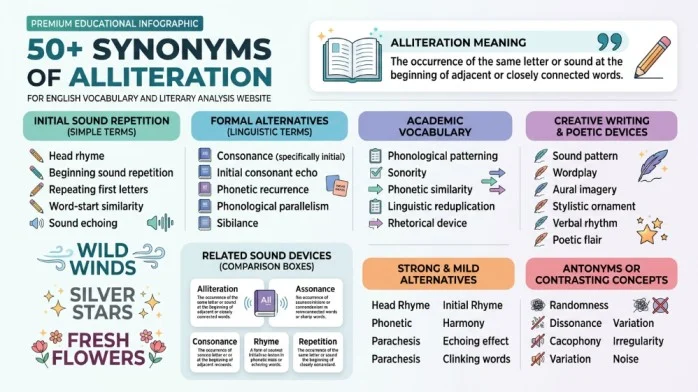
Alliteration refers to the repetition of the same or similar initial consonant sounds in nearby words. Depending on the context, writers may describe it as initial sound repetition, repeated beginning sounds, consonant sound patterning, or use established literary terms such as head rhyme. Understanding these distinctions helps you describe sound patterns accurately instead of treating every form of repetition as alliteration.
What Are the Best Synonyms of “Alliteration”?
The closest alternatives to alliteration include initial consonant repetition, initial sound repetition, repetition of beginning sounds, consonant sound patterning, and head rhyme. For academic writing, use precise terms such as initial consonant repetition. For creative writing, descriptive phrases such as repeated beginning sounds can make explanations easier to understand.
Meaning, Tone, and Context
Simple Definition
Alliteration is the repetition of the same or similar consonant sound at the beginning of nearby words, especially stressed words.
For example:
“Peter Piper picked peppers.”
The repeated initial p sound creates a noticeable sound pattern.
A key point is that alliteration concerns sound, not simply spelling. Two words can begin with different letters and still participate in alliteration if they begin with the same consonant sound.
Part of Speech
Alliteration is a noun.
Example:
“The poet uses alliteration to create a musical effect.”
The related adjective is alliterative.
Example:
“The poem contains several alliterative phrases.”
Overall Tone
The word alliteration is neutral and technical. It does not carry a positive or negative emotional meaning by itself.
The effect of alliteration can be playful, dramatic, memorable, humorous, harsh, gentle, or musical depending on the sounds and context.
Formality Level
Alliteration is a formal and academic literary term. It is appropriate in:
- Literary analysis
- English essays
- Poetry discussions
- Creative writing courses
- Language studies
- Rhetorical analysis
- Classroom instruction
- Professional editing
- Writing guides
In casual conversation, a descriptive phrase such as “repeated beginning sounds” may be easier for a general audience.
Common Uses
Native English speakers and language professionals commonly use alliteration when discussing:
- Poetry
- Songs
- Speeches
- Advertising slogans
- Children’s books
- Fiction
- Headlines
- Brand names
- Creative writing
- Rhetorical techniques
- Literary analysis
Word Forms
| Form | Example |
|---|---|
| Noun | alliteration |
| Adjective | alliterative |
| Related noun | alliterator, less commonly used |
| Related concept | initial consonant repetition |
The most useful form for everyday writing is alliterative.
When and How to Use “Alliteration”
Use alliteration when you need to identify a deliberate or noticeable repetition of initial consonant sounds. It is especially useful when analyzing how a writer creates rhythm, emphasis, memorability, mood, or musical quality.
Professional
“The campaign uses alliteration to make the brand message more memorable.”
Academic
“The poet uses alliteration to reinforce the poem’s rhythmic structure.”
Workplace
“The marketing team considered alliteration when developing the campaign slogan.”
Personal
“I noticed the alliteration in the title because several words begin with the same sound.”
“Please highlight any examples of alliteration in the poem before tomorrow’s discussion.”
Resume
“Analyzed literary devices, including alliteration, metaphor, imagery, and symbolism.”
Social Media
“The repeated initial sounds give this caption a playful alliterative quality.”
Best Synonyms of “Alliteration”
No single alternative replaces alliteration perfectly in every context. Some expressions are established literary labels, while others are descriptive phrases that explain exactly what the technique does.
Professional Writing: Initial Consonant Repetition
Initial consonant repetition is one of the clearest alternatives when accuracy matters.
Example:
“The advertisement uses initial consonant repetition to increase memorability.”
It works well in professional explanations because it describes the mechanism without relying on specialized terminology.
Academic Writing: Initial Sound Repetition
Initial sound repetition is useful in essays and literary analysis when you want to explain alliteration in accessible language.
Example:
“The poet uses initial sound repetition to create a rhythmic effect.”
Business Communication: Repeated Beginning Sounds
When explaining a slogan or marketing phrase to a general audience, repeated beginning sounds is straightforward and easy to understand.
Example:
“The slogan uses repeated beginning sounds to make the phrase easier to remember.”
Casual Conversation: Same Beginning Sounds
In everyday speech, same beginning sounds is more natural than a technical literary term.
Example:
“Those words have the same beginning sounds.”
Emotional Writing: Sound Repetition
Sound repetition can describe the audible pattern without making the explanation overly technical.
Example:
“The sound repetition gives the passage a soft, flowing quality.”
Creative Writing: Alliterative Pattern
Alliterative pattern works well when discussing how a writer deliberately organizes repeated initial sounds.
Example:
“The alliterative pattern gives the poem a lively rhythm.”
Resume Writing: Literary Sound Technique
A professional resume may benefit from the broader phrase literary sound technique when describing knowledge of poetic devices.
Example:
“Applied literary sound techniques in educational and creative writing projects.”
Workplace Communication: Repeated Initial Sounds
Repeated initial sounds is clear when discussing advertising, branding, or content development with people who may not know literary terminology.
Example:
“The headline uses repeated initial sounds to improve recall.”
Stronger Meaning: Deliberate Initial Sound Repetition
Adding deliberate emphasizes intentional use.
Example:
“The writer uses deliberate initial sound repetition to emphasize the central theme.”
Softer Meaning: Similar Beginning Sounds
When you are not certain that a passage meets the strictest definition of alliteration, similar beginning sounds is a safer description.
Example:
“The phrase contains similar beginning sounds that contribute to its rhythm.”
When Not to Use “Alliteration”
When You Mean Any Kind of Sound Repetition
Not every repeated sound is alliteration.
If the repeated sound occurs at the beginning of nearby words, alliteration may be appropriate. If the repetition occurs elsewhere, another literary term may be more accurate.
Less precise:
“The poem uses alliteration because it repeats the vowel sound.”
Better:
“The poem uses assonance because it repeats a vowel sound.”
When You Mean Repeated Ending Sounds
Alliteration should not be used simply because words sound alike at the end.
Less precise:
“Night” and “light” demonstrate alliteration.
Better:
“Night” and “light” demonstrate rhyme because their ending sounds correspond.
When You Mean Repeated Vowel Sounds
Assonance is the more accurate term for repeated vowel sounds.
Example:
“The repetition of the long ‘o’ sound creates assonance.”
When You Mean Repeated Consonants Anywhere in Words
Consonance is broader than alliteration because the repeated consonant sound can occur at the beginning, middle, or end of words.
Example:
“The repeated ‘t’ sound throughout the line creates consonance.”
When You Are Writing for a General Audience
The term alliteration may be too technical if your readers are unfamiliar with literary devices.
Instead, explain it first:
“The writer repeats the same beginning consonant sound in several nearby words.”
This approach improves accessibility without sacrificing accuracy.
Words Commonly Confused With “Alliteration”
| Word | Difference | When to Use It | Example |
|---|---|---|---|
| Assonance | Repetition of vowel sounds. | When vowels create a recurring sound pattern. | “The repeated long ‘a’ sound creates assonance.” |
| Consonance | Repetition of consonant sounds anywhere in words. | When consonants repeat beyond the beginning position. | “The repeated ‘k’ sound creates consonance.” |
| Rhyme | Similarity between ending sounds. | Poetry and verse with matching end sounds. | “The final words rhyme.” |
| Onomatopoeia | A word imitates or suggests a real sound. | Sound-imitating vocabulary. | “Buzz” is an example of onomatopoeia. |
| Repetition | A broad term for deliberately repeating words, phrases, sounds, or ideas. | When the repeated element is not limited to initial consonants. | “The repeated phrase emphasizes the speaker’s frustration.” |
| Parallelism | Repetition of similar grammatical or structural patterns. | Speeches, essays, and persuasive writing. | “She came, she saw, she conquered” uses parallel structure. |
Best Synonyms of “Alliteration” by Context
| ContextBest Synonym or AlternativeWhy It WorksExample | |||
|---|---|---|---|
| Formal writing | Initial consonant repetition | Precise and explanatory | “Initial consonant repetition strengthens the phrase.” |
| Academic writing | Initial sound repetition | Clear for literary analysis | “Initial sound repetition creates rhythm.” |
| Professional communication | Repeated initial sounds | Easy for general readers | “Repeated initial sounds improve slogan recall.” |
| Business emails | Alliterative pattern | Concise and professional | “The alliterative pattern makes the headline memorable.” |
| Resume writing | Literary sound technique | Shows broader writing knowledge | “Used literary sound techniques in content projects.” |
| Workplace communication | Repeated beginning sounds | Easy to understand | “The headline uses repeated beginning sounds.” |
| Casual conversation | Same beginning sounds | Natural and simple | “Those words have the same beginning sounds.” |
| Everyday speaking | Similar beginning sounds | Avoids unnecessary technicality | “The phrase has similar beginning sounds.” |
| Creative writing | Alliterative pattern | Highlights deliberate construction | “The alliterative pattern adds energy.” |
| Storytelling | Repeated initial sounds | Explains the effect clearly | “Repeated initial sounds make the character’s name memorable.” |
| Emotional writing | Sound repetition | Focuses on auditory effect | “The sound repetition gives the passage a gentle mood.” |
| Strong emphasis | Deliberate initial sound repetition | Highlights intentional technique | “The writer uses deliberate initial sound repetition.” |
| Mild tone | Similar beginning sounds | Avoids overstating the technique | “The phrase has similar beginning sounds.” |
| Social media captions | Alliterative phrase | Short and recognizable | “Fresh Friday” is an alliterative phrase. |
| American English | Alliteration | Standard literary term | “The poem uses alliteration effectively.” |
| British English | Alliteration | The standard term is also used | “The poet uses alliteration throughout the verse.” |
How to Choose the Best Synonym of “Alliteration”
Choosing an alternative depends primarily on accuracy and audience.
Choose Based on Meaning
- If you are identifying the literary device itself, use alliteration.
If you are explaining the mechanism, use initial consonant repetition or initial sound repetition.
If you are speaking to a general audience, repeated beginning sounds may be clearer.
Choose Based on Tone
Academic writing benefits from technical precision:
“The poem demonstrates initial consonant repetition.”
A casual explanation can be simpler:
“The writer repeats the same beginning sound.”
Choose Based on Audience
A literature professor will understand alliteration immediately.
A social media audience may respond better to:
“Notice how several words begin with the same sound.”
The second version communicates the idea without requiring literary terminology.
Choose Based on Emotional Strength
Alliteration itself is not inherently emotional. Its effect depends on the sounds selected and the surrounding language.
For example, repeated soft sounds may create a gentle mood, while repeated hard consonants may contribute to a sharper or more forceful effect.
Choose Based on Writing Purpose
- For literary analysis, choose alliteration or initial consonant repetition.
- For teaching, use alliteration followed by a simple explanation.
For marketing, alliterative phrase or repeated initial sounds may be more useful.
For creative writing, alliterative pattern can emphasize deliberate sound design.
Choose Based on Natural Usage
Do not replace alliteration with an unfamiliar phrase simply to avoid repetition. If the technical term is the clearest choice, use it.
A strong vocabulary is not about avoiding the same word at all costs. It is about choosing the most accurate word for the situation.
Real Life Examples of “Alliteration”
School
Basic:
“The poem uses alliteration.”
Improved:
“The poem uses alliteration to make the opening line more rhythmic.”
College
“The writer’s use of initial consonant repetition reinforces the poem’s energetic tone.”
Workplace
“The marketing team used repeated initial sounds to make the campaign slogan easier to remember.”
Business
“The brand name uses an alliterative pattern that gives it a distinctive sound.”
“The attached analysis identifies several examples of alliteration in the selected poem.”
Resume
“Analyzed literary devices, including alliteration, imagery, metaphor, and symbolism.”
Conversation
“Those words start with the same sound, so the phrase has an alliterative quality.”
Storytelling
“The repeated ‘s’ sounds create a smooth, almost whispered rhythm in the scene.”
Blogging
“Alliteration can make headlines more memorable when the repeated sounds feel natural.”
Social Media
“Sunny Saturday” uses alliteration because both words begin with the same consonant sound.
22 Best Synonyms of “Alliteration”
Because alliteration is a technical literary term, it has fewer exact one word synonyms than ordinary adjectives such as happy or important. The following table therefore includes established alternative labels and precise descriptive expressions that can accurately explain the concept.
| Synonym or Alternative | Simple Meaning | Best Used For | Example Sentence |
|---|---|---|---|
| Initial consonant repetition | Repeating consonant sounds at word beginnings | Academic writing | “The poem uses initial consonant repetition for emphasis.” |
| Initial sound repetition | Repeating sounds at the beginnings of words | Teaching and essays | “Initial sound repetition gives the line a musical quality.” |
| Repeated initial sounds | The same starting sounds appear repeatedly | General explanations | “The repeated initial sounds make the slogan memorable.” |
| Repeated beginning sounds | Similar sounds recur at word beginnings | Beginners | “The phrase contains repeated beginning sounds.” |
| Repetition of initial sounds | A descriptive explanation of alliteration | Academic analysis | “The repetition of initial sounds creates rhythm.” |
| Repetition of beginning sounds | Repeated sounds at the start of words | Educational content | “The repetition of beginning sounds adds emphasis.” |
| Consonant sound repetition | Repeated consonant sounds | Linguistic explanations | “Consonant sound repetition shapes the line’s rhythm.” |
| Initial phoneme repetition | Repetition of starting speech sounds | Linguistics | “Initial phoneme repetition is noticeable throughout the verse.” |
| Initial consonantal patterning | An organized pattern of starting consonants | Literary analysis | “Initial consonantal patterning strengthens the passage.” |
| Consonantal sound patterning | Organized repetition of consonant sounds | Advanced analysis | “Consonantal sound patterning contributes to the poem’s texture.” |
| Sound patterning | Deliberate organization of recurring sounds | Creative writing | “The sound patterning gives the stanza a distinctive character.” |
| Sound repetition | Repeated sounds used for an effect | General writing | “Sound repetition makes the phrase more memorable.” |
| Beginning sound repetition | Recurring sounds at the beginning of words | Teaching | “Beginning sound repetition is easy to hear aloud.” |
| Repeated consonant beginnings | Recurring consonant sounds at word starts | Explanatory writing | “Repeated consonant beginnings add rhythm to the slogan.” |
| Alliterative pattern | A pattern created through alliteration | Literary analysis | “The alliterative pattern reinforces the poem’s mood.” |
| Alliterative phrase | A phrase containing alliteration | Creative and marketing writing | “Fresh flowers” forms an alliterative phrase. |
| Alliterative expression | An expression built around repeated initial sounds | Writing discussions | “The title uses an alliterative expression.” |
| Alliterative wording | Word choice that creates alliteration | Editing and copywriting | “The editor replaced the phrase with more alliterative wording.” |
| Head rhyme | A traditional term associated with repeated initial sounds | Poetry and literary studies | “The poet uses head rhyme to strengthen the line’s rhythm.” |
| Initial rhyme | A term sometimes used for repeated initial sounds | Historical or specialized literary discussion | “The passage displays initial rhyme through its recurring opening sounds.” |
| Initial sound pattern | A recurring pattern at the beginning of words | General literary analysis | “The initial sound pattern creates cohesion.” |
| Consonantal repetition at word beginnings | A precise descriptive phrase for the technique | Formal explanation | “Consonantal repetition at word beginnings creates a strong rhythmic effect.” |
Accuracy note: Terms such as assonance, consonance, and rhyme are related sound devices, but they are not interchangeable synonyms for alliteration. They should be used only when the sound pattern actually matches their definitions.
Synonyms of “Alliteration” by Usage
Professional vs Personal Synonyms
In professional settings, clarity matters more than stylistic variation. Initial consonant repetition, repeated initial sounds, and alliterative pattern are useful when discussing branding, advertising, editing, or content strategy.
In personal conversation, a simpler explanation often sounds more natural:
“The words start with the same sound.”
For general audiences, explaining the concept is often more effective than using a technical term repeatedly.
Formal vs Conversational Synonyms
Reports
Use:
Initial consonant repetition
“Initial consonant repetition contributes to the rhetorical structure of the passage.”
Essays
Use:
Alliteration or initial sound repetition
“The poet uses alliteration to reinforce the poem’s rhythm.”
Business Writing
Use:
Alliterative pattern
“The campaign title uses an alliterative pattern.”
Presentations
Use:
Repeated initial sounds
“Notice the repeated initial sounds in the slogan.”
Emails
Use:
Alliteration
“The poem contains several examples of alliteration.”
Casual Conversations
Use:
Same beginning sounds
“Those words have the same beginning sounds.”
Texting
Use:
Same starting sound
“That title has the same starting sound in each word.”
Academic Synonyms
Academic writing requires precision. The safest choice is usually alliteration, especially when identifying a recognized literary device.
When you want to explain the mechanism, use initial consonant repetition.
Research
“The analysis identifies initial consonant repetition as a recurring phonological feature.”
Essays
“Alliteration contributes to the poem’s rhythm and memorability.”
Reports
“The repeated initial sounds reinforce the author’s use of sound symbolism.”
Academic Discussions
“Unlike consonance, alliteration specifically emphasizes repetition at the beginning of nearby words.”
These choices sound authoritative because they distinguish alliteration from related sound devices rather than treating them as identical.
Professional and Business Synonyms
Resumes
Use alliteration, alliterative writing, or literary sound techniques when describing relevant writing skills.
“Applied literary sound techniques in creative and educational content.”
Interviews
If asked about literary techniques, say:
“Alliteration is the repetition of initial consonant sounds, often used to create rhythm or emphasis.”
Meetings
For general business audiences:
“The repeated initial sounds make the slogan easier to remember.”
Presentations
“The brand name uses an alliterative pattern.”
Performance Reviews
“Demonstrated strong command of language, including rhetorical and sound techniques.”
Client Communication
Avoid unnecessary terminology unless the client is discussing writing or branding.
Instead of:
“The phrase demonstrates initial phoneme repetition.”
Prefer:
“The repeated starting sounds make the phrase more memorable.”
Business Emails
Use the standard term when it is relevant:
“I identified several examples of alliteration in the proposed campaign copy.”
Creative and Literary Synonyms
Creative writers can use alliterative pattern, alliterative phrase, and sound patterning when discussing the artistic effect of repeated sounds.
Storytelling
Alliteration can create rhythm or make character names memorable.
“Peter Parker” is memorable partly because of its repeated initial sound pattern.
Fiction
“The soft sound repetition gives the description a calmer mood.”
Poetry
“The alliterative pattern creates a strong rhythmic pulse.”
Poetry Analysis
“The poet’s repeated initial consonants draw attention to key words.”
Speeches
Alliteration can make a phrase easier to remember.
“The speaker uses repeated beginning sounds to give the phrase rhetorical force.”
Slang or Modern Synonyms
There is no widely accepted slang synonym for alliteration in standard American English.
Expressions such as same starting sound or same beginning sound are informal explanations, not slang.
Acceptable
“Those words have the same starting sound.”
Avoid
Do not invent expressions and present them as established literary terminology.
For schoolwork, professional writing, and literary analysis, alliteration remains the safest standard term.
Strongest to Mildest Synonyms
Alliteration itself does not have a fixed emotional intensity scale because it describes a sound pattern rather than the strength of an emotion.
However, descriptive alternatives can vary in how strongly they identify the technique.
| Level | Useful Expression | Effect |
|---|---|---|
| Mild | Similar beginning sounds | Suggests a possible sound relationship |
| Mild | Similar initial sounds | Describes similarity without making a strong technical claim |
| Moderate | Repeated beginning sounds | Clearly identifies recurring sounds |
| Moderate | Repeated initial sounds | More precise description |
| Strong | Initial sound repetition | Clearly identifies the technique’s structure |
| Strong | Initial consonant repetition | Highly precise description |
| Very Strong | Deliberate initial consonant repetition | Emphasizes intentional use |
The strongest wording should be reserved for situations where the sound pattern is clearly deliberate and identifiable.
Emotional vs Neutral Synonyms
Emotional Synonyms and Alternatives
Alliteration itself is neutral, but its effect can become emotional depending on the sounds and surrounding words.
Useful descriptive expressions include:
- Expressive sound pattern
- Musical sound repetition
- Rhythmic sound pattern
- Evocative sound repetition
- Dramatic alliterative pattern
Example:
“The repeated ‘s’ sounds create an almost soothing effect.”
Neutral Synonyms and Alternatives
For objective analysis, use:
- Alliteration
- Initial consonant repetition
- Initial sound repetition
- Repeated initial sounds
- Alliterative pattern
- Consonant sound patterning
Example:
“The passage contains repeated initial consonant sounds.”
Neutral terminology is usually preferable in academic writing because it separates the observable technique from your interpretation of its emotional effect.
Antonyms of “Alliteration”
Alliteration is a literary technique, so it does not have true antonyms in the same way ordinary adjectives do. The following terms represent contrasting or non-alliterative approaches rather than strict dictionary opposites.
| Contrasting Term | Meaning | Example Sentence |
|---|---|---|
| Nonalliterative wording | Wording without intentional alliteration | “The revised sentence uses nonalliterative wording.” |
| Plain wording | Direct language without deliberate sound patterning | “The report uses plain wording.” |
| Nonrepetitive wording | Language without deliberate repeated elements | “The editor chose nonrepetitive wording.” |
| Varied initial sounds | Different starting sounds rather than repetition | “The sentence uses varied initial sounds.” |
| Irregular sound pattern | A sound arrangement without a clear repeated pattern | “The prose has an irregular sound pattern.” |
| Neutral phrasing | Wording without deliberate stylistic emphasis | “The instructions use neutral phrasing.” |
| Unpatterned language | Language without a noticeable sound structure | “The paragraph uses unpatterned language.” |
| Direct expression | Straightforward wording without ornamental sound effects | “The writer favors direct expression.” |
| Prosaic wording | Ordinary language without strong poetic effects | “The explanation uses prosaic wording.” |
| Nonmusical phrasing | Wording without deliberate musical sound effects | “The technical report uses nonmusical phrasing.” |
| Literal expression | Direct communication without sound-based ornament | “The author uses literal expression in the introduction.” |
| Unadorned language | Simple wording without stylistic decoration | “The manual uses unadorned language.” |
| Ordinary phrasing | Common wording without special sound effects | “The article uses ordinary phrasing.” |
| Varied consonant sounds | Different consonants at word beginnings | “The sentence contains varied consonant sounds.” |
| Lack of sound patterning | Absence of deliberate recurring sound structure | “The passage shows a lack of sound patterning.” |
These are contrasting descriptions, not strict antonyms. There is no universally recognized opposite literary device called the “antonym of alliteration.”
Comparison: “Alliteration” vs Similar Words
Alliteration vs Assonance
Main Difference
Alliteration repeats initial consonant sounds, while assonance repeats vowel sounds within nearby words.
Which Is Stronger?
Neither is inherently stronger. They describe different sound patterns.
Which Is More Formal?
Both are standard literary terms and work well in academic writing.
When to Use Each
Use alliteration for repeated beginning consonant sounds.
Use assonance for repeated vowel sounds.
Examples
Alliteration:
“Wild winds whispered.”
Assonance:
“The rain stayed late.”
The second example emphasizes recurring vowel sounds rather than initial consonants.
Alliteration vs Consonance
Main Difference
Alliteration generally focuses on repeated consonant sounds at the beginning of nearby words. Consonance can occur at the beginning, middle, or end.
Which Is Stronger?
Neither is stronger.
Which Is More Formal?
Both are suitable for literary analysis.
When to Use Each
Use alliteration when position at the beginning is important.
Use consonance when consonant repetition occurs more broadly.
Examples
Alliteration:
“Bright birds burst upward.”
Consonance:
“The blank trunk sank.”
Alliteration vs Rhyme
Main Difference
Alliteration concerns initial sounds, while rhyme usually involves corresponding ending sounds.
Which Is Stronger?
Neither.
Which Is More Formal?
Both are established literary terms.
When to Use Each
Use rhyme when words share relevant ending sounds.
Use alliteration when initial consonant sounds repeat.
Examples
Alliteration:
“Silver stars shine.”
Rhyme:
“Light” and “night.”
Alliteration vs Repetition
Main Difference
Repetition is a broad category. It can involve words, phrases, sounds, ideas, or grammatical structures. Alliteration is a specific type of sound-based repetition.
Which Is Stronger?
Alliteration is more specific.
Which Is More Formal?
Both are common in literary analysis.
When to Use Each
Use repetition when the repeated element is broad or unspecified.
Use alliteration when initial consonant sounds repeat.
Examples
Alliteration:
“Wild winds wandered.”
Repetition:
“Never give up, never give in.”
Alliteration vs Onomatopoeia
Main Difference
Alliteration repeats initial sounds, while onomatopoeia uses words that imitate or strongly suggest real sounds.
Which Is Stronger?
Neither.
Which Is More Formal?
Both are standard literary terms.
When to Use Each
Use onomatopoeia for sound-imitating words such as “buzz,” “hiss,” or “clang.”
Use alliteration for repeated initial sounds.
Examples
Alliteration:
“Buzzing bees bounced between blossoms.”
Onomatopoeia:
“The bees buzzed nearby.”
Alliteration vs Parallelism
Main Difference
Parallelism repeats grammatical or structural patterns, while alliteration repeats initial consonant sounds.
Which Is Stronger?
Neither. They operate at different levels of language.
Which Is More Formal?
Both are common in rhetorical and academic analysis.
When to Use Each
Use parallelism for repeated sentence structures.
Use alliteration for repeated initial sounds.
Examples
Alliteration:
“She sings softly.”
Parallelism:
“She came to learn, to grow, and to lead.”
Common Phrases and Expressions with “Alliteration”
Phrase: Use Alliteration
Meaning: Deliberately include repeated initial sounds.
Example Sentence:
“The copywriter decided to use alliteration in the campaign headline.”
Phrase: An Example of Alliteration
Meaning: A phrase or sentence demonstrating the literary technique.
Example Sentence:
“Fresh flowers is a simple example of alliteration.”
Phrase: Alliterative Phrase
Meaning: A group of words containing repeated initial consonant sounds.
Example Sentence:
“Wild winds is an alliterative phrase.”
Phrase: Alliterative Effect
Meaning: The rhythmic, memorable, or stylistic result created by alliteration.
Example Sentence:
“The alliterative effect makes the slogan easier to remember.”
Phrase: Alliterative Pattern
Meaning: A recurring structure of initial sound repetition.
Example Sentence:
“The poem develops an alliterative pattern across several lines.”
Phrase: Alliterative Device
Meaning: Alliteration considered as a literary or rhetorical technique.
Example Sentence:
“The author uses the alliterative device to emphasize key phrases.”
Phrase: Strong Alliteration
Meaning: Noticeable or repeated initial sound patterning.
Example Sentence:
“The opening stanza contains strong alliteration.”
Common Mistakes to Avoid
1. Confusing Letters With Sounds
Incorrect:
“Alliteration always means using the same first letter.”
Better:
“Alliteration involves repetition of initial sounds.”
Why:
Alliteration is based on sound, not simply visual spelling.
2. Calling Assonance Alliteration
Incorrect:
“The repeated vowel sounds are an example of alliteration.”
Better:
“The repeated vowel sounds are an example of assonance.”
Why:
Assonance specifically concerns repeated vowel sounds.
3. Calling Every Repeated Consonant Alliteration
Incorrect:
“The repeated consonant sounds anywhere in the words are alliteration.”
Better:
“The repeated consonant sounds create consonance.”
Why:
Consonance can occur throughout words, whereas alliteration emphasizes initial sounds.
4. Using “Rhyme” as a Synonym
Incorrect:
“Night and light demonstrate alliteration.”
Better:
“Night and light demonstrate rhyme.”
Why:
The matching sound occurs at the ends of the words.
5. Overstating a Weak Sound Pattern
Incorrect:
“Every repeated sound proves that the writer deliberately used alliteration.”
Better:
“The repeated beginning sounds may contribute to an alliterative effect.”
Why:
Not every recurring sound pattern is necessarily a deliberate literary device.
6. Using Technical Terms Without Explanation
Incorrect:
“The poem contains initial phoneme repetition.”
Better:
“The poem contains initial phoneme repetition, meaning several nearby words begin with the same consonant sound.”
Why:
The second version helps general readers understand the terminology.
7. Avoiding “Alliteration” Just to Sound More Sophisticated
Incorrect:
“The poem uses consonantal sound patterning at word beginnings.”
Better:
“The poem uses alliteration.”
Why:
The standard literary term is often clearer than a complicated replacement.
Frequently Asked Questions
1. What are the best synonyms of “alliteration”?
The best alternatives include initial consonant repetition, initial sound repetition, repeated initial sounds, repeated beginning sounds, and alliterative pattern. These expressions describe the technique without incorrectly treating related devices as synonyms.
2. What are the best formal synonyms of “alliteration”?
For formal or academic writing, initial consonant repetition, initial sound repetition, and alliterative pattern are useful alternatives. However, alliteration remains the clearest standard literary term when identifying the device itself.
3. What are common informal synonyms of “alliteration”?
There are no widely established informal synonyms for alliteration. For general audiences, simple expressions such as same beginning sounds, same starting sounds, or repeated beginning sounds explain the concept naturally.
4. What is another word for “alliteration” in professional writing?
In professional writing, initial consonant repetition is a precise alternative. For marketing or branding discussions, alliterative pattern or repeated initial sounds may be clearer for readers who are unfamiliar with literary terminology.
5. What is the difference between “alliteration” and “assonance”?
Alliteration repeats initial consonant sounds in nearby words, while assonance repeats vowel sounds. For example, “wild winds” demonstrates alliteration, while recurring vowel sounds within nearby words can demonstrate assonance.
6. What is the opposite of “alliteration”?
Alliteration does not have a true dictionary antonym because it is a literary technique. However, nonalliterative wording, varied initial sounds, and unpatterned language can describe writing that does not deliberately use alliteration.
Conclusion
Alliteration is the repetition of initial consonant sounds in nearby words, often used to create rhythm, emphasis, musicality, or memorability. Although the term has fewer true synonyms than many ordinary vocabulary words, expressions such as initial consonant repetition, initial sound repetition, repeated beginning sounds, and alliterative pattern can explain the concept accurately in different contexts.
For academic writing, alliteration and initial consonant repetition are usually the strongest choices. For general readers, repeated beginning sounds is easier to understand, while creative and marketing discussions may benefit from terms such as alliterative phrase or alliterative pattern.
The most important vocabulary tip is to choose precision over unnecessary variation. When a standard literary term communicates your meaning perfectly, keep it. Use an alternative only when it makes the explanation clearer for your audience. Understanding the difference between synonyms of alliteration, related sound devices, and descriptive alternatives will make literary analysis more accurate and your writing more confident.
Read More Related Articles:
50+ Synonyms of Because | Meanings, Uses, Examples, and …
50+ Synonyms of The | Meanings, Uses, Examples, and Best …