When students, writers, or English learners encounter pneumonoultramicroscopicsilicovolcanoconiosis, the first challenge is usually spelling and pronunciation. The second is finding a simpler way to describe the same idea without repeating an exceptionally long word.
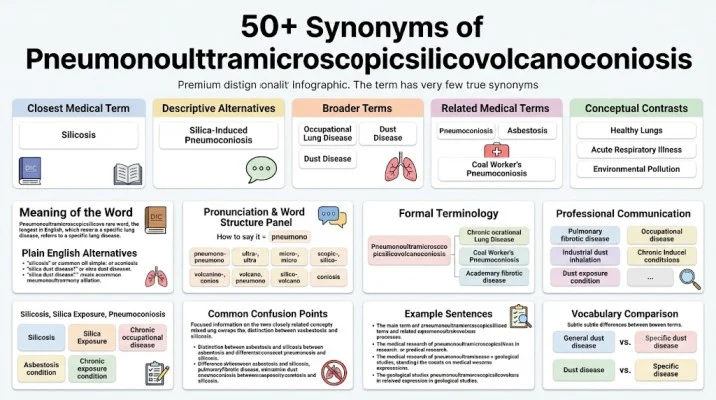
The search for synonyms of pneumonoultramicroscopicsilicovolcanoconiosis needs one important clarification: this is an unusually specialized term, and it does not have dozens of true interchangeable synonyms. The closest established medical term is silicosis, while expressions such as silica related lung disease and silica induced pneumoconiosis describe the condition more plainly or broadly. Merriam Webster defines the term as a pneumoconiosis caused by inhaling very fine silicate or quartz dust.
For accurate writing, the goal should therefore be precision rather than creating an artificial list of synonyms. The guide below separates true equivalents from broader medical terms, descriptive alternatives, and related conditions so you can choose wording that is both natural and medically responsible.
What Are the Best Synonyms of “Pneumonoultramicroscopicsilicovolcanoconiosis”?
The closest practical synonym for pneumonoultramicroscopicsilicovolcanoconiosis is silicosis, a lung disease caused by inhaling respirable crystalline silica. In formal or medical writing, silicosis is usually preferable. Descriptive alternatives include silica related lung disease and silica induced pneumoconiosis, but broader terms such as pneumoconiosis are not exact equivalents.
Meaning, Tone, and Context
Simple Definition
Pneumonoultramicroscopicsilicovolcanoconiosis is a noun referring to a lung disease associated with inhaling extremely fine silicate or quartz dust. Merriam Webster defines it specifically as a type of pneumoconiosis caused by inhaling very fine silicate or quartz dust.
Cambridge describes the word as an invented name for a lung disease caused by breathing in very small particles of ash or dust and notes its connection with the extremely long word phenomenon.
In practical modern medical communication, silicosis is the much more useful term. MedlinePlus defines silicosis as a lung disease caused by inhaling silica dust.
Part of Speech
Pneumonoultramicroscopicsilicovolcanoconiosis is a noun.
It is an uncountable medical noun, although the plural form listed by Merriam Webster is pneumonoultramicroscopicsilicovolcanoconioses.
Overall Tone
The word has a highly technical, medical, specialized, and unusual tone.
It is not normally appropriate for ordinary conversation. Its enormous length also makes it more noticeable as a vocabulary curiosity than as a practical everyday medical term.
Formality Level
The word is technically formal and specialized, but that does not automatically make it the best choice for professional writing.
For most medical, workplace, educational, and public health contexts, silicosis is clearer and more efficient.
Common Uses
The full word is most likely to appear in:
- Vocabulary articles
- Spelling discussions
- Language lessons
- Long word lists
- Dictionary discussions
- Word puzzles
- English learning content
- Linguistic discussions
- Educational examples
For actual health communication, silicosis is the more useful term.
Word Forms
| Form | Word |
|---|---|
| Noun | pneumonoultramicroscopicsilicovolcanoconiosis |
| Plural noun | pneumonoultramicroscopicsilicovolcanoconioses |
| Closest medical term | silicosis |
| Broader category | pneumoconiosis |
When and How to Use “Pneumonoultramicroscopicsilicovolcanoconiosis”
The full word should be used carefully because it is extremely specialized and cumbersome. If your purpose is to discuss the famous long word itself, the term is appropriate. If your purpose is to communicate medical information clearly, silicosis is usually the better choice.
Professional
Example:
“The article explains why pneumonoultramicroscopicsilicovolcanoconiosis is rarely the preferred term in modern workplace health communication.”
Academic
Example:
“Students examined pneumonoultramicroscopicsilicovolcanoconiosis as an example of an exceptionally long English word.”
Workplace
Example:
“Employees should understand the health risks associated with respirable silica exposure, including silicosis.”
Personal
Example:
“I first learned the word pneumonoultramicroscopicsilicovolcanoconiosis in an English vocabulary class.”
Example:
“For clarity, I have used the term silicosis rather than pneumonoultramicroscopicsilicovolcanoconiosis throughout the report.”
Resume
The full word is generally not a useful resume choice unless your work specifically involves vocabulary, linguistics, medical terminology, or education.
Better example:
“Developed educational materials explaining specialized medical vocabulary.”
Social Media
Example:
“Pneumonoultramicroscopicsilicovolcanoconiosis is one of those words that looks almost impossible to spell.”
Best Synonyms of “Pneumonoultramicroscopicsilicovolcanoconiosis”
A major distinction is necessary here. Unlike ordinary adjectives such as happy or important, this word does not have 20 or 50 true interchangeable synonyms.
Best Choice for Medical Writing: Silicosis
Silicosis is the closest established medical equivalent and the best practical replacement in most contexts.
The CDC describes silicosis as an occupational lung disease caused by inhalation of respirable dust containing crystalline silica.
Example:
“The worker developed silicosis after prolonged exposure to crystalline silica dust.”
Best Choice for General Readers: Silica Related Lung Disease
This phrase is easier for non specialists to understand.
Example:
“The article discusses silica related lung disease and ways to reduce workplace exposure.”
Best Choice for Technical Writing: Silica Induced Pneumoconiosis
This phrase clearly identifies the disease as a type of pneumoconiosis associated with silica exposure.
Example:
“The researchers examined cases of silica induced pneumoconiosis among exposed workers.”
Best Choice for a Broad Category: Pneumoconiosis
Pneumoconiosis is a broader category of dust related lung diseases. It should not normally be treated as a perfect synonym for the much more specific condition. CDC sources describe silicosis as a form of pneumoconiosis.
Best Choice for Educational Writing: Silicosis
For students and general English learners, silicosis is by far the clearest practical alternative.
When Not to Use “Pneumonoultramicroscopicsilicovolcanoconiosis”
When the Word Is Too General
Interestingly, the problem here is almost the opposite of being too general. The word is extremely specific and technical.
Less Practical:
“The worker has pneumonoultramicroscopicsilicovolcanoconiosis.”
Better:
“The worker has silicosis.”
When the Word Is Too Vague
The long word can actually create confusion because many readers will not recognize it.
Less Clear:
“The study discusses pneumonoultramicroscopicsilicovolcanoconiosis.”
Better:
“The study discusses silicosis caused by crystalline silica exposure.”
When the Word Is Too Formal
In patient education, public communication, and general health writing, the full word can distract readers.
Better:
Use silicosis and explain it in plain language.
When the Word Is Too Informal
This is not normally an issue. The word is not informal. It is highly technical and unusual.
When the Word Is Too Weak
The word itself is not weak. Its problem is readability.
If you need to emphasize seriousness, describe the actual medical condition rather than choosing a longer word.
Better:
“Silicosis is a serious occupational lung disease caused by inhaling crystalline silica dust.”
When the Word Is Too Strong
Again, the issue is not emotional strength. The word describes a specific condition and should not be replaced with an emotionally dramatic term.
When the Word Is Outdated
It is better to say that the term is uncommon or specialized, rather than simply calling it outdated. Modern medical sources use silicosis extensively. MedlinePlus, CDC, and NIOSH materials consistently use silicosis for the disease.
Words Commonly Confused With “Pneumonoultramicroscopicsilicovolcanoconiosis”
Silicosis
Difference:
Silicosis is the established medical term for a lung disease caused by inhaling crystalline silica dust.
When to Use It:
Use it for medical, workplace safety, educational, and professional communication.
Example:
“Workers exposed to respirable crystalline silica can develop silicosis.”
Pneumoconiosis
Difference:
Pneumoconiosis is a broader category covering lung diseases caused by inhaling mineral or other dust particles. Silicosis is one form.
When to Use It:
Use it when discussing dust related lung diseases as a group.
Example:
“Silicosis is one type of pneumoconiosis.”
Black Lung Disease
Difference:
Black lung disease generally refers to coal workers’ pneumoconiosis caused by coal dust exposure. It should not be casually substituted for silicosis.
When to Use It:
Use it when specifically discussing coal dust related lung disease.
Example:
“Coal workers can develop black lung disease after prolonged coal dust exposure.”
MedlinePlus distinguishes black lung disease from silicosis and identifies each as a different dust related lung condition.
Asbestosis
Difference:
Asbestosis is associated with inhaling asbestos fibers, not crystalline silica.
When to Use It:
Use it only when discussing asbestos related lung disease.
Example:
“Long term asbestos exposure can cause asbestosis.”
Silicoproteinosis
Difference:
Silicoproteinosis is associated with acute silicosis and represents a particular clinical form rather than a general replacement for the full long word.
When to Use It:
Use it in specialized medical discussions involving acute disease.
Example:
“Acute silicosis may present as silicoproteinosis.”
CDC materials identify silicoproteinosis as an acute form of silicosis.
Best Synonyms of “Pneumonoultramicroscopicsilicovolcanoconiosis” by Context
| Context | Best Synonym or Alternative | Why It Works | Example |
|---|---|---|---|
| Formal writing | Silicosis | Established and concise | “Silicosis can result from silica exposure.” |
| Academic writing | Silicosis | Precise medical terminology | “The study investigated silicosis among workers.” |
| Professional communication | Silicosis | Clear to professional audiences | “The training covers silicosis prevention.” |
| Business emails | Silicosis | Easier for readers to understand | “The report addresses silicosis risks.” |
| Resume writing | Silica exposure or silicosis | Concise and professional | “Educated workers about silica exposure.” |
| Workplace communication | Silicosis | Clear occupational health terminology | “Silicosis is a recognized workplace hazard.” |
| Casual conversation | Silicosis | Much easier to understand | “Silicosis is a lung disease caused by silica dust.” |
| Everyday speaking | Silica related lung disease | Plain and descriptive | “The worker developed a silica related lung disease.” |
| Creative writing | Extremely rare long medical word | Useful when the word itself matters | “He struggled to pronounce the enormous medical word.” |
| Storytelling | Silicosis | Keeps the story understandable | “The miner eventually developed silicosis.” |
| Emotional writing | Serious silica related lung disease | Makes the health impact clear | “The disease changed his ability to breathe.” |
| Strong emphasis | Serious silicosis | Describes severity without inventing a synonym | “The patient had serious complications from silicosis.” |
| Mild tone | Silica related lung condition | Less technical for general readers | “The article explains silica related lung conditions.” |
| Social media captions | Silicosis | Short and recognizable | “Silicosis is a serious risk of silica exposure.” |
| American English | Silicosis | Standard medical term | “Silicosis is linked to crystalline silica exposure.” |
| British English | Silicosis | Also widely recognized | “Silicosis is an occupational lung disease.” |
How to Choose the Best Synonym of “Pneumonoultramicroscopicsilicovolcanoconiosis”
The easiest way to choose the right alternative is to ask what your reader actually needs.
If You Need Medical Precision
Choose silicosis.
It is concise, established, and directly communicates the relevant disease.
If You Need a General Explanation
Choose silica related lung disease.
This phrase is more accessible to people without medical training.
If You Need a Technical Description
Choose silica induced pneumoconiosis when the broader classification matters.
If You Are Discussing Dust Diseases Generally
Choose pneumoconiosis, but remember that it is broader than silicosis.
If You Are Discussing the Word Itself
Use the full word.
For example:
“Pneumonoultramicroscopicsilicovolcanoconiosis is famous because of its extraordinary length.”
If You Are Writing for Patients
Prefer plain language.
“Silicosis is lung damage caused by breathing in silica dust.”
If You Are Writing for Researchers
Use established terminology such as silicosis, crystalline silica exposure, and silica induced pneumoconiosis, depending on the specific subject.
Real Life Examples of “Pneumonoultramicroscopicsilicovolcanoconiosis”
School
Original:
“Pneumonoultramicroscopicsilicovolcanoconiosis is a very long word.”
Improved:
“Pneumonoultramicroscopicsilicovolcanoconiosis is an unusually long English medical term.”
College
Original:
“The professor explained pneumonoultramicroscopicsilicovolcanoconiosis.”
Improved:
“The professor used pneumonoultramicroscopicsilicovolcanoconiosis to illustrate specialized medical vocabulary.”
Workplace
Original:
“The company discussed pneumonoultramicroscopicsilicovolcanoconiosis.”
Improved:
“The company provided training about silica exposure and silicosis.”
Business
Original:
“The business report mentioned pneumonoultramicroscopicsilicovolcanoconiosis.”
Improved:
“The business report addressed occupational silicosis and silica exposure.”
Original:
“We need to discuss pneumonoultramicroscopicsilicovolcanoconiosis.”
Improved:
“We need to discuss the risks of silicosis associated with silica exposure.”
Resume
Original:
“Knowledge of pneumonoultramicroscopicsilicovolcanoconiosis.”
Improved:
“Knowledge of occupational silica exposure and related respiratory health risks.”
Conversation
Original:
“Do you know pneumonoultramicroscopicsilicovolcanoconiosis?”
Improved:
“Have you ever heard of silicosis?”
Storytelling
Original:
“He proudly pronounced pneumonoultramicroscopicsilicovolcanoconiosis.”
Improved:
“He proudly attempted to pronounce the famously long medical word.”
Blogging
Original:
“Pneumonoultramicroscopicsilicovolcanoconiosis is an interesting word.”
Improved:
“Pneumonoultramicroscopicsilicovolcanoconiosis is an unusual example of extremely long English vocabulary.”
Social Media
Original:
“I finally spelled pneumonoultramicroscopicsilicovolcanoconiosis correctly!”
Improved:
“I finally spelled one of English’s most famous long words correctly!”
20 Best Synonyms and Related Alternatives
A medically accurate article should not pretend that 20 exact synonyms exist for this specialized term. The closest exact practical equivalent is silicosis. The table below therefore separates the closest synonym from descriptive alternatives, broader categories, and related medical terms.
| Synonym or Related Term | Simple Meaning | Best Used For | Example Sentence |
|---|---|---|---|
| Silicosis | Lung disease caused by silica dust | Medical and professional writing | “The worker was diagnosed with silicosis.” |
| Pulmonary silicosis | Silicosis affecting the lungs | Technical medical writing | “The patient had pulmonary silicosis.” |
| Silica induced pneumoconiosis | Pneumoconiosis caused by silica | Technical explanations | “The report examined silica induced pneumoconiosis.” |
| Silica related lung disease | Lung disease associated with silica | General readers | “Silica related lung disease can result from workplace exposure.” |
| Silica induced lung disease | Lung disease resulting from silica exposure | Educational writing | “Silica induced lung disease is a workplace concern.” |
| Silica associated lung disease | Lung disease linked to silica | General professional writing | “The study reviewed silica associated lung disease.” |
| Crystalline silica lung disease | Lung disease related to crystalline silica | Public health writing | “Crystalline silica lung disease is preventable through exposure controls.” |
| Silica dust lung disease | Lung disease from silica dust | Plain language | “The campaign explains silica dust lung disease.” |
| Silica pneumoconiosis | Pneumoconiosis associated with silica | Specialized writing | “Silica pneumoconiosis was identified in exposed workers.” |
| Silicoproteinosis | Acute form associated with silicosis | Specialized medical writing | “The patient was evaluated for silicoproteinosis.” |
| Acute silicosis | Rapidly developing silicosis | Medical discussions | “Acute silicosis can follow intense exposure.” |
| Chronic silicosis | Silicosis developing after long exposure | Medical discussions | “Chronic silicosis may develop after prolonged exposure.” |
| Accelerated silicosis | Silicosis developing more quickly after substantial exposure | Medical discussions | “Accelerated silicosis can develop after several years of exposure.” |
| Occupational silicosis | Silicosis associated with workplace exposure | Workplace safety | “Occupational silicosis remains a concern in some industries.” |
| Silica exposure related lung disease | Lung disease associated with silica exposure | Public education | “Silica exposure related lung disease can be serious.” |
| Crystalline silica induced disease | Disease resulting from crystalline silica exposure | Technical discussions | “The research focused on crystalline silica induced disease.” |
| Silica dust related respiratory disease | Respiratory disease connected with silica dust | Educational writing | “Workers should learn about silica dust related respiratory disease.” |
| Silica related pneumoconiosis | Pneumoconiosis linked to silica | Technical writing | “Silica related pneumoconiosis was considered in the assessment.” |
| Silicon dioxide dust related lung disease | Lung disease linked to silica dust | Explanatory writing | “The article explains silicon dioxide dust related lung disease.” |
| Respirable crystalline silica related disease | Disease associated with inhalable crystalline silica | Occupational health | “Respirable crystalline silica related disease requires effective exposure controls.” |
Accuracy note: These 20 entries should not be treated as 20 perfect dictionary synonyms. Several are descriptive equivalents, subtypes, broader classifications, or related medical expressions. That distinction is important because pneumoconiosis is a broader category, while acute silicosis, chronic silicosis, and accelerated silicosis describe forms of silicosis.
Synonyms of “Pneumonoultramicroscopicsilicovolcanoconiosis” by Usage
Professional vs Personal Synonyms
Professional writing should favor silicosis, occupational silicosis, or a precise silica related description.
Personal communication usually benefits from plain language:
“Silicosis is a lung disease caused by breathing silica dust.”
There is little benefit in using the full 45 letter term when communicating with someone who simply needs to understand the health condition.
Formal vs Conversational Synonyms
For reports and essays, use:
- Silicosis
- Pulmonary silicosis
- Silica induced pneumoconiosis
- Crystalline silica related lung disease
For casual conversations, use:
- Silicosis
- Lung disease caused by silica dust
- Silica related lung disease
The full word is more appropriate when the subject is vocabulary itself.
Academic Synonyms
Academic writing should favor precise terminology rather than unusual vocabulary.
Good choices include:
- Silicosis
- Pneumoconiosis
- Crystalline silica exposure
- Silica induced pneumoconiosis
- Pulmonary silicosis
For example:
“The study evaluated the relationship between occupational crystalline silica exposure and silicosis.”
This is clearer than using the full long word repeatedly.
Professional and Business Synonyms
For resumes, interviews, meetings, presentations, client communication, and business emails, silicosis is the strongest practical choice.
Resume:
“Developed workplace education materials concerning silica exposure and respiratory health.”
Presentation:
“This section explains workplace risks associated with silicosis.”
Business email:
“The safety report includes information about silica exposure and silicosis prevention.”
Creative and Literary Synonyms
Creative writing can use the full word when its extraordinary length is relevant.
For example:
“He stared at the board, trying to pronounce pneumonoultramicroscopicsilicovolcanoconiosis without losing his place.”
If the medical condition itself matters more than the word’s unusual appearance, silicosis is better.
Slang or Modern Synonyms
There is no widely accepted slang synonym that should replace silicosis in accurate medical communication.
Expressions such as lung trouble or bad lungs may occur informally, but they are too vague to function as medical synonyms.
Strongest to Mildest Synonyms
An intensity scale is not particularly useful for this word because its alternatives describe specificity, not emotional strength.
A more useful scale is a precision hierarchy:
Most precise medical term:
Silicosis
More descriptive:
Silica induced lung disease
Broader classification:
Pneumoconiosis
Very general:
Dust related lung disease
The more general the phrase becomes, the less precisely it identifies the underlying condition.
Emotional vs Neutral Synonyms
Emotional Synonyms
There are no genuine emotional synonyms for this medical term.
Words such as terrible, devastating, or deadly are descriptions of severity or consequences, not synonyms. They should only be used when medically supported by the context.
Neutral Synonyms
The following are more appropriate:
- Silicosis
- Pulmonary silicosis
- Silica related lung disease
- Silica induced pneumoconiosis
- Crystalline silica related lung disease
Neutral terminology is preferable in academic, medical, professional, and educational writing.
Antonyms of “Pneumonoultramicroscopicsilicovolcanoconiosis”
A crucial accuracy point applies here as well: medical diseases do not normally have direct lexical antonyms.
Therefore, producing 15 supposed antonyms would be misleading. Terms such as health, wellness, and healthy lungs are conceptual contrasts, not dictionary antonyms.
For educational purposes, the following are conceptual opposites, not true antonyms:
| Conceptual Contrast | Meaning | Example Sentence |
|---|---|---|
| Healthy lungs | Lungs without the disease | “The examination showed healthy lungs.” |
| Normal lung function | Expected respiratory function | “The test indicated normal lung function.” |
| Respiratory health | Healthy functioning of the respiratory system | “Protective equipment supports respiratory health.” |
| Healthy respiratory system | A functioning respiratory system | “Regular medical care can support a healthy respiratory system.” |
| No silica exposure | Absence of the relevant exposure | “The assessment found no silica exposure.” |
| Silica free environment | Environment without relevant silica dust | “The laboratory maintained a controlled silica free environment.” |
| Disease free lungs | Lungs without detectable disease | “The scan showed disease free lungs.” |
| Unexposed worker | Worker without relevant occupational exposure | “The comparison group included unexposed workers.” |
| Normal respiratory condition | No identified respiratory disorder | “The patient had a normal respiratory condition.” |
| Respiratory wellness | General respiratory health | “The program promotes respiratory wellness.” |
| Lung health | General condition of the lungs | “Protective measures help preserve lung health.” |
| Healthy breathing | Normal, comfortable breathing | “The patient reported healthy breathing.” |
| Absence of lung disease | No identified lung disease | “The screening showed an absence of lung disease.” |
| Safe dust exposure conditions | Conditions designed to minimize harmful exposure | “The facility maintains safe dust exposure conditions.” |
| Protected respiratory health | Respiratory health maintained through prevention | “Workers need effective measures to protect respiratory health.” |
These are not true antonyms. They are conceptual contrasts provided so readers understand why an antonym table is not linguistically appropriate for a disease name.
Comparison: “Pneumonoultramicroscopicsilicovolcanoconiosis” vs Similar Words
Pneumonoultramicroscopicsilicovolcanoconiosis vs Silicosis
Main Difference
The first is an exceptionally long and specialized term, while silicosis is the established practical medical term for a silica related lung disease.
Which Is Stronger?
Neither is emotionally stronger. They identify a medical condition.
Which Is More Formal?
The long term is more specialized, but silicosis is more appropriate for modern medical communication.
When to Use Each
Use the long word when discussing vocabulary. Use silicosis when discussing health.
Examples
Pneumonoultramicroscopicsilicovolcanoconiosis:
“The spelling bee contestant attempted pneumonoultramicroscopicsilicovolcanoconiosis.”
Silicosis:
“Workers exposed to crystalline silica can develop silicosis.”
Pneumonoultramicroscopicsilicovolcanoconiosis vs Pneumoconiosis
Main Difference
Pneumoconiosis is a broader category of dust related lung diseases.
Which Is Stronger?
Neither is stronger. The key difference is specificity.
Which Is More Formal?
Both are technical terms.
When to Use Each
Use pneumoconiosis when discussing the broader group. Use the long word or silicosis for silica specific terminology.
Examples
Pneumonoultramicroscopicsilicovolcanoconiosis:
“The unusual term refers to a silica related lung condition.”
Pneumoconiosis:
“Several occupational diseases are classified as pneumoconioses.”
Pneumonoultramicroscopicsilicovolcanoconiosis vs Black Lung Disease
Main Difference
Black lung disease usually refers to coal workers’ pneumoconiosis, whereas silicosis is caused by crystalline silica exposure.
Which Is Stronger?
Neither.
Which Is More Formal?
The specific medical names are more precise than the informal phrase black lung disease.
When to Use Each
Use black lung disease when discussing coal dust exposure.
Examples
Pneumonoultramicroscopicsilicovolcanoconiosis:
“The word is famous for its unusual length.”
Black lung disease:
“Coal dust exposure can cause black lung disease.”
Pneumonoultramicroscopicsilicovolcanoconiosis vs Asbestosis
Main Difference
Asbestosis is associated with asbestos fiber exposure, not silica dust.
Which Is Stronger?
Neither.
Which Is More Formal?
Both are medical terms.
When to Use Each
Use asbestosis only for asbestos related disease.
Examples
Pneumonoultramicroscopicsilicovolcanoconiosis:
“The word is primarily encountered in vocabulary discussions.”
Asbestosis:
“Long term asbestos exposure can cause asbestosis.”
Pneumonoultramicroscopicsilicovolcanoconiosis vs Silicoproteinosis
Main Difference
Silicoproteinosis is associated with acute silicosis and is not a general synonym for the entire concept.
Which Is Stronger?
Neither.
Which Is More Formal?
Both are specialized medical terms.
When to Use Each
Use silicoproteinosis only when the specific acute clinical form is being discussed.
Examples
Pneumonoultramicroscopicsilicovolcanoconiosis:
“The word is famous for its extraordinary length.”
Silicoproteinosis:
“Silicoproteinosis is associated with acute silicosis.”
Common Phrases and Expressions with “Pneumonoultramicroscopicsilicovolcanoconiosis”
Because the term is exceptionally rare, there are not many established everyday collocations.
“The word pneumonoultramicroscopicsilicovolcanoconiosis”
Meaning:
Used when discussing the vocabulary item itself.
Example:
“Pneumonoultramicroscopicsilicovolcanoconiosis is often discussed as an unusually long English word.”
“Spell pneumonoultramicroscopicsilicovolcanoconiosis”
Meaning:
Used in spelling or vocabulary contexts.
Example:
“Can you spell pneumonoultramicroscopicsilicovolcanoconiosis without looking it up?”
“Pronounce pneumonoultramicroscopicsilicovolcanoconiosis”
Meaning:
Used when teaching or practicing pronunciation.
Example:
“The students practiced how to pronounce pneumonoultramicroscopicsilicovolcanoconiosis.”
“A long word”
Meaning:
A general phrase used when discussing the unusual length of the term.
Example:
“The teacher used the word as an example of an extremely long word.”
“Medical term”
Meaning:
Identifies the specialized nature of the word.
Example:
“Although it is a medical term, it is more commonly encountered in vocabulary discussions.”
Common Mistakes to Avoid
1. Treating Pneumoconiosis as an Exact Synonym
Incorrect:
“Pneumoconiosis is exactly the same thing as pneumonoultramicroscopicsilicovolcanoconiosis.”
Better:
“Silicosis is the closest practical medical term, while pneumoconiosis is a broader category.”
Why:
Pneumoconiosis includes several dust related lung diseases.
2. Calling Black Lung Disease a Synonym
Incorrect:
“Pneumonoultramicroscopicsilicovolcanoconiosis means black lung disease.”
Better:
“Silicosis and black lung disease are different dust related lung diseases.”
Why:
Black lung generally refers to coal workers’ pneumoconiosis, while silicosis is associated with crystalline silica.
3. Confusing Silica With Silicone
Incorrect:
“The disease is caused by inhaling silicone dust.”
Better:
“The disease is associated with inhaling crystalline silica dust.”
Why:
Silica and silicone are different substances.
4. Assuming the Full Word Is Better Medical Writing
Incorrect:
“Doctors should always use pneumonoultramicroscopicsilicovolcanoconiosis.”
Better:
“Medical communication generally benefits from the clearer term silicosis.”
Why:
Specialized vocabulary should improve precision, not create unnecessary reading difficulty.
5. Calling Every Related Term a Synonym
Incorrect:
“Acute silicosis, pneumoconiosis, and asbestosis are all synonyms.”
Better:
“These terms describe related but distinct concepts.”
Why:
Medical terminology depends heavily on cause, classification, and clinical form.
6. Inventing Emotional Synonyms
Incorrect:
“A terrifying lung disease is a synonym for pneumonoultramicroscopicsilicovolcanoconiosis.”
Better:
“Silicosis is the closest established medical alternative.”
Why:
Emotional descriptions are not lexical synonyms.
7. Using the Long Word When a Shorter Term Is Clearer
Incorrect:
“The employee handbook repeatedly uses pneumonoultramicroscopicsilicovolcanoconiosis.”
Better:
“The employee handbook explains silicosis and silica exposure.”
Why:
Shorter established terminology improves workplace communication.
Frequently Asked Questions
What are the best synonyms of “pneumonoultramicroscopicsilicovolcanoconiosis”?
The closest practical synonym is silicosis. Other expressions, such as silica related lung disease and silica induced pneumoconiosis, are descriptive alternatives rather than perfect dictionary synonyms.
What are the best formal synonyms of “pneumonoultramicroscopicsilicovolcanoconiosis”?
Silicosis is the strongest formal alternative for most medical and professional writing. Depending on context, pulmonary silicosis or silica induced pneumoconiosis may provide additional technical precision.
What are common informal synonyms of “pneumonoultramicroscopicsilicovolcanoconiosis”?
There is no widely accepted informal synonym. For general readers, lung disease caused by silica dust is much clearer than the extremely long term, although it is a description rather than a true synonym.
What is another word for “pneumonoultramicroscopicsilicovolcanoconiosis” in professional writing?
Silicosis is the best professional alternative. It is concise, recognizable, and medically established. CDC and MedlinePlus use silicosis when describing lung disease caused by inhaling crystalline silica or silica dust.
What is the difference between “pneumonoultramicroscopicsilicovolcanoconiosis” and “silicosis”?
Silicosis is the practical medical term for a silica related lung disease. The extremely long word is a specialized and unusual term referring to a similar silica dust related condition, but it is rarely the clearest choice for ordinary medical communication.
What is the opposite of “pneumonoultramicroscopicsilicovolcanoconiosis”?
The term has no direct dictionary antonym because it names a disease. Conceptual contrasts include healthy lungs, normal lung function, and absence of lung disease, but these are not true lexical antonyms.
Conclusion
Pneumonoultramicroscopicsilicovolcanoconiosis is an extraordinary English word with a highly specialized meaning. It refers to a silica or silicate dust related lung condition, while silicosis is the most useful established medical alternative. Merriam Webster defines the long term as a pneumoconiosis caused by very fine silicate or quartz dust, while medical references commonly use silicosis for the disease.
The most important vocabulary lesson is that not every word has dozens of genuine synonyms. In this case, forcing 20 or 50 supposed synonyms would reduce accuracy. Good writing distinguishes between exact synonyms, descriptive alternatives, broader categories, and related medical conditions.
When choosing among alternatives, consider your audience, purpose, and level of technical detail. For most readers, silicosis is clearer than the extraordinarily long term, while the full word is most useful when the topic is vocabulary, spelling, pronunciation, or unusual English words.
A practical vocabulary tip is to learn the shortest accurate term first, then learn specialized alternatives only when your context requires them.
Read More Related Articles:
50+ Best List of Synonyms | for Better Writing and …
50+ Synonyms of Love | Powerful Words to Express Every …
Synonyms for Thus | Meaning, Examples, and Better Word …