Finding the right alternative to a common word can instantly improve your writing, making every sentence feel smoother, more natural, and more engaging. While “with” is used in countless situations, relying on it too often can make your content repetitive. Learning the best synonyms of with helps you create polished, professional, and reader-friendly text without changing your original meaning.
You’re writing essays, emails, business documents, or creative content, choosing the right replacement adds variety and clarity. Different contexts require different word choices, and understanding those subtle differences strengthens both communication and style. Using synonyms of with naturally also makes your writing more dynamic and appealing.
This guide explores the best alternatives, explains when to use each one, and provides practical examples so you can write with greater confidence and precision.
What Are the Best Alternatives to “With”?
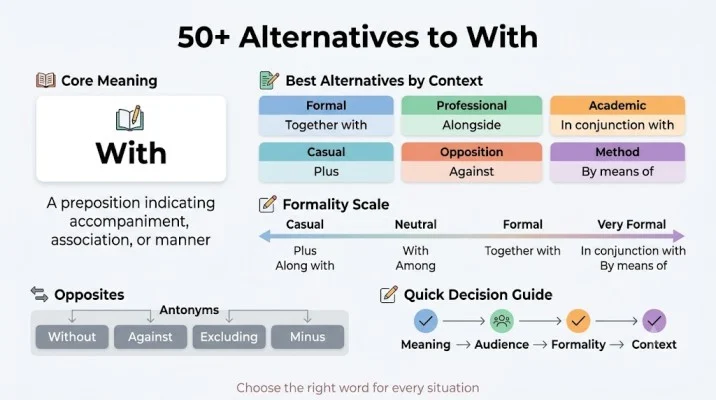
With is a preposition indicating accompaniment, association, or manner. Since it is a grammatical function word, it does not have direct synonyms in the traditional sense. However, depending on context, you can replace with using alternatives like alongside, together with, accompanied by, plus, including, using, by means of, via, through, against, among, between, besides, beyond, despite, regarding, and concerning. The right choice depends on the specific meaning you want to convey.
Meaning, Tone, and Context
Simple Definition
With is a preposition used to indicate accompaniment, association, manner, or instrumentality. It shows that two or more things are together or connected.
Part of Speech
Preposition
Overall Tone
The word is completely neutral. It simply connects ideas without adding emotion or emphasis.
Formality Level
With is considered neutral and appears naturally in all types of communication, from casual conversations to formal academic writing.
Common Uses
Native English speakers commonly use with when:
- Indicating accompaniment: I went with my friend.
- Showing association: She works with the marketing team.
- Expressing manner: He spoke with enthusiasm.
- Indicating instrumentality: She wrote with a pen.
- Showing cause: He trembled with fear.
- Expressing agreement: I agree with you.
- Showing opposition: He fought with his brother.
Related Forms
Since with is a preposition, it does not have different word forms. However, it appears in many common phrases.
When and How to Use “With”
The word with works well whenever you want to show connection, accompaniment, or manner. However, choosing a more specific preposition or phrase can make your message clearer and more impactful.
Professional
“We collaborated with the client to develop the new strategy.”
Academic
“The researcher worked with a team of experienced scientists.”
Workplace
“Please coordinate with the marketing department on this project.”
Personal
“I spent the weekend with my family.”
“I have attached the document with my signature.”
Resume
“Collaborated with cross-functional teams to improve efficiency.”
Social Media
“Enjoying a beautiful sunset with my best friend.”
Best Alternatives to “With”
The word with is useful because it appears in almost every type of writing, but no single alternative works perfectly in every situation. Some prepositions emphasize accompaniment, while others highlight manner, instrumentality, or association. Choosing the right alternative helps your writing sound more natural and precise.
Professional Writing: Alongside
Alongside is one of the strongest professional alternatives to with. It suggests working together in a supportive or collaborative way.
Example:
“The new manager worked alongside the team to implement changes.”
Why it works:
Business writing benefits from precise language, and alongside clearly communicates collaboration.
Academic Writing: Together with
In essays, research papers, and reports, together with is often a better choice than with because it emphasizes inclusion and connection.
Example:
“The data, together with the findings, supports the conclusion.”
Why it works:
It sounds objective, formal, and academically appropriate.
Business Communication: In conjunction with
In conjunction with expresses partnership and cooperation in a formal manner.
Example:
“The marketing team, in conjunction with sales, launched the campaign.”
Why it works:
It immediately communicates formal collaboration and shared effort.
Casual Conversation: Plus
For everyday speaking, plus sounds natural without becoming overly formal.
Example:
“I’ll bring snacks, plus some drinks.”
Why it works:
Native speakers frequently use plus to indicate additional items or people.
Descriptive Writing: Accompanied by
When discussing personal experiences or describing scenes, accompanied by is usually more descriptive than with.
Example:
“The queen entered the hall, accompanied by her royal guard.”
Why it works:
It emphasizes presence and adds a formal, descriptive quality.
Creative Writing: Amidst
Creative writing often benefits from descriptive vocabulary. Amidst creates stronger imagery.
Example:
“The old house stood amidst the towering pine trees.”
Why it works:
It captures the reader’s attention and adds depth to storytelling.
Resume Writing: Alongside
Recruiters frequently see alongside because it highlights collaboration and teamwork.
Example:
“Worked alongside senior developers to deliver projects on time.”
Why it works:
It sounds concise, professional, and achievement-focused.
Workplace Communication: In partnership with
In partnership with emphasizes that something is necessary for success or smooth operations.
Example:
“We delivered the project in partnership with our overseas office.”
Why it works:
It communicates shared responsibility while maintaining a professional tone.
Stronger Emphasis: By means of
When you need stronger emphasis on the method, by means of is one of the best replacements for with.
Example:
“The data was collected by means of a detailed survey.”
Why it works:
It emphasizes the method or instrument used.
Softer Emphasis: Among
Sometimes you want to indicate being part of a group without strong association.
Example:
“She felt comfortable among her colleagues.”
Why it works:
It gives a sense of belonging without emphasizing action.
When Not to Use “With”
Although with is versatile, it is not always the most effective word. In many situations, a more specific alternative communicates your message more clearly.
When a More Formal Tone Is Needed
Sometimes with is too casual for formal writing.
Less Effective
“He spoke with confidence.”
Better
“He spoke with great confidence and authority.”
Why
Adding descriptive language makes the sentence stronger and more formal.
When You Need to Show Cause
With can be vague when expressing cause.
Less Effective
“She trembled with fear.”
Better
“She trembled because of fear.”
Why
Because of more clearly expresses the cause-effect relationship.
When You Need to Show Opposition
With can mean both accompaniment and opposition, causing confusion.
Less Effective
“He fought with his brother.” (Could mean alongside or against)
Better
“He fought against his brother.”
Why
Against clearly indicates opposition.
When Describing Instrumentality
With is common but not always precise enough.
Less Effective
“She wrote with a pen.”
Better
“She wrote using a pen.”
Why
Using emphasizes the act of employing the pen.
When Expressing Agreement
With may sound vague in professional contexts.
Less Effective
“I agree with you.”
Better
“I am in agreement with your proposal.”
Why
In agreement with sounds more formal and professional.
When Describing Accompanying Items
With can make sentences feel cluttered.
Less Effective
“The package arrived with a note.”
Better
“The package arrived, accompanied by a note.”
Why
Accompanied by adds clarity and formality.
Prepositions Commonly Confused with “With”
| Alternative | Difference | When to Use It | Example |
|---|---|---|---|
| Alongside | Emphasizes collaboration or side-by-side presence | Professional contexts, teamwork | “She worked alongside her mentor.” |
| Together with | Emphasizes inclusion and connection | Formal and academic writing | “The results, together with the data, support the hypothesis.” |
| By means of | Emphasizes the method or instrument | Explanations, instructions | “The data was gathered by means of a survey.” |
| Using | Emphasizes the act of employing something | Instructions, how-to writing | “Fix the issue using the new software.” |
| Against | Indicates opposition | Conflicts, resistance | “The team fought against the proposal.” |
| Among | Indicates being part of a group | Belonging, inclusion | “She felt comfortable among her peers.” |
| Besides | Indicates in addition to | Additional items, exceptions | “Besides the report, she submitted the data.” |
| Despite | Indicates contrast | Unexpected outcomes | “The project succeeded despite the challenges.” |
Best Alternatives to “With” by Context
| Context | Best Alternative | Why It Works | Example |
|---|---|---|---|
| Formal Writing | Together with | Sounds precise and professional. | “The report, together with the data, was submitted.” |
| Academic Writing | Together with | Fits research and essays naturally. | “The study, together with previous research, supports this view.” |
| Professional Communication | Alongside | Highlights collaboration. | “I worked alongside the team to meet the deadline.” |
| Business Emails | In conjunction with | Concise and professional. | “We completed the project in conjunction with our partners.” |
| Resume Writing | Alongside | Emphasizes collaboration. | “Collaborated alongside the marketing team.” |
| Workplace Communication | In partnership with | Stresses shared responsibility. | “The initiative was launched in partnership with the IT department.” |
| Casual Conversation | Plus | Sounds natural in daily speech. | “I’ll bring snacks, plus some drinks.” |
| Everyday Speaking | With | Common and widely used. | “I went with my friend.” |
| Creative Writing | Amidst | Adds vivid description. | “The castle stood amidst the misty mountains.” |
| Storytelling | Alongside | Shows side-by-side presence. | “The soldier marched alongside his comrades.” |
| Descriptive Writing | Accompanied by | Expresses formal presence. | “The president arrived, accompanied by his advisors.” |
| Strong Emphasis | By means of | Indicates the method used. | “The data was collected by means of interviews.” |
| Mild Tone | Among | Gives moderate emphasis. | “She found peace among the trees.” |
| Social Media Captions | With | Sounds natural and engaging. | “Enjoying the sunset with my favorite people.” |
| American English | With | Frequently used in all contexts. | “I agree with you.” |
| British English | Together with | Common in formal and everyday usage. | “Together with the data, the results are conclusive.” |
Alternatives to “With” by Usage
The word with works in almost every situation, but choosing a more specific alternative makes your writing stronger and more natural. The sections below explain which alternatives fit different types of communication.
Professional vs Personal Alternatives
- Professional communication requires precise vocabulary, while personal conversations sound better with simpler, more relatable words.
Professional Alternatives
| Alternative | Best Used For | Why It Works |
|---|---|---|
| Alongside | Reports, teamwork | Shows collaboration. |
| In conjunction with | Formal partnerships | Indicates formal cooperation. |
| Together with | Formal inclusion | Sounds precise and professional. |
| By means of | Explanations | Emphasizes method. |
Recommendation
Use alongside, in conjunction with, or together with in resumes, business emails, presentations, and reports because they sound more precise than with.
Personal Alternatives
| Alternative | Best Used For | Example |
|---|---|---|
| Plus | Daily conversations | “I’ll bring drinks, plus some food.” |
| Among | Belonging | “I felt at home among them.” |
| Alongside | Side-by-side presence | “I walked alongside my dog.” |
| With | General use | “I went with my sister.” |
Recommendation
In conversations with friends and family, natural words like plus, among, and alongside often sound better than overly formal alternatives.
Formal vs Conversational Alternatives
Choosing the right level of formality helps your writing match the audience.
| Situation | Best Alternatives |
|---|---|
| Reports | Together with, In conjunction with |
| Essays | Together with, By means of |
| Business Writing | Alongside, In conjunction with |
| Presentations | Alongside, In partnership with |
| Professional Emails | In conjunction with, Alongside |
| Casual Conversations | Plus, With |
| Text Messages | Plus, With |
Example
Formal:
“The proposal, together with the supporting documents, was submitted.”
Conversational:
“I brought the proposal and the documents with me.”
Academic Alternatives
Academic writing benefits from vocabulary that sounds precise and objective.
Together with
Commonly used when emphasizing inclusion.
Example
“The data, together with the findings, supports the conclusion.”
By means of
Best for describing methods.
Example
“The results were obtained by means of a controlled experiment.”
In conjunction with
Useful for describing formal partnerships.
Example
“The study was conducted in conjunction with the university.”
Alongside
Appropriate when describing side-by-side work.
Example
“The researchers worked alongside community leaders.”
Recommendation
For essays and research papers, together with, by means of, and in conjunction with usually sound stronger and more authoritative than with.
Professional and Business Alternatives
Business communication often requires concise and specific language.
Alongside
Perfect for describing teamwork.
Example
“The team worked alongside external consultants.”
In conjunction with
Highlights formal cooperation.
Example
“We launched the campaign in conjunction with our marketing partners.”
In partnership with
Shows shared responsibility.
Example
“The product was developed in partnership with a leading tech company.”
Together with
Frequently appears in formal documents.
Example
“The proposal, together with the budget, was approved.”
By means of
Describes methods and instruments.
Example
“We tracked progress by means of weekly reports.”
Recommendation
Use these alternatives in resumes, interviews, meetings, presentations, business emails, and client communication to sound more professional.
Creative and Literary Alternatives
Creative writing benefits from expressive vocabulary that creates emotion and imagery.
Amidst
Creates atmosphere and setting.
Example
“The old cabin stood amidst the silent forest.”
Alongside
Shows side-by-side presence.
Example
“The young knight rode alongside his king.”
Accompanied by
Adds formality to descriptions.
Example
“The queen entered, accompanied by her royal guard.”
Among
Shows inclusion in a group.
Example
“She found peace among the gentle hills.”
Throughout
Suggests being present in all parts.
Example
“The fragrance of flowers lingered throughout the garden.”
These words make stories, speeches, and descriptive writing more engaging.
Slang or Modern Alternatives
There are very few true slang alternatives for with, but native speakers often use casual expressions.
| Expression | Meaning | Appropriate For | Avoid In |
|---|---|---|---|
| Plus | In addition to | Everyday conversations | Academic papers |
| Along with | Together with | Casual speech | Formal writing |
| Together with | In addition to | Semi-formal | Casual writing |
Example
Casual:
“I’ll bring my laptop along with the charger.”
Formal:
“The laptop, together with the charger, was packed.”
Strongest to Mildest Alternatives
The following scale shows how different alternatives express different levels of formality and emphasis.
| Intensity | Alternatives |
|---|---|
| Mild | With, Plus |
| Moderate | Alongside, Among, Besides |
| Strong | Together with, In conjunction with |
| Very Strong | By means of, In partnership with |
Understanding the Scale
- With is the most common and neutral.
- Plus adds casual inclusion.
- Alongside emphasizes side-by-side presence.
- Together with is formal and precise.
- In conjunction with is formal and collaborative.
- By means of emphasizes method.
- In partnership with indicates formal cooperation.
Antonyms of “With”
Since with is a preposition, it does not have direct antonyms. However, the following prepositions express opposite or contrasting meanings.
| Antonym | Meaning | Example Sentence |
|---|---|---|
| Without | Not having or accompanied by | “She left without her phone.” |
| Against | In opposition to | “He fought against the proposal.” |
| Despite | In spite of | “The project succeeded despite the obstacles.” |
| Excluding | Not including | “Everyone attended, excluding the manager.” |
| Minus | With the subtraction of | “He earned $50,000, minus taxes.” |
| Besides | In addition to (can imply exception) | “No one else knew, besides me.” |
| Apart from | Separately from | “The whole building burned, apart from the office.” |
Comparison: “With” vs Similar Prepositions
Although with is the most common preposition for accompaniment, several similar words carry different shades of meaning. Understanding these differences helps you choose the most accurate word for each situation.
With vs Alongside
Main Difference
With is a general word for accompaniment. Alongside emphasizes side-by-side presence and collaboration.
Which Is Stronger?
Alongside is stronger because it implies active cooperation.
Which Is More Formal?
Alongside is common in professional contexts.
When to Use Each
Use with for general accompaniment.
Use alongside for collaboration.
Examples
With:
“She walked with her friend.”
Alongside:
“She worked alongside her mentor.”
With vs Together with
Main Difference
With is general. Together with emphasizes inclusion and connection.
Which Is Stronger?
Together with is more formal and precise.
Which Is More Formal?
Together with is more formal.
When to Use Each
Use with for general connection.
Use together with for formal inclusion.
Examples
With:
“The report was submitted with the data.”
Together with:
“The report, together with the data, was submitted.”
With vs By means of
Main Difference
With can indicate instrumentality. By means of specifically emphasizes the method used.
Which Is Stronger?
By means of is more precise and formal.
Which Is More Formal?
By means of is more formal.
When to Use Each
Use with for simple instrumentality.
Use by means of for formal explanations.
Examples
With:
“She wrote with a pen.”
By means of:
“The data was collected by means of a survey.”
With vs Against
Main Difference
With can mean accompaniment or opposition. Against specifically means opposition.
Which Is Stronger?
Against is clearer for indicating conflict.
Which Is More Formal?
Both are suitable.
When to Use Each
Use with for accompaniment.
Use against for opposition.
Examples
With:
“He fought with his friend.” (Ambiguous)
Against:
“He fought against his friend.” (Clear)
With vs Among
Main Difference
With indicates direct accompaniment. Among indicates being part of a group.
Which Is Stronger?
Neither is stronger. They emphasize different ideas.
Which Is More Formal?
Among is slightly more formal.
When to Use Each
Use with for direct connection.
Use among for being part of a group.
Examples
With:
“I went with my friends.”
Among:
“I felt comfortable among my friends.”
With vs Using
Main Difference
With can indicate instrumentality. Using specifically emphasizes the act of employing something.
Which Is Stronger?
Using is more precise for instrumentality.
Which Is More Formal?
Both are suitable.
When to Use Each
Use with for general instrumentality.
Use using for active employment.
Examples
With:
“She fixed the issue with the software.”
Using:
“She fixed the issue using the new software.”
Common Phrases and Expressions with “With”
| Phrase | Meaning | Example Sentence |
|---|---|---|
| With pleasure | Willingly and happily | “I will help you with pleasure.” |
| With regard to | Concerning | “With regard to your question, I will respond soon.” |
| With respect to | Regarding | “With respect to the budget, we need to be careful.” |
| With ease | Easily | “She completed the task with ease.” |
| With confidence | Confidently | “He spoke with confidence.” |
| With time | As time passes | “With time, things will improve.” |
| With love | Affectionately | “She signed the card with love.” |
| With all due respect | Politely disagreeing | “With all due respect, I disagree.” |
Common Mistakes to Avoid
1. Using “With” When “Against” Is Needed
Incorrect
“He argued with the proposal.” (Ambiguous)
Better
“He argued against the proposal.”
Why
Against clearly indicates opposition.
2. Using “With” When a More Formal Word Is Needed
Incorrect
“The application was submitted with the documents.”
Better
“The application, together with the documents, was submitted.”
Why
Together with adds formality and precision.
3. Confusing “With” and “By” for Method
Incorrect
“She paid with credit card.”
Better
“She paid by credit card.”
Why
By is used for payment methods.
4. Using “With” for Cause When “Because of” Is Clearer
Incorrect
“She trembled with fear.”
Better
“She trembled because of fear.”
Why
Because of clearly expresses the cause.
5. Using “With” When “Among” Is More Precise
Incorrect
“She stood with the crowd.”
Better
“She stood among the crowd.”
Why
Among indicates being part of a group.
6. Repeating “With” Too Often
Incorrect
“She worked with the team with enthusiasm with the new project.”
Better
“She worked alongside the team enthusiastically on the new project.”
Why
Using varied alternatives improves readability and style.
7. Confusing “With” and “To”
Incorrect
“She spoke with her manager about the issue.”
Better
“She spoke to her manager about the issue.”
Why
To is more direct when addressing someone.
Frequently Asked Questions
What are the best formal alternatives to “with”?
Strong formal alternatives include together with, in conjunction with, by means of, and alongside. These words work well in academic papers, reports, and business communication.
What are common informal alternatives to “with”?
Common informal alternatives include plus, along with, and together with. These expressions sound natural in everyday conversations and social media posts.
What is another word for “with” in professional writing?
In professional communication, excellent alternatives include alongside, in conjunction with, together with, and in partnership with. These words make reports, emails, resumes, and presentations sound more precise and polished.
What is the difference between “with” and “alongside”?
With is a general word for accompaniment. Alongside emphasizes side-by-side presence and collaboration, making it more common in professional contexts.
What is the opposite of “with”?
The most common opposites include without, against, excluding, and minus. Each describes a lack of accompaniment, opposition, or exclusion.
Conclusion
The word with is one of the most common prepositions in English, but using it repeatedly can make your writing feel repetitive. Learning the best alternatives to with helps you express your ideas with greater accuracy, stronger style, and better clarity.
You’re writing an essay, preparing a business presentation, updating your resume, or having a casual conversation. No single alternative fits every situation. Words like alongside, together with, in conjunction with, by means of, against, and among each carry unique meanings and should be chosen based on your audience, tone, and purpose.
A simple way to improve your vocabulary is to pause before writing with and ask yourself what kind of connection you mean. Choosing the most appropriate alternative will make your writing more engaging, professional, and natural.
Read More Related Articles:
Synonyms for Liked| Meaning, Examples, and Better Word …
50+ Synonyms of Information | Meanings, Uses, Examples …










1 thought on “50+ Synonyms of With | Smarter Alternatives for Clear, Natural Writing in 2026”