You may notice yourself using the word “delusional” repeatedly in emails, essays, captions, blog posts, assignments, or everyday conversations. The word can be useful, but it is also strong, and choosing the wrong alternative can make your writing sound unnecessarily harsh or inaccurate.
Understanding the synonyms of delusional helps you communicate the exact idea you intend. Depending on the context, you may need a softer word such as unrealistic, a more precise expression such as under a false impression, or a stronger phrase such as detached from reality. The best choice depends on meaning, audience, tone, and purpose.
What Are the Best Synonyms of “Delusional”?
Featured Snippet Answer:
The best synonyms of delusional include deluded, unrealistic, self deceived, misguided, mistaken, illusory, and out of touch with reality. For formal or academic writing, use precise phrases such as based on a false belief or under a misapprehension. In casual speech, unrealistic or delulu may fit better.
The word delusional generally describes someone who believes something that is not true. Cambridge Dictionary defines it as believing things that are not true, and its examples show both clinical and everyday uses.
For professional writing, unrealistic, misguided, or based on a false assumption is often more appropriate than delusional. For academic or clinical writing, precision matters, so delusional should not be casually replaced with a word that changes the meaning.
Meaning, Tone, and Context
Simple Definition
Delusional is an adjective describing a belief, idea, perception, or person associated with a belief that is not true.
In everyday American English, people also use it more loosely to describe someone whose expectations seem extremely unrealistic. That casual use can sound insulting, so context matters.
Part of Speech
Delusional is an adjective.
Examples:
- He has a delusional belief about his abilities.
- Her expectations were completely unrealistic.
- The character becomes increasingly delusional as the story progresses.
Overall Tone
The word is generally negative and can be highly judgmental when applied directly to a person.
It can also have a specialized clinical meaning. Because of that, writers should avoid treating it as a casual synonym for every form of optimism, imagination, disagreement, or unrealistic thinking.
Formality Level
Delusional is grammatically neutral to formal, but its tone can be severe.
It can appear in academic, clinical, journalistic, and everyday writing. However, the appropriate alternative depends heavily on what you are actually describing.
Common Uses
You may encounter delusional in:
- Clinical or psychological discussions
- Academic writing about beliefs or cognition
- Journalism
- Literary criticism
- Character descriptions
- Informal conversations
- Social media
- Discussions about unrealistic expectations
Word Forms
Related forms include:
- Delusion, noun
- Delusional, adjective
- Deluded, adjective
- Delude, verb
- Delusive, adjective
- Delusively, adverb
- Self delusion, noun phrase
Cambridge also lists delusive as an adjective meaning false, while delude means to make someone believe something that is not true.
When and How to Use “Delusional”
Use delusional when the meaning genuinely involves a belief that conflicts with reality. Do not automatically use it whenever someone is merely optimistic, wrong, ambitious, imaginative, or stubborn.
Professional
Example: The proposal rests on a delusional assumption that costs will remain unchanged indefinitely.
In professional writing, however, unrealistic assumption is often more diplomatic.
Academic
Example: The study examined how delusional beliefs can affect a person’s interpretation of events.
In academic writing, the word should be used precisely rather than as an insult.
Workplace
Example: Calling the manager’s plan delusional would probably escalate the discussion.
A better workplace alternative might be unrealistic, unsupported, or unfounded.
Personal
Example: She thought her former partner would return immediately, but her expectations seemed unrealistic.
Here, unrealistic is usually softer than delusional.
Example: The proposed deadline seems unrealistic given the amount of testing still required.
This is usually more professional than calling the deadline delusional.
Resume
Example: Avoid describing yourself as “delusional” or using the word negatively in a resume.
Resume language should focus on evidence, qualifications, and measurable results.
Social Media
Example: “I’m being delusional if I think my favorite actor will see this post.”
Online, playful uses of the word are common. The newer slang term delulu is also used humorously to mean believing something unrealistic or untrue, often by choice. Cambridge identifies delulu as slang and explicitly lists delusional as a synonym.
Best Synonyms of “Delusional”
No synonym is identical to delusional in every situation. Some alternatives describe the belief itself, while others emphasize error, unrealistic expectations, lack of evidence, or self deception.
Professional Writing
Best choice: unrealistic
Use unrealistic when you want to criticize an expectation without making a personal or psychological judgment.
Example: The projected sales target is unrealistic given current market conditions.
Academic Writing
Best choice: based on a false belief
This phrase is precise and avoids implying more than the evidence supports.
Example: The argument appears to be based on a false belief about consumer behavior.
Business Communication
Best choice: unfounded
Unfounded works well when an idea lacks sufficient evidence.
Example: The report contains several unfounded assumptions about future demand.
Casual Conversation
Best choice: unrealistic
It is natural, understandable, and less severe.
Example: That’s an unrealistic expectation.
Emotional Writing
Best choice: self deceived
Use this when someone appears to believe something because they cannot or will not accept the truth.
Example: He seemed completely self deceived about the consequences of his actions.
Creative Writing
Best choice: detached from reality
This creates a stronger image and can suit character descriptions.
Example: The king became increasingly detached from reality as his power grew.
Resume Writing
Best choice: unsupported
A resume should avoid emotionally loaded judgments.
Example: The candidate’s claim was unsupported by measurable results.
Workplace Communication
Best choice: misguided
Use misguided when an action or judgment is based on a poor understanding rather than necessarily on a fixed false belief.
Example: The team made a misguided assumption about customer demand.
Stronger Meaning
Best choice: detached from reality
This is forceful and descriptive without necessarily making a clinical claim.
Softer Meaning
Best choice: unrealistic
It communicates the problem while leaving room for reasonable disagreement.
When Not to Use “Delusional”
When the Idea Is Simply Unrealistic
Less effective: His plan is delusional.
Better: His plan is unrealistic.
Unrealistic focuses on feasibility rather than the person’s mental state.
When Evidence Is Missing
Less effective: Her claim is delusional.
Better: Her claim is unfounded.
Unfounded directly addresses the lack of supporting evidence.
When Someone Is Simply Mistaken
Less effective: The employee is delusional about the deadline.
Better: The employee is mistaken about the deadline.
Being wrong does not automatically mean being delusional.
When You Need a Professional Tone
Less effective: That is a delusional business strategy.
Better: That strategy appears impractical and unsupported by the available data.
The revised sentence gives specific reasons rather than using a personal label.
When You Are Describing Creativity
Less effective: Her story is delusional.
Better: Her story is fantastical.
Creative or imaginary material is not necessarily based on a delusion.
When You Mean Excessive Confidence
Less effective: He is delusional about his abilities.
Better: He has an inflated view of his abilities.
This version identifies the specific problem more accurately.
When the Word Would Sound Insulting
If your purpose is to persuade rather than attack, choose a word that describes the idea instead of labeling the person.
Words such as unsupported, unrealistic, mistaken, misguided, and unfounded often make criticism more constructive.
Words Commonly Confused With “Delusional”
| Word | Difference | When to Use It | Example |
|---|---|---|---|
| Unrealistic | Describes expectations or ideas that are not practical or likely | Plans, goals, expectations | Her sales target is unrealistic. |
| Mistaken | Means simply wrong about something | Facts, assumptions, information | He was mistaken about the meeting time. |
| Misguided | Suggests poor judgment or direction | Decisions, actions, opinions | The campaign was based on misguided assumptions. |
| Paranoid | Describes excessive suspicion or fear of harm | Suspicious beliefs or behavior | He became paranoid after receiving several anonymous messages. |
| Imaginative | Suggests creativity rather than false belief | Fiction, art, ideas | She is an imaginative storyteller. |
| Deluded | Describes someone who holds a false belief | Stronger descriptions of false belief | He was deluded about his chances of success. |
Best Synonyms of “Delusional” by Context
| Context | Best Synonym | Why It Works | Example |
|---|---|---|---|
| Formal writing | Unfounded | Focuses on lack of support | The claim was unfounded. |
| Academic writing | Based on a false belief | Precise and descriptive | The conclusion was based on a false belief. |
| Professional communication | Unrealistic | Clear and diplomatic | The target is unrealistic. |
| Business emails | Unsupported | Focuses on evidence | The estimate appears unsupported. |
| Resume writing | Misguided | Useful for describing poor judgment | The strategy was misguided. |
| Workplace communication | Unrealistic | Firm without being insulting | That deadline is unrealistic. |
| Casual conversation | Unrealistic | Natural and mild | That’s pretty unrealistic. |
| Everyday speaking | Mistaken | Appropriate for ordinary errors | You are mistaken about that. |
| Creative writing | Detached from reality | More vivid and expressive | He seemed detached from reality. |
| Storytelling | Deluded | Strong character description | The deluded ruler trusted no one. |
| Emotional writing | Self deceived | Emphasizes denial | She was self deceived about the relationship. |
| Strong emphasis | Detached from reality | Communicates severe unreality | His expectations were detached from reality. |
| Mild tone | Unrealistic | Softens criticism | The proposal may be unrealistic. |
| Social media captions | Delulu | Playful internet slang | I’m being delulu again. |
| American English | Unrealistic | Common and natural | That’s an unrealistic expectation. |
| British English | Unrealistic | Also natural in British usage | The assumption seems unrealistic. |
How to Choose the Best Synonym of “Delusional”
Choosing the right alternative is easier when you identify five things first.
1. Meaning: Are you describing a false belief, a practical problem, an error, or a lack of evidence?
2. Audience: Would the reader understand the word naturally, or could it sound overly harsh?
3. Tone: Do you want to sound neutral, diplomatic, critical, humorous, or dramatic?
4. Intensity: Is the problem mildly unrealistic, clearly unsupported, or strongly detached from reality?
5. Purpose: Are you writing an academic paper, business email, social media caption, story, or personal message?
A simple rule works well: describe the specific problem rather than choosing the strongest possible synonym.
For example, if a project deadline cannot realistically be met, unrealistic is clearer than delusional. If a claim has no evidence, unfounded is more precise. If a character refuses to accept reality, deluded or detached from reality may be more appropriate.
Real Life Examples of “Delusional”
School
Original: The student’s belief that he could complete an entire semester’s work overnight was delusional.
Better for most school writing: The student’s expectation was unrealistic.
College
Original: The argument presents a delusional view of economic behavior.
Better: The argument presents an unrealistic view of economic behavior.
Workplace
Original: The manager’s plan is delusional.
Better: The manager’s plan appears unrealistic and unsupported by current data.
Business
Original: Their prediction seems delusional.
Better: Their prediction appears overly optimistic and unsupported.
Original: That deadline is delusional.
Better: That deadline seems unrealistic given the remaining work.
Resume
Original: I have delusional confidence in my leadership abilities.
Better: I have strong confidence in my leadership abilities, supported by experience managing cross functional projects.
Conversation
Original: You’re delusional if you think they’ll agree immediately.
Softer: You’re being unrealistic if you think they’ll agree immediately.
Storytelling
Example: The deluded ruler became convinced that every citizen secretly admired him.
Blogging
Example: Expecting instant success from a new website is often unrealistic without consistent work and a clear strategy.
Social Media
Example: “Maybe I’m being delulu, but I still think my favorite team can win.”
The slang use is playful and should generally remain in informal settings. Cambridge describes delulu as humorous slang.
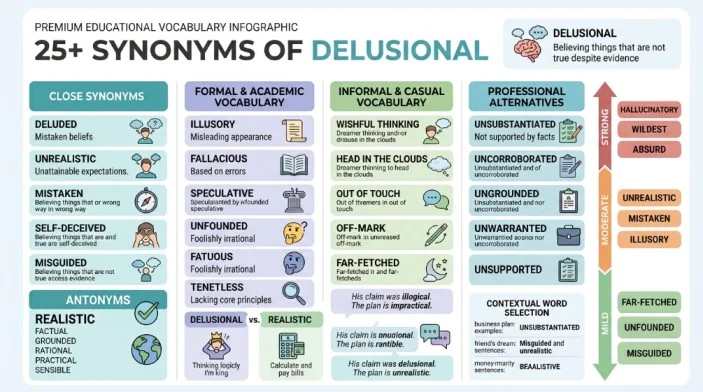
25 Best Synonyms of “Delusional”
Because delusional has both a specialized sense and a broad everyday use, not every alternative below is interchangeable in every sentence. These are the closest usable synonyms and context specific alternatives for describing false, reality disconnected, or poorly grounded beliefs.
| Synonym | Simple Meaning | Best Used For | Example Sentence |
|---|---|---|---|
| Deluded | Holding a false belief | Strong descriptions of a person | He was deluded about his chances of winning. |
| Delusive | Creating or involving a false impression | Formal or literary writing | The promise proved to be delusive. |
| Self deceived | Believing something false about oneself or a situation | Personal and emotional writing | She was self deceived about the relationship. |
| Self deluding | Misleading oneself into accepting something untrue | Reflective writing | His self deluding optimism prevented him from seeing the problem. |
| Unrealistic | Not consistent with practical reality | Everyday and professional writing | The deadline is unrealistic. |
| Misguided | Based on poor judgment or understanding | Professional and academic writing | The policy was based on misguided assumptions. |
| Mistaken | Incorrect in belief or understanding | General communication | She was mistaken about the results. |
| Misinformed | Based on incorrect information | News, education, and professional settings | The customer was misinformed about the policy. |
| Unfounded | Lacking evidence or justification | Academic and professional writing | The accusation was unfounded. |
| Groundless | Having no reasonable basis | Formal criticism | The rumor was completely groundless. |
| Baseless | Having no factual support | Reports and arguments | The allegation was baseless. |
| Unsupported | Not backed by evidence | Business and academic writing | The conclusion was unsupported by the data. |
| Illusory | Based on an illusion or false appearance | Formal and literary writing | The promise of effortless success was illusory. |
| Imaginary | Existing only in the imagination | Fiction and descriptive writing | He feared an imaginary threat. |
| False | Not true or accurate | General writing | The belief was false. |
| Fictitious | Invented rather than real | Formal and creative contexts | The story was built around a fictitious belief. |
| Fanciful | Imaginative and not realistic | Creative writing | She developed a fanciful theory about the house. |
| Misapprehended | Incorrectly understood | Formal or academic writing | The researcher had misapprehended the evidence. |
| Based on a false belief | Founded on something untrue | Academic and professional writing | The decision was based on a false belief. |
| Under a false impression | Believing something because of an incorrect impression | Polite communication | He was under a false impression about the agreement. |
| Under a misapprehension | Mistaken because something was misunderstood | Formal communication | She acted under a misapprehension about the requirements. |
| Detached from reality | Severely disconnected from practical facts | Strong descriptive writing | His expectations were detached from reality. |
| Out of touch with reality | Not recognizing actual circumstances | Conversational and journalistic writing | The proposal seems out of touch with reality. |
| Wishful | Influenced by a strong desire rather than facts | Personal and analytical writing | The forecast was based on wishful thinking. |
| Reality disconnected | Not adequately connected to observable circumstances | Descriptive analysis | The argument was reality disconnected and unsupported. |
Important Accuracy Note
Some words above are contextual substitutes rather than perfect one word replacements. For example, mistaken is much broader than delusional, while unfounded focuses on evidence rather than belief.
For clinical or technical writing, do not replace delusional simply to avoid repetition. The exact meaning matters more than stylistic variety.
Synonyms of “Delusional” by Usage
Professional vs Personal Synonyms
Professional writing usually benefits from words that describe the specific weakness in an idea.
Choose unrealistic for impractical expectations, unfounded for unsupported claims, misguided for poor judgment, and unsupported when evidence is missing.
Personal conversations allow stronger language, but delusional can sound insulting. If maintaining a respectful tone matters, mistaken or unrealistic is usually safer.
Formal vs Conversational Synonyms
For reports and essays, consider:
- Unfounded
- Unsupported
- Misguided
- Illusory
- Based on a false belief
- Under a misapprehension
For emails and conversations, consider:
- Unrealistic
- Mistaken
- Unreasonable
- Out of touch with reality
For texting and social media, delulu may be acceptable when the tone is intentionally humorous. It should not appear in formal academic or professional writing.
Academic Synonyms
Academic writing benefits from precision rather than emotional force.
Useful alternatives include:
- Unfounded
- Unsupported
- Misguided
- Misapprehended
- Based on a false belief
- Under a misapprehension
- Illusory
For example:
Less precise: The author has a delusional view of the issue.
More precise: The author’s argument appears to rest on an unsupported assumption.
The second sentence identifies the actual weakness.
Professional and Business Synonyms
For resumes, interviews, meetings, presentations, performance reviews, client communication, and business emails, avoid using delusional as a casual criticism.
Better choices include:
- Unrealistic
- Unsupported
- Misguided
- Unfounded
- Overly optimistic
- Based on an incorrect assumption
- Inconsistent with available evidence
These alternatives focus attention on the proposal, claim, or assumption rather than labeling a person.
Creative and Literary Synonyms
Creative writing gives you more freedom.
Strong choices include:
- Deluded
- Illusory
- Fanciful
- Self deceived
- Detached from reality
- Out of touch with reality
For example:
The old king had become completely detached from reality, hearing praise even in the silence of an empty hall.
This creates character and atmosphere without relying on the same adjective repeatedly.
Slang or Modern Synonyms
The main modern slang alternative is delulu.
It is informal, playful, and often humorous. Cambridge defines it as slang for believing things that are not real or true, usually because someone chooses to believe them, and lists delusional as a synonym.
Acceptable: I’m being delulu about getting front row tickets.
Avoid: The patient’s symptoms were delulu.
The second sentence is inappropriate because slang should not replace precise terminology in clinical or formal contexts.
Strongest to Mildest Synonyms
There is no universal scientific scale for these alternatives because intensity depends on context. A practical writing scale is:
Mild
- Mistaken
- Unrealistic
- Misinformed
These usually allow room for correction.
Moderate
- Misguided
- Unfounded
- Unsupported
- Groundless
These communicate stronger criticism of an idea or belief.
Strong
- Self deceived
- Deluded
- Out of touch with reality
These suggest a deeper disconnect from facts.
Very Strong
- Delusional
- Detached from reality
These can carry substantial emotional or clinical weight and should be used carefully.
Emotional vs Neutral Synonyms
Emotional Synonyms
These alternatives can carry stronger judgment:
- Deluded
- Self deceived
- Detached from reality
- Out of touch with reality
- Delusional
Use them when the emotional or dramatic effect is intentional.
Neutral Synonyms
These are generally safer when the goal is objective communication:
- Mistaken
- Unrealistic
- Misinformed
- Unsupported
- Unfounded
- Misguided
Use neutral language in workplaces, schools, business communication, and situations where respectful disagreement matters.
Antonyms of “Delusional”
There is no single perfect opposite for every use of delusional. The following are contextual antonyms that describe realistic, rational, evidence aware, or reality grounded thinking.
| Antonym | Meaning | Example Sentence |
|---|---|---|
| Realistic | Consistent with actual circumstances | Her expectations are realistic. |
| Rational | Based on reason and logic | He made a rational decision. |
| Reasonable | Fair and sensible | That is a reasonable assumption. |
| Sensible | Showing practical judgment | She offered a sensible solution. |
| Grounded | Closely connected to reality | He remains grounded despite his success. |
| Clear eyed | Seeing a situation honestly | She gave a clear eyed assessment of the risks. |
| Level headed | Calm and sensible in judgment | The manager stayed level headed during the crisis. |
| Objective | Based on facts rather than personal bias | We need an objective evaluation. |
| Evidence based | Supported by reliable evidence | The recommendation is evidence based. |
| Well informed | Based on adequate and accurate information | She made a well informed choice. |
| Perceptive | Quick to understand what is actually happening | He was perceptive enough to notice the warning signs. |
| Discerning | Able to judge differences accurately | The editor was discerning about unreliable claims. |
| Factual | Based on facts | The report provides factual information. |
| Lucid | Clear and rational in thought or expression | His explanation was lucid and convincing. |
| Reality based | Consistent with observable facts | The plan needs a more reality based assessment. |
Comparison: “Delusional” vs Similar Words
Delusional vs Unrealistic
Main Difference:
Delusional can suggest belief in something untrue, while unrealistic usually means an expectation, plan, or idea is impractical or unlikely.
Which Is Stronger?
Delusional is generally stronger.
Which Is More Formal?
Both can be formal, but unrealistic is usually more neutral.
When to Use Each:
Use unrealistic for goals, plans, expectations, and forecasts. Use delusional only when the stronger meaning is genuinely intended.
Examples:
Delusional: He remained delusional about what had actually happened.
Unrealistic: His expectation of finishing the project in one hour was unrealistic.
Delusional vs Deluded
Main Difference:
Both describe false beliefs, but deluded commonly describes a person, while delusional frequently modifies beliefs, thinking, ideas, or states.
Which Is Stronger?
They can be similarly strong.
Which Is More Formal?
Both are established English words.
When to Use Each:
Use deluded when describing someone’s state or judgment. Use delusional when describing beliefs or thinking.
Examples:
Delusional: The character displayed delusional thinking.
Deluded: The character was deluded about his identity.
Delusional vs Mistaken
Main Difference:
Mistaken simply means wrong. Delusional implies a much stronger disconnect from truth.
Which Is Stronger?
Delusional is stronger.
Which Is More Formal?
Both work formally, but mistaken is usually less emotionally loaded.
When to Use Each:
Use mistaken for ordinary errors.
Examples:
Delusional: He was delusional about the evidence.
Mistaken: She was mistaken about the meeting date.
Delusional vs Misguided
Main Difference:
Misguided means based on poor judgment or understanding. It does not necessarily imply a false personal belief of the kind associated with delusional.
Which Is Stronger?
Delusional generally carries more intensity.
Which Is More Formal?
Misguided is especially useful in professional and academic criticism.
When to Use Each:
Use misguided for decisions, strategies, policies, or opinions.
Examples:
Delusional: He held a delusional belief about his abilities.
Misguided: The company followed a misguided strategy.
Delusional vs Paranoid
Main Difference:
Paranoid specifically relates to excessive suspicion, distrust, or fear of harm. Delusional is broader.
Which Is Stronger?
Neither is universally stronger. They describe different things.
Which Is More Formal?
Both can occur in clinical and general writing, but both require care.
When to Use Each:
Use paranoid only when suspiciousness or fear of persecution is actually relevant.
Examples:
Delusional: He held a false belief about his importance.
Paranoid: He became paranoid that everyone was secretly watching him.
Delusional vs Imaginative
Main Difference:
Imaginative is generally positive and describes creativity. Delusional describes a belief or perception that is not true.
Which Is Stronger?
Delusional carries much more negative weight.
Which Is More Formal?
Both are common across formal and informal writing.
When to Use Each:
Use imaginative for creative ideas, stories, designs, and original thinking.
Examples:
Delusional: His belief was disconnected from reality.
Imaginative: She created an imaginative fantasy world.
Common Phrases and Expressions with “Delusional”
Delusional Thinking
Meaning: Thinking associated with beliefs that are not true.
Example: The paper discusses the effects of delusional thinking in a clinical context.
Delusional Belief
Meaning: A belief described as delusional.
Example: The study examined the persistence of a delusional belief.
Delusional State
Meaning: A state characterized by delusional beliefs or thinking.
Example: The character appeared to be in a delusional state.
Delusional Ideation
Meaning: A formal expression referring to delusion related thoughts or beliefs.
Example: The researchers measured changes in delusional ideation.
Delusional Thinking About
Meaning: Using the adjective to describe unrealistic or false thinking about a particular subject.
Example: His delusional thinking about his career prevented him from considering other options.
Completely Delusional
Meaning: A strong informal expression suggesting someone is deeply disconnected from reality.
Example: Calling the plan completely delusional made the meeting more confrontational.
Delusional About Something
Meaning: Informally, believing something that is not true about a situation.
Example: She was delusional about how quickly the project could be completed.
Common Mistakes to Avoid
Mistake 1: Treating Every Mistake as Delusional
Incorrect: He is delusional because he got the date wrong.
Better: He was mistaken about the date.
A simple factual error does not justify the stronger word.
Mistake 2: Using Delusional in a Professional Email
Incorrect: Your deadline is delusional.
Better: Your proposed deadline appears unrealistic.
The second version communicates the problem without unnecessarily attacking the recipient.
Mistake 3: Confusing Delusional With Imaginative
Incorrect: The author has a delusional imagination.
Better: The author has a highly imaginative style.
Creative imagination is not the same as believing something false.
Mistake 4: Using a Dramatic Word When Evidence Is the Real Issue
Incorrect: His argument is delusional.
Better: His argument is unsupported by evidence.
The improved sentence identifies the specific weakness.
Mistake 5: Using Slang in Academic Writing
Incorrect: The theory is totally delulu.
Better: The theory appears unrealistic and lacks supporting evidence.
Delulu is slang and is unsuitable for serious academic prose.
Mistake 6: Repeating Delusional Too Often
Incorrect: The delusional character has delusional beliefs and makes delusional decisions.
Better: The character is detached from reality, holds false beliefs, and makes increasingly unrealistic decisions.
The revised version improves variety while adding more specific information.
Mistake 7: Labeling a Person Instead of Describing the Problem
Incorrect: She is delusional.
Better: Her expectations appear unrealistic and are not supported by the available evidence.
The second version is more specific and less personally judgmental.
Frequently Asked Questions
What is a good delusional synonym?
Common alternatives include deluded, unrealistic, irrational, misguided, and unrealistic-minded, depending on the context.
What is the opposite of delusional?
The opposite can be realistic, rational, sensible, clear-headed, or grounded, especially when describing someone’s view of reality.
What are some delulu synonyms?
Informal delulu synonyms include unrealistic, irrational, fantasizing, and out of touch. The best choice depends on the tone.
What is another word for deluded?
Another word for deluded is misguided, deceived, mistaken, unrealistic, or self-deceived.
What are delusional meaning synonyms?
Depending on the intended meaning, synonyms include unrealistic, irrational, mistaken, misguided, and out of touch with reality.
What are synonyms of delusion?
Common synonyms of delusion include false belief, misconception, illusion, deception, and misbelief.
What are common delusional synonyms?
Common delusional synonyms include unrealistic, irrational, misguided, mistaken, and deluded.
What is a delulu synonym?
A delulu synonym can be unrealistic, out of touch, fantasizing, or self-deluded, depending on the context.
What does delusional mean?
Delusional describes a strongly held belief that is not supported by reality or evidence, often despite clear reasons to question it.
1. What are the best synonyms of “delusional”?
The best synonyms of delusional include deluded, unrealistic, self deceived, unfounded, misguided, and detached from reality. The best choice depends on whether you mean false belief, poor judgment, or impractical expectations.
2. What are the best formal synonyms of “delusional”?
Formal alternatives include unfounded, unsupported, misguided, illusory, misapprehended, and based on a false belief. These options can make academic and professional writing more precise than a broad personal label.
3. What are common informal synonyms of “delusional”?
Common informal alternatives include unrealistic, out of touch with reality, and, in playful online language, delulu. The last option is slang and should generally be avoided in academic or professional writing.
4. What is another word for “delusional” in professional writing?
In professional writing, unrealistic is often the safest alternative. Depending on the issue, unsupported, unfounded, or misguided may be more precise because each identifies a different weakness without unnecessarily labeling a person.
5. What is the difference between “delusional” and “unrealistic”?
Delusional can describe a false belief or serious disconnect from reality, while unrealistic usually describes expectations, plans, or ideas that are impractical or unlikely. Unrealistic is generally softer and more professional.
6. What is the opposite of “delusional”?
Common contextual opposites include realistic, rational, reasonable, grounded, objective, clear eyed, and evidence based. The best antonym depends on whether you want to emphasize practical judgment, factual accuracy, or connection with reality.
Conclusion
Delusional describes a belief or way of thinking that is not grounded in reality, but it is stronger and more sensitive than many everyday alternatives. Ordinary communication, unrealistic is often the clearest choice. For evidence based criticism, unfounded or unsupported may be better. For strong descriptive or literary writing, deluded or detached from reality can work.
The best synonyms of delusional are not interchangeable in every situation. Choose according to your audience, intended tone, emotional strength, and the exact problem you want to describe. A useful vocabulary habit is to ask yourself what is actually wrong with the idea before choosing a synonym. Precision will usually make your writing stronger than simply choosing the harshest word.
Read More Related Articles:
- Synonyms for Empty | Meaning, Examples, and Better Word …
- 25+ Synonyms of Perseverance | Meanings, Uses, Examples …