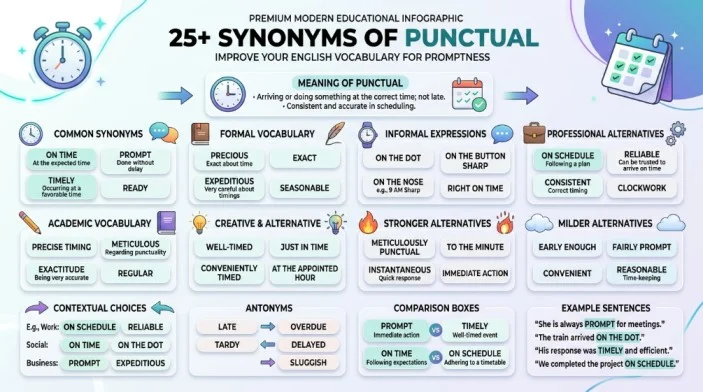
When you write emails, resumes, essays, or workplace messages, using punctual repeatedly can make your vocabulary feel limited. Finding the right synonym of punctual can help you describe someone who arrives on time, meets deadlines, or follows a schedule without changing the meaning of your sentence.
The best alternative depends on context. Prompt works well when you want to emphasize quick and timely action, while timely focuses on something happening at the right moment. Expressions such as on time and on schedule sound natural in everyday and professional English. Choosing the right word makes your communication clearer and more precise.
What Is the Best Synonym of “Punctual”?
A synonym of punctual is a word or expression describing someone or something that happens at the expected or agreed time. The best alternatives include prompt, timely, on time, and on schedule. Use prompt in professional settings, timely in formal writing, and on time in everyday conversation.
Meaning, Tone, and Context
Simple Definition
Punctual means arriving, happening, or being completed at the expected or agreed time.
A punctual person respects schedules and deadlines. For example, someone who arrives at work at 9:00 a.m. as expected can be described as punctual.
The word can describe both people and actions:
- “Maria is always punctual for work.”
- “The train was punctual.”
- “He is punctual with his assignments.”
Part of Speech
Punctual is an adjective.
It describes a person, event, action, or activity that occurs at the expected time.
Overall Tone
The word punctual has a positive and neutral tone. It often suggests reliability, responsibility, discipline, and respect for other people’s time.
In professional communication, calling someone punctual is usually a compliment because it suggests dependable time management.
Formality Level
Punctual is a neutral to moderately formal word.
It is appropriate in:
- Academic writing
- Business communication
- Workplace conversations
- Resumes
- Performance reviews
- Professional emails
- Everyday English
For casual conversation, on time is often more natural than punctual.
Common Uses
Native English speakers commonly use punctual when discussing:
- Arriving at work
- Attending meetings
- Showing up for appointments
- Completing assignments
- Meeting deadlines
- Following schedules
- Starting events
- Public transportation
- Professional reliability
- Time management
Word Forms
| Word | Part of Speech | Example |
|---|---|---|
| Punctual | Adjective | She is always punctual. |
| Punctually | Adverb | The meeting started punctually at noon. |
| Punctuality | Noun | His punctuality impressed his manager. |
| Unpunctual | Adjective | The employee was often unpunctual. |
When and How to Use “Punctual”
Use punctual when you want to emphasize reliable adherence to an expected time. It is especially useful when describing a person’s behavior, professional habits, or consistent timekeeping.
Professional
“Jordan is highly punctual and consistently arrives before his scheduled start time.”
This works well in a performance review or professional recommendation.
Academic
“Students are expected to be punctual for examinations.”
Here, the word emphasizes compliance with a scheduled time.
Workplace
“Being punctual helps the team begin meetings without unnecessary delays.”
The word fits naturally when discussing workplace expectations.
Personal
“My sister is very punctual, so she usually arrives exactly when she says she will.”
This sounds natural when describing someone’s personal habit.
“Thank you for being punctual and joining the meeting at the scheduled time.”
This is suitable for a polite professional message.
Resume
“Recognized for being punctual, dependable, and organized.”
The word can describe a desirable professional quality, although a specific achievement may be stronger on a resume.
Social Media
“Nothing feels better than having friends who are punctual and ready when they say they will be.”
In casual social media writing, on time may sound even more conversational.
Best Synonyms of “Punctual”
No alternative has exactly the same meaning in every situation. Some choices describe a person’s habit of arriving on time, while others focus on an action happening at the right moment or a schedule being followed.
Professional Writing: Prompt
Prompt is one of the most useful professional alternatives when the emphasis is on acting without delay or responding quickly.
Example:
“We appreciate your prompt response to the client’s request.”
Why it works:
In business writing, prompt often describes quick action rather than simply arriving at a specific time.
Academic Writing: Timely
Timely works well in academic and formal writing when something occurs at an appropriate or expected time.
Example:
“Timely submission of research materials helps maintain the project schedule.”
Why it works:
It sounds formal and focuses on appropriate timing.
Business Communication: On Schedule
On schedule is useful when discussing projects, meetings, deliveries, or planned activities.
Example:
“The project remains on schedule despite the recent changes.”
Why it works:
It clearly communicates that planned timing has been maintained.
Casual Conversation: On Time
On time is usually the most natural everyday alternative.
Example:
“I’ll be there on time.”
Why it works:
It is simple, familiar, and conversational.
Emotional Writing: Reliable
Reliable is useful when punctuality is part of a person’s broader pattern of dependable behavior.
Example:
“She has always been reliable, arriving on time whenever I needed her.”
Why it works:
It expands the idea from punctuality to overall dependability.
Creative Writing: Timely
Timely can work in creative or descriptive writing when an action happens at exactly the right moment.
Example:
“His timely arrival prevented the situation from becoming worse.”
Why it works:
It highlights the importance of the timing, not simply the person’s habit of being punctual.
Resume Writing: Consistently on Time
For a resume, a concrete phrase such as consistently on time can communicate punctuality naturally.
Example:
“Maintained a record of arriving consistently on time for scheduled shifts.”
Why it works:
It describes an observable workplace behavior rather than relying on a general adjective.
Workplace Communication: Prompt
Prompt is effective when discussing responses, actions, or service.
Example:
“Thank you for your prompt attention to this issue.”
Why it works:
It communicates efficiency and timely action in a professional tone.
Stronger Meaning: Consistently on Time
When you want to emphasize a repeated pattern rather than a single occasion, consistently on time is more specific.
Example:
“She is consistently on time for every client appointment.”
Softer Meaning: Timely
Timely can be less personal than punctual because it often describes an action, response, or event rather than a person’s character.
Example:
“We received a timely response from the supplier.”
When Not to Use “Punctual”
Although punctual is accurate in many situations, another word may communicate your meaning more precisely.
When “Punctual” Sounds Too General
If you mean that someone responds quickly rather than simply arrives on time, prompt is better.
Less Precise:
“Thank you for being punctual with your response.”
Better:
“Thank you for your prompt response.”
Why:
A response is not usually described as punctual. Prompt naturally describes a quick response.
When “Punctual” Sounds Too Vague
If you are describing a project that follows its planned timeline, on schedule is clearer.
Less Precise:
“The project is punctual.”
Better:
“The project is on schedule.”
Why:
Projects do not usually have the personal habit implied by punctual. On schedule directly describes planned progress.
When Casual Language Is Better
In everyday conversation, on time is often more natural.
Less Casual:
“She was punctual for dinner.”
More Natural:
“She arrived on time for dinner.”
Why:
Both are understandable, but on time sounds more conversational.
When You Mean Dependability
If the broader meaning is that someone can be trusted to do what they promise, reliable may be more accurate.
Less Precise:
“James is punctual and can always be trusted.”
Better:
“James is reliable and can always be trusted.”
Why:
Reliability includes more than timekeeping.
When You Mean Speed
If you mean that someone acts quickly, use prompt rather than punctual.
Less Precise:
“The manager was punctual in answering the complaint.”
Better:
“The manager was prompt in answering the complaint.”
Why:
The focus is on speed of response, not arrival at an agreed time.
Words Commonly Confused With “Punctual”
| Word | Difference | When to Use It | Example |
|---|---|---|---|
| Prompt | Emphasizes quick action or response. | Emails, replies, service, decisions. | “Thank you for your prompt reply.” |
| Timely | Means occurring at a suitable or useful time. | Reports, decisions, responses. | “The timely warning prevented further problems.” |
| Early | Means before the expected time. | Arrivals and preparation. | “She arrived early for the interview.” |
| Reliable | Means consistently dependable, not only on time. | People, services, workers. | “He is a reliable employee.” |
| Regular | Means happening repeatedly or consistently. | Schedules, habits, events. | “She is a regular attendee at the meetings.” |
| Expeditious | Means done quickly and efficiently. | Formal processes and official writing. | “The agency promised an expeditious review.” |
Best Synonyms of “Punctual” by Context
| Context | Best Synonym | Why It Works | Example |
|---|---|---|---|
| Formal writing | Timely | Formal and precise | “The timely submission was appreciated.” |
| Academic writing | Timely | Fits formal discussion of deadlines | “Timely completion of the study was necessary.” |
| Professional communication | Prompt | Common in business contexts | “We appreciate your prompt response.” |
| Business emails | Prompt | Natural for replies and actions | “Thank you for your prompt attention.” |
| Resume writing | Consistently on time | Describes an observable habit | “Consistently arrived on time for scheduled shifts.” |
| Workplace communication | On time | Clear and natural | “Please make sure you are on time.” |
| Casual conversation | On time | Most conversational | “He was on time for dinner.” |
| Everyday speaking | On time | Simple and familiar | “The bus arrived on time.” |
| Creative writing | Timely | Can emphasize useful timing | “Her timely decision changed everything.” |
| Storytelling | At the appointed time | More literary and descriptive | “He returned at the appointed time.” |
| Emotional writing | Reliable | Connects punctuality with trust | “She was always reliable when I needed her.” |
| Strong emphasis | Consistently on time | Highlights repeated behavior | “He is consistently on time for every shift.” |
| Mild tone | Timely | Focuses on appropriate timing | “We received a timely update.” |
| Social media captions | On time | Short and natural | “Made it on time for the big day.” |
| American English | On time | Very common everyday expression | “The flight arrived on time.” |
How to Choose the Best Synonym of “Punctual”
Choosing the right alternative becomes easier when you identify what you actually want to communicate.
If You Mean “Arrives at the Expected Time”
Use on time or punctual.
Example:
“She is always on time for work.”
If You Mean “Responds Quickly”
Use prompt.
Example:
“We received a prompt response from the customer service team.”
If You Mean “Happens at an Appropriate Time”
Use timely.
Example:
“The doctor provided a timely recommendation.”
If You Mean “Follows a Planned Schedule”
Use on schedule.
Example:
“The construction project is on schedule.”
If You Mean “Dependable in General”
Use reliable.
Example:
“Maria is a reliable employee who can be trusted with important tasks.”
If You Mean “Before the Expected Time”
Use early.
Example:
“He arrived early for the interview.”
The key is to choose based on meaning first, then consider tone, audience, writing purpose, and formality.
Real Life Examples of “Punctual”
School
Original:
“Students should be punctual for class.”
Alternative:
“Students should arrive on time for class.”
The alternative sounds slightly more natural in everyday school communication.
College
Original:
“Students must be punctual when submitting assignments.”
Improved:
“Students must make timely submissions to meet course requirements.”
Here, timely focuses on meeting the required deadline.
Workplace
Original:
“Employees are expected to be punctual.”
Improved:
“Employees are expected to arrive on time for their scheduled shifts.”
The second version provides more specific information.
Business
Original:
“The company is punctual with deliveries.”
Improved:
“The company makes timely deliveries.”
This version focuses on delivery timing rather than describing the company as a person.
Original:
“Thank you for being punctual with your response.”
Improved:
“Thank you for your prompt response.”
Prompt is the natural choice for a response.
Resume
Original:
“I am punctual and responsible.”
Improved:
“Consistently arrived on time and maintained reliable attendance.”
The improved version provides more concrete information about the behavior.
Conversation
Original:
“Was he punctual?”
Natural Alternative:
“Did he arrive on time?”
The second version is more conversational.
Storytelling
Original:
“The messenger was punctual and arrived at noon.”
Improved:
“The messenger arrived at the appointed time, just as promised.”
The alternative gives the sentence a more literary feel.
Blogging
Original:
“Punctual communication is important for customer service.”
Improved:
“Prompt communication is essential for effective customer service.”
Here, prompt better expresses the idea of responding quickly.
Social Media
Original:
“I was punctual for the event.”
Natural Alternative:
“I made it on time for the event.”
The second version is more relaxed and natural for social media.
25 Best Synonyms of “Punctual”
Some alternatives below are single words, while others are natural English expressions that communicate punctuality in specific contexts. They should not be treated as interchangeable in every sentence.
| Synonym or Expression | Simple Meaning | Best Used For | Example Sentence |
|---|---|---|---|
| On time | At the expected time | Everyday English | “She arrived on time for the meeting.” |
| Prompt | Quick and timely | Responses and actions | “Thank you for your prompt reply.” |
| Timely | Happening at a suitable time | Formal and professional writing | “The timely warning helped everyone prepare.” |
| On schedule | Following the planned timetable | Projects and events | “The construction remains on schedule.” |
| At the appointed time | At the specifically agreed time | Formal and literary writing | “The guests arrived at the appointed time.” |
| At the scheduled time | At the planned time | Professional communication | “The interview began at the scheduled time.” |
| On the dot | Exactly at the stated time | Informal conversation | “She arrived at six on the dot.” |
| To the minute | Exactly according to the time | Informal emphasis | “He arrived at 8:00 to the minute.” |
| Time conscious | Careful about time | Workplace descriptions | “She is highly time conscious.” |
| Time disciplined | Consistently controlled about timing | Professional descriptions | “The team is time disciplined and organized.” |
| Time aware | Conscious of schedules and deadlines | Workplace and general writing | “Good managers remain time aware.” |
| Deadline conscious | Careful about meeting deadlines | Work and academic contexts | “She is deadline conscious and rarely submits work late.” |
| Schedule conscious | Careful about following schedules | Professional contexts | “The coordinator is schedule conscious.” |
| Consistently on time | Repeatedly arriving at the expected time | Resumes and workplace writing | “He is consistently on time for every shift.” |
| Regularly on time | Usually arriving when expected | General descriptions | “She is regularly on time for appointments.” |
| Always on time | Never or almost never late | Personal and professional contexts | “My colleague is always on time.” |
| Never late | Consistently avoids lateness | Informal and descriptive writing | “He is almost never late for work.” |
| Timely in attendance | Consistently present at the expected time | Formal descriptions | “The employee was timely in attendance throughout the year.” |
| Schedule abiding | Following an established schedule | Formal or specialized writing | “The schedule abiding team completed each stage as planned.” |
| Time reliable | Dependable about meeting expected times | Descriptive usage | “The service has remained time reliable.” |
| Well timed | Happening at an appropriate moment | Actions and decisions | “Her well timed response calmed the situation.” |
| Properly timed | Occurring at the intended time | Formal and general writing | “The announcement was properly timed.” |
| Timely arriving | Arriving at an appropriate time | Descriptive contexts | “His timely arrival prevented a delay.” |
| Punctilious about time | Extremely careful about time | Formal, literary contexts | “She was punctilious about time and rarely missed an appointment.” |
| Timekeeping | Careful management of attendance and time | Workplace contexts | “Accurate timekeeping is essential for the team.” |
Synonyms of “Punctual” by Usage
Professional vs Personal Synonyms
Professional settings often favor precise terms such as prompt, timely, and on schedule.
For example:
“Thank you for your prompt response.”
Personal conversations usually sound more natural with on time.
For example:
“Thanks for being on time.”
Reliable can work in both settings when punctuality is part of someone’s broader dependability.
Formal vs Conversational Synonyms
Reports
Use timely, on schedule, or prompt depending on the meaning.
Essays
Use timely when discussing appropriate timing, but use punctual when describing a person’s habit of arriving on time.
Business Writing
Prompt is especially useful for responses and actions.
Presentations
On schedule works well when discussing projects and planned activities.
Emails
Use prompt for replies and responses.
Casual Conversations
Use on time.
Texting
Use on time, right on time, or on the dot when the context is informal.
Academic Synonyms
Academic writing requires precision, so the best alternative depends on what is being described.
Timely
Use timely when an action, response, or submission occurs at an appropriate time.
“Timely feedback can help students improve their work.”
Prompt
Use prompt when emphasizing a quick response or action.
“The researcher provided a prompt response to the reviewer.”
On Schedule
Use this expression when discussing whether research or a project is following its planned timeline.
“The study remained on schedule throughout the semester.”
Punctual
Use punctual when specifically describing a person’s attendance or habit.
“Students were expected to be punctual for laboratory sessions.”
Professional and Business Synonyms
Resumes
Instead of simply writing “punctual,” describe the behavior when possible.
Better:
“Maintained consistent on time attendance throughout employment.”
Interviews
Punctual is a suitable word when discussing professional habits.
Example:
“I take pride in being punctual and prepared for meetings.”
Meetings
On time is usually the clearest choice.
Example:
“Please arrive on time for the client meeting.”
Presentations
On schedule is useful for projects and presentations.
Example:
“The presentation preparation remained on schedule.”
Performance Reviews
Punctual and reliable both work.
Example:
“She is punctual, dependable, and consistent in meeting workplace expectations.”
Client Communication
Use prompt for responses.
Example:
“We provide prompt responses to client inquiries.”
Business Emails
Prompt is usually more natural than punctual.
Example:
“Thank you for your prompt attention to this matter.”
Creative and Literary Synonyms
Creative writing allows more expressive alternatives, but the choice should still match the intended meaning.
At the Appointed Time
This expression creates a formal or historical atmosphere.
“At the appointed time, the messenger entered the hall.”
On the Dot
This is informal and can add a conversational voice.
“She arrived at noon on the dot.”
Timely
This can emphasize how an action happens at a useful moment.
“His timely warning saved the travelers from trouble.”
Well Timed
This describes an action that occurs at exactly the right moment.
“Her well timed question changed the direction of the conversation.”
Slang or Modern Synonyms
There is no major slang word that is a direct replacement for punctual in standard American English.
However, informal expressions are common.
On the Dot
Meaning: Exactly at the stated time.
Acceptable in: Casual conversation, texts, social media, informal storytelling.
Avoid in: Academic papers, formal reports, and highly professional documents.
Example:
“He showed up at seven on the dot.”
Right on Time
Meaning: Arriving or happening at exactly the needed moment.
Acceptable in: Everyday speech and informal writing.
Example:
“You got here right on time.”
Strongest to Mildest Synonyms
Punctuality is not usually measured by emotional intensity, so the following scale is better understood as a scale of specificity and emphasis rather than a strict strength ranking.
| Level | Expression | What It Emphasizes |
|---|---|---|
| Mild | Timely | Appropriate timing |
| Mild | On schedule | Following a plan |
| Moderate | Punctual | Reliable adherence to expected time |
| Moderate | On time | Meeting the expected time |
| Strong | Consistently on time | Repeated punctual behavior |
| Strong | On the dot | Exact timing |
| Very Strong | To the minute | Extremely exact timing |
Emotional vs Neutral Synonyms
Emotional Synonyms
Words related to punctuality rarely carry strong emotion by themselves. However, reliable can create a positive impression because it suggests that someone can be trusted.
Example:
“She has always been reliable and never leaves people waiting.”
Neutral Synonyms
These words simply describe timing:
- Punctual
- Timely
- On time
- On schedule
- Prompt
- Scheduled
- Properly timed
Use neutral vocabulary when writing reports, instructions, academic assignments, or professional documents.
Antonyms of “Punctual”
| Antonym | Meaning | Example Sentence |
|---|---|---|
| Late | Arriving after the expected time | “He was late for the meeting.” |
| Tardy | Late, especially in school or formal contexts | “The student was tardy for class.” |
| Unpunctual | Frequently failing to arrive on time | “The employee was often unpunctual.” |
| Delayed | Happening later than planned | “The flight was delayed.” |
| Overdue | Not completed by the expected deadline | “The report is overdue.” |
| Behind schedule | Later than the planned timetable | “The project is behind schedule.” |
| Belated | Happening later than appropriate or expected | “She sent a belated birthday message.” |
| Untimely | Happening at an unsuitable time | “The interruption was untimely.” |
| Slow | Taking longer than expected | “The response was slow.” |
| Procrastinating | Delaying an action unnecessarily | “He kept procrastinating on the assignment.” |
| Overdue | Past the expected completion time | “Several payments are overdue.” |
| Dragging | Continuing for too long | “The meeting was dragging.” |
| Deferred | Put off until a later time | “The decision was deferred until Monday.” |
| Postponed | Moved to a later scheduled time | “The event was postponed because of the weather.” |
| Behindhand | Late in completing something | “The team was behindhand with the project.” |
Comparison: “Punctual” vs Similar Words
Punctual vs Prompt
Main Difference
Punctual focuses on arriving or happening at the expected time. Prompt usually emphasizes quick action or a quick response.
Which Is Stronger?
Neither is universally stronger. They describe different aspects of timing.
Which Is More Formal?
Both are suitable for professional writing.
When to Use Each
Use punctual for appointments, attendance, and arrivals.
Use prompt for replies, actions, service, and responses.
Examples
Punctual:
“She is always punctual for meetings.”
Prompt:
“She always provides a prompt response.”
Punctual vs Timely
Main Difference
Punctual usually describes adherence to an expected time. Timely means occurring at a suitable or useful time.
Which Is Stronger?
Neither is inherently stronger.
Which Is More Formal?
Timely often sounds more formal.
When to Use Each
Use punctual for people and attendance.
Use timely for decisions, information, responses, and actions.
Examples
Punctual:
“The employee is punctual every morning.”
Timely:
“The manager provided timely feedback.”
Punctual vs Early
Main Difference
Punctual means arriving at the expected time. Early means arriving before that time.
Which Is Stronger?
Neither.
Which Is More Formal?
Both are neutral.
When to Use Each
Use punctual when the expected time has been met.
Use early when someone arrives before the expected time.
Examples
Punctual:
“She arrived at 9:00, exactly as planned.”
Early:
“She arrived at 8:30, before the meeting began.”
Punctual vs Reliable
Main Difference
Punctual specifically concerns time. Reliable describes broader dependability.
Which Is Stronger?
Reliable has a broader meaning.
Which Is More Formal?
Both work well in professional contexts.
When to Use Each
Use punctual when discussing attendance.
Use reliable when discussing overall trustworthiness.
Examples
Punctual:
“He is punctual for every appointment.”
Reliable:
“He is a reliable employee who consistently meets expectations.”
Punctual vs Regular
Main Difference
Regular means happening repeatedly or according to a pattern. It does not necessarily mean happening exactly on time.
Which Is Stronger?
Neither.
Which Is More Formal?
Both are neutral.
When to Use Each
Use regular for repeated habits or events.
Use punctual when timing is the main point.
Examples
Punctual:
“She is punctual for every class.”
Regular:
“She is a regular attendee at the weekly class.”
Punctual vs Expeditious
Main Difference
Expeditious means quick and efficient. It does not necessarily mean something happens at an agreed time.
Which Is Stronger?
Expeditious emphasizes speed.
Which Is More Formal?
Expeditious is considerably more formal.
When to Use Each
Use punctual for schedules.
Use expeditious for processes that should be completed quickly.
Examples
Punctual:
“The technician arrived punctually at 10:00.”
Expeditious:
“The company promised an expeditious review of the complaint.”
Common Phrases and Expressions with “Punctual”
Punctual for Work
Meaning: Arriving at work at the expected time.
Example:
“She is always punctual for work.”
Punctual for Meetings
Meaning: Arriving at meetings when expected.
Example:
“Please be punctual for tomorrow’s meeting.”
Punctual Attendance
Meaning: Consistently arriving at the required time.
Example:
“His punctual attendance was recognized during the review.”
Punctual Arrival
Meaning: Arriving at the expected time.
Example:
“Her punctual arrival helped the event start smoothly.”
Punctual Employee
Meaning: An employee who reliably arrives on time.
Example:
“She is a punctual employee who rarely misses a scheduled start time.”
Punctual Service
Meaning: Service that occurs according to the promised timing.
Example:
“The hotel is known for punctual service.”
Punctual Delivery
Meaning: Delivery made at the promised time.
Example:
“The supplier is valued for punctual delivery.”
Punctual Attendance at Appointments
Meaning: Arriving at appointments when expected.
Example:
“Patients are encouraged to maintain punctual attendance at appointments.”
Common Mistakes to Avoid
1. Using “Punctual” for a Quick Response
Incorrect:
“Thank you for your punctual response.”
Better:
“Thank you for your prompt response.”
Why:
Prompt is the natural word for a response that arrives quickly.
2. Confusing “Punctual” With “Early”
Incorrect:
“She was punctual because she arrived 30 minutes early.”
Better:
“She was early because she arrived 30 minutes before the scheduled time.”
Why:
Punctual means meeting the expected time. Early means arriving before it.
3. Using “Punctual” for Project Progress
Incorrect:
“The project is punctual.”
Better:
“The project is on schedule.”
Why:
On schedule is the natural expression for projects following their planned timeline.
4. Using “Punctual” When You Mean Reliable
Incorrect:
“Maria is punctual because she always keeps her promises.”
Better:
“Maria is reliable because she always keeps her promises.”
Why:
Keeping promises involves dependability, not just timekeeping.
5. Using “On the Dot” in Formal Writing
Incorrect:
“The research meeting began at 10:00 on the dot.”
Better:
“The research meeting began promptly at 10:00.”
Why:
On the dot is informal. Promptly is more appropriate for formal contexts.
6. Assuming “Timely” Always Means “Punctual”
Incorrect:
“The employee is timely every morning.”
Better:
“The employee is punctual every morning.”
Why:
Timely is more naturally used for actions, responses, decisions, or events occurring at an appropriate time.
7. Replacing Every Use With a Synonym
Incorrect:
“The punctual employee arrived on time and was prompt for every scheduled meeting.”
Better:
“The punctual employee arrived on time for every scheduled meeting.”
Why:
Using multiple alternatives unnecessarily can make writing sound forced. A synonym should clarify meaning, not simply replace a familiar word.
Frequently Asked Questions
What are the best synonyms of “punctual”?
The best synonym of punctual depends on context. On time is best for everyday English, prompt works for quick responses, timely suits formal writing, and on schedule works well for projects and planned events.
What are the best formal synonyms of “punctual”?
The strongest formal alternatives include timely, prompt, on schedule, and at the scheduled time. However, punctual itself is already appropriate for professional and academic writing when describing reliable adherence to a specific time.
What are common informal synonyms of “punctual”?
Common informal alternatives include on time, right on time, on the dot, and never late. These expressions sound natural in conversations, texts, and casual social media posts, although some are less suitable for formal writing.
What is another word for “punctual” in professional writing?
Prompt is a strong professional alternative when discussing responses or actions. For attendance, punctual or consistently on time is clearer. For projects, on schedule is usually the most natural choice.
What is the difference between “punctual” and “prompt”?
Punctual means arriving or happening at an expected time, while prompt usually means acting or responding quickly. For example, a person can be punctual for a meeting, while a reply can be prompt.
What is the opposite of “punctual”?
The most direct opposite of punctual is unpunctual, while late is the most common everyday alternative. Other related opposites include tardy, delayed, overdue, and behind schedule, depending on the situation.
Conclusion
The best synonym of punctual depends on exactly what you want to say. On time is the most natural everyday alternative, prompt works well for quick responses and actions, timely fits formal contexts, and on schedule is ideal for projects and planned events.
Remember that synonyms are not always interchangeable. Punctual focuses specifically on meeting an expected time, while words such as reliable, early, and prompt communicate different ideas.
For stronger vocabulary, identify the exact meaning you want before choosing an alternative. If you mean arriving at the agreed time, start with punctual or on time, then choose a more specific expression only when it adds useful information.
Read More Related Articles:
50+ Synonyms of Change | Meanings, Uses, Examples, and …
50+ Synonyms of Infinitive | Meanings, Uses, Examples, and …