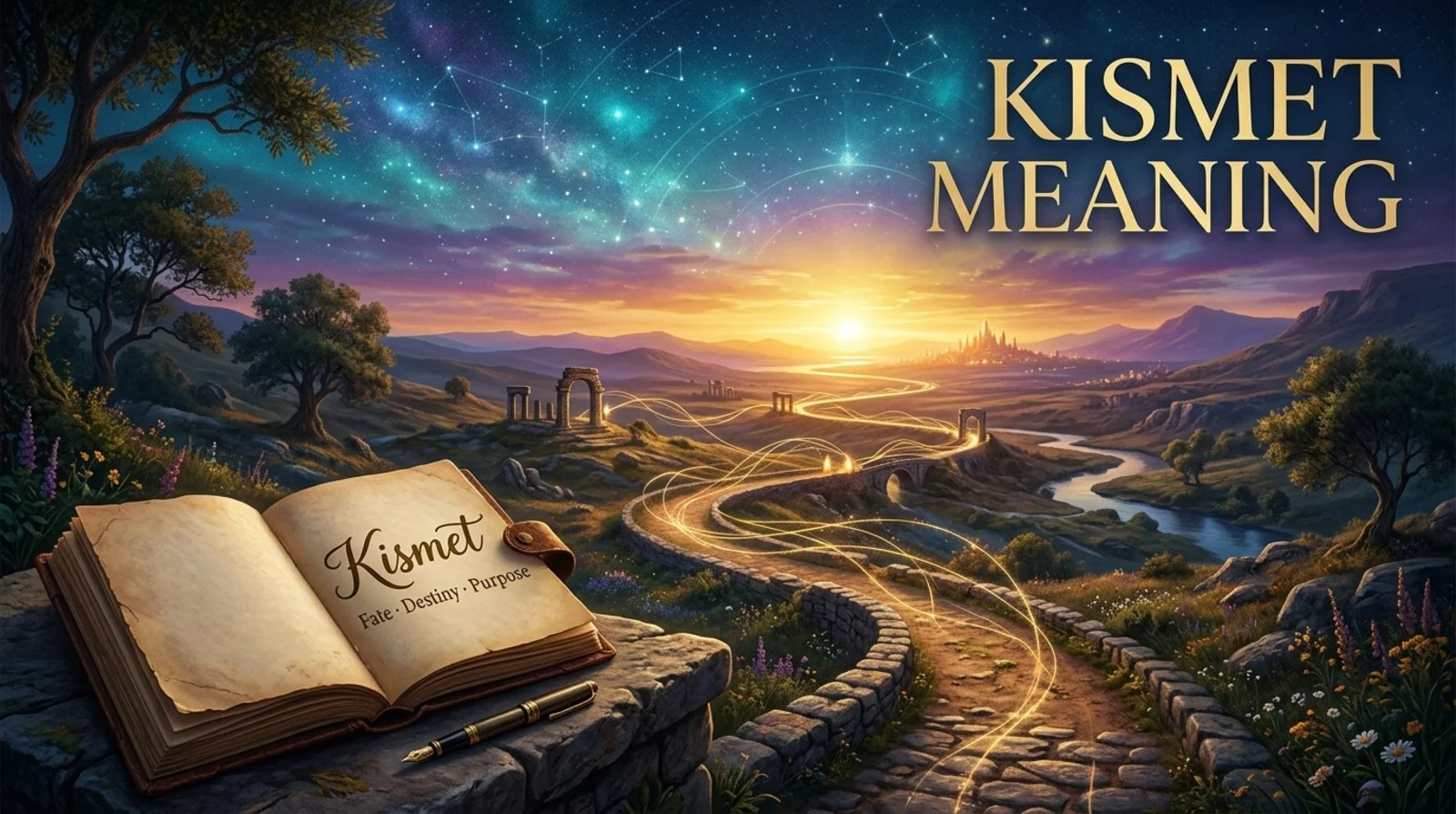
Some words carry more than a definition, and kismet meaning is one of them. The word is often used when people talk about fate, destiny, or events that seem meant to happen. It comes from a rich linguistic and cultural tradition and has connections with the idea of what is allotted or destined for a person. In everyday English, kismet can describe an unexpected outcome that feels destined rather than purely accidental.
Understanding kismet meaning also requires looking beyond a simple synonym for “fate.” Its use can carry cultural, literary, and emotional nuances depending on the context. This guide explains its definition, origin, pronunciation, usage, examples, and relationship with related ideas such as destiny and fortune, helping you understand how this distinctive word works in modern English.
What Does Kismet Mean?
Kismet means fate or destiny, especially the belief that some events are meant to happen and are beyond human control. It is an English noun often used when an unexpected event feels destined rather than purely accidental. For example, if two people meet by chance and later realize their meeting changed both of their lives, someone might describe it as kismet. Cambridge defines kismet as a force that some people believe controls what happens in the future and lies outside human control.
The word can sound more literary, romantic, or philosophical than ordinary words such as luck or chance. In modern English, it commonly appears in phrases such as “It was kismet” or “We met by kismet.”
Kismet Meaning in Simple English
In simple English, kismet means that something was destined to happen.
Imagine you miss a train. Because you missed it, you walk into a nearby café. There, you meet someone who later becomes an important friend or business partner. You might say:
“Maybe it was kismet.”
The idea is that the event was not simply random. It happened because it was somehow meant to happen.
Kismet is therefore closely connected with fate, destiny, fortune, and the idea of a predetermined future. Oxford describes it as the idea that everything happening in a person’s life has already been decided and cannot be changed or controlled.
Kismet Definition and Part of Speech
Kismet is a noun, and it is generally treated as an uncountable noun in English.
| Word | Meaning | Part of Speech | Tone |
|---|---|---|---|
| Kismet | Fate or destiny | Noun | Literary, reflective |
| Fate | A predetermined course of events | Noun | Neutral to serious |
| Destiny | A future believed to be meant for someone | Noun | Often positive or grand |
| Fortune | Luck or circumstances affecting someone’s life | Noun | Neutral |
| Chance | An event occurring without a planned cause | Noun | Everyday |
Unlike chance, kismet suggests that an event has some deeper sense of inevitability.
Pronunciation of Kismet
Kismet is commonly pronounced approximately:
KIZ-met
Cambridge gives the pronunciation as /ˈkɪz.met/.
The word is usually pronounced as two syllables.
Kismet Origin and Etymology
The history of kismet is one reason the word carries such a strong sense of fate.
English borrowed the word through Turkish, from Persian qismat, which traces back to Arabic qisma or qismat, meaning ideas such as a portion, lot, or fate. The Arabic root is connected with a verb meaning “to divide” or “to allot.”
That history gives the word an interesting underlying image: a person’s allotted portion or share.
The English word appeared in the 19th century. Collins dates its English origin to around 1840 to 1850, while Oxford describes it as an early 19th-century borrowing.
Why Does Kismet Mean Fate?
The connection becomes clearer when you think about the older sense of a person’s “lot” or “portion.”
If life is imagined as giving each person a particular portion or lot, then that portion can come to represent the events and circumstances assigned to them.
Over time, kismet became strongly associated with fate and destiny.
Kismet vs. Fate vs. Destiny
These words overlap, but they do not always create exactly the same feeling.
| Word | Main Idea | Common Feeling | Example |
|---|---|---|---|
| Kismet | Events are meant to happen | Literary or romantic | “Our meeting felt like kismet.” |
| Fate | Events are controlled by forces beyond us | Serious or philosophical | “She believed fate brought them together.” |
| Destiny | A future believed to be meant for someone | Often hopeful or significant | “He felt destined for that career.” |
| Luck | Good or bad results influenced by chance | Casual | “We had good luck today.” |
| Chance | Something happens without deliberate planning | Everyday and neutral | “We met by chance.” |
| Fortune | Luck or circumstances affecting life | Formal or literary | “Fortune favored the travelers.” |
Kismet vs. Fate
Kismet and fate are very close synonyms.
The main difference is often stylistic.
Fate is an ordinary and widely used English word. Kismet has a more distinctive cultural and literary flavor.
Compare:
- “It was fate that brought us together.”
- “It was kismet that brought us together.”
Both express the same broad idea, but the second can feel more unusual and romantic.
Kismet vs. Destiny
Destiny often points toward a person’s future or life purpose.
Kismet can describe a particular event that feels destined.
For example:
“She believed it was her destiny to become a teacher.”
But:
“Meeting her at that conference was kismet.”
The distinction is not absolute. In everyday English, the words can overlap.
Is Kismet a Positive or Negative Word?
Kismet is not inherently positive or negative.
Its emotional meaning depends on the situation.
A happy coincidence may be called kismet:
“Finding that apartment on the same day I got my new job felt like kismet.”
A difficult event can also be described through the idea of fate:
“He accepted the result as kismet.”
In modern English, however, kismet is frequently used in positive, romantic, or meaningful situations.
It often appears when people want to describe a coincidence that feels unusually significant.
How to Use Kismet in a Sentence
Kismet is usually used as a noun.
Here are natural examples:
- It was kismet that we met at the bookstore.
- Their unexpected friendship felt like kismet.
- She believed kismet had brought them together.
- Finding that opportunity at exactly the right moment seemed like kismet.
- Maybe our paths crossed because of kismet.
- He considered their reunion an act of kismet.
- The timing was so perfect that it felt like kismet.
- They laughed and called their accidental meeting kismet.
- Sometimes a strange coincidence feels like kismet.
- She saw the unexpected invitation as kismet.
Common Pattern: “It Was Kismet”
One of the easiest ways to use the word is:
It was kismet.
This means that something happened in a way that felt destined.
Examples:
- “We both arrived early and ended up sitting together. It was kismet.”
- “I almost canceled the trip, but meeting my future business partner made me think it was kismet.”
This pattern works especially well in storytelling.
Kismet Meaning in Love and Relationships
The word kismet is particularly common in romantic contexts.
When people say that a relationship was kismet, they usually mean that meeting the other person felt destined.
For example:
“We lived in different cities, booked the same flight, and ended up sitting next to each other. It felt like kismet.”
Here, kismet does not prove that the relationship was destined. It expresses the speaker’s interpretation of the coincidence.
That distinction matters.
Kismet describes a belief or feeling about an event. It does not provide objective proof that an event was predetermined.
This makes the word useful in romantic writing, personal stories, novels, and reflective conversations.
Kismet Meaning in Life
In a broader sense, kismet can describe the belief that major events in life happen according to a predetermined course.
Someone might use the word when talking about:
- Meeting an important person
- Finding an unexpected opportunity
- Moving to a new place
- Changing careers
- Experiencing an unusual coincidence
- Recovering from an unexpected setback
- Arriving somewhere at exactly the right moment
For example:
“I never planned to move there, but that decision changed my entire career. Sometimes life has its own kismet.”
This usage gives the word a reflective quality.
Kismet Meaning in Urdu
In Urdu, kismet is commonly associated with قسمت (qismat).
Depending on context, related meanings include:
- قسمت
- نصیب
- تقدیر
- ভাগ्य / fortune in South Asian usage
- Fate
- Destiny
- Fortune
The exact translation depends on the sentence.
For example:
“It was kismet.”
can be understood broadly as:
“یہ قسمت تھی” or “یہ تقدیر میں تھا”
In South Asian languages, forms related to qismat are widely used, and the word has developed rich cultural associations around luck, destiny, and one’s allotted share in life.
The linguistic connection is also reflected in the history of the English word, which passed through Turkish and Persian from Arabic.
Kismet Meaning in Turkish
The Turkish form is kısmet.
Turkish dictionary data gives the word meanings connected with a person’s allotted life circumstances, fortune, and destiny. It can also have culturally specific uses beyond the broad English meaning of fate.
This is important because the English word should not automatically be treated as identical to every meaning or cultural use of Turkish kısmet.
English mainly uses kismet to mean fate or destiny.
Is Kismet an Islamic Word?
Kismet has a historical connection to Arabic and has been used in Muslim cultural contexts, but its English meaning needs some care.
The English word comes through Turkish and ultimately traces to Arabic qisma/qismat, associated with portion, lot, or fate.
Some English dictionaries also record an Islamic-related sense involving divine will. Dictionary.com, for example, notes this usage in British English while also giving the broader meanings of fate and destiny.
However, kismet should not automatically be treated as a complete synonym for every theological idea about destiny in Islam.
Religious concepts can have more specific meanings than an English vocabulary word. When discussing theology, it is better to use the terminology appropriate to the specific tradition and context.
Kismet Synonyms
The closest everyday synonyms for kismet are:
- Fate
- Destiny
- Fortune
- Lot
- Providence
- Predestination
They are not interchangeable in every sentence.
Best Synonym by Context
| If you mean… | Better choice |
|---|---|
| A predetermined event | Fate |
| A person’s future path | Destiny |
| Good or bad luck | Fortune |
| An allotted share | Lot |
| Divine guidance or care | Providence |
| A predetermined outcome | Predestination |
| A meaningful coincidence | Kismet |
Cambridge directly lists fate and destiny as synonyms of kismet.
Is Kismet the Same as Karma?
No. Kismet and karma are related ideas in some conversations, but they are not synonyms.
Kismet concerns fate, destiny, or events believed to be outside human control.
Karma is a concept with specific religious and philosophical histories, especially in Indian traditions. It is commonly associated with the consequences of actions, although its meaning varies considerably across traditions.
So replacing kismet with karma can change the meaning.
Compare:
“Meeting her felt like kismet.”
This focuses on destiny.
“His actions eventually had karmic consequences.”
This focuses on consequences associated with actions.
Kismet vs. Chance
This is one of the most useful distinctions for English learners.
Chance describes something that happens without planning or certainty.
Kismet describes something that happens and is interpreted as destined or meant to happen.
For example:
“We met by chance.”
This simply describes an accidental meeting.
“We met by chance, but it felt like kismet.”
This adds the idea that the meeting seemed meaningful or destined.
The two words can therefore appear in the same sentence without contradicting each other.
Is Kismet Formal or Informal?
Kismet is best described as literary or somewhat formal compared with everyday words such as fate, luck, and chance.
Oxford labels it literary, which is useful guidance for English learners.
You may encounter it in:
- Personal essays
- Literature
- Romantic writing
- Feature articles
- Storytelling
- Reflective conversations
- Creative writing
It is less common in highly technical or straightforward professional communication.
For example, this sounds natural in a personal story:
“Meeting my mentor felt like kismet.”
But in a business report, a simpler phrase may be clearer:
“The opportunity arose unexpectedly.”
Common Mistakes With Kismet
1. Treating kismet as exactly the same as luck
Kismet and luck overlap, but they emphasize different ideas.
Luck usually concerns fortunate or unfortunate circumstances.
Kismet suggests destiny or a predetermined outcome.
2. Using kismet as a verb
Kismet is a noun.
Incorrect:
“The universe kismeted us.”
Better:
“It felt like kismet.”
3. Assuming kismet proves destiny
Kismet expresses an interpretation or belief.
Calling something kismet does not establish that the event was objectively predetermined.
4. Using kismet in every situation involving coincidence
A simple coincidence does not automatically need the word kismet.
Use it when the event carries a sense of meaning, destiny, or inevitability.
5. Confusing kismet with karma
The two concepts have different histories and meanings.
Use kismet when the focus is fate or destiny. Use karma only when the context genuinely concerns that concept.
When Should You Use Kismet?
Use kismet when you want to express more than simple coincidence.
It works especially well when:
- Two unexpected events connect perfectly.
- A meeting changes someone’s life.
- An opportunity arrives at an unusually meaningful time.
- A relationship seems destined.
- Someone reflects on the course of their life.
- A coincidence feels too meaningful to dismiss.
A useful test is this:
If you could replace the word with “meant to happen” without changing the main idea, kismet may fit.
Words Similar to Kismet
Some related words are close in meaning but should not be treated as exact synonyms.
- Fate
- Destiny
- Fortune
- Providence
- Serendipity
- Chance
- Luck
- Predestination
- Lot
- Fortune
- Coincidence
Serendipity is especially interesting.
Serendipity usually describes a fortunate discovery or pleasant outcome that happens unexpectedly. Kismet focuses more strongly on the idea that an event was destined.
For example:
“Finding the old photograph was a moment of serendipity.”
versus:
“Meeting my future partner that day felt like kismet.”
Antonyms and Contrasting Ideas
There is no single perfect antonym for kismet because its meaning involves a philosophical idea rather than a simple physical action.
Depending on context, contrasting concepts include:
- Free will
- Choice
- Agency
- Control
- Deliberate action
- Chance
- Randomness
- Uncertainty
The contrast between kismet and free will is particularly interesting.
Kismet emphasizes events that seem predetermined. Free will emphasizes a person’s ability to make meaningful choices.
These ideas can be discussed together without assuming that one completely eliminates the other.
10 More Natural Examples of Kismet
Here are additional examples showing different contexts:
- Their paths crossed at exactly the right moment, and they called it kismet.
- I had planned to leave early, but staying gave me the chance to meet her. It felt like kismet.
- He viewed the unexpected job offer as kismet.
- The reunion seemed like kismet after twenty years apart.
- She does not believe in kismet, but she enjoyed the coincidence.
- Their friendship began through a series of events that felt like kismet.
- The timing was so unusual that everyone joked about kismet.
- For him, the opportunity was more than luck; it was kismet.
- The couple described their first meeting as pure kismet.
- Sometimes people use kismet to give meaning to unexpected events.
Quick Guide to Kismet
| Question | Answer |
|---|---|
| What does kismet mean? | Fate or destiny |
| Is kismet a noun? | Yes |
| Is kismet countable? | Usually uncountable |
| Is kismet positive? | Not inherently |
| Is kismet formal? | Somewhat literary |
| What is the closest synonym? | Fate or destiny |
| What is kismet in Urdu? | Commonly associated with قسمت (qismat) |
| What is kismet in Turkish? | kısmet |
| Does kismet mean luck? | It can overlap with fortune, but destiny is closer |
| Is kismet the same as karma? | No |
| Can kismet describe love? | Yes |
| Can kismet describe coincidence? | Yes, when the coincidence feels destined |
Frequently Asked Questions
What is the exact kismet meaning?
Kismet means fate or destiny, especially the idea that certain events are controlled by forces beyond human control. In everyday English, it can describe a coincidence that feels as if it was meant to happen.
What does kismet mean in love?
In love, kismet usually means that meeting or being with someone feels destined or meant to happen. It is often used to describe an unusually meaningful romantic coincidence.
Is kismet a positive word?
Kismet is not inherently positive or negative. The context determines its emotional tone. In modern English, it is often used positively when people describe a fortunate or romantic event that feels destined.
What is another word for kismet?
The closest alternatives are fate and destiny. Depending on context, fortune, lot, and providence can also be related. Cambridge lists fate and destiny as synonyms.
What is kismet in Urdu?
Kismet is closely related to the Urdu word قسمت (qismat), commonly associated with fate, destiny, fortune, or one’s allotted share in life.
Is kismet the same as fate?
Kismet and fate have very similar meanings. The main difference is often tone. Fate is much more common in everyday English, while kismet can sound more literary, distinctive, or romantic.
Is kismet the same as destiny?
They can mean nearly the same thing. Destiny often emphasizes a person’s future or life path, while kismet can emphasize a particular event that seems destined.
Where did the word kismet come from?
English kismet came through Turkish from Persian qismat, ultimately from Arabic qisma/qismat, connected with ideas of division, portion, lot, and fate.
Final Thoughts
Kismet means fate or destiny, but the word carries more feeling than a simple dictionary definition suggests. It is often used when an unexpected event seems perfectly timed or strangely meaningful.
Its history also explains its connection to the idea of an allotted portion or “lot.” English borrowed the word through Turkish, with deeper roots in Persian and Arabic.
In everyday writing, fate or destiny will usually be the simplest choices. But when you want to describe a coincidence that feels almost destined, kismet can add a more literary and memorable touch.
Discover More Post:
- Hawk Tuah Meaning | Origin, Definition, Viral Slang & How It’s …
- CYA Meaning in Text: The Real Meaning, Examples, Tone …
- SB Meaning in Text | The Real Meaning, Modern Uses …