You ask a simple question in the group chat. “Pizza or tacos tonight?” The reply comes back in three flat letters: “idc.” No emoji, no follow up, no hint about what they actually want. You read it twice and still cannot tell if your friend is relaxed, bored or quietly annoyed.
Here is the short answer first. IDC means “I don’t care”, and people type it when they have no strong preference or when a topic simply does not matter much to them. That sounds simple, but the same three letters can be a friendly shrug or a cold shutdown, and the difference sits in the chat around them. This guide covers the idc meaning in text, the tone traps, IDC vs IDK and IDGAF, where you will see it, and the best replies for every version of it.
What Does IDC Mean in Text?
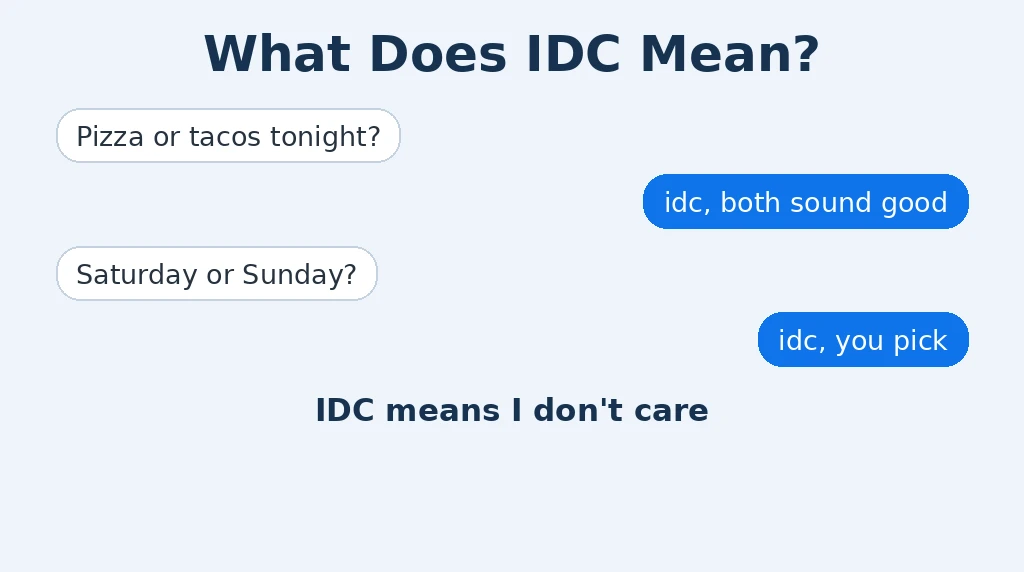
IDC is short for “I don’t care”. Someone sends it when a choice feels equal to them, when a topic does not move them either way, or when they want to hand the decision to the other person. “idc, you pick the movie” is not a complaint. It is permission to choose, wrapped in three letters.
The same letters turn colder when they land alone. A bare “idc” after a long, thoughtful message can read like a door closing, even if the sender only meant to be quick. Punctuation sharpens that edge. “idc.” with a full stop looks firmer than “idc” on its own, and “idc lol” reads lighter than either one. Lowercase idc is the everyday form and feels softer than capital IDC, which can look like someone raising their voice a little.
So the letters never tell the whole story. Read the message above them, the relationship behind them, and the emoji beside them. A friend who adds “idc, whatever makes you happy” is being easy. A friend who answers a serious question with a lone “idc” may be upset, tired or done with the topic. Context is the real dictionary here.
Full Form of IDC
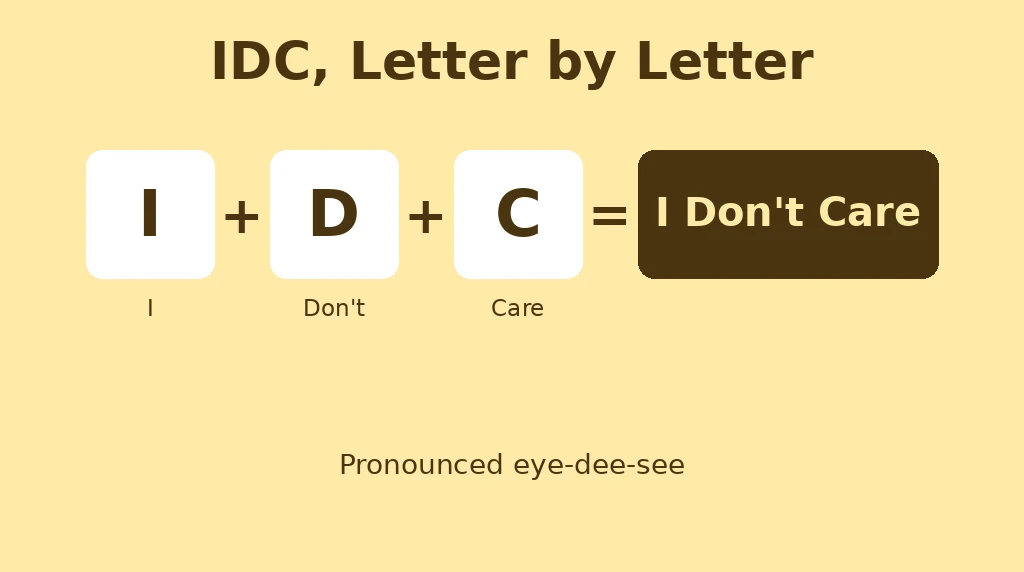
The full form is as direct as the abbreviation, with one word behind each letter:
- I: I
- D: don’t
- C: care
Put together, you get “I don’t care”. There is no hidden second layer in the texting sense, which is why it spread so fast. Say it out loud and people pronounce each letter on its own: eye-dee-see. You will hear that spoken version in voice chats and in jokes between friends who text all day.
IDC vs IDK vs IDGAF: What Is the Difference?
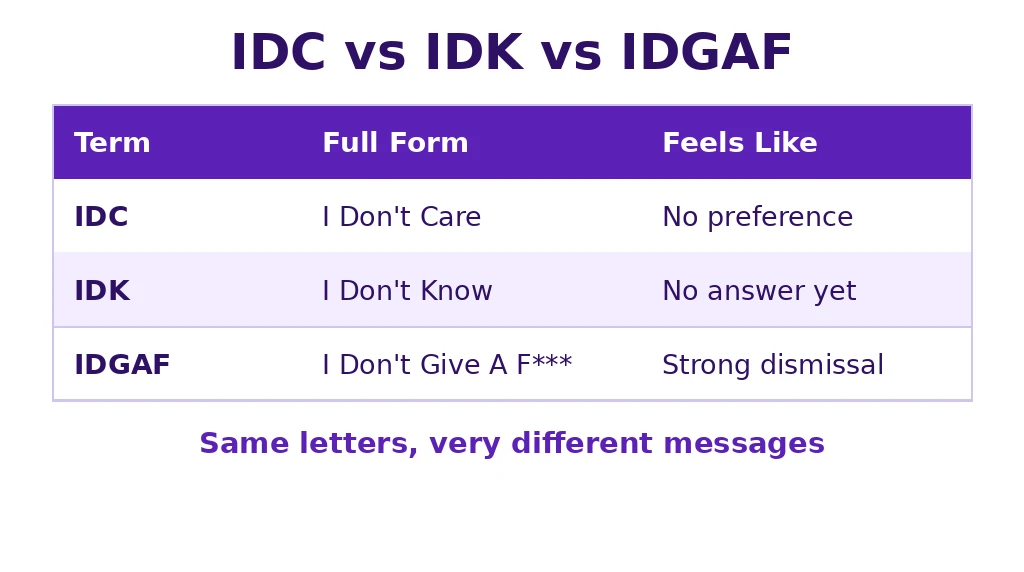
Three short abbreviations cause most of the mix ups in this corner of texting, so here they are side by side.
| Abbreviation | Full Form | What It Really Says | Tone |
|---|---|---|---|
| IDC | I don’t care | I have no preference | Neutral, sometimes blunt |
| IDK | I don’t know | The answer is missing | Neutral, honest |
| IDGAF | I don’t give a f*** | I refuse to care at all | Hard, dismissive |
The classic mix up is IDC versus IDK, because the two look almost identical at a glance. They say different things, though. idk talks about knowledge: the person is missing information. IDC talks about attitude: the person has the facts, or could get them, and simply does not mind either way. Reply “idk” to “where should we eat?” and you are undecided. Reply “idc” and you are happy with anything. Swap them and the whole mood of the reply flips.
IDGAF sits far beyond both of them. It adds a swear word and a hard edge, so it reads as a deliberate dismissal rather than a shrug. If IDC is a closed door, IDGAF is a slammed one. A softer cousin worth knowing is IDM, short for “I don’t mind”, which says the same easy thing as IDC without any of the cold edge. When you want to sound relaxed instead of blunt, IDM is the safer pick.
Where IDC Is Commonly Used
Texting and WhatsApp
One to one chats are the natural home of idc. It answers quick either or questions about food, films and plans without slowing anything down. A typical line looks like this: “tacos or burgers?” “idc, both sound good, you pick”. Short, honest, and the chat keeps moving.
Instagram and Snapchat
On Instagram and Snapchat, idc shows up in DMs and in replies to stories, often when someone reacts to a plan or a photo they have no strong feelings about. It also appears in captions and bios, where people use it as a small badge of attitude, a way of saying they are not bothered by outside opinions. You will see lines like “idc what anyone thinks” under a bold photo, or a quick “idc, post it” in a DM about a picture choice.
TikTok Comments
Scroll a busy TikTok comment section and idc is everywhere. Viewers use it to shrug at drama, to dismiss a debate, or to admit a trend leaves them cold. Comments like “idc, the sequel was better” and “idc what yall say, this song slaps” have become formats of their own, and the hashtag #idc gathers the same carefree energy in one place.
Group Chats
Group chats run on half finished plans, so idc is the glue holding them together. One person asks who is bringing snacks, two people reply idc, and the plan stays tbd until someone finally decides. It keeps the thread alive without forcing a fake opinion out of anyone.
Gaming Chats
In game chat there is no time for full sentences, so idc does quick work between rounds. Players type things like “idc which map we play” or “idc, you pick the loadout” while the match is still moving. Everyone understands it instantly, and nobody stops playing to decode it.
Discord and Forums
Discord servers and forums use idc the same way, just in longer threads. Someone asks about a patch note or a build, and “idc, both builds work fine” is a normal, accepted reply. It signals “I have no stake in this” without pretending to be an expert answer.
Origin and History of IDC
IDC belongs to the first big wave of texting shortcuts. It grew out of 1990s internet chat rooms and instant messaging, when slow keyboards and small screens pushed people to shorten the phrases they typed most often. “I don’t care” is one of the most typed sentences in daily life, so it was an early candidate for the chop.
The abbreviation was already in circulation by the early 2000s, with slang dictionaries recording entries around 2003, and it travelled with texting from SMS to instant messenger to every social app that followed. It never really went out of fashion because the need behind it never changed. People still face choices they feel neutral about every single day, and they still want to say so quickly. Its staying power is now official, too: major dictionaries list IDC as a real entry, which is more than most slang ever manages.
Other Meanings and Variations of IDC
In casual texting, IDC almost always means “I don’t care”, but the same letters carry other meanings in other rooms, and a few close cousins shift the tone.
- In due course: in formal business writing, IDC can stand for “in due course”, meaning something will happen at the right time. You will see it in emails like “payment will follow in due course”, never in a chat about dinner.
- International Data Corporation: in tech and business news, IDC is a well known market research firm. “IDC published a report on phone sales” has nothing to do with texting.
- IDRC: “I don’t really care”. A slightly softer IDC, useful when you want to sound less blunt.
- IDM: “I don’t mind”. The warmest version of the idea, and the best pick when you want to sound easy rather than cold.
- IDGAF: the hard, sweary version. Same idea, far more force, and easy to regret in the wrong chat.
On social media, idc also works as a caption and a tag. A photo captioned “idc” or tagged #idc is not answering a question at all. It is a mood, a small public shrug that says the poster is unbothered. Read that use as attitude, not as an answer.
How to Use IDC Correctly
- Keep it casual. IDC belongs in friendly, informal chats. If the conversation would not welcome a “lol”, it will not welcome an “idc” either.
- Mean it. Use it when you truly have no preference. People can tell a lazy idc from an honest one, and the lazy version reads very differently.
- Add one small detail. “idc, whatever works best for you” takes two extra seconds and sounds ten times warmer than a bare idc on its own.
- Watch the moment. If a friend is upset or asking about something that matters to them, a flat idc can land badly. Slow down and write a real sentence instead.
- Pair it with a next step. “idc, you pick and I will go along with it” closes the loop. The other person knows the decision is made, not just dodged.
Example Conversations Using IDC
Planning dinner with a friend
Person A: “Pizza or tacos tonight?”
Person B: “idc, both sound good honestly”
Picking a weekend day
Person A: “Saturday or Sunday for the trip?”
Person B: “idc, whichever works better for you”
Choosing a movie
Person A: “Comedy or horror tonight?”
Person B: “idc, you choose, I will watch either”
A group chat decision
Person A: “Movie night or game night?”
Person B: “idc, just excited to hang out”
Gaming with a teammate
Person A: “Which map should we play?”
Person B: “idc, you pick this time”
An Instagram DM
Person A: “Which photo should I post?”
Person B: “idc, they are both really nice”
A TikTok comment
Person A: “People are arguing about this online again”
Person B: “idc tbh, not that deep”
The cold one
Person A: “Are you even listening to me?”
Person B: “idc.”
That last one stings, and the full stop is doing half the damage. Same letters, very different message.
When Not to Use IDC
- Work email: write “I am flexible either way” instead. Three letters look careless on the record.
- Job interviews and applications: even over chat, recruiters read idc as unprepared or uninterested.
- Teachers and bosses: anyone grading or managing you deserves the full sentence.
- Customer service chats: on either side of the counter, idc sounds like nobody is taking the problem seriously.
- Serious conversations: when someone is upset or asking for real support, a bare idc can feel like a door closing.
- During an argument: idc in a fight reads as “I have stopped listening”, and it usually makes things worse.
How to Respond When Someone Sends You IDC
An idc lands in your chat and the ball is suddenly in your court. What you send next decides whether the conversation picks up again or quietly stalls. Pick the lane that matches the moment.
Decisive replies work when the idc was a friendly shrug:
- “Okay, I will pick then.”
- “Done, tacos it is.”
- “Cool, I will decide and send the plan.”
Patient replies suit a flat or tired sounding idc:
- “No worries, we can decide later.”
- “All good, tell me if you change your mind.”
Playful replies fit close friends and light topics:
- “smh, okay, I will decide then”
- “lol you say idc to everything”
- “idc either, we are a great team”
Check in replies help when the idc feels off:
- “Everything okay? You seem a little off today.”
- “You sure? I can switch if you would rather do something else.”
One thing to avoid: do not fire back a sarcastic reply when the idc was honest. Most of the time the person is not dismissing you. They really do not mind, and a calm response keeps the chat friendly.
Common Mistakes People Make With IDC
- Confusing IDC with IDK. One letter changes “I do not mind either way” into “I do not know the answer”. In a sensitive chat, that swap can start an argument out of nothing.
- Reading every idc as rude. Most idc replies are honest and quick, not dismissive. Tone in text is easy to misjudge, so give the sender the benefit of the doubt first.
- Using it to dodge decisions. An idc here and there is normal. An idc for every plan, every day, quietly trains your friends to stop asking you.
- Using it at work. A manager who gets “idc” about a deadline hears “I have not looked into this”. Spell it out and add when you will know.
- Sending a bare idc in a serious chat. When feelings are involved, three letters are not enough. Add a sentence that shows you are still listening.
Frequently Asked Questions
What does IDC mean in text?
IDC means “I don’t care”. People type it in chats and messages when they have no strong preference about something, or when a topic simply does not matter much to them.
Is IDC rude?
Not by itself. In casual chats it is a normal, relaxed reply, though a bare idc in a serious conversation can sound dismissive, so adding a few extra words softens it.
What is the difference between IDC and IDK?
IDC means “I don’t care”, so it is about attitude and preference. IDK means “I don’t know”, so it is about missing information. The two are easy to mix up because they look almost the same.
What does IDC mean in due course?
In formal writing, IDC can stand for “in due course”, which means something will happen at the proper time. That meaning belongs in business emails, not in casual texting.
Can I use IDC in a work email?
No. IDC is casual texting shorthand, and it looks careless in professional writing. In a work email, write the full sentence, such as “I am flexible either way, please go ahead with your preferred option.”
How do I reply when someone sends me IDC?
Keep it easy. If it was a friendly shrug, just decide and move on. If it felt flat or cold, a gentle check in like “everything okay?” works better than a sarcastic reply.
Final Thoughts
Three letters, one simple job with a surprising amount of tone packed inside. IDC is the quickest way to say “either way works for me” in texting, and it has earned its place in everyday chats because everyone faces choices they feel neutral about. Used casually, with a little warmth when the moment is serious, it never really causes trouble.
If you want the official stamp, Dictionary.com lists idc with exactly this meaning, which shows how far a humble texting shortcut has come. Either way, you now have the idc meaning in text down, plus a decent reply ready for the next time it shows up in your messages.

1 thought on “IDC Meaning in Text: What It Means, How to Use It and How to Reply”