Your friend sends a photo of the goal they just scored in the game, and the group chat explodes. Not with sentences, not with paragraphs, just one letter repeated again and again: “W. W. W.” Nobody explains it, nobody needs to, and somehow everyone knows exactly what it means.
Here is the short answer first. W means “win”. People type it in chats, comments and livestreams to celebrate a victory, to praise someone, or to call a post, a play or an opinion good. It is the smallest compliment on the internet, and this guide covers the w meaning in text, where it came from, W vs L and dub, where you will see it, and the best replies for every version of it.
What Does W Mean in Text?
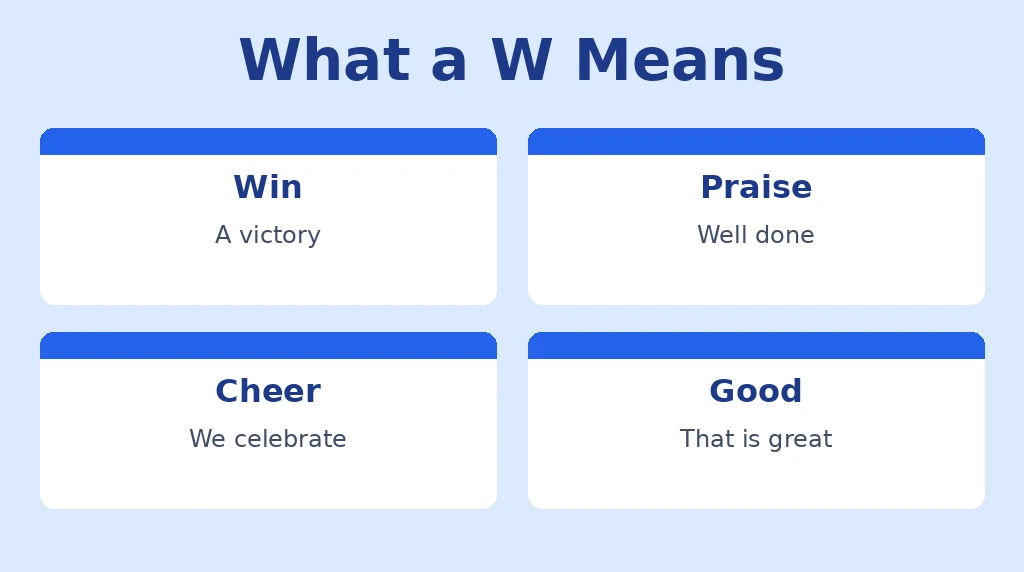
W is short for “win”. When someone drops a single W into a chat or a comment section, they are saying “that is a win”, “nice job” or “well done”, all in one letter. It works as a reaction, a compliment and a celebration at the same time, which is why it spread so fast.
You will see it standing alone and stuck in front of other words. A lone “W” under a video means the video is good. “W take” means a good opinion, “W fit” means a great outfit, and “W edit” means a great video edit. Put W before almost any noun and it turns into praise. The plural works the same way: “taking Ws” means collecting wins, one after another.
Lowercase “w” means the same thing as capital “W”, though the capital letter is far more common because it reads louder and clearer in a fast moving chat. A string of them, “WWWW”, is just a bigger celebration, like clapping harder. The meaning stays positive unless the context flips it: a W after a story about losing a wallet is sarcasm, because everyone knows that was not a win. Read the message above the W before you decide how it was meant.
Full Form of W
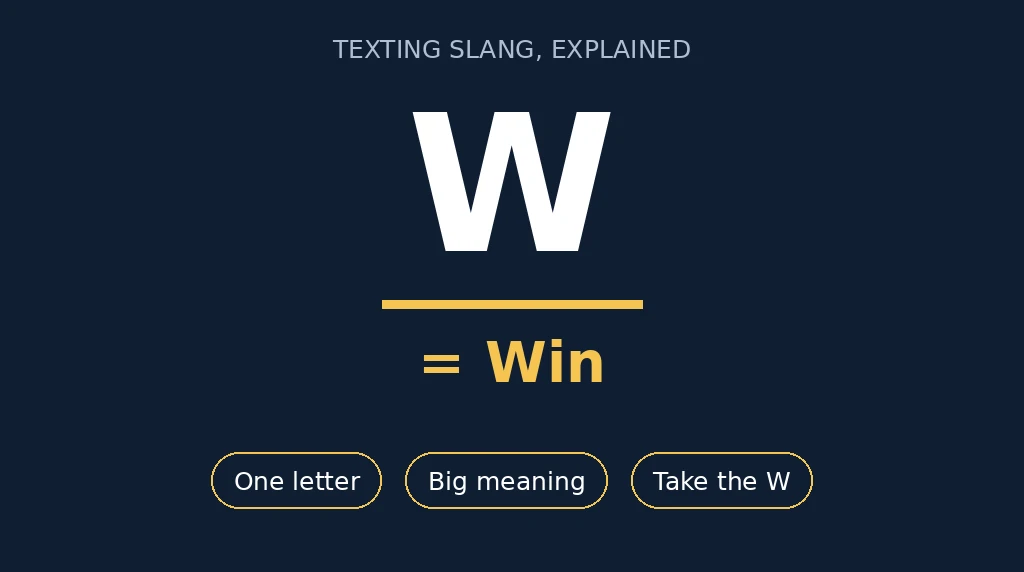
There is only one letter to unpack here, and it stands for a single word:
- W: win
Put plainly, W means win. People say the letter out loud as “double-u”, and the spoken slang shortens that to “dub”. So “take the dub” means the same as “take the W”: accept the win and enjoy it. You will hear it in gaming voice chats after a match and see it written in comments under a comeback story.
W vs L vs Dub: What Is the Difference?
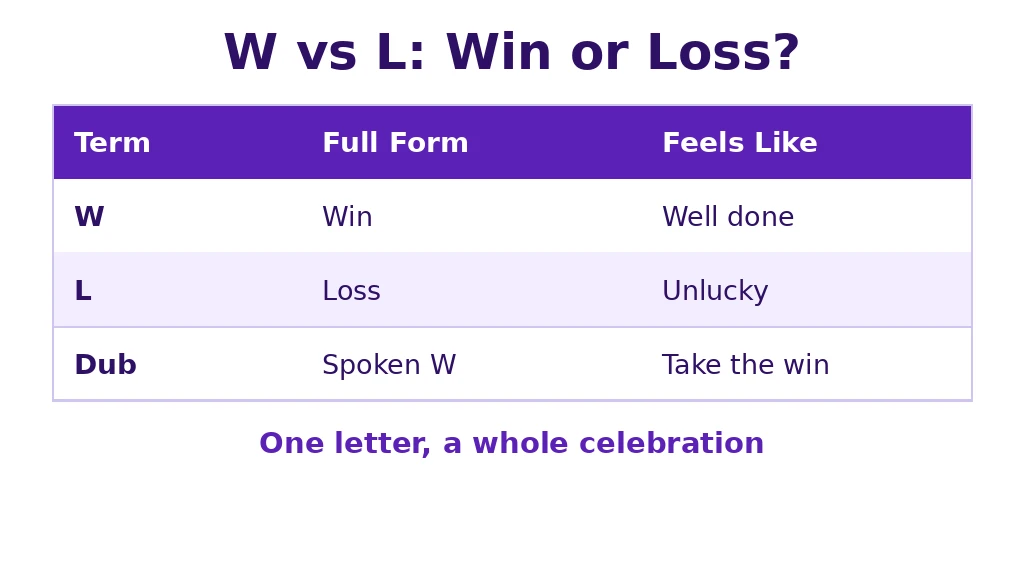
W, L and dub all live in the same win and loss family, but they do different jobs in a chat. Here they are side by side.
| Abbreviation | Full Form | What It Really Says | Tone |
|---|---|---|---|
| W | Win | That is a win, well done | Positive, celebratory |
| L | Loss | That is a loss, unlucky | Negative, teasing |
| Dub | Double-u, spoken W | We won, take the win | Positive, casual |
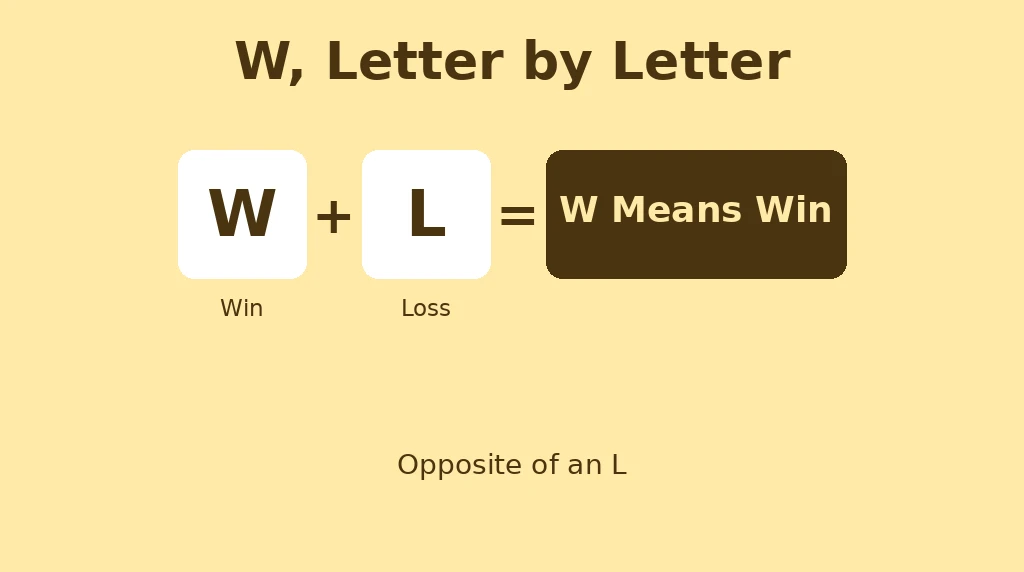
W and L are direct opposites, and both come from sports scorekeeping, where a W marks a win and an L marks a loss in the standings. Drop a W and you are cheering someone on. Drop an L and you are pointing at a failure, usually with a teasing edge, like “big L” under a video of a terrible decision. Nobody confuses the two, which is why they work so well as a pair in fast chats.
Dub is not a different meaning at all. It is simply how W sounds when people say it out loud. Gamers say “take the dub” after a match in the same way commenters type “take the W” under a post. If W is the written form, dub is the spoken form, and you can use either one in the right place. One more cousin is “W rizz”, good flirting or charm, where W does the same job and turns rizz into a compliment.
Where W Is Commonly Used
Texting and WhatsApp
In one to one chats and group chats, W is the quickest way to celebrate a friend. Someone shares good news, a promotion, a passed exam, a goal scored, and a single W says you are happy for them. A typical exchange: “I got the job!” “W, congrats, we are celebrating tonight”.
Instagram and Snapchat
On Instagram and Snapchat, W lives in DMs, story replies and captions. People reply “W” to a story showing a new outfit or a holiday photo, and creators caption their own posts “W day” to say the day went well. It also shows up under Reels, where a lone W is the fastest possible compliment.
TikTok Comments
TikTok is where W feels most at home. Comment sections fill with W under impressive videos, clever jokes and bold opinions, and phrases like “W take” and “W edit” have become formats of their own. Creators read a flood of Ws as the highest praise a video can get.
Group Chats
Group chats use W as a shared cheer. One person drops good news and the rest answer with a run of Ws, sometimes ten in a row, and the whole thread turns into a small celebration. It also works as a quick vote: “W or L?” after someone shares a risky plan, and the answers tell them what the group really thinks in seconds.
Gaming Chats
Gaming is where W grew up. After a match, players type “W” or “GG W” to mark the win, and in voice chat they shout “we got the dub”. It is the fastest possible victory lap between rounds, and everyone in the lobby understands it instantly. Even in defeat, a player might type “W” for a great play by an opponent, because a win is a win whoever earned it.
Discord and Forums
Discord servers and forums use W the same way, just in longer threads. Someone shares a build, a clip or a hot take, and “W” replies stack up underneath it. On Reddit, a comment starting with W is a quick endorsement. It is a vote, a compliment and a cheer in a single letter.
Origin and History of W
W starts in sports, long before phones existed. Scorekeepers and league tables have marked wins with a W and losses with an L for decades, because a single letter fits neatly in a standings column. Fans picked up the habit, and “taking the W” became everyday sports talk for winning a game or a bet.
Gaming carried it online. Multiplayer lobbies in games like Fortnite, Call of Duty and League of Legends filled with players typing W after a match win, and the letter became a habit in game chat. Then Twitch livestreaming turned it into a crowd event. Viewers spam “W in the chat” when a streamer pulls off something impressive, and the whole chat becomes a cheering crowd made of one repeated letter. A meme helped it along too: the phrase “look at the size of this W” went viral on X in November 2020, joking about an oversized win.
From Twitch it spread to TikTok, Instagram and everyday texting in the early 2020s. A W can now praise a meal, an outfit, a joke or a life decision, and it needs no translation.
Other Meanings and Variations of W
In texting and on social media, W almost always means win, but the letter has a few close cousins and one important lookalike to know about.
- Big W, huge W, massive W: a bigger than usual win. “Huge W” under a comeback story means the win was impressive, not just ordinary.
- Common W: someone who regularly does good things. “Common W for her” means she is good at this, as usual.
- Rare W: an unusual win from someone who rarely gets one. It is a compliment with a joke inside it.
- W rizz: good flirting or charm. The W turns rizz, which means romantic charm, into a compliment.
- Take the W: accept a victory gracefully and enjoy it, even a small one. “We take those” is the matching reply.
- Dub: the spoken form of W, from double-u. “Take the dub” and “take the W” mean the same thing.
- w/ (with a slash): this one is different and easy to mix up. Lowercase “w/” with a slash means “with”, as in “coffee w/ Sam”. A bare W means win, so the slash is the clue.
On social media, W also works as an adjective in captions. “W day”, “W outfit”, “W couple” all mean the same thing: that day, outfit or couple is good. Read it as praise, not as a reply to a question, because a caption W is a mood, not an answer.
How to Use W Correctly
- Use it to celebrate, not to inform. W is a reaction, not a message. It belongs after good news, a great play or a good post, where everyone already knows what happened.
- Match the size to the win. A single W suits a small win and a run of Ws suits a big one. Spamming ten Ws for a minor thing reads as a joke, so save the flood for real moments.
- Keep it casual. W belongs in friendly chats, comment sections and livestreams. If the conversation would not welcome a “lol”, it will not welcome a W either.
- Watch the sarcasm line. A W after bad news is a joke, and jokes about bad news can sting. Only use it sarcastically with close friends who will read it as a joke.
- Pair it with words when it matters. “W, so proud of you” means far more than a bare W when a friend shares real news. The letter starts the cheer, and the words finish it.
Example Conversations Using W
Celebrating a job offer
Person A: “I got the job! Starting Monday”
Person B: “W! So happy for you, we are celebrating tonight”
A gaming win
Person A: “We won the match 3 to 0”
Person B: “W, we take those every time”
A TikTok comment
Person A: “This edit is unreal, the timing is perfect”
Person B: “W edit, idc what anyone says”
A group chat vote
Person A: “Road trip this weekend, W or L?”
Person B: “W, obviously, I am already packing”
Praising an outfit
Person A: “New fit for tonight, what do you think?”
Person B: “W fit, ong that jacket is unreal”
A Twitch stream
Person A: “He just hit that shot from across the map”
Person B: “W in the chat, that was insane”
The sarcastic one
Person A: “Forgot my wallet again, had to walk home”
Person B: “W. Great planning as always”
That W is a joke, and both friends know it. Same letter, opposite meaning, all from context.
A small everyday win
Person A: “Finally finished my assignment at 2am”
Person B: “W, now go get some sleep”
When Not to Use W
- Work email: write “great work” or “well done” instead. A single letter looks careless on the record.
- Job interviews and applications: even over chat, recruiters read a bare W as unserious.
- Serious or sad news: a W after someone shares bad news reads as dismissive or mocking, even if you meant it lightly.
- Someone’s misfortune: never reply W to a story about an accident, a loss or a failure. It will look like you are celebrating their bad luck.
- Formal writing: essays, applications and official messages need full words, not chat shorthand.
- When the tone is unclear: if a stranger cannot tell whether you are joking, skip the sarcastic W and write a real sentence.
How to Respond When Someone Sends You W
A W in your chat is almost always good news: someone is cheering for you. Pick the lane that matches the moment.
Grateful replies work when the W was praise for you:
- “Thank you! Appreciate it.”
- “Thanks, means a lot.”
- “Appreciate the love, honestly.”
Hype replies suit a big win with friends:
- “Let’s go! We take those.”
- “We got the dub!”
- “W, I know right, still cannot believe it.”
Playful replies fit close friends and light topics:
- “W back at you.”
- “Common W for me, what can I say.”
- “I know, I am built different.”
Confused replies help when a W makes no sense:
- “huh, what did I win?”
- “Wait, what happened? Fill me in.”
One thing to avoid: do not answer a sincere W with a sarcastic one. Most of the time the person is genuinely happy for you, and a warm reply keeps the good feeling going.
Common Mistakes People Make With W
- Mixing up W and w/. A bare W means win, while “w/” with a slash means with. Reading “coffee w/ Sam” as a win makes no sense, and the slash is the only difference.
- Using a sarcastic W with strangers. Friends know your humour, strangers do not. A sarcastic W from someone new reads as mocking, not funny.
- Sending a W for serious news. A friend sharing something sad does not want a cheer. Read the message first, then choose your reply.
- Spamming Ws for tiny things. A flood of Ws for every small moment wears thin fast.
- Assuming every W is sincere. Context decides. A W under a fail video is a joke, and replying as if it were praise misses the joke completely.
Frequently Asked Questions
What does W mean in text?
W means “win”. People type a single W in chats and comments to celebrate a victory, praise someone, or call something good.
Is W always positive?
Almost always. A W is a compliment or a celebration by default. It only turns sarcastic when the context is clearly a failure, such as replying W to a story about losing your keys.
What is the difference between W and L?
W stands for win and L stands for loss. A W celebrates something good, while an L marks a failure or a bad take. They are direct opposites, and both come from sports scorekeeping.
What does W in the chat mean?
“W in the chat” is a Twitch and livestream phrase. Viewers spam W in the chat to applaud a streamer together, like a crowd cheering. It means the streamer just did something worth celebrating.
What does dub mean in slang?
Dub is the spoken form of W. It comes from the way the letter W is pronounced, double-u, shortened to dub. Saying “take the dub” means the same as saying “take the W”, to accept a win.
Can I use W in a work message?
Not in a formal work email, where a full sentence is better. In a casual team chat among close colleagues, a quick W after good news is usually fine, though a plain “great work” is safer with a manager.
Final Thoughts
One letter, one simple job, and a surprising amount of history packed inside. W is the quickest way to say “that is a win” in texting, and it has earned its place in everyday chats because everyone loves a short, clear cheer. It started in sports tables, grew up in gaming lobbies, became a crowd chant on Twitch, and now praises everything from outfits to exam results.
If you want the official stamp, Dictionary.com lists the slang sense of win and the spoken form dub, which shows how far a humble letter has travelled. Either way, you now have the w meaning in text down, plus a decent reply ready for the next time a W shows up in your messages.
