You are scrolling through the comments under a video when one short word stops you. Someone wrote “ong” at the end of a sentence, and the whole comment suddenly reads louder, bolder, more certain. You have seen it before, in group chats and TikTok captions, and every time it pops up it feels like the person is leaning in to make a point.
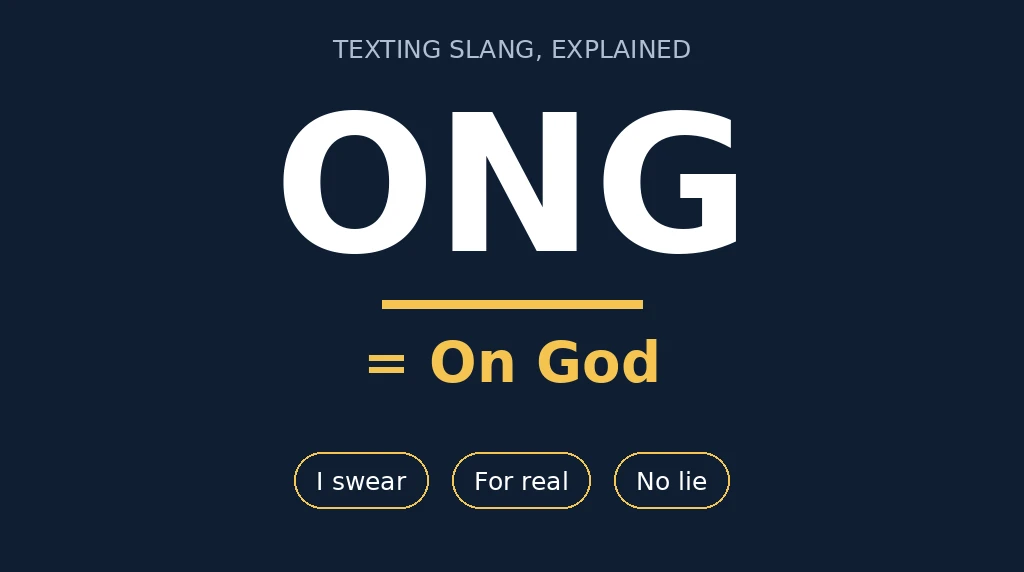
Here is the quick answer. ONG means “On God”, and people use it the way they would say “I swear” or “for real”. It adds weight to a sentence, a promise that the person is telling the truth and means every word. This guide covers the ong meaning in text, how it sounds in different chats, where it came from, and what to send back when it lands in your messages.
What Does ONG Mean in Text?
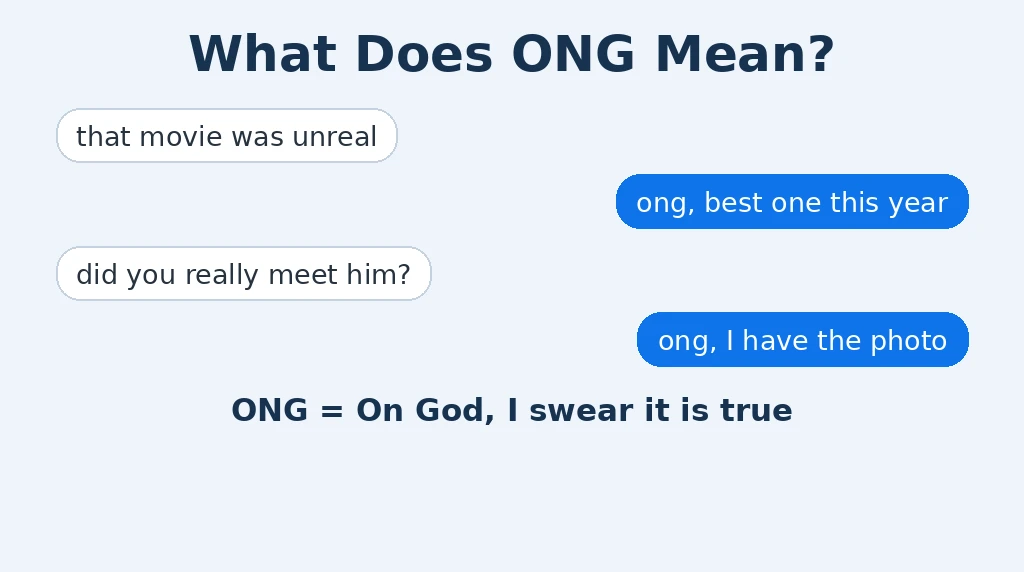
ONG is short for “On God”. Someone types it after a statement to swear that what they just said is true, or to agree with something so strongly that a plain “yes” would feel too weak. It works like an underline drawn under the whole sentence. “That concert was unreal ong” does not just say the concert was good. It says the person stands behind every word of it.
The feeling behind it is honesty with energy. ONG shows up when someone wants you to believe them, when a story sounds too wild to be true, or when they are backing a friend up in public. It is not a quiet word. Even typed in lowercase, it carries a punch, because the phrase it comes from is an oath, a way of putting your word on the line.
Capital letters change the volume, not the meaning. Lowercase “ong” is the everyday form you will see in most chats and comments, relaxed and quick. All caps “ONG” reads louder, almost like the person raised their voice a little. Either way the message is the same: I mean this, I swear it, and I am not joking around.
Full Form of ONG

The full form is plain and simple, because the three letters come straight from a spoken phrase:
- O: On
- N: (the middle sound of “On”)
- G: God
Put together, you get “On God”. The phrase itself is an oath people have said out loud for a long time, a way of swearing that something is true. Texting just squeezed it into three letters. If you hear someone say it out loud, they say the full phrase, “on God”, not the letters one by one. The abbreviation lives almost entirely on screens.
ONG vs No Cap vs FR: What Is the Difference?
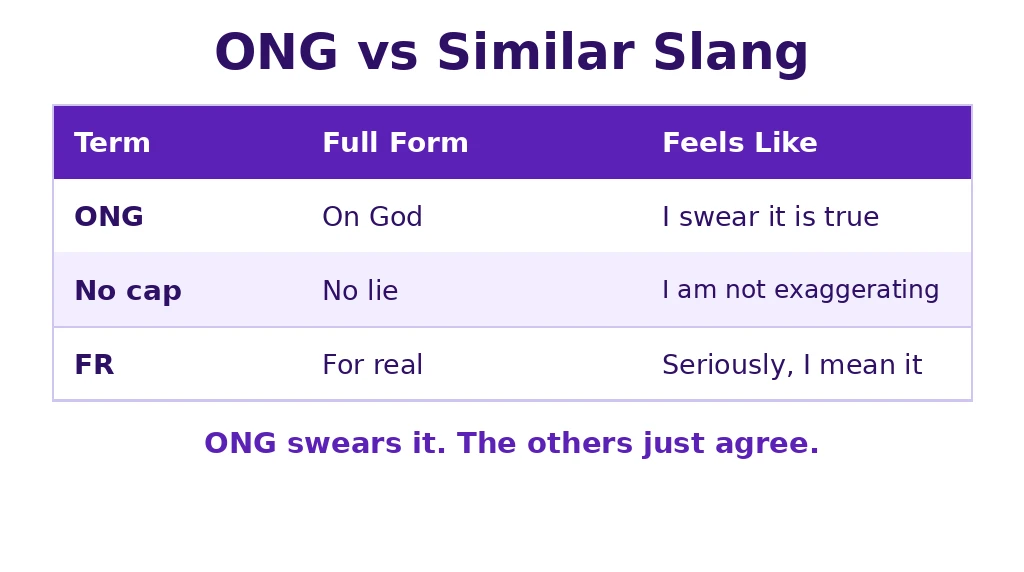
Three honesty words crowd the same corner of texting, and they are easy to mix up. Here they are side by side.
| Abbreviation | Full Form | What It Really Says | Tone |
|---|---|---|---|
| ONG | On God | I swear this is true | Strong, sincere |
| No cap | No lie | I am not exaggerating | Confident, casual |
| FR | For real | Seriously, I mean it | Relaxed, general |
ONG and no cap look like twins, but they point at slightly different things. No cap denies a lie: the person is telling you they did not stretch the truth. ONG swears a truth: the person is putting weight behind what they said, almost like a promise. “No cap, I finished the whole series in one night” says it really happened. “I finished the whole series in one night ong” says the same thing, but with more feeling behind it.
FR is the lightest of the three. It works as a general “seriously” or “I agree” and fits almost anywhere. ONG is the heaviest, because it borrows the force of an oath. That is why people reach for ong when the moment matters, a big claim, a strong opinion, or a story nobody believes at first.
Where ONG Is Commonly Used
Texting and WhatsApp
In one to one chats, ong backs up personal stories and opinions between friends. A typical message reads like this: “ong the food at that place was unreal, we have to go back”. It is the kind of word that fits a close chat, where both people already trust each other.
Instagram and Snapchat
On Instagram and Snapchat, ong lives in DMs and in replies to stories, usually when someone reacts to a photo or a plan. You will see lines like “ong this picture is unreal” or a quick “ong, count me in” under a story about a night out.
TikTok Comments
TikTok is where ong went truly mainstream. Viewers drop it under videos to agree hard with a take or to swear a story is real. Comments like “ong this is literally me” or “ong I watched this ten times” pile up under relatable clips, and creators say “on God” out loud in videos too.
Group Chats
Group chats move fast, and ong is a quick way to add weight without typing a whole sentence. One person shares a wild story, another replies “ong no way”, and the chat keeps rolling. Plans still stay tbd until someone decides, but nobody doubts the story itself.
Gaming Chats
In game chat there is no time for long sentences, so ong does quick work between rounds. Players type things like “ong that clutch was insane” or “ong I was one hit away” while the match is still moving. Everyone reads the emphasis instantly.
Discord and Forums
Discord servers and forums use ong the same way, just in longer threads. Someone shares a hot take about a game update, and “ong, the new patch ruined it” is a normal reply. It signals strong agreement without needing a paragraph to back it up.
Origin and History of ONG
ONG starts with the spoken phrase “on God”, which comes from African American Vernacular English, where oaths like “on God” and “on my mama” have long been used to swear that something is true. These phrases carried real weight in spoken conversation long before texting slang existed, and they travelled into mainstream speech through music, comedy and social media.
The phrase was added to Urban Dictionary in December 2008, but it stayed fairly niche online until the early 2010s, when big accounts on Twitter started using it. The shortened form “ong” got its own Urban Dictionary entry in August 2018. Around the same time, meme pages began using “on God” so often that people started using it ironically too, which only spread it further.
TikTok gave it the final push. In 2021 a clip of creator Tana Mongeau saying “on God” while talking about a boxing match went viral, and the phrase flooded comment sections. By the early 2020s, ong was a standard part of Gen Z texting, sitting next to “no cap” and “fr fr” as one of the main ways to stress honesty online.
Other Meanings and Variations of ONG
In casual texting, ONG almost always means “On God”. A few other uses exist, and knowing them keeps you from getting confused.
- Oh No God: very rarely, some people use ONG to mean “Oh No God” in a dramatic reaction, though this is uncommon and context usually makes it clear.
- ONG as a typo of OMG: because the two look so similar, ong is often mistaken for a misspelling of OMG, “Oh My God”. They are different words, though. OMG expresses surprise. ONG swears something is true.
- ONG outside slang: in several languages, including Spanish, French and Italian, ONG is the standard abbreviation for a non-governmental organization. That has nothing to do with texting, and you will not meet it in a chat.
- On God, said out loud: the full phrase is still spoken in everyday conversation, in videos and in voice chats, while the three letter form stays on screen.
If you see ong in a chat, a comment or a caption, read it as “On God” first. The other meanings only show up in very specific settings, and the chat around it will tell you which one applies.
How to Use ONG Correctly
- Mean it. ONG is a small oath, so use it when you really believe what you just said. Dropping it on every sentence wears it out fast.
- Place it at the end. It usually lands after the statement it supports: “this song is unreal ong”. That spot feels natural, like a signature on the sentence.
- Keep it lowercase in casual chats. Lowercase ong reads relaxed. Save the all caps version for moments when you really want the emphasis to jump off the screen.
- Match the room. ONG fits friends, group chats and comment sections. It does not fit a serious talk, where a plain honest sentence works better.
- Do not use it to win an argument. Swearing something is true does not make it true. If someone doubts you, add a detail or a photo instead of stacking more ongs.
Example Conversations Using ONG
Agreeing with a friend
Person A: “This new album is the best thing this year.”
Person B: “ong, I have had it on repeat all week.”
Backing up a wild story
Person A: “You will not believe who I saw at the mall.”
Person B: “Who?”
Person A: “Your old teacher. Ong, I almost hid behind a plant.”
A TikTok comment
Person A: “Why does this video keep showing up on my feed?”
Person B: “ong same, I have watched it like ten times now.”
Group chat plans
Person A: “Beach on Saturday, who is in?”
Person B: “ong yes, I have been waiting all month for this.”
Gaming with a teammate
Person A: “Did you see that last play?”
Person B: “ong that was the cleanest clutch I have ever seen.”
Talking about food
Person A: “That new burger place any good?”
Person B: “ong, best fries in town. Go hungry.”
A surprised reaction
Person A: “He finished the whole marathon?”
Person B: “ong, and he barely looked tired at the end.”
A soft, honest answer
Person A: “Are you really okay with the plan changing?”
Person B: “idk, ong I just want everyone to have a good time.”
When Not to Use ONG
- Work email: write “I can confirm this is accurate” instead. Three letters look careless on the record.
- Job interviews and applications: even over chat, recruiters read ong as far too casual for the setting.
- Teachers and bosses: anyone grading or managing you deserves the full sentence.
- Customer service chats: on either side of the counter, ong sounds like nobody is taking the problem seriously.
- Serious conversations: when someone is upset or asking for real support, an oath can sound like pressure instead of honesty.
- With people who may find it religious: the phrase names God, so some people find it uncomfortable. Read the room before using it.
How to Respond When Someone Sends You ONG
An ong usually means the person is being sincere or agreeing hard with you, so your reply just needs to match that energy. Pick the lane that fits the moment.
Agreeing replies work when they backed you up:
- “Right? I knew you would get it.”
- “Exactly, thank you.”
- “See, I told you it was that good.”
Curious replies fit when they swore a wild story is true:
- “Wait, seriously? Tell me everything.”
- “No way, I need the full story.”
Playful replies suit close friends and light topics:
- “smh, okay, I believe you this time”
- “ong back at you, that was unreal”
- “lol you say ong to everything now”
One thing to avoid: do not argue with the oath itself. If you doubt the claim, ask for a detail or a photo. Saying “yeah right” to an ong just starts a pointless back and forth.
Common Mistakes People Make With ONG
- Reading it as OMG. One letter apart, totally different jobs. OMG reacts with surprise. ONG swears something is true. Mixing them up flips the meaning of the message.
- Overusing it until it loses meaning. If every sentence ends with ong, it stops sounding sincere and starts sounding like filler, the same way saying “like” too much weakens a story.
- Using it in formal messages by accident. Because it feels so natural in casual texting, it can slip into a semi formal message where it looks very out of place.
- Using it sarcastically without a signal. ONG can be ironic, but text hides tone. Without a “lol” or an emoji, a sarcastic ong reads as a serious oath.
- Assuming everyone knows it. Older relatives or people outside internet culture may read ong as a typo. If the reader might not know it, spell the idea out instead.
Frequently Asked Questions
What does ONG mean in text?
ONG means “On God”. People type it in chats and comments to swear that what they just said is true, or to agree very strongly with something.
Is ONG rude?
Not usually. It is casual slang, not a swear word, though the phrase names God, so some people find it uncomfortable in religious settings. In friendly chats it is a normal, accepted word.
What is the difference between ONG and no cap?
Both stress honesty, but no cap denies exaggeration, as in “I am not lying”, while ONG swears sincerity, as in “I promise this is true”. ONG carries a little more emotional weight.
Is ONG the same as OMG?
No. OMG means “Oh My God” and expresses surprise or shock. ONG means “On God” and swears that something is true. They look alike, but they do different jobs in a sentence.
Can I use ONG in a work email?
No. ONG is casual texting slang, and it looks unprofessional in work writing. In a work email, write the full sentence, such as “I can confirm this is correct.”
How do I reply when someone sends me ONG?
Match their energy. Agree back with “right?” or “exactly”, ask for details if they shared a wild story, or keep it playful with close friends. No special reply is needed.
Final Thoughts
Three letters, one small oath. ONG is the quickest way to put weight behind a sentence in texting, and it has earned its place in everyday chats because everyone needs a way to say “I swear this is true” without typing a whole speech. Used casually, with a little care about who is reading, it never really causes trouble.
If you want the dictionary view, Dictionary.com lists ong with exactly this meaning, which shows how far a spoken oath has travelled into everyday typing. Either way, you now have the ong meaning in text down, plus a decent reply ready for the next time it shows up in your messages.
