You are reading a comment under a video when a small word catches your eye. Someone wrote “lowk obsessed with this song”, and the sentence feels softer than it should. Not “obsessed”, not “kind of obsessed”, just lowk obsessed, like the person is admitting something while keeping one foot out the door.
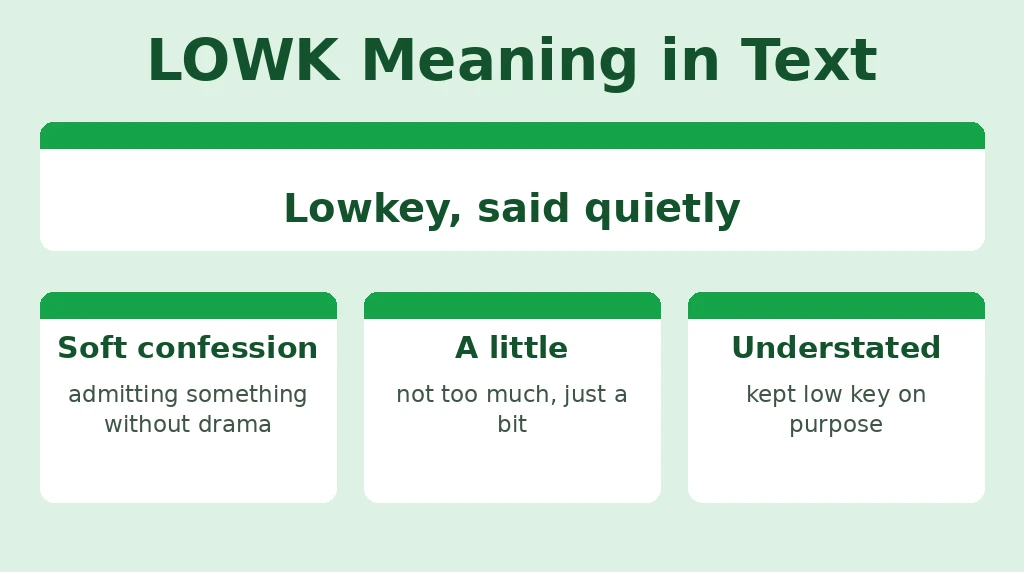
Here is the quick answer. Lowk is a shortened spelling of “lowkey”, and it means something said quietly, subtly, or without making a big deal of it. It softens whatever comes after it, turning a strong feeling into a gentle admission. This guide covers the lowk meaning in text, how it changes the tone of a sentence, where it came from, and what to send back when someone uses it on you.
What Does Lowk Mean in Text?
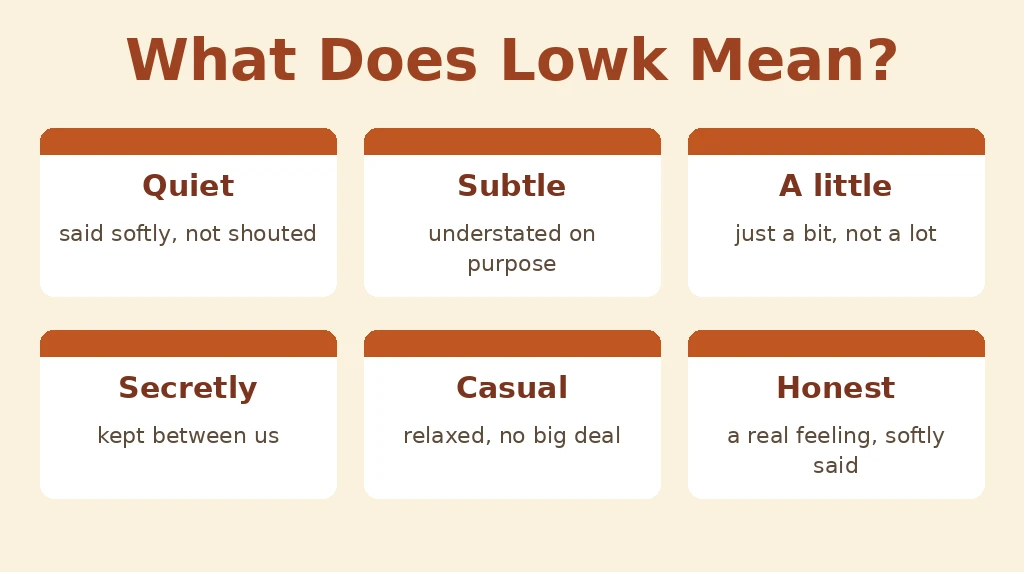
Lowk means “lowkey”. Someone types it before an opinion, a feeling or a confession they want to share without sounding dramatic about it. “Lowk nervous about tomorrow” admits the nerves but keeps the volume down. “Lowk think that movie was overrated” shares a hot take while leaving room to back away from it. The word works like a volume knob for emotion, turning the statement down a few notches.
It does two jobs at once. First, it softens the feeling, so a strong opinion reads as a casual one. Second, it can hint at a little secrecy, as if the person is telling you something they would not shout in public. “Lowk dating someone” does not just mean dating a little. It usually means keeping it quiet for now. Context tells you which job it is doing.
Lowk is almost always lowercase. People rarely type LOWK in all caps, because shouting defeats the whole point of a word that means “quietly”. You will also almost never hear someone say “lowk” out loud. In speech, people say the full word, “lowkey”, pronounced low-kee. The clipped spelling lives on keyboards, in chats, comments and captions.
Full Form of Lowk
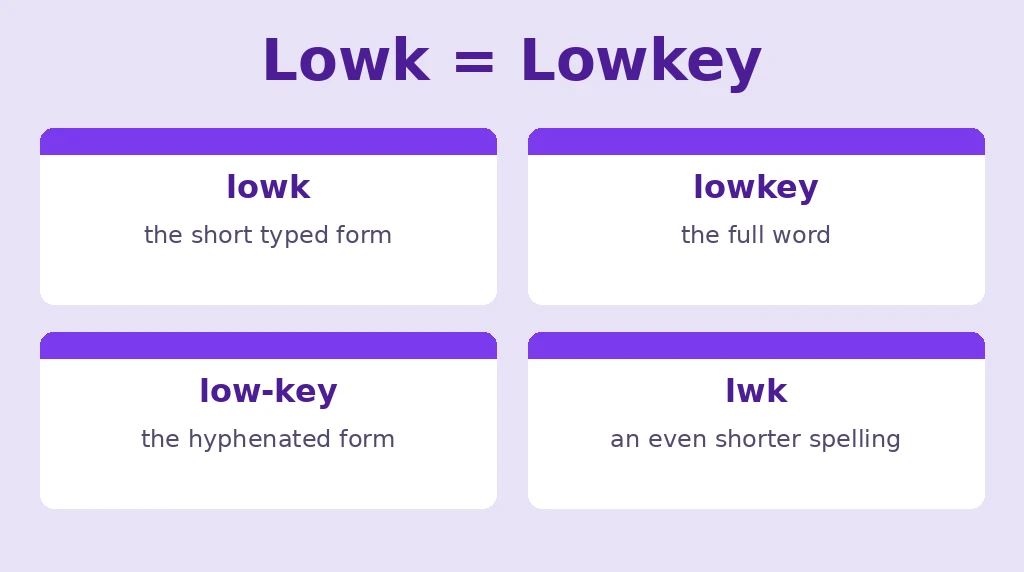
Lowk is not really an acronym, because it does not stand for a phrase. It is a clipped spelling of one word, “lowkey”, with the ending trimmed off for speed. That is a familiar pattern in texting: “because” becomes “bc”, “though” becomes “tho”, and “lowkey” becomes “lowk”.
- lowk: the short typed form, most common in chats and comments
- lowkey: the full word, works in speech and in longer messages
- low-key: the hyphenated form, seen in more careful writing
- lwk: an even shorter spelling, the same word with the “o” dropped
All four spellings mean the same thing. Which one a person uses says more about how fast they are typing than about what they mean. Lowk is simply the version that won in fast, casual texting.
Lowk vs Highkey vs Ngl: What Is the Difference?
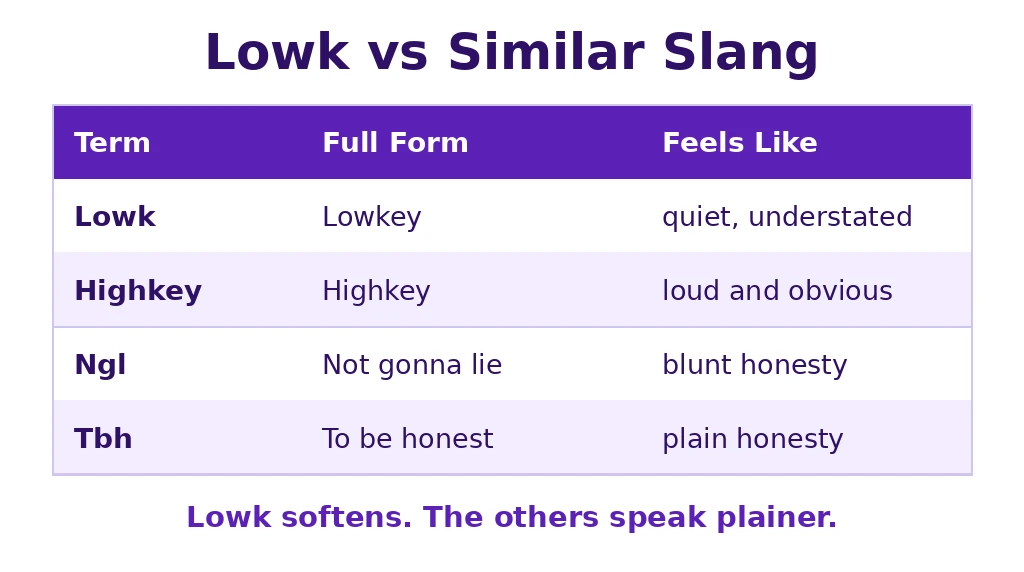
Lowk belongs to a small family of words that qualify how honest or how loud a statement is. Here they are side by side.
| Abbreviation | Full Form | What It Really Says | Tone |
|---|---|---|---|
| Lowk | Lowkey | Quietly, a little, not a big deal | Soft, understated |
| Highkey | Highkey | Openly, obviously, a lot | Loud, confident |
| Ngl | Not gonna lie | Honestly, I will be blunt | Direct, blunt |
| Tbh | To be honest | Honestly speaking | Plain, open |
The classic pair is lowk versus highkey, because they are direct opposites. “Lowk love this song” keeps the feeling small and private. “Highkey love this song” shouts it from the rooftops. Swap one for the other and the whole sentence flips, so it pays to know which one you mean before you send it.
Ngl and tbh sit in a different lane. Both introduce honesty, but they do it bluntly, without the softening that lowk adds. “Ngl, I hated it” lands like a straight punch. “Lowk hated it” lands like the same punch thrown with a glove on. Lowk is the only one of the four whose main job is to make a statement smaller, not stronger.
Where Lowk Is Commonly Used
Texting and WhatsApp
Day to day chats are the natural home of lowk. Friends use it to admit preferences and feelings without turning them into announcements. A typical exchange looks like this: “how was the date?” “lowk it went really well actually”. Short, honest, and the chat keeps moving.
Instagram and Snapchat
On Instagram and Snapchat, lowk shows up in captions and in replies to stories, usually when someone shares an opinion with a wider audience but wants it to land softly. You will see captions like “lowk one of the best days ever” or a quick “lowk love this” under a friend’s photo.
TikTok Comments
TikTok comments are full of lowk confessions. Viewers use it to admit they cried at a video, liked a song they expected to hate, or agree with an unpopular opinion. Comments like “lowk did not expect to cry at this but here we are” have basically become a format of their own.
Group Chats
Group chats run on half finished opinions, so lowk fits right in. One person asks if anyone liked the new episode, someone replies “lowk yeah, been looking forward to it all week”, and nobody has to commit to a full review. Plans stay tbd until someone decides, but the vibe is already clear.
Gaming Chats
In game chat, lowk admits things players would not say out loud in a lobby. “Lowk kinda nervous for this match” is a normal message before a ranked game, and “lowk this map is growing on me” is how a player admits they were wrong about it. It keeps the mood light while still being honest.
Discord and Forums
Discord servers and forums use lowk the same way, just in longer threads. Someone shares an opinion about a patch or a build and starts with lowk to signal “this is just my take, no big deal”. It softens the comment before anyone can argue with it.
Origin and History of Lowk
Lowk starts with the word “lowkey”, which is much older than texting. In the 1800s, “low-key” was a term from music and art, describing a sound or a tone that was quiet, restrained and understated rather than bright and dramatic. Writers used it to describe a calm voice or a subdued mood in a room.
The slang sense grew out of African American Vernacular English, where “lowkey” came to mean something done quietly, secretly, or without drawing attention. Through hip-hop and everyday speech it spread into mainstream slang, and by the 2010s it was a staple of internet conversation. Merriam-Webster dates the slang adverb use to around 2010, when the word moved from describing a mood to describing how a feeling is shared.
The clipped spelling “lowk” arrived with the mid 2010s wave of shortened slang, the same wave that gave us “ngl” and “tbh”. Dropping the ending saved keystrokes and matched the fast, casual rhythm of phone keyboards. TikTok then pushed it further, because captions and comments reward short, soft phrasing. Today lowk is one of the most common softeners in online English.
Other Meanings and Variations of Lowk
Lowk is unusually steady for slang. It has one main meaning, “lowkey”, across nearly every online space, because it is a spelling shortcut rather than a true acronym. A few variations and edge cases are still worth knowing.
- Lowkey: the full word, used in speech and in longer messages. Same meaning, slightly more deliberate.
- Low-key: the hyphenated spelling, closer to the original music and art term. Rare in chats, more common in articles.
- Lwk: the shortest form, with the “o” dropped. Collins lists it as a texting abbreviation of lowkey, and it means exactly the same thing.
- Lowk as a typo: very rarely, someone types “lowk” by accident when they meant another word. Context almost always makes this obvious, because the sentence will not make sense with “lowkey” in it.
Outside texting, “lowkey” keeps its older, non slang sense too: a low-key event is a quiet one, and a low-key person is a restrained one. That older meaning and the slang meaning point in the same direction, which is part of why the word has lasted so long.
How to Use Lowk Correctly
- Put it before the feeling. Lowk works best right before the opinion or confession it softens: “lowk think that movie was overrated”, “lowk kind of nervous”. That spot is where readers expect it.
- Use it for small admissions. Lowk shines on opinions, preferences and mild feelings. It is the right tool for “lowk want pizza” and the wrong tool for news that actually matters.
- Keep it casual. Lowk belongs in friendly, informal chats. If the conversation would not welcome a “lol”, it will not welcome a “lowk” either.
- Do not stack it with other softeners. “Lowk kinda sorta maybe” piles three hedges into one sentence and reads as if you are afraid of your own opinion. One softener is enough.
- Mean the softness. If you actually feel strongly about something, say so. Using lowk to hide a strong feeling just confuses the person reading it.
Example Conversations Using Lowk
Admitting a crush on a song
Person A: “You keep playing that song, are you obsessed?”
Person B: “lowk yeah, it has been stuck in my head all week.”
A quiet confession
Person A: “Be honest, did you like the party?”
Person B: “lowk it was the best night I have had in months.”
Before a match
Person A: “You good?”
Person B: “lowk kinda nervous for this match, ngl.”
An unpopular opinion
Person A: “Everyone loves that show, right?”
Person B: “lowk think it is overrated. The first season was better.”
Talking about food
Person A: “What do you want for dinner?”
Person B: “lowk craving noodles again. Third time this week.”
A TikTok comment
Person A: “Why is everyone crying in these comments?”
Person B: “lowk did not expect to cry at this but here we are.”
Keeping something private
Person A: “Are you two a thing now?”
Person B: “lowk yeah, but keep it between us for now.”
A soft, honest answer
Person A: “Are you still mad about yesterday?”
Person B: “lowk yeah, a little. idk why it still bugs me.”
When Not to Use Lowk
- Work email: write “I slightly prefer the other option” instead. A clipped slang spelling looks careless on the record.
- Job interviews and applications: even over chat, recruiters read lowk as far too casual for the setting.
- Academic writing: essays and reports need the full, standard wording. Lowk has no place in them.
- Serious conversations: because lowk softens statements, using it when something important is on the table can accidentally downplay it. If a friend is upset, be direct instead.
- With people unfamiliar with slang: someone outside internet culture may read lowk as a typo and miss your point entirely.
How to Respond When Someone Sends You Lowk
A lowk message is usually a soft admission, so the best reply keeps the same relaxed tone. There is no special code to crack. Pick the lane that matches the moment.
Matching replies keep the relaxed tone going:
- “lowk same, I was thinking the exact same thing.”
- “same tbh, glad I am not the only one.”
- “haha, lowk me too.”
Curious replies invite them to say more:
- “wait really? Why though?”
- “oh yeah? Tell me more.”
Playful replies suit close friends and light topics:
- “smh, you say lowk about everything”
- “lowk? More like highkey, admit it”
- “knew it, you were never fooling anyone”
One thing to avoid: do not treat a lowk admission as a full confession. If someone says “lowk nervous”, they are telling you gently. Pushing them with “so you ARE nervous” just makes them wish they had not said anything.
Common Mistakes People Make With Lowk
- Mistaking it for a typo. Lowk looks like a word that got cut off mid type, so some people read it as a mistake the first time they see it. It is intentional slang, not an error.
- Confusing it with highkey. The two are opposites, so swapping them flips the sentence completely. “Lowk love it” and “highkey love it” say very different things.
- Overusing it until it loses meaning. If every sentence starts with lowk, the softening effect wears off and the word just becomes filler.
- Using it for serious news. Lowk downplays whatever follows it, so it is the wrong tool for anything that deserves a straight, clear statement.
- Assuming it always means something negative. Lowk is not a negative word. It softens positive, negative and neutral statements alike, from “lowk love it” to “lowk hate it”.
Frequently Asked Questions
What does lowk mean in text?
Lowk is a shortened spelling of “lowkey”. It means something said quietly, subtly, or without making a big deal of it, usually before an opinion or a mild confession.
Is lowk the same as lowkey?
Yes. Lowk and lowkey mean exactly the same thing. Lowk is just the quicker, clipped way of typing the word in fast chats and comments.
What is the opposite of lowk?
The opposite is “highkey”, used when someone wants to openly and confidently express something rather than admitting it quietly. Lowk turns the volume down, highkey turns it up.
Is lowk rude?
No. Lowk is a soft, casual word, and it is almost never rude. It can only land badly if it downplays something serious that deserved a direct answer.
Can I use lowk in a work email?
No. Lowk is casual internet slang, and it looks unprofessional in work writing. In a work email, write the full idea out, such as “I slightly prefer the other option.”
How do I reply when someone sends me lowk?
Match the relaxed tone. A simple “lowk same” or “same tbh” keeps the chat easy, or ask a gentle follow up like “wait really? Why though?” if you want to hear more.
Final Thoughts
Four letters, one quiet job. Lowk is the softener of the internet, the word people reach for when they want to say something real without saying it loudly. It turns strong feelings into gentle admissions, hot takes into casual opinions, and secrets into whispers between friends. Used in the right chats, it keeps conversations easy and honest at the same time.
If you want the dictionary view, Dictionary.com lists low-key with this quiet, understated sense, which shows how an old music term grew into one of the most used words in texting. Either way, you now have the lowk meaning in text down, plus a decent reply ready for the next time it shows up in your messages.

1 thought on “LOWK Meaning in Text: What It Means, How to Use It and How to Reply”