You are in the middle of a debate in the group chat. The argument has gone back and forth for ten minutes, nobody is giving ground, and then one friend drops a single line: “Cheating is wrong. Period.” The chat goes quiet. There is nothing left to say, because that one word just closed the whole discussion.
Here is the short answer first. Period means “end of discussion, that is final”. People put it at the end of a statement to say there is nothing more to debate, no argument left, and the point stands as it is. This guide covers the period meaning in text, period vs periodt, where it came from, where you will see it, and the best replies for every version of it.
What Does Period Mean in Text?
Period is an interjection used at the end of a statement to signal that it is final. It borrows the job of the punctuation mark: just as a full stop ends a sentence, the word period ends a discussion. “I am done with him. Period.” means the decision is made, the conversation is over, and there is nothing else to say about it.
The tone is confident and emphatic, never unsure. It caps off a strong opinion, expresses strong agreement, or shuts down a debate in one word. “This is the best meal I have ever had. Period.” is not an invitation to argue about food. It is a declaration. Lowercase “period” reads a little softer, while capital “PERIOD” or “PERIODT” reads louder and more forceful, like someone raising their voice a little.
So the word never tells the whole story on its own. Read the sentence before it, because period only stamps what came first. After a fact, it sounds sure. After an opinion, it sounds bold. After a boundary, it sounds final. Context is the real dictionary here.
Full Form of Period
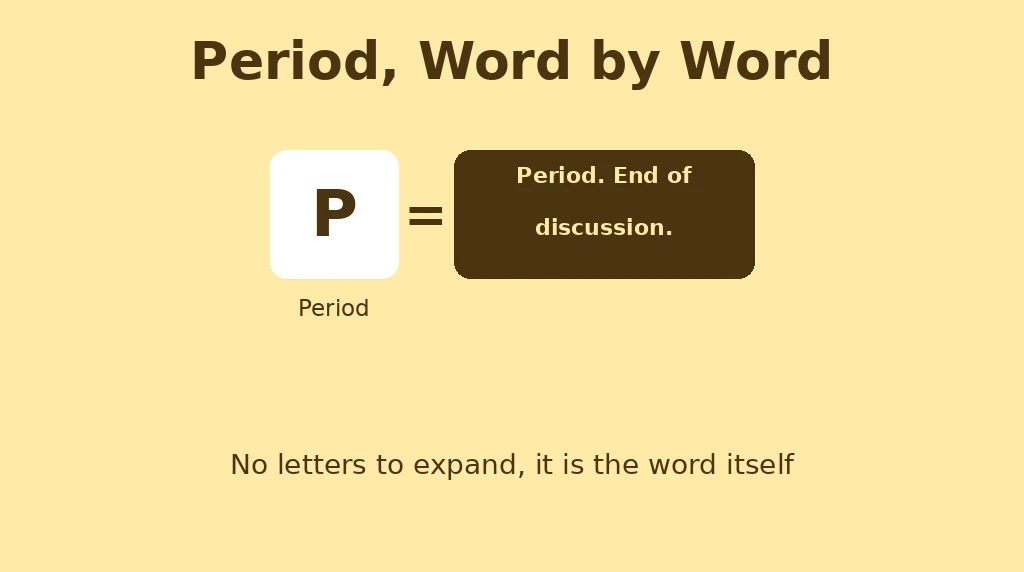
Period is not an acronym, so there are no letters to expand. It is the ordinary English word period, the same word as the punctuation mark at the end of a sentence, used as an interjection to show a statement is final. There is no hidden full form, and any backronym you see online claiming the letters stand for a phrase is a joke, not the origin.
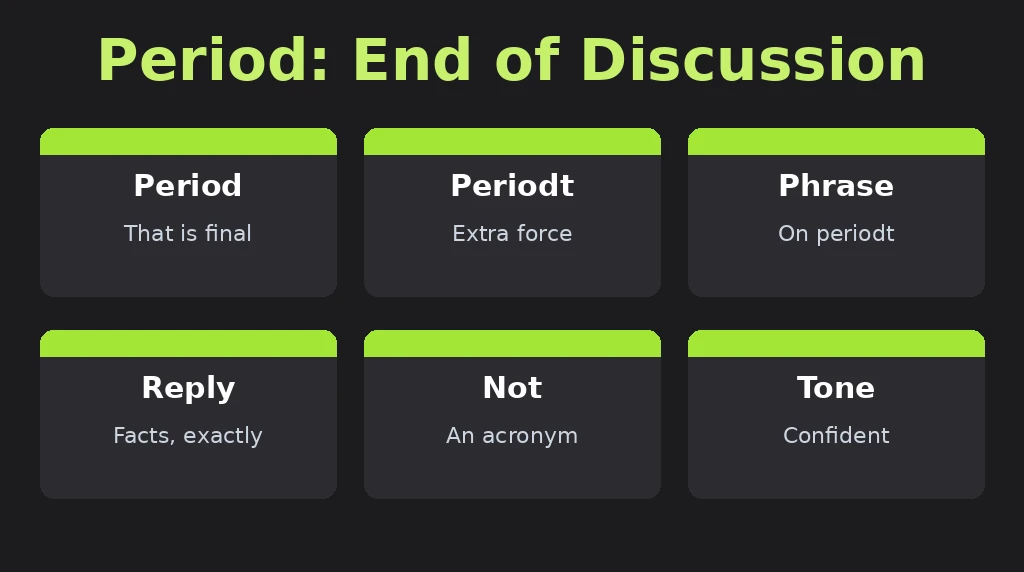
The stronger spelling, periodt, works the same way. It is period with the final D sound swapped for a T, a pattern found in Black English where a final D can be pronounced as a T. Say it out loud and it sounds like “peer-ee-uht”, while plain period sounds like “peer-ee-uhd”. The T adds force, which is why periodt feels like period with the volume turned up.
Period vs Periodt vs Facts: What Is the Difference?
Period, periodt and facts all close a statement, but they do different jobs in a chat. Here they are side by side.
| Abbreviation | Full Form | What It Really Says | Tone |
|---|---|---|---|
| Period | Not an acronym | End of discussion | Confident, final |
| Periodt | Period, with a T | End of discussion, no debate | Forceful, emphatic |
| Facts | Not an acronym | That is true, I agree | Supportive, casual |
The classic mix up is period versus periodt, because the two look almost identical at a glance. They mean the same thing, though. Periodt is simply the more forceful version, the one people reach for when they want extra emphasis or a little extra attitude. Think of period as a full stop and periodt as a full stop with an exclamation mark behind it.
Facts is the odd one out. It agrees with someone else, while period usually closes your own statement. Reply “facts” to a friend’s hot take and you are backing them up. Reply “period” to your own take and you are telling the room the debate is over. A phrase worth knowing is “and that is on periodt”, which adds weight to a statement, like saying “and I stand by that, no debate”. It turns a plain opinion into a declaration.
Where Period Is Commonly Used
Texting and WhatsApp
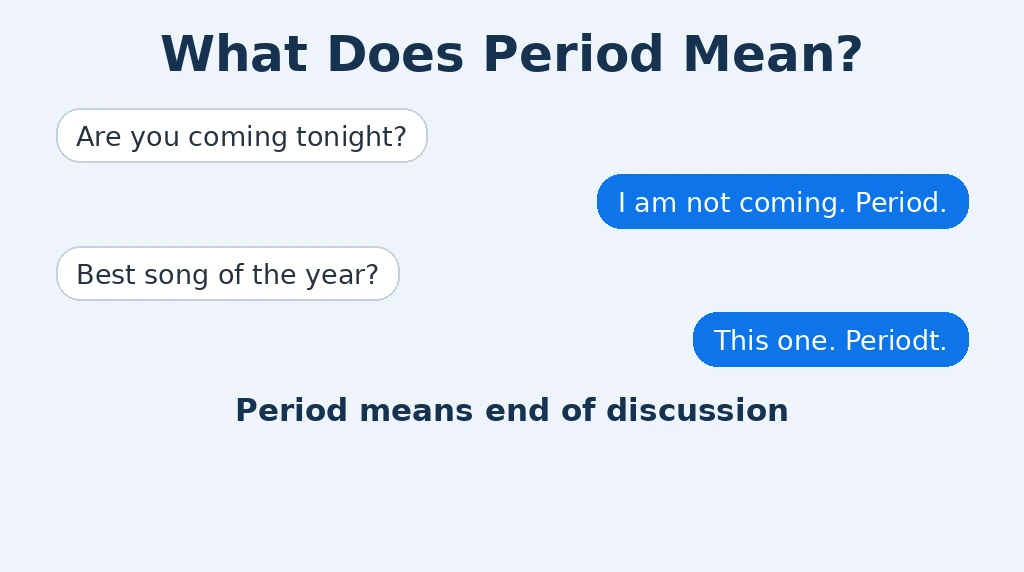
One to one chats and group chats are the natural home of period. It ends debates, settles plans and draws lines without needing a paragraph. A typical line looks like this: “I am not going, period.” Short, final, and the chat moves on to something else.
Instagram and Snapchat
On Instagram and Snapchat, period shows up in DMs, story replies and captions. People use it to cap off a bold opinion under a photo, or to agree hard with a friend’s post. A caption like “best night ever, period” is not asking for opinions. It is telling you the night was the best, full stop.
TikTok Comments
Scroll a busy TikTok comment section and period is everywhere. Viewers use it to end a debate about a video, to agree with a creator, or to state a hot take with confidence. Comments like “she ate that, periodt” and “this is the best song of the year, period” have become formats of their own, and the hashtag #periodt gathers the same energy in one place.
Group Chats
Group chats run on debates that never end, so period is the word that finally ends them. One person states an opinion, three people argue, and then someone drops “period” and the thread moves on. It also works as a quick vote: “pineapple on pizza is wrong, period” tells the whole group where you stand, with no room for negotiation.
Gaming Chats
In game chat there is no time for long arguments, so period does quick work between rounds. Players type things like “that was the best play, period” or “we are not switching maps, period” while the match is still moving. Everyone understands it instantly, and nobody stops playing to decode it.
Discord and Forums
Discord servers and forums use period the same way, just in longer threads. Someone states a take about a patch note or a build, adds “period”, and the thread knows the debate is closed. It signals confidence without pretending to be a full argument, and in a busy server that is often all anyone needs.
Origin and History of Period
Period starts with the punctuation mark itself. The finality sense of the word, using “period” to show a statement is finished and not open to debate, has been recorded since the early 1900s. It comes straight from the way a full stop ends a sentence: the word borrowed the job of the dot.
The spelling periodt has a more specific home. It is generally credited to Black English, and has been specifically attributed to Southern Black gay slang, where a final D sound can become a T. The form spread through social media in the 2010s, helped along by the rap duo City Girls, whose 2018 song “Period (We Live)” features it, and by Black Twitter, where it moved into mainstream slang around 2019. Michelle Obama even repeated “periodt” in a speech in September 2018. The earliest known online use dates to a Twitter post from May 2009, though that may have been accidental. No single inventor is known, and the exact first use is unclear, which is normal for slang that spreads person to person.
Other Meanings and Variations of Period
In casual texting, period almost always means “end of discussion”, but the same word carries other meanings, and a few close forms shift the force.
- Periodt: the stronger spelling, with a T at the end. Same meaning as period, with extra emphasis. “I am finished with him. PERIODT.” is period with the volume turned up.
- Period’t: a rarer spelling with an apostrophe, meaning the same as periodt. You will see it occasionally in older posts, though periodt is the standard form now.
- And that is on periodt: a phrase that adds weight to a statement. It means “and I stand by that, no debate”, and it usually closes a strong opinion.
- My period, on my period: a completely different sense. In texting, “I got my period today” means menstruation, not finality. Context decides: a statement plus “period” at the end means final, while “my period” means something else entirely.
- A period of time: the ordinary meaning, a length of time, as in “a period of two weeks”. Nobody confuses this with the slang sense, because the sentence around it is completely different.
On social media, period also works as a caption and a tag. A photo captioned “periodt” or tagged #periodt is not answering a question at all. It is a mood, a small public declaration that says the poster is confident and done explaining. Read that use as attitude, not as an answer.
How to Use Period Correctly
- Use it to close, not to open. Period belongs at the end of a statement, after the point is made. It stamps what came before it, so put your opinion first and the period last.
- Mean it. Use it when you are genuinely sure and genuinely done discussing it. People can tell a confident period from a bluff, and the bluff invites the very argument you wanted to end.
- Save periodt for extra force. Periodt is period with more attitude. Use it when you want emphasis, not in every sentence, or the force wears off.
- Watch the moment. If a friend is upset or asking about something that matters to them, a flat period can land as a shutdown. Slow down and write a real sentence instead.
- Keep it casual. Period as slang belongs in friendly, informal chats. If the conversation would not welcome a “lol”, it will not welcome a “periodt” either.
Example Conversations Using Period
Ending a debate with a friend
Person A: “Cheating is wrong, no matter what”
Person B: “Exactly. Period.”
Drawing a boundary
Person A: “Are you coming tonight or not?”
Person B: “I am not coming. Period.”
A TikTok comment
Person A: “This is the best song of the year, no debate”
Person B: “Periodt, I have had it on repeat all week”
A group chat vote
Person A: “Pineapple on pizza is wrong”
Person B: “Period. End of discussion.”
Agreeing hard
Person A: “She is the best singer alive right now”
Person B: “And that is on periodt”
A plan that is settled
Person A: “idk if I can make it on Saturday”
Person B: “You already said yes. Period.”
The confident caption
Person A: “Best night ever, period”
Person B: “No notes, you looked amazing”
The playful one
Person A: “I am the best cook in this house, periodt”
Person B: “lmbo, okay, prove it tonight then”
When Not to Use Period
- Work email: write “that is the final decision on this point” instead. Slang period looks careless on the record.
- Job interviews and applications: even over chat, recruiters read periodt as unserious.
- Teachers and bosses: anyone grading or managing you deserves a full sentence, not a shutdown.
- Customer service chats: on either side of the counter, period sounds like nobody is willing to help.
- Serious conversations: when someone is upset or asking for real support, a flat period can feel like a door closing.
- During an argument: period in a fight reads as “I have stopped listening”, and it usually makes things worse.
How to Respond When Someone Sends You Period
A period lands in your chat and the debate just ended, at least in the other person’s mind. What you send next decides whether the conversation moves on smoothly or restarts the argument. Pick the lane that matches the moment.
Agreeing replies work when you share the opinion:
- “Facts, exactly.”
- “lowk, you are right. Period.”
- “Could not have said it better.”
Moving on replies suit a debate that needed to end:
- “Fair enough, moving on.”
- “Okay, noted. Next topic.”
Playful replies fit close friends and light topics:
- “Periodt, and that is on that.”
- “Okay okay, you win this one.”
Push back replies help only when the point genuinely needs more discussion:
- “I hear you, but can we talk about one part of it?”
- “I get the feeling, though I see it a little differently.”
One thing to avoid: do not fire back a sarcastic reply when the period was honest. Most of the time the person is not dismissing you. They really are done with the topic, and a calm response keeps the chat friendly.
Common Mistakes People Make With Period
- Treating it as an acronym. Period is not an acronym and the letters do not stand for other words. Any backronym you see online is a joke, not the origin.
- Using periodt in formal writing. The T spelling is the most casual form of all. It belongs in chats and captions, never in an email or an application.
- Confusing it with the other meaning. “My period” means menstruation, while a statement plus “period” means finality. Context decides, so read the whole sentence.
- Using it to shut down every debate. A period here and there is normal. A period for every disagreement quietly trains your friends to stop sharing opinions with you.
- Sending a bare period in a serious chat. When feelings are involved, one word is not enough. Add a sentence that shows you are still listening.
Frequently Asked Questions
What does period mean in text?
Period means “end of discussion, that is final”. People put it at the end of a statement to say there is nothing more to debate. It is the texting version of putting a full stop on an argument.
What does periodt mean?
Periodt is a stronger, stylised spelling of period, pronounced with a T sound at the end. It means the same thing, that a statement is final, but with extra emphasis. It comes from Black English, where a final D sound can become a T.
Is period an acronym?
No. Period is not an acronym and the letters do not stand for other words. It is the ordinary word period, from the punctuation mark, used as an interjection to show a statement is final.
What does and that is on periodt mean?
The phrase “and that is on periodt” adds weight to a statement, like saying “and I stand by that, no debate”. People use it to cap off a strong opinion and show they are confident about it.
Can I use period in a work message?
No. Period as slang is casual and emphatic, and it can sound confrontational in professional writing. In a work message, write a full sentence instead, such as “That is the final decision on this point.”
How do I reply when someone sends me period?
If you agree, a simple “facts” or “exactly” works well. If it ended a debate, do not argue further, just move on. Only push back if the point genuinely needs more discussion, and then do it calmly.
Final Thoughts
One word, one simple job with a surprising amount of history packed inside. Period is the quickest way to say “end of discussion” in texting, and it has earned its place in everyday chats because everyone has a point they are sure about. Used casually, with a little warmth when the moment is serious, it never really causes trouble.
If you want the official stamp, Dictionary.com lists periodt as an interjection used to signal the end of a discussion, which shows how far a humble punctuation word has come. Either way, you now have the period meaning in text down, plus a decent reply ready for the next time it shows up in your messages.
