You send a long message. You planned the whole evening, picked a time, even offered to drive. The reply comes back in one letter: “k.” No emoji, no thanks, no “sounds good”. You read it three times and still cannot tell if your friend is fine with the plan or quietly annoyed with you.
Here is the short answer first. K means “okay”. It is the shortest possible form of OK, typed when someone wants to accept, agree or acknowledge a message without writing a full word. That sounds harmless, but a bare k carries more tone trouble than almost any other letter in texting, and this guide covers the k meaning in text, why it so often reads as rude, K vs KK vs OK, where you will see it, and the best replies for every version of it.
What Does K Mean in Text?
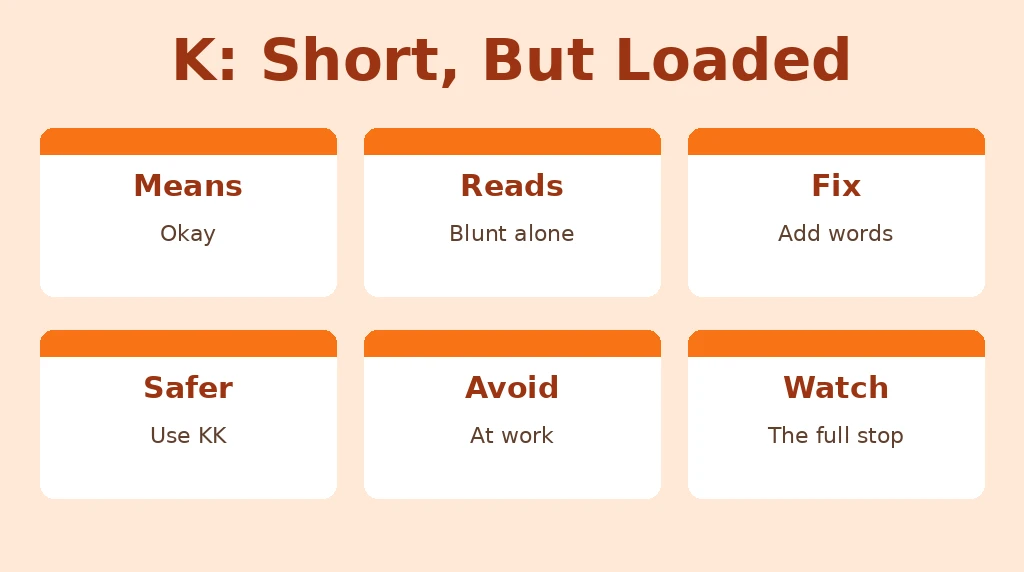
K is short for “okay”. Someone sends it to say “I agree”, “I got it”, “sounds fine” or simply “message received”. It answers quick questions about plans, times and choices without slowing the chat down. “Meet at 7?” “K.” The plan is set, and nobody needed a sentence to set it.
The trouble starts with how little it gives you. A bare k has no warmth, no detail and no clue about the sender’s mood, so the reader fills in the gaps, and readers usually fill them in badly. Research on texting backs that feeling up: a study found that one word replies ending in a period were rated as less sincere than the same word without one, so “k.” reads colder than “k”. Lowercase k is the everyday form, and capital K can read a fraction louder, though neither one softens the message on its own.
So the letters never tell the whole story. A k from a close friend who always texts in one word bursts is normal. A k after an apology or a long, thoughtful message feels very different. Read the message above it, the relationship behind it, and the pattern of how that person usually texts. Context is the real dictionary here.
Full Form of K
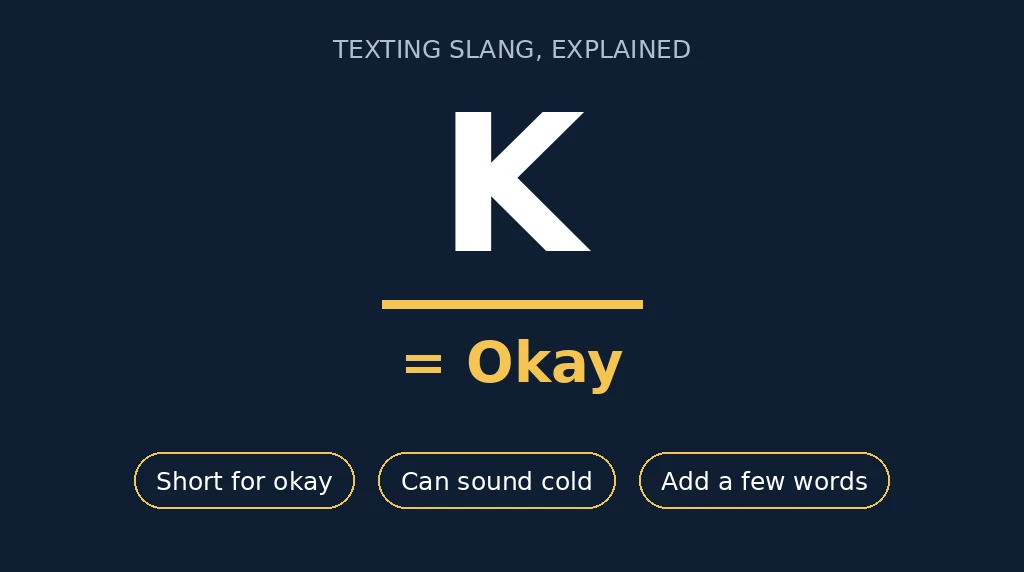
There is only one letter to unpack here, and it stands for a whole word:
- K: okay
Put plainly, K means okay. It is OK shortened one step further, from two letters to one. Say it out loud and people pronounce the letter name: “kay”. You will hear that spoken version in voice chats and in jokes between friends, as in “she just replied kay to my whole paragraph”. The letter is the eleventh letter of the English alphabet, though in texting it has almost nothing to do with the alphabet and everything to do with speed.
K vs KK vs OK: What Is the Difference?
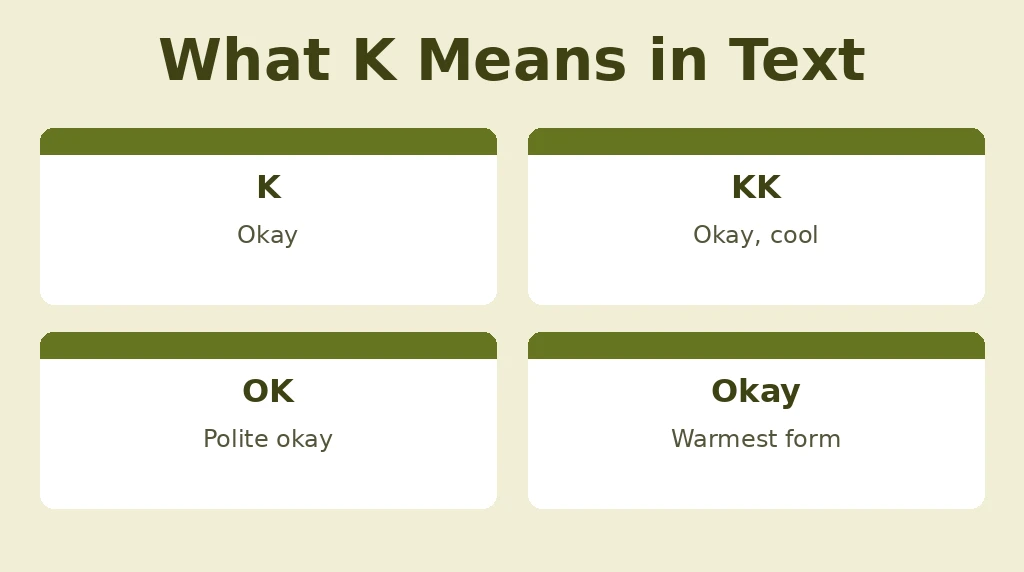
K, KK and OK all say the same word, but they land very differently in a chat. Here they are side by side.
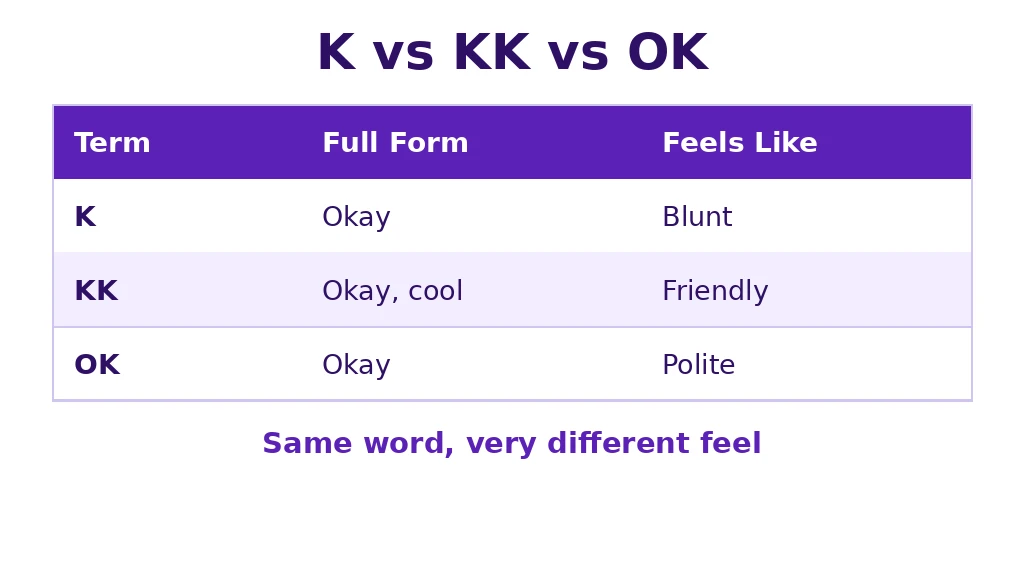
| Abbreviation | Full Form | What It Really Says | Tone |
|---|---|---|---|
| K | Okay | Fine, I accept | Blunt, sometimes cold |
| KK | Okay, cool | Okay, sounds good | Warm, friendly |
| OK | Okay | Okay, agreed | Neutral, polite |
The classic mix up is K versus KK, because the two look almost identical at a glance. They feel different, though. KK is widely seen as a safe, neutral way to acknowledge a message, and it almost never reads as annoyed. A single K can read as a shrug or a shutdown, especially on its own. When in doubt, KK is the safer pick, and it costs only one extra keystroke.
OK sits in the middle. It is the full, familiar form, so it reads as more polite and more complete than a bare K, and it works in places where K would look careless. “Okay” spelled out is the warmest of all, because it shows the sender took a second to write the whole word. The rule of thumb is simple: the shorter the reply, the colder it can feel, so match the length to the moment.
Where K Is Commonly Used
Texting and WhatsApp
One to one chats are the natural home of k. It answers quick logistics questions about times, places and plans without slowing anything down. A typical line looks like this: “Meet at 7 outside the station?” “k”. Short, honest, and the chat keeps moving.
Instagram and Snapchat
On Instagram and Snapchat, k shows up in DMs and in replies to stories, often as a quick acknowledgement of a plan or a photo. Someone asks “sending you the address now” and a “k” says “got it”. It also appears in comment sections, where a lone k can be a short, flat reply to a question nobody wants to discuss at length.
TikTok Comments
Scroll a busy TikTok comment section and k is everywhere. Viewers use it to acknowledge a reply, to agree without enthusiasm, or to end a back and forth that has run out of steam. Comments like “k” under a long argument usually mean “I have heard enough”, and everyone reading it understands that meaning instantly.
Group Chats
Group chats run on half finished plans, so k is the glue holding them together. One person asks who is bringing snacks, two people reply k, and the plan stays alive without forcing a fake opinion out of anyone. It also works as a quick headcount: “everyone good with Saturday?” “k” “k” “k”. Three letters, three yeses, no fuss.
Gaming Chats
In game chat there is no time for full sentences, so k does quick work between rounds. Players type things like “k, go left” or “k, I will cover you” while the match is still moving. Everyone understands it instantly, and nobody stops playing to decode it. In gaming, a bare k rarely reads as rude, because everyone is typing fast.
Discord and Forums
Discord servers and forums use k the same way, just in longer threads. Someone asks about a patch note or a build, and “k, thanks” is a normal, accepted reply. It signals “message received” without pretending to be a full answer, and in a busy server that is often all anyone needs.
Origin and History of K
K belongs to the first big wave of texting shortcuts. It grew out of early 2000s online gaming and mobile texting, when slow keyboards and small screens pushed people to shorten the words they typed most often. “Okay” is one of the most typed words in daily life, so it was an early candidate for the chop, first to “ok” and then to a single “k”.
The earliest known record comes from an Urban Dictionary entry dated 27 February 2003, defining k as a term of acknowledgement, and a Rice University internet slang list included it in 2004. The exact moment it caught on is unclear, which is normal for slang that spreads person to person rather than through a single viral post. The parent word OK is far older: it first appeared in the Boston Morning Post in 1839 as a joking abbreviation of “oll korrect”, meaning “all correct”. K is simply the newest, shortest branch of a word that has been shrinking for nearly two hundred years.
Other Meanings and Variations of K
In casual texting, K almost always means “okay”, but the same letter carries other meanings in other rooms, and a few close cousins shift the tone.
- KK: “okay, cool”. A friendlier, safer version of k that almost never reads as annoyed. Use it when you want to sound warm without writing a sentence.
- K. (with a period): the same letter, colder. A full stop after a one word reply makes it read more final and less sincere, so “k.” lands harder than “k” on its own.
- OK: the full, familiar form. More polite and more complete than k, and the right choice for anyone you do not know well.
- Okay: the whole word, spelled out. The warmest version, because it shows the sender took a second to write it properly.
- K as thousand: in numbers, K means thousand, from the prefix kilo. “10K followers” means 10,000 followers, and a “10K race” means 10 kilometres. That is a different meaning from the texting K, and the numbers around it make it obvious.
On social media, k carries the same meaning as in texting, a short okay in DMs and comment sections. The only distinct social media use is the numerical one: “10K likes” and “50K views” are counts, not replies. Read the numbers, not the letter, to tell which meaning applies.
How to Use K Correctly
- Keep it casual. K belongs in friendly, informal chats with people who know your texting style. If the conversation would not welcome a “lol”, it will not welcome a “k” either.
- Mean it as okay, not as a shutdown. Use it when you truly agree or have received the message. People can tell a lazy k from an honest one, and the lazy version reads very differently.
- Add one small detail. “k, sounds good” takes two extra seconds and sounds ten times warmer than a bare k on its own. That tiny addition fixes almost every tone problem.
- Watch the moment. If a friend is upset, apologising or asking about something that matters to them, a flat k can land badly. Slow down and write a real sentence instead.
- Use KK when you want warmth. One extra letter turns a blunt reply into a friendly one. When the message matters even a little, KK is the better default.
Example Conversations Using K
Planning a meetup
Person A: “Meet at 7 outside the station?”
Person B: “k, see you there”
Confirming an address
Person A: “Sending you the address now”
Person B: “k, got it”
A group chat headcount
Person A: “Everyone good with Saturday?”
Person B: “k”
Gaming with a teammate
Person A: “Go left, I will cover you”
Person B: “k”
The cold one
Person A: “I am really sorry about yesterday, I did not mean it”
Person B: “k.”
That full stop is doing half the damage. Same letter, very different message.
A quick check in
Person A: “sup, are we still on for tonight?”
Person B: “k, yeah, see you at 8”
Giving up on a plan
Person A: “Do you even want to come or not?”
Person B: “nvm, forget it”
The friendly version
Person A: “I will bring the snacks, you bring the drinks”
Person B: “kk, perfect”
When Not to Use K
- Work email: write “okay” or “got it” instead. One letter looks careless on the record.
- Job interviews and applications: even over chat, recruiters read k as unprepared or uninterested.
- Teachers and bosses: anyone grading or managing you deserves the full word.
- Customer service chats: on either side of the counter, k sounds like nobody is taking the problem seriously.
- Serious conversations: when someone is upset, apologising or asking for real support, a bare k can feel like a door closing.
- Early dating chats: a bare k to someone you are still getting to know reads as bored or uninterested, even when you only meant okay.
How to Respond When Someone Sends You K
A bare k lands in your chat and suddenly you are guessing. Was that a friendly okay or a cold shutdown? Before you react, check the context: the message above it, the relationship, and how that person usually texts. Then pick the lane that matches the moment.
Move on replies work when the k was a friendly okay:
- “Perfect, see you then.”
- “Great, I will send the details.”
- “Sounds good, talk later.”
Check in replies suit a flat or tired sounding k:
- “Everything okay? You seem a little quiet.”
- “You good with Saturday, or should we change it?”
Warm replies fit close friends and light topics:
- “kk, love that for us”
- “thx for letting me know”
One thing to avoid: do not chase a k with a long paragraph or a sarcastic reply. If the k was honest, a calm response keeps the chat friendly. If it was cold, one gentle check in is enough, and the other person can explain if they want to.
Common Mistakes People Make With K
- Reading every k as rude. Most k replies are honest and quick, not dismissive. Tone in text is easy to misjudge, so give the sender the benefit of the doubt first.
- Sending a bare k in a serious chat. When feelings are involved, one letter is not enough. Add a sentence that shows you are still listening.
- Using k. with a full stop when you are not upset. That tiny dot makes the reply read more final and less sincere, so it can start an argument out of nothing.
- Using it at work. A manager who gets “k” about a deadline hears “I have not looked into this”. Spell it out and add when you will know.
- Confusing K with the number meaning. “10K” is a count, not a reply. In a sentence about followers or money, K means thousand, and answering it as if someone said okay misses the point.
Frequently Asked Questions
What does K mean in text?
K means “okay”. It is the shortest form of OK, used to accept, agree or acknowledge a message. One letter does the job of a whole word, which is why it is so common in fast chats.
Is K rude?
Not by itself, though a bare k often reads cold, dismissive or annoyed, even when the sender only meant a plain okay. Adding a word or two, such as “k, sounds good”, removes almost all of that risk.
What is the difference between K and KK?
K is the shortest possible okay and can read blunt. KK is a friendlier, softer version that feels warmer and less abrupt. Both mean the same thing, but KK almost never reads as annoyed.
What does K mean in numbers like 10K?
In numbers, K means thousand, from the prefix kilo. So 10K followers means 10,000 followers and a 10K race means 10 kilometres. That is a different meaning from the texting K, and context makes it obvious.
Can I use K in a work message?
No. A bare k looks careless in professional writing. In a work chat, write “okay”, “got it” or “sounds good” instead. Save k for friends and family who know your texting style.
How do I reply when someone sends me K?
If it was a friendly okay, just move on with the plan. If it felt flat or cold, do not assume anger from one letter alone. A calm check in, such as “everything okay?”, works better than a long paragraph or a sarcastic reply.
Final Thoughts
One letter, one simple job with a surprising amount of tone packed inside. K is the quickest way to say “okay” in texting, and it has earned its place in everyday chats because everyone faces questions that only need a yes. Used casually, with a little warmth when the moment is serious, it never really causes trouble.
If you want the official stamp, Dictionary.com lists K as a form of okay and as the abbreviation for thousand, which shows how much work a single letter can do. Either way, you now have the k meaning in text down, plus a decent reply ready for the next time a bare k shows up in your messages.
