You send a question to a friend, then find the answer yourself a minute later. You type three quick letters, “nvm”, and hit send. No apology, no long explanation, just a tiny eraser for the message above it.
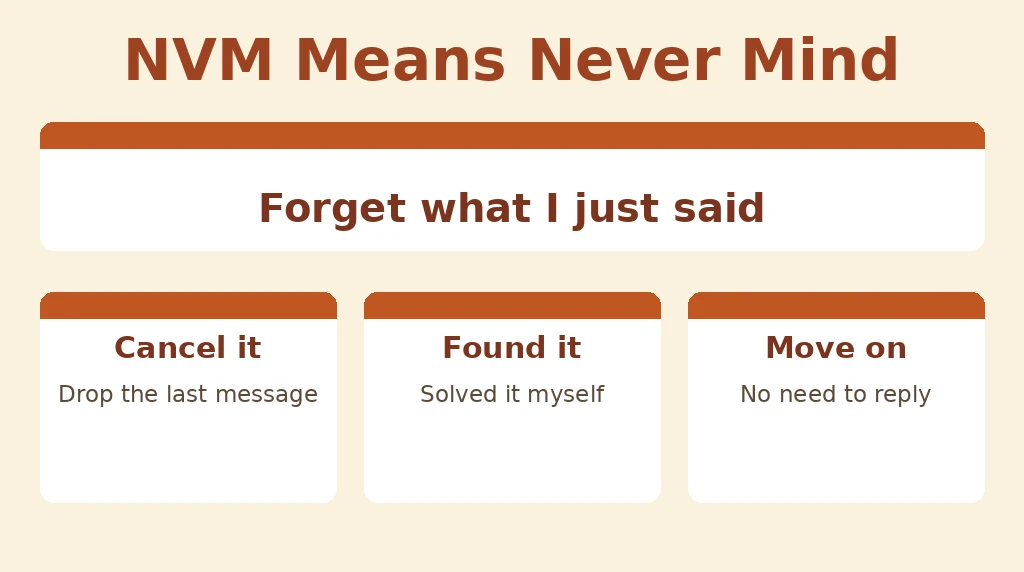
Here is the short answer first. NVM means “never mind”, and people type it when they want to cancel, drop or take back something they just said. It can sound relaxed and helpful, or cold and shutting, and the difference sits in the moment around it. It looks tiny, but it can end a chat, rescue you from an awkward question, or quietly annoy someone who was halfway through answering. This guide covers the nvm meaning in text, when it turns rude, NVM vs IDC and IDK, where you will see it, and the easiest replies for every version of it.
What Does NVM Mean in Text?
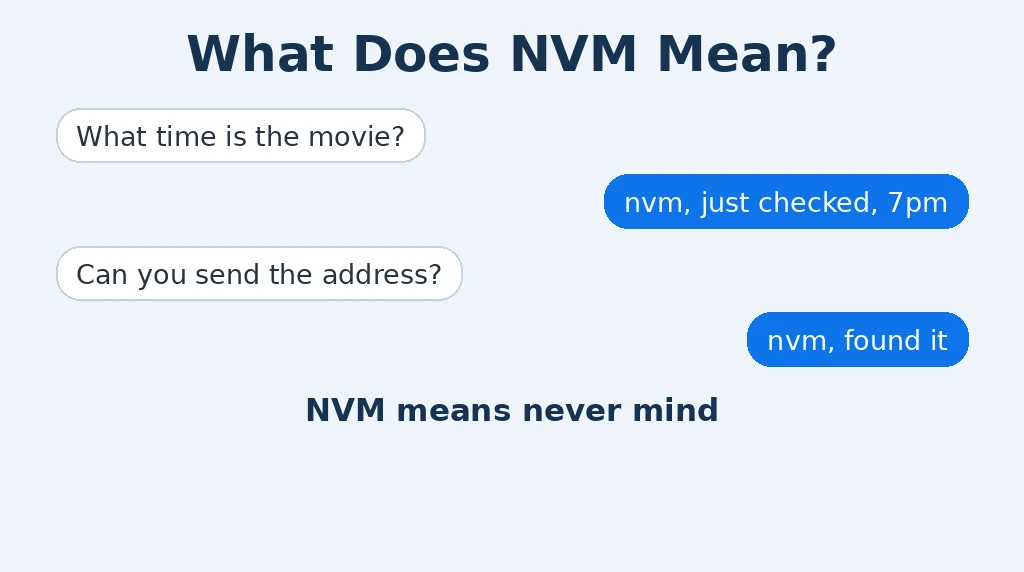
NVM is short for “never mind”. Someone sends it when a question answers itself, when a message was sent to the wrong chat, or when a thought simply stops mattering halfway through. “nvm, just checked, the movie starts at seven” is the classic case. The question is gone, the answer is found, and the chat moves on.
Think of it as an eraser for your last text. It tells the other person not to spend time on what you just asked, because the problem already solved itself. That is why you so often see nvm sent by the same person who asked the question in the first place, replying to their own message a minute later.
Tone still matters. A cheerful “nvm, found it lol” feels fine. A flat “nvm.” after someone tried hard to help can feel like a door closing. Lowercase nvm is the everyday form and reads softer, while capital NVM can look a little sharper. Add one small detail and the message almost always lands better.
Full Form of NVM
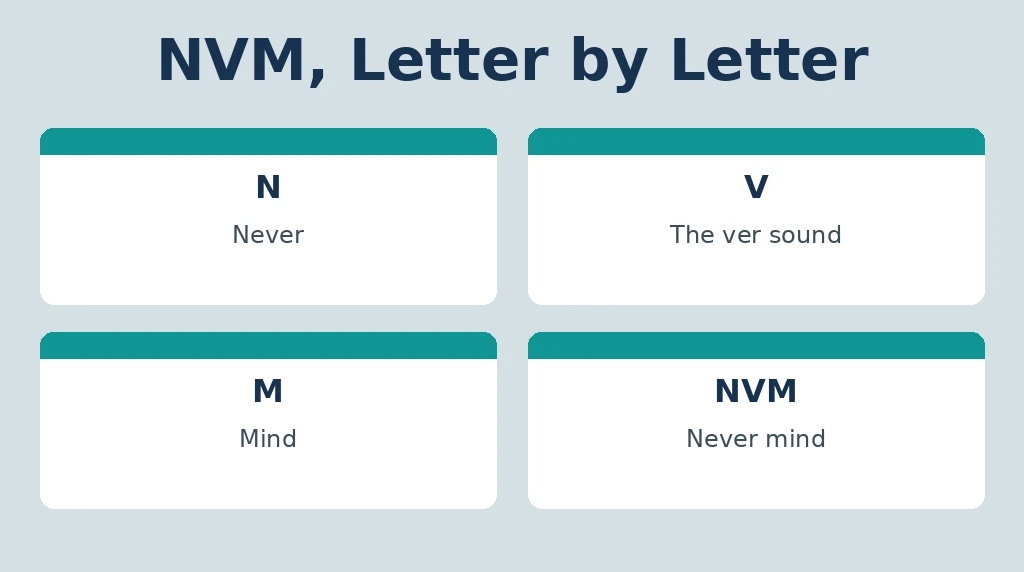
The full form is “never mind”, and the letters work a little differently from most abbreviations:
- N: Never
- V: the “ver” sound in “never”, a phonetic shortcut
- M: Mind
Put together, you get “never mind”, written as two words in standard English. The one word spelling “nevermind” also floats around online, but two words is the correct form. Say it out loud and people pronounce each letter on its own: en-vee-em. You will hear that spoken version in voice chats and in jokes between friends who text all day.
NVM vs IDC vs IDK: What Is the Difference?
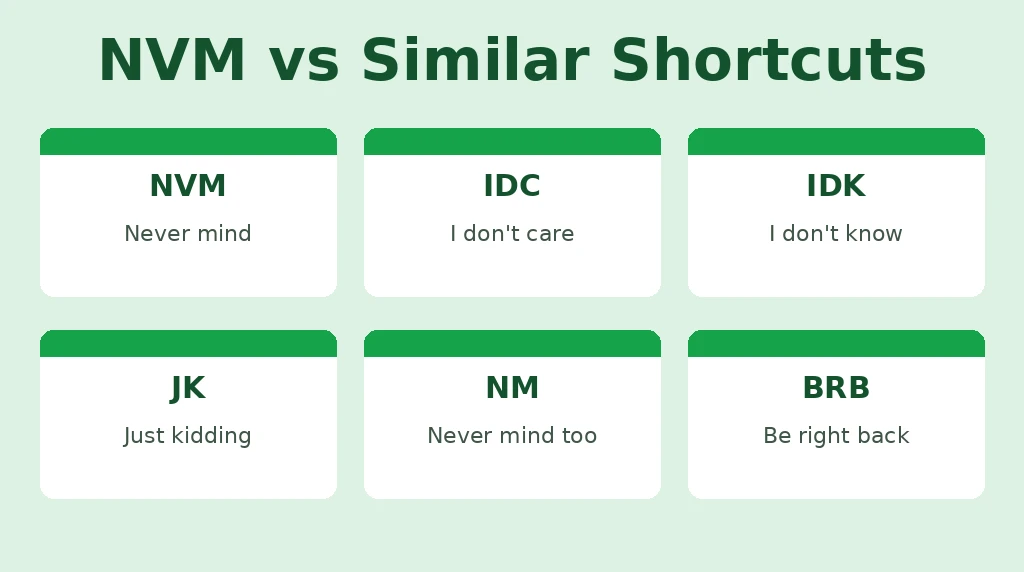
Three short abbreviations cause most of the mix ups in this corner of texting, so here they are side by side.
| Abbreviation | Full Form | What It Really Says | Tone |
|---|---|---|---|
| NVM | Never mind | Forget what I just said | Neutral, quick |
| IDC | I don’t care | I have no preference | Neutral, sometimes blunt |
| IDK | I don’t know | The answer is missing | Neutral, honest |
The classic mix up is NVM versus IDC, because both can end a topic. They do it in different ways, though. NVM cancels a message that already exists, usually your own. IDC shrugs at a question that is still open. “nvm, found the address” closes a question you asked. “idc where we eat” leaves a question open for someone else to answer.
idk sits in another lane again. It says the answer is missing, not that the question is cancelled. Reply “idk” to “what time is the movie?” and you still need the answer. Reply “nvm” and the question is gone. Swap them and the whole chat heads in a different direction.
Where NVM Is Commonly Used
Texting and WhatsApp
One to one chats are the natural home of nvm. It cancels a question the moment it stops mattering, like directions you found yourself or a time you just looked up. A typical line looks like this: “can you send the address again?” “nvm, found it in the old chat”. Short, honest, and the chat keeps moving.
Instagram and Snapchat
On Instagram and Snapchat, nvm shows up in DMs and in replies to stories, often when someone asks a question and then spots the answer in the photo or caption above. You will see lines like “nvm, just saw it in your bio” or a quick “nvm, I remember now” under a story about a meetup.
TikTok Comments
Scroll a busy TikTok comment section and nvm is everywhere. Viewers ask a question, then answer it themselves in a reply to their own comment. Comments like “wait, how do you get this filter?” followed by “nvm, found it in effects” are a format of their own, and everyone reading understands the rhythm.
Group Chats
Group chats run on half finished questions, so nvm is the glue holding them together. One person asks for the wifi password, scrolls up, and replies “nvm, it is on the fridge” before anyone else can answer. It keeps the thread tidy, and the plan stays tbd only until someone finally decides.
Gaming Chats
In game chat there is no time for full sentences, so nvm does quick work between rounds. Players type things like “can someone help with this boss” and then “nvm, got it” seconds later when they win the fight alone. Everyone understands it instantly, and nobody stops playing to decode it.
Discord and Forums
Discord servers and forums use nvm the same way, just in longer threads. Someone posts a problem, solves it, and edits the post to add “nvm, fixed it”. It signals “this is resolved” without pretending the question was never asked.
Origin and History of NVM
NVM belongs to the first big wave of texting shortcuts, but the phrase behind it is far older. “Never mind” has been part of English since the late 1700s, with its first recorded use around 1795, when it meant “do not trouble yourself about it”. The abbreviation came much later, once chat rooms and SMS gave people a reason to shorten it.
By the early 2000s, nvm was already a fixture of instant messaging and early social apps, with slang dictionaries recording entries around 2003. It travelled with texting from SMS to instant messenger to every social app that followed, and it never really went out of fashion because the need behind it never changed. People still ask questions and then answer them themselves, every single day, and they still want to cancel the question quickly. Its staying power is now official, too: major dictionaries list NVM as a real entry, which is more than most slang ever manages.
Other Meanings and Variations of NVM
In casual texting, NVM almost always means “never mind”, but the same letters carry other meanings in other rooms, and a few close cousins shift the tone.
- NM: “never mind” or “not much”, depending on the chat. “nm, forget it” means never mind, while “nm, just chilling” means not much. Read the sentence around it.
- NVMD: “never mind, done”. A firmer version, used when the topic is closed for good.
- Nevermind: the one word spelling. Common online, but “never mind” in two words is the standard form.
- Non-volatile memory: in computer hardware, NVM is a type of memory that keeps its data even when the power is off. You will see it in spec sheets, never in a chat about dinner.
- Node Version Manager: in software work, NVM is a tool developers use to manage versions of Node.js. Same letters, totally different world.
On social media, nvm also works as a caption and a tag. A comment that just says “nvm” under a post usually means the writer figured something out on their own. It is a shrug in public, a small note that the question answered itself.
How to Use NVM Correctly
- Use it to cancel your own message. NVM works best when you asked a question and then found the answer. That is its home turf.
- Keep it casual. NVM belongs in friendly, informal chats. If the conversation would not welcome a “lol”, it will not welcome an “nvm” either.
- Add one small detail. “nvm, I found it” takes two extra seconds and sounds ten times warmer than a bare nvm on its own.
- Watch the moment. If a friend is upset or asking something serious, a flat nvm can land badly. Slow down and write a real sentence instead.
- Do not use it to dodge a question. “nvm” after someone asks how you feel reads like a shutdown, not a shortcut. Answer honestly or say you need time.
Example Conversations Using NVM
Finding the answer yourself
Person A: “Hey, do you know what time the movie starts?”
Person A: “nvm, just checked, it is 7pm”
An address you already had
Person A: “Can you send me the address again?”
Person A: “nvm, found it in the old chat”
An Instagram DM
Person A: “Wait, are you free tonight?”
Person A: “nvm, I just remembered I have plans lol”
Gaming with a teammate
Person A: “Can someone carry me this round?”
Person A: “nvm, just clutched it myself”
A group chat question
Person A: “Does anyone have the wifi password?”
Person A: “nvm, it is on the fridge”
A TikTok comment
Person A: “Wait, how do you get this filter?”
Person A: “nvm, found it in effects”
A changed plan
Person A: “Hey, wanna hang out later?”
Person B: “Yeah sure, what time?”
Person A: “nvm, actually something came up, next time!”
A wrong chat
Person A: “Did you get my email about the meeting?”
Person A: “nvm, it just came through”
When Not to Use NVM
- Work email: write “please disregard my previous message” instead. Three letters look careless on the record.
- Job interviews and applications: even over chat, recruiters read nvm as unprepared or uninterested.
- Teachers and bosses: anyone grading or managing you deserves the full sentence.
- Customer service chats: on either side of the counter, nvm sounds like nobody is taking the problem seriously.
- Serious conversations: when someone asks how you feel, a bare nvm can feel like a door closing.
- When someone is mid answer: if they are already typing a helpful reply, let them finish instead of cutting them off.
How to Respond When Someone Sends You NVM
An nvm lands in your chat and the topic just closed itself. What you send next decides whether the conversation picks up again or quietly stalls. Pick the lane that matches the moment.
Easy replies work when the nvm was a simple cancel:
- “Okay lol”
- “No worries!”
- “Lol okay, np”
Helpful replies suit a question that still hangs in the air:
- “Aw okay, let me know if you figure it out”
- “Want me to check anyway?”
Playful replies fit close friends and light topics:
- “smh, you always do this”
- “Haha fair enough”
- “nvm squad, we never finish a question”
Check in replies help when the nvm feels sudden:
- “Wait, you sure? What is up?”
- “Everything okay? You seemed keen a minute ago.”
One thing to avoid: do not press someone who clearly wants to drop a topic. Most of the time the question really did answer itself, and a calm response keeps the chat friendly.
Common Mistakes People Make With NVM
- Thinking it is always rude. Most nvm replies are neutral, not dismissive. Tone in text is easy to misjudge, so give the sender the benefit of the doubt first.
- Using it to avoid serious questions. An nvm here and there is normal. Using it to dodge feelings or hard talks quietly hurts the people around you.
- Confusing it with sarcasm. Some people read a plain nvm as passive aggressive, when it usually just means the topic is resolved.
- Using it at work. A manager who gets “nvm” about a task hears “I have stopped caring”. Spell it out and add what changed.
- Sending a bare nvm after someone helped. If a friend went out of their way to answer, thank them first. A cold nvm makes the effort feel wasted.
Frequently Asked Questions
What does NVM mean in text?
NVM means “never mind”. People type it in chats and messages to cancel or drop something they just said, usually because they solved it themselves or it no longer matters.
Is NVM rude?
Not usually. In casual chats it is a normal, neutral reply, though a bare nvm in a serious or emotional conversation can sound cold, so adding a few words softens it.
What is the difference between NVM and IDC?
NVM cancels something that was just said, like a question you no longer need answered. IDC means “I don’t care”, so it is about having no preference. One drops a topic, the other shrugs at it.
What does NVM mean in tech?
In tech, NVM can stand for “non-volatile memory”, a type of computer memory that keeps data without power, or “Node Version Manager”, a tool for developers. In texting it always means “never mind”.
Can I use NVM in a work email?
No. NVM is casual texting shorthand, and it looks careless in professional writing. In a work email, write the full sentence, such as “Please disregard my previous message, I found the answer.”
How do I reply when someone sends me NVM?
Keep it easy. A simple “okay” or “no worries” works in most cases. If the nvm felt sudden in a serious chat, a gentle “you sure? What happened?” shows you are listening.
Final Thoughts
Three letters, one simple job. NVM is the quickest way to cancel a message that stopped mattering, and it has earned its place in everyday chats because everyone asks questions and then answers them alone. Used casually, with a little context when the moment is serious, it never really causes trouble.
If you want the official stamp, Dictionary.com lists nvm with exactly this meaning, which shows how far a humble texting shortcut has come. Either way, you now have the nvm meaning in text down, plus a decent reply ready for the next time it shows up in your messages.
