Cadence meaning refers to the rhythm, pace, or pattern in which something happens or sounds. It can describe the flow of someone’s voice, the rhythm of music, a regular schedule of business activities, or the rate of steps taken while running. The exact meaning depends on the context.
The word is useful because it describes more than speed. It can also suggest timing, consistency, flow, and the way one part of an activity connects to the next. For example, a speaker may have a calm cadence, a company may follow a weekly meeting cadence, and a runner may increase their cadence to take quicker steps.
What Does Cadence Mean?
Cadence is a noun that describes a rhythm, a pattern of movement or activity, or the way a sound or voice rises, falls, and flows. It is often used when the timing and arrangement of something matter as much as its speed.
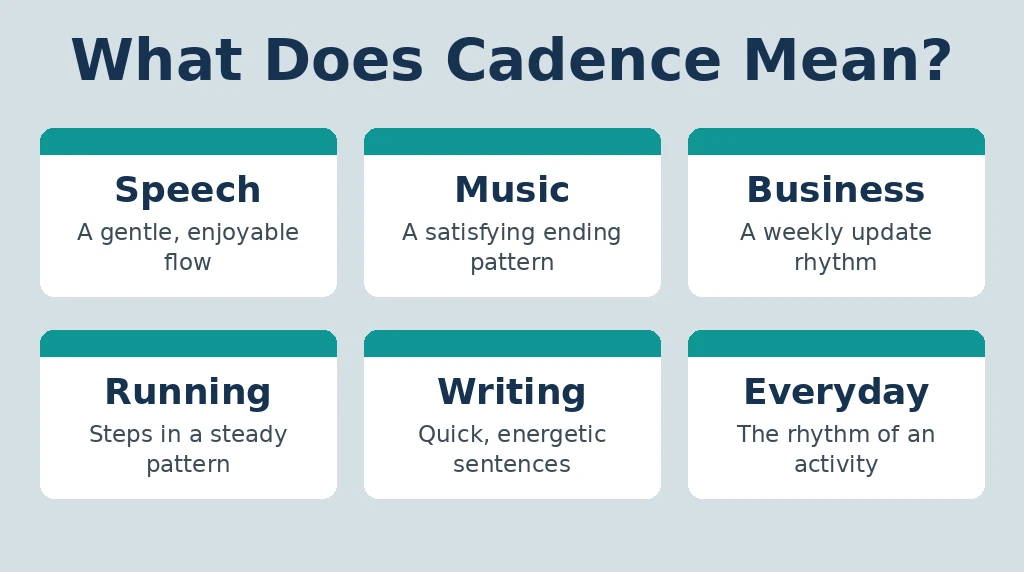
Consider these examples:
- Speech: Her gentle cadence made the story enjoyable to listen to.
- Music: The song ended with a satisfying musical cadence.
- Business: Our team follows a weekly cadence for project updates.
- Running: The athlete increased her cadence during the final mile.
- Writing: Short sentences gave the paragraph a quick, energetic cadence.
Although these examples describe different activities, they share one idea: cadence concerns the pattern or rhythm through which something unfolds.
The word can also suggest a natural ending or sense of resolution, especially in music and speech. In business, however, it usually refers to a recurring schedule. Understanding the context is the key to interpreting it correctly.
Cadence Definition and Pronunciation
Definition: Cadence is the rhythm, flow, or recurring pattern of sounds, movements, speech, or activities.

Pronunciation: KAY-dन्स, commonly represented as /ˈkeɪ.dəns/ in phonetic notation and pronounced like “KAY-dन्स” in English. The first syllable receives the stress.
Part of speech: Noun
Plural: Cadences
Word forms and related expressions:
| Form | Meaning or use | Example |
|---|---|---|
| Cadence | The rhythm or recurring pattern | The cadence feels natural. |
| Cadences | More than one rhythm or pattern | The two speakers have different cadences. |
| Rhythmic | Relating to rhythm | The rhythmic pattern is easy to follow. |
| Cadenced | Having a particular rhythm or flow | His cadenced speech sounded measured. |
The adjective rhythmic is common in everyday English. Cadenced is less common and is usually used in descriptive writing.
Is Cadence a Noun or a Verb?
Cadence is a noun, not a standard verb. You can say that a meeting has a regular cadence, but you would not normally say that a team cadences its meetings.
Natural alternatives include:
- We establish a weekly meeting cadence.
- We schedule weekly meetings.
- We meet every Friday.
- We follow a regular communication schedule.
The first example sounds more common in business and project management. The others may be clearer for a general audience.
The Different Meanings of Cadence in Everyday Life
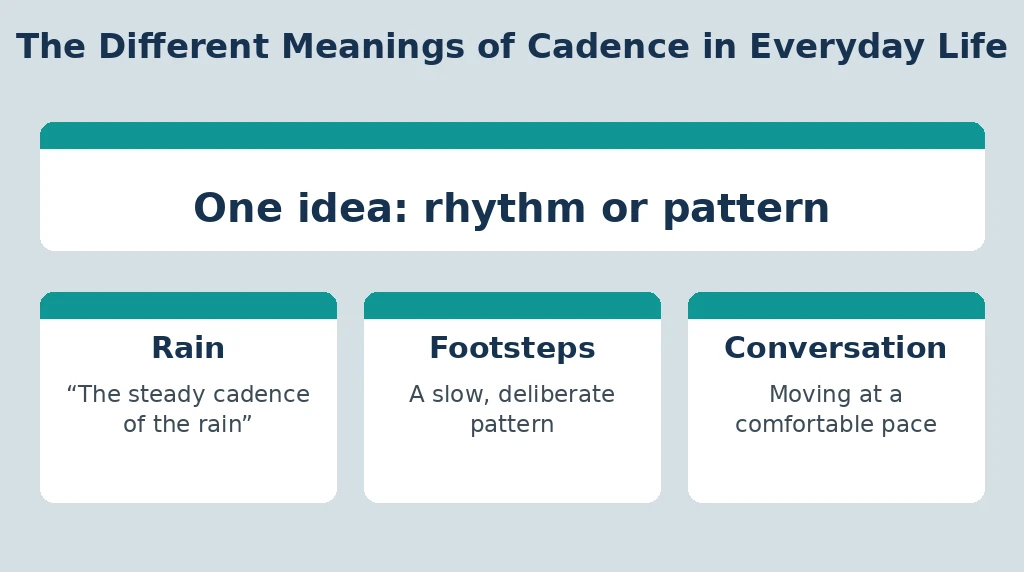
The meaning of cadence changes slightly from one subject to another. The central idea remains rhythm or pattern, but each field uses the word for a different purpose.
Cadence Meaning in Everyday English
In everyday English, cadence often describes the natural rhythm or flow of an action, sound, or sequence of events.
For example, imagine someone walking slowly along a quiet street. Their footsteps follow a steady pattern. You could describe that pattern as a walking cadence.
The word can also describe the way a person speaks, the rhythm of a poem, or the regular timing of daily activities.
Examples:
- The steady cadence of the rain helped me relax.
- Her footsteps had a slow, deliberate cadence.
- The conversation moved at a comfortable cadence.
- The familiar cadence of the morning routine made the day feel organized.
In these examples, cadence highlights the way something progresses rather than simply identifying its speed.
Cadence Meaning in Speech
When used to describe speech, cadence refers to the rhythm, flow, and changes in a person’s voice while speaking.
It can involve pauses, emphasis, changes in pitch, and the timing of words. These features help listeners understand a speaker’s meaning and emotional tone.
For example, a teacher who speaks at a measured cadence may be easier to follow than someone who rushes through every sentence.
Consider these examples:
- The speaker’s confident cadence held the audience’s attention.
- His slow cadence made each instruction easy to understand.
- The newsreader used a steady cadence throughout the broadcast.
- Her voice changed cadence when she became excited.
Cadence is especially useful when describing the overall delivery of speech. It does not mean accent alone. Two people can share the same accent but have very different speaking cadences.
A speaker might use long pauses, emphasize certain words, or speak in short, energetic bursts. These differences create an individual vocal rhythm.
Cadence Meaning in Music
In music, cadence has a more specific technical meaning. It commonly refers to a progression of chords that brings a musical phrase to a pause, ending, or sense of resolution.
A cadence can make a piece of music feel complete, create suspense, or suggest that more music is about to follow.
For example, a song may finish with a chord progression that sounds final. A different progression may leave the listener expecting another phrase.
Musicians commonly study several types of cadence:
| Type of cadence | General effect | Simple explanation |
|---|---|---|
| Perfect authentic cadence | Strong resolution | Often gives a musical phrase a clear ending |
| Imperfect authentic cadence | Resolution with a different sense of finality | Reaches the tonic but does not meet all the conditions of a perfect authentic cadence |
| Plagal cadence | Often sounds settled | Commonly moves from the subdominant to the tonic |
| Half cadence | Creates a sense of pause or continuation | Ends on the dominant chord |
| Deceptive cadence | Creates an unexpected turn | Moves away from the tonic where a listener might expect it |
These descriptions are simplified. The exact musical effect depends on harmony, melody, arrangement, and context.
Example sentence: The composer used a deceptive cadence to surprise the listener before the final section.
In this context, cadence is not simply another word for beat or tempo. It refers to harmonic movement and the way a musical phrase arrives at a stopping point or resolution.
Cadence Meaning in Business
In business, cadence usually means a recurring schedule or established rhythm for work, communication, meetings, reviews, or reporting.
You may hear expressions such as meeting cadence, sales cadence, communication cadence, and reporting cadence.
For example, a project team might review progress every Monday, send status reports every Friday, and evaluate its results at the end of each month. These recurring activities form the team’s operating cadence.
Common business examples include:
- Meeting cadence: How frequently a team meets.
- Sales cadence: The planned sequence and timing of sales outreach.
- Communication cadence: How often updates are shared and through which channels.
- Reporting cadence: The regular timing of performance reports.
- Review cadence: How often a process, project, or result is evaluated.
- Release cadence: The regular pattern of product or software releases.
Consider this sentence:
Our team established a weekly cadence for project updates to reduce confusion and missed deadlines.
The sentence means the team created a predictable schedule for sharing project information.
A useful business cadence gives people clarity about what happens next. It can reduce unnecessary meetings, improve coordination, and help teams identify problems sooner.
However, more frequent communication is not automatically better. A daily meeting may help a team handling urgent tasks, while a weekly update may be sufficient for a project that changes slowly. The right cadence depends on the work, the people involved, and how quickly information becomes outdated.
Cadence Meaning in Running
In running, cadence usually refers to the number of steps a runner takes per minute. It is commonly expressed as steps per minute, or SPM.
For example, if a runner takes 170 steps in one minute, their running cadence is 170 steps per minute.
Cadence can change with running speed, stride length, terrain, fatigue, and an individual’s natural movement pattern.
Examples:
- The runner increased her cadence during the final stretch.
- His running watch recorded an average cadence of 168 steps per minute.
- The coach studied the athlete’s cadence during the training session.
A higher cadence means more steps per minute, but it does not automatically mean a runner is more efficient or less likely to get injured. A suitable cadence depends on the individual and the situation.
Runners should avoid chasing a universal target simply because it is popular online. Training goals, comfort, current pace, and professional guidance may all matter.
Cadence Meaning in Cycling
In cycling, cadence refers to how quickly a cyclist turns the pedals. It is commonly measured in revolutions per minute, or RPM.
For example, a cadence of 80 RPM means the pedals complete 80 revolutions in one minute.
Cyclists adjust cadence according to the terrain, gear selection, effort, and their training goals. A rider may use a lower cadence when pushing a heavy gear uphill or a higher cadence when spinning more easily on flatter terrain.
Examples include:
- The cyclist maintained a steady cadence on the flat road.
- She increased her cadence during the warm-up.
- The trainer displayed the rider’s average cadence throughout the session.
Running cadence and cycling cadence describe different movements. Running cadence counts steps, while cycling cadence counts pedal revolutions. The units matter when interpreting fitness data.
Cadence Meaning in Writing
In writing, cadence describes the rhythm created by sentence length, punctuation, word choice, stress, and the arrangement of ideas.
Good cadence can make a paragraph feel calm, urgent, dramatic, conversational, or reflective.
Compare these two examples:
Example A:
The door opened. He stopped. Nobody spoke.
Example B:
When the door opened, he stopped in the hallway and waited for someone to explain the strange silence.
The first example has a short, abrupt cadence. The second creates a slower, more descriptive flow.
Neither style is always better. The right choice depends on the intended effect.
Writers can create different cadences by varying sentence length, placing pauses carefully, using parallel structures, and controlling the order of information.
For example, a fast-paced action scene may benefit from short sentences. A reflective passage may use longer sentences that allow ideas to unfold gradually.
Cadence also matters in speeches, advertisements, storytelling, poetry, and website copy because readers respond to the way language moves, not just to the meaning of individual words.
Cadence Meaning in Technology and Software
In technology, cadence often describes the regular timing of development, deployment, testing, or software releases.
A company might release updates every two weeks or review development progress at the end of each sprint. These repeated intervals establish a release or development cadence.
For example:
The software team adopted a predictable release cadence to make updates easier for customers to anticipate.
In this sentence, cadence refers to the recurring schedule of releases, not the speed of the software itself.
A steady release cadence can help teams plan work, coordinate testing, and communicate changes. Still, a regular schedule should not replace quality checks or responsible release decisions.
Cadence Meaning in Education
In education, cadence can describe the rhythm of a lesson, the pace of instruction, or the recurring schedule of classroom activities.
A teacher may alternate explanations, questions, exercises, and discussion to create a productive learning cadence. A school may also use a regular assessment cadence to check student progress.
Examples:
- The teacher adjusted the lesson cadence to give students more time to practice.
- Weekly quizzes established a consistent assessment cadence.
- The discussion had a lively cadence that kept students involved.
In these cases, cadence concerns how learning activities unfold over time. It can refer to the flow within a single lesson or the regular repetition of activities over several weeks.
Cadence Examples in Sentences
Seeing cadence in different sentences makes its meaning easier to recognize. The following examples show how the word works in common situations.
| Sentence | Meaning of cadence |
|---|---|
| Her calm cadence helped the audience relax. | The rhythm and flow of her speech |
| The drummer maintained a steady cadence. | A regular rhythmic pattern |
| Our team has a Monday meeting cadence. | A recurring meeting schedule |
| The poem’s cadence made it enjoyable to read aloud. | The rhythm of the language |
| The runner increased her cadence on the track. | More steps per minute |
| The cyclist monitored his cadence on the climb. | Pedal revolutions per minute |
| The song ended with a powerful cadence. | A musical resolution |
| The company changed its reporting cadence. | The frequency of reports |
| The speaker’s cadence became faster near the conclusion. | The changing rhythm of speech |
| The product team follows a monthly release cadence. | The regular timing of releases |
| The footsteps echoed in a slow cadence. | A repeated rhythm of movement |
| The lesson’s cadence gave students time to think. | The pace and flow of instruction |
Notice that the word does not always mean the same precise thing. In speech, it describes vocal rhythm. In business, it often describes a recurring schedule. In running, it refers to a measurable rate.
The surrounding words usually reveal which meaning is intended.
Cadence vs. Rhythm vs. Pace vs. Tempo
These four words are closely related, but they emphasize different aspects of an activity. Choosing the right one can make your writing clearer.
| Word | Main emphasis | Example |
|---|---|---|
| Cadence | A pattern, flow, or recurring sequence | The team follows a weekly cadence. |
| Rhythm | A pattern of sounds, movements, or events | The music has a strong rhythm. |
| Pace | The speed or rate of progress | She increased her pace. |
| Tempo | The speed of music or a repeated activity | The song has a fast tempo. |
What Is the Difference Between Cadence and Rhythm?
Rhythm generally refers to a pattern of sounds, movements, or events. Cadence often emphasizes how that pattern flows, changes, or reaches a stopping point.
For example, a song has a rhythm created by its musical patterns. A cadence may bring a phrase to a sense of resolution.
In speech, the terms can overlap. Rhythm may describe the pattern of stressed and unstressed syllables, while cadence can refer to the overall flow of the speaker’s delivery.
What Is the Difference Between Cadence and Pace?
Pace focuses mainly on speed. Cadence focuses on rhythm, pattern, or recurring timing.
For example:
- The runner increased her pace. This means she ran faster.
- The runner increased her cadence. This means she took more steps per minute.
These changes can occur together, but they are not identical. A runner’s speed depends on both cadence and stride length.
In business, the difference is also useful. A project can move at a fast pace while following a weekly reporting cadence.
What Is the Difference Between Cadence and Tempo?
Tempo usually refers to the speed of music and can also describe the speed of an activity. Cadence has a broader range of meanings, including speech flow, recurring work schedules, and musical resolution.
For instance, a song can have a fast tempo but end with a slow, sustained cadence. A business team can work at a rapid tempo while maintaining a monthly review cadence.
Quick rule: Use pace when speed is the main concern, tempo when speed or musical timing is central, rhythm when describing a pattern, and cadence when the pattern’s flow or recurring structure matters.
Cadence Synonyms and Related Words
The best synonym for cadence depends on the sentence. Some alternatives describe sound, others describe speed, and some refer to recurring schedules.
| Synonym | Meaning | Best use case | Example |
|---|---|---|---|
| Rhythm | A pattern of sounds or movements | Music, speech, writing | The rhythm of her speech was soothing. |
| Pace | The speed of progress | Running, work, conversation | We need to maintain a steady pace. |
| Tempo | The speed of music or activity | Music, performance | The band increased the tempo. |
| Flow | The smooth movement of ideas or actions | Writing, speech, conversation | The paragraph has a natural flow. |
| Beat | A regular pulse or rhythmic unit | Music, dance, movement | The dancers followed the beat. |
| Timing | When something happens | Communication, performance | The timing of the announcement was perfect. |
| Pattern | A repeated or recognizable arrangement | Behavior, schedules, events | We noticed a pattern in the meetings. |
| Meter | A structured pattern of rhythm | Poetry, music | The poem uses a regular meter. |
| Frequency | How often something happens | Business, science, communication | We reduced the frequency of status meetings. |
| Schedule | A planned timetable | Work, meetings, activities | The team follows a fixed schedule. |
| Regularity | The quality of occurring consistently | Habits, routines, processes | The regularity of her practice improved. |
| Intonation | Changes in the pitch of the voice | Speech and pronunciation | Her intonation made the question clear. |
These terms overlap with cadence, but none is a perfect replacement in every situation.
For instance, schedule may replace cadence in a business sentence when the intended meaning is simply a timetable. It would not replace cadence naturally in a sentence about the final chord progression of a song.
Similarly, intonation describes changes in vocal pitch, while cadence can include pitch along with pauses, emphasis, and overall flow.
Which Synonym Is Best for Cadence?
Use the meaning of the sentence to guide your choice:
- Choose rhythm for repeated sounds or movements.
- Choose pace for the speed of progress.
- Choose tempo for musical speed or the speed of an activity.
- Choose flow for the smoothness of speech or writing.
- Choose frequency when discussing how often something occurs.
- Choose schedule when the main idea is a planned timetable.
- Choose intonation when the rise and fall of the voice is important.
For example, weekly meeting cadence can become weekly meeting schedule. The replacement is clearer for many readers, particularly if the business context does not require specialized terminology.
How to Use Cadence in a Sentence
Using cadence naturally starts with identifying the pattern you want to describe. The word is especially useful when a sentence needs to convey more than a simple speed or timetable.
Use Cadence to Describe Speech
Cadence works well when describing a person’s vocal delivery.
Examples:
- The narrator’s slow cadence created a peaceful mood.
- He changed his cadence to emphasize the important points.
- Her natural cadence made the presentation sound conversational.
- The politician’s deliberate cadence gave the speech a serious tone.
In each example, cadence describes the overall rhythm of speaking rather than the person’s accent or vocabulary.
Use Cadence to Describe a Schedule
In professional writing, cadence can refer to a repeated pattern of work.
Examples:
- We established a weekly cadence for team check-ins.
- The manager changed the reporting cadence from weekly to monthly.
- Our sales team uses a consistent outreach cadence.
- The product team agreed on a quarterly review cadence.
The word is especially natural when discussing an established process rather than a single event.
Use Cadence to Describe Writing
Cadence can help writers explain why a passage sounds smooth, abrupt, dramatic, or repetitive.
Examples:
- The writer varied the sentence cadence to maintain interest.
- Short sentences gave the introduction a forceful cadence.
- The speech had a natural cadence when read aloud.
- Repeated phrases created a memorable cadence in the closing paragraph.
A useful editing technique is to read a passage aloud. If every sentence has the same length and structure, the writing may sound monotonous. Varying the cadence can make it more engaging.
Use Cadence to Describe Sports Performance
In running and cycling, cadence is often a measurable training metric.
Examples:
- The runner tracked her cadence during the interval session.
- The cyclist maintained a comfortable cadence on the hill.
- The coach compared cadence data from two training sessions.
When using the word in sports, specify the activity or unit if the reader might not know which measurement you mean.
For example, 170 steps per minute is clearer than simply stating that a runner had a cadence of 170.
Common Phrases and Expressions With Cadence
Cadence appears in several common expressions, especially in professional, creative, and technical contexts.
| Expression | Meaning | Example |
|---|---|---|
| Natural cadence | A rhythm that feels unforced | The speaker has a natural cadence. |
| Steady cadence | A consistent rhythm or schedule | The team maintained a steady cadence. |
| Meeting cadence | How often meetings occur | We reviewed our meeting cadence. |
| Sales cadence | A planned sequence of sales contacts | The sales cadence includes emails and calls. |
| Communication cadence | The pattern or frequency of updates | The client requested a clearer communication cadence. |
| Release cadence | The regular timing of releases | The company adopted a monthly release cadence. |
| Cadence of speech | The rhythm and flow of speaking | The cadence of speech changed during the story. |
| Running cadence | Steps taken per minute | The watch recorded running cadence. |
| Cycling cadence | Pedal revolutions per minute | The cyclist monitored cycling cadence. |
| Cadence of a sentence | The rhythm created by words and structure | The final sentence has a strong cadence. |
What Does “At a Cadence” Mean?
The expression at a cadence usually refers to something happening at a particular recurring rate or according to a defined rhythm.
For example:
The department publishes its performance report at a monthly cadence.
This means the report follows a monthly reporting pattern.
However, the phrase can sound unnecessarily technical in everyday communication. A clearer version would be:
The department publishes its performance report every month.
The more direct wording is often preferable when the schedule itself is the main point.
What Does “Change the Cadence” Mean?
To change the cadence means to alter the rhythm, flow, frequency, or recurring pattern of something.
The exact interpretation depends on the context.
- A speaker may change cadence by slowing down and adding pauses.
- A business may change its cadence by moving from weekly meetings to monthly meetings.
- A runner may change cadence by taking steps at a different rate.
- A writer may change cadence by alternating short and long sentences.
The expression is useful because it describes a change in pattern without requiring the speaker to specify every detail immediately.
Why Cadence Matters in Communication and Work
Cadence is more than a vocabulary word. Recognizing patterns can help people communicate clearly, organize work, and understand how activities unfold.
It Makes Communication Easier to Follow
A speaker who pauses at appropriate points gives listeners time to process information. A speaker who rushes through every sentence may make even simple ideas difficult to follow.
Cadence can support clarity by creating a natural sequence of emphasis, pauses, and transitions.
For example, during a presentation, a speaker might slow down before explaining an important result. The pause gives the audience time to focus on the information.
This does not mean every speaker needs a slow cadence. An energetic, quick delivery can work well for an enthusiastic presentation. The important factor is whether the rhythm suits the message and audience.
It Helps Teams Set Expectations
A consistent business cadence can clarify when people should meet, share updates, and review progress.
Imagine a team that sends updates at random times. Some employees receive information early, others receive it late, and important decisions may be delayed.
Now imagine that the same team shares progress every Friday and reviews major decisions on the first Monday of each month. Everyone knows when to expect information.
The cadence creates predictability.
Still, the goal is not to fill every week with meetings. A useful cadence should match the team’s needs and leave enough time for focused work.
It Helps Writers Control Tone
Sentence cadence influences how writing feels to the reader.
Longer sentences can support explanation, reflection, and description. Shorter sentences can emphasize important details or create urgency.
Consider this passage:
The lights went out. The room fell silent. Then someone knocked.
The short sentences create a quick, suspenseful cadence.
Compare it with:
As the lights went out, the room gradually settled into silence, until a sudden knock interrupted the stillness.
The longer structure creates a more gradual effect.
Writers can use both approaches in the same piece. Changing cadence helps prevent every paragraph from sounding alike.
It Provides Useful Information in Sports
In running and cycling, cadence data can help athletes understand movement patterns and monitor changes during training.
However, cadence should not be treated as a complete measure of athletic performance. A single number cannot explain technique, endurance, fatigue, comfort, or overall efficiency.
It is most useful when interpreted alongside other relevant information, such as speed, effort, terrain, and the athlete’s goals.
How to Choose the Right Cadence for a Business Team
If you encounter cadence in a workplace discussion, the term often raises a practical question: how frequently should an activity happen?
There is no universal schedule that works for every team. A useful cadence depends on how quickly the work changes, how much coordination it requires, and how often people need new information.
Here is a practical starting point:
| Activity | Possible cadence | When it may help |
|---|---|---|
| Daily team check-in | Daily | Work changes quickly or blockers need immediate attention |
| Project update | Weekly | Team members need regular progress visibility |
| Performance review | Monthly | Trends need to be assessed over time |
| Strategy review | Quarterly | Goals and priorities require broader evaluation |
| Customer communication | Based on customer needs | Updates must match the stage of a project or relationship |
| Software release | Based on development and testing needs | Users benefit from predictable updates |
These are examples, not fixed rules.
A team handling urgent customer issues may need more frequent check-ins than a team completing a long-term research project. A customer who needs daily updates during a critical launch may prefer monthly updates once the system is stable.
Three Questions to Ask Before Setting a Cadence
1. How quickly does the information change?
If the situation changes several times a day, a weekly update may be too slow. If little changes from week to week, daily meetings may add unnecessary overhead.
2. Who needs the information?
A project manager may need detailed daily updates, while senior leadership may only need a weekly summary. Different audiences can have different cadences.
3. What decision or action should follow?
Every recurring meeting or report should have a purpose. If an update rarely leads to a decision, useful action, or meaningful exchange, the cadence may need to be reconsidered.
A well-designed cadence creates enough structure to keep people aligned without making communication feel like a burden.
Common Mistakes to Avoid When Using Cadence
Although cadence is a useful word, it can sound awkward when used in the wrong context. Understanding these common mistakes will help you use it more naturally.
Using Cadence When You Only Mean Speed
Cadence and speed are related, but they do not mean exactly the same thing.
Incorrect or unclear: The car’s cadence increased on the highway.
Better: The car’s speed increased on the highway.
Cadence describes a rhythm or repeated pattern, not speed in general. It works best when the activity has a recognizable rhythm or recurring sequence.
Treating Cadence and Frequency as Identical
Frequency refers to how often something happens. Cadence can describe frequency as part of a broader recurring pattern.
For example:
- The frequency of our emails increased. This focuses on how often emails are sent.
- We changed our communication cadence. This can include the frequency, timing, and sequence of communication.
The second sentence may be more suitable when discussing an organized communication process.
Assuming Cadence Always Means a Regular Schedule
In business, cadence often describes a recurring schedule. In music and speech, it usually refers to rhythm, flow, or resolution.
For example, the cadence of her voice describes how she speaks, not how frequently she speaks.
Always check the context before deciding which meaning applies.
Using Business Jargon When Simple English Is Better
Phrases such as operational cadence and communication cadence are common in professional settings, but they are not always the clearest choices.
Compare these examples:
- Technical: We need to optimize our communication cadence.
- Clearer: We need to decide how often we share updates.
Both can communicate the same general idea. The second is often more accessible to readers who are unfamiliar with business terminology.
Use cadence when it adds precision or fits the audience. Choose simpler wording when it communicates the point more directly.
Confusing Running Cadence With Stride Length
Running cadence counts steps per minute. Stride length describes the distance covered by a step or stride, depending on the measurement convention.
They are related to running speed, but they are not interchangeable.
A runner can change speed by adjusting cadence, stride length, or both. A cadence number alone does not provide a complete picture of running technique.
Frequently Asked Questions
What does cadence mean in simple words?
Cadence means the rhythm, flow, or regular pattern of something. It can describe how someone speaks, how music resolves, how frequently a team meets, or how quickly a runner takes steps.
What is an example of cadence?
An example is: The teacher spoke at a calm cadence, giving students time to understand each point. Here, cadence refers to the rhythm and flow of the teacher’s speech.
Is cadence the same as rhythm?
Not exactly. Rhythm describes a pattern of sounds, movements, or events. Cadence can describe that rhythm’s flow or, in music, a chord progression that brings a phrase to a pause or resolution. The words sometimes overlap in everyday English.
What does cadence mean in business?
In business, cadence usually means the recurring schedule or pattern of meetings, reports, communications, reviews, or other work activities. A weekly meeting cadence means that meetings follow a weekly schedule.
What does cadence mean in speech?
Cadence in speech refers to the rhythm and flow of someone’s voice. It can include pauses, emphasis, changes in pitch, and the timing of words. A speaker’s cadence can affect how natural, engaging, or easy to follow their speech sounds.
What does cadence mean in running?
Running cadence is the number of steps a runner takes per minute. It is commonly measured in steps per minute and can change with running speed, terrain, fatigue, and individual technique.
What is the difference between cadence and tempo?
Tempo generally refers to the speed of music or an activity. Cadence can refer to rhythm, flow, recurring timing, or a musical resolution. A piece of music can have a fast tempo and still end with a distinct cadence.
What is another word for cadence?
Common alternatives include rhythm, pace, tempo, flow, timing, and pattern. In a business context, schedule or frequency may be more appropriate. The best synonym depends on the intended meaning.
How do you pronounce cadence?
Cadence is pronounced KAY-duhns, with the stress on the first syllable. Its common phonetic transcription is /ˈkeɪ.dəns/.
Can cadence be used to describe writing?
Yes. Cadence describes the rhythm created by sentence length, punctuation, word choice, and sentence structure. Short sentences can create a sharp cadence, while longer sentences can produce a slower, more flowing effect.
Conclusion:
The word cadence describes the rhythm, flow, or recurring pattern through which something happens. Its meaning becomes more specific depending on the subject. In speech, it describes vocal flow. In music, it can refer to a chord progression that creates a pause or resolution. In business, it often means a recurring schedule, while in running and cycling, it refers to measurable movement rates.
The easiest way to understand cadence is to look at what it describes and how that activity unfolds over time. If you are discussing speed alone, pace or tempo may be more precise. If you are describing a recurring work schedule, cadence can be useful, although schedule may sound clearer to a general audience.
Once you recognize these distinctions, you can understand the word in everyday conversations, professional communication, music discussions, and sports training, and use it confidently in your own writing.
Discover More Post:
- 111 Meaning | Spiritual Significance, Symbolism, Love & the …
- Unhinged Meaning | Definition, Examples, Tone & Why It’s …
- FUPA Meaning in Text & Slang – SynonyMore.com
