The word dovetail describes something that fits together so naturally that the connection makes sense. You might hear it when a manager explains how two business plans support each other, when a writer connects two ideas, or when a carpenter discusses a strong wooden joint. Although these situations seem different, they share the same central idea: two parts fitting together in a useful or compatible way.
The dovetail meaning depends on context. As a verb, it usually means to fit, coordinate, or complement something else. As a noun, it can refer to a particular interlocking joint used in woodworking. Understanding both meanings helps you recognize the word in conversations, professional writing, books, and technical discussions. This guide explains its definitions, pronunciation, grammar, synonyms, common expressions, and realistic examples so you can use dovetail confidently and accurately.
What Does Dovetail Mean?
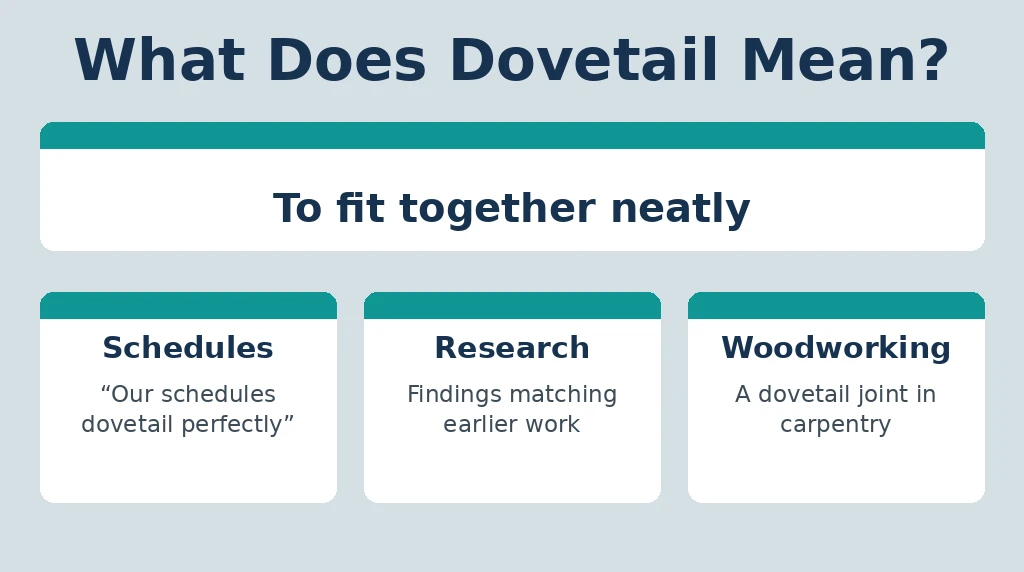
Dovetail means to fit together neatly, work well together, or complement one another. It is commonly used figuratively when ideas, plans, schedules, goals, or pieces of information align. In woodworking, a dovetail is an interlocking joint designed to connect two pieces of wood securely.
Examples:
- “Our schedules dovetail perfectly.” This means the schedules fit together without conflict.
- “Her findings dovetail with the earlier research.” This means her findings are consistent with the earlier research.
- “The carpenter made a dovetail joint.” This refers to a specific woodworking connection.
The word often suggests more than a simple match. It can imply that separate parts fit together in a practical, coherent, or complementary way.
What Is the Definition of Dovetail?
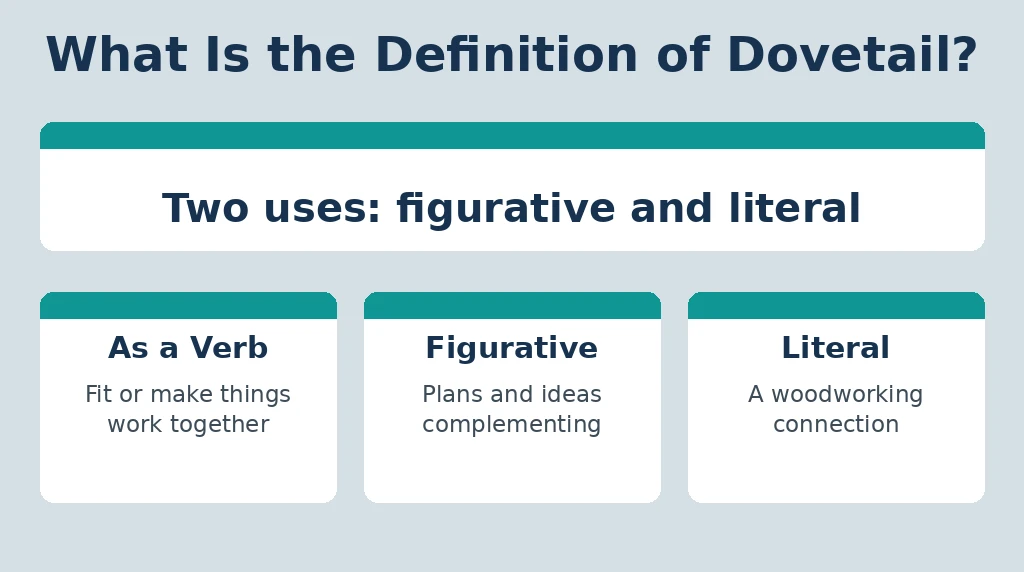
The word dovetail has two main uses: a figurative use involving compatibility and a literal use involving woodworking.
Dovetail as a Verb
As a verb, dovetail means to fit together neatly or to make separate things work well together.
It often appears when two or more things have different roles but support the same outcome.
For example:
“Her communication skills dovetail with his technical knowledge.”
The sentence means that her skills and his knowledge complement each other. Together, they may make a team more effective.
Another example:
“The new training program dovetails with the company’s long-term goals.”
Here, the program fits the company’s broader direction.
The verb can describe an existing relationship or an action that creates a better fit. The surrounding sentence usually makes the intended meaning clear.
Dovetail as a Noun
As a noun, dovetail most commonly refers to a type of woodworking joint.
The joint uses wedge-shaped projections and matching recesses cut into two pieces of wood. These shapes interlock when the pieces are assembled.
Dovetail joints are especially associated with drawers, cabinets, boxes, and fine furniture. Their interlocking shape helps resist the force that would pull the joined pieces apart.
Example:
“The cabinetmaker used a dovetail to join the drawer’s sides.”
In this sentence, dovetail refers to the physical joint rather than a general relationship between ideas.
The Core Idea Behind Both Meanings
The literal and figurative meanings are connected by the same image: separate parts fitting together.
In woodworking, the parts physically interlock. In everyday language, plans, skills, schedules, or ideas fit together in a compatible way.
This connection makes the figurative meaning easier to remember. Imagine two pieces that have been shaped to fit. When one piece supports the other, the result is a more unified whole.
Dovetail Meaning in Everyday English
In everyday English, dovetail often describes situations in which separate activities, needs, or ideas work together.
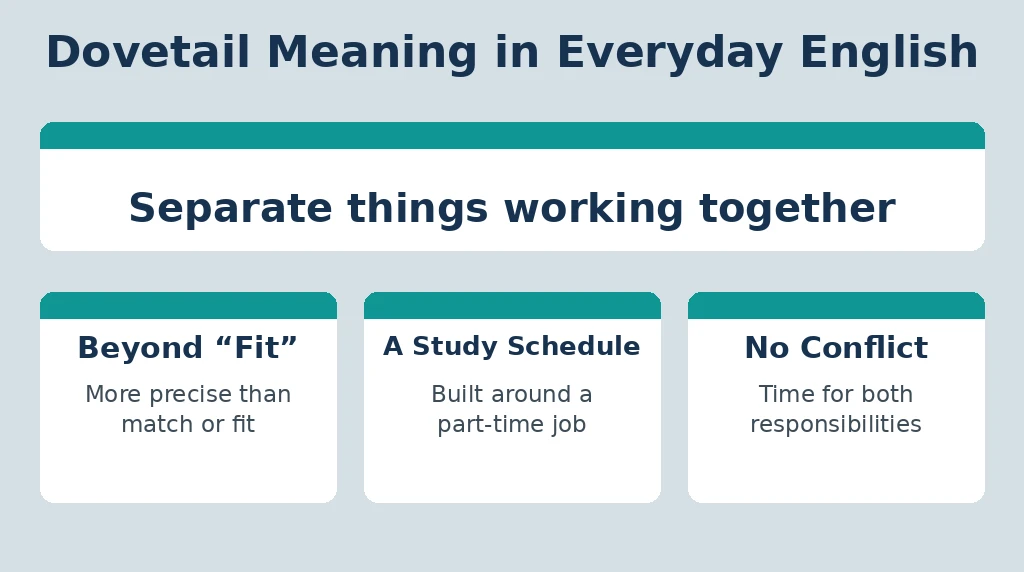
It is particularly useful when match or fit feels too general.
When Two Plans Work Together
Suppose a student creates a study schedule around a part-time job. The work shifts and study sessions do not conflict, and the arrangement leaves enough time for both responsibilities.
You could say:
“My work schedule dovetails with my classes.”
This means the two schedules fit together conveniently.
When Ideas Support Each Other
Imagine a team discussing a new product. One employee suggests a lower price, while another recommends a simpler design. Both suggestions support the same goal of making the product more accessible.
You could say:
“The two proposals dovetail.”
The ideas do not have to be identical. They fit together because they support a compatible outcome.
When Information Is Consistent
Suppose an interview reveals details that are also found in a written report.
A writer might say:
“The interview details dovetail with the report.”
This indicates that the two sources are consistent in relevant ways.
However, consistency alone does not prove that information is true. Two accounts can agree and still be inaccurate. In research, journalism, and professional investigations, dovetail describes the relationship between pieces of information, not a guarantee of their reliability.
When Different Skills Complement Each Other
A project may need someone who understands customers and another person who understands technology.
You could say:
“Their skills dovetail nicely.”
This suggests that each person’s strengths contribute something useful to the shared task.
Dovetail Meaning in Business and Professional Communication
The expression dovetail with is common in workplace discussions because it describes alignment between separate activities, priorities, and objectives.
It can help explain how one decision supports another without suggesting that both are identical.
Business Strategy
Example:
“Our customer service improvements dovetail with the company’s retention strategy.”
Meaning: Better customer service supports the goal of keeping existing customers.
The word is useful when describing the relationship between a specific initiative and a larger business objective.
Project Management
Example:
“The design team’s deadlines dovetail with the development team’s schedule.”
Meaning: The timelines fit together in a way that helps the project move forward.
This usage is most appropriate when the tasks are coordinated. If deadlines simply happen to occur at the same time, overlap may be more accurate.
Team Collaboration
Example:
“Her experience in marketing dovetails with his background in data analysis.”
Meaning: Their different areas of knowledge complement each other.
This is a natural way to describe a team whose members bring compatible strengths.
Business Writing Examples
| Sentence | Intended meaning |
|---|---|
| The proposal dovetails with our annual priorities. | The proposal supports existing priorities. |
| The sales and delivery schedules dovetail. | The schedules fit together. |
| This campaign dovetails with our customer outreach efforts. | The campaign complements related activities. |
| The findings dovetail with the market research. | The findings are consistent with the research. |
| Her recommendations dovetail with the team’s objectives. | Her recommendations support the team’s goals. |
Is Dovetail Too Formal for Business Writing?
No. Dovetail is professional but not excessively formal. It works in meetings, reports, presentations, proposals, and emails when the relationship between two things is important.
However, clarity should come first. If your audience might not know the word, choose a simpler alternative such as fit together, align with, or work well with.
For example:
Formal: “The implementation plan dovetails with our existing workflow.”
Simpler: “The implementation plan fits our existing workflow.”
Both communicate the same general idea. The first emphasizes coordination; the second is more direct.
Dovetail Meaning in Woodworking
In woodworking, a dovetail is a joint formed by cutting complementary shapes into two pieces of wood so they interlock.
The joint is named for its resemblance to a dove’s tail. Its distinctive shape is functional, not merely decorative.
How a Dovetail Joint Works
One piece of wood has flared, wedge-shaped projections called tails. The other has corresponding spaces called pins. The two parts fit together when assembled.
The wider ends of the tails help resist forces that would pull the joint apart in the direction of separation.
Dovetail joints are commonly used in drawer construction, cabinetry, and box making. Their strength depends on factors such as the quality of the cuts, the fit of the parts, the wood, and the way the joint is assembled.
Common Types of Dovetail Joints
Through dovetail: The joint remains visible on both faces of the assembled corner. It is common in boxes and some furniture.
Half-blind dovetail: The joint is visible from one side but concealed from the other. It is frequently used for drawer fronts, where the joint is hidden from the outside.
Sliding dovetail: A dovetail-shaped groove in one piece receives a matching projection from another. It is often used to connect shelves, partitions, or other components.
These types serve different design purposes. A through dovetail highlights the joinery, while a half-blind dovetail can provide a cleaner exterior appearance.
Why Dovetail Joints Matter
A properly made dovetail joint can provide strong mechanical resistance to separation. It can also be attractive when the maker wants the joinery to remain visible.
However, it is not automatically the best joint for every project. Construction requirements, materials, tools, appearance, and manufacturing time all affect the choice.
Example:
“The furniture maker chose half-blind dovetails for the drawer fronts.”
This is a literal use of dovetail, not the figurative meaning found in expressions about plans or ideas.
Dovetail With Meaning: How the Expression Works
The phrase dovetail with means to fit, align, or complement something else.
The word with introduces the thing that fits or agrees with the subject.
Examples:
- “The new policy dovetails with existing regulations.”
- “My travel dates dovetail with the conference schedule.”
- “The evidence dovetails with the witness’s account.”
- “This lesson dovetails with what students learned last week.”
- “The proposal dovetails with the department’s priorities.”
In each example, the subject and the object have a compatible relationship.
Dovetail With vs. Dovetail Into
These constructions can overlap, but they emphasize slightly different relationships.
Dovetail with usually highlights compatibility or alignment between two things.
Example: “The new plan dovetails with the current strategy.”
Dovetail into can emphasize how a part fits into a larger arrangement or system.
Example: “The introductory lesson dovetails into the advanced course.”
The second construction is less common in some contexts, and the best preposition depends on what you want to express. Dovetail with is the more widely useful choice when describing alignment between plans, ideas, goals, or information.
Dovetail in a Sentence: 15 Practical Examples
The easiest way to understand a vocabulary word is to see how it works in different situations. These examples show the range of dovetail without changing its central meaning.
| Example sentence | Meaning |
|---|---|
| 1. Our vacation dates dovetail with the school break. | The dates fit together conveniently. |
| 2. Her research dovetails with earlier findings. | Her research is consistent with earlier findings. |
| 3. The two departments’ responsibilities dovetail well. | Their responsibilities complement one another. |
| 4. His teaching style dovetails with the students’ needs. | His style suits their needs. |
| 5. The project milestones dovetail with the delivery schedule. | The timelines are coordinated. |
| 6. Their professional strengths dovetail naturally. | Their strengths work well together. |
| 7. The new campaign dovetails with our brand message. | The campaign supports the same message. |
| 8. The evidence appears to dovetail with the original account. | The evidence seems consistent with the account. |
| 9. My morning routine dovetails with my work hours. | The routine fits my schedule. |
| 10. The final chapter dovetails with the opening scene. | The two parts connect coherently. |
| 11. The training modules dovetail with the job requirements. | The training supports the required skills. |
| 12. The architect designed a dovetail connection for the wooden structure. | The sentence refers to a physical joint. |
| 13. The cabinetmaker cut each dovetail by hand. | The maker shaped the woodworking joints manually. |
| 14. The proposed changes dovetail with the organization’s mission. | The changes support its mission. |
| 15. The two explanations do not dovetail. | The explanations are inconsistent or do not fit together. |
Notice that dovetail can describe both positive and negative relationships. Saying that two accounts do not dovetail means they fail to fit together logically or consistently.
Synonyms of Dovetail and Their Differences
Several English words are similar to dovetail, but they are not interchangeable in every sentence.
The best alternative depends on whether you mean physical fit, agreement, coordination, or complementary strengths.
| Synonym | Meaning | Best use |
|---|---|---|
| Align | To be in agreement or in line with something | Goals, policies, priorities |
| Complement | To add something that improves or completes another thing | Skills, qualities, design |
| Coordinate | To organize things so they work together | Schedules, tasks, teams |
| Fit together | To be compatible or form a whole | Everyday conversation |
| Harmonize | To work or agree together without conflict | Ideas, colors, plans |
| Integrate | To combine parts into a larger whole | Systems, processes, information |
| Match | To correspond or be similar | Requirements, descriptions, qualities |
| Correspond | To be similar, consistent, or related | Facts, records, findings |
| Mesh | To fit or work together successfully | Personalities, plans, systems |
| Interlock | To connect through parts that fit into one another | Physical objects, mechanisms |
Which Synonym Is Best?
Choose align when the focus is agreement with a goal or standard.
“The proposal aligns with our priorities.”
Choose complement when two different things improve each other.
“Her analytical skills complement his creativity.”
Choose coordinate when timing, organization, or activities must work together.
“The teams coordinated their schedules.”
Choose correspond when comparing information or accounts.
“The figures correspond to the published records.”
Choose interlock for a physical connection or a particularly close relationship between parts.
“The pieces interlock securely.”
Use dovetail when you want to emphasize a neat, compatible fit between separate elements, especially when the relationship is more specific than simple similarity.
Dovetail vs. Similar Words
Some words describe relationships that resemble dovetailing but do not communicate exactly the same idea.
Dovetail vs. Align
Align means to be in agreement or to match a direction, objective, or standard. Dovetail often suggests that two elements fit together in a practical and complementary way.
- Align: “The company’s policies align with its values.”
- Dovetail: “The customer support plan dovetails with the new product launch.”
The first emphasizes agreement. The second emphasizes how two activities work together.
Dovetail vs. Complement
Complement means to complete, enhance, or improve something by adding a suitable quality or element.
- “The blue curtains complement the room.”
- “The design plan dovetails with the construction schedule.”
The curtains improve the room’s appearance. The design plan and schedule fit together operationally.
The words can overlap when different skills or ideas support each other.
Dovetail vs. Coordinate
Coordinate usually involves arranging activities or people so they work together efficiently.
- “We coordinated the meeting times.”
- “The meeting schedule dovetails with the training calendar.”
The first describes an organizing action. The second describes the resulting fit.
Dovetail vs. Coincide
Coincide can mean to occur at the same time or to agree.
- “The two meetings coincide.” They happen at the same time.
- “The two schedules dovetail.” They fit together in a useful way.
Two schedules that dovetail do not necessarily occur at the same time. They may be arranged so one activity follows another without a conflict.
Dovetail vs. Correlate
Correlate describes a relationship or association between variables, facts, or observations. It does not necessarily mean they fit together neatly or support the same plan.
For example, two measurements may correlate statistically without one causing the other.
Use dovetail when describing compatibility or consistency. Use correlate when discussing an observed relationship between variables.
Antonyms of Dovetail
Antonyms are words that express an opposite or contrasting idea. The best opposite for dovetail depends on the context.
| Antonym or contrasting expression | Meaning | Example |
|---|---|---|
| Conflict | To be incompatible or opposed | The two plans conflict. |
| Clash | To disagree or fail to work together | Their priorities clash. |
| Contradict | To state or imply the opposite | The new evidence contradicts the claim. |
| Misalign | To fail to match or fit correctly | The schedule is misaligned with the deadline. |
| Disagree | To have different or opposing views | Their explanations disagree. |
| Mismatch | To be poorly suited to each other | The skills mismatch the job requirements. |
| Diverge | To move or develop in different directions | Their strategies diverge. |
| Disrupt | To interrupt the normal operation of something | The delay disrupts the schedule. |
| Separate | To move or keep things apart | The design separates the two components. |
| Disconnect | To lack a meaningful link or connection | The recommendation feels disconnected from the evidence. |
These words do not all function as direct dictionary antonyms. They are context-dependent opposites that help express the failure of things to fit, agree, or work together.
For example, contradict is especially appropriate when statements conflict, while misalign works better for goals or schedules.
Dovetail Grammar: Forms, Tenses, and Usage
Understanding the grammar of dovetail helps you use it naturally in conversation and writing.
Base Form: Dovetail
Use the base form after modal verbs and with plural subjects in the present tense.
- “The plans dovetail nicely.”
- “These responsibilities can dovetail.”
- “The two systems may dovetail.”
Third-Person Singular: Dovetails
Use dovetails with a singular third-person subject in the simple present.
- “Her experience dovetails with the role.”
- “The proposal dovetails with our objectives.”
Past Tense: Dovetailed
Use dovetailed for a relationship or action in the past.
- “The schedule dovetailed with our travel plans.”
- “The new proposal dovetailed with the original design.”
Present Participle: Dovetailing
Use dovetailing in continuous tenses or as a modifier.
- “The two projects are dovetailing well.”
- “We are dovetailing the training sessions with the rollout.”
The second sentence describes an intentional effort to coordinate activities.
Is Dovetail Transitive or Intransitive?
It can be both.
Intransitive use: The subject fits or works well with another element, often introduced by with.
“The two plans dovetail.”
“The new strategy dovetails with our goals.”
Transitive use: The subject brings elements together or makes them fit.
“The manager dovetailed the training sessions with the project schedule.”
Transitive use is possible, but it may sound more technical or less natural than simply saying coordinated. In many everyday sentences, the intransitive form is the clearest choice.
Common Mistakes When Using Dovetail
The word is straightforward once you understand the idea of fit, but a few errors can make a sentence confusing.
Treating Dovetail as a Synonym for Identical
Incorrect assumption: If two ideas dovetail, they must be exactly the same.
Better understanding: They may be different but compatible.
Example: “Her design skills dovetail with his engineering experience.”
Their skills are not identical. They work well together.
Using Dovetail When Things Merely Happen at the Same Time
Two events occurring simultaneously does not automatically mean they dovetail.
Less precise: “The two appointments dovetail because they are at 2 p.m.”
Clearer: “The two appointments coincide because they are scheduled for 2 p.m.”
Use dovetail when the relationship involves a practical fit or coordination.
Assuming Dovetail Proves Something Is True
If two reports dovetail, they are consistent with each other. That consistency does not prove either report is accurate.
For careful writing, use phrases such as “the accounts dovetail” rather than claiming that agreement between them establishes the truth.
Confusing the Verb With the Woodworking Noun
In “the schedules dovetail,” the word is a verb.
In “the carpenter cut a dovetail,” it is a noun.
The spelling remains the same, so sentence structure determines the function.
Overusing the Word in Simple Sentences
Dovetail can make writing precise, but it is not always the best choice.
Instead of “The two tasks dovetail,” you can write “The two tasks fit together” if your audience prefers plain English.
Choose the word because it adds meaning, not simply because it sounds sophisticated.
How to Choose the Right Word for Your Sentence
Before using dovetail, identify the relationship you want to describe.
If two plans support the same goal: Use dovetail or align.
Example: “The outreach plan dovetails with our recruitment strategy.”
If two people have different but useful strengths: Use dovetail or complement.
Example: “Their skills dovetail on complex projects.”
If activities need to be arranged in the right order: Use coordinate or dovetail.
Example: “The delivery schedule dovetails with the installation plan.”
If two statements agree with each other: Use dovetail with, correspond to, or be consistent with.
Example: “The witness’s account dovetails with the available records.”
If two physical parts connect: Use interlock or the technical term dovetail joint, depending on the context.
Example: “The wooden pieces interlock through a dovetail joint.”
A useful test is to replace dovetail with fit together. If the sentence keeps its intended meaning, the word may work. If the meaning is mainly about timing, statistical association, or exact agreement, a more specific alternative might be clearer.
Quick Reference: Dovetail Meaning at a Glance
| Question | Answer |
|---|---|
| What does dovetail mean? | To fit together neatly or work well together. |
| What does dovetail mean in business? | To align or coordinate plans, goals, or activities. |
| What does dovetail with mean? | To fit, agree, or complement something else. |
| What is a dovetail in woodworking? | An interlocking joint used to connect pieces of wood. |
| Is dovetail a verb? | Yes. It can also be a noun. |
| What is the past tense of dovetail? | Dovetailed. |
| What is a synonym for dovetail? | Align, complement, coordinate, or fit together, depending on context. |
| What is the opposite of dovetail? | Conflict, clash, or misalign, depending on context. |
| Is dovetail formal? | It is suitable for both everyday and professional communication. |
| Can dovetail describe ideas? | Yes. It can describe ideas that fit together or support a common purpose. |
Frequently Asked Questions
What does dovetail mean in simple words?
Dovetail means that two things fit together or work well together. For example, two people’s skills dovetail when their different abilities complement each other.
What does it mean when two things dovetail?
It means that two things fit together neatly, are compatible, or support one another. The word can describe schedules, ideas, plans, skills, and pieces of information.
What does dovetail with mean?
Dovetail with means to fit or align with something else. For example, “The proposal dovetails with our goals” means the proposal supports or fits those goals.
Is dovetail a positive word?
It is generally neutral to positive. It often describes a useful fit or a harmonious relationship, but a sentence such as “The explanations do not dovetail” describes an inconsistency.
What is another word for dovetail?
Common alternatives include align, complement, coordinate, harmonize, and fit together. The best choice depends on the sentence and the relationship being described.
What is a dovetail joint used for?
A dovetail joint connects pieces of wood through interlocking, wedge-shaped projections and matching recesses. It is commonly used in drawers, cabinets, boxes, and furniture.
What is the difference between dovetail and align?
Align emphasizes agreement with a direction, goal, or standard. Dovetail often emphasizes how separate parts fit together or work well as a whole.
Is dovetail one word or two?
Dovetail is one word. It can function as a verb, as in “the plans dovetail,” or as a noun, as in “a dovetail joint.”
How do you use dovetail in a professional email?
Use it to explain how two plans, projects, or objectives work together. For example: “The proposed timeline dovetails with the launch schedule, so we can proceed with the next phase.”
Conclusion
The meaning of dovetail centers on the idea of separate parts fitting together in a useful or compatible way. In everyday English, it describes plans, schedules, ideas, skills, or information that complement one another. In woodworking, it refers to an interlocking joint that connects pieces of wood.
Use dovetail when you want to express a meaningful fit rather than simple similarity. Choose align for agreement, complement for mutually beneficial qualities, and coordinate for organized activities. Understanding these distinctions helps you choose clearer words in conversation, academic writing, and professional communication.
Discover More Post:
- 111 Meaning | Spiritual Significance, Symbolism, Love & the …
- Unhinged Meaning | Definition, Examples, Tone & Why It’s …
- FUPA Meaning in Text & Slang – SynonyMore.com
