The way people shop has changed dramatically. A customer can order groceries during a lunch break, compare laptops from different brands in minutes, or buy a birthday gift from a phone without visiting a physical store. Behind many of these everyday purchases is a business concept known as etail.
The etail meaning is electronic retail, the sale of products or services to customers through online channels. Also written as e-tail or e-tailing, the term describes retail transactions conducted through websites, online stores, and digital marketplaces. An online clothing shop, a furniture website, and a seller operating through an online marketplace are all examples of etail businesses.
Understanding this term helps consumers make sense of online shopping and helps business owners understand how digital selling works. It also makes it easier to distinguish etail from the broader concept of e-commerce, which includes many other types of electronic transactions.
What Does Etail Mean in Simple English?
Etail means selling products online instead of relying on a traditional physical store. The word combines the letter “e,” which stands for electronic, with “tail,” a shortened form of retail.
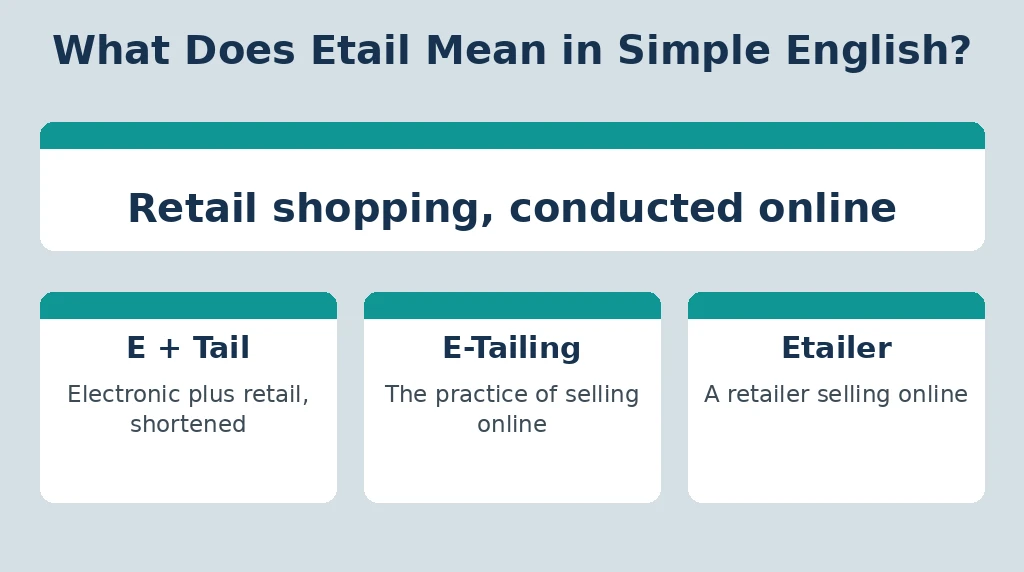
In simple English, etail is retail shopping conducted through the internet.
For example, imagine a small business that sells handmade candles. Customers browse the company’s website, select a scent, pay online, and receive their candles by mail. The business is operating an etail store because it sells products through a digital storefront.
The same concept applies to larger online retailers, independent sellers, and businesses that sell through digital marketplaces.
Here is a quick breakdown:
| Term | Simple meaning |
|---|---|
| Etail | Selling products through online retail channels |
| E-tailer | A business or seller that sells products online |
| E-tailing | The activity or process of selling through online retail channels |
| Etail store | A website or digital storefront used to sell products |
| Etail business model | The way an online retail business attracts customers, sells products, and earns revenue |
These terms are closely related, but they serve different grammatical purposes. Etail names the activity or concept, e-tailer identifies the seller, and e-tailing describes the process.
Is Etail a Real Word?
Yes. Etail is an established business term, commonly written as e-tail. Both forms refer to electronic retailing.
The hyphenated spelling makes the connection with electronic retail especially clear. The unhyphenated form is also used in business writing, online publications, and search queries.
For readers researching the word, these variations are useful:
- Etail meaning: The definition of online retail.
- E-tail definition: The same concept using the hyphenated spelling.
- E-tailing: The practice of selling goods online.
- Etailer: A retailer that sells through online channels.
The term is most relevant in discussions about retail, digital business, online shopping, and the development of internet-based sales.
What Is the Difference Between Etail and E-Commerce?
Etail and e-commerce are related, but they are not interchangeable in every situation.

Etail is a specific form of retail conducted online, while e-commerce is the broader category of commercial activity carried out electronically.
E-commerce can include online retail, digital subscriptions, electronic ticket sales, business-to-business transactions, and other commercial activities conducted through digital systems.
Etail focuses more specifically on retail sales to end customers.
Consider a streaming company that sells monthly subscriptions. The transaction is e-commerce, but it is not usually described as traditional etail because the customer is purchasing access to a digital service rather than shopping through an online retail store.
Now consider a website that sells headphones, phone cases, and speakers. This is a clear example of etail because the business sells retail products online.
Etail vs. E-Commerce: Comparison Table
| Feature | Etail | E-commerce |
|---|---|---|
| Main meaning | Online retailing | Electronic commercial transactions |
| Scope | Narrower | Broader |
| Common activity | Selling products to consumers online | Selling products, services, subscriptions, and more |
| Typical customers | Individual retail shoppers | Consumers and businesses |
| Example | Buying shoes from an online store | Buying shoes, paying for software, or ordering business supplies online |
| Business models | Online retail stores and marketplace sellers | B2C, B2B, C2C, subscriptions, and online retail |
| Physical products | Common | May involve physical or digital products |
| Digital services | Possible, depending on the retail offering | A major part of the broader category |
The distinction is useful because it helps describe a business more precisely.
A company selling physical products through a website can reasonably be described as an etailer. A company that primarily processes electronic payments, sells software subscriptions, or facilitates business-to-business transactions may be better described as an e-commerce business.
The categories can overlap. An etail business is generally part of the larger e-commerce ecosystem, but not every e-commerce business is an etailer.
Etail vs. Traditional Retail
Traditional retail usually involves customers purchasing products through physical locations, such as supermarkets, clothing stores, pharmacies, and furniture showrooms.

Etail allows customers to shop through a website or another online channel.
Both models serve the same basic purpose: connecting products with buyers. The main difference is how customers discover, evaluate, purchase, and receive their orders.
For example, a customer buying a jacket from a shopping mall can touch the fabric, try on different sizes, and take the jacket home immediately. A customer buying the same jacket online may have access to more colors and sizes but must rely on product photos, descriptions, size charts, and customer reviews.
Neither model is automatically better for every purchase. The right choice depends on the product, customer preferences, delivery options, and shopping situation.
Key Differences Between Etail and Retail
| Factor | Etail | Traditional retail |
|---|---|---|
| Shopping location | Website, app, or online marketplace | Physical store |
| Opening hours | Often available around the clock | Depends on store hours |
| Product inspection | Photos, videos, specifications, and reviews | Direct inspection and, in many cases, testing |
| Product selection | Can include a large online catalog | Limited by physical shelf and storage space |
| Payment | Online payments, digital wallets, and sometimes cash on delivery | In-store cards, cash, and other accepted methods |
| Delivery | Shipping or local delivery is common | Customers often take purchases home |
| Customer interaction | Chat, email, phone, and digital support | Face-to-face assistance is possible |
| Operating costs | Website, technology, fulfillment, and shipping expenses | Rent, store utilities, staffing, and inventory expenses |
| Returns | Often require shipping or a drop-off process | May be handled directly at the store |
| Geographic reach | Can serve distant customers, subject to delivery coverage | Usually attracts customers within a local area |
Can a Business Use Both Models?
Absolutely. A business that sells through both a physical store and a website is often called an omnichannel retailer when it integrates its different shopping channels into a connected customer experience.
For example, a shoe retailer might let customers:
- Browse available sizes online.
- Purchase shoes through its website.
- Collect an order from a nearby store.
- Return an online purchase at a physical location.
- Check product availability before traveling to a store.
This arrangement combines the convenience of online shopping with the advantages of physical retail.
It also shows why etail should not be understood as a business model that must replace physical stores. For many businesses, online and offline sales complement each other.
Real-World Examples of Etail
The easiest way to understand the meaning of etail is to look at the different ways businesses sell products online.
An etail business does not need to be a large international company. A small independent seller can use the same basic model, provided customers can purchase products through an online retail channel.
Here are several practical examples.
Online Marketplaces
Example: A customer buying a phone charger from an online marketplace.
The customer searches for a charger, compares prices and reviews, selects a seller, and completes the purchase online. The seller or marketplace then arranges fulfillment according to its business model.
Online marketplaces bring multiple sellers and product listings together. They can make products easier to discover, but buyers should still check seller ratings, product specifications, return policies, and delivery estimates.
Brand-Owned Online Stores
Example: A skincare company selling directly through its own website.
The company displays its product range, explains ingredients, accepts orders, and ships products to customers. It controls much of the brand presentation and may collect customer feedback to improve its offerings.
This model gives the brand more control over the shopping experience. However, the company must also attract website visitors and manage its own online sales operations.
Small Business Websites
Example: A local bakery accepting cake orders online.
Customers view available designs, select a size, choose a pickup or delivery option, and submit their order. The bakery uses its website to manage sales without requiring every customer to place an order by phone.
A small etail business can start with a limited product range and a simple online storefront. Its success depends on factors such as product quality, accurate listings, dependable fulfillment, and customer service.
Social Commerce Stores
Example: A clothing seller promoting products through social media and directing customers to an online checkout.
Customers discover products through photos, videos, recommendations, or creator content. They then purchase through an integrated shopping feature or the seller’s website.
Social media can support etail by helping businesses attract attention and build relationships with potential customers. However, posting products on social media is not necessarily a completed retail transaction. The sale occurs when a customer places an order through an available purchasing channel.
Subscription-Based Product Stores
Example: A coffee company shipping a selected blend to customers every month.
Customers choose a subscription, provide payment details, and receive recurring shipments according to the plan’s terms.
This is a form of online retail when the subscription involves recurring physical product deliveries. It differs from a digital-only subscription, such as access to an online video service, which falls under the broader e-commerce category rather than ordinary physical-product etail.
Digital Product Stores
A website that sells downloadable templates, photographs, fonts, or ebooks can also conduct online retail, depending on its business model and how the products are classified.
The important point is that etail is defined by the retail activity and sales channel, not by the size of the company or the physical location of the seller.
How Does Etailing Work?
Etailing may look simple from a customer’s perspective, but a successful online sale involves several connected steps. The customer sees a product, places an order, and receives it. Behind that experience, the business must manage product information, inventory, payments, order processing, fulfillment, and customer support.
Understanding this process is useful for shoppers who want to know what happens after checkout and for business owners considering online sales.
Step 1: Products Are Listed Online
The business creates product pages containing details such as names, prices, photographs, descriptions, available sizes, specifications, and stock status.
Accurate product information helps customers make informed decisions.
For example, an online furniture store should provide the dimensions of a desk, the material used, assembly requirements, and delivery information. A description that only says “beautiful modern desk” leaves too many questions unanswered.
Step 2: Customers Discover and Compare Products
Customers can find products through search engines, marketplace searches, advertisements, social media, email campaigns, or direct visits to a store’s website.
They may compare prices, shipping costs, product features, reviews, and return conditions before deciding to buy.
This stage is especially important because an online shopper cannot always inspect the product in person. Clear information reduces uncertainty and helps customers select an appropriate item.
Step 3: Customers Add Products to Their Cart
After choosing a product, customers typically select the required quantity, size, color, or other options and add the item to a shopping cart.
The cart summarizes the selected products and may display estimated taxes, delivery charges, discounts, and the total cost.
A well-designed checkout experience makes these details easy to understand before payment.
Step 4: The Order Is Placed and Payment Is Processed
Customers enter their delivery information and select an available payment method.
Depending on the store and country, payment options may include credit cards, debit cards, digital wallets, bank transfers, or cash on delivery.
The payment system authorizes or processes the transaction according to the payment method. The store then confirms the order, subject to its payment and order-verification procedures.
Businesses must protect customer information and use appropriate security practices when handling payments.
Step 5: Inventory Is Checked
The business confirms that the product is available and allocates inventory to the order.
Some stores maintain their own stock. Others use suppliers, dropshipping arrangements, marketplace fulfillment services, or third-party warehouses.
Inventory accuracy matters. If a product is shown as available but is actually out of stock, the customer may face delays, cancellations, or refunds.
Step 6: The Order Is Packed and Shipped
For physical products, the business or its fulfillment partner picks the items, packs them, prepares the shipping label, and hands the parcel to a delivery service.
Delivery time depends on the product’s location, destination, shipping method, carrier capacity, and other factors.
Digital products follow a different fulfillment process. A customer who purchases a downloadable template, for example, may receive immediate access through a download link instead of a physical shipment.
Step 7: The Customer Receives the Order
The customer receives the product or digital access according to the terms of the purchase.
The business should provide appropriate order updates and a clear way to report missing, damaged, incorrect, or delayed items.
Delivery is not always the end of the customer relationship. Returns, exchanges, product questions, and warranty claims may require further assistance.
Step 8: Customer Support and Repeat Purchases
After the sale, the retailer may handle returns, respond to feedback, resolve problems, or recommend relevant products.
A positive experience can encourage repeat purchases and recommendations. A confusing return process or poor response to a complaint can have the opposite effect.
For an etail business, the full customer journey matters more than simply getting someone to click the Buy button.
Main Types of Etail Business Models
Not every online retailer operates in the same way. Some businesses manufacture their own products, others purchase inventory from suppliers, and some provide a platform where independent sellers can reach customers.
Understanding these business models helps explain how etailing generates revenue and how different online stores manage their operations.
Business-to-Consumer (B2C)
Business-to-consumer, or B2C, describes a business selling directly to individual customers.
For example, an online cosmetics company sells face wash to a customer who wants to use it personally. The business displays the product, accepts the order, and arranges delivery.
B2C is one of the most familiar forms of etail because it resembles conventional shopping, except that the transaction takes place online.
Best suited for: Brands, online stores, specialty retailers, and businesses selling directly to consumers.
Business-to-Business (B2B)
Business-to-business, or B2B, involves commercial transactions between businesses.
For example, a website sells office chairs in bulk to companies furnishing their offices. Customers may receive volume discounts, request quotations, or order products under negotiated payment terms.
B2B transactions are part of e-commerce when conducted electronically. However, not every B2B transaction is technically etail, since the term etail is most commonly associated with retail sales to end consumers.
Best suited for: Wholesale suppliers, office supply businesses, commercial equipment sellers, and manufacturers with online ordering systems.
Consumer-to-Consumer (C2C)
Consumer-to-consumer, or C2C, involves individuals selling products to other individuals, often through an online marketplace.
Imagine someone selling a used bicycle through a marketplace website. Another person finds the listing, agrees to the price, and purchases the bicycle.
This is an example of online commerce and may resemble online retail in its customer experience. However, a secondhand sale between individuals is not always classified as traditional retail, particularly when the seller is not operating a retail business.
Best suited for: Secondhand goods, collectibles, used electronics, and peer-to-peer resale.
Direct-to-Consumer (D2C)
Direct-to-consumer, or D2C, describes a brand selling directly to customers rather than relying entirely on intermediaries such as wholesalers and independent retailers.
For example, a company that manufactures running shoes may sell through its own website instead of depending only on third-party stores.
D2C is closely associated with etail, but the terms describe different things. Etail refers to online retail activity, while D2C describes the relationship between the brand and the buyer.
A D2C business can sell online, through physical stores, or through both channels.
Best suited for: Manufacturers, consumer brands, specialty product companies, and businesses seeking a direct customer relationship.
Marketplace-Based Etailing
Some retailers sell products through established online marketplaces rather than building an independent store.
The marketplace may provide product discovery, payment processing, seller tools, or fulfillment services. The seller may still be responsible for product quality, inventory, pricing, and customer service, depending on the platform’s rules.
For a small business, this model can reduce the initial effort required to reach online shoppers. The trade-off is greater dependence on the marketplace’s fees, policies, competition, and customer access rules.
Best suited for: New sellers, small businesses, niche product makers, and retailers testing demand before investing in their own online store.
Subscription Etailing
Subscription etailing involves customers receiving physical products on a recurring schedule.
Examples include monthly coffee deliveries, pet food subscriptions, and curated personal care boxes.
The model can make revenue more predictable, but only if customers continue to see value in the products and service. Businesses must communicate renewal terms, manage recurring payments, and make cancellation procedures clear.
Best suited for: Consumable products, replenishment items, curated boxes, and products customers purchase regularly.
What Are the Advantages of Etailing?
Online retail creates opportunities for both customers and businesses. However, its advantages depend on how the store is managed, what it sells, and which customers it serves.
Convenience for Customers
Customers can browse products from home, work, or while traveling, subject to internet access and the retailer’s availability.
They can compare specifications, read reviews, and place orders without traveling to multiple stores.
This convenience is particularly useful for people who have limited access to nearby shops or who need specialized products that local retailers do not carry.
Wider Geographic Reach
A physical store generally depends heavily on its local market. An online store can reach customers across a city, country, or international market if its shipping arrangements, payment options, and legal requirements permit it.
For example, a small business selling handmade stationery may attract customers beyond its home town by displaying its products online.
However, a website does not automatically make a business global. Shipping costs, customs requirements, language differences, local regulations, and delivery times can limit its actual reach.
A Broader Product Selection
An online catalog can display more products than a small physical store has room to keep on its shelves.
Some items may be held in a warehouse or supplied by a partner rather than stored at the seller’s main location.
Customers can also use search and filtering tools to narrow down a large selection by price, size, color, brand, or product specifications.
A larger catalog is useful only when products are organized well. Too many confusing options can make shopping more difficult instead of easier.
Easier Product Comparison
Online shoppers can compare prices, features, ratings, and product descriptions across different stores.
For example, a customer purchasing a laptop can compare memory, storage capacity, screen size, warranty terms, and shipping charges before making a decision.
The quality of this comparison depends on the accuracy of the information provided. A low advertised price may not represent the best overall value if delivery costs are high or the return policy is restrictive.
Access to Customer Feedback
Reviews and ratings can help customers understand how a product performs in real situations.
Comments about sizing, durability, packaging, or ease of use may reveal details that a short product description does not cover.
Businesses can also use recurring feedback to identify product defects, improve descriptions, and address service problems.
Reviews should not be treated as unquestionable proof. Customers should consider the number of reviews, the relevance of the comments, and signs of suspicious or manipulated feedback.
Opportunities for Small Businesses
Etailing can give small businesses access to customers without requiring them to open a large retail location.
A seller may begin with a limited catalog, use an established marketplace, or launch a simple website before expanding.
The financial commitment still depends on the product category and operating model. Inventory, packaging, delivery, returns, advertising, payment fees, and technology can create substantial costs.
Online retail lowers some barriers to entry, but it does not remove the need for sound business planning.
Useful Sales and Inventory Data
Digital retail systems can help businesses measure product views, add-to-cart activity, completed purchases, return rates, and repeat orders.
These measurements can reveal where customers encounter problems.
For example, if many shoppers add a product to their cart but do not complete checkout, the business might investigate unexpected shipping fees, payment errors, or confusing delivery information.
Data can guide decisions, but it should be interpreted carefully. A change in sales may have several causes, and customer privacy must be respected when collecting and using personal information.
What Are the Disadvantages of Etailing?
Understanding the etail meaning also involves recognizing its limitations. Online retail can be convenient, but it creates challenges that do not affect physical stores in exactly the same way.
Customers Cannot Always Inspect Products in Person
Photos and videos cannot fully reproduce the experience of touching a fabric, trying on a shoe, testing a chair, or examining the finish of a piece of furniture.
Customers may receive a product that looks different from their expectations, even when the listing is technically accurate.
Retailers can reduce this problem through detailed photographs, measurements, size guides, demonstration videos, and realistic descriptions.
Shipping and Delivery Costs
Physical products must reach customers through a delivery network or another collection method.
Shipping costs can reduce profit margins or make a product less attractive at checkout. Delays, damaged parcels, incorrect addresses, and lost shipments can also create customer service problems.
Offering free shipping does not eliminate these costs. The retailer must absorb them or account for them elsewhere in its pricing and operations.
High Competition
An online retailer may compete with local stores, national chains, international marketplaces, and specialist sellers.
Customers can often compare several alternatives quickly, making it difficult for businesses to compete on price alone.
A retailer may need to stand out through product quality, specialized knowledge, reliable delivery, useful support, or a clearly defined audience.
Dependence on Technology
A website outage, checkout error, payment failure, or inventory synchronization problem can interrupt sales.
Online stores also need appropriate cybersecurity measures, software updates, backups, and processes for handling customer data.
Businesses that depend on third-party marketplaces or payment providers face additional risks if those services change their policies, charge higher fees, or experience disruptions.
Returns and Refunds
Customers sometimes return products because they are damaged, unsuitable, incorrectly described, or no longer needed.
The retailer may have to pay return shipping, inspect the product, restock it, issue a refund, or dispose of damaged inventory.
Return policies differ by business, product type, and jurisdiction. Customers should review the applicable policy and local consumer protections before purchasing.
Building Customer Trust
An online shopper may hesitate to purchase from an unfamiliar store, especially when the product is expensive or the business has few reviews.
Missing contact information, unclear return policies, suspiciously low prices, and poor product descriptions can increase uncertainty.
Retailers can build trust by providing accurate business information, secure payment options, transparent policies, realistic delivery estimates, and responsive customer support.
How to Start an Etail Business
Starting an online retail business requires more than uploading products to a website. A practical plan should account for demand, pricing, fulfillment, customer experience, and the costs of operating the business.
The following steps offer a useful starting point for beginners.
1. Choose a Specific Product Category
Begin with a product category you understand or can research thoroughly.
Examples include stationery, home organization products, pet accessories, specialty clothing, hobby supplies, or reusable household items.
A focused category makes it easier to understand customer needs, identify competitors, and create relevant product listings.
Before purchasing inventory, investigate whether customers actually want the products and whether the expected selling price can cover the total cost of supplying them.
2. Research Your Target Customers
Identify the people most likely to buy your products.
Consider their needs, budgets, preferred shopping channels, common concerns, and reasons for choosing one product over another.
For example, customers shopping for professional office equipment may care more about durability, warranties, and bulk pricing than decorative packaging.
Customer research should influence the products you offer, the information you provide, and the way you communicate your value.
3. Choose a Sales Channel
You can sell through an established marketplace, your own website, a social commerce platform, or a combination of channels.
Each option has different costs and responsibilities.
| Sales channel | Main advantage | Main consideration |
|---|---|---|
| Online marketplace | Access to an existing shopping audience | Fees, competition, and platform rules |
| Independent website | Greater control over branding and the customer experience | You must attract visitors and maintain the store |
| Social commerce | Products can be discovered through social content | Platform changes and dependence on audience engagement |
| Multiple channels | More opportunities to reach customers | Inventory, pricing, and order management become more complex |
A beginner may find it easier to test demand on one channel before expanding. The best starting point depends on the product, target market, available budget, and business capabilities.
4. Calculate the True Cost of Each Sale
One of the most common mistakes in online retail is assuming that the difference between the selling price and the purchase price is the profit.
A more realistic calculation includes the cost of the product, packaging, payment processing, marketplace fees, shipping subsidies, returns, and other variable expenses.
For example, consider a product sold for $40.
| Item | Illustrative amount |
|---|---|
| Selling price | $40.00 |
| Product cost | $15.00 |
| Packaging | $2.00 |
| Payment and marketplace fees | $3.00 |
| Shipping paid by the seller | $5.00 |
| Amount remaining before other expenses | $15.00 |
In this example, $15 remains before overhead, marketing, taxes, and other expenses. It is not necessarily the final net profit.
The figures are illustrative, not industry averages. Actual costs depend on the product, platform, delivery arrangements, location, and transaction terms.
5. Create Accurate Product Listings
Product pages should answer the questions a customer would naturally ask before purchasing.
Include clear photographs, specific measurements, relevant materials, compatibility information, available options, care instructions, and delivery details where applicable.
Avoid exaggerated claims or descriptions that hide important limitations.
For example, a listing for a water bottle should explain its capacity, material, dimensions, and cleaning instructions. A phrase such as “the best bottle ever” does not give buyers much useful information.
Accurate listings can reduce confusion, support better purchasing decisions, and help prevent avoidable returns.
6. Set Up Payments and Order Fulfillment
Choose payment methods that customers can use and that your business can support securely.
Then establish a reliable process for checking inventory, confirming orders, packing products, arranging delivery, and notifying customers about shipment status.
If you use a supplier or fulfillment partner, clarify who is responsible for stock accuracy, shipping delays, damaged products, and returns.
A clear process becomes increasingly important as order volume grows.
7. Create Clear Customer Policies
Before accepting orders, explain shipping charges, estimated delivery times, cancellation rules, returns, exchanges, and refund procedures.
Make sure these policies comply with the consumer protection and privacy requirements applicable to your business and customers.
Clear policies help customers make informed decisions and give staff a consistent way to handle common problems.
8. Measure Results and Improve
After launching the store, review performance regularly.
Useful measurements include:
- Conversion rate: The proportion of relevant visits that result in a completed purchase, based on a clearly defined measurement method.
- Average order value: The average amount spent per order.
- Return rate: The proportion of orders or products returned under a consistent definition.
- Repeat purchase rate: The proportion of customers who purchase again during a specified period.
- Contribution per order: The amount remaining after the variable costs associated with an order.
- Delivery performance: The proportion of orders delivered within the promised timeframe.
Do not focus on visitor numbers alone. A store with fewer visitors but more profitable orders and satisfied customers may be in a stronger position than a store that attracts large amounts of low-quality traffic.
The goal is to build a business that can fulfill its promises consistently, not simply generate clicks.
How Is Etail Different From an Online Store?
The terms etail and online store are closely connected, but they refer to different things.
Etail describes the activity of selling products online, while an online store is a channel or platform through which those sales happen.
For example, a business might operate an online store to sell handmade jewelry. The website is the store, and the business’s online retail activity is etailing.
An etail business does not always own its own website. It may sell through a marketplace, an integrated social shopping feature, or another digital retail platform.
This distinction is useful when discussing business operations. A website can exist without making sales, while an etail business focuses on the process of attracting customers and completing retail transactions online.
Common Misunderstandings About Etail
Some confusion arises because etail overlaps with other business and technology terms. These distinctions help prevent inaccurate usage.
Mistake 1: Treating Etail and E-Commerce as Identical
The terms overlap, but e-commerce covers a broader range of electronic transactions.
Better approach: Use etail when discussing online retail sales and e-commerce when discussing electronic commercial activity more generally.
Mistake 2: Assuming Etail Requires a Company-Owned Website
Online retailers can sell through third-party marketplaces or other digital sales channels.
Better approach: Describe the business according to how it sells, not simply who owns the website.
Mistake 3: Thinking Etail Always Means Selling Physical Goods
Physical products are the clearest example of etail, but online retail offerings can vary by business model and how a product is classified.
Better approach: Explain the specific product or service when the distinction matters, especially when comparing physical retail with digital subscriptions or downloadable content.
Mistake 4: Assuming Every Online Seller Is a Retailer
An individual selling a used item online may be participating in C2C commerce rather than operating a retail business.
Similarly, a company selling wholesale supplies to other companies may be conducting B2B e-commerce.
Better approach: Consider the seller, the buyer, the product, and the purpose of the transaction.
Mistake 5: Assuming Online Retail Has No Major Operating Costs
An online business may avoid some expenses associated with physical premises, but it still has costs for inventory, technology, payment processing, shipping, customer acquisition, and returns.
Better approach: Evaluate the entire business model rather than assuming an online store is automatically cheaper to operate.
Frequently Asked Questions
What is the etail meaning in simple words?
Etail means selling products to customers through online retail channels. For example, purchasing shoes from a website is an etail transaction. The term is short for electronic retail.
What does e-tail stand for?
E-tail stands for electronic retail. The term describes retail sales conducted through internet-based channels, including online stores and digital marketplaces.
What is the difference between etail and e-commerce?
Etail refers specifically to online retailing, while e-commerce covers a broader range of electronic commercial transactions. Online product sales are a form of e-commerce, but electronic transactions also include activities such as digital subscriptions and business-to-business purchases.
What is an etailer?
An etailer is a retailer that sells products online. It can be a small independent business, a brand-owned online store, or a larger company that sells through a website or digital marketplace.
What is e-tailing with an example?
E-tailing is the process of selling products through online retail channels. For example, a business that lists skincare products on its website, accepts online orders, and ships purchases to customers is engaged in e-tailing.
Is Amazon an example of etail?
Yes. Amazon is a familiar example of online retail activity. Customers can purchase products through its platform, although the specific seller may be Amazon itself or an independent third-party merchant.
Is etail the same as online shopping?
Not exactly. Online shopping is the customer’s activity of browsing and purchasing products online. Etail refers to the retail business activity that makes those online purchases possible.
What are the main advantages of etailing?
The main advantages include convenience, access to a broader geographic market, flexible shopping hours, easier product comparisons, and opportunities for small businesses to reach customers online. The actual benefits depend on the retailer’s products, costs, and delivery capabilities.
Can a small business start an etail store?
Yes. A small business can start selling online through an independent website, an established marketplace, or a supported social commerce channel. It should research demand, calculate costs, create accurate product listings, and establish dependable payment, shipping, and customer service processes.
How do you pronounce etail?
Etail is generally pronounced as two syllables, like “ee-tail.” The hyphenated spelling, e-tail, makes this pronunciation easier to recognize.
Final Thoughts
The etail meaning is straightforward: it refers to electronic retail, or selling products through online channels. The term applies to a wide range of businesses, from small independent sellers to large online retailers.
Etail is closely related to e-commerce, but the distinction matters. Etail focuses on online retail sales, while e-commerce includes a broader range of commercial transactions conducted electronically.
For customers, etailing offers convenient shopping, product comparisons, and access to sellers beyond their local area. For businesses, it creates opportunities to reach new markets, but it also requires careful management of pricing, inventory, delivery, returns, and customer trust.
Understanding these basics makes it easier to recognize how online retail works and how it fits into the modern business world.
Discover More Post:
- 111 Meaning | Spiritual Significance, Symbolism, Love & the …
- Unhinged Meaning | Definition, Examples, Tone & Why It’s …
- FUPA Meaning in Text & Slang – SynonyMore.com
