The word biweekly can be confusing because it has two accepted meanings: every two weeks or twice a week. The correct interpretation depends on the situation. In workplace conversations, payroll information, and scheduling, biweekly usually means once every two weeks. In other contexts, it can describe something that happens two times per week.
For example, a company might pay employees biweekly, meaning they receive a paycheck every other week. A fitness instructor might schedule biweekly training sessions twice a week, although this wording can cause confusion. Understanding the context helps you identify the intended frequency without guessing.
This guide explains the biweekly meaning in everyday English, work schedules, payroll, meetings, and appointments. It also compares biweekly with semimonthly, weekly, semiweekly, and fortnightly so you can use the word accurately in conversations, emails, and professional documents.
What Does Biweekly Mean?
Biweekly means either every two weeks or twice a week. It is an adjective when it describes a noun, such as a biweekly meeting, and an adverb when it describes how often an action occurs, as in “The team meets biweekly.”
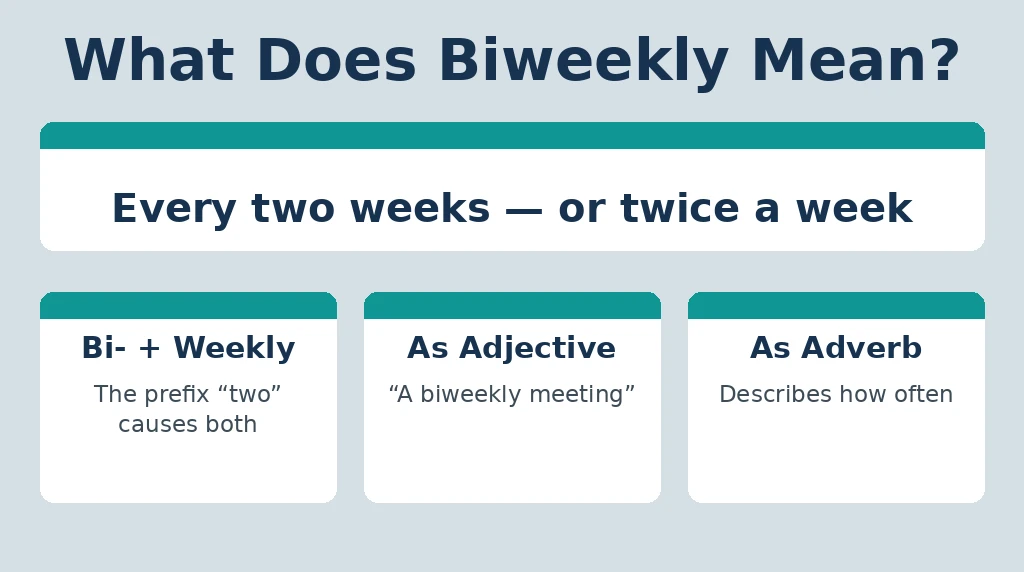
The word combines the prefix bi-, associated with two, and weekly, which relates to a week. This combination creates two possible interpretations, making the word potentially ambiguous.
Here is how to understand it in common situations:
| Context | Common interpretation | Example |
|---|---|---|
| Payroll | Every two weeks | Employees receive biweekly pay. |
| Office meetings | Usually every two weeks | The team has a biweekly meeting. |
| Personal appointments | Depends on the agreed schedule | We have biweekly counseling appointments. |
| Exercise classes | Could mean twice a week or every two weeks | The instructor offers biweekly sessions. |
| Newsletters | Depends on the publication’s stated schedule | A biweekly newsletter arrives on a regular cycle. |
| School activities | Depends on the calendar | The club holds biweekly meetings. |
The key is not to assume that the word always describes the same interval. If the timing affects a payment, deadline, appointment, or work commitment, confirm the actual dates.
Why Does Biweekly Have Two Meanings?
Biweekly is an example of an ambiguous frequency word. Its prefix can be interpreted as referring to two occurrences within a period or a period made up of two units.

That is why readers can understand it differently.
- Every two weeks: One event occurs, then another occurs two weeks later.
- Twice a week: Two events occur within each week.
Both meanings are recognized in English dictionaries. In practice, however, the intended meaning is often determined by the topic and surrounding words.
For instance, “Employees are paid biweekly” commonly refers to a two-week payroll cycle. By contrast, “The program includes two classes each week” expresses the twice-weekly meaning much more clearly.
This distinction matters because a misunderstanding can affect more than vocabulary. It can create confusion about paydays, appointments, project deadlines, or attendance requirements.
Is Biweekly Every Two Weeks or Twice a Week?
It can mean either, but every two weeks is the common interpretation in payroll and many workplace schedules.
Consider these two examples:
- “We receive our paychecks biweekly.” This generally means one paycheck every 14 days.
- “We practice twice a week.” This clearly means two practice sessions during each week.
If a manager says, “We will have biweekly check-ins,” you should not automatically assume the intended schedule. Ask whether the check-ins occur every other week or twice each week.
For clear professional writing, replace biweekly with the exact frequency whenever the distinction matters.
Biweekly Meaning in Everyday English
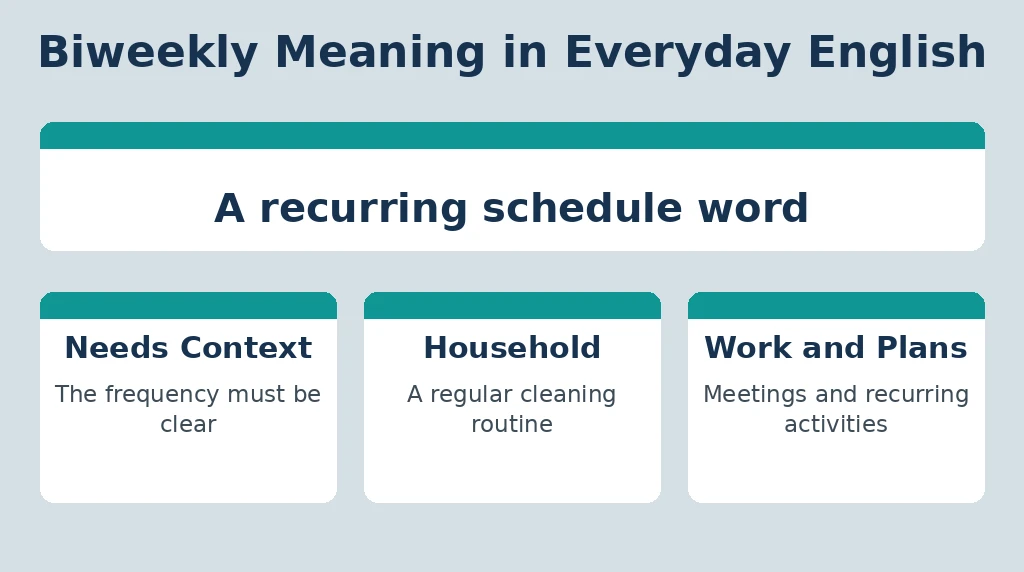
In everyday English, biweekly describes an activity that happens on a recurring schedule. The word is useful when the frequency has already been established or the context makes the intended meaning obvious.
Here are examples from ordinary situations.
Example 1: Household cleaning
“We schedule a biweekly cleaning service.”
This could mean a cleaner visits every two weeks or twice a week. If the schedule is not clear, the sentence needs more detail.
Clearer version: “A cleaner visits our home every other Friday.”
Example 2: A book club
“Our book club holds biweekly discussions.”
Readers may need to check the club calendar to determine how often discussions occur.
Clearer version: “Our book club meets every two weeks.”
Example 3: A fitness routine
“I attend fitness classes twice a week.”
This is clearer than “I attend biweekly fitness classes” because it identifies the exact frequency.
Example 4: A personal budget
“I review my spending every two weeks.”
This describes a regular two-week interval and avoids the ambiguity of biweekly.
The lesson is simple: biweekly is appropriate when its intended meaning is clear. When it is not, specific wording makes communication more reliable.
Biweekly Meaning at Work
In professional settings, biweekly commonly describes recurring meetings, performance reviews, payroll cycles, progress reports, and project updates.
However, the exact meaning can differ by company and department. A workplace calendar or written policy should establish the schedule rather than leaving employees to interpret the word independently.
Biweekly Meetings
A biweekly meeting is a recurring meeting that may happen every two weeks or twice a week.
For example:
- “Our biweekly project meeting is scheduled for Monday.”
- “The manager requested biweekly progress updates.”
- “We discuss customer feedback during our biweekly review.”
These sentences do not establish the frequency on their own.
For a team that meets every other Monday, write:
“Our project team meets every two weeks on Monday.”
For a team that meets on Tuesday and Thursday, write:
“Our project team meets twice a week, on Tuesday and Thursday.”
This small change helps colleagues understand expectations and prevents missed meetings.
Biweekly Reports
A biweekly report summarizes work, progress, performance, or results over a recurring period.
If the report covers two weeks of activity, it might include completed tasks, current challenges, spending, milestones, and upcoming priorities.
For example:
“Please submit your progress report every two weeks, including completed milestones and unresolved issues.”
If a report is required twice a week, specify the submission days. This makes the responsibility easier to follow.
Biweekly Performance Reviews
Some managers use biweekly check-ins to discuss progress, goals, workload, or employee concerns. These may be held every two weeks, but the term alone does not guarantee that schedule.
A clearer calendar invitation might say:
“Project check-in: every other Wednesday at 10 a.m.”
Specific timing is especially useful for remote teams, distributed workplaces, and employees working across time zones.
Biweekly Pay Meaning: How Often Do You Get Paid?
Biweekly pay usually means employees receive a paycheck every two weeks, or every 14 days. It is one of the common payroll schedules used by employers in the United States.
A biweekly payroll schedule generally produces 26 paychecks in a 52-week year. Some calendar years can contain 27 pay dates because of how the dates fall. The actual payroll calendar determines the number of paychecks.
For employees, understanding this schedule makes it easier to plan bills, savings, rent, debt payments, and other regular expenses.
How Does Biweekly Pay Work?
Suppose an employee receives a paycheck every other Friday.
| Pay period example | Payday |
|---|---|
| First two-week pay cycle | Friday, January 9 |
| Second two-week pay cycle | Friday, January 23 |
| Third two-week pay cycle | Friday, February 6 |
| Fourth two-week pay cycle | Friday, February 20 |
These dates illustrate a hypothetical schedule rather than a specific employer’s payroll calendar.
The gap between paydays is 14 days. The actual dates depend on the employer’s payroll rules, pay-period closing dates, bank holidays, and processing arrangements.
How Many Paychecks Do You Get in a Year?
Most years contain 26 biweekly pay dates, although a particular calendar year may have 27.
For an employee earning a fixed annual salary of $52,000, a simple gross-pay calculation using 26 pay periods is:
[
$52,000 div 26 = $2,000
]
That equals $2,000 in gross pay per paycheck before taxes, insurance premiums, retirement contributions, and other deductions.
If the calendar year contains 27 pay dates, the employer’s payroll and compensation policies determine how salary payments are handled. Do not assume that every employer calculates an extra payday in exactly the same way.
Is Biweekly Pay the Same as Twice a Month?
No. Biweekly and semimonthly pay schedules are different.
- Biweekly: A paycheck arrives every two weeks, usually 26 times a year.
- Semimonthly: A paycheck arrives twice a month, usually 24 times a year.
For example, a semimonthly employee might get paid on the 15th and the last day of each month. A biweekly employee might receive pay every other Friday, so the calendar dates change from month to month.
This difference can affect monthly budgeting. In most months, biweekly employees receive two paychecks, but two months in a typical 26-paycheck year have three paychecks. Semimonthly employees generally receive two paychecks each month.
A three-paycheck month is not automatically a bonus. It usually reflects the timing of regular pay periods, and the money should be planned according to the employee’s actual obligations.
Biweekly vs. Semimonthly
Biweekly and semimonthly are frequently confused because both involve regular payments and can appear similar on a monthly budget.
The main difference is the length of the interval.
| Feature | Biweekly | Semimonthly |
|---|---|---|
| Meaning | Every two weeks | Twice a month |
| Typical annual pay dates | 26 | 24 |
| Timing | Every 14 days | Two scheduled dates each month |
| Common payday pattern | Every other Friday | 15th and last day of the month |
| Monthly paychecks | Usually two, sometimes three | Usually two |
| Interval length | Consistent 14-day cycle | Varies by month |
Which Is Better for Budgeting?
Neither schedule is automatically better for every employee. The best way to manage either one is to base your budget on actual pay dates and monthly expenses.
For biweekly pay, divide fixed monthly bills into a plan that covers the entire month. Avoid treating every third paycheck as extra spending money before accounting for savings, debt, and upcoming expenses.
For semimonthly pay, you can often assign bills to the first or second paycheck because the payment dates are relatively predictable.
The important point is to distinguish the payroll frequency from the way your personal budget is organized.
Biweekly vs. Semiweekly
The difference between biweekly and semiweekly is particularly important because the words describe different schedules.
- Biweekly: Every two weeks or, in some contexts, twice a week.
- Semiweekly: Twice a week.
The term semiweekly is more specific when you mean two occurrences per week.
For example:
“Staff members attend semiweekly training on Tuesday and Thursday.”
This sentence gives the reader a clear understanding of the frequency.
By comparison, “Staff members attend biweekly training” may leave the schedule open to interpretation.
If you are creating a work policy, class schedule, or appointment reminder, naming the days is often the clearest option.
Biweekly vs. Fortnightly
Fortnightly means every two weeks. It is a useful alternative when you want to express a two-week interval without the ambiguity associated with biweekly.
The word fortnight refers to a period of two weeks. Fortnightly is commonly used in British English and other varieties of English, while biweekly is familiar in American English, especially in workplace and payroll contexts.
Examples:
- “The team meets fortnightly.”
- “The team meets every two weeks.”
- “The team meets biweekly.”
All three can communicate the same schedule when biweekly is intended to mean once every two weeks.
For an American audience, “every two weeks” is particularly direct. For an audience familiar with British English, “fortnightly” may sound natural.
Biweekly vs. Weekly
Weekly means once a week. Biweekly can mean every two weeks or twice a week, so the two terms should not be treated as interchangeable.
| Term | Frequency | Example |
|---|---|---|
| Weekly | Once per week | We have a weekly staff meeting. |
| Biweekly | Every two weeks or twice a week | We have a biweekly staff meeting. |
| Fortnightly | Every two weeks | We have a fortnightly staff meeting. |
| Semiweekly | Twice a week | We have semiweekly staff meetings. |
If an event occurs every Monday, it is weekly. If it occurs every other Monday, it is every two weeks. If it occurs on Monday and Thursday, it happens twice a week.
Describing the actual days removes any doubt.
Biweekly Meaning in a Sentence: 15 Examples
These biweekly examples show how the word appears in conversations, workplace messages, personal plans, and financial discussions.
| Example sentence | Intended meaning or note |
|---|---|
| 1. I receive biweekly pay from my employer. | Usually every two weeks |
| 2. Our manager scheduled a biweekly meeting. | Could mean either frequency |
| 3. The company uses a biweekly payroll system. | Usually every two weeks |
| 4. We review our budget every two weeks. | Explicit two-week interval |
| 5. The newsletter is published biweekly. | Frequency depends on the publisher’s stated schedule |
| 6. She attends biweekly therapy appointments. | Confirm the intended interval |
| 7. Our team sends biweekly project updates. | Clarify the reporting frequency |
| 8. Employees receive biweekly performance feedback. | Depends on company policy |
| 9. The club organizes biweekly events. | Could mean every two weeks or twice a week |
| 10. Rent is due monthly, but I get paid biweekly. | Monthly and two-week schedules differ |
| 11. The coach scheduled two practices per week. | Clear twice-weekly frequency |
| 12. We meet every other Friday. | Clear two-week interval |
| 13. The committee holds semiweekly meetings. | Twice a week |
| 14. The magazine releases a new issue every two weeks. | Clear two-week publishing cycle |
| 15. The team meets fortnightly to review its goals. | Every two weeks |
Notice that several examples deliberately use more precise expressions. That is often the better choice in situations where dates, money, or responsibilities are involved.
How to Use Biweekly Correctly
The best way to use biweekly is to consider your audience, the subject, and the consequences of a misunderstanding.
Use Biweekly When the Context Is Clear
Biweekly works well when the intended schedule has already been established.
For example, a company handbook might define its biweekly payroll cycle. Once employees know that the term means every 14 days, later references to biweekly pay are easy to understand.
Use Exact Dates for Important Schedules
For appointments, project deadlines, and payment instructions, write the interval or list the dates.
Instead of:
“Your next review will be biweekly.”
Write:
“Your next review will take place every two weeks, starting November 6.”
The second sentence gives the reader a practical reference point.
Confirm the Schedule Before Making Plans
If a colleague, manager, client, or service provider uses biweekly, a short clarification can prevent unnecessary confusion.
You can ask:
“Just to confirm, do you mean every two weeks or twice a week?”
This is a normal, professional question. It demonstrates attention to detail rather than a lack of vocabulary knowledge.
Avoid Mixing Different Frequency Terms
Do not use biweekly when you specifically mean semimonthly, weekly, or semiweekly.
For example, if a company pays on the 15th and 30th, describe the schedule as semimonthly rather than biweekly. If a class takes place on Monday and Thursday, say twice a week or semiweekly.
Precise language makes calendars, policies, invoices, and emails easier to follow.
Synonyms and Related Words for Biweekly
The best synonym depends on which meaning you intend.
| Word or phrase | Meaning | Best use |
|---|---|---|
| Every two weeks | Once per 14-day interval | Clear everyday English |
| Every other week | Once in alternate weeks | Informal conversation and scheduling |
| Fortnightly | Every two weeks | British English and formal writing |
| Twice a week | Two times within a week | Clear, unambiguous frequency |
| Semiweekly | Twice a week | Formal or technical scheduling |
| Recurring | Happening repeatedly | When the exact frequency is not specified |
| Periodic | Occurring at intervals | General descriptions of repeated events |
These words are related, but they are not all interchangeable.
For instance, recurring does not tell the reader how often an event happens. Periodic also leaves the interval unspecified. Use these words only when the exact timing is not essential.
If you need a precise replacement for biweekly, choose “every two weeks” or “twice a week” according to the intended meaning.
Common Mistakes People Make With Biweekly
Assuming It Always Means Every Two Weeks
This is a common interpretation, especially in payroll discussions, but it is not the only accepted meaning. Check the context before deciding what a speaker intends.
Confusing Biweekly With Semimonthly
A two-week interval is not the same as twice a month. Biweekly payroll generally has 26 pay dates per year, while semimonthly payroll generally has 24.
Using Biweekly in Important Instructions Without Clarification
A vague instruction can lead to missed meetings or incorrect expectations. If the exact frequency matters, specify the interval or the dates.
Assuming Three Paychecks Mean Extra Earnings
A three-paycheck month often occurs because a biweekly schedule continues on a 14-day cycle across calendar months. It does not automatically mean the employee is receiving a bonus or additional annual compensation.
Believing the Word Has Only One Correct Meaning
Biweekly has two established interpretations. The practical solution is not to insist that one meaning is always correct, but to communicate the intended schedule clearly.
How to Remember the Meaning of Biweekly
A useful way to remember the word is to separate the two possible interpretations:
- Biweekly = every two weeks: Think of a calendar with one event repeated 14 days later.
- Biweekly = twice a week: Think of two events appearing in the same week.
If you are unsure which meaning a sentence uses, look for clues. A payroll discussion usually points toward a two-week cycle. A training schedule mentioning two classes in one week points toward twice-weekly activity.
However, context is a guide, not a guarantee. If the sentence does not provide enough information, ask for clarification.
For professional writing, the easiest memory trick is also the most useful rule: write the actual frequency instead of relying on an ambiguous word.
Frequently Asked Questions
What does biweekly mean in simple words?
Biweekly means either every two weeks or twice a week. The intended meaning depends on context. In payroll and many workplace settings, it commonly means every two weeks.
Does biweekly mean every 14 days?
Yes, biweekly can mean every 14 days, and this is a common meaning in payroll and scheduling. However, the word can also mean twice a week, so confirm the intended frequency when it matters.
Does biweekly mean twice a week?
Yes. Biweekly has two accepted meanings, one of which is twice a week. To avoid confusion, use “twice a week” or “semiweekly” when that is the intended schedule.
What does biweekly pay mean?
Biweekly pay usually means employees are paid every two weeks. This schedule generally produces 26 paychecks in a year, although some calendar years contain 27 pay dates.
Is biweekly the same as semimonthly?
No. Biweekly generally means every two weeks, while semimonthly means twice a month. Biweekly payroll usually has 26 pay dates per year, compared with 24 for semimonthly payroll.
What is the difference between biweekly and semiweekly?
Biweekly can mean every two weeks or twice a week. Semiweekly specifically means twice a week, making it more precise when describing two weekly occurrences.
Is fortnightly the same as biweekly?
Fortnightly means every two weeks. It matches the every-two-weeks meaning of biweekly, but not the twice-a-week meaning.
How many times does a biweekly event happen in a month?
If biweekly means every two weeks, an event usually happens twice in a typical month, although some calendar months can contain three occurrences. If it means twice a week, it generally happens about eight or nine times per month.
How can I use biweekly without confusing people?
State the exact frequency. Use “every two weeks,” “every other Friday,” or “twice a week,” depending on your meaning. For payroll, meetings, and deadlines, specific dates are especially helpful.
Final Thoughts
The meaning of biweekly depends on context. It can describe something that happens every two weeks or something that happens twice a week. In payroll and many workplace settings, the first meaning is common, but the word is not always precise enough to communicate a schedule on its own.
The most important distinction is between biweekly and semimonthly. A biweekly schedule follows a 14-day cycle, while a semimonthly schedule usually follows two fixed dates each month. Fortnightly means every two weeks, and semiweekly means twice a week.
When writing emails, organizing meetings, planning payments, or setting appointments, use the exact interval whenever possible. Clear wording saves time, prevents misunderstandings, and helps everyone follow the same schedule.
Discover More Post:
- 111 Meaning | Spiritual Significance, Symbolism, Love & the …
- Unhinged Meaning | Definition, Examples, Tone & Why It’s …
- FUPA Meaning in Text & Slang – SynonyMore.com

1 thought on “Biweekly Meaning | The Confusing Time Word Explained With Real-Life Examples in 2026”