You are in the middle of a gaming session when a teammate disconnects. Ten minutes later they pop back into the chat, and before you have even typed a word, three other players have already written the same thing: “wb!” No one explains it. No one needs to.
Here is the short answer first. WB means “welcome back”, and people type it as a quick, friendly greeting when someone returns to a conversation, a game, a livestream or any online space after being away. That sounds simple, and it is, but the same two letters can feel warm, flat or completely out of place, and the difference sits in the timing. This guide covers the wb meaning in text, where it fits, WB vs BRB and AFK, the mistakes to avoid, and the best replies.
What Does WB Mean in Text?
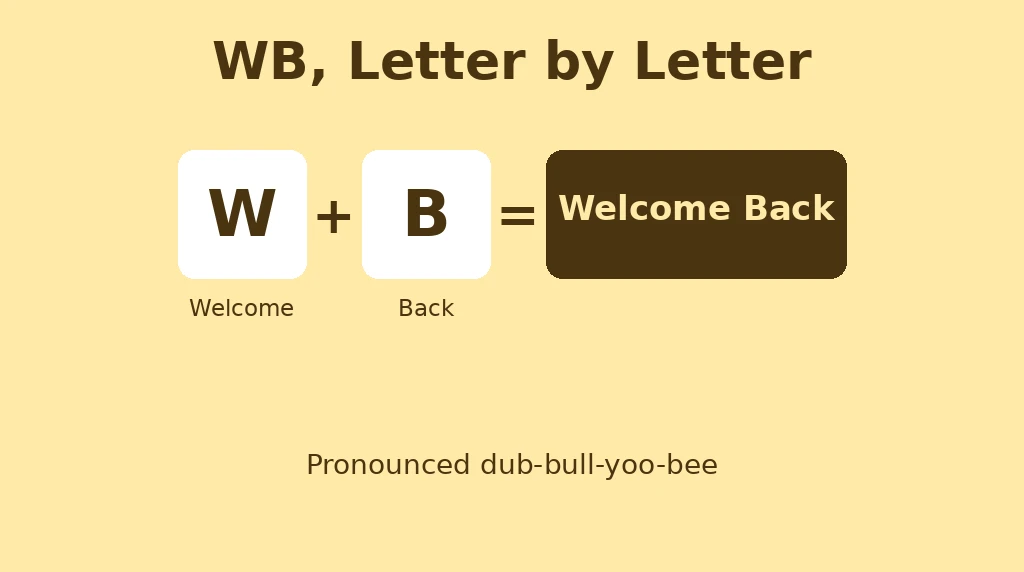
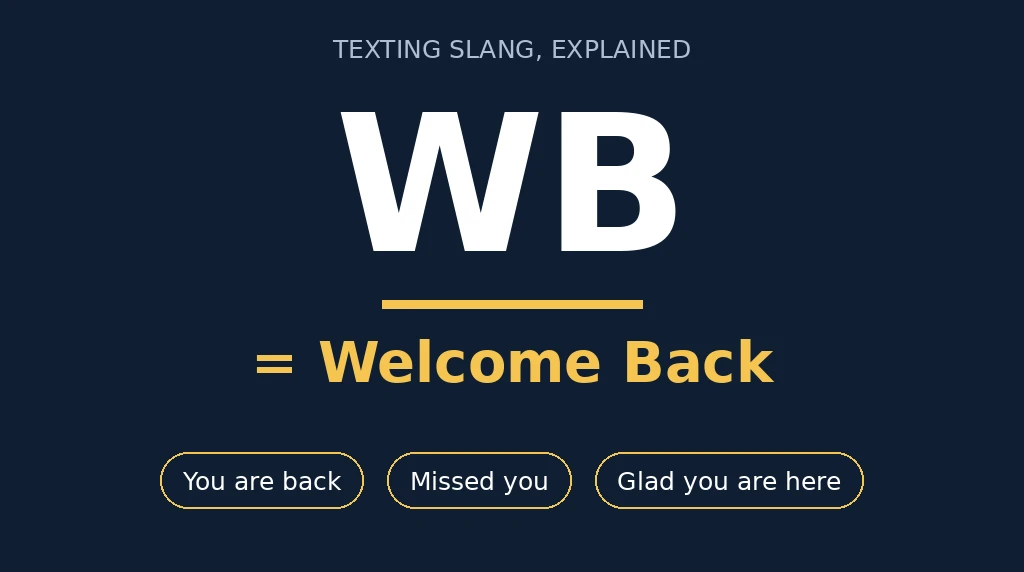
WB is short for “welcome back”. Someone sends it the moment a person rejoins a chat, a voice call, a match or a livestream after stepping away. Think of it as the digital version of saying “oh hey, you are back!” when a friend walks back into the room. It is warm, it is casual, and it takes almost no effort to type, which is exactly why it caught on in fast moving chats where nobody wants to type full sentences.
The tone depends on the moment. A plain “wb” is a simple, friendly nod. “wb!!” with extra punctuation reads more excited, like someone is genuinely glad to see the person again. A capital WB in the middle of an otherwise lowercase chat can look like extra emphasis, though most of the time people just write it lowercase, because lowercase is the everyday form. None of these versions change the meaning, but they change how much energy the greeting carries.
So read the chat around the letters. A “wb” after a teammate reconnects mid match is a warm welcome, while one sent to someone who never left is just confusing.
Full Form of WB
The full form is as direct as the abbreviation, with one word behind each letter:
- W: welcome
- B: back
Put together, you get “welcome back”. There is no hidden second layer in the texting sense, which is why it spread so fast. Say it out loud and people pronounce each letter on its own: dub-bull-yoo-bee. You will hear that spoken version in voice chats and in jokes between friends who game together every night.
WB vs BRB vs AFK: What Is the Difference?
Three short abbreviations cause most of the mix ups in this corner of texting, and they all describe the same coming and going, just from different sides of it.
| Abbreviation | Full Form | What It Really Says | Tone |
|---|---|---|---|
| WB | Welcome back | Glad you returned | Warm, friendly |
| BRB | Be right back | I am leaving briefly | Neutral, quick |
| AFK | Away from keyboard | I stepped away | Neutral, factual |
The key difference is timing and direction. BRB and AFK both talk about leaving. BRB is a promise to return soon, while AFK simply reports that someone has stepped away from the keyboard, with no promise attached. WB is the other side of the coin: it is what everyone else types when that person actually comes back. Mix them up and the message turns strange, like greeting someone who is still sitting right there.
TTYL sits nearby too, and it is worth keeping separate. TTYL means “talk to you later”, and it closes a conversation instead of reopening one. If BRB is the door closing for a minute and WB is the door opening again, TTYL is someone heading home for the night. A softer cousin worth knowing is WBU, short for “what about you”, which turns a greeting back into a question. When someone says “wb” to you, answering “ty, wbu?” keeps the chat moving nicely.
Where WB Is Commonly Used
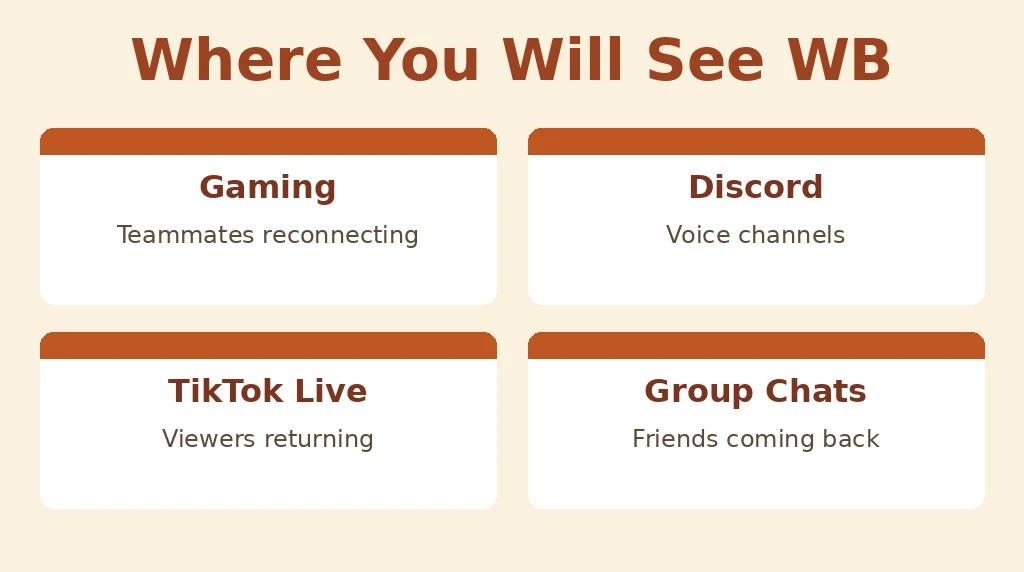
Texting and WhatsApp
One to one chats and family groups are a natural home for wb. It answers quick returns without slowing anything down, like when a friend steps away for a call and comes back to the thread. A typical line looks like this: “sorry, had to step away for a call” “wb! we were just talking about weekend plans”. Short, warm, and the chat keeps moving.
Instagram and Snapchat
On Instagram and Snapchat, wb shows up in DMs and in replies to stories, often when someone posts again after being quiet for a while. Friends comment things like “wb bestie, we missed you” or “wb queen” under a comeback post. It also appears in captions, where people use it as a small badge of return, a way of saying they are back and they noticed who missed them.
TikTok Comments
TikTok live streams are a huge hub for this abbreviation. When a streamer goes live again after a break, or a regular viewer rejoins the stream chat after disappearing for a few minutes, the screen fills with “wb” comments. The hashtag #wb gathers the same welcoming energy in one place, mostly under comeback videos and return announcements.
Group Chats
Group chats run on people drifting in and out, so wb is the glue holding them together. One person goes quiet for an hour, then types again, and someone drops a quick “wb” to show the return was noticed. It keeps the thread friendly without forcing a big reunion out of a small absence, and it works best when you add a name, like “wb Sarah”.
Gaming Chats
In game chat there is no time for full sentences, so wb does quick work between rounds. Players type things like “wb, let us push together” when a teammate respawns, or “wb, you missed a wild round” when someone reconnects after a lag spike. Everyone understands it instantly, and nobody stops playing to decode it. This is the place where wb feels most at home.
Discord and Forums
Discord servers and forums use wb the same way, just in longer threads. Someone leaves a voice channel and comes back, or a familiar face returns to a forum after months away, and “wb! good to see you around again” is a normal, accepted welcome. On older forums it shows up when a longtime member posts after a long silence, a small public way of saying the community remembered them.
Origin and History of WB
WB belongs to the first big wave of internet chat shortcuts. It grew out of 1990s chatrooms and instant messaging, when slow connections and small chat boxes pushed people to shorten the phrases they typed most often. “Welcome back” is one of the most repeated greetings in any chat room, so it was an early candidate for the chop, and the two letter version was almost inevitable.
The abbreviation travelled from AOL Instant Messenger and IRC to MSN Messenger, then to texting and gaming. Gaming communities picked it up fast, because players disconnect and reconnect constantly. It never really went out of fashion because the need behind it never changed. People still come and go from chats every single day, and they still want to say “glad you are back” quickly. Slang guides such as 7ESL list WB with exactly this meaning, and its history in early chatrooms is well documented.
On social media, wb also works as a caption and a tag, not just as a private greeting. A comeback post captioned “wb to me” or tagged #wb is not answering a question at all. It is a mood, a small public announcement that the poster has returned. Read that use as a welcome aimed at an audience, not as a message to one person.
Other Meanings and Variations of WB
In casual texting, WB almost always means “welcome back”, but the same letters carry other meanings in other rooms, and a few close cousins shift the tone.
- Write back: in older texting and email contexts, WB sometimes meant “write back”, as in asking someone to reply. That use is rare today, but it still pops up in old message threads.
- Way back: when talking about the distant past, WB can mean “way back”, as in “that song takes me way back”. The sentence around it makes this one easy to spot.
- Warner Bros: in film and entertainment talk, WB is the famous movie studio. “The new WB film” has nothing to do with texting.
- World Bank: in finance and news, WB can stand for the World Bank. Again, context makes this obvious.
- WBU: “what about you”. A question, not a greeting, and the one people mix up with WB most often.
- WB!!!: the same greeting with extra punctuation, used when someone is genuinely excited that a person has returned.
There is also a close cousin worth knowing: sup is what people type when they want to start a conversation, while WB is what they type when someone returns to one. One opens the door, the other welcomes a person back through it, which is why the two rarely get confused even though they both live in casual chats.
How to Use WB Correctly
- Use it right when someone returns. WB belongs in the moment of return, not randomly later. Send it when the person rejoins, and it lands perfectly.
- Keep it casual. WB belongs in friendly, informal chats. If the conversation would not welcome a “lol”, it will not welcome a “wb” either.
- Add a name to make it personal. “wb Sarah” or “wb @gamer123” takes one extra second and sounds ten times warmer than a bare wb on its own.
- Match the energy of the chat. If everyone else is typing casually, wb fits perfectly. If the conversation is serious, a fuller greeting works better.
- Do not overuse it. Greeting every single return in a busy chat gets noisy fast. Save it for returns that actually matter, and it will keep its warmth.
Example Conversations Using WB
Gaming with a teammate
Person A: “Anyone still there?”
Person B: “Yeah, just respawned”
Person A: “wb, let us push together”
WhatsApp group chat
Person A: “Sorry guys, had to step away for a call”
Person B: “wb! we were just talking about weekend plans”
An Instagram comment
Person A: “omg you are posting again!!”
Person B: “wb bestie we missed you”
A TikTok live chat
Person A: “Wait, is she back live?”
Person B: “Yes, wb everyone come say hi”
A Discord voice channel
Person A: “Had to mute for a sec, kid was yelling lol”
Person B: “All good, wb”
A text between friends
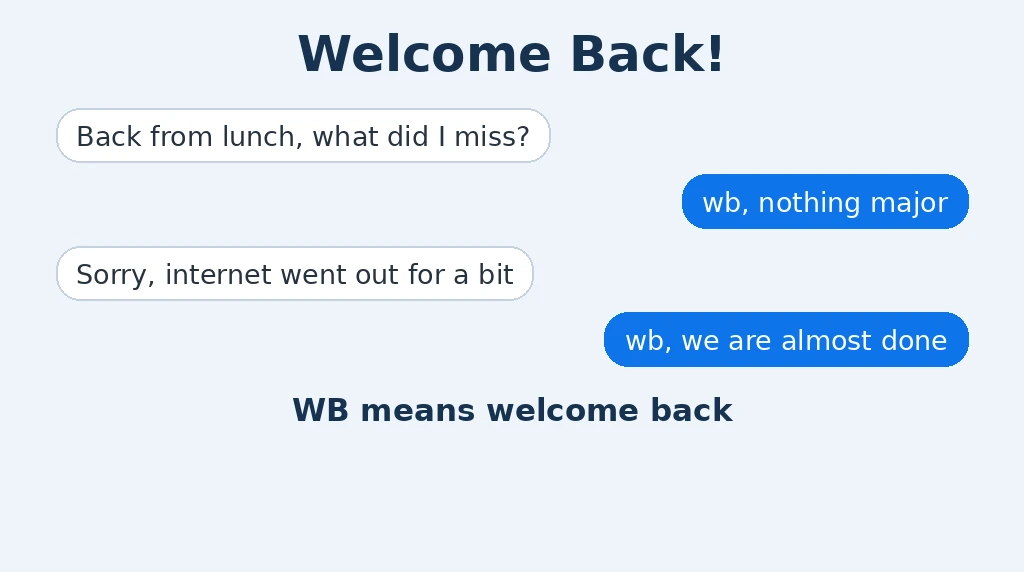
Person A: “Back from lunch, what did I miss”
Person B: “wb, nothing major, just planning tonight”
An online forum reply
Person A: “Have not posted in months, life got busy”
Person B: “wb! good to see you around again”
The one that misses the mark
Person A: “Hey, I have been here the whole time”
Person B: “wb”
That last one falls flat, and the timing is doing half the damage. Same letters, very different message, because nobody actually left.
When Not to Use WB
- Work email: write “welcome back” in full instead. Two letters look careless on the record.
- Job interviews and applications: even over chat, recruiters read wb as unprepared or uninterested.
- Teachers and bosses: anyone grading or managing you deserves the full sentence.
- Customer service chats: on either side of the counter, wb sounds like nobody is taking the problem seriously.
- When nobody left: sending wb to someone who never went away is confusing, so save it for a real return.
- Serious conversations: when someone is upset or asking for real support, a bare wb can feel too light. Add words that show you are really there.
How to Respond When Someone Sends You WB
A wb lands in your chat and the ball is suddenly in your court. The good news is that it asks almost nothing of you. Pick the lane that matches the moment.
Simple replies work almost every time:
- “Thanks!”
- “thx, good to be back.”
- “Glad to be back.”
Warm replies suit a welcome that felt genuine:
- “Missed this chat lol, what did I miss?”
- “Thanks, missed you guys.”
Playful replies fit close friends and light moments:
- “Did you even notice I was gone?”
- “Back and better than ever.”
No reply at all is also fine:
- In fast gaming chats and livestreams, most people just jump back into the action. WB is a friendly nod, not a question, so nobody expects a formal answer.
One thing to avoid: do not answer a warm wb with a confused “huh?” unless you really did not go anywhere. A short “thanks” keeps the chat friendly.
Common Mistakes People Make With WB
- Confusing WB with WBU. WB welcomes someone back, while WBU asks “what about you?” One letter changes a greeting into a question, so check which one you mean.
- Sending it when nobody left. WB only works after a real absence. Used randomly, it confuses the other person instead of welcoming them.
- Using it in formal messages. A manager who gets “wb” about a return from leave hears “I did not bother to write properly”. Spell it out and add a warm line.
- Thinking it is rude or dismissive. WB is short, but it is meant to be warm, not cold. New texters sometimes read it as lazy, when it is really just fast.
- Overusing it in busy chats. Greeting every return in a crowded livestream floods the screen. Save it for moments when the return actually matters.
Frequently Asked Questions
What does WB mean in text?
WB means “welcome back”. People type it when someone returns to a chat, a game, a livestream or any online space after being away for a while.
Is WB only used in gaming chats?
No. Gaming made it popular, but WB is now common in group chats, Discord servers, TikTok live streams, Instagram comments and forums too.
What is the difference between WB and BRB?
BRB means “be right back” and is typed before someone leaves. WB means “welcome back” and is typed after someone returns. They are opposite sides of the same moment.
Can WB mean something other than welcome back?
Yes, though rarely in chats. In older messages it can mean “write back”, and outside texting it can stand for Warner Bros or the World Bank. Context makes the intended meaning clear.
Is it rude to not respond to WB?
Not at all. WB is a friendly greeting, not a question, so it needs no direct answer. In fast chats people often just carry on with the conversation.
Can I use WB in a work email?
No. WB is casual texting shorthand, and it looks unprofessional in formal writing. In a work email, write the full phrase “welcome back” instead.
Final Thoughts
Two letters, one simple job with a surprising amount of warmth packed inside. WB is the quickest way to say “welcome back” in texting, and it has earned its place in everyday chats because people drift in and out of conversations all day long. Used at the right moment, with a name added when you can, it never really causes trouble.
If you want the official stamp, Dictionary.com lists wb with exactly this meaning, which shows how far a humble chatroom greeting has come. Either way, you now have the wb meaning in text down, plus a friendly reply ready for the next time it shows up in your messages.
