You send a message you think is perfectly clear, and the reply comes back in three letters: “wat”. No question mark, no emoji, no follow up. Your friend is either confused, amused, or quietly judging your life choices, and you have no idea which one it is.
Here is the short answer first. WAT means “what”, spelled without the H, and people type it as a fast reaction to something confusing, surprising or absurd. It is the typed version of a double take, the face you make when a sentence does not add up. This guide covers the wat meaning in text, the tone traps, WAT vs HUH and WTF, where you will see it, and the best replies for every version of it.
What Does WAT Mean in Text?
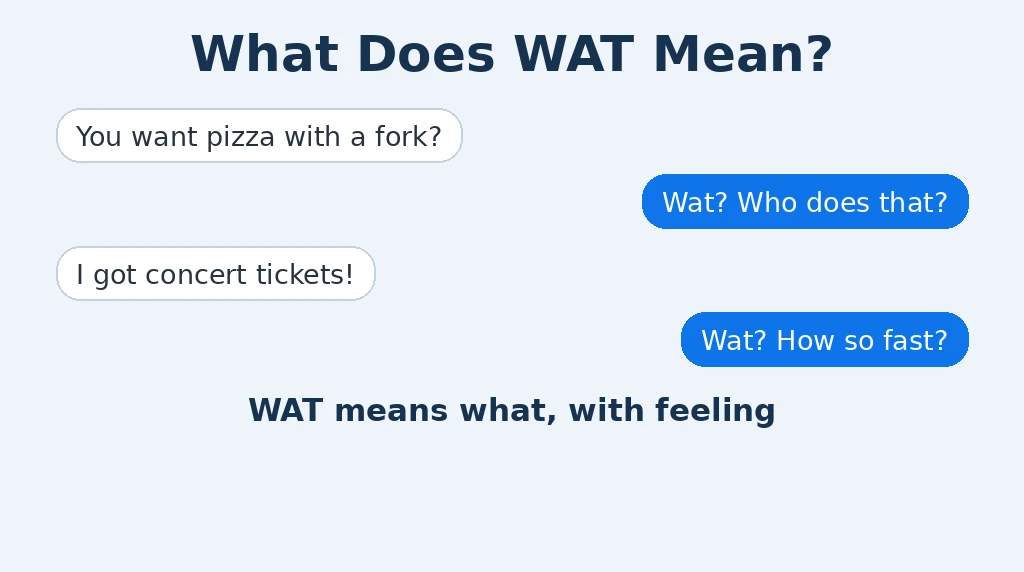
WAT is “what” with the H dropped. Someone sends it when a message makes no sense to them, when news catches them off guard, or when something is so strange that a normal reply feels too slow. “You want me to eat pizza with a fork? Wat?” is the classic shape of it: confusion, disbelief and a little humor packed into one word.
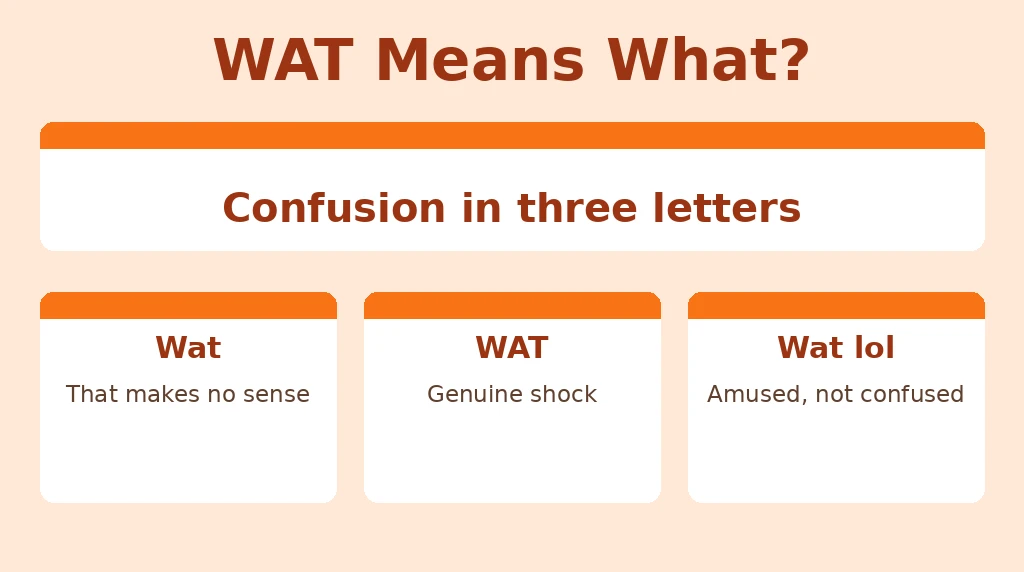
The spelling is the whole point. Typing “what” is a real question, but typing “wat” is a reaction. It says “that cannot be right” before it says “please explain”. Punctuation steers the tone. A lowercase “wat” reads chill and low key, an uppercase “WAT” reads loud and shocked, “wat??” asks for a real explanation, and “wat lol” means the sender is amused, not confused at all. A full stop after it, “WAT.”, turns it deadpan and sarcastic.
So the letters never tell the whole story. Read the message above them and the friendship behind them. A close friend who replies “wat lol” to your wild story is laughing with you. A stranger who replies “wat” to your serious question may genuinely have no idea what you mean. Context is the real dictionary here.
Full Form of WAT
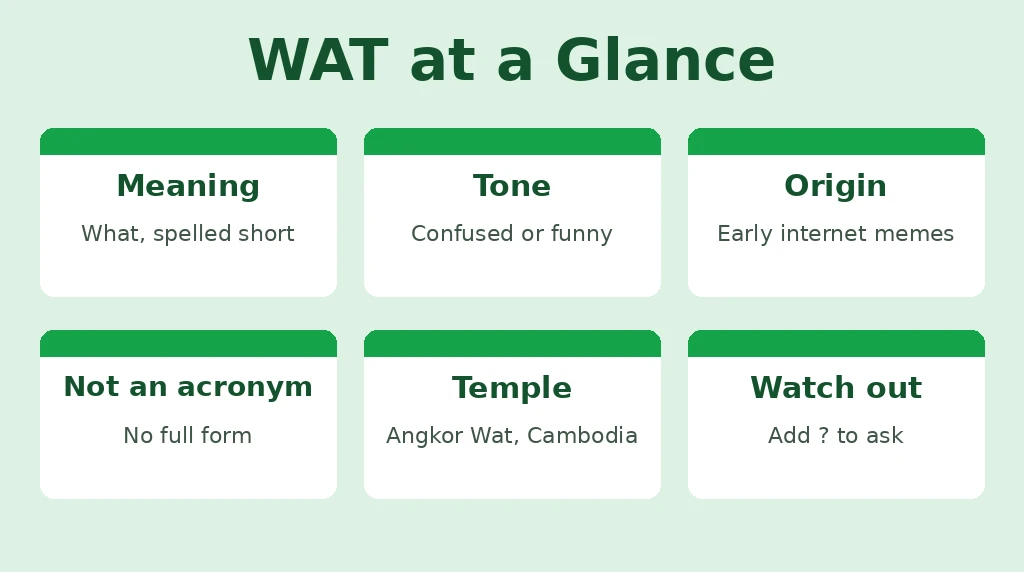
WAT has no full form, because it is not an abbreviation. It is a spelling shortcut, and the breakdown is simple:
- W: W, the first letter of “what”
- A: A, the middle of “what”
- T: T, the last letter of “what”
Put together, you get “wat”, which is “what” minus the silent H. Say it out loud and it sounds like “wot”, rhyming with “hot”. You will hear that spoken version in gaming voice chats and in jokes between friends, usually right after something absurd happens.
That missing H is doing real work. Dropping a letter makes the word look lazier and funnier, which is exactly the feeling it carries. It is the same trick behind reaction images captioned with a single confused “wat”. The spelling tells the reader the tone before the rest of the sentence even starts.
WAT vs HUH vs WTF: What Is the Difference?
Three short reactions cause most of the mix ups in this corner of texting, so here they are side by side.
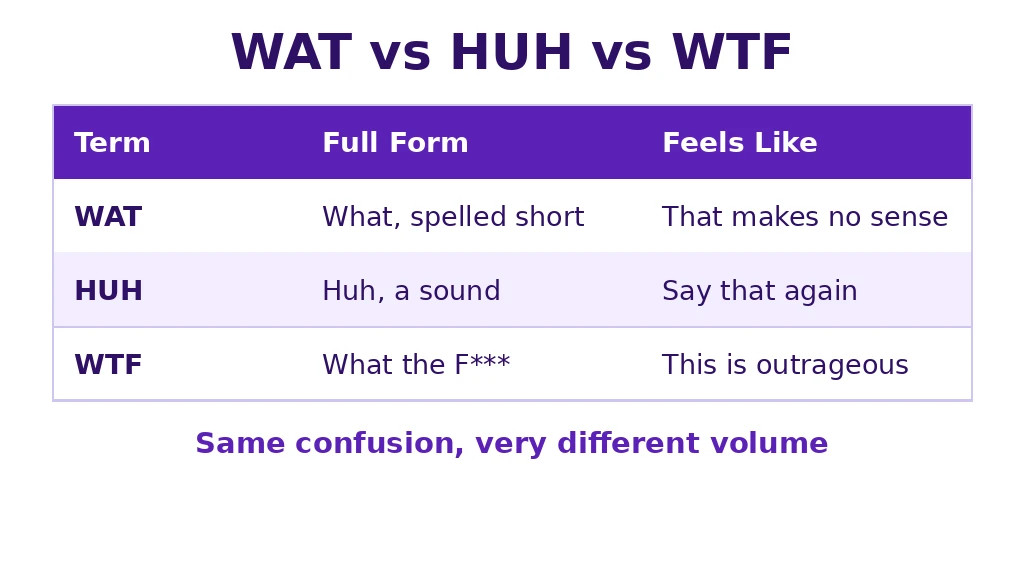
| Abbreviation | Full Form | What It Really Says | Tone |
|---|---|---|---|
| WAT | What (spelled short) | That makes no sense | Confused, funny |
| HUH | Huh (a sound) | I missed that, say again | Mild, polite |
| WTF | What the F*** | This is outrageous | Shocked, strong |
The classic mix up is WAT versus HUH, because both show confusion at a glance. They say different things, though. Huh is a quiet request for a repeat, as if you did not hear the words. WAT is a loud reaction to the meaning, as if you heard the words fine and they still do not add up. Reply “huh” to a wild story and you are asking for the details again. Reply “wat” and you are saying the story itself sounds unreal.
WTF sits far beyond both of them. It adds a swear word and a hard edge, so it reads as shock or anger rather than funny confusion. If WAT is a raised eyebrow, WTF is both eyebrows plus a shout. A softer cousin worth knowing is “lolwut”, which stretches the same joke out longer and is almost always playful. When you want to sound amused instead of annoyed, lolwut is the safer pick.
Where WAT Is Commonly Used
Texting and WhatsApp
One to one chats are the natural home of wat. It answers a confusing message, a surprising plan or a joke that landed sideways without slowing anything down. A typical line looks like this: “wait, you are moving to another city next week?” “wat, no, next year”. Short, honest, and the chat keeps moving.
Instagram and Snapchat
On Instagram and Snapchat, wat shows up in DMs and in replies to stories, often when someone reacts to a surprising photo or a strange update. It also appears as a caption on reaction images, where a confused face plus the word “wat” does all the talking. You will see lines like “wat is this filter” under a wild selfie, or a quick “wat lol” in a DM about a bizarre story post.
TikTok Comments
Scroll a busy TikTok comment section and wat is everywhere. Viewers use it to react to strange videos, plot twists and absurd claims, or to admit a clip left them lost. Comments like “wat did I just watch” and “wat lol this is unreal” have become formats of their own, and the hashtag #wat gathers the same confused energy in one place.
Group Chats
Group chats run on half finished stories, so wat is the glue holding the reactions together. One person shares a wild update, two people reply wat, and the thread stays funny instead of stalling. It lets everyone say “hold on, explain that” at the same time without typing a paragraph each.
Gaming Chats
In game chat there is no time for full sentences, so wat does quick work between rounds. Players type things like “wat, how did that hit me” or “wat was that play” while the match is still moving.
Discord and Forums
Discord servers and forums use wat the same way, just in longer threads. Someone posts a strange screenshot or a confusing patch note, and “wat, is this real?” is a normal, accepted reply.
Origin and History of WAT
WAT grew out of early internet culture, where speed mattered more than spelling. The word “what” itself comes from Old English, with cousins in German “was” and Dutch “wat”, which is a fun coincidence: the Dutch word for “what” is spelled exactly the same way. Online, though, the spelling caught on for a different reason. Dropping the H made the word faster to type and funnier to read, and it fit the playful tone of forums and chat rooms.
The word got a big boost from meme culture in the early 2010s. Reaction images of confused faces captioned with a single “wat” spread across 4chan and Reddit, and a viral 2013 conference talk where a developer kept saying “wat” at baffling code pushed the word even further. By 2013 and 2014 the word had settled into everyday texting as the standard confused reaction.
It never really went out of fashion because the need behind it never changed. People still hear things that do not add up every single day, and they still want a one word reaction for it. Its staying power is now official, too: the word is listed in slang dictionaries and tracked by meme archives, which is more than most internet jokes ever manage.
Other Meanings and Variations of WAT
In casual texting, WAT almost always means “what” as a confused reaction, but the same letters carry other meanings in other rooms, and a few close cousins shift the tone.
- A Buddhist temple: in Southeast Asia, a “wat” is a temple or monastery, most famously Angkor Wat in Cambodia. “We visited a beautiful wat today” has nothing to do with texting.
- Lolwut: a longer, funnier version of the same joke, mixing “lol” with “wut”. It is almost always playful and never serious.
- Wut: a close spelling variant with a U instead of an A, used the same way and just as common in gaming chats.
- Wat: a rare claim in some slang lists says WAT stands for “wiping away tears”. That reading comes from a single source, so treat it as a rumor.
- What: the plain word itself. When someone types “what?” with the H and a question mark, they are asking a real question, not reacting.
On social media, wat also works as a caption and a tag. A photo captioned “wat” or tagged #wat is not asking a question at all. It is a mood, a small public double take that says the poster saw something strange. Read that use as a reaction image, not as a request for an answer.
How to Use WAT Correctly
- Keep it casual. WAT belongs in friendly, informal chats. If the conversation would not welcome a “lol”, it will not welcome a “wat” either.
- Mean the confusion. Use it when something genuinely surprises you or does not add up. People can tell a real wat from a lazy one, and the lazy version reads very differently.
- Add a question mark for a real question. “wat?” asks for an explanation. A bare “wat” on its own is just a reaction, and the sender may not know you need an answer.
- Watch the moment. If a friend is upset or sharing something serious, a flat wat can land badly. Slow down and write a real sentence instead.
- Pair it with a laugh when you mean it funny. “wat lol” closes the loop. The other person knows you are amused, not annoyed.
Example Conversations Using WAT
A confusing plan
Person A: “You want me to eat pizza with a fork?”
Person B: “Wat? Who eats pizza with a fork?”
Surprising news
Person A: “I just got tickets to the concert tonight!”
Person B: “Wat? How did you get those so fast?”
A wild story
Person A: “So I woke up and my car was just gone”
Person B: “wat lol, that cannot be real”
A group chat reaction
Person A: “Guys, I am moving to another country next month”
Person B: “wat, you never mentioned this before”
Gaming with a teammate
Person A: “How did that shot even hit me through the wall?”
Person B: “wat, I saw the same thing happen yesterday”
An Instagram DM
Person A: “Did you see the photo I just posted?”
Person B: “wat, is that filter even legal?”
A TikTok comment
Person A: “This video makes no sense at all”
Person B: “wat did I just watch, I need answers”
The quiet one
Person A: “sup? Did you hear what happened at school today?”
Person B: “wat, no, tell me everything”
When Not to Use WAT
- Work email: write “Could you explain that again, please?” instead. Three letters look careless on the record.
- Job interviews and applications: even over chat, recruiters read wat as unprepared or uninterested.
- Teachers and bosses: anyone grading or managing you deserves the full sentence.
- Customer service chats: on either side of the counter, wat sounds like nobody is taking the problem seriously.
- Serious conversations: when someone is upset or sharing bad news, a bare wat can feel dismissive.
- When you need a real answer: a lone “wat” is a reaction, not a question. Add the question mark and the actual question if you want a reply.
How to Respond When Someone Sends You WAT
A wat lands in your chat and the ball is suddenly in your court. What you send next decides whether the confusion clears up or the chat stalls. Pick the lane that matches the moment.
Explaining replies work when the wat was genuine confusion:
- “Sorry, let me say it again more clearly.”
- “I meant next year, not next week, my bad.”
- “Long story, but here is the short version.”
Patient replies suit a wat that sounds lost:
- “No worries, it is confusing, I will break it down.”
- “Take your time, ask me anything.”
Playful replies fit close friends and light topics:
- “lol I know, it sounds wild but it is true.”
- “idk either, I am still processing it myself.”
Check in replies help when the wat feels off:
- “Did I say something weird? Tell me what threw you off.”
- “Want me to send the screenshot so you can see it?”
One thing to avoid: do not fire back a sarcastic “wat” of your own when the other person was honestly confused. Most of the time they really did not follow you, and a calm explanation keeps the chat friendly. And if they were clearly joking, a simple “lowk same, I had the same reaction” keeps the laugh going.
Common Mistakes People Make With WAT
- Treating WAT as an acronym. It is not short for a longer phrase. Trying to expand it into words will only confuse people more.
- Reading every wat as rude. Most wat replies are playful or honestly confused, not dismissive. Tone in text is easy to misjudge, so give the sender the benefit of the doubt first.
- Using a bare wat when you need an answer. A reaction is not a question. If you want an explanation, add the question mark and say what confused you.
- Using it in serious chats. A friend sharing bad news who gets “wat” back hears “I am not taking this seriously”. Spell it out and add when you will know.
- Assuming tone from text alone. “wat” and “WAT” and “wat lol” are three different feelings. Read the punctuation before you decide how the sender feels.
Frequently Asked Questions
What does WAT mean in text?
WAT means “what”, spelled without the H. People type it as a fast reaction to something confusing, surprising or absurd, the same way they would say “what?” out loud.
Is WAT an acronym?
No. WAT is not short for a longer phrase. It is simply the word “what” with the H dropped, which is why it reads as a reaction.
Is WAT rude?
Not usually. A bare WAT can sound blunt or sarcastic in a serious chat, but most of the time it is playful. Adding “lol” or a question mark softens it a lot.
What is the difference between WAT and HUH?
Both show confusion, but WAT is louder, more like “what on earth?” HUH is quieter, more like “sorry, I missed that”. WAT reacts to absurdity, HUH asks for a repeat.
Can I use WAT in a work email?
No. WAT is casual internet slang, and it looks careless in professional writing. In a work email, write the full question, such as “Could you explain that again, please?”
How do I reply when someone sends me WAT?
Explain yourself, briefly and kindly. Something like “sorry, I meant…” clears the confusion fast. If they were joking, a laugh back keeps the chat light.
Final Thoughts
Three letters, one missing H, and a whole confused reaction packed inside. WAT is the quickest way to say “that makes no sense” in texting, and it has earned its place in everyday chats because everyone hears something baffling sooner or later. Used casually, with a question mark when you actually need an answer, it never really causes trouble.
If you want the dictionary side of the story, Dictionary.com lists wat with exactly this meaning, which shows how far a humble spelling shortcut has come. Either way, you now have the wat meaning in text down, plus a decent reply ready for the next time it shows up in your messages.
