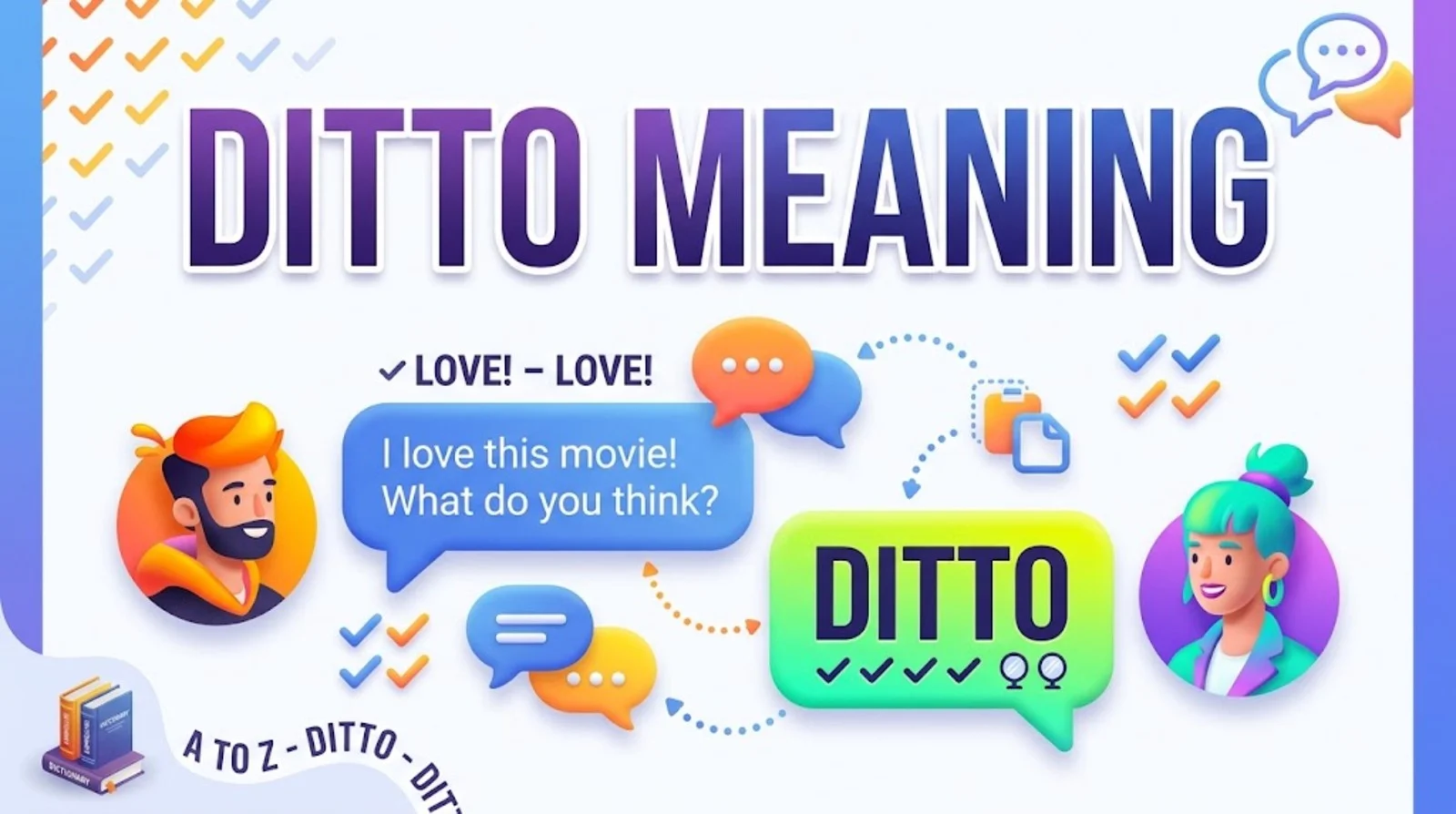
Ditto means “the same as what was just mentioned.” It can also mean “same here,” “me too,” or “I agree” when someone uses it to show that they share another person’s opinion, feeling, or situation. The word is useful in both everyday conversation and writing, especially when repeating the same information would be unnecessary.
For example, if someone says, “I love this restaurant,” replying “Ditto” means “I love it too.” If a document repeats information from a previous line, ditto can also indicate that the same information applies again. Its exact meaning depends on context, but the central idea stays the same: something is the same as something already stated.
What Does Ditto Mean?
Ditto means “the same” or “same as above.” In conversation and texting, it often expresses agreement with something another person has said.
Example:
“I’m exhausted after that meeting.”
“Ditto.”
Here, “Ditto” means “I’m exhausted too.”
The word can sound casual, friendly, or slightly playful in everyday communication. In formal writing, clearer phrases such as “the same,” “as stated above,” or a repeated piece of information may be more appropriate.
Ditto Definition and Core Meaning
The word ditto is used when a person wants to indicate that something is the same as something already mentioned.
Its common meanings include:
- The same
- Same as above
- Same here
- Me too
- I agree
- The same thing applies
- Repeat the information previously given
The meaning changes slightly depending on how it is used.
Ditto in Conversation
In conversation, ditto usually signals agreement or shared experience.
Example:
“That movie was surprisingly good.”
“Ditto.”
The second speaker is saying that they have the same opinion.
Another example:
“I need coffee before I can function.”
“Ditto.”
Here, the speaker means, “I feel exactly the same way.”
Ditto in Writing
In written material, ditto can indicate that information in one entry is identical to information above it.
For example:
| Name | City | Country |
|---|---|---|
| Alex | Boston | USA |
| Jordan | Ditto | Ditto |
The second row means Jordan is also from Boston, USA.
This use is less common in polished modern writing because repeating the actual information is often clearer.
Ditto Meaning in Text
In text messages, ditto generally means “same here” or “I feel the same.”
It is especially useful when a person wants to agree without writing a full sentence.
Example 1: Sharing an Opinion
Person A:
“This new album is amazing.”
Person B:
“Ditto.”
Meaning: “I think the same thing.”
Example 2: Sharing a Feeling
Person A:
“I’m so tired today.”
Person B:
“Ditto.”
Meaning: “I’m tired too.”
Example 3: Agreeing With a Plan
Person A:
“I think we should leave early.”
Person B:
“Ditto. I don’t want to get stuck in traffic.”
Here, ditto shows agreement, while the second sentence gives an additional reason.
Example 4: Casual Chat
Person A:
“Pizza sounds perfect tonight.”
Person B:
“Ditto 🍕”
This gives the word a relaxed, friendly tone.
Ditto Meaning in Chat and Texting
When someone sends “ditto” in a chat, the safest interpretation is usually “I agree” or “same here.”
The surrounding message provides the exact meaning.
| Message | “Ditto” means |
|---|---|
| “I love this song.” | I love it too. |
| “I’m ready to go home.” | I’m ready too. |
| “That was a difficult exam.” | I also found it difficult. |
| “I think we should wait.” | I agree. |
| “I’m hungry.” | I’m hungry too. |
| “You did a great job.” | I agree with that statement, depending on context. |
A useful point is that ditto does not always mean “me too” word for word. It means that the relevant idea or statement is the same. Context determines exactly what is being repeated.
Why Do People Say “Ditto”?
People use ditto mainly because it is short and convenient.
Imagine someone writes:
“I really enjoyed the trip. The weather was great, the food was excellent, and I would happily go back.”
A person who feels exactly the same could respond:
“Ditto.”
Instead of repeating the entire thought, one word communicates agreement.
This makes ditto especially useful in casual conversations, comments, emails, and messages where the previous statement is already clear.
Is Ditto a Slang Word?
Ditto is not strictly slang. It is a standard English word with a long history of use.
However, its conversational use can feel informal.
For example:
“I completely agree with your assessment.”
sounds more formal than:
“Ditto.”
In modern texting, ditto often feels casual, concise, and sometimes humorous. It is better described as a common informal expression in conversational English rather than pure slang.
Ditto Tone and Usage
The tone of ditto depends heavily on the situation.
| Tone | How “ditto” may sound | Example |
|---|---|---|
| Casual | Natural and relaxed | “I’m exhausted.” “Ditto.” |
| Friendly | Warm agreement | “That was fun!” “Ditto!” |
| Playful | Light or humorous | “I need another vacation.” “Ditto!” |
| Concise | Short and direct | “I agree.” “Ditto.” |
| Formal | Sometimes too casual | “Ditto” in a formal report |
In professional communication, it can be acceptable in a relaxed workplace conversation. In highly formal documents, clearer wording is generally easier for readers to understand.
15 Examples of Ditto in Sentences
Seeing the word in different contexts makes its meaning much easier to understand.
- “I love this book.” “Ditto.”
Meaning: I love it too. - “That was the best part of the trip.” “Ditto.”
Meaning: I agree. - “I’m ready for the weekend.” “Ditto.”
Meaning: I am ready too. - “She thinks the project needs more time, and I ditto that opinion.”
Meaning: I have the same opinion. - “I’m worried about the deadline.” “Ditto.”
Meaning: I share your concern. - “He ordered the chicken, and I did ditto.”
Meaning: I ordered the same thing. - “I would definitely visit that city again.” “Ditto.”
Meaning: I would also visit it again. - “The first two entries list New York. The third uses ‘ditto’ to indicate the same city.”
- “I need a break.” “Ditto.”
Meaning: I need one too. - “You handled that situation well.” “Ditto for you.”
Meaning: The same praise applies to you. - “My favorite part was the final scene.” “Ditto.”
Meaning: The final scene was also my favorite. - “I agree with your suggestion.” “Ditto.”
Meaning: I have the same opinion. - “Everyone else chose Friday, so we did ditto.”
Meaning: We chose Friday as well. - “I’m not ready for Monday.” “Ditto.”
Meaning: I am not ready either. - “The second form contains ditto marks because the information matches the previous entry.”
Ditto vs. “Same Here” vs. “Me Too”
These expressions overlap, but they are not always interchangeable.
| Expression | Main meaning | Typical setting |
|---|---|---|
| Ditto | The same as what was just said | Conversation, writing, texting |
| Same here | I have the same feeling or experience | Casual conversation |
| Me too | I also do, feel, or think that | Everyday conversation |
| I agree | I share your opinion | Conversation and professional settings |
| Same | I relate to or agree with that | Very casual texting |
| Likewise | The same applies to me or you | Polite and somewhat formal |
Consider this exchange:
“I’m nervous about tomorrow.”
“Me too.”
This is extremely natural.
You could also say:
“I’m nervous about tomorrow.”
“Same here.”
Or:
“I’m nervous about tomorrow.”
“Ditto.”
All three communicate a similar idea, but ditto has a slightly different flavor. It can sound more concise or playful.
Ditto vs. Likewise
Ditto and likewise can overlap, but they are used differently.
Likewise often means that the same sentiment or action applies in return.
“Nice to meet you.”
“Likewise.”
Here, “likewise” means “nice to meet you too.”
Ditto is broader:
“I think the ending was confusing.”
“Ditto.”
The second person is agreeing with the opinion.
So, likewise is often used for reciprocal sentiments, while ditto can repeat an idea, opinion, feeling, or piece of information.
Ditto vs. Same
The word same has become especially common in informal digital communication.
“I’m staying home tonight.”
“Same.”
This is very casual.
“I’m staying home tonight.”
“Ditto.”
This also works, but ditto can sound slightly more deliberate or playful.
Neither is automatically better. The best choice depends on the relationship, platform, and tone.
How to Use Ditto Correctly
There are several natural ways to use ditto.
1. Use It Alone
“I’m exhausted.”
“Ditto.”
This is probably the simplest conversational use.
2. Use It to Agree With an Opinion
“I think the second option is more practical.”
“Ditto.”
This means you share the same opinion.
3. Use It in a Written List
Address: Chicago
Country: USA
Previous entry: Ditto
Here, the word points back to information already provided.
4. Use “Ditto” for the Same Action
“She chose the blue folder, and I did ditto.”
This construction exists, but it sounds less natural in modern everyday English than simply saying:
“I chose the blue folder too.”
For natural contemporary writing, ditto works best when the repeated idea is obvious from context.
Common Mistakes With Ditto
Mistake 1: Assuming It Always Means “I Agree”
Agreement is a common meaning, but the broader concept is sameness.
For example:
“The address is the same as the previous entry.”
A historical or administrative use of ditto can refer directly to repeated information rather than an opinion.
Mistake 2: Using It When the Context Is Unclear
If someone says:
“The meeting was complicated.”
Replying only:
“Ditto.”
could mean several things. You might mean the meeting was complicated, boring, stressful, or something else.
When the reference is unclear, a complete sentence is better.
Mistake 3: Treating It as Highly Formal
Although ditto is a standard English word, it can sound casual in many modern contexts.
Instead of writing:
“The company adopted the same procedure. Ditto for the second department.”
a formal report might be clearer with:
“The second department adopted the same procedure.”
Mistake 4: Assuming It Is Only a Texting Term
Ditto predates modern texting by a long time. Texting simply gives people another setting in which the word can be used as a short response.
What Does Ditto Mean on Social Media?
On social media, ditto generally means “I agree,” “same,” or “I feel the same way.”
For example:
“This is the best coffee shop in town.”
“Ditto.”
A commenter may also use it after a longer opinion to indicate that they share the original poster’s view without rewriting the entire statement.
The tone can range from sincere to playful.
For example:
“I need three days off after this week.”
“Ditto 😂”
The emoji makes the casual tone even clearer.
Is “Ditto” Positive or Negative?
Ditto itself is neutral. The statement it refers to determines the positive or negative meaning.
Positive:
“This was an amazing experience.”
“Ditto.”
Negative:
“I’m disappointed with the result.”
“Ditto.”
The word simply indicates that the same idea applies.
What Is the Origin of Ditto?
Ditto entered English from Italian. The Italian detto means “said,” from the past participle of dire, meaning “to say.”
The word developed as a way to indicate that something had already been stated and should be repeated.
This history helps explain why ditto can refer both to:
- Repeated information in a list or document.
- A person’s agreement with something previously said.
The modern conversational meaning grew naturally from the basic idea of repeating or saying the same thing.
Ditto Marks: What Are They?
A ditto mark is a symbol historically used to show that information should be repeated from the line above.
For example, an old-style list might contain:
| Item | Location |
|---|---|
| Event A | London |
| Event B | ″ |
| Event C | ″ |
The repeated marks indicate London.
Today, this practice is less common in carefully formatted documents because repeating the actual word or phrase can be clearer.
Synonyms for Ditto
The best synonym depends on the context.
- When You Mean “Same Here”
- same here
- me too
- same
- likewise
- I feel the same
- I agree
- When You Mean “The Same Thing”
- identical
- same
- equivalent
- duplicate
- matching
- corresponding
- When You Mean “Repeat Previous Information”
- same as above
- as stated above
- repeated
- aforementioned
- duplicate entry
Not every synonym works in every sentence. “Same here” works naturally in conversation, while “as stated above” is more suitable for structured writing.
Antonyms and Contrasting Ideas
There is no single perfect opposite of ditto, because its meaning changes with context. Useful contrasting expressions include:
- different
- another
- distinct
- unlike
- opposite
- changed
- new
- separate
- unique
- not the same
For example:
“I agree with your choice.”
“Ditto.”
The contrasting idea would be:
“I have a different opinion.”
When Should You Use Ditto?
Use ditto when the thing you are referring to is obvious and repeating it would add little value.
It works especially well in:
- Casual text messages
- Friendly conversations
- Social media comments
- Informal emails
- Personal notes
- Lists containing repeated information
- Conversations where a short agreement is enough
Avoid relying on it when:
- The reference is unclear.
- The audience may not know the expression.
- You are writing highly formal material.
- Precision is more important than brevity.
- Several previous statements could be the intended reference.
A simple rule is useful: if the reader can instantly identify what “ditto” refers to, it is probably clear enough.
Frequently Asked Questions
What does ditto mean in simple words?
Ditto means “the same.” In conversation or texting, it commonly means “same here,” “me too,” or “I agree.”
What does ditto mean in texting?
In texting, ditto usually means that you share the same feeling, opinion, or experience as the person who sent the previous message.
Is ditto a slang word?
No. Ditto is a standard English word, although using it as a one-word response can feel informal, casual, or playful.
Is ditto rude?
Usually, no. Ditto is generally neutral and harmless. However, replying with only “ditto” can seem dismissive in a serious conversation if the other person expects a more thoughtful response.
Does ditto mean “I agree”?
It can. When someone expresses an opinion and you respond “ditto,” you usually mean “I agree” or “I have the same opinion.”
Can I use ditto in a formal email?
You can, but context matters. In formal professional writing, phrases such as “I agree,” “the same applies,” or a direct repetition of the information may communicate your meaning more clearly.
What is another word for ditto?
Depending on context, alternatives include same, same here, me too, likewise, I agree, identical, same as above, and as stated above.
What does “ditto” mean in a conversation?
In conversation, ditto usually means that the speaker shares the previous person’s statement, feeling, opinion, or situation.
What are ditto marks?
Ditto marks are symbols historically used to show that the same information from a previous line should be repeated. They are less common in modern polished documents.
Final Takeaway
Ditto means “the same,” and in everyday conversation it often works like “same here,” “me too,” or “I agree.” Its strength is simplicity. One short word can connect directly to a previous statement without repeating everything.
The key is context. In a text message, “Ditto” can be a natural and friendly way to show agreement. In a formal document, spelling out the repeated information is often clearer. Understanding this small difference helps you use the word naturally instead of treating it as a one-size-fits-all replacement for “same.”
Discover More Post:
- ND Meaning in Text | Decode This Short Form, Its Uses & Real …
- PFP Meaning in Text | What It Really Means in Chats, Social …
- Enigma Meaning | Definition, Examples, Origins & The …