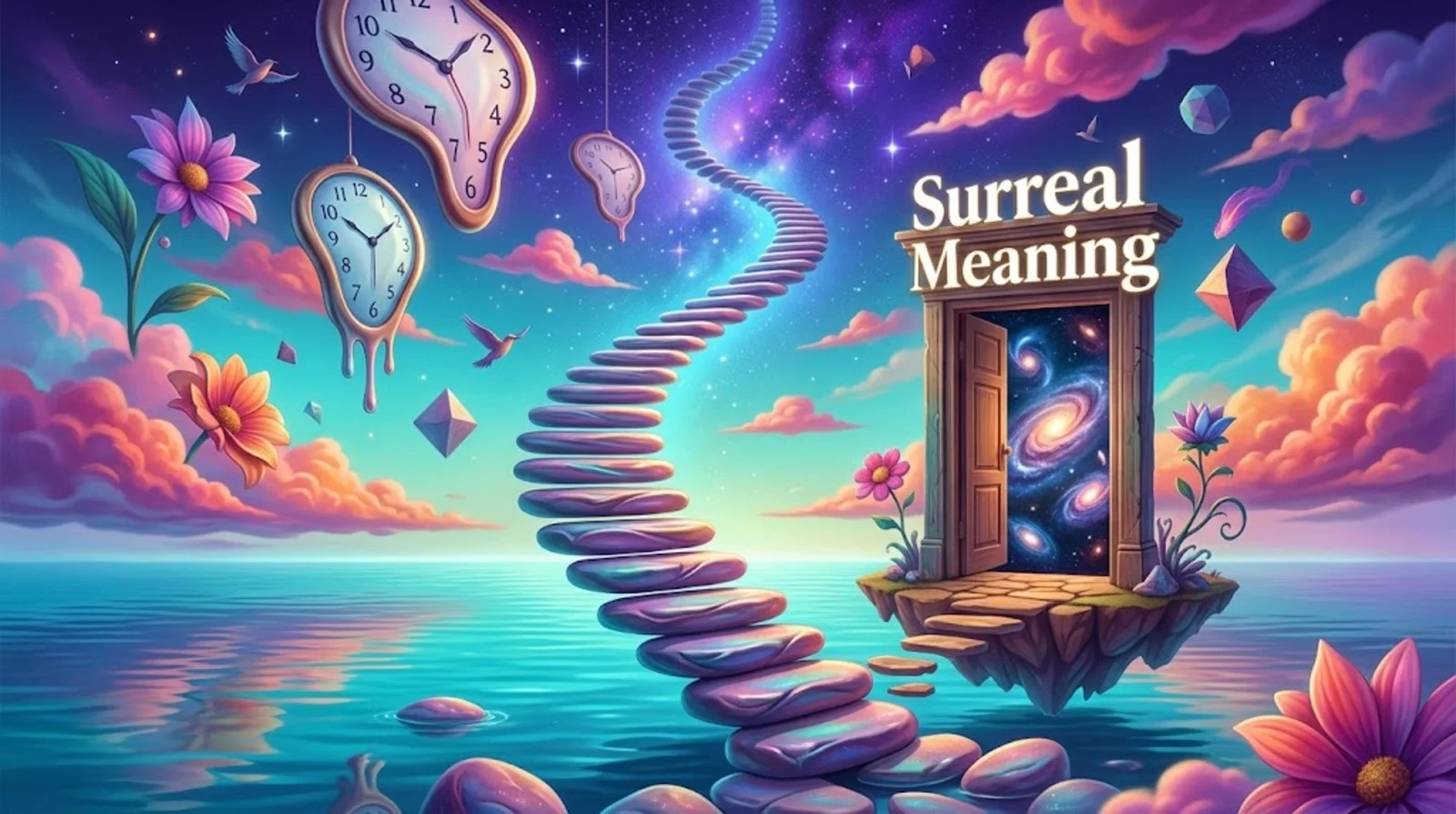
The surreal meaning describes something that feels dreamlike, strangely unreal, or far removed from normal experience. The word surreal is commonly used when a situation is so unusual, unexpected, beautiful, confusing, or extraordinary that it does not seem completely real.
For example, if you meet your favorite author unexpectedly in a small coffee shop, you might say, “That was a surreal experience.” You are not necessarily saying the event was literally a dream. You mean it felt so unexpected that your mind had trouble treating it like an ordinary moment.
The word can describe experiences, places, images, conversations, events, memories, and even emotions. Its exact sense depends on context.
What Does Surreal Mean?
Surreal means strange, dreamlike, or seemingly unreal. It describes something that feels outside ordinary reality, often because it is unusually unexpected, bizarre, beautiful, confusing, or difficult to believe.
Example:
“Standing on the stage in front of thousands of people felt surreal.”
Here, surreal means the experience felt almost like a dream because it was extraordinary and difficult to fully process.
Surreal Definition and Meaning
Surreal is an adjective used to describe something that seems unreal or dreamlike.
In everyday English, people often use it for moments that are difficult to believe or that feel strangely disconnected from normal life.
Consider these examples:
- “The whole evening felt surreal.”
- “The mountains looked surreal at sunset.”
- “Winning the competition was a surreal moment.”
- “The movie creates a surreal world.”
- “It was surreal seeing my childhood home after twenty years.”
The word can carry different shades of meaning.
Sometimes surreal suggests something wonderful:
“Meeting my childhood hero was surreal.”
Sometimes it describes something disturbing or confusing:
“The empty streets after the sudden evacuation felt surreal.”
It can also simply describe something visually unusual:
“The painting has a surreal quality.”
So, surreal does not automatically mean good or bad. The surrounding context tells the reader how the experience feels.
Surreal Meaning in Simple English
In simple English, surreal means:
“So strange or unusual that it feels like a dream.”
A useful way to remember it is:
Surreal = strange + dreamlike + hard to believe
For instance, imagine walking through your hometown and suddenly seeing a famous movie star filming a scene outside your old school. Nothing supernatural has happened, but the situation may feel surreal because it is completely outside your normal expectations.
What Does Surreal Mean in Everyday Language?
In everyday conversation, surreal often describes a moment that feels unreal because it is unexpected or emotionally powerful.
Example 1: A major achievement
“I finally graduated, and seeing my family there felt surreal.”
The speaker knows the graduation is real. The word describes the emotional feeling of the moment.
Example 2: An unexpected encounter
“I ran into my former teacher on a flight to Tokyo. It was surreal.”
The encounter was unusual and unexpected.
Example 3: A beautiful scene
“The lake looked surreal under the moonlight.”
Here, the speaker is describing an extraordinary visual appearance.
Example 4: A difficult situation
“After the storm, the normally busy neighborhood was completely silent. It felt surreal.”
The unusual environment created a strange, almost unreal feeling.
Why Do People Say Something Feels Surreal?
People often use surreal when ordinary language does not fully capture how unusual a moment feels.
There is an important distinction here.
Something can be completely real but still feel surreal.
Imagine receiving a message telling you that you have been accepted into a university you have dreamed about for years. You can see the message on your screen. You know it is real. Yet your immediate reaction might be:
“This feels surreal.”
The word captures the gap between knowing something is real and emotionally processing that reality.
That is one reason surreal has become common in descriptions of major achievements, unexpected meetings, dramatic events, travel experiences, and emotional milestones.
Surreal vs. Unreal
These words are related, but they are not interchangeable in every sentence.
| Word | Main Idea | Example |
|---|---|---|
| Surreal | Dreamlike, strangely unreal, or extraordinary | “The entire experience felt surreal.” |
| Unreal | Not real, or extremely surprising | “The story sounded unreal.” |
| Bizarre | Very strange or unusual | “It was a bizarre coincidence.” |
| Absurd | Ridiculous or unreasonable | “The rule was completely absurd.” |
| Uncanny | Strange in a mysterious or unsettling way | “The resemblance was uncanny.” |
| Dreamlike | Similar to the feeling or appearance of a dream | “The landscape had a dreamlike quality.” |
Surreal vs. Unreal: The Key Difference
Unreal can literally mean something is not real.
Surreal usually describes the feeling or appearance of something that is real but seems dreamlike or extraordinary.
Compare:
- “The creature in the story was unreal.”
This can mean the creature does not exist in reality. - “Seeing the northern lights was surreal.”
The event was real, but the experience felt extraordinary.
This distinction is especially useful when writing personal experiences.
Surreal Synonyms
The best synonym depends on the context.
Common Synonyms
- dreamlike
- unreal
- strange
- bizarre
- unusual
- extraordinary
- uncanny
- fantastical
- otherworldly
- absurd
- mysterious
- imaginary
These words are not perfect substitutes in every sentence.
For example, dreamlike is close to surreal when describing an atmosphere or visual scene. Bizarre works better when the main idea is unusual behavior. Uncanny is more appropriate when something feels strangely familiar or unsettling.
Surreal Meaning and Surrealism
The adjective surreal is closely connected to Surrealism, an influential artistic and literary movement that developed in Europe during the early twentieth century.
Surrealism explored dreams, the subconscious mind, unexpected combinations, and ideas that challenged conventional ideas of reality.
This connection helps explain why modern English uses surreal for things that resemble dream imagery.
However, calling an everyday experience surreal does not necessarily mean that it is related to the Surrealist art movement.
For example:
“Winning the championship felt surreal.”
This is ordinary modern usage.
By contrast:
“The artist used Surrealist techniques to combine realistic objects in an impossible setting.”
This refers specifically to the artistic tradition.
Surreal Experience Meaning
A surreal experience is an event that feels unusually strange, extraordinary, dreamlike, or difficult to process.
Common examples include:
- meeting someone famous unexpectedly
- achieving a lifelong goal
- returning to a place after many years
- experiencing a dramatic change in your surroundings
- witnessing an extraordinary natural event
- being present during a major historical moment
- seeing something you once believed was impossible
- receiving unexpected life-changing news
Example Sentences
- “Walking into the stadium for the first time was a surreal experience.”
- “It felt surreal to see my name on the award.”
- “The sudden silence in the city created a surreal atmosphere.”
- “Watching the eclipse was a surreal experience.”
- “Moving back to my childhood neighborhood felt surreal.”
- “The whole conversation seemed surreal.”
- “It was surreal meeting the person whose books I had read for years.”
- “The empty airport looked almost surreal.”
- “Seeing the finished house after years of planning was surreal.”
- “The dreamlike lighting gave the photograph a surreal quality.”
- “For a few minutes, the situation felt completely surreal.”
- “Standing there after reaching the summit was a surreal moment.”
Notice that these examples do not all describe the same emotion. The common idea is that the experience feels far outside normal expectations.
Is Surreal Positive or Negative?
Surreal can be positive, negative, neutral, or mixed.
The word itself does not determine the emotional tone.
Positive
“It was surreal to finally hear the audience applaud.”
The speaker is describing an amazing experience.
Negative
“The abandoned building and complete silence made the scene feel surreal.”
The atmosphere is unsettling.
Neutral
“The city looked surreal from the airplane window.”
The speaker is mainly describing an unusual appearance.
Mixed
“It was surreal seeing the old neighborhood after the earthquake.”
The word can describe emotional complexity without explicitly saying how the speaker feels.
Surreal Meaning in a Sentence
Here are examples across different situations:
| Context | Sentence | What “Surreal” Expresses |
|---|---|---|
| Achievement | “Winning the award felt surreal.” | The achievement was difficult to process |
| Travel | “The desert landscape looked surreal.” | The scene seemed dreamlike |
| Celebrity | “Meeting her unexpectedly was surreal.” | The encounter was extraordinary |
| Nature | “The frozen lake looked surreal.” | The appearance seemed unreal |
| Memory | “Returning home after twenty years felt surreal.” | The familiar place felt strangely different |
| Crisis | “The quiet streets felt surreal.” | The unusual situation felt strange |
| Art | “The painting has a surreal atmosphere.” | The artwork resembles dream imagery |
| Emotion | “The news left me feeling surreal.” | The moment felt difficult to process |
Surreal Meaning in Text and Social Media
In texts, comments, and social media posts, surreal is often used casually.
Someone might post:
“Still feels surreal.”
This usually means:
“I still cannot believe this actually happened.”
For example, after getting married, graduating, meeting a famous person, moving abroad, or achieving an important goal, someone may simply write:
“This is surreal.”
The expression is short, but it can communicate a strong emotional reaction.
Common Casual Phrases
- “This feels surreal.”
- “Still surreal.”
- “Such a surreal moment.”
- “That was surreal.”
- “Life feels surreal right now.”
- “What a surreal experience.”
- “It honestly feels like a dream.”
These expressions are common because surreal communicates more than simple surprise. It suggests that the situation feels strange in relation to what the person expected reality to be.
How to Use Surreal Correctly
Because surreal is an adjective, it normally describes a noun or follows a linking verb.
Before a noun
“It was a surreal experience.”
“We walked through a surreal landscape.”
“The film creates a surreal atmosphere.”
After a linking verb
“The whole situation felt surreal.”
“The moment seemed surreal.”
“The scene looked surreal.”
A useful pattern is:
feel + surreal
seem + surreal
look + surreal
be + surreal
These structures are especially natural in everyday English.
Common Mistakes With Surreal
Mistake 1: Treating surreal as exactly the same as fake
Incorrect assumption:
“Surreal means fake.”
Not necessarily.
A surreal experience can be completely real. The word often describes how something feels, rather than whether it actually exists.
Mistake 2: Using surreal for every surprising event
Surprising and surreal are not identical.
“I got a text from my friend.”
That is usually not surreal.
“I received a message from a friend I had not heard from in twenty years on the exact day I was thinking about them.”
That could reasonably be described as surreal because the coincidence creates an unusual, dreamlike feeling.
Mistake 3: Assuming surreal always means positive
It does not.
A frightening, confusing, beautiful, or emotionally complicated situation can all feel surreal.
Mistake 4: Confusing surreal with absurd
Absurd often emphasizes something unreasonable or ridiculous.
Surreal emphasizes something dreamlike, strange, or disconnected from normal experience.
A situation can be both, but the meanings are not identical.
Surreal vs. Dreamlike
These words overlap strongly, but they have different common uses.
Dreamlike usually focuses on the appearance or atmosphere of something.
“The soft light created a dreamlike scene.”
Surreal can describe appearance, but it is also widely used for experiences and situations.
“Getting the call after waiting for ten years felt surreal.”
So, use dreamlike when emphasizing visual or atmospheric qualities, and surreal when you want to capture a broader sense of unusual reality.
Words Similar to Surreal
Several related words can help you choose a more precise expression.
Dreamlike
Something resembles the atmosphere or quality of a dream.
Otherworldly
Something appears to belong to another world or reality.
Uncanny
Something feels strangely unfamiliar, mysterious, or unsettling.
Fantastical
Something is imaginative and resembles fantasy.
Bizarre
Something is extremely unusual or strange.
Extraordinary
Something is far beyond what is ordinary.
Absurd
Something appears irrational, ridiculous, or unreasonable.
Unusual
Something differs from what normally happens.
Choosing among these words depends on the specific idea you want to communicate.
Antonyms of Surreal
Possible opposites include:
- realistic
- ordinary
- normal
- familiar
- conventional
- practical
- believable
- natural
- typical
- mundane
Again, context matters.
For example, mundane is a useful contrast when discussing an extraordinary experience:
“The morning started as a mundane routine but ended with a surreal encounter.”
How to Choose the Right Word
Before using surreal, identify what makes the situation unusual.
- If it feels like a dream, use surreal or dreamlike.
- If it is simply unusual, unusual may be clearer.
- If it is extremely strange, bizarre may be stronger.
- If it is mysterious and unsettling, uncanny may fit better.
- If it is impossible or belongs to fantasy, fantastical may be more precise.
This approach makes your writing sound more natural because you are choosing a word based on meaning rather than replacing words mechanically.
Quick List: Surreal Meaning at a Glance
- Part of speech: Adjective
- Basic meaning: Dreamlike, strangely unreal, or extraordinary
- Common phrase: “It felt surreal.”
- Related noun: Surrealism
- Common contexts: Experiences, events, art, places, memories, emotions
- Positive meaning: An amazing or unbelievable experience
- Negative meaning: A strange or unsettling situation
- Neutral meaning: An unusual or dreamlike appearance
- Close synonyms: Dreamlike, unreal, bizarre, uncanny, extraordinary
- Common contrast: Realistic, ordinary, normal
Frequently Asked Questions
What does surreal mean in simple terms?
Surreal means something feels strange, dreamlike, or almost unreal. It can describe a real event that feels difficult to believe or an image that looks unlike ordinary reality.
What does it mean when someone says “this feels surreal”?
It usually means the person knows the situation is real but is having an unusual emotional reaction to it. The moment may be exciting, unexpected, overwhelming, strange, or difficult to process.
Is surreal the same as unreal?
Not exactly. Unreal can mean something is not real, while surreal commonly describes something real that feels dreamlike, strange, or extraordinary.
Is surreal a positive word?
Not always. Surreal can describe positive, negative, neutral, or mixed experiences. The emotional meaning comes from the surrounding context.
What is a good synonym for surreal?
Dreamlike is one of the closest general synonyms. Depending on the context, unreal, bizarre, uncanny, otherworldly, or extraordinary may also work.
Can surreal describe a person?
Yes, although it is more commonly used for an experience, situation, scene, or artistic style. In some contexts, a person’s appearance or behavior can be described as surreal if it seems unusually strange or dreamlike.
What is the difference between surreal and bizarre?
Surreal emphasizes a dreamlike or strangely unreal quality. Bizarre emphasizes extreme unusualness or strangeness. Something can be bizarre without feeling dreamlike.
What is the noun form related to surreal?
The closely related noun is Surrealism, which refers to the artistic and literary movement associated with dream imagery, the subconscious, and unexpected combinations. Surreality can also be used to describe a surreal quality or condition.
Final Takeaway
The simplest surreal meaning is “strange or dreamlike in a way that makes something feel unreal.” The word is especially useful when a normal explanation such as strange or surprising does not fully capture the experience.
A real event can feel surreal. A landscape can look surreal. A painting can have a surreal quality. A major life achievement can be a surreal moment.
The key idea is not that something is literally unreal. It is that the experience, appearance, or situation feels unusually disconnected from ordinary reality.
Discover More Post:
- ND Meaning in Text | Decode This Short Form, Its Uses & Real …
- PFP Meaning in Text | What It Really Means in Chats, Social …
- Enigma Meaning | Definition, Examples, Origins & The …