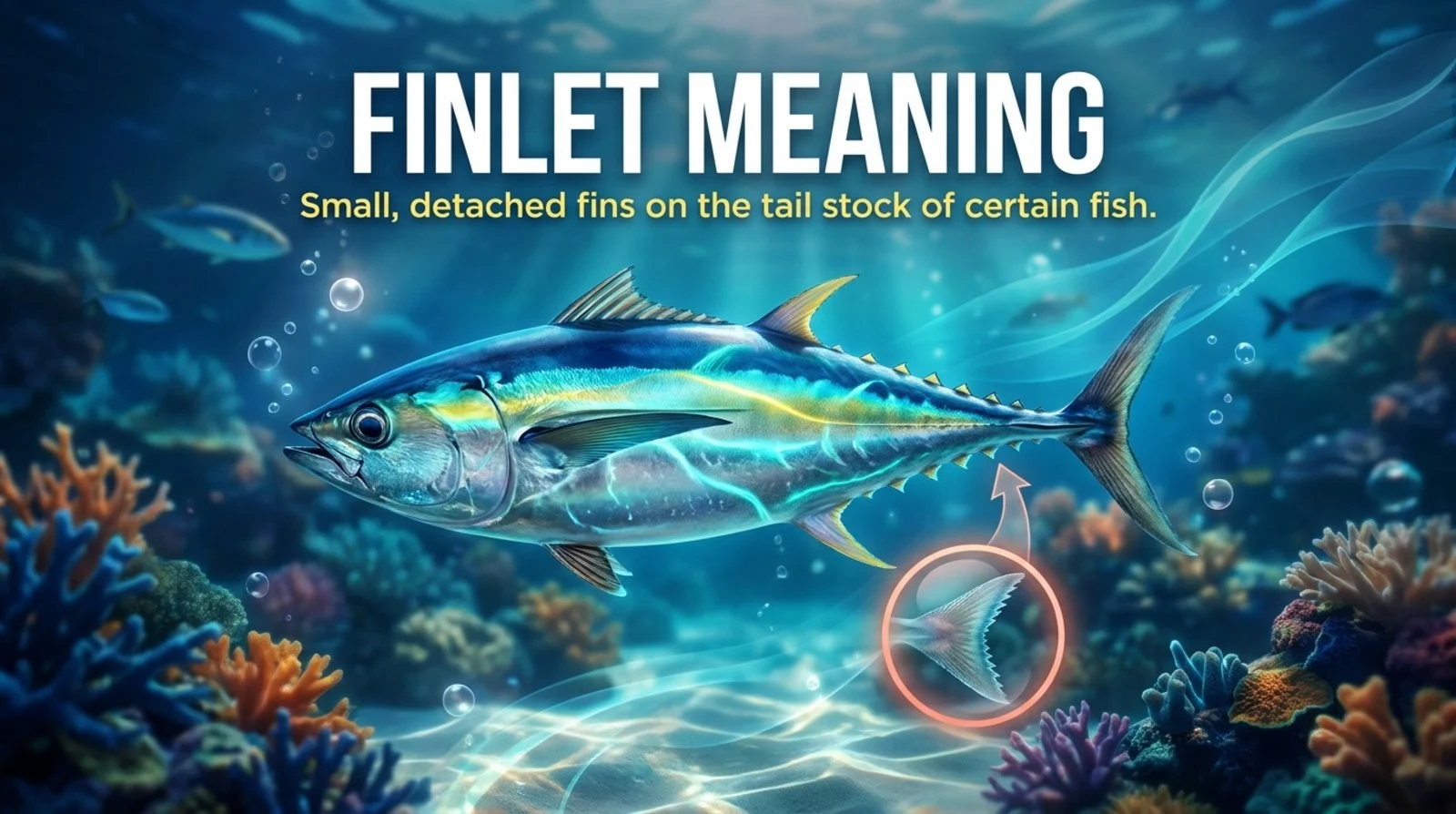
A finlet is a small, separate fin found on the body of certain fish. It is usually positioned behind the main dorsal or anal fin and appears as a series of small, individual fins rather than one continuous fin. Finlets are especially noticeable in fast-swimming fish such as tuna and mackerel.
In simple terms, a finlet is a small fin that helps shape and control water flow around a fish’s body. Its position, size, and arrangement vary among species. Understanding finlets gives you a clearer picture of fish anatomy and how specialized body structures support swimming.
What Is a Finlet?
A finlet is a small, distinct fin located behind a larger fin on some fish. Unlike the main dorsal, anal, or caudal fin, a finlet is generally separated from the neighboring fin by a visible gap.
Some fish have a single small fin in this position, while others have a row of several finlets.
Finlets are most commonly associated with highly active, streamlined fish. Tuna and mackerel are familiar examples. In these fish, small finlets can be seen between the main dorsal or anal fins and the tail.
The exact structure of a finlet differs among species. It may contain fin rays and connective tissue and can have a narrow, pointed, or triangular appearance.
Finlet Definition in Simple English
A simple finlet definition is:
A finlet is a small, separate fin on certain fish, commonly found behind the main dorsal or anal fin.
The word combines fin with the suffix -let, which indicates something small. So, the basic idea behind the term is a small fin.
Finlet Meaning in Biology
In biology, a finlet refers to a distinct small fin structure that forms part of the external anatomy of certain fish.
The term is particularly useful in fish identification and biological descriptions because the number, location, and shape of finlets can help distinguish one species from another.
For example, scientists and fish identification guides may describe a fish by noting:
- The number of dorsal fins
- The number of anal fins
- The presence or absence of finlets
- The number of dorsal or anal finlets
- The shape of the caudal fin
- The position of the fins
- The number and arrangement of fin rays
This makes finlet anatomy more than a vocabulary detail. It can be an important feature when describing fish morphology.
Where Are Finlets Located?
Finlets are usually found toward the rear portion of a fish’s body.
In many species, they occur between a main dorsal or anal fin and the caudal fin, which is the tail fin.
A simplified arrangement can look like this:
Main dorsal fin → finlets → caudal fin
On the lower side of the body, a similar pattern can occur:
Main anal fin → finlets → caudal fin
Not every fish has finlets. Their location and number depend on the species.
Dorsal Finlets
Dorsal finlets are small fins located along the upper surface of the fish, behind the main dorsal fin.
They are particularly recognizable in tuna and related fast-swimming fish.
Anal Finlets
Anal finlets occur along the lower surface of the fish, behind the main anal fin and before the tail.
Some species have both dorsal and anal finlets.
What Is the Function of a Finlet?
The exact role of finlets can vary between species, so it is better to think of them as specialized structures that interact with water flow rather than assigning one universal function.
Finlets can influence the flow of water around the rear part of a fish’s body. In fast-swimming species, small changes in water flow can matter because the fish moves through the water at high speed.
Their possible functional importance includes:
- Helping manage water flow near the rear of the body
- Contributing to swimming control
- Supporting stability during movement
- Reducing unwanted flow disturbances in some swimming conditions
- Working as part of the fish’s overall propulsion and control system
The tail and surrounding body structures remain central to propulsion. Finlets should not be treated as tiny replacement tails. Their role is more closely connected with flow control, stability, and efficient movement.
How Finlets Help Fish Swim
Fish swimming is not controlled by one fin alone. Different body structures work together.
The main body produces much of the movement needed to push water backward. The caudal fin then plays a major role in generating thrust. Other fins help with steering, balance, braking, and maneuvering.
Finlets sit in a strategically important area near the rear of the body.
Imagine a tuna moving rapidly through the ocean. Water passes along its streamlined body and reaches the region around the tail. The small finlets interact with this moving water and can affect the flow before it reaches the caudal fin.
Research on fish locomotion and hydrodynamics has examined how fin structures influence the movement of water around swimming fish. This helps explain why fast-swimming fish can have highly specialized fin arrangements.
The key point is simple: finlets are part of a larger hydrodynamic system rather than isolated swimming tools.
Finlet Anatomy
Finlet anatomy is relatively simple compared with the anatomy of larger fins, but the details can differ from one fish species to another.
A typical finlet may contain:
| Structure | General role |
|---|---|
| Fin rays | Provide structural support |
| Fin membrane | Connects and supports the fin rays |
| Base of finlet | Anchors the structure to the body |
| Finlet surface | Interacts with surrounding water |
The shape and number of fin rays can vary. Some finlets appear narrow and pointed, while others have a more triangular form.
Their small size does not mean they are biologically unimportant. In specialized fish, even small external structures can contribute to the way the body interacts with its environment.
Finlets in Tuna
Tuna are among the best-known examples of fish with finlets.
Tuna have a streamlined body designed for sustained and rapid swimming. Behind their main dorsal and anal fins are rows of smaller finlets.
These finlets are easy to spot in photographs or illustrations of tuna because they form a series of separate structures leading toward the tail.
When identifying tuna species, fin characteristics can be useful alongside other features such as body shape, coloration, fin shape, and markings.
Finlets in Mackerel
Mackerel are another familiar group of fish associated with finlets.
Many mackerel have small finlets behind their dorsal and anal fins. These structures contribute to the distinctive appearance of the fish.
Mackerel also have streamlined bodies adapted for active swimming. Their fin arrangement is therefore useful when studying their external anatomy.
Why Do Some Fish Have Finlets?
Finlets are not present in all fish because fish have evolved many different body designs for different environments and swimming styles.
A fish living in a particular habitat may benefit from a body shape and fin arrangement suited to its lifestyle. Fast-moving open-water species often show specialized features associated with efficient movement through water.
Finlets are one example of this broader principle.
They demonstrate how fish anatomy can become highly specialized. A small external feature may have a meaningful relationship with the animal’s movement, stability, and interaction with water.
Types of Finlets
There is no single universal classification of finlets based simply on shape. In practical fish descriptions, they are often discussed according to their location.
1. Dorsal Finlets
These occur behind the dorsal fin on the upper surface of the fish.
They are common in groups such as tuna and mackerel.
2. Anal Finlets
These occur behind the anal fin on the lower surface of the fish.
Some species have a series of anal finlets leading toward the tail.
3. Multiple Finlets
Certain fish have several small finlets arranged in a row.
This is one reason photographs of tuna can look different from photographs of fish that have only large continuous fins.
Finlet vs. Fin
The terms fin and finlet are related, but they are not interchangeable.
| Feature | Fin | Finlet |
|---|---|---|
| Meaning | General term for a fish’s fin structure | Small, separate fin |
| Size | Can be large or small | Usually small |
| Occurrence | Very widespread among fish | Found in particular groups |
| Arrangement | May form a continuous fin | Often separated from nearby fins |
| Example | Dorsal fin, anal fin, caudal fin | Small fins behind dorsal or anal fins |
The suffix -let is useful here because it signals a smaller structure.
Calling a large dorsal fin a finlet would therefore be inaccurate.
Finlet vs. Dorsal Fin
A dorsal fin is a major fin located on the back of a fish.
A dorsal finlet is a much smaller, separate fin that can occur behind the main dorsal fin.
For example:
Main dorsal fin → small gap → dorsal finlets → tail
The two structures are related by location but are not the same anatomical feature.
Finlet vs. Caudal Fin
The caudal fin is the tail fin at the rear end of the fish.
It is much larger and has a different primary role in swimming than individual finlets.
A fish may have finlets immediately before the caudal fin, but the finlets should not be confused with the tail itself.
A useful way to remember the difference is:
- Finlet: small separate fin
- Caudal fin: main tail fin
- Dorsal fin: fin on the back
- Anal fin: fin on the underside
Examples of Fish With Finlets
Several active fish are associated with finlets. Examples include:
- Tuna
- Mackerel
- Bonitos
- Some other members of the mackerel and tuna family
The exact number and appearance of finlets can vary between species.
This is important when using finlets for fish identification. A single visible feature should not always be used alone. Species identification often requires several characteristics considered together.
Why Are Finlets Important in Fish Identification?
Fish can look remarkably similar, especially when viewed quickly or in poor conditions.
Biologists, anglers, fisheries workers, and fish identification guides may use external characteristics to tell species apart.
Finlet-related features can include:
- Presence or absence of finlets
- Number of finlets
- Position of finlets
- Shape of individual finlets
- Relationship between finlets and the tail
- Appearance of nearby dorsal and anal fins
These characteristics can be combined with body proportions, coloration, scale patterns, mouth structure, and other anatomical details.
This is one practical reason the word finlet appears in biological descriptions and identification resources.
Finlet Meaning in a Sentence
Seeing the word in context makes its meaning easier to understand.
- The tuna had several small finlets between its dorsal fin and tail.
- The researcher recorded the number of finlets during the fish identification process.
- The mackerel’s finlets were clearly visible near the caudal fin.
- Finlets are small structures found in certain species of fish.
- The fish’s dorsal finlets helped distinguish it from a similar species.
- The illustration shows the finlets positioned just ahead of the tail.
In each sentence, finlet refers to a small, separate fin rather than a general fin.
Common Mistakes About Finlets
Mistake 1: Thinking Every Fish Has Finlets
Not all fish have them.
Finlets are characteristic of certain groups and species.
Mistake 2: Calling the Tail a Finlet
The caudal fin is the main tail fin. It is not simply a large finlet.
Mistake 3: Assuming Finlets Are Only Decorative
Their position near the rear of the body means they interact with water flow and can have functional significance.
Mistake 4: Treating Every Finlet as Identical
Finlet shape, number, and structure can differ among species.
Mistake 5: Using Finlets Alone to Identify a Fish
Finlets can provide useful clues, but accurate identification may require several anatomical characteristics.
How to Remember the Meaning of Finlet
A simple memory trick is to break the word into two parts:
Fin + let = small fin
The ending -let commonly indicates something small. For example, a booklet is a small book, and a leaflet is a small leaf or sheet.
So, when you see finlet, think:
“A small separate fin.”
That shortcut captures the basic meaning without requiring a complicated biology definition.
Quick Guide to Finlet Meaning
| Question | Answer |
|---|---|
| What is a finlet? | A small, separate fin found on certain fish |
| Where is it found? | Commonly behind the dorsal or anal fin |
| Which fish have finlets? | Tuna, mackerel, bonitos, and related fish |
| What does it do? | It interacts with water flow and can contribute to swimming control and stability |
| Is a finlet the same as a fin? | It is a type of small fin structure, but the terms are not interchangeable |
| Is a finlet the tail? | No. The caudal fin is the tail fin |
| Does every fish have finlets? | No |
| Is finlet an anatomical term? | Yes, it is used in descriptions of fish anatomy |
Frequently Asked Questions
What does finlet mean?
Finlet means a small, separate fin found on certain fish. It is commonly located behind the main dorsal or anal fin, close to the caudal fin.
What is a finlet in fish?
A finlet is a small external fin structure found in some fish, especially active swimmers such as tuna and mackerel. Finlets can occur in rows near the tail.
What is the function of a finlet?
Finlets interact with water flow around the rear part of a fish. Depending on the species, they can contribute to swimming control, stability, and efficient movement through water.
Where are finlets located?
Finlets are commonly located between a main dorsal or anal fin and the caudal fin. Dorsal finlets are found on the upper side, while anal finlets are found on the lower side.
Do tuna have finlets?
Yes. Tuna are well-known for having rows of small finlets behind their main dorsal and anal fins.
Do mackerel have finlets?
Many mackerel species have small finlets behind their dorsal and anal fins. Their fin arrangement is one of several features used when describing or identifying these fish.
Are finlets the same as fins?
A finlet is a small type of fin structure, but the word usually refers specifically to a small, separate fin found in certain fish. It should not be used as a general replacement for terms such as dorsal fin or caudal fin.
Why are finlets useful for identifying fish?
The presence, number, position, and shape of finlets can provide useful anatomical clues. They are normally considered alongside other features rather than used as the only identification characteristic.
Final Takeaway
The simplest finlet meaning is a small, separate fin found on certain fish. Finlets are commonly positioned behind the main dorsal or anal fins, close to the tail. Tuna and mackerel are familiar examples of fish with these structures.
Finlets are small, but they are not meaningless anatomical details. Their position near the rear of a fish places them within an important area of water flow and movement. Their number, shape, and location can also provide useful clues for fish identification.
Once you remember “finlet = small separate fin,” the term becomes easy to recognize in biology textbooks, fish identification guides, and descriptions of aquatic anatomy.
Discover More Post:
- ND Meaning in Text | Decode This Short Form, Its Uses & Real …
- PFP Meaning in Text | What It Really Means in Chats, Social …
- Enigma Meaning | Definition, Examples, Origins & The …