A confident speaker can sound convincing, but confidence does not always come with knowledge. Someone may promise incredible results, use impressive language, and present themselves as an expert while having little genuine skill to support their claims. English has a specific word for this kind of person: charlatan.
The charlatan meaning refers to a person who falsely claims to possess knowledge, expertise, or special abilities, usually to mislead others or gain money, trust, status, or attention. The word is often used for people who pretend to be qualified professionals, miracle healers, financial gurus, or authorities on subjects they barely understand. Learning this word helps you describe dishonesty more precisely, recognize misleading claims, and communicate your concerns without relying on vague labels such as “fake” or “fraud.”
What Does Charlatan Mean?
A charlatan is someone who pretends to have special knowledge, professional qualifications, or abilities that they do not genuinely possess. This person may use impressive words, exaggerated promises, or a convincing public image to make others believe they are more capable than they really are.
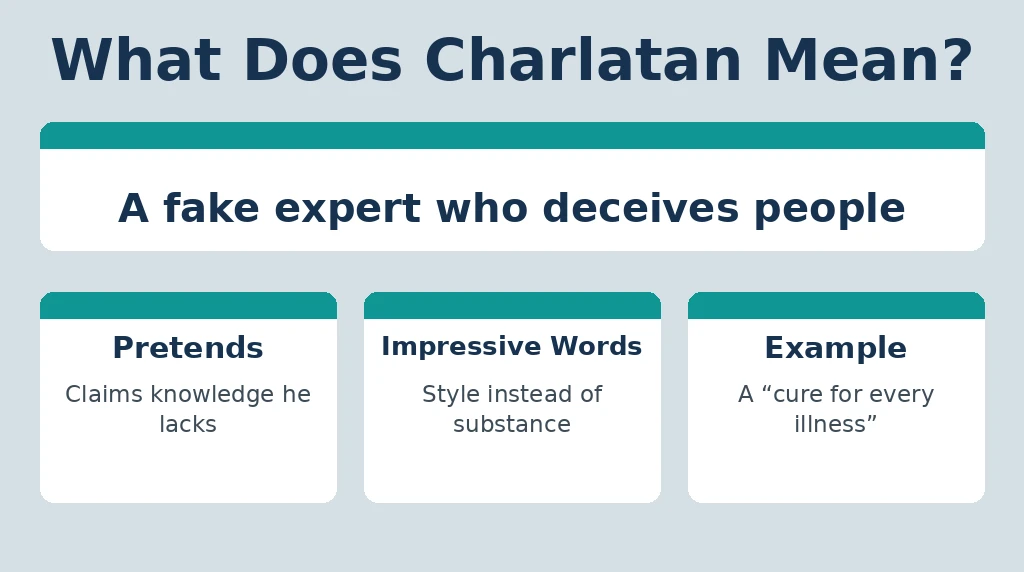
In simple English, a charlatan is a fake expert who deceives people by pretending to know more than they actually do.
For example, imagine someone advertising a guaranteed cure for every illness despite having no credible medical training or reliable evidence. If that person deliberately pretends to possess medical expertise to gain money or influence, the word charlatan may describe them accurately.
The key issue is not simply a lack of knowledge. Everyone has gaps in their understanding, and even qualified professionals make mistakes. A charlatan knowingly or dishonestly creates a false impression of expertise.
Charlatan Meaning in Simple Words
A charlatan is a person who acts like an expert but is not genuinely qualified or capable, often to fool others.
Example: “The so-called investment expert was exposed as a charlatan after his claims of guaranteed profits proved misleading.”
Here, charlatan suggests more than ordinary incompetence. It implies that the person has misrepresented their knowledge or abilities.
Charlatan Meaning in English
In English, charlatan is a noun. It describes a person who falsely presents themselves as knowledgeable, skilled, or professionally capable.
The word usually carries a strongly negative meaning. Calling someone a charlatan questions their honesty and credibility, especially when they claim expertise in a field where others may rely on their advice.
It can be used in formal writing, news commentary, everyday conversation, and criticism. However, because it implies deception, it should be used carefully when discussing a real person.
Charlatan Definition, Pronunciation, and Grammar
Understanding how the word works grammatically makes it easier to use naturally in conversation and writing.
| Word Detail | Explanation |
|---|---|
| Word | Charlatan |
| Part of speech | Noun |
| Plural form | Charlatans |
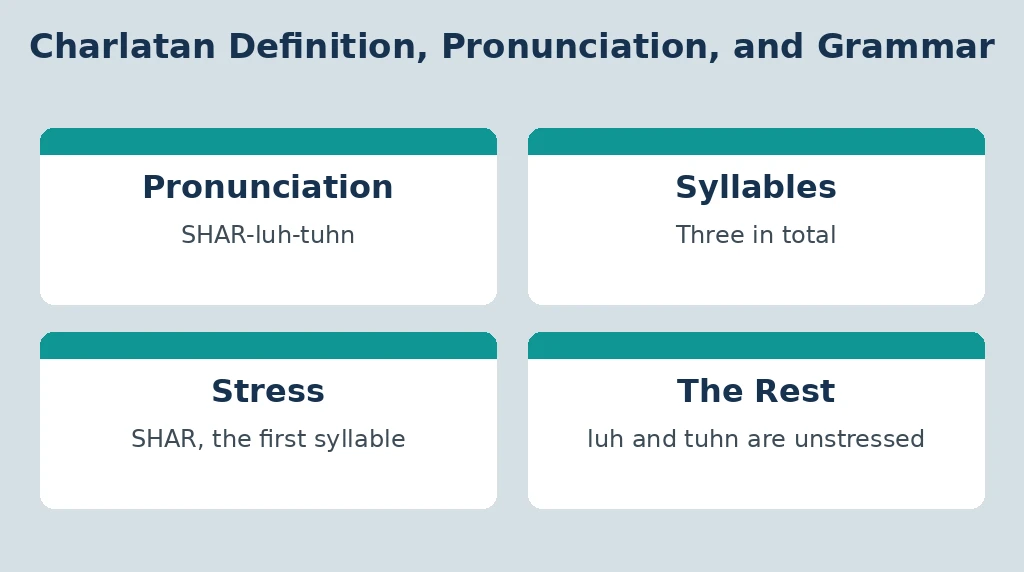
| Pronunciation | SHAR-luh-tuhn |
| Main meaning | A person who falsely claims knowledge, expertise, or ability |
| Tone | Negative, critical, and often accusatory |
| Common contexts | Health, business, finance, politics, and public advice |
| Related word | Charlatanism, meaning the practice or behavior associated with being a charlatan |
How to Pronounce Charlatan
The word charlatan is commonly pronounced SHAR-luh-tuhn.
It has three syllables:
- SHAR: The strongest syllable.
- luh: A short, unstressed sound.
- tuhn: The final syllable.
Try saying it slowly first, then naturally: SHAR-luh-tuhn.
The spelling can seem unfamiliar to English learners, so listening to a reputable dictionary’s audio pronunciation can help.
Is Charlatan a Noun or an Adjective?
Charlatan is a noun because it names a person.
Correct: “The charlatan persuaded several customers to buy his ineffective treatment.”
Incorrect: “His charlatan advice confused the audience.”
For the second sentence, use an appropriate adjective or rewrite it:
“His deceptive advice confused the audience.”
You can also use charlatan in phrases such as “a charlatan doctor” or “a financial charlatan.” In these examples, it remains a noun identifying the person.
Real-Life Examples of a Charlatan
The clearest way to understand a charlatan is to see how the behavior might appear in ordinary situations. These examples are illustrative, not claims about specific real people.
1. The Fake Medical Expert
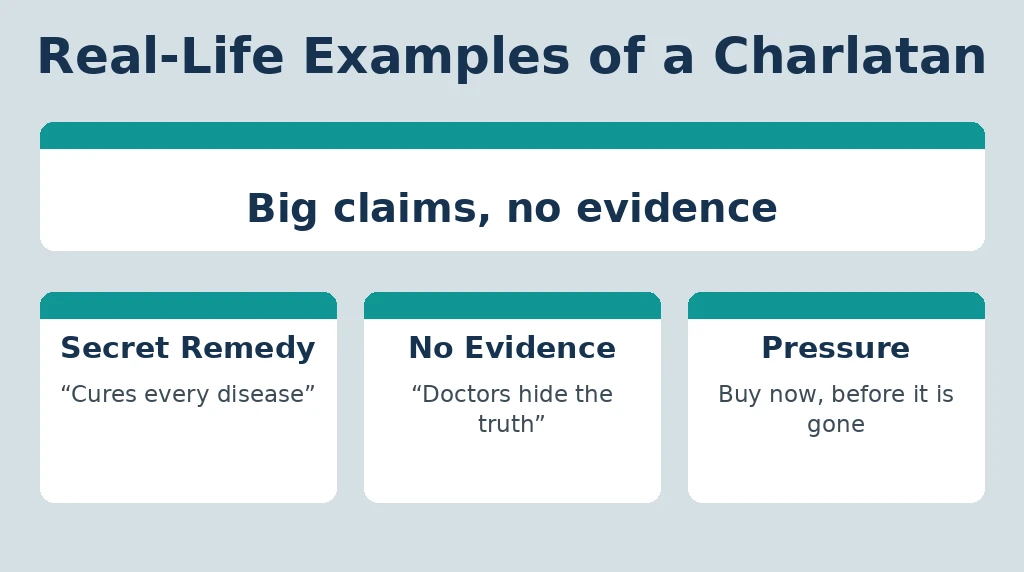
A person advertises a secret remedy that supposedly cures every disease. They claim that doctors are hiding the truth, provide no reliable evidence, and pressure customers to purchase expensive treatments.
If the person knowingly misrepresents their qualifications and the effectiveness of the remedy, they may be described as a charlatan.
Why the word fits: The person uses a false impression of medical expertise to gain trust or money.
2. The Self-Proclaimed Financial Guru
Someone online claims to be a successful investment professional. They promise risk-free profits, display luxurious possessions as proof of success, and refuse to explain the risks behind their recommendations.
If they deliberately fabricate their credentials or expertise, charlatan may be appropriate.
Why the word fits: Their public image is designed to create trust that their actual knowledge or experience does not justify.
3. The Fake Business Consultant
A consultant claims to have helped hundreds of companies grow. However, their testimonials are fabricated, their credentials are false, and their advice consists of generic promises presented as specialized knowledge.
Why the word fits: They pretend to possess professional experience they do not have.
4. The Pretend Academic Expert
A speaker repeatedly claims to have advanced knowledge of history or science but invents sources, misrepresents research, and refuses to correct obvious errors.
A single mistake would not make this person a charlatan. Deliberately inventing evidence to maintain a false image of expertise is a different matter.
Why the word fits: The deception concerns the person’s claimed authority and knowledge.
5. The Fake Online Coach
A social media personality sells an expensive course by promising that every student will become wealthy within a month. They invent success stories and hide the fact that their advertised results are unsupported.
If the claims are intentionally deceptive, the person may be called a charlatan.
Why the word fits: The person sells an illusion of expertise and guaranteed success.
6. The Dishonest Spiritual Adviser
Someone claims to possess extraordinary powers that allow them to solve every personal problem. They frighten vulnerable clients into paying for repeated sessions by claiming that terrible consequences will follow if they refuse.
If the person knowingly uses false claims to manipulate clients, charlatan may describe the conduct.
Why the word fits: The person exploits trust by pretending to have abilities they cannot substantiate.
Charlatan in a Sentence: 12 Natural Examples
These sentences show how the word appears in different contexts.
- The journalist exposed the self-proclaimed health expert as a charlatan.
- She refused to trust a charlatan who promised instant financial success.
- The scientist criticized the charlatan for presenting speculation as proven fact.
- His impressive speeches could not hide the fact that he was a charlatan.
- The company hired a consultant who later turned out to be a charlatan.
- Customers lost money after discovering that the investment adviser was a charlatan.
- The author described the fictional healer as a charlatan who preyed on desperate families.
- A genuine professional admits uncertainty instead of pretending to know everything like a charlatan.
- The documentary examined how a charlatan built a following through exaggerated claims.
- The researcher warned readers not to confuse unconventional ideas with charlatanism.
- He called the speaker a charlatan, although he offered little evidence to support the accusation.
- Her careful investigation revealed that the supposed expert had invented several of his qualifications.
Notice that charlatan often appears after verbs such as exposed, called, described, and revealed. These combinations are useful when writing about dishonesty or disputed expertise.
Charlatan Synonyms: Words With Similar Meanings
Several English words describe dishonest people, but each emphasizes a slightly different aspect of deception. Choosing the right one makes your writing more precise.
| Synonym | Meaning | Best Use Case | Example |
|---|---|---|---|
| Impostor | Someone pretending to be someone or something they are not | False identity or status | The impostor claimed to be a licensed specialist. |
| Fraud | A dishonest person or, more broadly, deception or fraudulent conduct | General dishonesty or fraud | The business owner was accused of being a fraud. |
| Deceiver | Someone who misleads others | Broad, general deception | The deceiver hid important information from clients. |
| Quack | Someone who dishonestly claims medical knowledge or offers unreliable treatment | Medical deception | The quack sold an unproven cure. |
| Con artist | Someone who tricks people, often for money | Scams and confidence tricks | The con artist persuaded investors to hand over their savings. |
| Swindler | Someone who cheats others out of money or property | Financial cheating | The swindler disappeared with the customers’ payments. |
| Pretender | Someone who claims a status, role, or ability they do not genuinely possess | False claims or status | The pretender presented himself as an experienced researcher. |
| Fake expert | Someone who falsely presents themselves as knowledgeable | Everyday explanations | The fake expert gave advice without understanding the subject. |
| Charlatan | Someone who falsely claims knowledge, skill, or special abilities | False expertise | The charlatan claimed to have a secret formula for success. |
| Trickster | Someone who deceives or tricks others, sometimes playfully and sometimes maliciously | General trickery | The trickster fooled the audience with a clever scheme. |
What Is the Best Synonym for Charlatan?
The best synonym depends on what the person is pretending to be.
- Use impostor when the focus is on a false identity or status.
- Use con artist when someone deliberately tricks people, particularly for financial gain.
- Use quack when the deception concerns medical knowledge or treatment.
- Use fraud when emphasizing dishonesty or fraudulent conduct more generally.
- Use fake expert when you want a direct, easy-to-understand expression.
- Use charlatan when the central issue is pretending to possess expertise, knowledge, or special abilities.
These terms overlap, but they are not perfect replacements for one another. A person may be an impostor without claiming specialized knowledge, and a person who commits fraud may not pretend to be an expert.
Charlatan Antonyms: What Is the Opposite?
Antonyms help explain what a charlatan is not. There is no single perfect opposite in every situation, but these words express genuine knowledge, skill, honesty, or professional competence.
| Antonym or Contrast | Meaning | Example |
|---|---|---|
| Expert | Someone with extensive knowledge or skill | The expert explained the evidence clearly. |
| Specialist | Someone with advanced knowledge in a particular field | A qualified specialist reviewed the case. |
| Professional | Someone who works in a field with appropriate competence or standards | The professional acknowledged the limits of the available evidence. |
| Authority | A recognized source of knowledge or expertise | The historian is a respected authority on the subject. |
| Authentic practitioner | Someone who genuinely practices a profession or discipline | The authentic practitioner explained the process honestly. |
| Honest adviser | Someone who provides advice truthfully | The honest adviser discussed both benefits and risks. |
| Qualified professional | Someone who meets the relevant requirements for a role | A qualified professional reviewed the treatment options. |
| Genuine expert | Someone whose expertise is real rather than fabricated | The genuine expert supported the explanation with evidence. |
These are contextual opposites rather than exact dictionary antonyms. Someone can be a genuine expert and still behave dishonestly in a particular situation. Likewise, a person can lack expertise without being deceptive.
Charlatan vs. Fraud vs. Scammer vs. Quack
These words are often used interchangeably in casual conversation, but their meanings differ in useful ways.
| Word | Main Focus | Typical Example |
|---|---|---|
| Charlatan | False claims of expertise or special abilities | A person pretending to be a scientific authority |
| Fraud | Dishonesty or deceptive conduct, including schemes involving money or identity | A business that deliberately falsifies financial records |
| Scammer | Someone who tricks people, often to obtain money, information, or access | A person sending fake payment requests |
| Quack | False or misleading claims about medical knowledge or treatment | Someone selling a supposed miracle cure without credible evidence |
| Impostor | Pretending to have another identity, role, or status | A person posing as a licensed professional |
Charlatan vs. Fraud
A charlatan specifically creates a false impression of knowledge or ability. Fraud is broader and may refer to a person, an act of deception, or a legally defined offense.
For example, someone who invents academic credentials to sell expert consulting may be called a charlatan. Someone who secretly alters financial records to steal money may be committing fraud without pretending to possess specialized expertise.
Charlatan vs. Scammer
A scammer typically deceives people to obtain money, personal information, or another benefit. A charlatan may also seek money, but the defining feature is the false presentation of expertise or ability.
A fake online investment coach could fit both descriptions if they falsely claim professional expertise and use that lie to extract money.
Charlatan vs. Quack
A quack is associated especially with false medical claims or unreliable treatments presented as legitimate medicine. A charlatan can operate in almost any field, including business, education, science, finance, and spiritual advice.
A dishonest person selling a fake cure might be described as both a quack and a charlatan.
Charlatan vs. Incompetent Person
This is one of the most important distinctions.
An incompetent person may lack the skills needed for a job. They may make mistakes because of poor training, inexperience, or bad judgment. A charlatan, by contrast, is characterized by a false or misleading presentation of their knowledge or abilities.
Lack of skill alone does not prove deception. Evidence of deliberate misrepresentation matters.
Signs of a Charlatan: How to Evaluate Claims Carefully
Recognizing a charlatan is not about judging someone by appearance, confidence, popularity, or communication style. It is about examining what they claim, what evidence supports those claims, and how they respond to reasonable scrutiny.
The following warning signs can help you assess questionable claims without jumping to conclusions.
1. They Promise Guaranteed Results
A person claims that their method will always work, regardless of the circumstances. They may guarantee wealth, perfect health, instant success, or complete solutions to complex problems.
Strong promises are not proof of dishonesty on their own. However, guarantees that ignore real-world risks deserve closer examination.
What to check: Look for clear explanations of limitations, realistic outcomes, and evidence supporting the promised results.
2. Their Qualifications Cannot Be Verified
They describe themselves as a leading specialist or experienced professional but provide no verifiable credentials, relevant work history, or credible evidence of expertise.
Some capable people gain knowledge through experience rather than formal degrees, so the absence of a particular qualification is not automatically suspicious.
What to check: Verify the qualifications that are legally or professionally required for the specific service.
3. They Use Impressive Language Instead of Evidence
They rely on complicated terminology, grand statements, or vague explanations that sound authoritative but do not answer basic questions.
Technical language can be appropriate in specialized fields. The problem arises when terminology is used to avoid scrutiny or disguise unsupported claims.
What to check: Ask for a plain-language explanation, supporting evidence, and a clear description of how the proposed method works.
4. They Dismiss Every Criticism as Jealousy or Conspiracy
A person refuses to engage with reasonable questions. Instead, they insist that all critics are dishonest, ignorant, or part of a conspiracy.
Experts can face unfair criticism, and some legitimate discoveries challenge established beliefs. However, dismissing every challenge without examining the evidence is a warning sign.
What to check: Notice whether the person responds to specific objections and can acknowledge credible counterevidence.
5. They Invent Testimonials or Credentials
They display fabricated reviews, false qualifications, misleading success stories, or invented professional affiliations.
This is more serious than exaggerated self-confidence because it involves evidence that may be deliberately falsified.
What to check: Verify testimonials where possible, consult independent sources, and confirm professional registrations with the relevant organization.
6. They Pressure You to Decide Immediately
They claim that an offer will disappear, a cure will become unavailable, or a unique opportunity will be lost unless you pay immediately.
Urgency is not always deceptive, but pressure can prevent people from checking important details.
What to check: Slow down, read the terms, compare alternatives, and seek independent advice before making a significant decision.
7. They Avoid Clear Accountability
They refuse to explain fees, define the service they provide, identify meaningful limitations, or describe what happens if their claims fail.
What to check: Request written terms, clear deliverables, refund conditions where applicable, and verifiable evidence of relevant experience.
No single sign proves that someone is a charlatan. A fair assessment considers the full pattern of behavior and the available evidence.
How to Protect Yourself From Charlatan Claims
You do not need to be an expert in every subject to evaluate an expert’s credibility. A few practical habits can help you make better decisions.
Verify before trusting. Check relevant licenses, credentials, professional registrations, and work history using independent sources.
Ask for evidence. Look for research, documented results, transparent methods, or other evidence appropriate to the claim. Testimonials alone rarely establish that a method works.
Compare independent opinions. If the decision involves health, finances, legal matters, or significant expenses, consult a qualified professional who has no obvious incentive to sell you the same solution.
Be cautious of absolute promises. Complex decisions often involve uncertainty. Claims of guaranteed results deserve particular scrutiny when the person refuses to discuss risk.
Separate confidence from competence. A polished presentation, large audience, expensive office, or impressive website does not automatically establish expertise.
Look for honest limits. A credible professional should generally be able to explain what they know, what they do not know, and what their advice can reasonably achieve.
The aim is not to label everyone who makes a mistake as a charlatan. It is to make informed decisions and recognize when claims deserve further investigation.
Where Does the Word Charlatan Come From?
The word charlatan entered English through French charlatan, which is generally traced to Italian ciarlatano. The Italian term is associated with ciarlare, meaning to chatter or talk excessively.
This background fits the word’s modern association with people who use persuasive talk to create an impression of knowledge or ability they do not genuinely possess.
Over time, charlatan became a general term for someone who falsely presents themselves as an expert or possesses special abilities. Although the word has historical associations with traveling sellers and supposed healers, its current use extends well beyond those settings.
Today, a person may be described as a charlatan in discussions about business, public speaking, science, education, finance, or online influence.
The word’s history helps explain its connotations, but its present meaning should be understood through contemporary English usage.
Is Charlatan a Strong or Offensive Word?
Charlatan is a strongly negative word because it questions a person’s honesty and credibility. It can suggest that someone deliberately misleads others by pretending to possess expertise.
It is not generally a profanity or vulgar insult, but it can still be hurtful and damaging when directed at a real person.
Compare these statements:
- Neutral: “The speaker has limited experience in this field.”
- Critical: “The speaker’s claims are not supported by reliable evidence.”
- Strong accusation: “The speaker is a charlatan.”
The third statement goes beyond criticizing the person’s knowledge or claims. It suggests deceptive conduct.
In professional writing, it is often more effective to describe the evidence directly. Instead of simply calling a person a charlatan, explain which credentials were misrepresented, which claims were unsupported, or which statements were demonstrably false.
This approach makes criticism more precise and easier for readers to evaluate.
Common Mistakes When Using Charlatan
English learners and native speakers alike can misuse the word by applying it too broadly or confusing it with related terms.
Mistake 1: Calling Every Inexperienced Person a Charlatan
Incorrect reasoning: “She is new to the job, so she must be a charlatan.”
A beginner may lack experience without intentionally misleading anyone.
Better approach: Use inexperienced, unqualified for the role, or unskilled when those descriptions fit the evidence.
Mistake 2: Treating Charlatan as a Direct Synonym for Liar
A liar is someone who tells a lie. A charlatan typically creates a broader false impression about knowledge, skill, or special ability.
Better approach: Use liar when the focus is on a false statement and charlatan when the focus is on a deceptive claim of expertise.
Mistake 3: Using Charlatan as an Adjective
Incorrect: “He gave a charlatan explanation.”
Correct: “He gave a deceptive explanation.”
You can write “He is a charlatan” or “He is a charlatan adviser,” but the word itself remains a noun.
Mistake 4: Assuming Every Unusual Belief Makes Someone a Charlatan
An unconventional opinion is not enough to establish dishonesty. People can sincerely hold mistaken beliefs or disagree with accepted views.
Better approach: Evaluate evidence, representations of qualifications, and behavior rather than treating disagreement as proof of deception.
Mistake 5: Using the Word Without Supporting Evidence
Calling someone a charlatan is a serious accusation. In real-world situations, unsupported claims may damage reputations and create legal risks.
Better approach: Describe verifiable conduct and distinguish proven facts from suspicions or opinions.
Charlatan vs. Related Words: Quick Reference
Use this table when you need to choose a precise word for writing, conversation, or vocabulary study.
| If You Mean… | Use This Word |
|---|---|
| Someone falsely claims specialized knowledge | Charlatan |
| Someone pretends to have another identity | Impostor |
| Someone deceives others for financial gain | Con artist |
| Someone makes dishonest medical claims | Quack |
| Someone tells a false statement | Liar |
| Someone lacks the necessary ability | Incompetent person |
| Someone cheats others out of money | Swindler |
| Someone misleads people in a broad sense | Deceiver |
| Someone lacks relevant experience but is honest | Inexperienced person |
| Someone has genuine knowledge and skill | Expert |
The distinction is simple: charlatan focuses on deceptive claims of expertise, not merely on being wrong, inexperienced, or unpopular.
Frequently Asked Questions
What does charlatan mean in simple English?
A charlatan is someone who pretends to have special knowledge, skills, or abilities they do not genuinely possess, usually to mislead other people.
What is an example of a charlatan?
A person who falsely claims to be a medical expert and sells an unsupported miracle cure may be called a charlatan if they knowingly misrepresent their expertise or the treatment’s effectiveness.
Is a charlatan the same as a fraud?
Not exactly. A charlatan specifically pretends to possess expertise or special abilities. Fraud is a broader term for deception and can include many forms of dishonest conduct.
What is the difference between a charlatan and a scammer?
A charlatan creates a false impression of expertise or ability. A scammer deceives people to obtain money, information, or another benefit. The same person can be both.
What is the opposite of charlatan?
There is no single exact antonym in every context. Genuine expert, qualified professional, and honest adviser are useful opposites because they emphasize real competence or honesty.
What are the best synonyms for charlatan?
Common synonyms include impostor, deceiver, con artist, quack, pretender, and fake expert. The best choice depends on the type of deception involved.
Is charlatan a negative word?
Yes. It is a strongly critical word that implies someone dishonestly pretends to possess knowledge, expertise, or abilities. Use it carefully when discussing real people.
How do you pronounce charlatan?
Charlatan is commonly pronounced SHAR-luh-tuhn, with the emphasis on the first syllable.
Can you use charlatan in formal writing?
Yes. It can appear in essays, journalism, commentary, and other formal writing. Because it implies deception, support the description with reliable evidence when referring to a real person.
Does being wrong make someone a charlatan?
No. Mistakes, limited knowledge, and inexperience do not automatically indicate deception. The word is most appropriate when someone falsely represents their expertise or abilities.
Final Thoughts on Charlatan Meaning
The word charlatan describes more than someone who lacks knowledge. It refers to a person who falsely presents themselves as possessing expertise, skills, or special abilities, often to gain trust, money, influence, or attention.
Understanding the charlatan meaning helps you distinguish deliberate deception from ordinary mistakes, inexperience, and honest disagreement. Words such as fraud, scammer, impostor, and quack can express related ideas, but each emphasizes a different kind of behavior.
When using the word, focus on evidence rather than appearances or assumptions. Clear, accurate descriptions are more useful than unsupported accusations, particularly when a person’s reputation or a reader’s important decisions are involved.
Discover More Post:
- 111 Meaning | Spiritual Significance, Symbolism, Love & the …
- Unhinged Meaning | Definition, Examples, Tone & Why It’s …
- FUPA Meaning in Text & Slang – SynonyMore.com

2 thoughts on “Charlatan Meaning | How to Spot a Fake Expert, Uncover Deception, and Understand the Word in 2026”