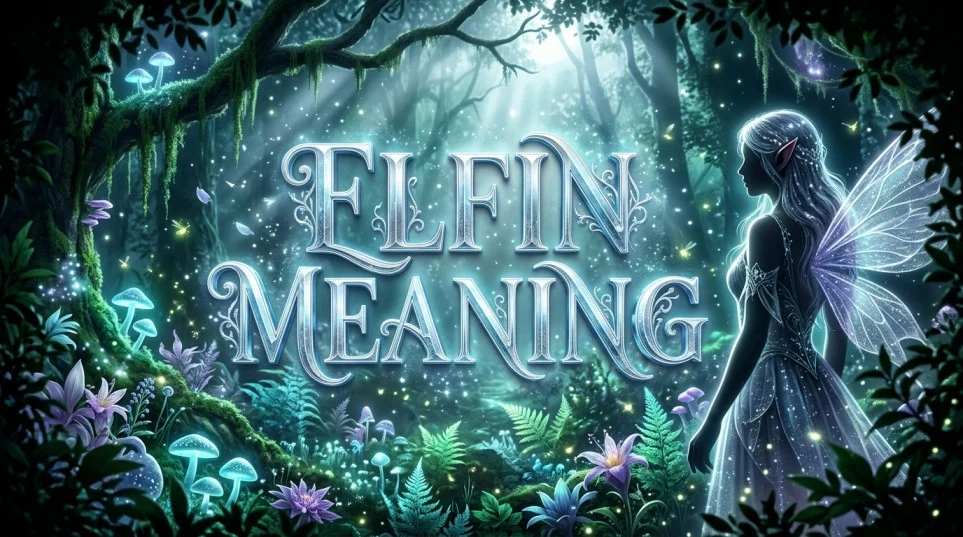
Some words bring a little magic into ordinary language, and elfin is one of them. The word elfin meaning describes something that resembles an elf, often suggesting a small, delicate, playful, or magical appearance. It can describe a person’s features, a mysterious character, or a fantasy setting filled with wonder. From literature and fairy tales to modern descriptions of beauty and personality, elfin adds a distinctive touch that ordinary adjectives cannot always capture. Understanding this word helps readers recognize its meaning, emotional tone, and the imagery it creates in different contexts.
The word elfin has strong connections to folklore, fantasy, and imaginative storytelling. Writers may use it to describe a face with delicate features, a mischievous expression, or an almost otherworldly charm. However, its meaning depends on context, and it does not always refer to a literal elf. This guide explores the definition of elfin, its origin, pronunciation, synonyms, practical examples, and everyday usage. You will learn how to understand the word accurately and use it naturally in writing and conversation.
What Does Elfin Mean?
The word elfin means resembling an elf, especially in appearance, size, or character. It often describes someone with small, delicate features, a youthful look, or a playful, magical quality. The word can also describe something that feels charming, whimsical, or connected to fantasy.
For example, in the sentence, “She had an elfin face and bright, curious eyes,” the word elfin creates an image of someone with delicate features and an almost fairy-like appearance.
The meaning of elfin depends on the context. In everyday descriptions, it often refers to someone’s appearance. In poetry, novels, and fantasy stories, it can suggest mystery, enchantment, or an otherworldly charm. It is usually an adjective, which means it describes a person, place, object, or quality.
Understanding this word can help you make descriptions more vivid without relying on ordinary words like small, pretty, or cute.
Elfin Definition and Pronunciation
Definition: Elfin is an adjective meaning elf-like or resembling an elf in appearance, character, or qualities.
Pronunciation: EL-fin
Part of speech: Adjective
Word origin: Related to elf, a figure from traditional folklore and fantasy.
The word has a literary, imaginative feel. It is less common in everyday conversation than words such as delicate or petite, but it can make writing more expressive.
Simple Meaning of Elfin
In simple English, elfin means looking or seeming like an elf.
Depending on the sentence, it may suggest:
- A small, delicate appearance.
- A youthful face with fine features.
- A playful or mischievous personality.
- A magical or fairy-like quality.
- A character that seems to belong in a fantasy story.
These meanings overlap, but they are not interchangeable in every situation. For example, a person can have an elfin face without having a mischievous personality.
What Does Elfin Mean When Describing a Person?
When used to describe a person, elfin usually creates an impression of delicacy, charm, or an unusual, almost magical appearance.
It can refer to facial features, body size, expressions, or a person’s overall presence.
Elfin Features Meaning
Elfin features are delicate, small, or elf-like facial features. The phrase may describe a narrow face, a small nose, pointed-looking ears, bright eyes, or other features that give someone a whimsical appearance.
Example: “His elfin features made him stand out in the family portrait.”
The phrase is subjective. It does not refer to a fixed set of facial measurements or a scientific category.
Elfin Face Meaning
An elfin face is a face that looks delicate, youthful, or reminiscent of an elf in fantasy art and literature.
Example: “The actress was known for her elfin face and expressive eyes.”
The description focuses on appearance, not age. An adult can have an elfin face, and the word does not necessarily mean that someone looks like a child.
Elfin Appearance Meaning
An elfin appearance suggests a combination of delicate features, lightness, and a slightly magical or unusual quality.
For example:
“Her short haircut and bright eyes gave her an elfin appearance.”
This description combines physical details with an impression created by the person’s overall look.
Elfin Personality Meaning
When elfin describes personality, it can suggest playfulness, lightheartedness, or mischievous charm.
Example: “His elfin sense of humor kept everyone guessing.”
Here, the word describes behavior rather than facial features. It suggests a playful, unpredictable quality, not necessarily childishness.
Elfin Meaning in Different Contexts
The word becomes easier to understand when you look at how writers use it in different situations.
| Context | Meaning | Example |
|---|---|---|
| Physical appearance | Small, delicate, or elf-like | She had an elfin face. |
| Facial features | Fine, youthful-looking features | His elfin features were distinctive. |
| Personality | Playful or mischievous | Her elfin humor brightened the room. |
| Fantasy | Resembling a mythical elf | An elfin warrior guarded the forest. |
| Poetry and literature | Magical, delicate, or otherworldly | An elfin figure appeared beneath the moonlight. |
| Art and fashion | A whimsical, delicate aesthetic | The costume created an elfin look. |
Notice that the word does not always mean physically small. In fantasy writing, an elfin character might be described as graceful, mysterious, or magical even when their size is never mentioned.
Elfin Examples in Sentences
These examples show how to use elfin naturally in different situations.
- Her elfin features gave her a distinctive appearance.
- The child had an elfin smile that seemed full of mischief.
- An elfin figure appeared between the ancient trees.
- His delicate nose and bright eyes created an elfin look.
- The novelist described the stranger as an elfin creature.
- She wore an elaborate costume that gave her an elfin appearance.
- His elfin charm made the character memorable.
- The painting showed an elfin girl standing beside a stream.
- Her elfin sense of humor made even ordinary conversations entertaining.
- Moonlight fell across the garden, creating an elfin atmosphere.
- The fantasy novel featured an elfin messenger with silver hair.
- His elfin face contrasted with his deep, serious voice.
Examples in Everyday Conversation
Although elfin is more common in descriptive writing than casual speech, it can still work in conversation.
Example 1
Person A: “How would you describe the character in the film?”
Person B: “She has an elfin appearance, with delicate features and a mysterious expression.”
Example 2
Person A: “What makes that character so memorable?”
Person B: “It’s her elfin charm. She is playful but also a little mysterious.”
Example 3
Person A: “What kind of style are you going for?”
Person B: “Something soft and whimsical, with an elfin touch.”
These examples show that the word can describe appearance, behavior, or an overall style.
Synonyms of Elfin
The best synonym depends on the meaning you want to express. Some words describe physical appearance, while others focus on fantasy, charm, or behavior.
| Synonym | Meaning | Best Use |
|---|---|---|
| Elflike | Resembling an elf | Direct replacement |
| Fairy-like | Resembling a fairy | Magical appearance |
| Pixie-like | Small, lively, or mischievous in a fairy-like way | Playful descriptions |
| Delicate | Fine, subtle, or fragile-looking | Facial features |
| Petite | Small and slender in build | Physical size |
| Dainty | Small and graceful | Features or movements |
| Whimsical | Imaginative, unusual, or playful | Style and atmosphere |
| Sprightly | Lively and energetic | Personality |
| Impish | Playfully mischievous | Expressions or behavior |
| Enchanting | Delightfully charming | Appearance or presence |
| Ethereal | Seemingly delicate or otherworldly | Poetic descriptions |
| Elf-like | Similar to an elf | Fantasy writing |
These words are related, but they are not perfect substitutes. Petite emphasizes size, impish emphasizes mischief, and ethereal emphasizes an otherworldly quality. Elfin can bring several of these impressions together.
Elfin vs. Elfish
The words elfin and elfish both relate to elves, but their usual associations can differ.
| Word | Common emphasis | Example |
|---|---|---|
| Elfin | Delicate appearance, charm, or a magical quality | She had an elfin face. |
| Elfish | Behavior or qualities associated with elves, sometimes mischievous | He gave an elfish grin. |
There is overlap between the words, and writers sometimes use them similarly. The distinction is a general tendency, not an absolute grammar rule.
Antonyms of Elfin
There is no single exact antonym for elfin. The opposite depends on the intended meaning.
| Related Opposite | Meaning | Example |
|---|---|---|
| Ordinary | Lacking unusual or magical qualities | His appearance was ordinary rather than elfin. |
| Mundane | Lacking fantasy or enchantment | The setting felt mundane, not magical. |
| Coarse | Lacking delicacy or refinement | The description emphasized coarse features. |
| Rugged | Having a rough, strong appearance | His rugged features contrasted with her elfin look. |
| Sturdy | Solidly built | The sturdy figure looked unlike the delicate elfin character. |
| Earthy | Natural and grounded rather than ethereal | The character had an earthy presence. |
These are contextual opposites, not strict dictionary antonyms. Choose one based on whether you mean appearance, personality, or magical atmosphere.
Elfin Meaning in Literature and Fantasy
In fantasy stories, elfin often helps establish a character’s connection to an imagined world. It can suggest grace, mystery, unusual beauty, or a playful nature without requiring a long physical description.
For example:
“An elfin traveler emerged from the mist, carrying a lantern that glowed blue.”
The word immediately gives the reader a fantasy-oriented impression. The lantern, mist, and traveler reinforce the atmosphere, while elfin hints at the character’s nature.
In poetry, the word can create a delicate or dreamlike mood. In children’s stories, it may describe a playful creature or a magical visitor. In modern fantasy, it can evoke traditional folklore without defining the character’s exact species.
One important distinction: elfin does not automatically mean an actual elf. A human character can have elfin features, and a landscape can have an elfin atmosphere. The word often communicates resemblance rather than literal identity.
Is Elfin a Compliment?
Yes, elfin can be a compliment, especially when it describes someone’s delicate features, distinctive appearance, or charming personality.
For example, “You have an elfin smile” may suggest that the person’s smile looks playful, bright, or enchanting.
However, the meaning depends on tone and context. Some people may appreciate the description, while others may find it unusual or unclear. If you are describing someone’s appearance in a professional or unfamiliar setting, a more direct compliment such as expressive eyes or a graceful smile may be easier to understand.
The word itself is not inherently insulting or romantic. It can sound poetic, affectionate, neutral, or fantastical depending on how it is used.
Common Mistakes When Using Elfin
A few simple distinctions can help you use the word accurately.
Assuming Elfin Always Means Short
The word can suggest smallness or delicacy, but it does not require a person to be short. It may describe facial features, an expression, or a magical quality.
Using Elfin as a Noun
Elfin is primarily an adjective.
Incorrect: “She is an elfin.”
Better: “She has an elfin appearance.”
In fantasy contexts, elf or elfin creature may be more appropriate when referring to a being.
Treating Elfin and Beautiful as Identical
The word can suggest attractiveness, but it does not simply mean beautiful. Its distinctive associations are elf-like delicacy, playfulness, or enchantment.
Confusing Elfin With Elfish
The two words overlap. Still, elfin often suits descriptions of appearance, while elfish can work well for mischievous expressions or behavior.
How to Use Elfin in Your Writing
Choose elfin when you want a description to feel more imaginative than ordinary words such as small or pretty.
- For character descriptions: Use it to suggest delicate features or an elf-like appearance.
- For fiction: Use it to introduce a mysterious, magical, or whimsical impression.
- For poetry: Use it to create a delicate, dreamlike mood.
- For personality: Use it when a playful or mischievous quality is genuinely intended.
- For everyday writing: Prefer clearer words if your audience may not know the term.
A useful writing technique is to pair elfin with a concrete detail. Instead of writing, “She looked elfin,” try, “Her bright eyes and delicate features gave her an elfin appearance.” The second sentence helps readers picture what you mean.
Frequently Asked Questions
What does elfin mean in simple words?
Elfin means resembling an elf. It often describes someone with delicate features, a youthful appearance, or a playful, magical quality.
What does elfin mean in a text message?
In a text message, elfin usually means elf-like, delicate, or whimsical. The exact meaning depends on the sentence and the person using it.
What does an elfin face look like?
An elfin face is often described as delicate, youthful-looking, or slightly magical. The description is subjective and does not refer to a fixed facial type.
Is elfin a positive word?
Usually, yes. It often suggests charm, delicacy, or playfulness. However, the intended meaning depends on the context and the recipient’s interpretation.
What is the difference between elfin and elf-like?
Elfin and elf-like have very similar meanings. Elfin is a compact adjective often used in literary descriptions, while elf-like makes the comparison more explicit.
What is the difference between elfin and elfish?
Both words relate to elves. Elfin often describes delicate or elf-like appearance, while elfish may emphasize mischievous or elf-associated behavior. Their meanings can overlap.
Is elfin the same as fairy-like?
Not exactly. Both can suggest magical qualities, but elfin relates specifically to elves, while fairy-like relates to fairies. Their associations can overlap in fantasy writing.
Can elfin describe a man’s appearance?
Yes. Elfin can describe anyone’s appearance, regardless of gender. For example, “He had an elfin face and bright, expressive eyes.”
Conclusion
The word elfin means resembling an elf in appearance, character, or qualities. It often describes delicate facial features, a playful personality, or a magical, whimsical impression. Its exact meaning changes with context, making it useful in fiction, poetry, character descriptions, and expressive everyday writing.
For the clearest description, pair elfin with details that explain the impression you want to create. This makes your writing more vivid while keeping the meaning easy to understand.
Read More Related Articles:
- Draconian Meaning | Definition, Examples, and the Dark Side …
- Charlatan Meaning | How to Spot a Fake Expert, Uncover …
- Ditto Meaning | Definition, Uses, Examples & the Hidden Story …

1 thought on “Elfin Meaning | Discover the Magical Charm, Fairy-Like Beauty, and Hidden World of Elfin in 2026”