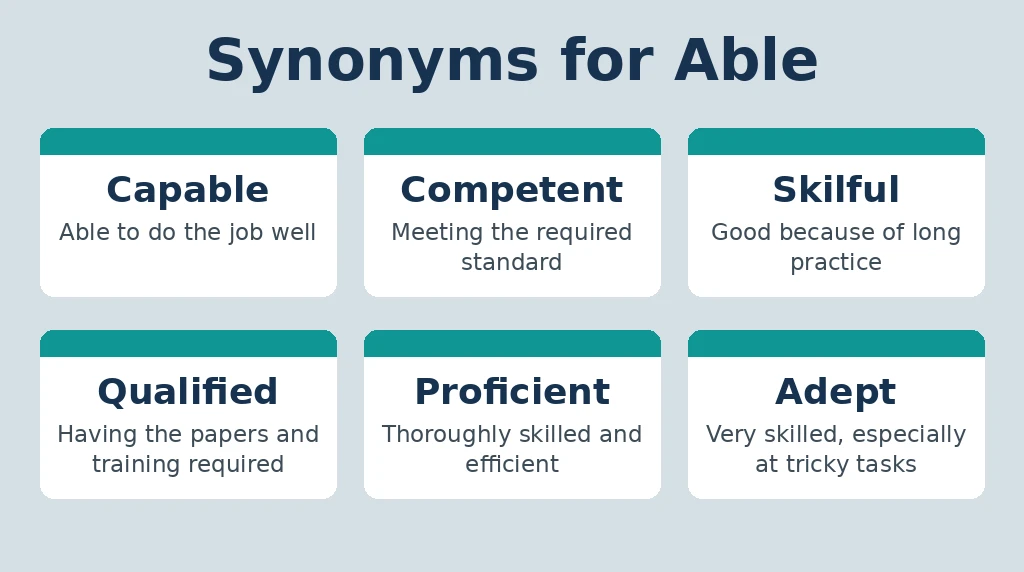
“We need someone able,” the manager says, and everyone in the room hears a slightly different job description. One person pictures a safe pair of hands. Another pictures a trained specialist. A third pictures the rare colleague who can turn to anything. The closest synonyms for able split along exactly those lines: capable for the one who can handle the work, competent for the one who meets the standard, skilful for the one whose practice shows, and gifted for the one who seems born to it.
This guide gathers the synonyms of able and sorts them by where the ability comes from: the core family of capability, skill built by practice, talent given by nature, quick minds, strong bodies, and the informal words workplaces actually use. Every word below sits in real thesaurus entries, with a plain meaning and an example for each, because able is praise that is easy to give in general and surprisingly hard to aim at one particular person in one particular sentence.
Top Synonyms for Able: Quick Reference
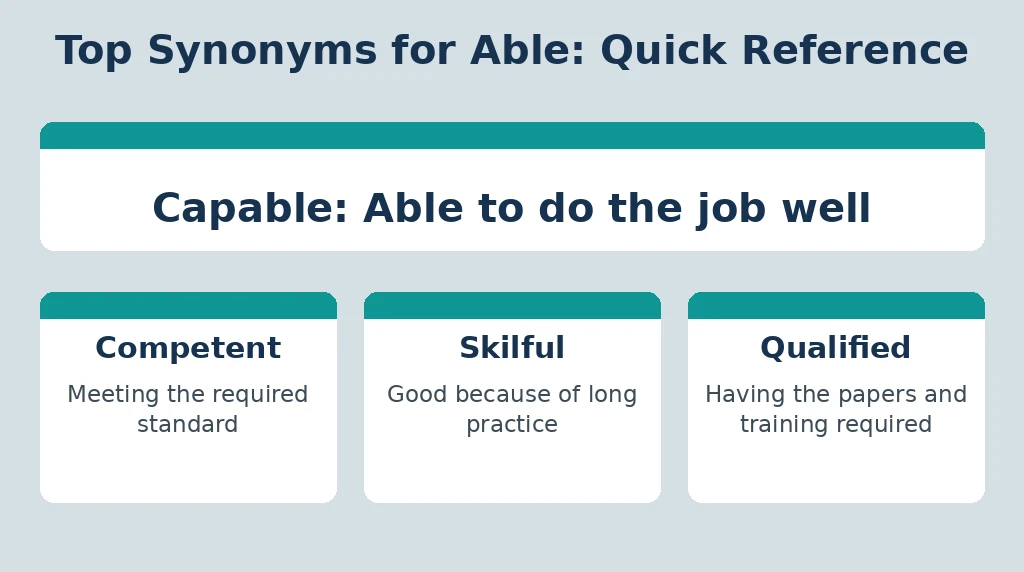
Start here for the shortlist. This table collects the able synonyms that cover most situations, and the sections after it sort the full list by the source and flavour of the ability.
| Word | Meaning in one line | Best for |
|---|---|---|
| Capable | Able to do the job well | General praise, references |
| Competent | Meeting the required standard | Professional and legal contexts |
| Skilful | Good because of long practice | Crafts, driving, surgery |
| Qualified | Having the papers and training required | Jobs, applications, experts |
| Proficient | Thoroughly skilled and efficient | Languages, instruments, systems |
| Adept | Very skilled, especially at tricky tasks | Negotiation, handling people |
| Skilled | Trained and experienced | Workers, trades, mechanics |
| Accomplished | Highly skilled and polished | Musicians, speakers, hosts |
| Gifted | Naturally talented beyond the usual | Children, artists, athletes |
| Talented | Having a natural skill | Performers, students, staff |
| Expert | Having deep skill and knowledge | Witnesses, users, marksmen |
| Fit | Suitable and able for a purpose | Fit to serve, fit to lead |
| Efficient | Able without wasting time or effort | Staff, systems, methods |
| Experienced | Able because of years doing it | Hiring, safety-critical work |
| Smart | Clever and quick to understand | Minds, students, operators |
| Strong | Physically able and powerful | Bodies, swimmers, labour |
| Deft | Skilful and quick in movement | Hands, repairs, cooking |
| Masterly | Showing the skill of a master | Performances, handling, writing |
| Versatile | Able to turn to many tasks | Staff, tools, players |
| Resourceful | Able to find a way around problems | Leaders, survivors, fixers |
| Seasoned | Made able by long experience | Travellers, campaigners, sailors |
| Suitable | Right and able for the role | Candidates, replacements |
| Consummate | Perfectly skilled, complete | Professionals, performers, liars |
| Top-notch | Informal: of the highest quality | Hires, teams, work |
| Able-bodied | Physically fit and able to work | Seamen, labour, official forms |
| Trained | Taught to be able | Staff, animals, voices |
What Does Able Mean?
Able carries two related meanings, and keeping them apart is the whole secret of this article. The first hides inside the phrase be able to, which simply means can: if you are able to swim, the skill, the strength and the chance are all present. The second stands alone as an adjective of praise. An able administrator is not merely permitted to administer but good at it, the sort of person a committee thanks in its report.
Merriam-Webster defines the standalone sense as having the required skills for an acceptable level of performance, which is why its closest neighbours are words like qualified and competent. Cambridge groups the family under good at doing something because of practice, which pulls in the skilled words instead. Both are right. Able sits exactly where permission, capacity and talent overlap, and different synonyms light up different corners of that ground.
The word arrived in English from Latin habilis, meaning easy to handle, by way of French, and the family resemblance to habit and habitat is no accident: all of them are about holding and having. It is a pleasing ancestry. Ability really is a kind of holding: of the tool, the subject or the room. Writers who feel that history under the word tend to use it steadily, which suits it, because able has never been a flashy performer in any century.
The Capable Core: Able to Do the Job
This family answers the basic hiring question: can this person be trusted with the work? Its words are the safest synonyms for able in professional English, neither glowing nor cold, and they run references, appraisals and committee minutes. Writing about colleagues rather than artists? Start here and you will rarely go wrong.
Inside the family there is a quiet ladder. Fit and suitable clear the lowest bar: right for the role. Competent certifies a standard. Capable promises more than the standard, a reserve of strength for the day the job gets bigger than its description.
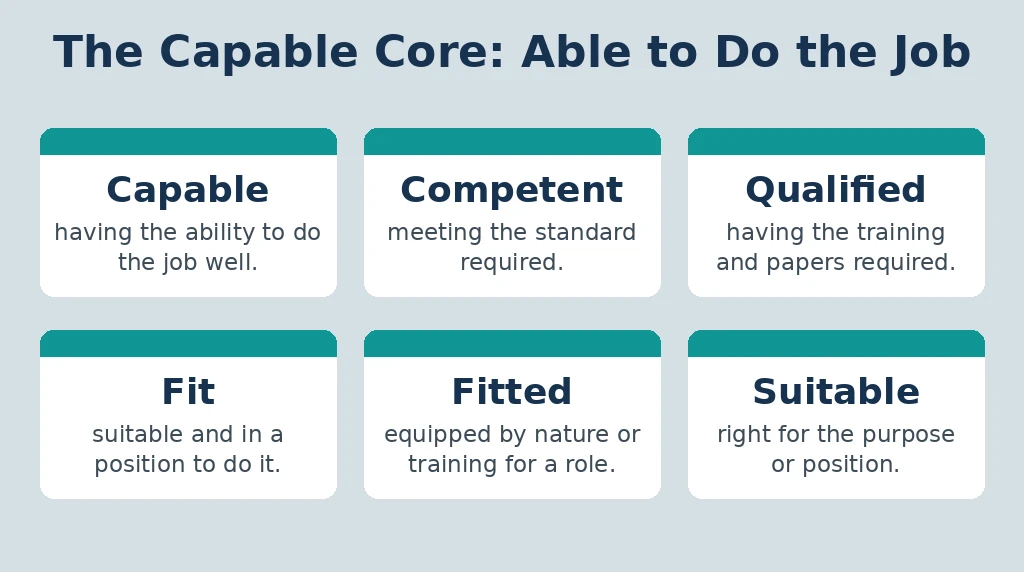
- Capable: having the ability to do the job well. A capable manager, she ran the branch alone for a month
- Competent: meeting the standard required. Every competent electrician checks twice before touching the board
- Qualified: having the training and papers required. A qualified diver led the inspection of the hull
- Fit: suitable and in a position to do it. Fit to plead, the defendant stood and answered clearly
- Fitted: equipped by nature or training for a role. Fitted by temperament for patient, unhurried work
- Suitable: right for the purpose or position. A suitable candidate will be appointed by Friday
- Efficient: able without wasting time, effort or money. An efficient clerk cleared the whole backlog by lunch
Consider the two sentences a headteacher might write about the same deputy. She is competent in post closes the file and invites no questions, including no impressed ones. She is capable of far more than the post demands opens a conversation about promotion. Nothing changed but the rung of the ladder, yet the second sentence will be quoted in the interview and the first will not. That is the practical weight these small words carry in professional life, and why they repay the attention this article gives them.
Skilled: Able Because of Practice
Cambridge builds its able family here, under the sign of practice: words for ability that was earned repetition by repetition. They suit crafts, instruments, languages and sports, anywhere the reader is meant to picture hours behind the performance. A skilful driver and a proficient pianist are able the way a path is smooth: something wore them into shape.
The family divides by what the practice produced. Some words praise the hands, deft and skilful. Some praise the record, experienced and seasoned. A few, like consummate and masterly, praise the finish, the sense that nothing is left to improve. Choosing among them is choosing which part of the story of practice you want the reader to see.
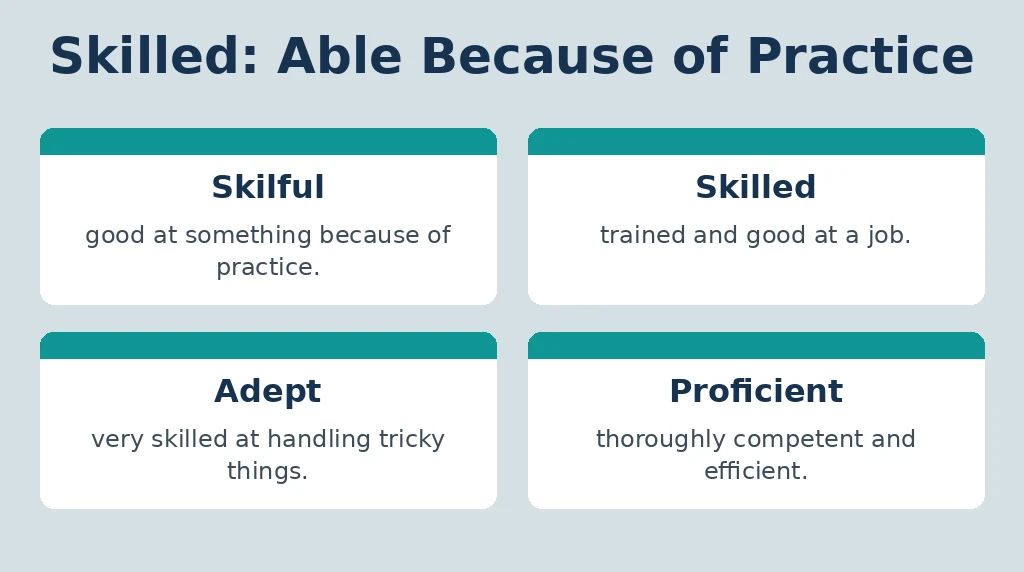
- Skilful: good at something because of practice. A skilful driver, unhurried even on icy roads
- Skilled: trained and good at a job. Skilled mechanics are booked solid for weeks
- Adept: very skilled at handling tricky things. Adept at calming angry customers without raising her voice
- Proficient: thoroughly competent and efficient. Proficient in three languages and passable in a fourth
- Masterly: showing the command of a master. A masterly handling of impossible negotiations
A second pattern hides in the list: the higher the word, the more it praises judgement rather than motion. Anyone can be trained into skilled hands, but masterly and consummate describe people who also know when not to act, which problems to refuse, and which corners are load-bearing. That is why these words gather around conductors, advocates and editors, professions where the visible work is a fraction of the ability being praised.
Talented: Able by Nature
Not all ability is earned. This small family credits nature instead of practice: the child who draws like a printmaker at six, the singer nobody taught. These words flatter more strongly than the skilled family, and they carry a risk. They can sound as if the achievement cost nothing, an implication hard workers are quick to resent.
- Gifted: having a great natural talent. A gifted musician by any standard you care to name
- Talented: having a natural skill for something. A talented young actor joined the company in March
- Natural: born with the ability, in phrases like a natural. A natural in front of the camera, bored by everything behind it
- Born: having the ability from birth, in phrases like a born leader. A born teacher, say her former pupils, decades later
- Brilliant: exceptionally clever or skilful. A brilliant surgeon with a waiting list to match
- Prodigious: having talent on an unusually large scale, formal. A prodigious memory for faces, names and birthdays
Use these words where the story really is about gift rather than grind: profiles of young performers, obituaries of the self-taught, the opening pages of novels. In a job reference they can backfire. A hiring manager may read talented as brilliant but untested, while the same manager reads proficient as a promise somebody has already kept.
There is a kindness argument for the earned words, too. Tell a student she is gifted and you give her an identity to defend. Tell her she is becoming proficient and you give her a road to walk. Coaches at the highest level mix the two deliberately: gift for confidence in the tunnel, practice for the training plan on Monday. Writers describing ability can borrow the same diplomacy.
Able Minds: Smart, Sharp and Quick to Understand
Ability is not only in the hands. A whole branch of the family praises the mind that grasps, decides and answers: the able debater, the able analyst, the student teachers describe as the ablest in the year. A smart operator and an able one overlap here, and the words below grade mental ability from sharpness to depth.
- Smart: clever, quick and able in mind. A smart lawyer spotted the clause everyone else skimmed
- Sharp: quick and keen in understanding. A sharp mind for figures and a sharper one for excuses
- Bright: intelligent and full of promise. The brightest pupil in the school, and the least boastful
- Keen: sharp and penetrating in judgement. A keen observer of office politics
- Clever: quick to learn and invent. A clever mechanic can fix most things with string and wire
- Intelligent: having a high ability to reason. An intelligent response to a crisis nobody had rehearsed
- Astute: clever at reading situations and motives. An astute judge of character, slow to be fooled twice
The shadings are social as much as intellectual. Bright belongs to the young and promising, astute to the experienced and slightly formidable, and clever, in British mouths, can carry a whisper of suspicion, as if the ability might be used for mischief. Able itself remains the most neutral word in the family, which is precisely its value in formal prose.
Examiners have a favourite in this family: the able mind is the one they set harder questions for. School reports across the English-speaking world use able almost as a technical term for the top band of pupils, and universities recruit the ablest school-leavers in a phrase that has barely changed in a century. If your context is education, this is the family to write in, and bright is its friendliest member.
Able Bodies: Strong, Sturdy and Able-Bodied
The oldest sense of able is physical: a body that can work, march, lift and endure. It survives in the compound able-bodied, long the language of navies and workhouses, and in plainer words for strength and health. Where the job is done by muscle, a strong back may matter more than a trained mind, and these are its words.
- Able-bodied: physically fit and able to work. Every able-bodied sailor to the pumps, at once
- Strong: having physical power and endurance. Strong swimmers only beyond this point, says the sign
- Sturdy: strongly and solidly built. A sturdy farmhand of sixty, still first to the field
- Robust: strong and healthy, unlikely to break down. Robust health carried him through the winter
- Hale: strong and healthy, especially in old age, in hale and hearty. Hale at ninety, he still gardens every day
- Hearty: strong, healthy and vigorous, old-fashioned. A hearty appetite after the climb, and a heartier laugh
Sports pages keep the physical family in daily training: sturdy full-backs, vigorous pressing, veterans described as hale well into unlikely ages. The words survive there because physical ability is the one kind a crowd can verify with its own eyes, and the vocabulary of the body tends to stay honest long after the vocabulary of the office has inflated.
Informal and Workplace Words for Able
Off the record, English praises ability in slangier colours. These are the words of team meetings, site cabins and sports pages, and several of them began as judgements of things, cards, cars and lunches, before wandering over to people. They are warm, quick and entirely unsuited to a tribunal.
- Top-notch: of the very best quality, informal. A top-notch hire for the design team
- First-rate: excellent, of the highest class. A first-rate mind wasted on filing
- Ace: excellent, as a person or at a task, informal. An ace mechanic with old engines and older jokes
- Crack: expert and first-class, in phrases like a crack shot. A crack shot with a rifle, calm as you like
- Handy: useful and skilful with practical things. Handy with a needle and thread, and with a deadline
- Resourceful: good at finding ways around problems. A resourceful cook can feed six from an empty kitchen
- Versatile: able to do many different things well. A versatile actor, at home on stage and screen
- All-round: able in many areas, British. An all-round sportsman at school, and a modest one
Two of these deserve a special nod. Versatile has become the great compliment of modern job advertisements, sometimes honestly and sometimes as a request for three employees in one coat. And resourceful is the word rescuers earn: it praises not what a person can do in the workshop, but what they invent at midnight when the workshop is locked.
Notice, finally, how many of these began life judging things rather than people: a crack regiment, an ace pilot borrowed from cards and combat, a first-rate hotel. English loves grading, and its grades keep escaping the classroom. Used about a colleague, they signal that the speaker is off duty and sincere, which is sometimes the most credible praise of all.
How to Choose the Right Synonym for Able
Ask first where the ability lives. In the hands and the training record, choose from the skilled family. The blood, from the talented family. In the head, from the minds. In the body, from the physical words, carefully. If none of those is the point and you simply mean the person can be trusted with the task, the capable core is your home, and capable itself is rarely the wrong answer.
Then ask how much praise the occasion allows. References and reports run on a rationing system in which competent is the minimum wage and consummate is a bonus nobody believes. Match the word to evidence you could produce if challenged. Courts, examiners and editors all respect qualified because it points to something checkable, and they all discount brilliant when it arrives without exhibits.
Do not confuse able with its neighbour ready. Ready means prepared and willing at this moment; able means having the skill and power at any moment. The firefighter at the station door is both. The retired chief watching on television may be able but is not ready. The keen volunteer with no training is ready but not yet able. Keeping the pair apart is one of the smallest and most useful acts of precision available to a writer.
Three rehearsals make the system stick. The surgeon with twenty years of lists behind her is seasoned and proficient, and the hospital that calls her merely competent will hear about it. The teenager who fixes the school network is gifted and smart, but not yet experienced, and a wise reference says both halves. The veteran goalkeeper, slower now but never beaten the same way twice, is standing proof that ability changes address as a career lengthens: from the body, to the mind, to the record.
Synonyms for Able in Essays, Stories and Professional Writing
Professional writing is where able earns its keep. The word is the workhorse of references, citations and commendations precisely because it praises without gushing: universities appoint able lecturers, regiments follow able commanders, prizes cite able service. In that register, upgrades should be small and earned: capable for breadth, accomplished for polish, seasoned for years, each one a half-step rather than a leap.
In stories, ability is better shown than certified, and the synonyms help a narrator grade what a scene has proved. Introduce the new engineer as competent in chapter one, let her be deft in the flood scene and resourceful by the climax, and the reader has watched ability grow without a single speech about it. Dialogue can borrow the informal family for the same purpose, since people praise each other as ace and top-notch far more often than as proficient.
Students and ESL writers should note the collocations, because able travels with set partners: able to for the can sense, ably as its adverb in formal phrases like ably assisted, and the comparative pair abler, ablest in formal prose. Examiners reward the writer who can say one of the ablest advocates of her generation without flinching, and punish, gently, the one who writes more able in a formal essay where the older form was wanted.
Essay writers can steal one more trick from the professionals: pair the adjective with its evidence in the same sentence. An able negotiator is a claim. An able negotiator who had settled the dock dispute in a weekend is a portrait. The synonym does the grading, the clause does the proving, and the reader trusts the grade precisely because the proof is attached to it.
Antonyms for Able
The opposites of able deny the same three things the word grants: skill, power, and fitness for the task.
- Unable: not having the skill, power or chance. Unable to swim, he stayed aboard and minded the bags
- Incapable: not able, or not capable of doing it well. Incapable of lying convincingly, she blushed at the first question
- Incompetent: failing to meet the standard. An incompetent repair caused the leak it was meant to fix
- Unqualified: lacking the required training or papers. Unqualified staff must not operate it, insured or not
- Unskilled: without training or skill. Unskilled labour built the road, and it shows in wet weather
- Inept: clumsy and without skill. An inept attempt at an apology made things worse
- Inexperienced: lacking practice and knowledge from doing. Inexperienced drivers should fear winter traffic, politely
- Untrained: never taught or drilled. An untrained dog at a funeral is a story waiting to happen
- Unfit: not suitable or not in condition. Unfit to stand trial, the court heard, and adjourned
One member of this list behaves differently from the rest: helpless and powerless describe situations more than skills, and they attract sympathy where incompetent attracts blame. A manager powerless to stop a closure is a figure in a tragedy; a manager incompetent to run one is a figure in a report. Choosing between them is choosing the genre of the story you are telling.
Common Mistakes: Words That Are Not True Synonyms for Able
Able-bodied appears in this article inside its own physical family, and it earns a second visit here. Used carelessly, it suggests nothing more than a working body; used as a general synonym for able, it erases skill, training and mind in one stroke. A surgeon is not praised as able-bodied, and a labourer is not only a body. Keep the word for the contexts that ask about bodies, and leave the rest of the person to the rest of the list.
Apt is the slipperiest neighbour. In an apt pupil it does mean quick to learn, and dictionaries honour that sense; but in most modern sentences apt means likely or inclined, as in apt to forget, or exactly suitable, as in an apt remark. A reader who meets an apt administrator will not know whether she is skilled or merely prone to administrate, and a synonym that needs a footnote has failed at its job.
Able seaman is a rank, not a review. On ships, and in the paperwork of navies and merchant fleets, the phrase names a grade of trained sailor, senior to the ordinary seaman, and every holder of the grade carries it whether gifted or merely adequate. Quoting it as evidence that a sailor was especially able is a small historical error that nautical readers will spot at once, and a good reminder that fixed phrases retire from the synonym market.
Frequently Asked Questions
What is the best synonym for able?
Capable is the safest all-purpose synonym, since it covers skill, strength and opportunity at once. Competent certifies a standard, qualified points to training, and skilful or adept praise the practised hand. Choose by which part of the ability you most want the reader to see, and by how much praise the occasion can honestly carry.
What is the difference between able and capable?
The two overlap almost completely, and in the phrases be able to and be capable of they are interchangeable for most purposes. Able as a standalone adjective praises a person directly, an able lawyer, while capable more often appears with of and a task, capable of running the case alone.
What is a formal word for able?
Qualified, competent and proficient are the formal working words, with accomplished and consummate for higher praise in citations. Seasoned suits experience, versed suits knowledge of a field, and ably is the matching formal adverb in phrases like ably assisted.
Does able mean the same as can?
In the phrase be able to, yes: will you be able to come is a politer, more future-friendly version of can you come. Standing alone as an adjective, though, able means something can does not: having real skill, as in an able seaman or an able administrator.
Is competent a compliment?
A careful one. Competent certifies that someone meets the standard, and in some workplaces it is the faintest praise available, one rung below capable. If you mean to praise warmly, climb to capable, adept or accomplished. If you mean only to certify, competent is exactly honest.
Final Thoughts
Able looks like a modest word, and modesty is its disguise. Inside it live the examiner and the talent scout, the surgeon and the sailor: capable hands, seasoned judgement, a gifted ear, a sturdy back. Sorting its synonyms by where the ability comes from turns a routine compliment into a diagnosis, and a writer who can say precisely how someone is able has learned to praise like a professional, which is to say, with evidence in every adjective.
If this article leaves you with one habit, let it be the follow-up question. Whenever you write able, or any of its cousins, ask able at what, on what evidence, in whose judgement, and let the answer pick the word. The families above are organised to make that question easy: practice, nature, mind, body and trust each keep their own shelf, and the right synonym is simply the one that lives where your evidence lives.
For the complete reference, with every related word, phrase and example gathered in one place, the Merriam-Webster Thesaurus entry for able is well worth your time. Read it with this guide open beside you, and the next reference, report or story you write will land its praise exactly where it was aimed, and at exactly the strength it deserved.

1 thought on “Synonyms for Able | 55+ Words for Skill, Competence and Being Up to the Job”