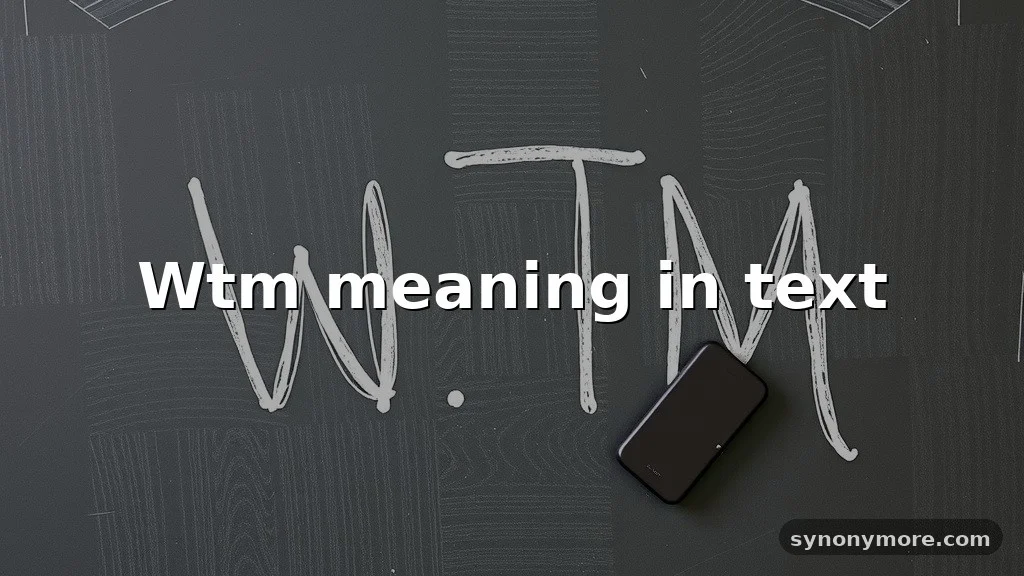
Have you ever opened a text message from a friend or a notification on your phone and seen the letters WTM? If you felt a little confused, you are not alone. Language is always changing, especially when we communicate through screens.
Whether you are scrolling through TikTok, checking Snapchat, or just chatting with friends, you have likely encountered this short abbreviation. It is a common part of digital life, but it can be tricky if you do not know the context.
If you are someone who values staying up to date with modern slang, or if you just want to avoid awkward misunderstandings in your daily chats, this guide is for you. We will break down exactly what this term stands for, how to use it, and how to handle it when someone sends it your way.
Understanding the Definition and Meaning of WTM
At its simplest level, the abbreviation WTM stands for what is the move. It is a casual way to ask someone about their plans or to suggest that it is time to make a decision.
When a person uses this, they are usually looking for information about what you are doing, what you want to do, or what the plan is for the evening or the weekend. Think of it as a shorthand for asking, what are we doing today or what is the plan for us?
The term is incredibly versatile. It can be used to initiate a hangout, to check in on a friend, or to see if there is an event happening that you should be aware of.
Because texting requires speed and efficiency, people prefer to use these three letters instead of typing out a full sentence. It keeps the conversation flowing without feeling too formal or demanding.
For example, if your friend sends you a message that says, WTM tonight?, they are essentially asking you what your plans are and if you want to get together. You might reply by saying, I am just hanging out at home, or you might suggest something specific like, I was thinking we could go grab some food. It is a low-pressure way to start a conversation about social activities.
The beauty of the term is that it puts the ball in the other person’s court to decide what happens next. It is a cornerstone of modern digital social navigation.
Background and History of the Term
The evolution of internet slang is a fascinating look at how we adapt to technology. As texting became the primary mode of communication, the need for brevity grew. People wanted to convey complex ideas or questions in as few characters as possible to save time.
This is how many common abbreviations, including WTM, were born. While there is no single inventor of the phrase, it originated in urban and youth culture where social plans are often fluid and spontaneous.
Over the last decade, as social media platforms like Twitter, Instagram, and Snapchat gained popularity, these types of abbreviations moved from private text threads into the public sphere. You might see someone post a status update that simply says, WTM? to their followers to see if anyone is free to go out or attend an event. This shift changed the term from a direct question to a more general inquiry.
The term has also been influenced by music, gaming, and urban slang, which often prioritize efficiency and a specific rhythm of speech. As these communities grew online, the language they used became the standard for younger generations. Today, it is widely recognized across many platforms.
It has evolved from a niche piece of slang into a standard part of the digital lexicon. It is no longer just for teenagers; many adults now use it as a standard way to check in on friends or coordinate casual meetings. It is a perfect example of how language adapts to the tools we use for communication.
Usage in Various Contexts and Dialogue
You will find this term in almost every corner of the digital world. It is most common in casual texting, but it is also very frequent on social media platforms like Snapchat and Instagram.
In a gaming environment, you might see it in a chat box when players are trying to decide which mission to tackle next. Because the term is so brief, it fits perfectly into the fast-paced nature of these interactions.
Let’s look at some examples of how it works in real-life dialogue.
Scenario 1: Texting a friend about the weekend.
Friend A: Hey, are you free on Friday?
Friend B: Yeah, I am free. WTM?
Friend A: Let’s go see that new movie at the cinema.
Scenario 2: Checking in on a group chat.
Person A: Is everyone still meeting at the park?
Person B: Not sure, WTM for the group?
Person C: Let’s move the time to later so more people can join.
Scenario 3: Casual social media comment.
You post a photo of a cool new restaurant. A friend comments: That looks good! WTM?
You reply: We should go there this Saturday!
The term acts as a bridge
As you can see, the term acts as a bridge to get to the point. It is useful because it avoids being too specific until you know if the other person is actually interested in making plans. It is a very natural way to test the waters before committing to a specific activity or time.
Common Misconceptions and Clarifications
Because slang is often context-dependent, there are times when WTM might be misunderstood. One common misconception is that the term is always a request for a hangout. While it is usually about plans, it can sometimes be used in a more abstract way.
For instance, if someone is frustrated by a situation, they might say, WTM, implying that they do not know what the next step should be or what the goal is. It is essentially saying, what is the play here?
Another confusion arises if the recipient is not familiar with the abbreviation. If you send it to someone who is not tech-savvy or who does not use social media, they might be confused.
It is always best to use this with friends or acquaintances who are likely to understand the shorthand. If you are in doubt about whether the other person knows what it means, it is better to type out the full question.
It is also important to note that while it is casual, it is not inherently rude. Some people might think that using abbreviations is a sign of laziness, but in the context of digital communication, it is usually just a way to match the speed of the conversation.
As noted by the Merriam-Webster dictionary, slang is a natural part of language growth. Understanding the nuance is key to using it effectively without causing any offense or confusion.
Similar Terms and Alternatives
There are many ways to ask about plans, and depending on your relationship with the person, you might choose a different phrase. If you want to be a bit more formal or if you want to be clearer, you have several options.
* What are the plans? (Clear and direct)
* What is the move? (The full version of WTM)
* What are you up to? (A broader check-in)
* Are you doing anything? (Soft and polite)
* What is the vibe? (Focuses on the atmosphere of an event)
Comparing these terms is helpful for choosing the right one for the situation. If you are talking to a boss or a professor, you should avoid WTM and use something like, What is the plan for the meeting?
If you are talking to a close friend, WTM is perfectly acceptable. Here is a simple breakdown of how these compare in terms of formality:
| Term | Formality Level | Best Used For |
|---|---|---|
| WTM | Very Casual | Close friends, texting |
| What is the move? | Casual | Peers, social settings |
| What are the plans? | Neutral | Anyone you know well |
| What is the agenda? | Professional | Work meetings |
Using the right term ensures that your message is received exactly as you intended. While WTM is great for quick chats, it is not a one-size-fits-all solution for every conversation you will ever have.
How to Respond to This Term
When someone asks you WTM, you have several ways to respond based on your current mood or your relationship with the person. You can keep it simple, be funny, or even keep your plans private if you aren’t ready to share.
If you are open to plans, you can provide a direct answer. For example, if you want to hang out, say: I was thinking of going to the park.
What do you think? Or, I am down for whatever, what do you have in mind?
If you are busy, it is okay to be honest. You can say: I have a lot of work to finish tonight, so I am staying in.
Maybe another time? This is polite and clear, which prevents any lingering confusion.
If you want to be funny, you can play with the ambiguity of the term. You might reply: WTM? I am currently attempting to survive the day.
How about you? This adds a bit of humor to the exchange.
If you value your privacy and don’t want to disclose your plans, you can deflect the question gently. A simple: Just taking it easy tonight, how about you? works well.
It shifts the focus back to the other person without you having to reveal too much about your own schedule. The goal is to keep the conversation comfortable for everyone involved.
Regional and Cultural Differences
While WTM is widely understood in English-speaking countries, its usage can vary slightly depending on the region. In some urban centers, it is a very common part of daily vernacular. In other, more rural areas, it might be less common, and people might prefer to use full sentences.
It is also worth noting that slang often crosses borders through the internet. Because of global social media platforms, a term that starts in a city like New York or London can quickly reach users in Australia, Canada, or even non-English speaking countries where English is used as a second language.
However, cultural context still matters. In some cultures, being too direct or using slang can be seen as informal or even disrespectful if the age gap between the speakers is large. Always consider who you are talking to before relying on abbreviations.
If you find yourself in a new social circle, it is a good idea to observe how others communicate for a few days before jumping in with your own slang. You will quickly learn whether WTM is the standard way to make plans or if people prefer a different approach.
Usage in Online Communities and Dating Apps
On dating apps like Tinder or Bumble, WTM is a common way to break the ice. After the initial match, someone might send a message like, Hey, WTM for the weekend?
It is a low-stakes way to move the conversation from the app to real-life interaction. If you are on a dating app, responding to this is a great way to show that you are interested in moving things forward.
In gaming communities, the term is used to coordinate team efforts. If your team is deciding which map to play or which strategy to use, WTM is a quick way to get a consensus. It keeps the game moving without forcing players to type out long sentences while they are trying to focus on their gameplay.
On platforms like Twitter or TikTok, you might see it in the comments section. People use it to engage with creators or to see if others are planning to attend the same events. It is a way to build a sense of community.
When responding on these platforms, keep it light and friendly. If you are not interested in the plans, you can just ignore the question or give a polite, vague response.
Hidden or Offensive Meanings
Generally, WTM is a harmless abbreviation. It does not have any offensive or hidden meanings that you need to worry about in most contexts. However, as with all language, tone is everything.
If someone uses the term in a way that sounds demanding or aggressive, it can be annoying. For example, if someone keeps asking WTM over and over again when you have already told them you are busy, it can feel like harassment.
Context is also key. If you are in a serious or somber conversation, using casual slang like WTM might come across as insensitive or dismissive. Always gauge the mood of the conversation before you use slang.
If you are talking about something important, it is better to use clear, full sentences. This shows that you are taking the conversation seriously and that you respect the other person’s time and feelings.
Suitability for Professional Communication
Is WTM appropriate for work? In most professional settings, the answer is no.
While some modern workplaces are very casual, it is generally safer to stick to professional language. Using abbreviations can make you seem less serious or less professional, especially if you are communicating with clients, supervisors, or people you do not know well.
If you are in a Slack channel or a group chat with coworkers, you might see people using it occasionally, but it is still better to err on the side of caution. Instead of saying, WTM for the meeting?, try saying, What is the goal for our meeting today? It sounds more polished and shows that you are focused on the work at hand.
If you want to be professional but still keep things efficient, you can use phrases like, What is the next step? or How should we proceed? These are clear, concise, and perfectly acceptable in any office environment. They get the job done without risking the professional image you have worked so hard to build.
Frequently Asked Questions
1. Can WTM be used in a professional email?
It is not recommended.
Professional emails should maintain a level of formality, and abbreviations like WTM can be seen as too casual. Stick to full sentences.
2. Is WTM only used by young people?
While it started in youth and urban culture, it is now used by people of many different ages who are active on social media and use messaging apps regularly.
3. Does WTM always mean the same thing?
Almost always, yes.
It stands for what is the move, implying a request for plans or actions. The only difference is the tone or the context in which it is used.
4. How should I reply if I don’t want to make plans?
You can be polite and honest. Say something like, I have other plans, but thanks for checking in, or I am just relaxing tonight.
5. Is WTM offensive?
No, it is not offensive.
It is a standard piece of digital slang. However, it can be annoying if used repeatedly or in an inappropriate context.
6. Can I use WTM on LinkedIn?
No, you should avoid using it on LinkedIn. LinkedIn is a professional networking site, and your communication there should be formal and clear.
7. What if I don’t know what the move means?
If someone says WTM and you are confused, you can always ask them to clarify. A simple, Sorry, what does that mean? is perfectly fine.
Conclusion
Navigating digital communication can feel like learning a new language. Abbreviations like WTM are just one small part of that, but they play a big role in how we connect with others. By understanding what the term means and how to use it, you can make your social interactions smoother and more efficient.
Remember that context is everything. Use it with friends when you want to make quick plans, but keep it out of your professional emails. When in doubt, it is always better to be clear and direct.
Understanding these small pieces of slang helps you stay connected in a fast-paced world, ensuring that you are never left wondering what someone meant when they hit send. Whether you are texting a friend about dinner or checking in with a group on social media, you now have the tools to handle this common abbreviation with total confidence.
Discover More Post:
- What Does OFC Mean in Text and Social Media?
- GTG Meaning in Text | What It Really Means, When to Use It …
- FFS Meaning Explained: Understanding the Popular Initialism







5 thoughts on “WTM Meaning in Text | What This Popular Slang Really Means & How to Use It in 2026”