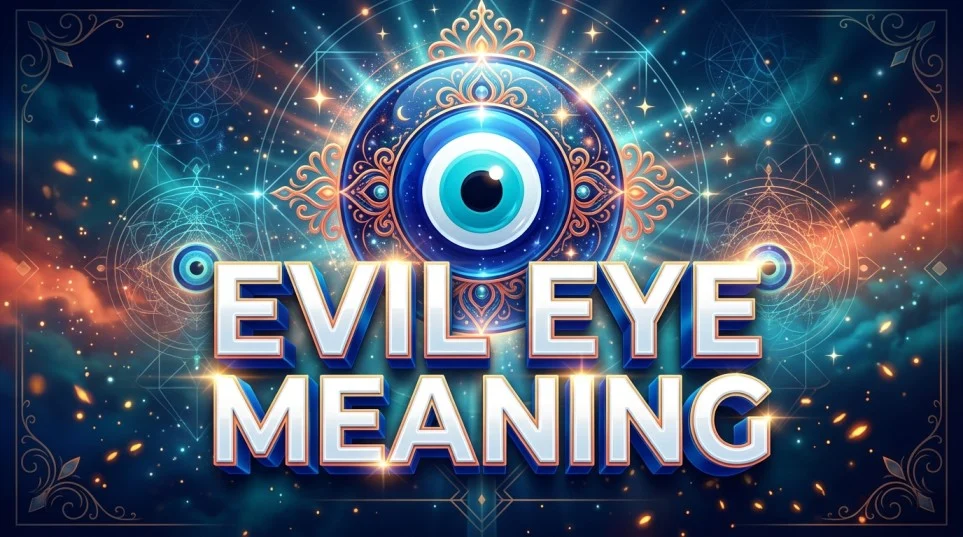
A blue eye-shaped bracelet, a small charm hanging near a doorway, or a symbol displayed in a car often represents more than decoration. For many people, it carries a story about envy, protection, and the desire to keep misfortune away. This familiar symbol is known as the evil eye, and its meaning reaches across several cultures and generations.
The evil eye meaning refers to a traditional belief that an envious or harmful gaze can bring misfortune to another person. The same term also describes the eye-shaped amulet that many people wear or display as a protective symbol. Its meaning varies across religious traditions, cultural practices, and personal beliefs. Some people consider it a spiritual reminder, others value it as cultural jewelry, and some simply appreciate its distinctive design. Understanding these differences reveals why the evil eye remains recognizable around the world.
What Does the Evil Eye Mean?
The evil eye is a cultural and spiritual belief that a person can cause harm, bad luck, or misfortune through a gaze associated with envy, jealousy, or excessive admiration.
In traditions that recognize this belief, harm may be thought to affect a person’s health, relationships, family, possessions, or success. The person believed to cast the evil eye does not always intend to cause harm. In some traditions, even unintentional envy or admiration is considered significant.
The term has two closely related meanings:
- The belief: The idea that an envious or harmful gaze can bring misfortune.
- The symbol: An eye-shaped charm or amulet that people use as a traditional form of protection against the perceived evil eye.
For example, a family might hang a blue eye bead near the entrance of a home because they believe it helps protect the household. Another person might wear an evil eye necklace because it represents cultural heritage or personal spirituality.
These examples show how the same symbol can carry different meanings for different people.
It is important to distinguish cultural belief from established fact. The idea that a gaze can cause supernatural harm has not been scientifically established.
Evil Eye Meaning in Simple Words
In simple English, the evil eye is the belief that someone’s jealousy or envious gaze can bring bad luck or harm to another person.
The protective eye symbol represents the traditional response to that concern. People may wear it, carry it, or display it in their homes.
Consider this example:
Your friend buys a new car, and someone gives it an unusually jealous look. In a culture where the evil eye is part of traditional belief, the owner might worry that the attention could bring misfortune. They may wear a protective charm or follow a familiar cultural practice for reassurance.
This example illustrates the belief, not proof that the gaze causes harm.
The easiest way to remember the meaning: the evil eye is associated with envy and perceived harm, while the eye-shaped charm is commonly associated with protection.
Evil Eye Symbol Meaning
The evil eye symbol usually appears as a series of circles resembling an eye. A popular version has a dark blue outer ring, a lighter blue circle, a white ring, and a dark center.
This design is especially associated with the Turkish nazar boncuğu, a traditional eye bead. Similar protective objects appear in different forms across the Mediterranean, the Middle East, and other regions. Museum collections document the use of eye-shaped amulets as objects intended to ward off perceived harm.
The symbol commonly represents three ideas.
Protection Against Envy
Many people use the evil eye as a protective charm against jealousy or harmful attention. The belief is that the charm can deflect, absorb, or guard against the perceived threat.
Awareness of Negative Intentions
For some wearers, the symbol serves as a reminder to protect their peace, maintain personal boundaries, and be mindful of the people and situations around them.
This is a personal interpretation rather than a universal traditional meaning.
Cultural Identity and Heritage
The evil eye is also a recognizable part of cultural jewelry and decorative art. Someone may wear it because it connects them to family traditions, a place they have visited, or a meaningful personal memory.
Not everyone who wears an evil eye charm believes in its supernatural properties.
Evil Eye History and Origins
The evil eye belief has a long history, with examples documented across ancient and modern societies. It cannot be attributed to one single modern culture or religious tradition.
Historical accounts describe concerns about envy, harmful gazes, and protective objects in ancient Mediterranean and West Asian societies. Archaeological collections also contain eye-shaped beads and other objects interpreted as possible protective charms. The exact meaning of an individual object may remain uncertain.
Over time, the belief developed different expressions across regions.
Ancient Mediterranean and West Asian Traditions
People in ancient societies used amulets and symbolic objects to protect themselves, their children, animals, and possessions from perceived misfortune. Eye-shaped designs became one recognizable form of protection.
Turkish and Greek Traditions
The blue eye bead is especially associated with Turkey, where it is known as the nazar boncuğu. Related beliefs are also found in Greek culture, where the evil eye is commonly called mati.
These traditions have their own customs and interpretations, even when their symbols look similar.
Middle Eastern and South Asian Traditions
Beliefs associated with the evil eye also appear in Middle Eastern and South Asian communities. The Arabic term al-ayn is associated with the evil eye in Islamic contexts, while nazar is widely used in South Asian everyday language to refer to the evil eye or its perceived effects.
Practices differ between families, communities, and religious interpretations. A shared term or symbol does not mean that everyone understands it in exactly the same way.
Blue Evil Eye Meaning
The blue evil eye is one of the most recognizable versions of the symbol. Its blue-and-white design is particularly associated with traditional Turkish eye beads.
For many people, blue represents protection within the tradition surrounding the charm. The eye-like design is commonly understood as a way to guard against or deflect envy.
However, there is no single universal meaning for every shade of blue. Interpretations of colors often come from modern jewelry traditions, personal preferences, and individual spiritual beliefs.
Here is a practical guide to commonly marketed color interpretations.
| Evil Eye Color | Common Modern Interpretation |
|---|---|
| Blue | Protection, peace, and good fortune |
| Light blue | Calmness, clarity, and tranquility |
| Dark blue | Security, stability, and protection |
| White | Purity, peace, and fresh beginnings |
| Green | Growth, hope, and personal development |
| Red | Courage, strength, and passion |
| Black | Strength, resilience, and protection |
| Pink | Love, kindness, and emotional harmony |
| Purple | Wisdom, creativity, and spiritual awareness |
Important: These color meanings are not universal historical rules. They are common contemporary interpretations, particularly in jewelry and spiritual lifestyle content. The traditional meaning of a particular charm depends on its cultural context.
Evil Eye Bracelet Meaning
An evil eye bracelet is a piece of jewelry featuring an eye-shaped bead, charm, or decorative design. Many people wear it because they associate the symbol with protection against envy and misfortune.
Its meaning can be personal as well as cultural.
- Traditional protection: The wearer believes the charm helps guard against the evil eye.
- Personal reassurance: The bracelet serves as a reminder to feel grounded and confident.
- Cultural connection: It represents a family tradition or connection to a community.
- Fashion: The wearer likes the color, shape, or design without necessarily believing in its protective power.
For example, someone might wear a blue evil eye bracelet when starting a new job. They may see it as a symbol of confidence and protection during a period of change.
There is no universally required wrist for wearing an evil eye bracelet. Advice about left or right wrists often comes from modern spiritual interpretations, personal practices, or particular traditions rather than one rule shared across all cultures.
Evil Eye Necklace Meaning
An evil eye necklace carries the same broad protective symbolism as an evil eye bracelet. The eye-shaped pendant is commonly associated with protection against jealousy, negative attention, or perceived misfortune.
People may choose a necklace for several reasons:
- To keep a meaningful symbol close to them.
- To honor cultural or family traditions.
- To express a personal spiritual belief.
- To wear a decorative item with symbolic meaning.
Some modern spiritual interpretations associate the left side of the body with receiving energy and the right side with projecting energy. These ideas are not universal rules, so a person does not need to follow them to wear the necklace meaningfully.
The significance of the jewelry ultimately depends on the wearer’s beliefs and intentions.
Evil Eye Meaning in Spirituality
In spiritual contexts, the evil eye is often connected to envy, vulnerability, protection, and the desire to maintain emotional or spiritual well-being.
Some people believe that negative attention can affect their peace or good fortune. They use an evil eye charm as a reminder of protection, while others incorporate prayer or other practices from their religious or cultural traditions.
The symbol may also encourage reflection on the difference between admiration and envy. Complimenting someone does not automatically mean a person has harmful intentions.
A useful distinction is that spiritual symbolism describes what a person believes or finds meaningful; it does not establish that an object has measurable supernatural powers.
For someone who values the evil eye symbol, its importance may come from faith, family history, personal comfort, or a combination of these factors.
Evil Eye Meaning in Islam
The evil eye has a recognized place in Islamic tradition. Islamic texts, including hadith, discuss the evil eye, and belief in it is present among many Muslim communities.
Muslims may understand the concept through religious teachings about envy, harm, reliance on Allah, and seeking protection through prayer.
Several practices are commonly associated with this subject:
- Seeking Allah’s protection: Muslims may recite protective passages from the Quran as part of their religious practice.
- Reciting Surah Al-Falaq and Surah An-Nas: These chapters are commonly recited when seeking refuge in Allah.
- Saying “MashaAllah”: The phrase expresses that something happens by Allah’s will and is often used when admiring a blessing.
- Making dua: Personal supplication is a common way to seek divine protection and reassurance.
An important distinction concerns amulets. Muslim scholars do not all interpret their permissibility in the same way, and many caution against treating an object as an independent source of supernatural protection. Religious guidance may distinguish between reliance on Allah, prescribed devotional practices, and objects believed to possess protective powers.
Therefore, wearing a blue eye bead is not automatically equivalent to following Islamic teachings about the evil eye. Muslims seeking a religious ruling should consult a knowledgeable scholar they trust.
Evil Eye Meaning in Christianity
The meaning of the evil eye varies among Christian communities, cultures, and historical traditions.
In some communities, the evil eye is understood through folklore about envy and harmful attention. Christian families may use prayers, blessings, or other religious practices when seeking protection. In other communities, the concept is treated primarily as a cultural superstition rather than a central Christian teaching.
The Bible includes passages that discuss envy, harmful intentions, and the condition of the heart. However, that does not mean every modern evil eye charm is a Christian symbol or that all Christians share the same beliefs about it.
For Christians, the religious significance of a protective charm may depend on personal convictions, church teachings, and local traditions.
Evil Eye Meaning in Hinduism and South Asian Culture
In South Asian communities, the idea of nazar is familiar in many families. It is often associated with the belief that excessive admiration or jealousy can bring unwanted effects to a person, especially a child, or to something valued.
Traditional responses vary by family and region. Some people use prayers, blessings, or culturally familiar rituals. Others wear protective jewelry or display charms.
In Hindu communities, practices connected with the evil eye may overlap with regional customs, family traditions, and religious beliefs. There is no single practice followed by all Hindus.
For example, a family might perform a traditional ritual after a child receives considerable attention from visitors. The family may understand the ritual as protection against nazar, while another family may interpret a similar practice as a cultural custom.
It is important to distinguish these community practices from formal religious teachings. A tradition followed in one region should not be presented as a universal Hindu belief.
Evil Eye vs. Hamsa: What Is the Difference?
The evil eye and the hamsa are related protective symbols in some cultural traditions, but their shapes and meanings are different.
< table >
</table>
| Feature | Evil Eye | Hamsa |
|---|---|---|
| Appearance | An eye or concentric eye-shaped design | An open hand with five fingers |
| Common association | Protection against envy or the harmful gaze | Protection, blessing, and good fortune in some traditions |
| Common use | Beads, bracelets, necklaces, and home decorations | Pendants, wall hangings, jewelry, and decorative objects |
| Cultural associations | Mediterranean, Middle Eastern, and other regional traditions | Middle Eastern and North African traditions, including Muslim and Jewish contexts |
| Combined designs | May appear alone or within another symbol | Sometimes includes an eye in the palm |
The hamsa is also known as the khamsa, a word associated with the number five. Some hamsa designs contain an eye at the center of the palm, combining two recognizable protective motifs. Museum collections document hand-shaped amulets associated with protection against the eye of envy.
Neither symbol has one interpretation accepted by every person who uses it.
Evil Eye Emoji Meaning 🧿
The evil eye emoji, 🧿, usually represents the protective eye charm associated with guarding against envy or negative attention.
On social media, its meaning depends on the message and situation.
| Example | Possible Meaning |
|---|---|
| “New home 🧿” | A wish for protection or good fortune |
| “Finally sharing my good news 🧿” | A symbolic gesture against envy or unwanted attention |
| “Love this bracelet 🧿” | Appreciation for evil eye jewelry |
| “Protecting my peace 🧿” | A personal expression of boundaries or spiritual reassurance |
The emoji may also be used simply because someone likes its appearance or identifies with its cultural symbolism.
It does not always indicate a serious spiritual belief. Context, tone, and the person’s background help clarify what they mean.
What Does It Mean When an Evil Eye Charm Breaks?
Some traditions interpret a broken evil eye charm as a sign that it has absorbed or deflected the harm it was intended to prevent. Under that interpretation, the charm has completed its protective purpose.
However, this is a cultural belief, not a scientifically verified explanation.
Glass and ceramic charms can break because of impact, wear, temperature changes, or manufacturing flaws. A broken bead does not provide reliable evidence that someone has envied you or that a supernatural event has occurred.
If your charm breaks, you can replace it if you wish, repair it if practical, or keep it as a personal object. There is no universally accepted requirement to bury it, discard it immediately, or perform a special ritual.
The meaning you attach to the event is a personal or cultural matter rather than proof of an external threat.
How Do People Traditionally Protect Themselves From the Evil Eye?
Practices vary by culture and religion. Some people use protective charms, while others prefer prayer, blessings, or established family customs.
Common approaches include:
- Wearing an amulet: A person may wear an eye-shaped bead as a traditional protective symbol.
- Displaying a charm: Some households place an eye bead near a doorway or in a vehicle.
- Using prayer or blessings: Religious communities may rely on practices rooted in their own teachings.
- Expressing gratitude: Some people prefer to acknowledge good fortune modestly and avoid excessive attention.
- Following family traditions: A person may observe a custom because it is meaningful within their household or community.
These practices reflect cultural and personal beliefs. There is no scientific evidence that an evil eye charm prevents supernatural harm, and there is no need to assume that ordinary setbacks are caused by jealousy.
For practical well-being, it is more useful to address identifiable problems directly, maintain healthy relationships, and seek appropriate help when needed.
Is the Evil Eye Good or Bad?
The answer depends on which meaning you have in mind.
The evil eye belief describes a perceived harmful gaze associated with envy or jealousy. In that sense, it concerns a possible threat.
The evil eye symbol, however, is commonly used as a protective charm. Many people consider it a positive symbol because they associate it with protection, reassurance, and good fortune.
Other people view it as a decorative object or a piece of cultural heritage without assigning it supernatural meaning.
A symbol’s meaning also depends on the context in which it is used. Someone may wear an evil eye necklace as a fashion accessory, while another person may regard the same design as a meaningful spiritual object.
Understanding these differences is more accurate than labeling the symbol itself as universally good or bad.
Frequently Asked Questions
What does the evil eye mean in simple terms?
The evil eye is a traditional belief that envy or a harmful gaze can bring misfortune. The eye-shaped charm is commonly used as a protective symbol against that perceived harm.
What does the blue evil eye symbolize?
The blue evil eye is commonly associated with protection against envy and misfortune. It is especially recognizable in Turkish nazar beads, although interpretations vary by culture and individual belief.
Is the evil eye a religious symbol?
It is primarily a cultural and protective symbol with different meanings across communities. The underlying belief also has religious significance in some traditions, including Islam, but the eye-shaped charm is not a universal symbol of any single religion.
What does wearing an evil eye bracelet mean?
It may represent protection against envy, cultural identity, spiritual reassurance, or simply a preference for the design. The meaning depends on the person wearing it.
Which wrist should an evil eye bracelet be worn on?
There is no universal rule. Some modern spiritual interpretations assign different meanings to the left and right wrists, but these practices are not shared by all cultures.
What does it mean if an evil eye charm breaks?
Some traditions interpret a broken charm as having fulfilled its protective purpose. In practical terms, it may simply have broken through normal wear or impact. The break itself does not prove that supernatural harm occurred.
What does the evil eye mean in Islam?
In Islamic tradition, the evil eye is discussed in religious texts. Muslims commonly seek Allah’s protection through prayer and Quranic recitation, although scholars differ on the permissibility of protective amulets.
What is the difference between nazar and the evil eye?
Nazar is a word used in several languages and cultural contexts to refer to a gaze or the evil eye. In Turkish usage, nazar boncuğu refers to the familiar protective eye bead. The precise meaning depends on the language and context.
Does the evil eye have scientific proof?
The belief that a gaze can cause supernatural harm has not been scientifically established. The evil eye is studied as a cultural and historical belief, while the protective meanings people attach to charms are matters of tradition and personal interpretation.
Final Thoughts
The evil eye is more than a familiar blue bead. It represents a longstanding set of beliefs about envy, harmful attention, protection, and good fortune. Across different cultures, people have used eye-shaped amulets to express those ideas, while others understand the symbol through family heritage, religious practice, or modern jewelry.
The most important distinction is between the belief itself and the object used to represent protection. The belief concerns the perceived effects of an envious gaze; the charm expresses how people respond to that concern. Religious teachings and cultural practices can differ, so no single interpretation applies to everyone.
Understanding the evil eye meaning helps explain why the symbol remains recognizable across generations. Its significance ultimately depends on the cultural background, religious convictions, and personal meaning of the person who uses it.
Read More Related Articles:
- Rizz Meaning | Definition, Examples, Types, and the Modern …
- Grifter Meaning | Definition, Examples, Origins & How to Spot …
- Pentacles Meaning | Symbolism, Love, Money & Tarot Insights …
