You send a message you think is harmless, and the reply comes back as three letters: kmt. No emoji, no explanation, just kmt sitting there like a slammed door. You can feel the annoyance through the screen, even though nobody raised their voice.
Here is the quick answer. In texting and on social media, KMT means “Kiss My Teeth.” It stands for the sharp sucking sound people make through their teeth when they are annoyed, frustrated, or fed up. This guide covers the kmt meaning in text, the sound behind it, when it reads as rude, KMT vs SMH, where it shows up, and the best ways to reply.
By the end you will know when a kmt is a joke between friends, when it is a real warning, and what to say back either way.
What Does KMT Mean in Text?
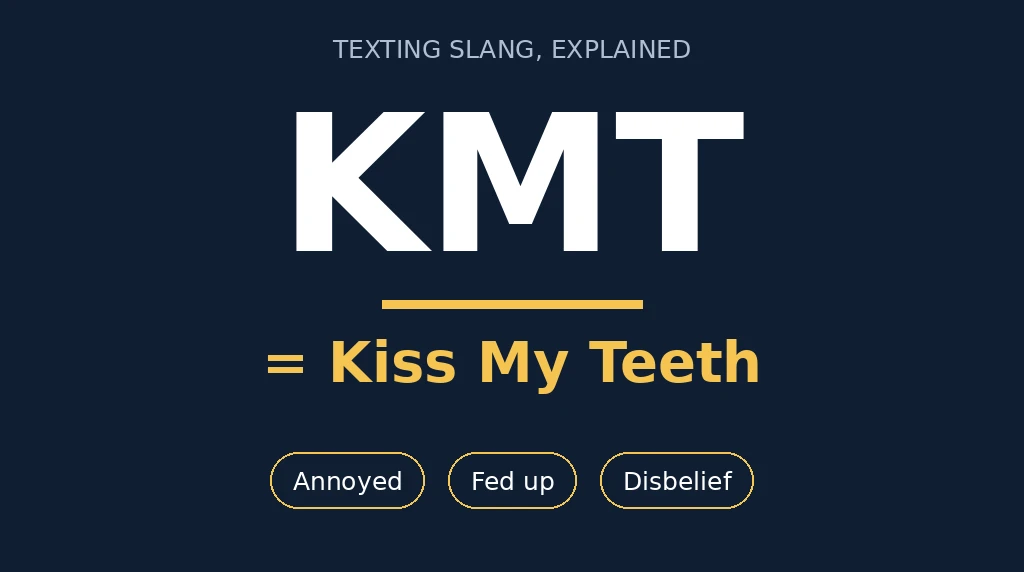
KMT is the written version of a sound. Picture someone sucking air sharply through their teeth, the short hiss people make when they are annoyed and do not want to start a full argument. That sound is the kiss, and typing KMT puts it into a text message. When a friend replies “kmt” to your message, they are telling you they are irritated, they disagree, or they cannot believe what you just said.
The feeling behind it is closer to a sigh than a shout. KMT says “I am annoyed” without spelling out a whole complaint, which is why it lands so often in fast chats where nobody wants to type a paragraph. It can also carry disbelief, as in “kmt, you actually did that?” where the sound does the work of a raised eyebrow.
Tone matters a lot here. Between close friends, a kmt can be playful, the text version of an eye roll shared over something silly. From a stranger, or in the middle of a real argument, it reads as sharp and dismissive. Lowercase “kmt” reads softer and more casual, while uppercase “KMT” hits harder and can look like a firm rebuke.
Full Form of KMT
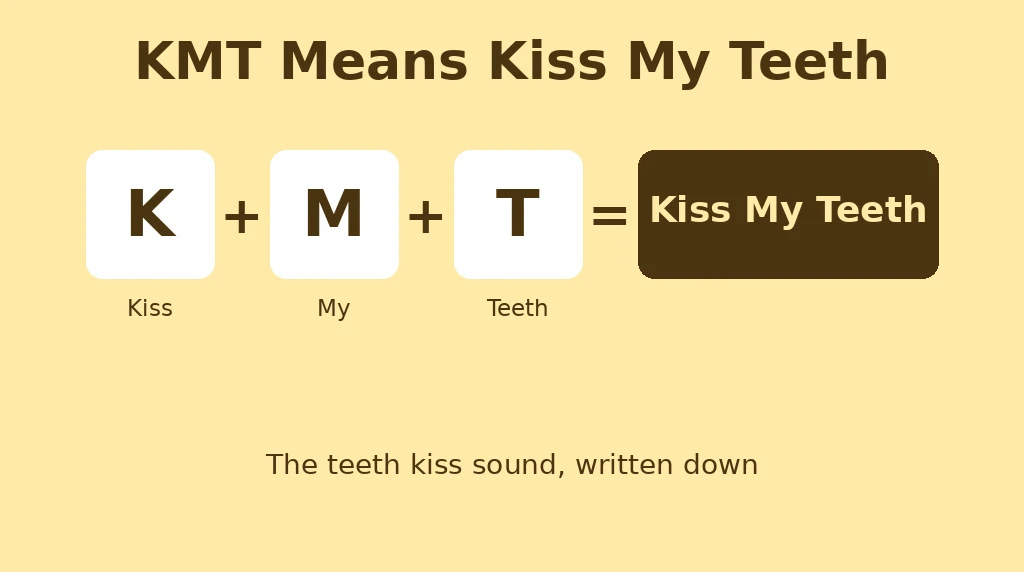
KMT breaks down into three simple words, one for each letter:
- K: Kiss, the sound itself
- M: My, the person making it
- T: Teeth, where the sound comes from
Say the letters out loud and you get kay em tee, because KMT is an initialism. Nobody says it as a single word. The phrase itself describes the gesture: kissing your teeth, the sharp sucking sound made by pulling air through closed teeth.
The sound has a name of its own in Caribbean culture, where it is often called a “steups.” That is the same gesture with a different label, and it carries the same meaning: annoyance, impatience, or disapproval without a word spoken.
KMT vs SMH vs TSK: What Is the Difference?

KMT belongs to a small family of annoyed reactions, and the family members look alike at a glance. Here they are side by side.
| Abbreviation | Full Form | What It Really Says | Tone |
|---|---|---|---|
| KMT | Kiss My Teeth | I am annoyed, do not even start | Annoyed, sharp |
| SMH | Shaking My Head | I cannot believe this happened | Disappointed, weary |
| TSK | The tsk sound | A short click of disapproval | Mild, brief |
The classic mix up is KMT versus smh, because both show up when something goes wrong. The gap is simple, though. SMH is weary disappointment, the head shake of someone who expected better. KMT is sharper, the hiss of someone who is actively annoyed right now. If a friend cancels plans for the third time, SMH fits the sigh, while KMT fits the sting.
TSK is the gentlest of the three, a tiny click of the tongue that says “that was not great” without making a scene. KMT is the louder cousin, and when the chat gives you no other clue, the setting tells you which one the sender meant. A joking group chat softens all three, while a serious argument sharpens them.
Where KMT Is Commonly Used
Texting and WhatsApp
In one to one chats, KMT usually arrives as a snap reaction to something annoying. A friend texts “I forgot your birthday, sorry” and the reply is a single “kmt” before the real conversation starts. It is fast, it is honest, and it tells the sender exactly how the message landed.
Instagram and TikTok
On Instagram and TikTok, KMT shows up in comments under videos that annoy people, from bad takes to obvious mistakes. A comment that says “kmt, he really said that” is reacting in real time, and the likes underneath it usually agree.
Twitter and X
On Twitter, now called X, KMT works like a quote tweet without the effort. Someone posts a hot take, and the replies fill with “kmt” from people who disagree but do not want a long debate. It is the shortest possible pushback.
Group Chats
In group chats, KMT tends to come from one person while everyone else watches. Someone drops a bad joke or a late reply, and a single “kmt” from a regular sets the tone for the room. One person writes “kmt not again” and the chat moves on, the point already made.
Gaming Chats
Gamers use KMT when a teammate makes a costly mistake or an opponent pulls a cheap move. A player types “kmt, you ran in alone” after a lost round, and the squad knows the frustration is real but the game goes on.
Discord and Forums
Discord servers and forums use KMT in fast moving threads where a full reply would slow things down. Someone posts a weak argument, and “kmt” lands as the whole response. It works best where the community already knows the sound it stands for.
Origin and History of KMT
KMT comes from a gesture, not a keyboard. Kissing teeth, the sharp sucking sound through closed teeth, has long been a way to show annoyance in Caribbean and West African cultures, where it is often called a steups. The sound needs no words, and everyone nearby understands it at once.
As texting and social media spread, the gesture needed a written form. “Kiss my teeth” became the phrase, and KMT became the shortcut, first in chats among people who already knew the sound, then across wider internet slang. Dictionaries of online slang now list it, which shows how far a small sound has travelled.
The meaning has stayed steady through that journey. From a Caribbean street corner to a group chat in London or New York, KMT still means the same thing: I am annoyed, and I would rather hiss than argue.
Other Meanings and Variations of KMT
Most of the time KMT means “Kiss My Teeth,” but the same letters carry a few other readings worth knowing.
- Kiss My Teeth, the lead meaning: this is the reading you will meet most often, in texts, comments, and group chats. It is a wordless hiss of annoyance, written down.
- Kissing my teeth, the full phrase: some people write the phrase out in full, “kissing my teeth,” when they want the sound to feel stronger. It means the same thing, but the extra words slow the reader down and make the annoyance feel heavier.
- Steups, the Caribbean name: in Caribbean culture the same gesture is often called a steups. If you hear someone say “steups” out loud, they are making the same sound KMT stands for.
- Lowercase kmt vs uppercase KMT: the small letters feel softer and more casual in a sentence, while the capitals hit harder and can look like a firm rebuke. The meaning stays the same either way.
- Playful KMT between friends: between close friends, KMT can be a joke, the text version of a mock eye roll over something silly. The same three letters that sting from a stranger can make a friend laugh, which is why the relationship matters more than the letters.
- KMT in usernames and bios: a few people put KMT in a username or bio as a warning that they do not suffer fools gladly. It is rare, and it usually belongs to someone with a sharp sense of humour.
How to Use KMT Correctly
- Read the room before you send it. KMT stings, so save it for chats where the other person knows your tone. With strangers it can read as hostile before you have said anything else.
- Use it for annoyance, not for hate. KMT says “I am annoyed.” It is not a tool for insults or pile ons, and using it that way will turn a small moment into a real fight.
- Add words when the reason is not obvious. A bare kmt leaves the other person guessing, so a short line after it, like “kmt, you were late again,” clears things up fast.
- Keep it out of serious talks. When someone is upset or sharing bad news, KMT can feel like you are dismissing them, even if that was not your intent.
- Do not stack it. One kmt makes the point. Three in a row reads as a rant, and most people will stop replying.
Example Conversations Using KMT
A forgotten plan
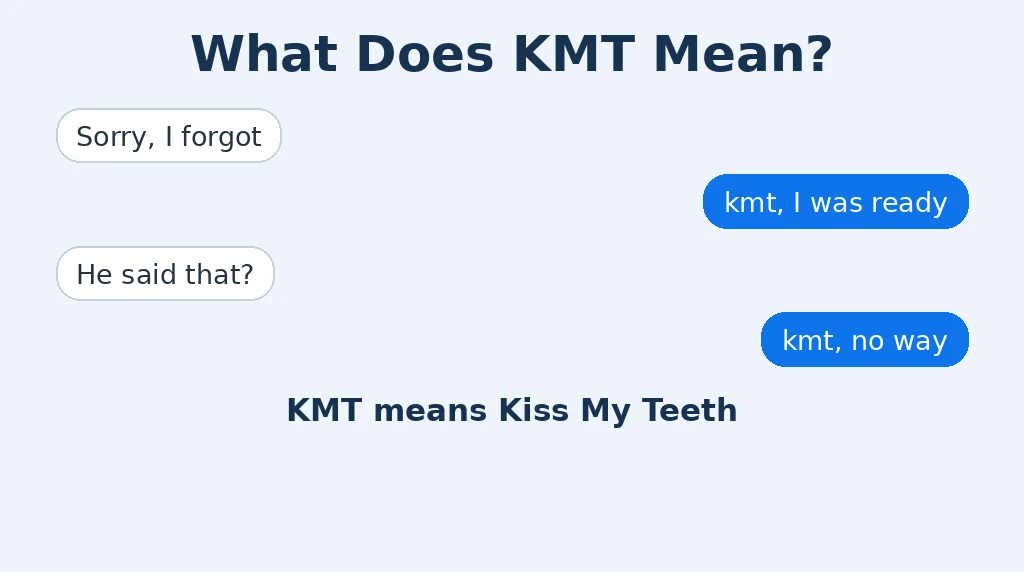
Person A: “sorry, I forgot about tonight”
Person B: “kmt, I was already dressed”
A bad take
Person A: “pineapple on pizza is a crime”
Person B: “kmt, here we go again”
A late reply
Person A: “I meant to text you back yesterday”
Person B: “kmt, a whole day later”
A gaming mistake
Person A: “I ran in alone and died”
Person B: “kmt, we had a plan”
The playful one
Person A: “I ate the last slice, sorry not sorry”
Person B: “kmt, you are so greedy”
A group chat moment
Person A: “who ate my fries”
Person B: “kmt, not this again”
A disbelief moment
Person A: “he actually said that in the meeting”
Person B: “kmt, no way”
The confused one
Person A: “kmt”
Person B: “idk what that means, are you mad at me?”
When Not to Use KMT
- In a work email: sending KMT to a colleague or a boss reads as hostile, and most workplaces expect plain words instead.
- In formal writing: reports, applications, and official documents should always use full words, never chat shortcuts.
- With elders or people you barely know: the hiss behind KMT can offend someone who does not know your humour yet.
- In serious conversations: when someone shares bad news or asks for real support, KMT can feel like you are brushing them off.
- When you actually want to solve the problem: KMT shuts talk down, so if you want a fix, say what went wrong in plain words.
- As a reply to every message: using it all the time drains the meaning out of it, and people will stop taking it seriously.
How to Respond When Someone Sends You KMT
A kmt lands in your chat and the ball is suddenly in your court. Check the setting first, then pick the lane that matches.
Patient replies work when someone has a fair complaint:
- “Fair enough, what did I miss?”
- “Sorry about that, tell me what happened.”
- “Give me a sec, I will fix it.”
Helpful replies suit a kmt that points at a real problem:
- “You are right, my bad, let me sort it.”
- “I hear you, what do you want me to do?”
Playful replies fit close friends and light topics:
- “kmt right back at you, lmfao“
- “Okay okay, I deserved that one”
One thing to avoid: do not answer a kmt with another kmt and nothing else. Two hisses in a row turn a small annoyance into a standoff, so add a word or two and keep the chat moving.
Common Mistakes People Make With KMT
- Using KMT with strangers. It can read as hostile when the other person does not know your humour, so save it for people who know you.
- Confusing KMT with SMH. SMH is weary disappointment, while KMT is active annoyance. They are related, not the same.
- Sending it in a serious conversation. When someone is upset, KMT feels like dismissal, even when you meant it lightly.
- Stacking it three times. One kmt makes the point, but three in a row reads as a rant, and most people will stop replying.
- Assuming everyone knows the sound. Some readers have never heard of kissing teeth, so a bare kmt can confuse them completely.
Frequently Asked Questions
What does KMT mean in text?
In texting and on social media, KMT means “Kiss My Teeth.” It stands for the sharp sucking sound people make through their teeth when they are annoyed, frustrated, or fed up.
Is KMT rude?
It can be. Between close friends it often works as a playful eye roll, but from a stranger or in a serious talk it reads as sharp and dismissive. The relationship and the setting decide how rude it feels.
What is the difference between KMT and SMH?
SMH means “Shaking My Head” and shows weary disappointment, the head shake of someone who expected better. KMT means “Kiss My Teeth” and shows active annoyance, the hiss of someone irritated right now. KMT hits harder than SMH.
What sound does KMT describe?
KMT describes the sound of sucking air sharply through closed teeth, often called kissing teeth. In Caribbean culture the same gesture is often called a steups. It is a wordless way to show annoyance or disapproval.
Can I use KMT at work?
It is best not to. In a work message, write out what you mean in plain words, such as “that delay is frustrating” or “I disagree with that call.” KMT can confuse colleagues and can read as hostile in a professional setting.
How do I reply when someone sends me KMT?
Stay calm and add words. A line like “sorry about that, tell me what happened” works better than another kmt. If it was playful, a light reply fits. If it was serious, ask what went wrong before you defend yourself.
Final Thoughts
KMT is a small sound with a sharp edge. Three letters carry a hiss, an eye roll, and a warning all at once, and the people who know the sound hear it the moment they read it. In a friendly chat it is a joke, in a tense one it is a line drawn in the sand, and the difference is always the relationship behind it.
If you want a second opinion from a slang dictionary, CyberDefinitions lists an entry for KMT. Either way, you now have the kmt meaning in text down, plus a calm reply ready for the next time it shows up in your messages.
